

An Atlanta IT manager can spend the morning watching a rack shutdown in a Midtown colocation facility and the afternoon reviewing a vendor quote for removal. The lease is ending, replacement infrastructure is live, and the drives still contain regulated records, credentials, application data, or business documents. Powering down the equipment is operationally simple. Proving what happened to every drive afterward is the difficult part.
Atlanta server decommissioning and secure removal should produce an evidence trail, not just a pickup receipt. Each asset needs a documented route from the rack to sanitization, transport, resale, recycling, or destruction. That standard matters across Atlanta's healthcare, financial, logistics, education, and government environments, where one project can involve several contractual and regulatory obligations.
Table of Contents
- Why Atlanta Server Decommissioning Demands a Real Plan
- Building the Inventory and Documentation Baseline
- Certified Wiping Versus Physical Shredding
- Physical Removal, Transport, and Chain-of-Custody
- Compliance Mapping for Atlanta Organizations
- Asset Recovery, Resale, and Circularity Reporting
- Choosing an Atlanta Decommissioning Partner
Why Atlanta Server Decommissioning Demands a Real Plan
A sound project starts before the loading dock. Freeze the approved change window, confirm that workloads and dependencies have moved, and assign a named owner for every phase. The Atlanta data center environment makes coordination especially important because facilities may have restricted loading schedules, shared security procedures, and multiple tenants operating in the same building.
The plan should answer four questions in writing:
- Which media will be sanitized: The decision must reflect the drive type, data classification, condition, and intended disposition.
- Which media will be physically destroyed: Failed, inaccessible, or high-risk drives may not support a defensible reuse pathway.
- Who controls each transfer: A custody record should identify the people, assets, time, and location involved.
- What happens after data removal: Hardware may be resold, harvested for parts, recycled, or sent to final disposal.
The FTC Disposal Rule provides an important federal foundation. Created under the Fair and Accurate Credit Transactions Act of 2003 and finalized in November 2004, it became effective on June 1, 2005. It applies to organizations under FTC jurisdiction that maintain or possess consumer-report information for business purposes, and it includes computer equipment among the media that can be sold, donated, transferred, or discarded. The FTC calls for reasonable measures that prevent unauthorized access or use, including erasing or destroying electronic media so information cannot practicably be read or reconstructed. FTC disposal guidance explains why secure disposal is a compliance obligation, not merely an internal IT preference.
Practical rule: If a reviewer can't connect the original asset record to the final certificate, the project has a documentation gap.
Building the Inventory and Documentation Baseline
The pre-decommission inventory becomes the reference record for security, compliance, finance, and sustainability teams. Capture information before equipment leaves the rack, then reconcile the digital record against a physical walkdown. A configuration management database, hypervisor export, or asset-management platform can accelerate collection, but none replaces a technician checking the chassis and each drive bay.
At the server level, record the hostname, service tag, chassis serial number, rack position, owning business unit, condition, and data classification. At the media level, record the bay or slot, capacity, media type, drive serial number, firmware revision, and applicable regulatory or contractual handling requirement. RAID adds another layer of risk because the array identifier may not match the serial numbers of the individual drives.
Atlanta projects often expose equipment that automated records missed. A server may still appear associated with an old network assignment, a warranty replacement may have bypassed the asset register, or an unlabeled drive may be sitting in a parts cabinet rather than its original chassis. Resolve those exceptions while the equipment is still under organizational control.
Minimum Fields per Server Asset Record
| Field | Why It Matters at Audit |
|---|---|
| Hostname and service tag | Connects the physical asset to operational records |
| Chassis serial number | Identifies the server that left the facility |
| Rack, chassis, and drive-bay position | Shows where each item was located |
| Drive serial number and media type | Links sanitization or destruction evidence to the actual media |
| Capacity and firmware revision | Helps distinguish similar drives and investigate exceptions |
| Owning business unit | Establishes accountability for the data |
| Data classification | Supports the selected Clear, Purge, or Destroy outcome |
| Regulatory or contractual handling | Records why a particular pathway was selected |
| Condition and final disposition | Supports resale, recycling, or destruction reconciliation |
Use the server disposal checklist for IT managers as a starting point, then adapt the fields to your CMDB and retention policies. Compliance will ask who owned the asset. Security will ask what was stored on it. Sustainability and finance will ask where it went and how that outcome was recorded.
Certified Wiping Versus Physical Shredding
Wiping and shredding solve different problems. A functioning, addressable drive may retain resale value after a validated sanitization process, while a failed or inaccessible drive may require destruction because the organization can't verify that every relevant storage area was addressed.
NIST SP 800-88 distinguishes Clear, Purge, and Destroy. Clear uses logical techniques to address user-accessible locations and protect against basic, non-invasive recovery. Purge uses physical or logical methods intended to make recovery infeasible even with state-of-the-art laboratory techniques while potentially preserving the media. Destroy makes recovery infeasible and prevents the media from being used for future data storage. The NIST media sanitization guidance emphasizes that media type, confidentiality, and intended disposition should drive the decision.
Route Each Drive, Not Each Server
Conventional spinning HDDs with no known faults may be candidates for a documented Clear or Purge outcome when the organization permits reuse. SSDs, NVMe devices, self-encrypting drives, embedded flash, and controller-managed storage need more careful evaluation because logical addressing and wear-leveling can complicate assurance. RAID arrays should be dismantled into their individual media records before sanitization. Tape should follow a separate workflow rather than being grouped with disk drives.
A practical routing policy looks like this:
- Healthy HDD: Evaluate for a validated wipe and possible resale.
- SSD or NVMe: Confirm the device-specific sanitization method and verification capability. If the state of the media or encryption cannot be established, route it to destruction.
- Failed drive or bad sectors: Quarantine it for physical destruction unless an approved method can produce defensible evidence.
- RAID member: Track and process each drive independently, not only the array.
- Tape or embedded flash: Apply a media-specific procedure and certificate.
On-site shredding keeps destruction under observation inside the Atlanta facility and can reduce custody handoffs, but it generally carries higher operational cost. Off-site shredding can simplify the work area and transport, but it requires sealed containers, controlled transfer, and a receiving acknowledgment. The secure data destruction comparison should be reflected in the project's written decision record.
Both routes need an asset-level result. A wipe certificate should state the media serial number, method, tool and version, operator, timestamp, result, and exception status. A destruction certificate should identify the same media and document the destruction method. NIST recommends verification whenever practical, including secondary testing with a different tool from a separate developer. Its sampling design calls for pseudorandom locations across addressable and reserved areas, with at least two non-overlapping locations per subsection and coverage of at least 10% of the media under that design. NIST SP 800-88 Rev. 1 provides the technical basis for that verification approach.
Physical Removal, Transport, and Chain-of-Custody
Decommissioning begins with a controlled shutdown and rack removal, not with a truck arriving at the loading dock. Confirm the approved change window, isolate power and network connections, label every cable that remains in service, and have the system owner sign off before technicians dismount equipment.
Atlanta facilities often require advance coordination with freight elevators, loading bays, building security, and after-hours access. In occupied Midtown and Buckhead data centers, the removal team may need to work inside a narrow window without obstructing another tenant's operations. Rack servers, tower systems, and blade chassis should be separated by handling requirements and packed in anti-static materials with serialized tags.
The custody packet should accompany the physical movement of the assets:
- Transfer form: List every server, drive, and component by serial number.
- Personnel record: Identify the releasing employee, technician, driver, and receiving employee.
- Container record: Tie tamper-evident seal numbers and container details to the relevant assets.
- Transport record: Preserve route and delivery evidence for the movement between facilities.
- Receiving acknowledgment: Record the arrival time, condition, seal status, and exceptions.
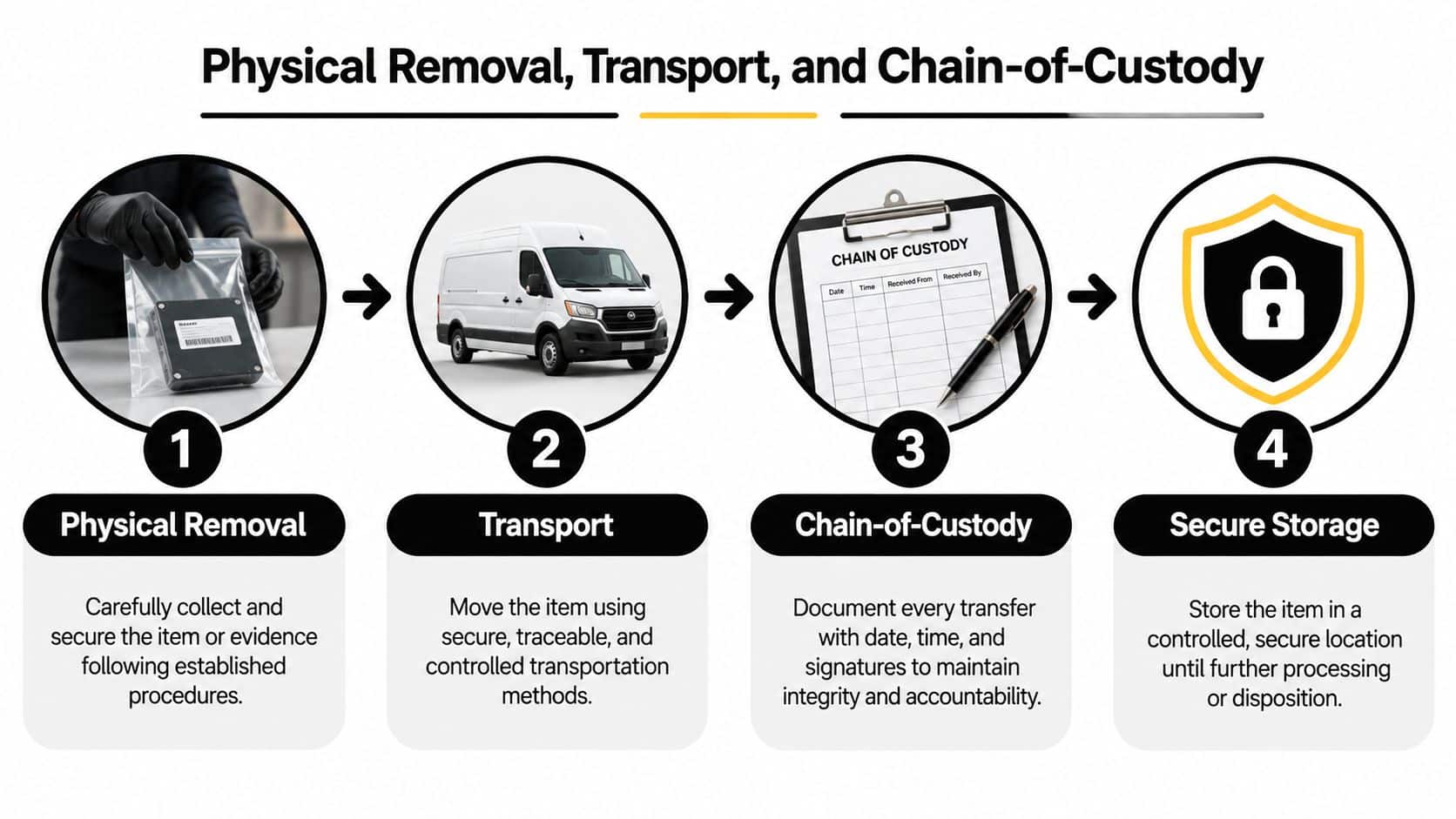
A sealed container doesn't replace an inventory. It supplements it. The receiving facility should reconcile the shipment against the originating list, document missing or extra items, and preserve the seal information in the processing record. The IT asset chain-of-custody process should remain continuous from de-racking through sanitization and final disposition.
Unbroken signatures matter because they show who controlled the hardware when responsibility changed hands.
Compliance Mapping for Atlanta Organizations
Compliance mapping works best when it produces concrete deliverables. Don't ask a vendor only whether its process is compliant. Ask for the exact record that links the approved method to the specific serial number in the inventory.
The FTC Disposal Rule requires reasonable measures during disposal for covered consumer-report information. That may translate into contractual disposal language, documented due diligence, custody controls, and evidence that electronic media was erased or destroyed so the information couldn't practicably be read or reconstructed. The FTC's guidance leaves room for organizations to choose an appropriate method, which makes the documented rationale important.
Healthcare, payment, and financial reporting environments may impose additional internal, contractual, or regulatory expectations. A healthcare organization should have counsel and its privacy team map HIPAA obligations to the applicable NIST outcome and retain per-drive sanitization or destruction evidence. Payment-card environments should align their disposal records with their PCI DSS control set. Organizations subject to Sarbanes-Oxley should connect sanitization records and asset disposition documents to their retention schedule rather than storing certificates in an unstructured email folder.
Compliance Requirements vs. Required Disposal Artifacts
| Framework | Required Artifact | Sanitization Standard | Retention Expectation |
|---|---|---|---|
| FTC Disposal Rule | Written disposal procedure, custody record, and destruction or erasure evidence | Reasonable measures appropriate to the information and media | Follow the organization's approved legal and compliance schedule |
| HIPAA program | Drive-level sanitization or destruction certificate and approved handling record | NIST Clear, Purge, or Destroy as selected for the media and risk | Follow the covered entity's documented retention policy |
| PCI DSS program | Certificate tied to each relevant media serial number and processing result | Approved method mapped to the organization's card-data controls | Retain according to the organization's PCI evidence policy |
| Sarbanes-Oxley environment | Asset register reconciliation and signed disposition record | Method and outcome documented against the asset baseline | Match the organization's records-retention schedule |
EPA recommends using certified electronics recyclers to help assess environmental protection, worker health and safety, and security practices. That screening criterion should extend to downstream processors, not only the first pickup company. EPA electronics recycling guidance supports asking for certification and downstream-handling evidence.
Asset Recovery, Resale, and Circularity Reporting
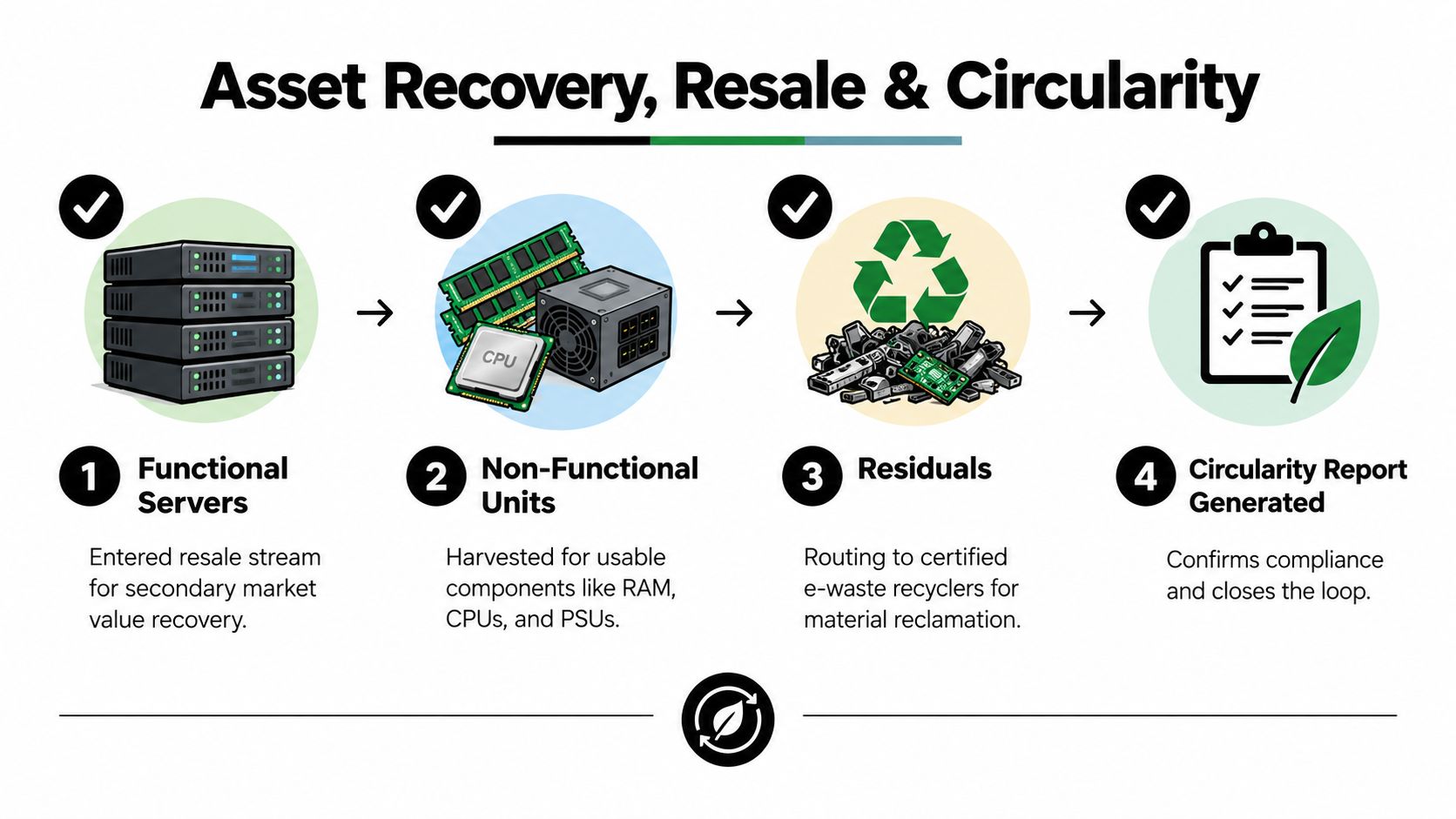
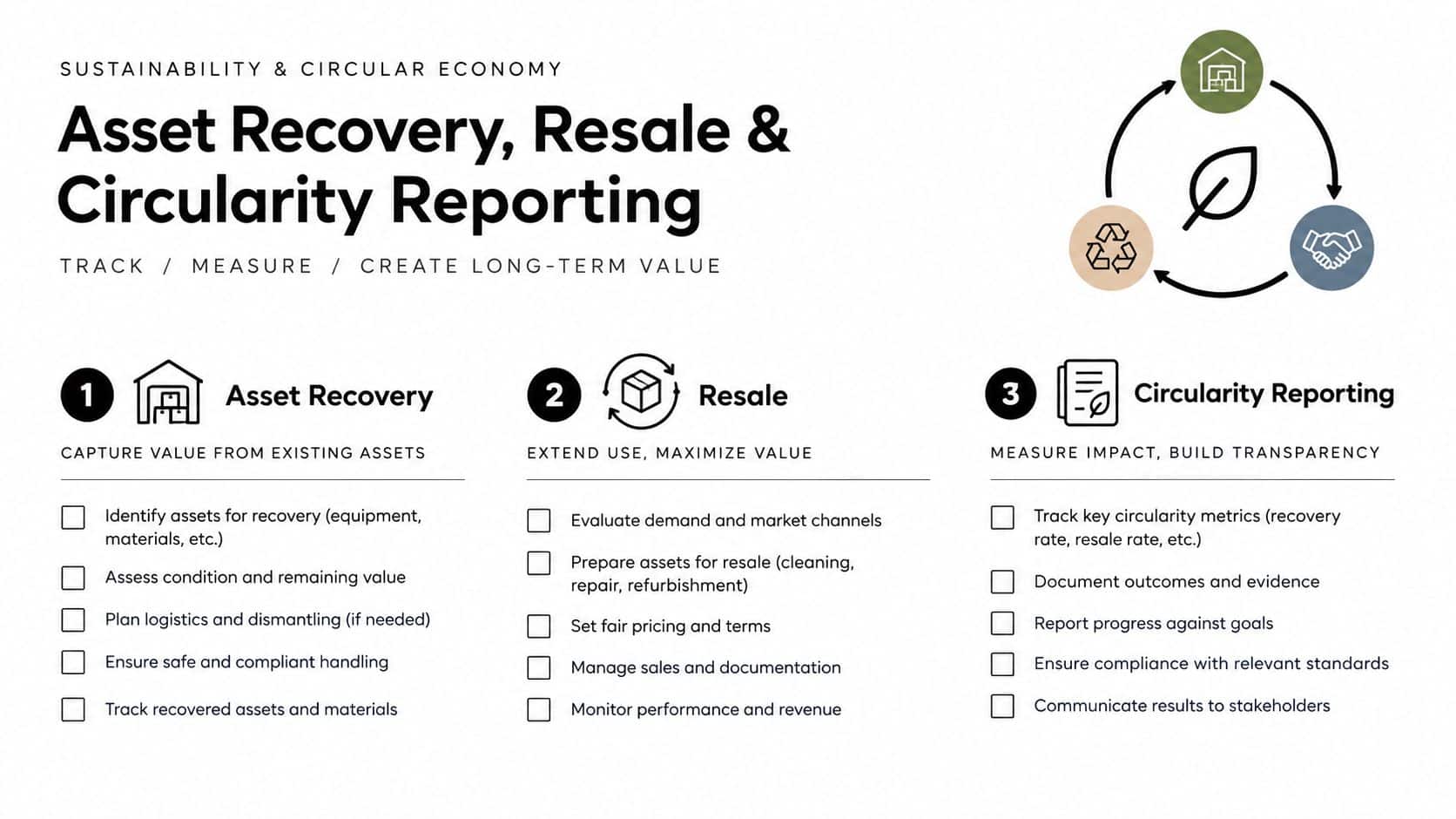
Secure removal doesn't end when a drive is wiped or shredded. The remaining server may have resale value, usable memory, processors, power supplies, chassis, or networking components. A non-functional unit can still contribute parts, while residual materials should move through qualified recycling channels.
The disposition report should separate these outcomes instead of presenting one broad recycling statement. For each asset, identify whether it was reused, resold, harvested, recycled, destroyed, or sent to final disposal. Record the serial number, processing date, sanitization outcome, resale channel, buyer or downstream processor where appropriate, and the evidence supporting the final result.
Read the Report as an Audit File
A useful circularity report answers operational and environmental questions without forcing IT, finance, or sustainability teams to rebuild the dataset:
- Asset reconciliation: Does every original serial number have one final outcome?
- Reuse evidence: Which functional servers or components entered a secondary market?
- Value recovery: Does the report distinguish open-market resale from brokered disposition?
- Material recovery: Are residuals identified by processor and material stream?
- Destruction evidence: Are destroyed drives separated from reused hardware?
- Downstream continuity: Can the processor show what happened after local pickup?
- Financial closeout: Can finance match proceeds, fees, and asset-register changes?
The trade-off is real. Organizations with lower-risk, functioning media may choose validated sanitization to preserve value. Organizations handling highly sensitive data may choose destruction even when a drive could have been resold, because certainty carries greater weight than recovery revenue. A credible Atlanta IT asset recovery program should make that trade-off visible rather than hiding it inside a single shipment-level certificate.
Google describes evaluating and disassembling retired hardware for reuse, resale, or material recovery, while Microsoft reported a goal of reusing or recycling 90% of decommissioned cloud hardware by 2025 in its circularity white paper. Microsoft's circularity documentation illustrates why organizations should request disposition-level reporting instead of accepting an unsupported recycling label.
Choosing an Atlanta Decommissioning Partner
A proposal should be scored against evidence, not polished language. Ask the vendor to show where each requirement appears on the certificate, inventory export, custody form, or downstream report.
Vendor Selection Checklist
- Certification: Verify whether the provider holds R2v3 or e-Stewards certification and confirm the scope of that certification.
- Sanitization evidence: Require NIST SP 800-88-aligned wipe or destruction records for each drive, including the selected outcome and exceptions.
- Serial reconciliation: Confirm that the vendor tracks individual drives, not only servers, racks, pallets, or shipment weights.
- Custody controls: Review sample transfer forms for signatures, timestamps, seal references, and receiving acknowledgment.
- Media expertise: Ask how the process handles SSDs, NVMe, RAID members, embedded flash, self-encrypting drives, and failed media.
- Downstream processing: Request the identity and qualification of recycling processors handling residual equipment.
- Environmental records: Ask for disposition-level reuse, resale, recycling, destruction, and final-disposal reporting.
- Insurance and liability: Review coverage limits, contractual responsibility, and the point at which custody transfers.
- Atlanta logistics: Confirm the provider can coordinate de-racking, palletizing, loading, transport, and facility access in the required service window.
- Commercial scope: Ensure the workflow supports enterprise IT equipment disposal rather than only small-item recycling.
Beyond Surplus offers Atlanta data center decommissioning support that includes asset tracking, certified data destruction, equipment removal, packing, transportation, recycling, and certificates of recycling and data destruction. Buyers should still compare any proposal against the same evidence checklist and verify that the promised deliverables match the organization's internal controls.
The scheduling call should settle the inventory format, drive-level routing, access requirements, custody documents, and final report structure before technicians arrive. That preparation turns a spreadsheet into a defensible evidence trail and keeps secure removal from becoming an undocumented gap between IT operations and final disposal.
Schedule an Atlanta server decommissioning project with Beyond Surplus for coordinated equipment removal, certified data wiping or destruction, chain-of-custody documentation, and responsible IT asset disposition. Share your asset inventory and facility requirements so the team can build a secure removal pathway for every server and drive.


