

A resignation email lands at 8:12 a.m. By noon, HR has disabled access, IT has pulled licenses, and a manager is asking the same question everyone asks too late: where's the laptop, phone, dock, badge, and external drive? If the employee worked remotely, the answer is often unclear, and that's where routine offboarding turns into avoidable risk.
An effective employee equipment return policy closes that gap before it opens. It tells employees what must come back, when it must arrive, how data is secured, who owns each step, and what happens if the process breaks down. The strongest policies also involve a certified ITAD partner at the start, not after a device finally appears in a shipping box. That's how companies reduce loss, protect data, and document compliance under standards that include the FTC Disposal Rule.
The High Cost of Unreturned Equipment
Ad hoc recovery fails because it depends on memory, manual follow-up, and employee goodwill during a departure that may already be tense. The business risk isn't limited to replacing hardware. An unreturned device may still hold customer records, credentials, cached email, VPN access artifacts, or regulated data.
The scale of the problem is hard to ignore. 71% of employees fail to return company equipment upon termination, and remote workers are 17% more likely to withhold assets, according to Teqtivity's analysis of equipment return failures. That's why policy language around deadlines, tracking, and proof of return needs to be operational, not aspirational.
Why informal offboarding breaks down
Most failed recoveries follow a familiar pattern:
- No single owner: HR assumes IT is coordinating shipping. IT assumes the manager has already spoken to the employee.
- No documented inventory: The company knows a laptop was issued, but not whether a monitor, token, headset, or spare charger went with it.
- No return deadline: Employees hear “send it back soon,” which usually means “this can wait.”
- No evidence trail: When a box arrives damaged or incomplete, nobody can prove what was packed.
Practical rule: If your policy can't survive a disputed return, it isn't a policy yet. It's a hope.
A strong return process also belongs inside a broader physical and information security posture. Teams revisiting offboarding controls often benefit from related thinking on asset protection security strategies, especially where device custody intersects with access control and loss prevention.
For companies trying to quantify exposure beyond the hardware itself, this breakdown of the hidden costs of unreturned company laptops is useful because it frames the issue the way finance, HR, and IT each see it. The policy has to satisfy all three groups. If it only addresses logistics, it leaves the actual liability untouched.
Laying the Foundation Scope Objectives and Roles
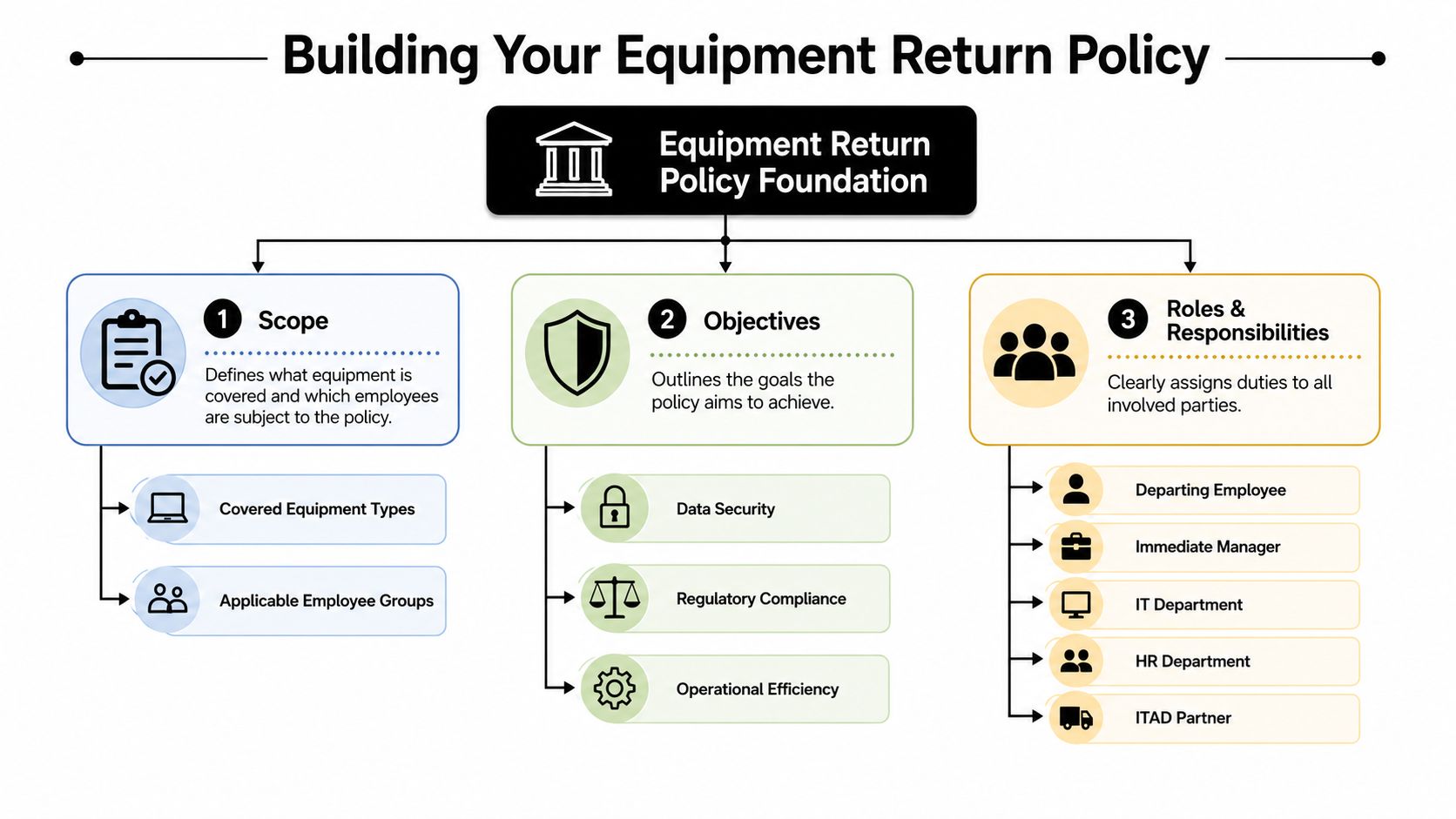
A return policy works when it removes ambiguity before an employee leaves. The document should answer five basic questions: who is covered, what property is covered, what the company is trying to protect, who performs each action, and how disputes are handled.
Define scope before you define enforcement
Start with coverage. Name the employee groups subject to the policy, including remote, hybrid, field, contract, and executive roles if applicable. Then define equipment categories in plain language: laptops, desktops, tablets, mobile phones, accessories, removable media, security keys, ID badges, and any specialized hardware.
Your scope should also state whether the policy applies to role changes, leaves of absence, and internal transfers. Many loss events happen outside formal terminations because the company only designed the process for resignations.
Write objectives that reflect real risk
A useful policy doesn't just say “return company property.” It states business objectives such as:
- Asset recovery: equipment is returned in identifiable condition and logged against the original assignment
- Data security: devices are locked down, wiped, or routed for destruction under a documented workflow
- Regulatory compliance: records support disposal, recycling, and defensible chain of custody
- Operational efficiency: HR, IT, and the manager act on the same timeline
Lifecycle management matters. A return policy should feed directly into IT asset lifecycle management, not sit in a disconnected HR file.
Assign owners or expect delays
If everyone owns the process, no one does. The cleanest model assigns:
| Role | Primary responsibility |
|---|---|
| Departing employee | Confirm inventory, remove personal items, pack equipment, meet deadline |
| Manager | Trigger offboarding workflow and confirm known assets |
| HR | Deliver signed policy terms and coordinate acknowledgment |
| IT | Secure access, validate serials, initiate wipe actions, inspect return status |
| ITAD partner | Receive, document, sanitize, recycle, remarket, or destroy assets |
A policy also needs language for condition disputes. 40% of companies report unresponsive employees, and 25% of remote returns involve damage or missing parts, based on ReturnCenter's discussion of HR and IT coordination during equipment recovery. That's why terms like normal depreciation and actionable negligence should be defined before they're tested.
Normal wear should cover expected cosmetic use. Cracked screens, liquid damage, missing drives, and removed asset tags should be assessed under a separate damage standard with documented review.
Without those definitions, payroll deductions and reimbursement demands become harder to defend.
Designing a Frictionless and Secure Return Process
The best return policies remove excuses. If the employee has to source a box, print a label, guess what accessories matter, or find a carrier on their own time, return rates drop and delays grow. The fix is simple. Design the return like a controlled reverse logistics workflow.
Use a shipping kit, not instructions alone
The most effective policies use a shipping kit strategy and a remote wipe first protocol with MDM tools, according to Unduit's guidance on remote employee equipment returns. That approach works because it removes friction and tightens security at the same time.
A proper kit should include:
- Prepaid shipping label: the employee shouldn't pay first and ask for reimbursement later
- Right-sized box and padding: loose packing creates damage disputes
- Checklist: list every item assigned, including chargers, docks, and adapters
- Packing instructions: tell the employee how to place the device and accessories
- Return confirmation steps: require a photo of packed contents and visible serial numbers before sealing the box
Lock down the device before it moves
The return process should begin with IT, not with shipping. Once departure is confirmed, IT should use its MDM platform to restrict access, preserve needed records, and trigger wipe or lock workflows according to policy. The device should not travel while still treated as a live endpoint.
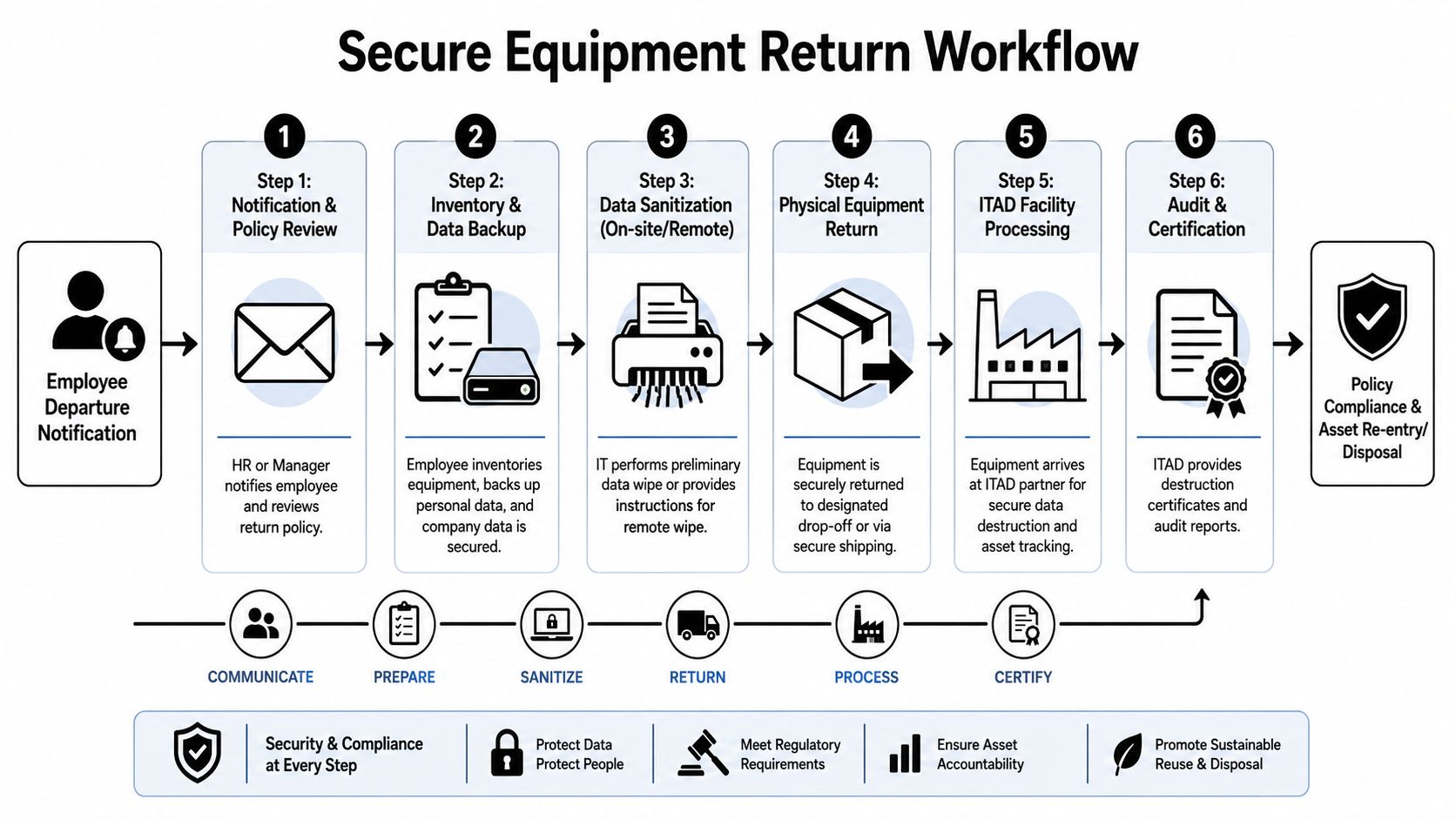
The safest sequence is simple: verify assignment, confirm backup needs, lock down access, document the device state, then release the shipping kit.
That workflow is easier to execute when HR and IT share the same checklist. Teams that need a practical model can adapt this remote employee equipment return checklist for HR and IT managers to fit their own approval chain and asset types.
Build the timeline around immediate action
Manual chasing is where most programs weaken. The policy should trigger automatic instructions, calendar notices, and reminders as soon as the departure is logged. Employees shouldn't wait days to find out what to do.
A workable process usually includes:
- Departure notice issued
- Inventory confirmed against asset records
- Return instructions sent immediately
- MDM action completed before shipment
- Employee submits packing photos
- Shipment tracked to receipt
- Receiving inspection logged
- Final disposition assigned
This is also the right point to involve the ITAD partner. Not after a pile of returns accumulates, but when the return method, receiving location, data handling path, and final disposition rules are being set. One option is Beyond Surplus, which provides logistics coordination, data destruction documentation, and downstream recycling or remarketing workflows for business equipment returns.
Ensuring Data Destruction and Chain of Custody
A returned laptop isn't a completed task. It's an asset in transit between one risk state and another. Until the business can prove where it went, who handled it, what happened to the data, and whether it was redeployed, recycled, or destroyed, liability is still attached to that device.
Treat chain of custody as evidence
60% of IT directors cite data security as their top offboarding concern, and TCWGlobal notes that a major failure point is the lack of synchronized timing between remote wipe actions and physical return logistics. That's the operational gap that creates stranded assets and unclear exposure.
Chain of custody should start before shipment and continue through final disposition. At minimum, keep records for:
- Assignment data: who had the asset and when
- Return evidence: employee acknowledgment, tracking number, packing photos
- Receiving log: date received, condition noted, serial number verified
- Sanitization record: wipe confirmation or destruction event
- Disposition outcome: redeploy, repair, retire, recycle, or destroy
Match destruction method to asset risk
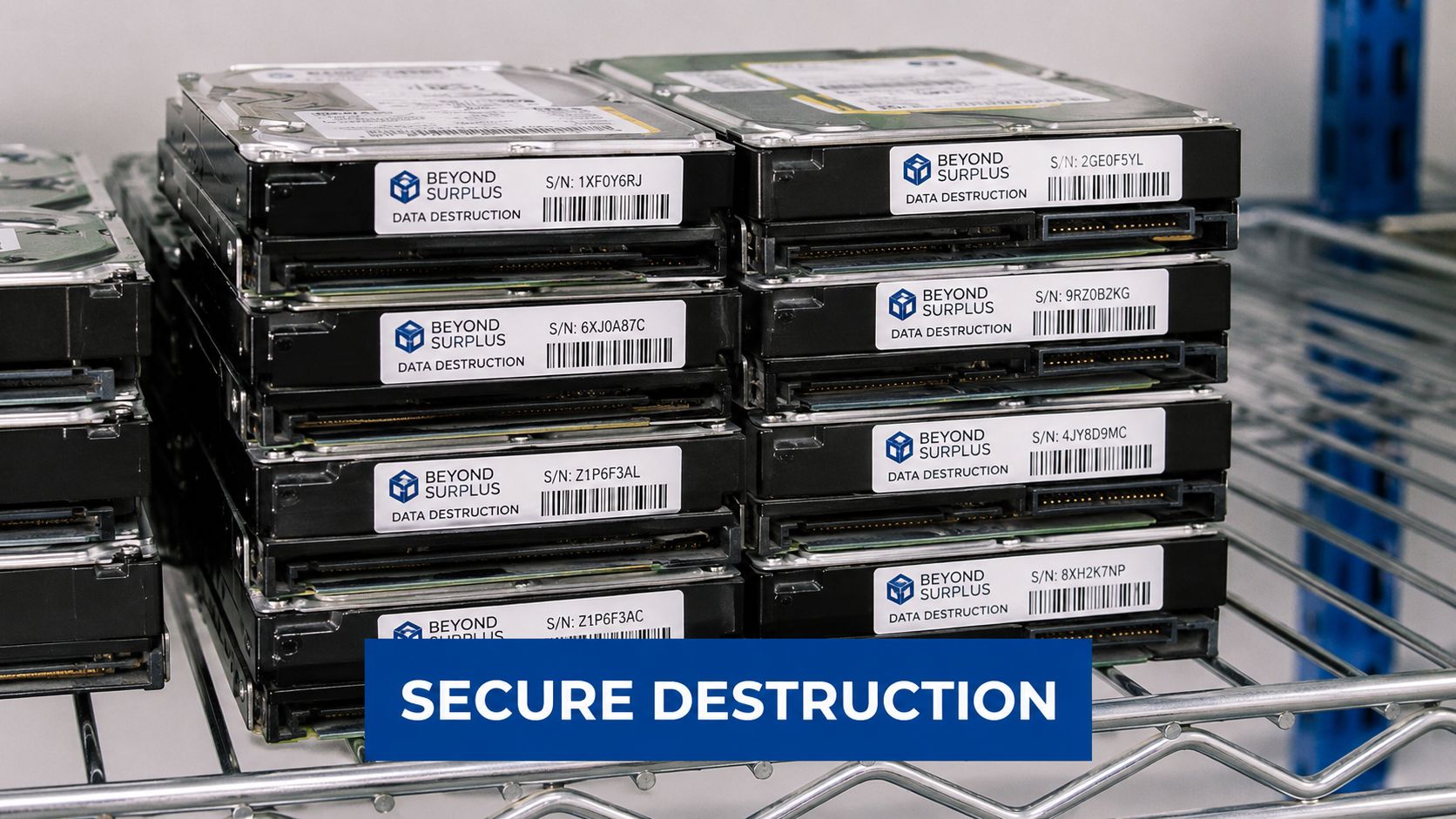
Not every asset needs the same treatment. Some devices can be securely wiped and redeployed. Others should be shredded or physically destroyed because of drive failure, policy requirements, or the sensitivity of the prior use case.
A defensible program usually separates methods like this:
| Asset condition or use | Typical handling approach |
|---|---|
| Working endpoint suitable for reuse | Certified data wiping, testing, redeployment or resale |
| Failed storage media | Physical destruction with destruction record |
| Devices tied to sensitive environments | Higher-control sanitization and stronger custody documentation |
For teams refining this handoff, this guide on protecting sensitive data during remote laptop returns is a practical reference because it connects endpoint security to transportation and downstream processing.
A certificate matters because it transfers the discussion from “we intended to destroy the data” to “we can document exactly how and when it happened.”
That's the difference between a shipping process and a compliance process.
Enforcement Exceptions and Legal Compliance
A policy without enforcement language invites selective compliance. Employees notice quickly whether deadlines are real, whether missing items are pursued, and whether damaged equipment is treated consistently. Fair enforcement isn't harsh. It's predictable, documented, and tied to signed policy terms.
Put recovery rights in writing
An enforceable policy should state that the employee authorizes deduction of the value of unreturned assets from final pay or severance, where legally permissible, and it should also define return windows, condition standards, and responsibility for shipping. That framework is consistent with ReadyCloud's guidance on managing employee equipment returns, which also emphasizes chain-of-custody records and confirmation workflows.
This language belongs in more than a handbook. It should appear in signed onboarding documents, equipment issuance records, and any remote work agreement tied to assigned property.
Handle exceptions with a documented decision path
Not every failed return is misconduct. Some involve medical leave, travel, disputed ownership of peripherals, or equipment already sent for repair. The policy should give HR and IT a decision tree for exceptions, including who can approve deadline extensions and how those approvals are recorded.
Use a consistent review for these cases:
- Silent employee: escalate communications, preserve all contact attempts, and suspend ad hoc side deals
- Incomplete return: compare contents to the issued inventory and request missing items by item description
- Damaged equipment: assess against the written wear-and-tear standard, not personal judgment
- Claimed loss or theft: require prompt written notice and any supporting report or carrier documentation
Stay firm, but don't improvise legal conclusions
State law matters. Wage deduction rules, final pay timing, and offboarding obligations vary. That's why a company should have counsel review its forms and enforcement language before the policy is rolled out. HR leaders also benefit from understanding broader employment concepts, including understanding employment at will, because termination process assumptions often spill into property recovery decisions.
Consistency protects the company twice. It improves return compliance, and it reduces the chance that one employee can argue they were treated differently from another.
The mistake to avoid is improvisation after a problem appears. By then, the facts are messy and your advantage is diminished.
Measuring Success and Partnering with an ITAD Expert
Once the policy is active, measure whether it's working. If you don't track outcomes, you won't know whether delays come from poor communication, weak inventory records, or a handoff problem between departments and vendors.
Watch the metrics that change behavior
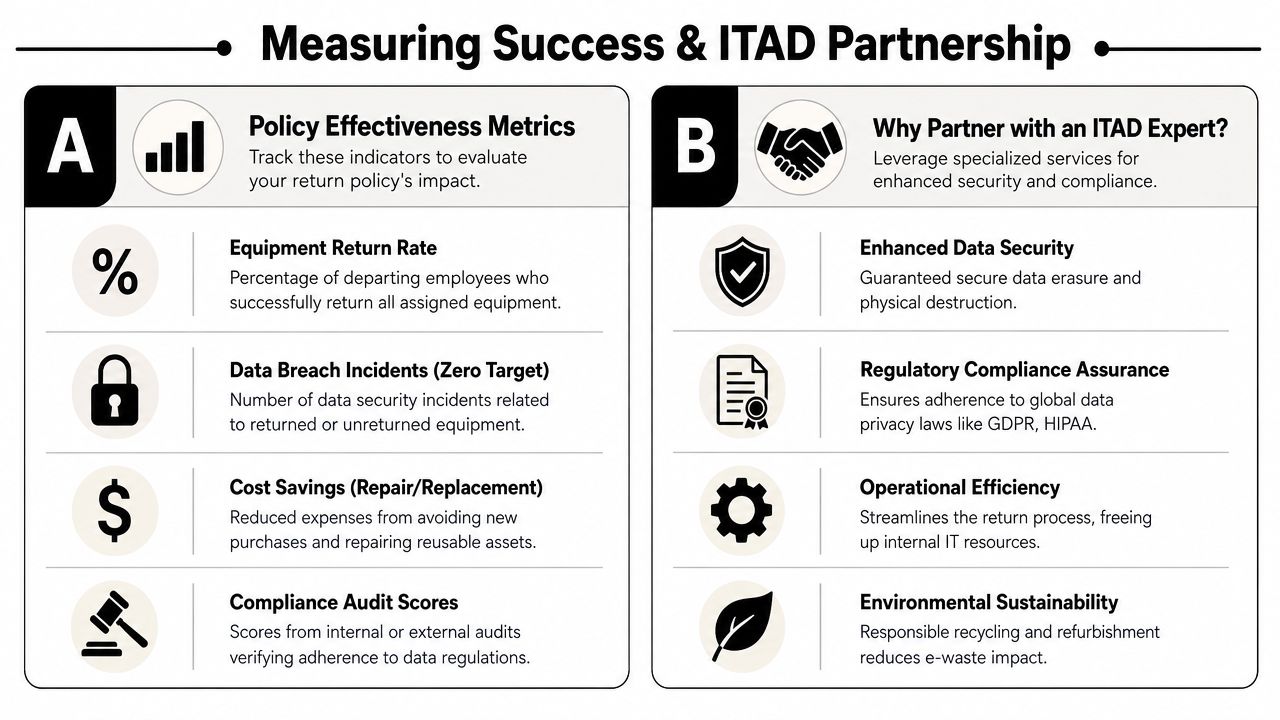
Useful program metrics include:
- Return rate: are employees sending back all assigned items
- Time to return: how long recovery takes from notice to receipt
- Condition variance: how often returned assets arrive incomplete or damaged
- Data destruction documentation: whether every required asset has matching sanitization records
- Disposition outcome: what portion is redeployed, repaired, recycled, or destroyed
These metrics matter because they reveal where the policy is leaking. A low return rate points to weak enforcement or poor logistics. A good return rate with weak documentation points to a compliance problem, not a logistics problem.
Why an ITAD partner should be involved early
An ITAD partner shouldn't just appear at end of life. The partner should help shape intake rules, custody documentation, receiving standards, destruction workflows, and downstream reporting before the first disputed return lands on someone's desk.
For a closer look at that operating model, this article on the role of ITAD in remote employee laptop recovery lays out how recovery, sanitization, and disposition fit together as one controlled process.
A strong employee equipment return policy does three things at once. It gets hardware back faster, secures company data before and after transit, and creates a record that stands up to audit, legal review, and internal scrutiny.
Contact Beyond Surplus for certified electronics recycling and secure IT asset disposal that supports employee equipment recovery, documented chain of custody, and compliant data destruction.


