A remote employee leaves on Friday. HR closes the file, IT disables access, and everyone assumes the laptop is on its way back. Two weeks later, there's no tracking number, no device on the dock, and no clear owner of the problem. That's how asset loss happens in real companies. Not through fraud most of the time, but through handoff gaps, weak process, and offboarding that treats hardware recovery like an afterthought.
If you're trying to improve remote employee asset recovery rates, the fix isn't a better reminder email alone. It's an operating system. Policy, logistics, legal review, tracking, data destruction, and final disposition all have to work together. When one piece is weak, the whole chain breaks.
The High Cost of Unrecovered Remote Assets
Many organizations underestimate how much slippage exists in remote offboarding. Organizations typically achieve remote IT asset return rates between 60% and 80%, leaving 20% to 40% of company equipment unrecovered according to Evercycle's analysis of remote equipment collection. That gap isn't random. It shows up when return steps are inconvenient, communication is inconsistent, or employees don't trust what happens to data on the device once they ship it back.
What the loss really looks like
An unreturned laptop isn't just a missing fixed asset. It creates three problems at once:
- Financial leakage because equipment can't be redeployed, remarketed, or recycled for value.
- Security exposure because a device may still hold company data, cached credentials, or locally stored files.
- Operational drag because IT, HR, legal, and managers all spend time chasing a device that should have been accounted for in the offboarding workflow.
That's why casual process fails. If the employee has to find a box, pay for shipping, guess what accessories matter, or wonder whether personal files will be handled properly, return friction climbs immediately.
Practical rule: If returning a company laptop requires effort from the former employee, your recovery program is already weaker than it should be.
The lesson is that retrieval rate is a management metric, not just a shipping outcome. Teams with mediocre results often think they have a compliance problem. In practice, they usually have a systems problem.
Why remote offboarding breaks down
Three failure points show up again and again:
- Process friction because the employee doesn't get packaging, labels, or a simple path to completion.
- Communication drift because reminders stop after one email or ownership shifts between HR and IT.
- Trust issues because the company never explains how returned devices will be wiped, inspected, and closed out.
If this sounds familiar, it's worth reviewing the broader business impact in Beyond Surplus's breakdown of the hidden costs of unreturned company laptops. The direct write-off is only part of the damage. The bigger issue is that weak recovery discipline usually points to weak lifecycle control overall.
Building an Ironclad Asset Recovery Policy
A strong recovery program starts long before someone resigns. It starts when equipment is issued. If your policy only appears during offboarding, you're negotiating under pressure instead of enforcing a documented standard.
Put the policy in writing before devices go out
Your asset recovery policy should spell out who owns the equipment, what must be returned, the expected timeline, acceptable condition standards, communication methods, and the consequences of non-compliance. It also needs sign-off from HR and legal, not just IT. That matters because recovery language often crosses into wage law, contract law, and employee relations.
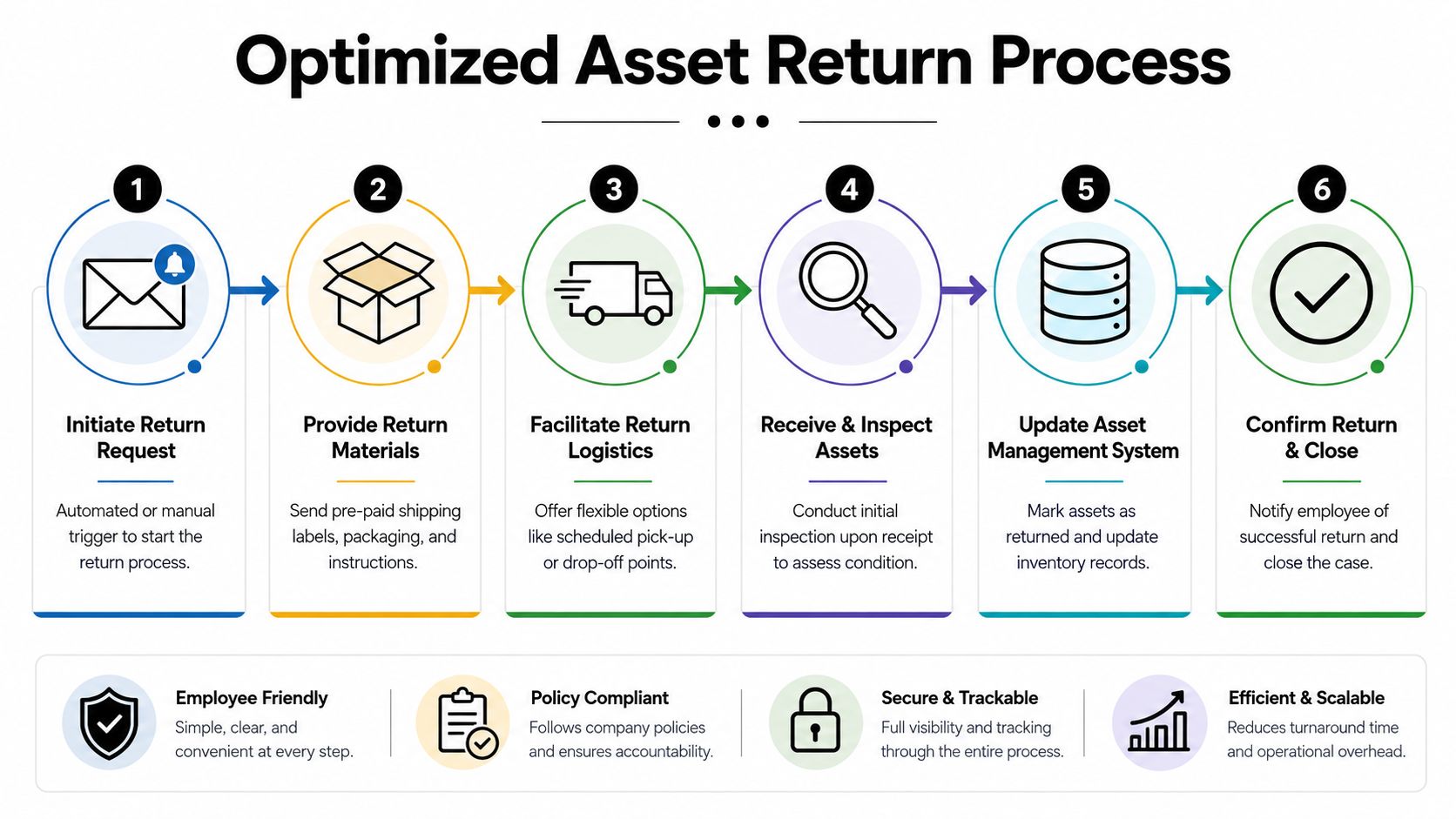
A practical policy usually covers:
- Assigned equipment records with serial numbers and accessory lists.
- Return deadlines tied to termination or resignation.
- Condition expectations so normal wear and true damage aren't confused.
- Logistics commitments stating that the company provides the return method.
- Escalation steps for non-response or missed deadlines.
- Disposition language explaining data wipe, inspection, and closure.
Don't assume paycheck deductions are legal
Many otherwise solid policies often encounter difficulty at this stage. A critical, often ignored legal barrier exists in 12 U.S. states and D.C., including California and New York, which explicitly prohibit employers from deducting unreturned equipment costs from final paychecks, forcing them into costly small claims court actions instead, as outlined in Unduit's review of remote employee equipment return laws.
That single fact changes how you design enforcement. If your policy relies on payroll deduction language in a non-deductible state, you may create a wage law problem while trying to solve an asset problem.
Policy language has to match the states where employees actually work, not just the state where your headquarters sits.
That's why legal drafting matters. HR templates tend to be broad, but recovery clauses need precision around ownership, responsibility, notice, and remedies. For teams tightening those documents, guidance on drafting airtight legal agreements is useful because vague contract language becomes expensive during disputes.
Build enforceability into the workflow
Good policies don't sit in a handbook. They appear in onboarding documents, equipment issuance forms, and offboarding tasks. The employee should see the same expectations at every stage.
A good audit question is simple. Could a manager, HR partner, and IT coordinator all describe the return process the same way? If not, the policy is too loose.
For a deeper look at what belongs in that document set, Beyond Surplus has a practical guide to employee laptop return policies every business needs to know.
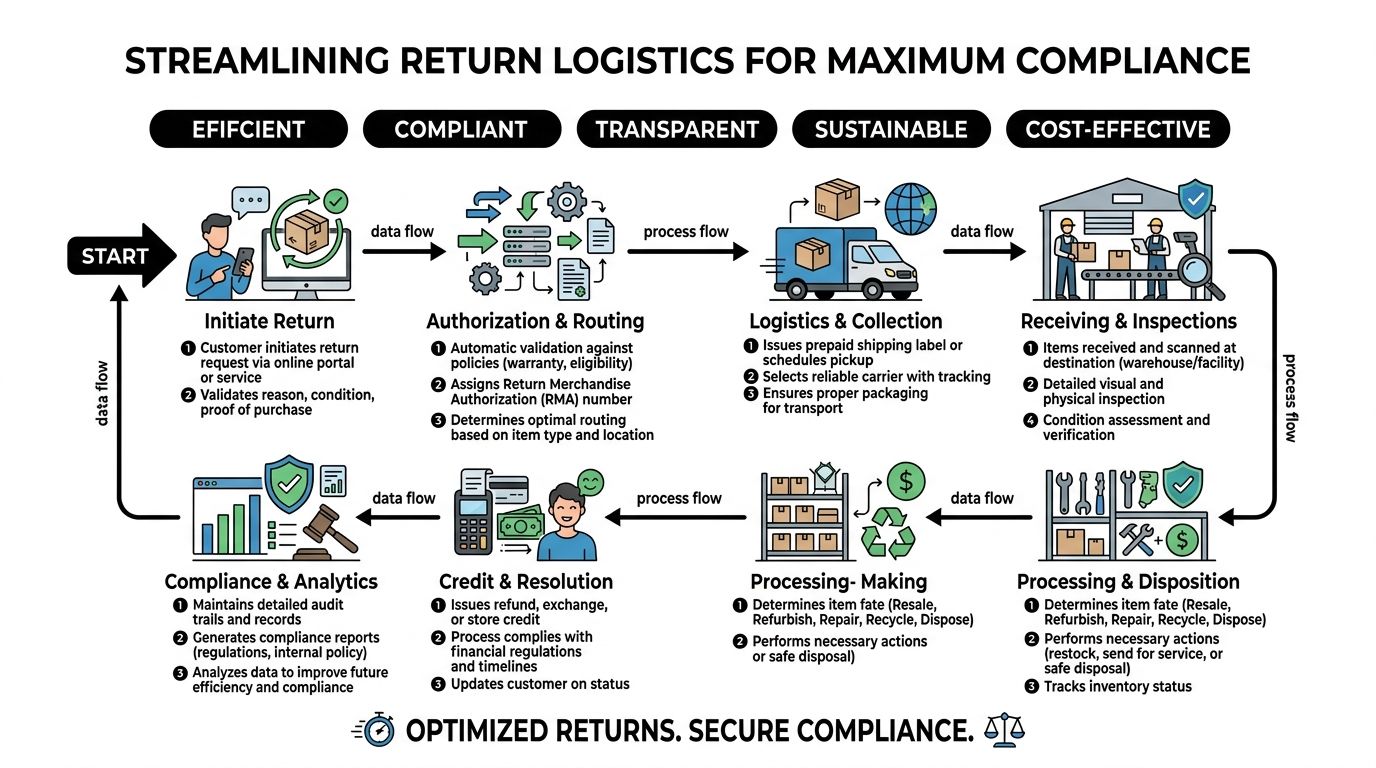
Streamlining Return Logistics for Maximum Compliance
Policy sets expectations. Logistics determine whether those expectations are realistic. If the return path is clumsy, compliance drops even when the employee is willing to cooperate.
Compare the three main return models
Most companies rely on one of three approaches. Each can work, but not for every workforce.
| Return method | Best use case | Strength | Limitation |
|---|---|---|---|
| Mail-back kits | Distributed workforces with standard laptop fleets | Consistent and scalable | Requires packaging prep and address accuracy |
| Scheduled pickup | Higher-value equipment or urgent terminations | Lowest effort for the employee | More coordination and higher service cost |
| Drop-off points | Employees near carrier networks or partner sites | Flexible and easy to track | Less effective for bulky or mixed equipment |
The right answer is often a mix. Standard laptops can go through mail-back kits. Executive devices or sensitive terminations may justify pickup. Large monitors and peripherals may need case-by-case handling because shipping can cost more than the remaining value.
Reduce friction at the employee level
The biggest mistake I see is making the former employee solve the return puzzle. If they have to source a box, print a label, or decide whether a dock and power adapter matter, delays start immediately.
Strong logistics remove those decisions:
- Prepaid labels so there's no out-of-pocket cost.
- Packaging materials sized for the actual equipment.
- Simple instructions with a short checklist.
- Flexible options if someone can't easily ship from home.
- Visible tracking so HR and IT can see progress without emailing for updates.
This is why companies that obsess over convenience tend to outperform companies that obsess over policy language alone. Enforcement matters, but ease gets the device moving.
Standardize the handoff
Operationally, the cleanest model is one owner for logistics, one owner for tracking, and one owner for final inspection. Shared ownership sounds collaborative. In practice, it creates dropped steps.
A return process should feel as routine as outbound provisioning. If it feels custom every time, it won't scale.
There's a useful parallel in operations disciplines outside IT. The best stress-free Perth moving strategies focus on reducing decision fatigue, labeling steps clearly, and controlling handoffs. Asset return is similar. The more ambiguity you remove, the fewer exceptions you have to manage.
For companies redesigning that flow, Beyond Surplus outlines practical ways to streamline laptop returns during remote employee offboarding.
Using Tracking Systems and Incentives to Drive Returns
Returns improve when companies combine visibility with motivation. Tracking tells you what's happening. Incentives influence whether the employee acts quickly or drifts.
Tracking closes the follow-up gap
A spreadsheet can record ownership, but it won't manage the recovery process. You need a system that shows asset assignment, offboarding trigger, shipment status, receipt confirmation, and exception handling in one view. That can sit in an ITAM platform, an MDM-connected workflow, or a tightly managed service process, but it has to be current.
When teams can't see where the device is in the return chain, they default to manual chasing. That wastes time and usually starts too late.
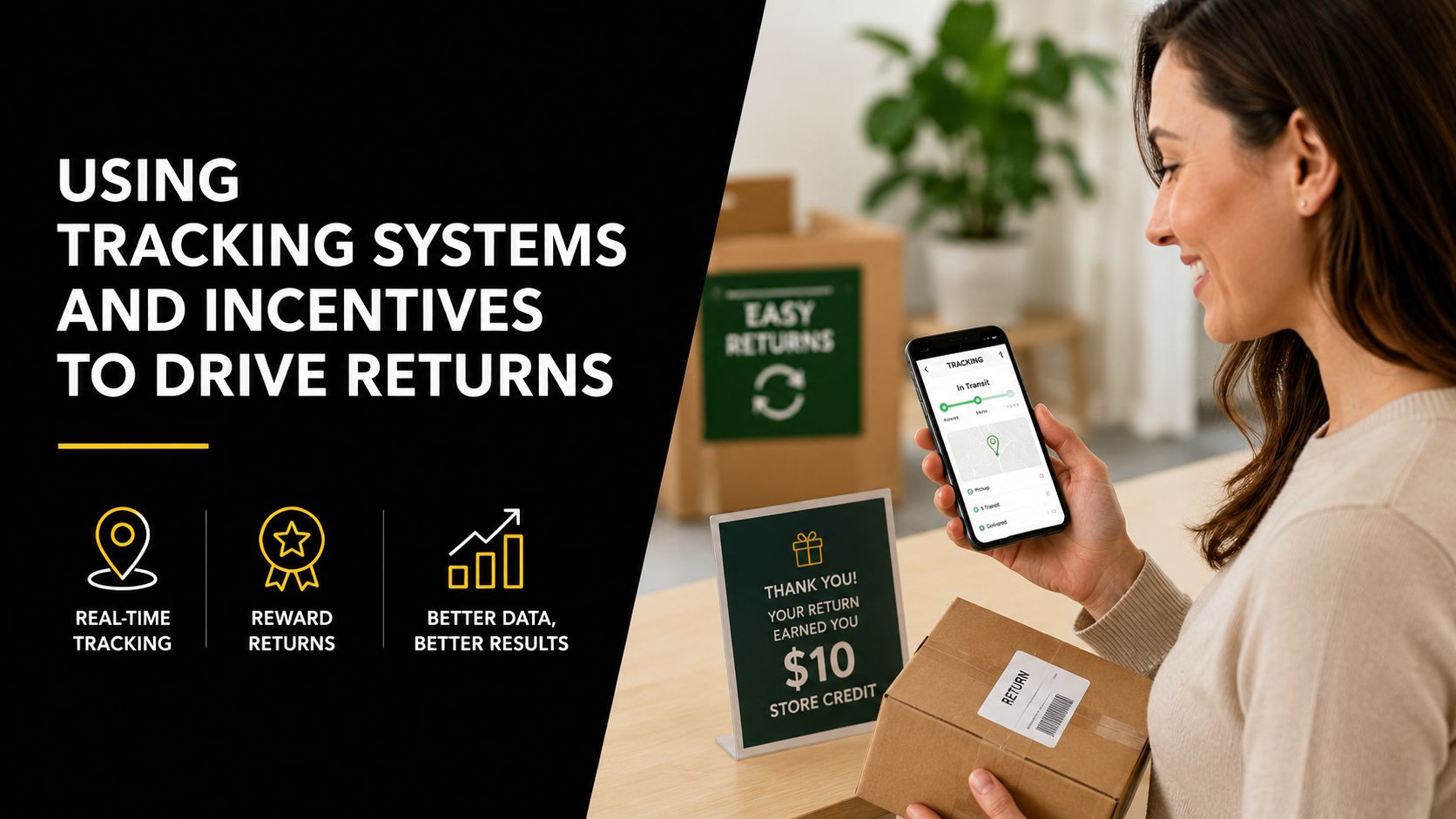
Useful tracking fields include:
- Asset identity with serial number and assigned user
- Return status such as label sent, in transit, received, inspected
- Reminder history so no one guesses whether follow-up happened
- Chain of custody notes when devices move through third parties
- Closeout confirmation after inspection and data handling
Incentives change the tone of offboarding
Purely punitive programs create resistance. Smart programs give the employee a reason to complete the task promptly. Incentivizing returns with rewards like gift cards or tying final-pay bonuses to equipment return can significantly increase compliance, while clear damage waivers and security deposits outline financial responsibility and further reduce asset risk, according to ReadyCloud's guidance on managing equipment returns from remote employees.
That matters because the psychology of return is simple. People act faster when the request is easy, specific, and linked to a clear outcome.
A workable incentive model can include:
- Completion rewards for prompt return within policy timelines
- Waiver language that clarifies how normal wear is treated
- Deposit structures where appropriate and legally reviewed
- Escalation notices that explain next steps if the asset isn't returned
The goal isn't to bribe employees. It's to move the interaction from reluctant compliance to straightforward task completion.
Use automation, not memory
Automated reminders outperform ad hoc follow-up because they don't depend on whoever happens to remember the case. Daily notifications may be right for some exits. For others, a staged sequence works better. What matters is consistency and a visible stop condition once the device is received.
If you're building that control layer, this guide on how to track and manage remote employee asset returns is a practical reference point.
Ensuring Secure Data Destruction and Value Recovery
Getting the laptop back isn't the finish line. It's the midpoint. The complete closeout happens after intake, inspection, sanitization, documentation, and final disposition.
Data security is part of return compliance
Many employees hesitate to ship a company laptop because they assume personal files, browser sessions, or saved credentials may still be on it. Even when company policy prohibits personal use, reality is messier. If you never explain what happens after receipt, that uncertainty becomes a return barrier.
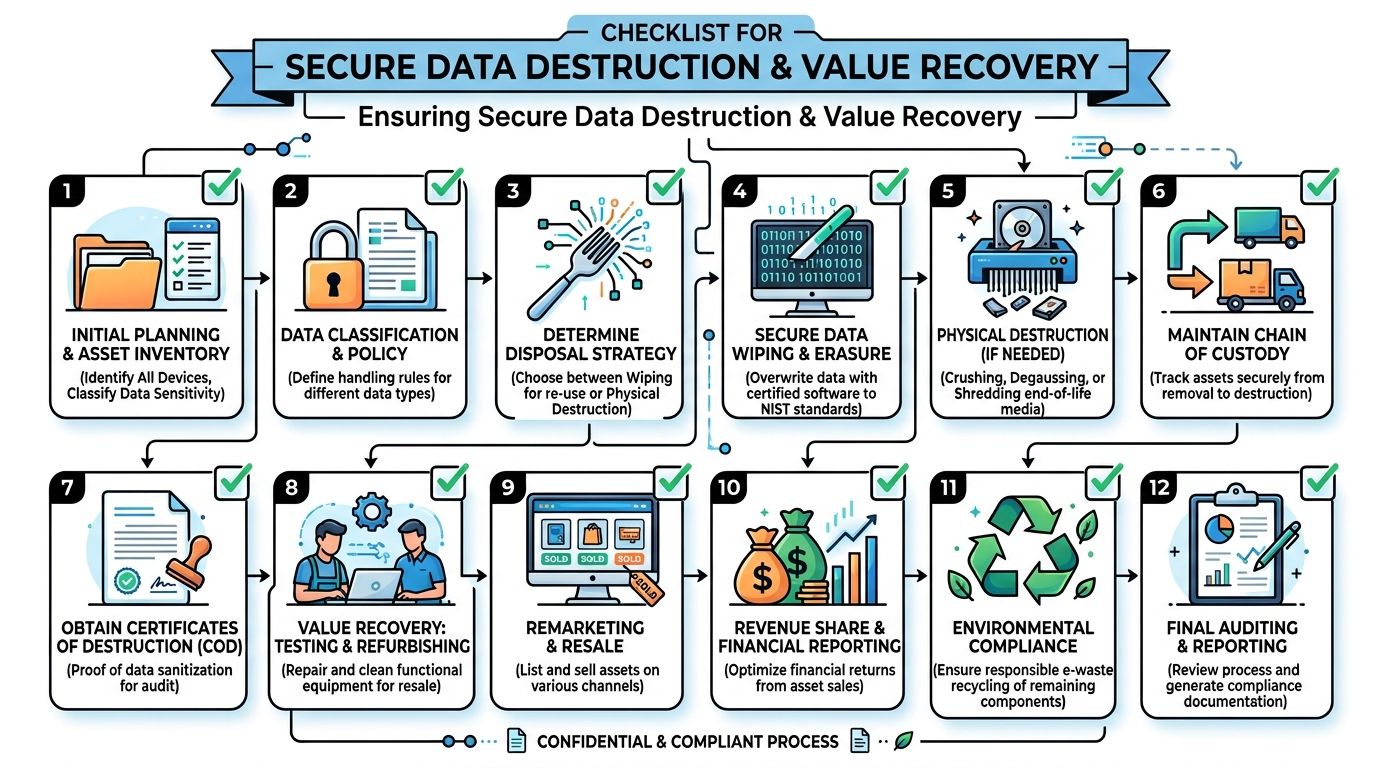
A disciplined intake process should include:
- Receipt confirmation so the employee knows the device arrived.
- Asset inspection to match serial numbers and condition.
- Secure data sanitization using documented procedures.
- Certificate issuance where required for compliance records.
- Disposition decision based on age, condition, and reuse potential.
That sequence protects both sides. The company reduces breach risk, and the employee gets confidence that the device won't sit untouched in a warehouse with data still intact.
Returned hardware without documented sanitization is still a risk item, not a recovered asset.
Recovery should include residual value
There's also a hard financial question after data destruction. Is the device fit for redeployment, resale, parts harvesting, or recycling? Internal teams often treat that as an afterthought, which leaves money on the table. Research by the Investment Recovery Association shows that professional asset recovery services can generate returns exceeding $20 for every $1 invested, while internal efforts often recover only a fraction of the asset's value, according to the Investment Recovery Association's overview of asset recovery services.
That's why ITAD should be part of the remote recovery design, not bolted on at the end. A qualified provider can manage intake controls, chain of custody, data destruction records, and value recovery channels in one process.
One option is Beyond Surplus's approach to ITAD in remote employee laptop recovery, which centers on controlled logistics, certified destruction, and downstream disposition. The important point isn't the brand. It's the operating model. If you want repeatable results, the disposition stage needs the same rigor as the retrieval stage.
Decide what stays in-house
Some companies should keep policy ownership and employee communication internal while outsourcing inspection, wipe, remarketing, and recycling. Others need a partner to handle the full lifecycle because internal teams don't have the bandwidth or facilities.
The wrong model is the one where returned devices pile up in a room waiting for someone to “get to them.” That turns recovered assets into unmanaged liability.
Measuring Success and Partnering for Excellence
You can't improve what you don't measure. Asset recovery needs the same discipline you'd apply to endpoint deployment or vendor performance. The baseline metric is simple. The recovery rate formula is (Number of Assets Recovered ÷ Number of Eligible Assets) × 100, and 80–90% indicates a highly optimized program, whereas below 70% signals systemic failure in policy, logistics, or communication, based on Unduit's IT asset recovery framework.
Track the right indicators
Recovery rate matters, but it's not enough by itself. Review the full operating picture:
- On-time return performance against your own policy deadlines
- Exception causes such as no response, shipping delay, damaged return, or legal hold
- Inspection outcomes that show which assets are reusable and which are not
- Cycle-time bottlenecks between termination, label creation, shipment, receipt, and closeout
Those indicators tell you where the program is breaking. If labels go out late, the issue is workflow. If assets arrive but sit untouched, the issue is intake capacity. If legal escalation spikes in certain states, your policy may be misaligned with wage rules.
Excellence comes from system ownership
The best programs share one trait. Someone owns the whole chain. Not just the laptop shipment. The entire lifecycle from policy and notice through receipt, sanitization, documentation, and value recovery.
That's the practical answer to how companies can improve remote employee asset recovery rates. Don't treat recovery as one offboarding task. Treat it as an operational process with legal controls, employee-centered logistics, visible tracking, and documented final disposition.
If your team needs a tighter recovery process, Beyond Surplus can support the final stages that usually break down, including secure IT asset disposition, certified data destruction, electronics recycling, and value recovery for business equipment returned from remote employees. Contact Beyond Surplus for certified electronics recycling and secure IT asset disposal.