You're staring at a retirement queue that doesn't care about your calendar. The refresh is approved, the lease return is due, the audit team wants answers, and nobody wants to sign off on 5,000 devices sitting in limbo. That's where IT asset recovery stops being a side task and becomes an operating discipline.
Done right, it protects data, recovers residual value, keeps regulated materials moving through traceable channels, and reduces the chance that old hardware becomes a security or compliance problem. Done poorly, it turns into a pickup-and-pray exercise where the most valuable asset left behind is the paperwork you wish you had.
Table of Contents
- When the Question of IT Asset Recovery First Surfaces
- Defining IT Asset Recovery and the Value It Captures
- The End-to-End IT Asset Recovery Process
- Choosing Between Reuse, Sanitization, and Physical Destruction
- Benefits Beyond Resale That Make the Program Worth Running
- How to Evaluate an IT Asset Recovery Vendor
- A Scorecard for Verifying Recovery Outcomes
- Getting Started and Choosing a Partner
When the Question of IT Asset Recovery First Surfaces
The first real signal usually isn't a strategy meeting. It's a deadline. A data center is being emptied, laptops are being replaced under a lease cycle, or a business unit is asking why retired servers are still in a storage room with no chain of custody and no owner.
That moment matters because every retired device carries four separate concerns at once. The media may hold recoverable data. The hardware may still have resale or parts value. The equipment may contain materials that need controlled downstream handling. And if the process breaks, the exposure is organizational, not just operational.
What the CIO should assume on day one
Practical rule: If you can't trace a device from pickup to final disposition, you don't have recovery, you have disposal risk.
A serious program starts by treating the queue as a portfolio, not a pile. Some assets should be reused internally. Some should be sanitized and resold. Some should be broken into parts. Some should be destroyed because the media, the data, or the condition makes reuse a bad decision.
The reason to be disciplined is simple. Global e-waste reached 62 million tonnes in 2022, equal to 7.8 kilograms per person, and only 22.3% was formally collected and recycled in an environmentally sound manner, according to the Global E-waste Monitor 2024 (ITU report). That gap is where both value and risk hide.
If you're deciding whether to keep reading linearly or jump to the part you need now, use this shortcut. If your problem is defining the program, start with the next section. If your problem is choosing wipe versus destruction, go straight to the sanitization section. If your problem is vendor selection, the evaluation section will save you the most pain.
Defining IT Asset Recovery and the Value It Captures
IT asset recovery is the controlled retirement of technology so you capture value without losing custody. That value is broader than resale. It covers reuse, parts recovery, material recovery, and compliance assurance through documented chain of custody and verified processing.
The four value streams that matter
Functional devices carry the clearest upside. A working laptop can be redeployed, resold, or donated inside a controlled workflow. Repairable hardware can be stripped for usable components. Nonfunctional units still hold value in metals, boards, batteries, and other recoverable fractions. Every asset that moves through a traceable process also reduces the odds of a compliance problem surfacing later.
This is why I push back when teams call the whole exercise "disposal." Disposal is one outcome among several. A real recovery program asks a harder question: what is the highest defensible use for this asset, given its condition, the data it holds, and the evidence a buyer or auditor will demand?
Regulation reinforces that discipline. The Basel Convention, adopted on 22 March 1989 and in force since 5 May 1992, now treats all electrical and electronic waste as subject to prior informed consent for cross-border movement under its 2022 amendments, effective 1 January 2025 (Basel Convention text). Downstream traceability is a live compliance obligation, not a theoretical one.
A device that can be reused safely should be reused. A device that can't should be sanitized or destroyed based on media and risk. Shredding everything by default leaves value on the floor.
Where recovery ends and generic recycling begins
Recycling is one component of recovery, not the whole program. Secure shredding is a control, not a strategy. Buyback is a pricing mechanism, not a process. If a vendor can't explain how those pieces connect, they're selling a transaction, and you're absorbing the gap.
For a practical walkthrough of value-capture logic, Beyond Surplus's recovery-focused guide is worth your time.
The End-to-End IT Asset Recovery Process
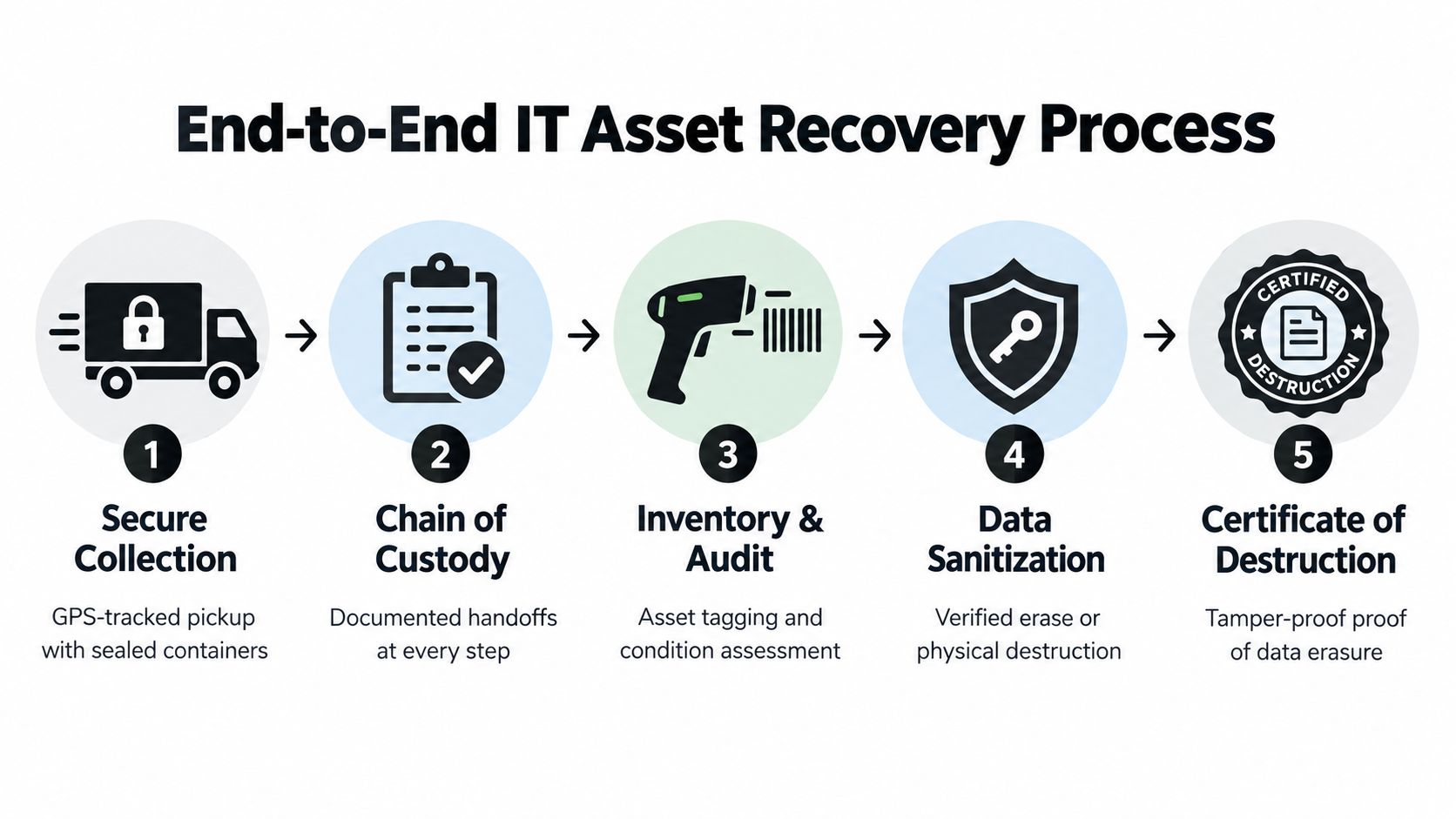
A real program moves in sequence. Skip a stage, and you create either a security gap or a value leak. On a 500-device refresh, that sequence should move from scheduled pickup to final certificate issuance in roughly ten business days if the scope is clean and the inventory is tight.
Collection, intake, and grading
Pickup should begin with sealed containers, a manifest, and named handoffs. Every device then gets serialized at intake, matched to the original list, and assessed for condition. If an asset is missing, damaged, or not on the manifest, that exception needs to be logged immediately.
Sanitization before anything leaves control
Data-bearing devices should not be treated as generic scrap. The sanitization method needs to match the media and the reuse plan. The record should show the device identifier, media type, method, tool and version, verification result, operator, timestamp, and any exception disposition.
Testing, refurbishment, resale, and recycling
Working units get functional testing and grading. Some go back into service internally. Some enter resale. Others are broken down for parts. What's left goes to controlled recycling with downstream traceability, not casual scrap handling.
| Stage | Primary Decision | Documentation Produced |
|---|---|---|
| Secure collection | Who owns custody | Pickup manifest, seal log |
| Intake and audit | What assets arrived | Serialized inventory record |
| Data sanitization | Clear, purge, or destroy | Verification report, operator log |
| Refurbishment or resale | Reuse or liquidate | Grade sheet, test results |
| Recycling and closeout | Material recovery or destruction | Recycling record, final certificate |
The hard truth is that a competent partner should be boring here. No mystery pallets. No “trust us” certificates without detail. No blended handling of live, failed, and destroyed assets.
Choosing Between Reuse, Sanitization, and Physical Destruction
NIST SP 800-88 gives you the right framework because it separates clear, purge, and destroy instead of pretending every device needs the same treatment (NIST SP 800-88 Rev. 2). That distinction matters. A sanitized, reusable device creates a different business outcome than a crushed one.
Match the method to the media
HDDs are often suitable for overwriting when reuse is planned and the device is healthy. SSDs and self-encrypting drives need more caution because remapped cells can make simple overwrite an incomplete answer. For those devices, cryptographic erase or a media-specific block erase may be more appropriate when encryption and key control are reliable.
Mobile devices usually follow a separate playbook because they're tightly integrated and often managed through platform resets plus verification. Damaged or legacy media, especially where audit evidence is the priority, may justify physical destruction.
If the asset will be reused, prove that sanitization was effective. If it won't be reused, don't overcomplicate the decision. Destroying unusable media is often the cleanest answer.
| Media Type | Reuse Planned | Recommended Method | Evidence Provided |
|---|---|---|---|
| HDD | Yes | Clear or purge | Verification log, serialized record |
| SSD | Yes | Purge or cryptographic erase | Tool output, operator record |
| Self-encrypting drive | Yes | Cryptographic erase | Key-management evidence, verification |
| Damaged media | No | Destroy | Destruction record, chain of custody |
| Mobile device | Maybe | Device-specific sanitization | Reset record, audit trail |
For an operational standard on media sanitization, review Beyond Surplus's NIST SP 800-88 resource.
Benefits Beyond Resale That Make the Program Worth Running
A recovery program earns its place when it controls more than resale value. Value recovery depends on accurate grading, parts harvesting, and appropriate resale routing. Risk reduction requires verified sanitization and serialized custody. Sustainability starts with reuse, then moves to responsible recycling. Compliance depends on records that legal, audit, and procurement teams can review.
What each outcome is actually built on
The FTC's Disposal Rule applies to businesses and individuals that use consumer reports for a business purpose. It expects disposal practices that are reasonable and appropriate for preventing unauthorized access to that information (FTC Disposal Rule guidance). Documented disposal decisions therefore belong in the control framework.
For cross-border shipments, require written downstream routing and consent documentation in the vendor statement of work. Record the destination, responsible processor, shipment controls, and exception process before equipment leaves your custody. This turns an international movement into a reviewable business process rather than an assumption about the vendor's network.
The operating standard should be simple: protect data, preserve usable equipment, and document what happens next. Those objectives often compete, so the program needs an explicit decision for each asset, reuse, sanitization, or destruction, rather than a blanket recycling route.
Where teams usually overstate the result
A recycling claim does not prove circularity. A resale total does not prove compliance. A destruction certificate without serialization gives auditors little to verify. The record should connect the device, the selected method, the outcome, and the downstream destination.
Use a practical circular economy resource for enterprise IT equipment to test whether reported recovery outcomes represent actual reuse and material value, or only polished reporting.
How to Evaluate an IT Asset Recovery Vendor
Buyers get into trouble when they pick the lowest price per pound and call it diligence. That number tells you almost nothing about control quality. I'd rather pay more to a vendor that can prove custody, sanitization, and downstream routing than save a few points and inherit ambiguity.
What to demand before the first pickup
Ask for the actual chain-of-custody record, not a marketing sample. Ask how serial numbers are captured and how exceptions are handled. Ask what a certificate of recycling and a certificate of data destruction contain, and whether those documents can be matched back to specific devices.
Then press on the hard parts. Who audits the downstream processors? How are resale proceeds calculated and paid? What happens to failed units, batteries, and mixed-media assets? How are regulated devices handled, and what happens if material crosses a border?
Vendor test: If the partner can't explain what happens to a serial-numbered device after pickup, they're not operating a recovery program. They're operating a transportation event.
If your business is in metro Atlanta, a local facility with its own fleet can make sense for short-haul, high-control work. If your portfolio is distributed across multiple states, a national pickup model through transportation partners may be the cleaner option. The right answer depends on custody, timing, and the density of your sites.
For a practical question set, review Beyond Surplus's vendor selection checklist.
A Scorecard for Verifying Recovery Outcomes
The weakest metric in this space is “percent recycled.” It sounds good and proves very little. A better scorecard starts with the device and follows it through the program.
What to measure
Use chain-of-custody completeness to see whether every asset has a serialized record. Use reuse rate to measure redeployed or resold devices against total received. Track recovery revenue net of logistics and processing so you see the economic result, not gross headlines. Add data-bearing-device disposition with method-specific evidence. And record the geographic destination of exported material so traceability doesn't stop at pickup.
| Metric | How It Is Measured | What Good Looks Like |
|---|---|---|
| Chain of custody completeness | Serialized records per asset | Every asset traced |
| Reuse rate | Redeployed or resold divided by total received | High enough to justify sorting before shredding |
| Net recovery revenue | Revenue minus logistics and processing | Positive, auditable margin |
| Data-bearing disposition | Method matched to media with proof | Clear evidence for each device |
| Downstream recycling | Documented processor routing | Traceable, compliant handling |
The best programs show that reuse happened before recycling. That's the strongest indicator of real circularity. A recycle-only summary can hide leakage, missed resale, and weak controls. A device-level scorecard doesn't let that happen.
For reporting discipline and audit-ready records, use Beyond Surplus's audit trail reporting page.
Getting Started and Choosing a Partner
Write the policy before the trucks arrive. Your internal retirement policy should define ownership, approved sanitization methods, exception handling, approval authority, and the records required for closeout. If that sounds basic, good. Basic is what keeps the process controllable.
How to pilot without creating chaos
Start with a small, representative batch. Use it to validate pickup timing, inventory capture, testing flow, certificate format, and escalation paths. If the pilot cannot produce clean records, a larger rollout will only scale the confusion.
Your first pickup should include a fixed manifest, device counts, serial numbers, data-bearing classifications, and a named contact on both sides. Multi-year contracts should preserve accountability by tying payment, reporting, and documentation to actual device-level outcomes, not loose summaries.
For Beyond Surplus, that means business pickup across the contiguous United States, Atlanta/Smyrna drop-off, secure data destruction, and certificates of recycling and data destruction as part of the engagement. It also means the vendor model needs to fit your scale, whether you are clearing a 50-device office or retiring a mixed estate of endpoints, servers, and storage.
Add a contract clause requiring serialized downstream routing and export consent records for any cross-border material movement. Treat that as a control, not a formality. If a partner cannot document where each asset went and what happened to it, the program is not audit-ready.