

A scanner refresh hits the Atlanta distribution dock, and the retired equipment arrives faster than anyone can inventory it. Pallets hold handheld scanners, laptops, printers, access points, batteries, monitors, and server hardware, while reusable devices sit beside failed units and data-bearing drives. If the team treats that load as ordinary scrap, chain of custody breaks before the recycler touches it.
Electronics recycling for Atlanta warehouses and distribution centers should begin as an asset-control project. The facility needs a serialized manifest, controlled staging, media-specific data destruction, and certificates that reconcile what left the building with what the processor handled. The scale is global: The Global E-waste Monitor 2024 reports that the world generated 62 million tonnes of electronic waste in 2022, about 7.8 kilograms per person, while only 22.3% was documented as formally collected and recycled in an environmentally sound manner.
Table of Contents
- What an Atlanta Warehouse ITAD Project Actually Involves
- Designing the Dock-to-Certificate Workflow
- Choosing the Right Data Destruction Method per Device
- Onsite Shredding Versus Scheduled Pickup
- Compliance Documents Atlanta Warehouses Should Require
- How to Vet an Atlanta ITAD Vendor
- Turning Retired Equipment Into Recovered Value
What an Atlanta Warehouse ITAD Project Actually Involves
The floor inventory in a major Atlanta logistics operation rarely looks like a neat IT department asset list. It includes rugged barcode scanners, vehicle-mounted computers, laptops, label printers, industrial displays, wireless controllers, switches, firewalls, servers, backup media, batteries, and equipment returned from several sites. A lease return, technology refresh, warehouse-management-system upgrade, or lease buyout can make dozens or hundreds of units obsolete at once.
A small office cleanout gives staff time to inspect equipment one item at a time. A distribution-center retirement happens at the dock, often during a narrow appointment window, with forklifts, trailers, production priorities, and multiple asset owners competing for attention. Speed matters, but speed without identity creates disputed counts, lost drives, and incomplete certificates.
Before the truck arrives, lock in three decisions.
Define the serialized asset. Decide whether every scanner, laptop, server, printer, monitor, battery pack, and network device receives an individual barcode or whether some low-value peripherals move under controlled lot numbers. Serial-level tracking is the safer choice for equipment with resale value, embedded storage, or ownership restrictions.
Classify data-bearing equipment. A laptop is obvious. A warehouse printer, multifunction copier, scanner, access point, server, or controller may also contain storage. Flag magnetic hard drives, SSDs, flash storage, tape, and embedded media before equipment reaches a mixed staging lane.
Specify minimum record requirements. Require the manifest, chain-of-custody transfers, outbound weights, destination, data-destruction evidence, certificate of recycling, certificate of destruction, and exception report. If the vendor can't identify what happened to a serial-numbered device, the job isn't complete.
Use a dedicated warehouse electronics cleanout service only after the internal controls are defined. The provider can move material efficiently, but the facility manager remains responsible for deciding what may be reused, what requires secure sanitization, and what evidence must return.
Designing the Dock-to-Certificate Workflow
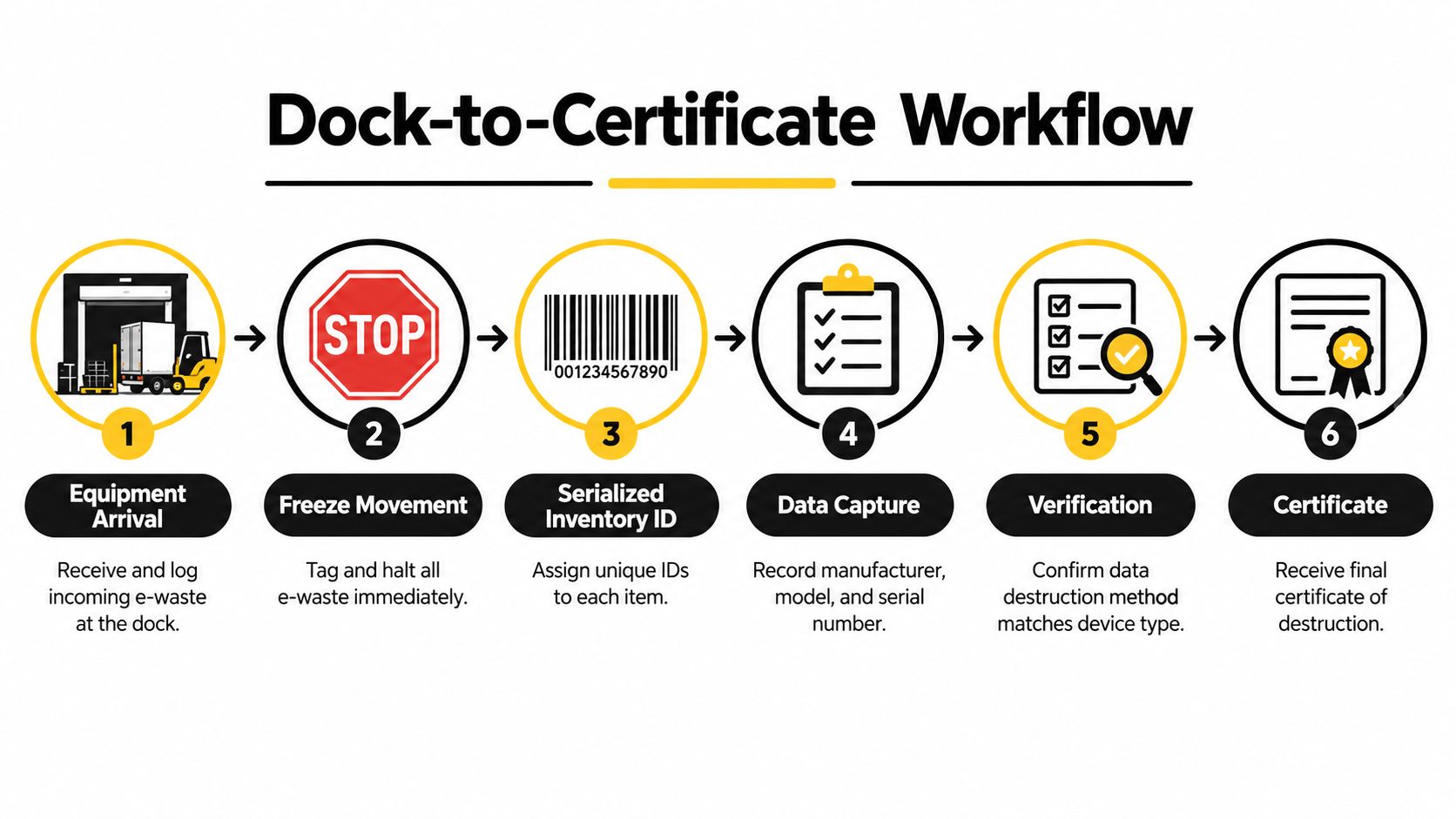
The dock needs a sequence that workers can follow under pressure. Don't let a vendor begin by counting pallets. Begin by freezing movement and creating an inventory boundary.
Control the handoff at the dock
Step one, freeze movement. Stop informal transfers as soon as the retirement load reaches the dock. Assign a project owner, record the starting location, and keep equipment inside a controlled zone until each item receives an ID.
Step two, serialize the load. Apply a unique barcode or serialized inventory ID to each controlled asset. Capture manufacturer, model, serial number, condition, storage type, battery presence, owner, and proposed disposition.
Step three, separate by risk. Use marked zones for reusable equipment, data-bearing media, lithium batteries, CRTs, lamps, damaged devices, and general electronics. Never place resale inventory in the same gaylord or pallet as scrap.
Step four, secure media. Put drives and devices awaiting sanitization in locked, tamper-evident containers. Restrict access to authorized staff, record every transfer, and investigate missing seals or unexplained quantity changes before shipment.
Step five, route by disposition. Send reusable equipment to testing and resale, while non-reusable units move to dismantling and material recovery. The processor should identify failed devices rather than changing a reuse decision to scrap without notice.
Step six, reconcile the outcome. Compare serials, weights, quantities, destination, and certificates. Require exception reports for missing serials, damaged batteries, unexplained weight variance, and assets held beyond the agreed processing SLA.
The internal workflow should mirror the downstream process. EPA describes electronics recycling as collection followed by sorting, dismantling, mechanical separation, and recovery of materials such as copper, gold, aluminum, and glass. The agency also identifies R2 and e-Stewards as the two principal accredited certification standards in the United States.
Practical rule: A pallet count proves that a pallet moved. A serialized mass balance shows what happened to the equipment.
Require chain-of-custody documentation that connects the dock manifest to the final processing record. A certificate without that connection is a receipt, not an audit defense.
Choosing the Right Data Destruction Method per Device
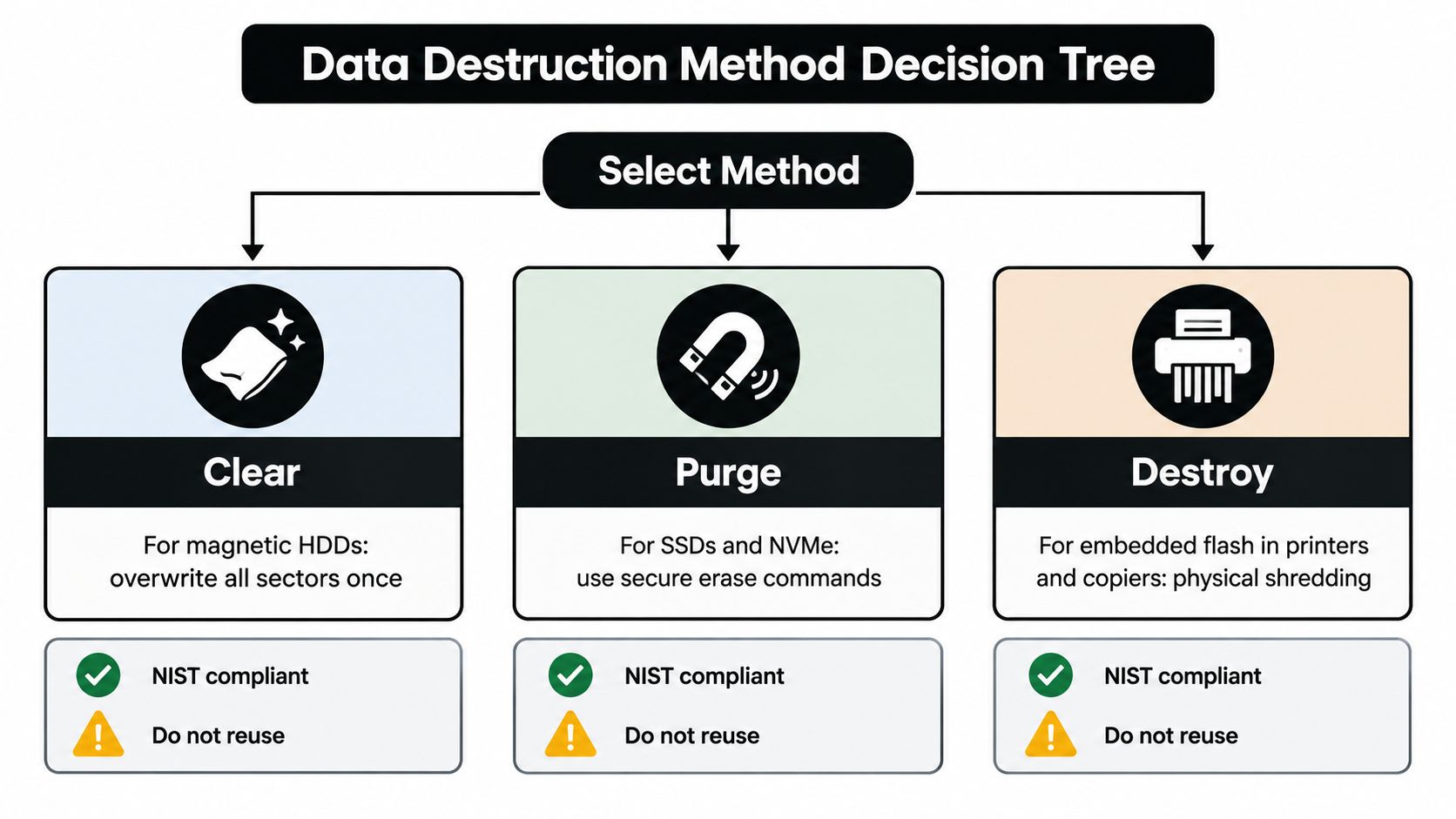
Treat data destruction as an engineering decision, not a reflexive shredding order. NIST SP 800-88 defines sanitization as rendering access to target data infeasible for a specified level of effort and distinguishes clear, purge, and destroy according to media technology and information sensitivity.
Apply the method to the media
Clear uses logical techniques within user-addressable storage locations. It can suit a magnetic HDD that will remain under controlled ownership when the information risk and technology support the method. A supported factory reset or validated overwrite isn't the same as dragging files to a recycle bin.
Purge uses physical or logical techniques intended to make recovery infeasible with state-of-the-art laboratory techniques while preserving the media for reuse. Secure erase commands, block erase, or cryptographic erase may fit SSDs and NVMe devices when the firmware supports the operation and the result can be verified.
Destroy makes recovery infeasible and leaves the media unusable for storage. Use physical destruction for failed drives, damaged media, exceptionally sensitive information, or embedded flash in printers, copiers, scanners, and other devices that can't be reliably sanitized through a validated process.
Software assumptions cause trouble with solid-state media. An SSD can distribute data across flash cells, reserve spare areas, and expose storage behavior that differs from a magnetic disk. Cryptographic erase also depends on supported encryption and firmware behavior. Degaussing has a place for appropriate magnetic media, but it isn't a universal solution for SSDs, NVMe, or embedded flash.
The IRS media-sanitization guidance states that simple deletion is insufficient because data must resist recovery utilities, keystroke-recovery attempts, and data-scavenging tools. Its examples include firmware Secure Erase commands for ATA drives, degaussing where appropriate, and physical methods such as pulverizing or shredding.
Record the evidence line for every device:
- Method: Clear, purge, or destroy, with the technique used.
- Technology: Magnetic HDD, SSD, NVMe, tape, flash, or embedded storage.
- Execution: Tool name and version, operator, date, serial number, and result.
- Verification: The validation method and whether the device passed.
- Exception: Failure reason, escalation method, and final disposition.
This Atlanta guide to NIST 800-88 data destruction is useful when converting a warehouse refresh into device-specific work orders. Don't issue one generic “wiped” certificate for a mixed load.
Onsite Shredding Versus Scheduled Pickup
The choice between onsite shredding and scheduled pickup depends on risk, volume, timing, and the evidence your reviewers expect. Neither option wins every project.
| Criterion | Onsite Shredding | Scheduled Pickup |
|---|---|---|
| Security | Destruction occurs at the facility, reducing transit exposure | Requires sealed containers, controlled loading, and documented transport |
| Downtime | Staff must support the shredding appointment and equipment feed | Dock work is concentrated into pickup and staging activities |
| Asset volume | Works well for large refreshes or concentrated media loads | Efficient when equipment can be consolidated without extended holding |
| Audit trail | Immediate destruction evidence can simplify the handoff | Requires strong reconciliation from pickup manifest to final certificates |
| Scheduling | Mobile equipment and site access need firm coordination | Pickup windows may be easier to align across locations |
| Cost per device | Can be justified for sensitive, dense loads | Often makes sense when reuse and material recovery occur off site |
Onsite shredding is the stronger choice when an active refresh produces a large, sensitive media load, when lease deadlines leave little time, or when leadership wants destruction completed before equipment leaves the property. It also reduces the risk associated with shared staging rooms, unsealed trailers, and transfers between multiple sites.
Scheduled pickup is cleaner when the load contains a substantial reuse stream, mixed equipment categories, or devices that need testing before a final disposition. Off-site processing can support resale, component recovery, and material separation more efficiently, but only if the vendor controls the container, transport, receiving process, and downstream partners.
The same discipline applies to any scheduled collection service. A practical guide to easy parcel collection illustrates why appointment details, pickup responsibility, packaging, and handoff clarity matter even in ordinary logistics. Warehouse ITAD requires those controls at a stricter level because the load may contain data and assets with residual value.
Decision rule: Choose onsite when the cost of leaving the facility with the media exceeds the cost of mobile destruction. Choose scheduled pickup when controlled transport and certified processing preserve more reuse value than onsite shredding.
Use the comparison of onsite and offsite ITAD services in Georgia to pressure-test the decision against your actual dock layout, lease deadline, media sensitivity, and expected reuse stream.
Compliance Documents Atlanta Warehouses Should Require
Compliance lives in the records, not in a vendor's verbal assurance. The facility should define the document package before approving the pickup.
The FTC Disposal Rule applies to any business that maintains or possesses consumer reports or information derived from consumer reports for a business purpose. It requires disposal practices that are reasonable and appropriate to prevent unauthorized access to or use of that information.
Match each obligation to evidence
For laptops, servers, backup media, employee equipment, and systems connected to customer operations, require a certificate of data destruction that identifies the asset or media serial, method, verification result, operator, and date. “Hard drives destroyed” doesn't identify which drives were destroyed.
For the recycling stream, require a certificate of recycling with serial-level detail where practical, material categories, weights, processing destination, and final disposition. The record should distinguish reuse, refurbishment, component harvesting, and commodity recovery from disposal.
For downstream activity, require vendor manifests and disposition records tied back to the original load. If a primary processor sends material to another facility, the chain shouldn't disappear at the transfer point.
Healthcare-adjacent distribution operations need additional discipline. A warehouse handling pharmacy logistics, clinic supplies, insurance records, or medical equipment should ask how the vendor protects protected health information and whether certificates preserve the fields a HIPAA-conscious reviewer expects. Financial and retail fulfillment environments should apply the same scrutiny to consumer-report, payment, and customer data.
Georgia's lack of a broad commercial e-waste mandate makes internal controls more important, not less. Your organization still needs to demonstrate that it controlled data, separated hazardous components, and selected a responsible downstream route.

Ask for these records in the contract:
- Asset manifest: Serial, model, condition, storage type, and disposition.
- Media certificate: Technique, tool, verification, operator, date, and result.
- Recycling certificate: Material route, weights, destination, and processing outcome.
- Transfer record: Every custody change, container seal, vehicle, and receiving confirmation.
- Exception report: Missing serials, failed sanitization, damaged batteries, and unresolved variance.
How to Vet an Atlanta ITAD Vendor
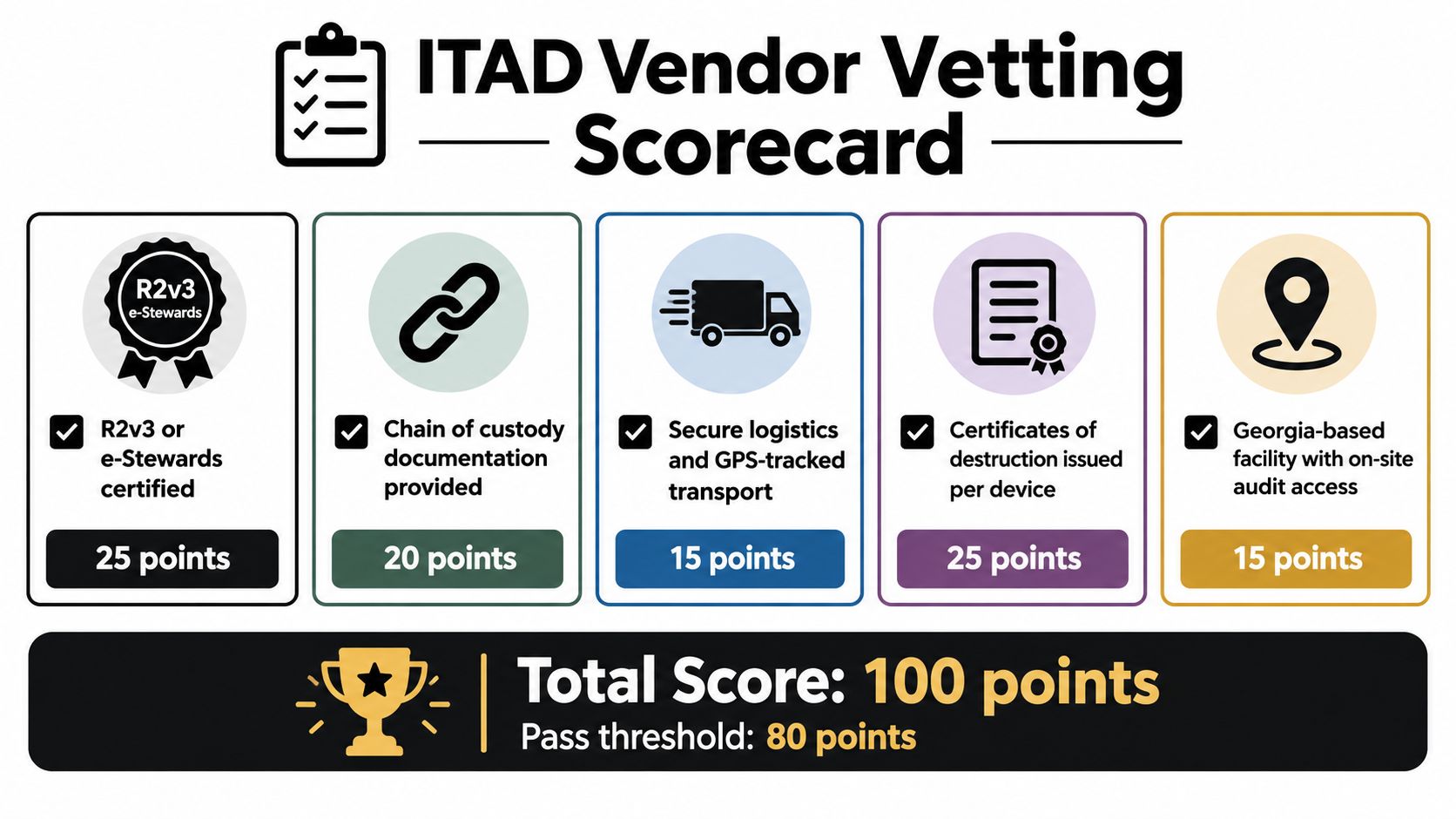
Start with certification, then test whether the vendor can operate at your dock. An attractive buyback quote doesn't compensate for weak receiving controls, vague downstream claims, or certificates that arrive without serial-level evidence.
Use a pass-fail screen before price comparison
Require R2v3 or e-Stewards certification appropriate to the services being offered. Then verify the certificate scope, physical locations, audit status, insurance coverage, and the identity of the party that physically handles the equipment.
Score the operational proposal against these criteria:
- Certification and controls: Does the provider maintain R2v3 or e-Stewards certification and show how its procedures apply to your asset types?
- Chain of custody: Will the vendor document pickup, sealed transport, receiving, processing, and downstream transfer?
- Media evidence: Can it issue a device-specific certificate with method, verification, operator, date, and result?
- Logistics execution: Can it coordinate dock appointments, pallets, loading, multi-site pickups, and exceptions without commingling loads?
- Commercial terms: Does the buyback calculation explain testing, market value, deductions, and the treatment of failed units?
Ask what happens when a drive fails sanitization, a serial doesn't scan, a battery arrives damaged, or a reused device is rejected during testing. The answer should include a defined escalation path, not “we'll handle it.”
NIST describes media sanitization as a process that renders access to target data infeasible for a defined level of effort. The provider should therefore match the method to the device and information sensitivity rather than apply one workflow to every item.
Red flags worth rejecting
Reject vendors that mix resale inventory with scrap, accept unidentified drives, promise certificates without verification fields, or rely on undocumented downstream processors. Be cautious when a provider can't explain where failed devices go, won't permit reasonable audit access, or offers a high buyback value without showing how it protects the data-bearing stream.
Require service-level timing for inventory reconciliation, sanitization, certificates, and payment. Keep the right to audit the facility, review downstream records, and challenge unexplained weight or serial variance.
Turning Retired Equipment Into Recovered Value
A retirement load should start with chain of custody, not a crusher.
Resale and compliance use the same discipline. A device headed for resale needs verified data disposition, condition testing, an ownership check, and a traceable buyer or downstream channel. A device headed for destruction needs controlled handling, weight records, material recovery, and a certificate that closes the chain. If the manifest is weak, the facility cannot defend either outcome.
Separate the streams before the value disappears
Use three practical lanes:
- Reuse and resale: Tested laptops, scanners, monitors, network equipment, and servers that can be sanitized and sold or redeployed.
- Component recovery: Equipment with usable memory, processors, boards, power supplies, or other parts that should be harvested under controlled records.
- Destruction and material recovery: Failed, damaged, obsolete, or sensitive equipment routed to dismantling, shredding, separation, and commodity recovery.
Do not price the entire load as scrap before testing. A working scanner, switch, server, or laptop can follow a different market route than a damaged chassis, and a reusable device may hold value that commodity pricing misses. Speed has a cost. Testing and sanitization take time, while immediate shredding gives faster closure and wipes out reuse value.
The material case is real, and warehouse operators should treat it that way. The Global E-waste Monitor reports point to large amounts of recoverable material still going unclaimed. That does not mean every warehouse load pays out cleanly. It means the first question should always be what can be reused, refurbished, harvested, or recovered before disposal starts.
For facilities that want a structured recovery path, Atlanta IT asset recovery services should be evaluated as part of the same disposition workflow.
Make the records support sustainability reporting
A credible environmental report needs more than a truck weight. Tie the serialized manifest to the certificate of recycling, certificate of destruction, downstream disposition record, and material category. That record set supports internal sustainability reporting and makes claims like zero-landfill handling more defensible when the processor can show the route.
Beyond Surplus is one commercial option for secure data destruction, electronics recycling, IT equipment disposal, product destruction, and coordinated ITAD logistics. The selection still belongs to the facility manager. The vendor should earn approval through certification, evidence, logistics capability, and transparent terms.
Start with the next refresh, not the warehouse closure. Freeze the asset list, classify data-bearing devices, define the three disposition lanes, and require a certificate package that reconciles every controlled item.


