

A server-room refresh, a controller retrofit, and a laboratory PC retirement can land on the same Atlanta plant manager's calendar. The equipment may sit in one staging area, but it doesn't carry the same data, safety, resale, or environmental risk. Treating every item as scrap is fast, but it can destroy recoverable value and leave sensitive media outside documented controls.
Electronics recycling for Atlanta manufacturers and industrial facilities should operate as a risk-based IT asset disposition program. The practical standard is simple: know what is leaving, choose a defensible disposition method, control every transfer, and retain evidence of the final outcome.
Table of Contents
- Why Electronics Recycling Is a Risk Decision in Atlanta
- Scope Your Asset Inventory Before You Call a Recycler
- Match Disposition Method to Risk and Value
- Plan De-Installation, Pickup, and Chain of Custody
- Apply the FTC Disposal Rule and NIST Controls
- Recover Value and Verify Downstream Outcomes
- Reporting, KPIs, and Choosing Your Atlanta ITAD Partner
Why Electronics Recycling Is a Risk Decision in Atlanta
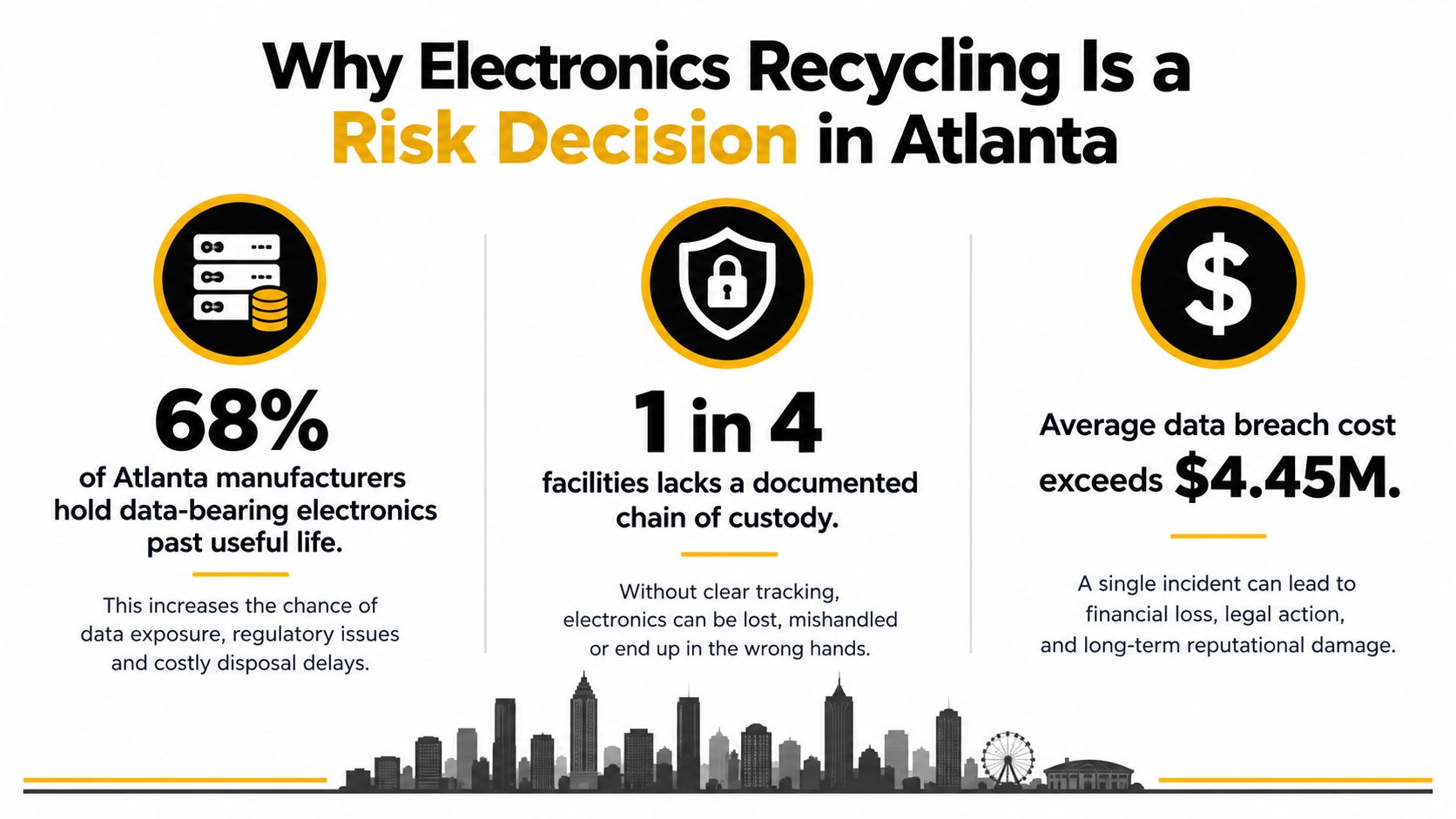
A retired engineering workstation can carry design files, while a server may contain employee or customer records. A programmable logic controller, human-machine interface, or diagnostic system may store operational data, configuration files, credentials, or proprietary process information. Sending all of these assets into one unmanaged load because they are obsolete creates avoidable data, operational, and environmental exposure.
Electronics recycling for Atlanta manufacturers and industrial facilities should function as a risk-based IT asset disposition program, not a pickup job. The program must account for both conventional IT and operational technology, assign each asset an appropriate outcome, and produce evidence that the outcome occurred.
The environmental stakes are substantial. Global electronic-waste generation reached 62 million tonnes in 2022, up from 34 million tonnes in 2010, according to the Global E-waste Monitor 2024. Only 13.8 million tonnes, or 22.3%, were documented as formally collected and recycled in an environmentally sound manner. The report projects 82 million tonnes by 2030, while the documented collection and recycling rate could fall to about 20% if formal capacity does not expand at the same pace.
One facility, several risk profiles
A plant server refresh requires documented media sanitization. A controller retrofit may require a controlled decision about embedded storage and proprietary configurations. A laboratory PC retirement may involve employee, customer, or research information. One general pickup receipt cannot prove that these streams received the right treatment.
Disposal volume alone also fails as a performance measure. EPA data for selected consumer electronics recorded approximately 2.7 million tons generated in 2018 and 1.04 million tons collected for recycling, a 38.5% recovery rate. The dataset is historical and does not precisely represent every industrial asset, but it shows the difference between equipment leaving service and equipment entering a documented recycling channel. The figures come from the EPA's consumer electronics dataset, while the Global E-waste Monitor publication page provides international context.
Practical rule: Emptying a storage room is not the objective. Protect data, preserve value, and prove responsible downstream handling.
Atlanta businesses should include Georgia requirements in their disposal planning. This overview of electronics recycling laws in Georgia and ITAD compliance provides a useful starting point. Require a serialized inventory, an approved disposition for every asset, controlled movement, verified sanitization where required, and certificates that match the devices handled.
Scope Your Asset Inventory Before You Call a Recycler
Don't start with a truck. Start with a list.
An industrial inventory should identify each asset by serial number, device type, owner, location, and data classification. Capture enough detail to distinguish a rack server from a desktop, a PLC from a network switch, and a removable drive from ordinary metal scrap. If the list can't answer what the item is, where it came from, and what information it may contain, the disposition decision is premature.
Separate IT from operational technology
Use two connected workstreams. IT may include laptops, desktops, servers, storage arrays, printers, copiers, switches, firewalls, and wireless equipment. Operational technology may include PLCs, HMIs, industrial PCs, motor drives, sensors, controls, diagnostic systems, and removable media used for configuration or maintenance.
Record the following before equipment is pulled:
- Identity: Serial number, manufacturer, model, asset tag, and device category.
- Ownership: Department, responsible manager, site, production line, or laboratory.
- Condition: Working, damaged, incomplete, obsolete, locked, or failed.
- Storage: Hard drive, solid-state drive, flash card, removable media, embedded storage, or no known storage.
- Information risk: Public, internal, confidential, regulated, proprietary, or unknown.
- Disposition intent: Reuse, resale, parts recovery, recycling, or destruction.
A condition review can separate equipment with resale potential from material that belongs in a controlled recycling or destruction stream. Use a documented equipment condition assessment rather than allowing a loader or warehouse worker to make that decision at the dock.
Flag difficult materials early
Mark damaged lithium-ion batteries, mercury-containing equipment, CRT displays, batteries, cabling, racks, and mixed loads before scheduling removal. Damaged batteries need escalation and controlled handling. Mercury-bearing equipment and CRTs shouldn't be treated as ordinary commodity electronics.
| Asset Class | Examples | Primary Concern |
|---|---|---|
| Enterprise IT | Servers, laptops, storage arrays | Data sanitization, resale value, chain of custody |
| Network infrastructure | Switches, routers, firewalls, wireless units | Configuration data, serial tracking, reuse |
| Operational technology | PLCs, HMIs, industrial PCs, controllers | Process data, embedded storage, production risk |
| Laboratory equipment | Diagnostic computers, analyzers, workstations | Sensitive research or patient-related information |
| Energy and hazardous components | Batteries, CRTs, mercury-containing equipment | Safe segregation, transport, downstream controls |
| Metals and peripherals | Racks, cabling, printers, displays | Material recovery and accurate weight records |
Don't let unknown assets enter a mixed commodity load. Unknown status is a disposition exception that requires investigation, not permission to proceed.
Match Disposition Method to Risk and Value
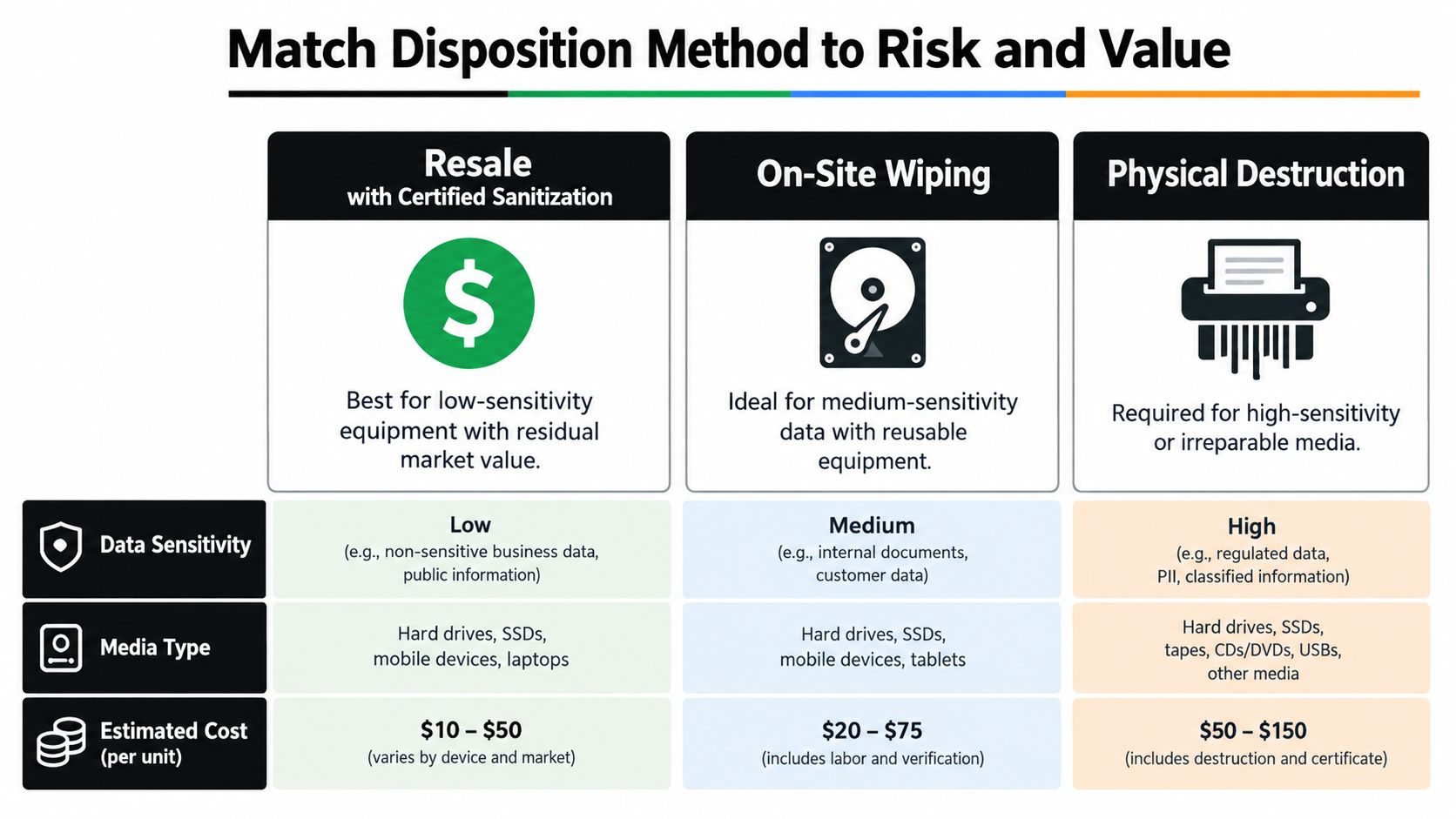
Physical destruction is not automatically the safest choice. It can be necessary, but destroying reusable equipment eliminates residual value and increases material processing. The correct decision depends on data sensitivity, media technology, equipment condition, reuse potential, and the required assurance level.
NIST defines three outcomes. Clear uses logical techniques across user-addressable storage locations and is intended to resist simple, non-invasive recovery attempts. Purge uses physical or logical techniques designed to make recovery infeasible with state-of-the-art laboratory methods while potentially preserving the media for reuse. Destroy makes recovery infeasible at that level and leaves the media unusable for storage. The definitions are detailed in NIST SP 800-88 Rev. 1.
Use a device-level decision matrix
| Disposition path | Appropriate when | Main control |
|---|---|---|
| Resale with certified sanitization | Equipment works, has residual value, and media can be reliably sanitized | Verified purge or another approved method, plus serialized records |
| On-site wiping | Reusable equipment contains medium-sensitivity data and can be processed in a controlled area | Approved tool, operator record, result, verification, and physical security |
| Physical destruction | Media is damaged, unreadable, highly sensitive, or cannot be reliably sanitized | Controlled destruction, exception record, and destruction certificate |
Cryptographic erase may be appropriate where the device and encryption architecture support it, but the decision must account for key management and the actual media technology. A failed drive, inaccessible flash storage, or media with areas that can't be reliably addressed should move to controlled destruction rather than a hopeful software wipe.
For an operational summary of the trade-offs between reuse and material processing, review refurbish or recycle options. The recommendation is straightforward: preserve equipment when secure sanitization is demonstrably effective, and destroy only when the information risk or media condition justifies losing reuse value.
Plan De-Installation, Pickup, and Chain of Custody
A pickup becomes risky when the equipment is removed before the receiving process is ready. Schedule the physical work around the inventory, disposition matrix, site-access requirements, and loading plan.
Prepare the site before the crew arrives
Tag each asset before pull. Match the tag to the serialized inventory and identify storage media that must be separated from ordinary scrap. For a server-room closure, confirm who will approve power-down, who will disconnect network and production interfaces, and which racks, cabinets, cable bundles, and accessories remain in place.
The work plan should define:
- Access: Dock availability, security clearance, escort requirements, operating hours, and elevator or doorway restrictions.
- Removal: Rack teardown, cabinet handling, palletization, packing, and protection of reusable equipment.
- Segregation: Data-bearing media, batteries, CRTs, mercury-containing items, and commodity material.
- Loading: Staged zones, pallet counts, serial checks, photographs where appropriate, and vehicle assignment.
- Handoff: Signatures or electronic confirmation at each transfer point.

Control every transfer
The chain-of-custody record should identify the releasing employee, receiving technician, date, location, asset or container reference, and next destination. Don't accept a generic bill of lading as the complete record for data-bearing equipment.
A controlled Atlanta pickup may involve de-installation, packing, loading, transportation, processing, and final disposition. Those stages need connected records, not separate documents that can't be reconciled. The chain-of-custody process for IT asset disposal should be clear before equipment leaves the plant.
If the vendor can't tell you who had the assets, when custody changed, and which serial numbers were processed, the program has a visibility gap.
Keep an exception lane for assets found during the pull. Stop and classify them rather than adding them to a pallet under an inaccurate category. That discipline prevents the common failure where a clean inventory is created after the pickup, when the most useful control opportunity has already passed.
Apply the FTC Disposal Rule and NIST Controls
The FTC Disposal Rule applies to businesses and individuals that use consumer reports for a business purpose, including service providers that maintain consumer-report information. Its standard requires disposal practices that are reasonable and appropriate to prevent unauthorized access or use. For electronic media, the FTC identifies destroying or erasing files so information can't be read or reconstructed, and it expects covered organizations to exercise due diligence when selecting a destruction contractor. The FTC disposal guidance for consumer report information explains that responsibility.
An Atlanta manufacturer may fall within this scope through HR records, applicant screening, customer accounts, financing activity, procurement records, vendor files, or outsourced services. The rule isn't limited to financial institutions. Its flexible standard requires attention to information sensitivity, disposal methods, costs and benefits, and changes in technology, as described in the FTC's Disposal Rule announcement.
Make sanitization auditable
For each data-bearing asset, record the selected method, media type, operator, date, tool and version, result, verification activity, and custody transfer. NIST recommends verification every time sanitization is applied, along with representative-sample verification by personnel who weren't involved in the original operation.
For supported ATA, SCSI, and solid-state interfaces, a full read of accessible addressable areas provides the highest practical non-laboratory assurance. Sampled media should include user-addressable and reserved areas, and a secondary verification tool from a different developer should be used for sampled media. The NIST 800-88 data destruction standards explanation provides a practical reference for program design.
Maintain exception records for unreadable or failed media. A recycling receipt doesn't prove that a drive was sanitized before downstream handling. If a device can't be read, can't be verified, or contains inaccessible areas that matter to the risk decision, route it to controlled physical destruction.
Organizations reviewing the broader controls around sensitive information can also consult this customer data protection guide. It provides useful context for connecting disposal decisions to wider data governance rather than treating retirement as an isolated warehouse task.
Recover Value and Verify Downstream Outcomes
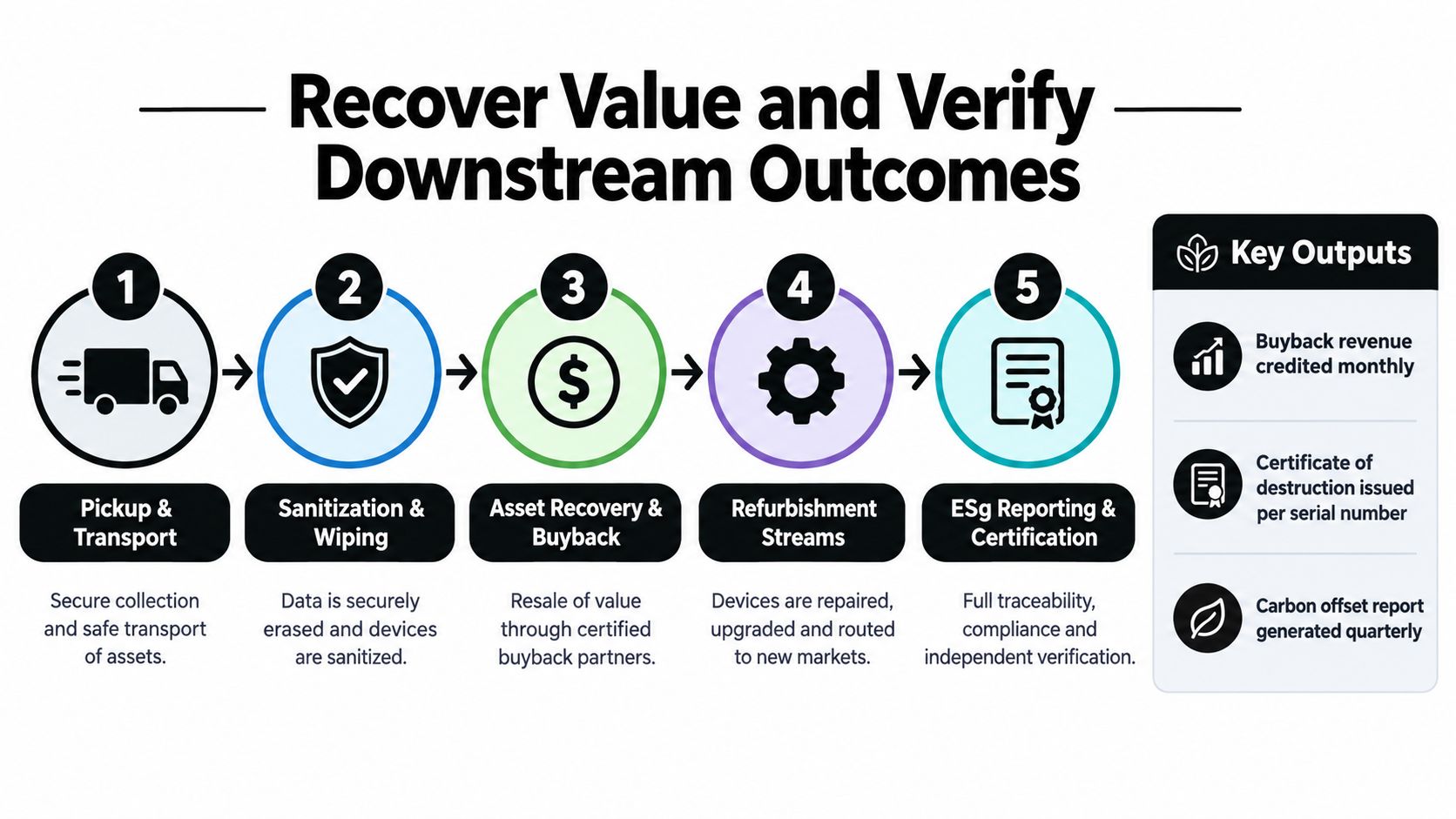
A disposition program has two outputs: controlled risk reduction and a defensible financial or environmental result. Treat them as one program, not two. Working laptops, servers, networking equipment, and compatible components can support IT asset recovery after sanitization. Scrap electronics follow a different path, where material identification, segregation, weight records, and downstream processing matter more than resale price.
Keep recovery streams separate
Never mix reusable equipment with commodity scrap. A resale stream needs condition grading, serial tracking, functional evaluation, secure sanitization, and a documented value calculation. A recycling stream needs material segregation, safe handling, weight evidence, and destination reporting. When a vendor quotes one blended price per pallet, you lose the ability to audit either stream, and that is exactly where recovery dollars disappear.
As noted earlier, the Global E-waste Monitor estimates roughly $62 billion in recoverable natural-resource value was left unaccounted for through improperly managed e-waste. For a plant leader, the practical lesson is simple: disposal and value recovery should be planned together, because sloppy handling destroys recoverable value before anyone counts it.
Demand proof beyond the pickup
A truck leaving your dock proves nothing. Put these questions to the downstream provider before you sign:
- Certification: Which independent certification applies to the facility, and which activities it covers?
- Destination: Where do batteries, CRTs, mercury-bearing equipment, and damaged lithium-ion cells go?
- Evidence: Can the provider supply weight tickets, processing records, and destination reporting?
- Exceptions: How are unverified, damaged, or rejected items isolated and documented?
- Closeout: Do certificates identify serial numbers, or only broad equipment categories?
EPA's electronics information and initiatives page encourages recyclers to obtain certification through independent third-party auditing and discusses tools for tracking generation and material flows. Review the EPA electronics and battery management guidance when you evaluate downstream claims, and treat uncertified answers as a reason to walk away.
"Recycled" is not a sufficient closeout description. Your records should distinguish equipment reused, resold, destroyed, recycled, or managed through a specialized stream. That separation keeps ESG reporting honest and protects you when an auditor asks where a specific asset ended up.
Reporting, KPIs, and Choosing Your Atlanta ITAD Partner
Your procurement and operations teams need a scorecard that measures control, not just truck speed. Track weight recovered, reuse versus recycling outcomes, certificates issued, audit findings, environmental reporting, and recovery dollars returned. For data-bearing equipment, reconcile certificates to the serialized inventory.
Score the provider before signing
Use these questions:
- Controls: Can the provider show its sanitization methods, verification process, and exception handling?
- Documentation: Will certificates identify the relevant serial numbers and final disposition?
- Physical capability: Can the team handle de-installation, on-site shredding when required, packing, palletizing, and secure transport?
- Downstream assurance: Does the contract preserve audit rights and identify responsible downstream vendors?
- Risk transfer: Are insurance coverage, incident procedures, and custody responsibilities clear?
- Regional execution: Can the provider support Atlanta-area access requirements and coordinate broader organizational pickups?
- Commercial recovery: Does the value calculation distinguish reusable assets from scrap and explain deductions?
Beyond Surplus provides commercial electronics recycling, IT equipment disposal, secure data wiping, hard-drive shredding, product destruction, data-center de-installation, logistics coordination, certificates of recycling, and certificates of data destruction for business customers. Treat those services as part of a scoped control plan, not as a substitute for your own asset inventory and approval process.
For an Atlanta manufacturer, the right partner can walk the site, classify mixed IT and operational technology, establish the disposition matrix, and produce a closeout package that procurement, security, facilities, and auditors can understand.
Beyond Surplus can help Atlanta manufacturers and industrial facilities inventory mixed IT and operational-technology assets, coordinate de-installation and pickup, sanitize or destroy data-bearing media, and document recycling and recovery outcomes. Visit Beyond Surplus to request a commercial ITAD and electronics recycling assessment for your facility.


