

The decommissioning crew has left the pallets in the corridor. Routers, switches, firewalls, wireless controllers, and servers are powered down, but storage media may still be inside. Treating that pile as scrap is how companies lose data, surrender resale value, and struggle to explain what happened during an audit.
A defensible network equipment recycling program follows four phases: identify every asset, sanitize storage, choose the highest-value safe disposition, and verify the downstream result. The process applies to enterprise infrastructure, data center decommissioning, secure e-waste management, and electronic waste pickup for commercial sites.
Table of Contents
- Why Network Equipment Recycling Deserves Real Attention
- Building the Inventory and Chain-of-Custody Foundation
- Choosing the Right Sanitization Method for Every Device
- Matching Each Asset to the Right Disposition Path
- Verifying What Actually Happens After Pickup
- Picking a Vendor and Running the Handoff
- Frequently Asked Questions About Network Equipment Recycling
- How often should chain-of-custody records be reconciled?
- What should we do when encryption keys can't be verified?
- Is refurbishment realistic for firewalls and core switches?
- How should we handle export-controlled software?
- What happens if the equipment is under a litigation hold?
- What should the final file contain?
Why Network Equipment Recycling Deserves Real Attention
A decommissioned network room can hold more than obsolete hardware. Routers, switches, access points, modems, and related equipment may contain removable drives or embedded flash, while still carrying resale or reuse value. Treating every device as scrap creates avoidable data, financial, regulatory, and environmental risk.
In 2022, the world generated approximately 62 billion kilograms of electronic waste, or 7.8 kilograms per person. Small information-technology and telecommunications equipment accounted for approximately 4.6 billion kilograms, yet only about 22% was documented as formally collected and recycled in an environmentally sound manner, according to the International Telecommunication Union's e-waste overview.
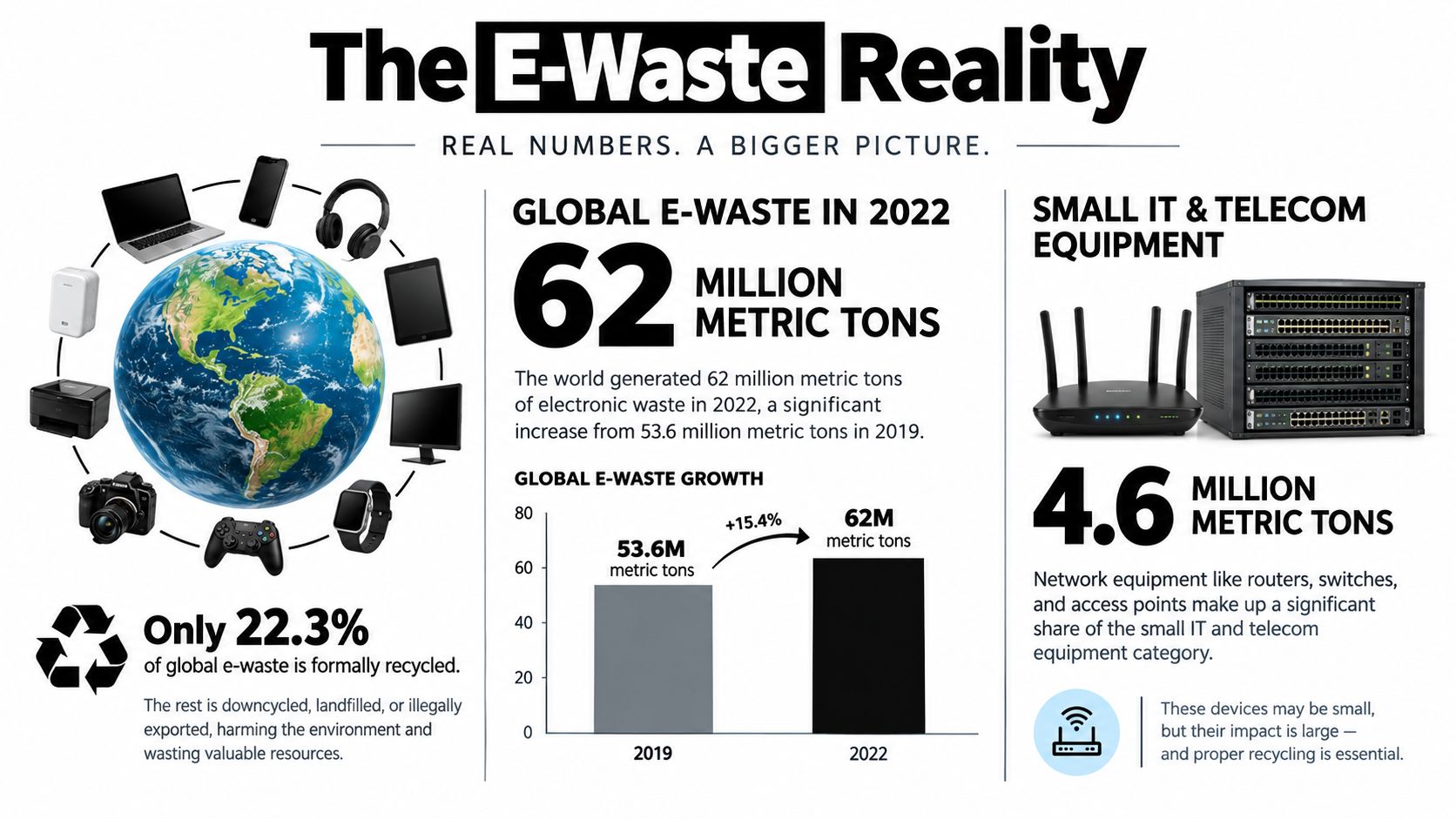
The practical risks are clear. Unidentified storage can expose information. Weak disposal controls can create regulatory exposure, including obligations under the FTC Disposal Rule, which requires reasonable practices to prevent unauthorized access to covered information. Sending reusable equipment directly to shredding destroys recoverable value. Poor downstream oversight can also leave the company unable to prove responsible environmental handling.
The scale of the problem makes recycling a procurement and governance decision, not a janitorial task. Between 2010 and 2022, global e-waste generation nearly doubled, while documented formal collection and recycling lagged substantially, by a factor of almost five, as reported in the Global E-waste Monitor 2024 publication.
Use a value-and-risk hierarchy: identify the asset, protect its data, test whether reuse is safe, then document the final path. A device remains a data-bearing business asset until storage is identified, sanitized, and recorded.
For replacement, migration, or network-room work, Indiana IT networking expertise can support practical planning. Record the environmental objective with the security objective, including through Beyond Surplus environmental impact reduction services.
Building the Inventory and Chain-of-Custody Foundation
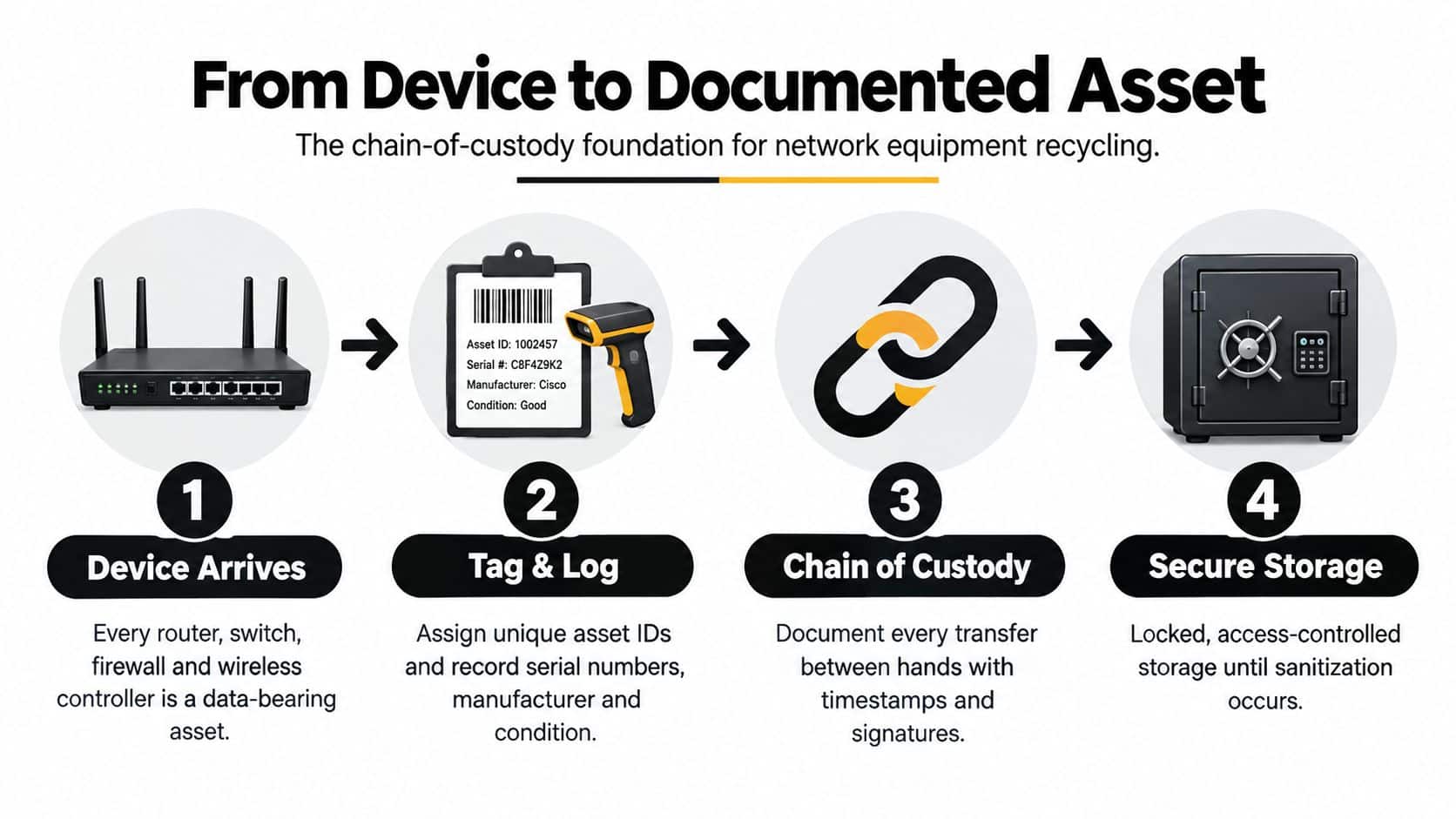
The recycler's truck is not the control point. Your control point is the record created before pickup. Photograph the front, rear, asset tag, serial label, removable media, and visible damage while each device remains under your control.
Create one row for every physical asset. Record:
- Asset identity: Manufacturer, model, serial number, internal asset ID, and device family.
- Technical state: Firmware version, storage type, removable media, condition, and functional status.
- Ownership details: Site, room or rack, current custodian, business owner, and transfer date.
- Disposition intent: Reuse, refurbishment, parts harvesting, material recovery, or destruction.
- Security status: Sanitization method, operator, verification result, exception record, and release authorization.
Build the record before the handoff
A practical spreadsheet can include asset ID, serial number, model, storage medium, firmware, location, custodian, photograph reference, intended path, sanitization status, transfer timestamp, receiving scan, final disposition, and certificate reference. Keep the asset identifier attached to the hardware and carry it into every transfer, processing record, and final certificate.
Isolate removable drives from the chassis and track them separately. Embedded flash deserves the same treatment, even when the device offers a factory reset. Record exceptions rather than allowing a missing field to disappear into a vendor's bulk manifest.
The small IT and telecommunications category reached approximately 4.6 billion kilograms in 2022. Formal collection performance also differs sharply across markets. Europe recorded 42.8%, the Americas 30.0%, Asia 11.8%, and Africa 0.7% in documented collection and recycling rates. A multinational company should not assume that one vendor label represents consistent local control.
For migration or replacement work, a practical migration guide for IT leaders can help connect infrastructure changes with operational ownership. Require the chain-of-custody file to show pickup, receiving, locked storage, processing, and final disposition. The Beyond Surplus chain-of-custody approach demonstrates the documentation a commercial ITAD provider should be able to supply. If the vendor cannot produce those records, do not release the equipment.
Choosing the Right Sanitization Method for Every Device
NIST SP 800-88 gives disposal teams three distinct outcomes. Clear uses logical techniques intended to protect against simple, non-invasive recovery attempts. Purge uses logical or physical techniques intended to make recovery infeasible with state-of-the-art laboratory methods while potentially preserving the medium. Destroy makes recovery infeasible and prevents the medium from being reused for data storage.
The decision depends on the medium, data sensitivity, device behavior, and intended disposition. A modern firewall with supported sanitization functions may qualify for purge if the operation is appropriate and verified. A router with embedded flash on a deprecated platform may require destruction when the organization can't prove that all addressable and reserved areas were sanitized.
Match method to evidence
Encryption isn't a shortcut. Cryptographic sanitization requires documented confidence that the encryption architecture and key history were valid. NIST guidance notes that sensitive data must not have been stored in plaintext before encryption keys were established, and it identifies a minimum cryptographic-key length of 128 bits for the relevant implementation. Organizations should validate key-management records rather than assuming that encryption enabled at retirement proves sanitization. The NIST guidance on SP 800-88 provides a useful operational reference for this control.
After sanitization, verify the result. NIST recommends verification whenever practical and representative sampling, including pseudorandom checks distributed across user-addressable and reserved areas. For a sample, two non-overlapping checks in each subsection should collectively cover at least 10% of the relevant media, with secondary verification performed by a different tool from a separate developer and a full check of the selected sample.
Don't release a batch because its average result looks acceptable. Each individually sanitized device should meet a 100% pass-rate release criterion. The technician can perform the operation, while a second authorized person reviews logs, exceptions, and sample results before resale, reuse, or material recovery.
Failed or unsupported media should move to physical destruction, with the destruction record tied to the serial number. A generic certificate that says “drives destroyed” without asset-level identifiers won't protect the organization when an auditor asks which device contained which data.
Matching Each Asset to the Right Disposition Path
Shredding everything is easy to administer and often poor business practice. Use a value-and-risk hierarchy that preserves reuse where the evidence supports it.
Start with tested reuse or refurbishment. A switch that passes functional testing, has a supported firmware path, and can be legally transferred may retain operational or resale value. Next consider parts harvesting for supported product families. Proprietary modules, power supplies, optics, and chassis components can be useful when complete units aren't commercially viable.
Material recovery comes after those options. Send non-reusable assets to an independently audited electronics recycler with documented downstream controls. Reserve destruction for devices or media that can't be reliably sanitized, can't be transferred legally, or present unacceptable residual risk.
Use measurable gates
Track three gates by device family and lot:
- Functional-test yield: Which units passed testing and what faults were found?
- Sanitization pass rate: Which devices completed the approved method without exceptions?
- Downstream accountability: Can the vendor connect each serial number to reuse, dismantling, commodity recovery, or destruction?
Keep tested inventory separate from untested inventory. Firmware locks, missing licenses, obsolete interfaces, and proprietary components can reduce recovery value without being obvious during a visual inspection. Batteries and hazardous components also need separate handling where applicable.
| Asset Family | Recommended Path | Required Gate |
|---|---|---|
| Routers and switches | Tested reuse, refurbishment, or material recovery | Functional test, sanitization record, serial reconciliation |
| Firewalls and controllers | Refurbishment when licensing and firmware permit, otherwise recovery or destruction | License review, supported reset method, verification |
| Servers and storage appliances | Reuse or refurbishment after media sanitization | Media inventory, approved sanitization, independent validation |
| Wireless access points | Reuse or parts harvesting | Configuration removal, functional test, downstream record |
| Unsupported or failed devices | Material recovery or destruction | Exception record and asset-linked final certificate |
Organizations handling storage-heavy infrastructure should define the path for storage and network equipment before the vendor arrives. The decision should account for data risk, support status, software licensing, spare-parts availability, embodied value, and legal transfer restrictions.
Verifying What Actually Happens After Pickup
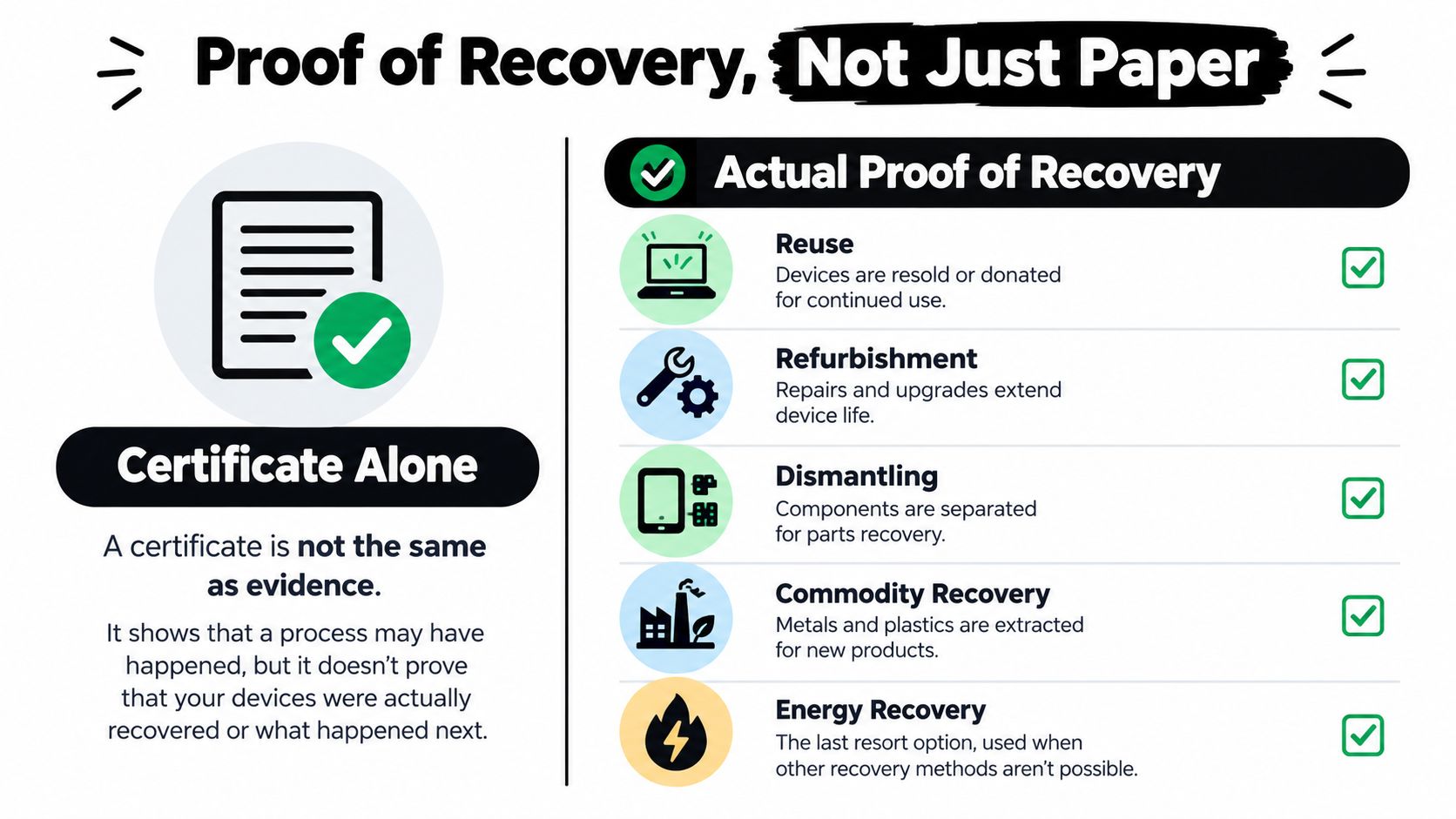
A certificate of recycling proves that a vendor issued a document. It doesn't automatically prove that materials were recovered. Buyers need to distinguish reuse, refurbishment, dismantling, commodity recovery, energy recovery, and landfill because each outcome carries a different environmental and commercial meaning.
Vodafone reports that the share of network-equipment e-waste ultimately recycled, and the amount of material recovered, isn't consistently available across its markets. Where data was available, only 80% to 94% of material sent to recyclers was reported as ultimately processed for material recovery, as described in its network equipment reporting. That distinction matters. “Sent to recycler” is a handoff metric, not a recovery metric.
Ask what the vendor can prove
Require answers to these questions before awarding the work:
- Outcome definition: Does the report distinguish reuse, refurbishment, dismantling, commodity recovery, energy recovery, and landfill?
- Measurement basis: Are outcomes tracked by weight, asset count, market value, or a combination?
- Downstream evidence: Can the vendor provide processor records, recovery yields, and certificates tied to your lot?
- Export controls: Where does material travel, and what controls prevent unauthorized export?
- Reconciliation: Can the vendor reconcile 100% of serial numbers from pickup through final disposition?
- Exceptions: How are missing assets, failed drives, damaged labels, and unsupported media reported?
Infrastructure limitations remain a real obstacle. An Analysys Mason survey of 31 operators worldwide identified limited recycling and repurposing infrastructure as a significant barrier to waste-reduction goals, according to the Vodafone report. A vendor that gives vague answers about what happens after the truck leaves is showing you the precise point where accountability ends.
Picking a Vendor and Running the Handoff
Vendor selection should start with evidence, not a glossy sustainability page. Ask for current R2v3 or e-Stewards documentation where relevant, data-destruction qualifications such as NAID AAA when required by your policy, insurance certificates, downstream-audit records, and sample serialized certificates.
The contract should define the controls in plain language:
- Asset-level records: Destruction and recycling certificates must identify serial numbers or unique asset IDs.
- Audit rights: Your organization can review processing records and downstream documentation.
- Export restrictions: The agreement defines destinations and prohibits unauthorized export to non-OECD economies where that restriction applies to your program.
- Liability transfer: The contract states when custody and responsibility transfer, and what happens after a discrepancy.
- Exception handling: Failed sanitization, missing assets, damaged labels, and rejected equipment require written escalation.
Use a controlled handoff
A workable sequence is straightforward:
- Approve the scope, asset list, pricing, disposition assumptions, and security requirements.
- Freeze the inventory and photograph equipment before pickup.
- Scan assets at collection and obtain a signed transfer record.
- Require receiving scans and locked storage confirmation.
- Review sanitization logs and exceptions before release.
- Receive serialized destruction, recycling, resale, or reuse records.
- Reconcile the final package against the original inventory.
Don't accept a generic “all equipment recycled” statement. The Beyond Surplus vendor due diligence checklist can help procurement teams structure questions around certifications, insurance, downstream management, and documentation. The same discipline applies whether the project involves a small network closet, a data center decommissioning program, medical equipment disposal, laboratory equipment disposal, laptop disposal, or product destruction.
Frequently Asked Questions About Network Equipment Recycling
How often should chain-of-custody records be reconciled?
Reconcile at every custody event, not only at project close. Compare the pickup list with collection scans, receiving scans, processing records, and final certificates. Investigate discrepancies immediately while the vendor can still locate the physical asset and the personnel involved.
What should we do when encryption keys can't be verified?
Don't treat the device as sanitized. Isolate the media, document the failed verification, and choose purge or destroy based on the data sensitivity and the device's technical capabilities. If the device can't support a defensible operation, physical destruction is the safer release decision.
Is refurbishment realistic for firewalls and core switches?
Sometimes, but only after technical and commercial checks. Confirm that the hardware passes functional testing, firmware remains usable, licenses can be transferred, configuration data has been removed, and the receiving environment supports the platform. A device that powers on may still be unsuitable for reuse.
How should we handle export-controlled software?
Flag the equipment before pickup and identify software, encryption, ownership, and destination restrictions. Require the vendor to document the approved destination and disposition route. Don't allow resale or export while legal review remains unresolved.
What happens if the equipment is under a litigation hold?
Stop disposition and preserve the affected devices, records, configurations, and custody evidence. The recycling schedule can't override a legal hold. Release the assets only after the responsible legal or compliance authority documents the decision.
What should the final file contain?
Keep the approved inventory, photographs, transfer records, sanitization logs, verification results, exception reports, downstream evidence, and serialized final certificates. A complete file should let an independent reviewer trace each asset from the rack to its final outcome.
Beyond Surplus provides commercial electronics recycling, secure data destruction, IT equipment disposal, IT asset recovery, product destruction, and data center de-installation services with chain-of-custody documentation for business customers. If you're retiring routers, switches, firewalls, servers, or other network infrastructure, visit Beyond Surplus to discuss pickup, sanitization, recovery, and audit-ready disposition records.


