

A half-stripped rack in a colocation cage can look harmless after the production cutover. Three SAN switches, two controller heads, and fourteen shelves of spinning disks may have been unpowered for nine months, yet they still represent a concentrated security, compliance, logistics, and financial decision. Treating that equipment as ordinary scrap is how organizations lose track of data-bearing components, active credentials, recoverable value, and the evidence needed to defend the disposal process.
Storage and network equipment needs a procurement-grade exit plan. The correct approach connects each component to a sanitization or destruction method, a defensible certificate, and a realistic recovery path. That framework applies to enterprise data centers, healthcare facilities, financial institutions, manufacturers, schools, government agencies, and any organization retiring shared infrastructure.
Table of Contents
- Why Storage and Network Equipment Is a High-Risk Asset Class
- Core Categories of Enterprise Storage and Network Hardware
- Data Security and Regulatory Exposure at End of Life
- On-Site vs Off-Site Data Destruction Compared
- Chain of Custody and Certificate Documentation
- Value Recovery Options Including IT Buyback
- How Beyond Surplus Supports Each Lifecycle Stage
Why Storage and Network Equipment Is a High-Risk Asset Class
The first problem in a rack like this isn't weight or transportation. It's uncertainty. Nobody may remember whether the shelves held production volumes, replicated snapshots, test data, or dormant backups. A quick inventory can identify model numbers, but it can't prove that every logical volume disappeared before the hardware was parked.
Storage arrays concentrate information from many endpoints. A single disk group can contain databases, virtual machines, user shares, application logs, and backup catalogs. Controller heads may retain volume metadata, replication credentials, cache contents, or configuration databases independently of the drives that users see. Network equipment creates a different exposure. A retired switch or SAN director may retain management-plane credentials, hashed passwords, event logs, topology information, and zoning maps that reveal how production hosts connect.
Practical rule: If a component can remember a configuration, cache a transaction, or authenticate to another system, track it as a data-bearing asset.
Three failure modes appear repeatedly during decommissioning:
- Latent volumes: A quick format or reimage can leave addressable sectors, snapshots, hidden partitions, or failed-drive remnants behind. Storage performance testing also varies by protocol, workload, latency, and test method, so a disposal team shouldn't assume that a device's visible state represents every retained data area. Enterprise Storage Forum's benchmarking guidance explains why the full stack matters when evaluating storage behavior.
- Active management access: A switch can leave local accounts, certificates, keys, or configuration flash intact after its ports are disconnected. Removing a device from monitoring doesn't sanitize its management plane.
- Exposed fabric knowledge: Fibre Channel zoning maps can identify production hosts, storage targets, and trust relationships even when the data volumes themselves aren't mounted.
Organizations often exclude SAN shelves, HBAs, NICs, switches, and controller modules from standard laptop-focused ITAD workflows. That gap creates the risk. A clear process should identify the equipment, determine where data or credentials reside, choose clear, purge, or destroy based on the media, and preserve serial-level evidence through final disposition. Guidance on the data security risks of improper computer disposal is relevant here, but storage fabrics require an even more granular inventory.
Core Categories of Enterprise Storage and Network Hardware
Think of enterprise storage as the warehouse and the network as the road system. The warehouse holds blocks, files, objects, backups, or metadata. The road system moves requests between hosts, users, applications, and storage targets. Both sides can retain sensitive information, and neither should be reduced to the visible disk pack.
Storage equipment
Block arrays present logical volumes to servers. The array may include disk shelves, SSD tiers, controller cache, management modules, and replication metadata. File appliances manage shared directories and permissions, while object platforms organize data through object identifiers and metadata rather than traditional drive letters.
Tape libraries add a separate concern. Cartridges are removable media, but robotics, inventory databases, barcode records, and management interfaces can still reveal backup architecture. Hyperconverged nodes combine compute, memory, local storage, and network interfaces, so the node must be assessed as a group rather than as a server with detachable drives.
Network equipment
The network side includes top-of-rack and spine-leaf switches, routers, firewalls, SAN directors, HBAs, and NICs. These devices don't usually hold the same volume of user content as an array, but their configuration can expose credentials, routes, VLANs, access-control rules, zoning, certificates, and host relationships.
Modern storage fabrics also depend on congestion control, buffering, and traffic isolation. Validation targets such as 100GbE minimum throughput per port and sub-10 microsecond latency are used for demanding AI and storage workloads, which makes the network fabric a critical design layer rather than a passive accessory. HPE Aruba's lossless Ethernet design guidance describes why shared fabrics need deliberate handling of congestion and buffering.
| Category | Typical Examples | Data or Credentials Held | Highest-Risk Component |
|---|---|---|---|
| Block storage | SAN arrays, RAID shelves, SSD tiers | Volumes, snapshots, replication data | Drives and controller cache |
| File storage | NAS appliances, file servers | Files, permissions, directory metadata | Disks and metadata databases |
| Object storage | Object nodes, storage clusters | Objects, indexes, access keys | Drives and cluster metadata |
| Backup storage | Tape libraries, disk backup appliances | Copies of production data, catalogs | Cartridges and backup disks |
| Network fabric | SAN directors, Fibre Channel switches | Zoning, host mappings, credentials | Configuration flash |
| IP network | ToR switches, routers, firewalls | Routes, ACLs, certificates, logs | Management storage |
| Host connectivity | HBAs, NICs, mezzanine cards | Firmware settings, identifiers, cached state | Non-volatile memory |
Track controllers, cache modules, HBAs, switch supervisors, and removable flash separately from the main chassis. The enterprise warehouse server and networking equipment recycling service should be evaluated against that component-level inventory, not just a pallet count.
Data Security and Regulatory Exposure at End of Life
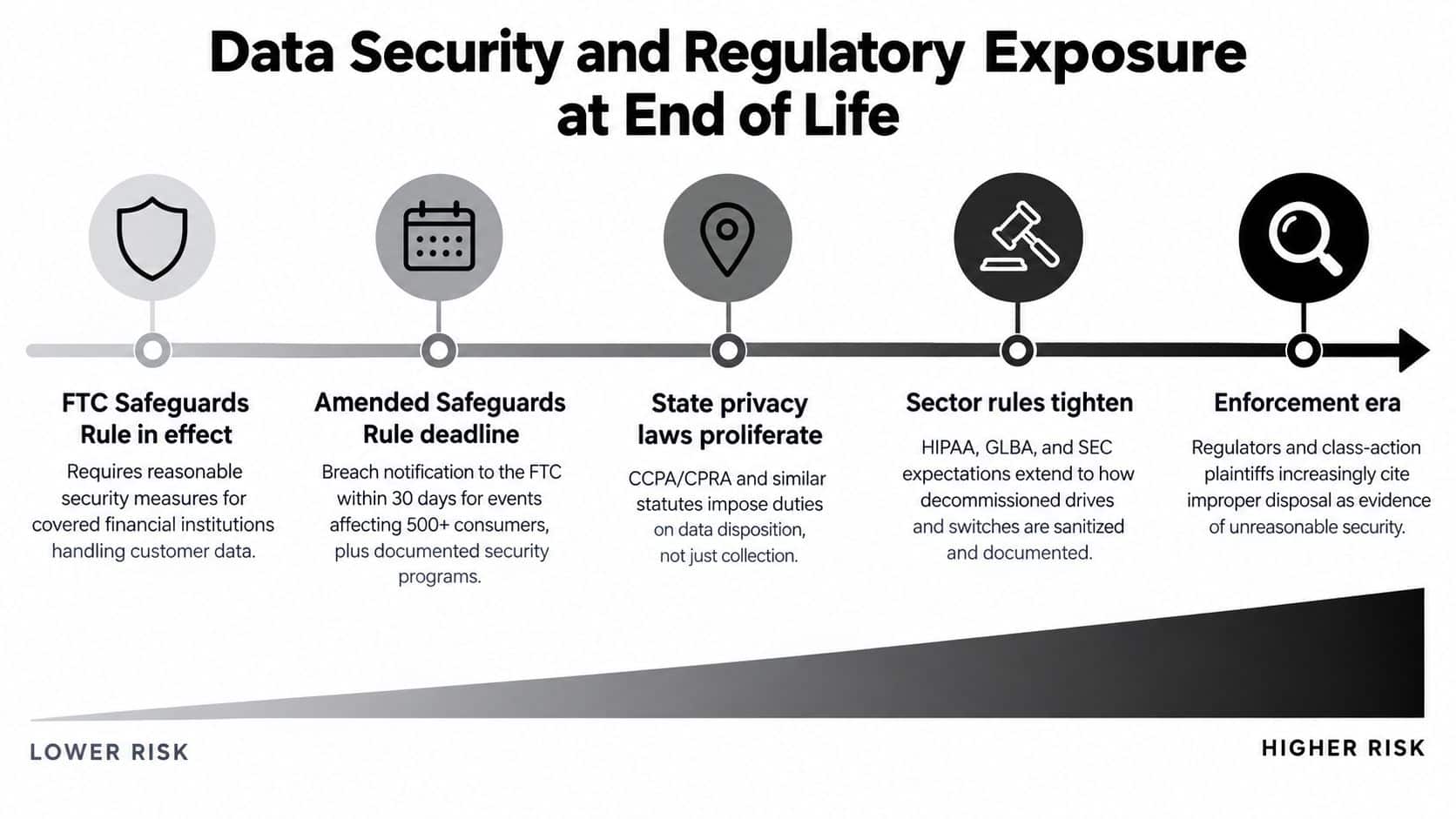
The FTC Disposal Rule took effect on June 1, 2005. It requires covered businesses to use reasonable measures when disposing of consumer report information so it can't be read or reconstructed. The FTC lists burning, pulverizing, shredding, destroying, or erasing electronic files or media as examples of acceptable controls in its disposal guidance for consumer report information.
That requirement doesn't turn every retirement into a single prescribed technique. It does require an organization to choose a reasonable control for the media and the risk, then demonstrate that the control was completed. A wipe suitable for a healthy spinning disk may not address failed sectors, SSD overprovisioning, flash-backed cache, or a controller's internal storage. Canada's cyber center identifies crushing, shredding, and disintegration as common secure-destruction methods for electronic devices in its sanitization and disposal guidance.
Match the control to the media
For a functioning hard drive, a validated purge process may be appropriate when the organization can verify coverage and retain the result. For SSDs and flash-backed components, firmware behavior, overprovisioning, wear-leveling, and inaccessible cells can complicate logical erasure. Physical destruction is often the cleaner audit outcome when the device is failed, encryption status is unknown, legal requirements are strict, or the organization can't validate every storage area.
The same logic applies to network hardware. A switch image may retain hashed credentials. A SAN controller may hold volume metadata and replication keys. A chassis pulled for refresh may never have had its management plane reset. The NIST 800-88 data destruction standards overview can help teams distinguish a documented clear, purge, or destroy decision instead of accepting a generic “wiped” statement.
On-Site vs Off-Site Data Destruction Compared
On-site destruction keeps the media inside the controlled facility until the destruction event is complete. A mobile team can remove drives, record serials, place them in tamper-evident containers, and shred or degauss them under site supervision. This model reduces transport exposure and suits customer contracts, legal holds, classified environments, or policies that prohibit movement of unprocessed media.
Off-site destruction moves equipment to a vetted processing facility. That option can simplify large batches of SAN shelves, controller heads, and switch chassis, especially when the equipment is already encrypted and the risk model accepts controlled transport. It may also reduce the amount of specialized equipment and staff time required inside a colocation cage.
| Factor | On-Site Destruction | Off-Site Destruction |
|---|---|---|
| Physical security | Media stays under site control | Requires sealed transport and verified handoffs |
| Downtime | Destruction can occur during the decommissioning visit | Site work may finish faster, but transport follows |
| Logistics | Needs space, power, and mobile equipment | Facility handles batch processing and equipment flow |
| Audit evidence | Witnessed event can strengthen the record | Facility controls serialized intake and processing records |
| Cost at scale | Can be efficient for sensitive, compact batches | Often practical for large mixed equipment loads |
A hybrid plan often works well. Wipe healthy encrypted drives on-site when the technical evidence is strong, then send failed drives and uncertain flash media for witnessed destruction. The decision should follow the highest-risk component, not the average condition of the pallet.
Before booking either model, ask who removes the media, how serials are captured, whether the vehicle or container is secured, who signs each handoff, what destruction method is used, and whether the certificate lists individual serial numbers. This comparison of on-site and off-site ITAD services provides useful questions for evaluating the operational trade-off.
Chain of Custody and Certificate Documentation
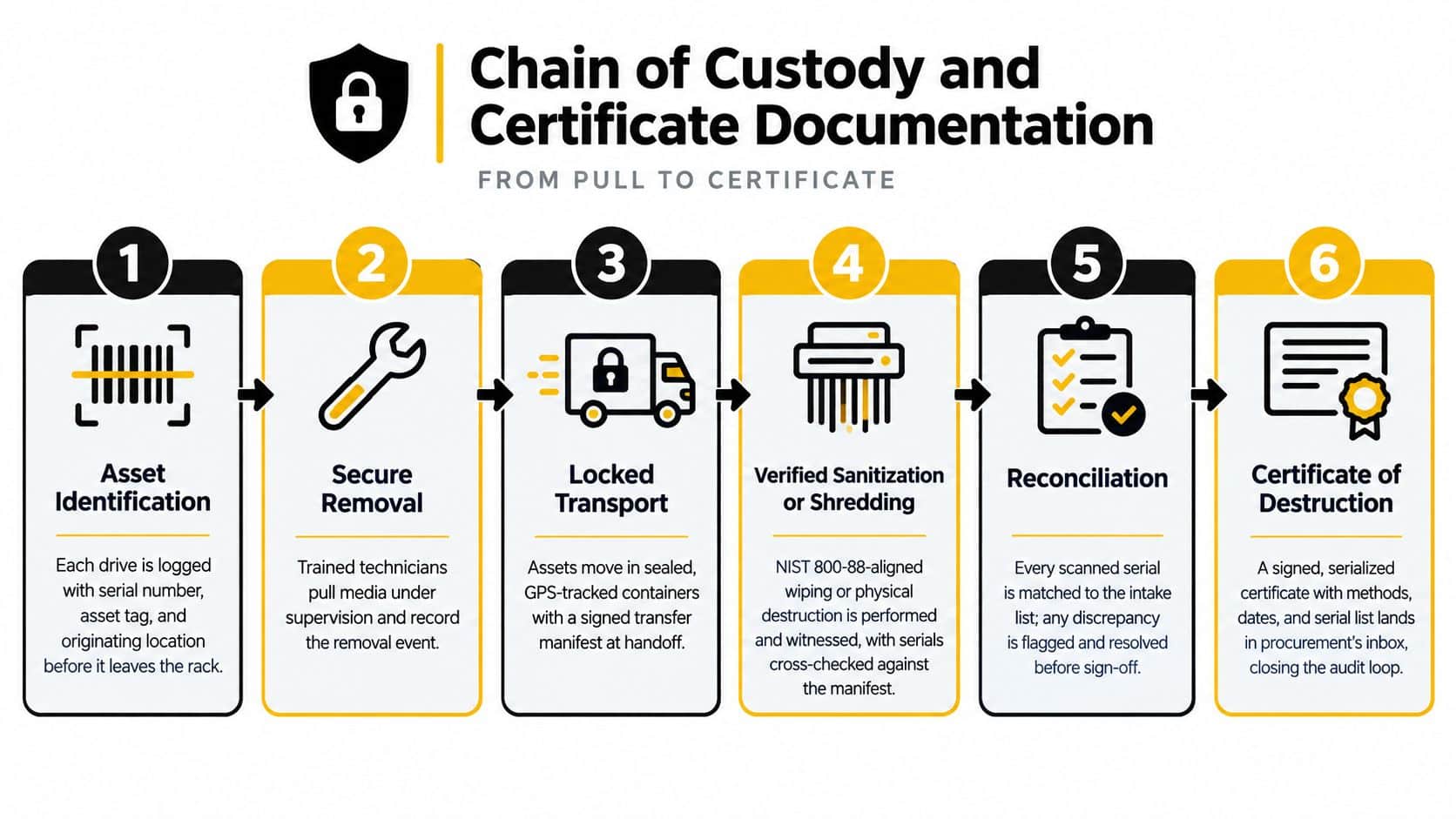
A defensible chain of custody starts before a truck arrives. The project owner should export the asset list, identify every drive and removable module, and reconcile the list against the rack, shelf, and controller configuration. Serial-number capture at the rack matters because a model-level count can't prove what happened to a particular disk later.
Build evidence at every handoff
- Identify the asset. Record serial number, asset tag, rack position, shelf position, and originating system.
- Remove it under control. A trained technician logs the removal event and separates drives, controllers, cache cards, and flash modules that need individual treatment.
- Seal the load. Use tamper-evident bags, locked containers, or sealed pallets. The manifest should name the releasing person and the receiving person.
- Verify transport. A named driver should present identification, and the transfer record should capture vehicle details, departure, arrival, and any seal discrepancy. GPS tracking adds useful corroboration for mobile assets.
- Reconcile at intake. The receiving facility should scan or verify serials, confirm weights or package counts, and stop processing if the intake list doesn't match.
- Witness destruction or sanitization. Cross-check serials while the technician performs the approved wipe, purge, shredding, crushing, or disintegration method.
The certificate is the legal and operational record of the final event, not a courtesy receipt. It should identify the customer, processing date, method used, applicable media-sanitization category, serial list, technician or witness signature, and timestamp. If a downstream auditor asks whether a particular drive left the rack, arrived at the facility, and received the stated treatment, the certificate and transfer records should answer without relying on memory.
Audit test: A certificate that says “one pallet of electronics destroyed” may confirm a service transaction, but it doesn't necessarily reconcile the individual media assets that created the risk.
Keep the asset list, signed manifests, seal records, processing logs, exception notes, and final certificate together. A practical explanation of chain of custody shows why each transfer protects the enterprise from an undocumented gap.
Value Recovery Options Including IT Buyback
Retired storage and network equipment isn't automatically worthless. The correct value decision comes after security classification, functional testing, firmware review, support-status review, and serial-level inventory. Resale should never outrank a destruction obligation, but a secure process can preserve value where the risk is controlled.
Four realistic disposition paths
Internal redeployment usually offers the simplest operational value. A switch, HBA, or storage shelf may support a lab, disaster-recovery environment, or non-production workload if firmware, compatibility, and support conditions are acceptable. Redeployment still requires sanitization before reassignment, especially when the equipment came from a shared production fabric.
IT buyback fits current-generation SSDs, recent switches, routers, firewalls, and supported storage units. Buyers generally need condition, tested functionality, configuration status, serials, firmware information, and support-contract details. A device that powers on but can't pass port, cache, fan, or controller tests won't receive the same treatment as verified working equipment.
Parts harvesting can recover controllers, power supplies, fans, optics, rails, cache modules, and other serviceable components. It becomes more attractive when a chassis has no practical resale market but several modules remain usable.
Certified recycling is the right destination for failed drives, unsupported chassis, damaged media, mixed loads with uncertain provenance, and equipment whose reputational risk exceeds its residual value. Circular recovery can include direct HDD reuse, magnet-assembly reuse, magnet-to-magnet recycling, and rare-earth-element recovery, as described in the global electronics circular-economy report.
| Asset Category | Typical Resale Value | Recommended Path |
|---|---|---|
| Current enterprise SSDs | Meaningful when tested and sanitized | Buyback or redeployment |
| Recent ToR switches | Stronger when supported and fully functional | Buyback |
| Routers and firewalls | Dependent on firmware and license status | Buyback or parts recovery |
| Older SAN shelves | Often limited by support and drive condition | Parts recovery or recycling |
| Failed HDDs and SSDs | No responsible resale before destruction | Physical destruction and recycling |
| Unsupported chassis | Usually constrained by serviceability | Parts harvesting or recycling |
| HBAs and NICs | Useful when compatible and tested | Redeployment or buyback |
Bundled lots are often quoted as a group rather than priced line by line, particularly when a shipment combines switches, shelves, drives, optics, and accessories. Ask for the assumptions behind the quote, including whether data destruction, testing, freight, and recycling are included. A high offer that depends on unverified resale can create more risk than a transparent recovery plan.
How Beyond Surplus Supports Each Lifecycle Stage
A sound Storage & Network Equipment disposition program connects inventory, security, transportation, recovery, and reporting in one controlled workflow. The service provider should be able to distinguish a disk shelf from its drives, a switch chassis from its supervisor module, and a working router from a unit that only powers on.
From rack inventory to final report
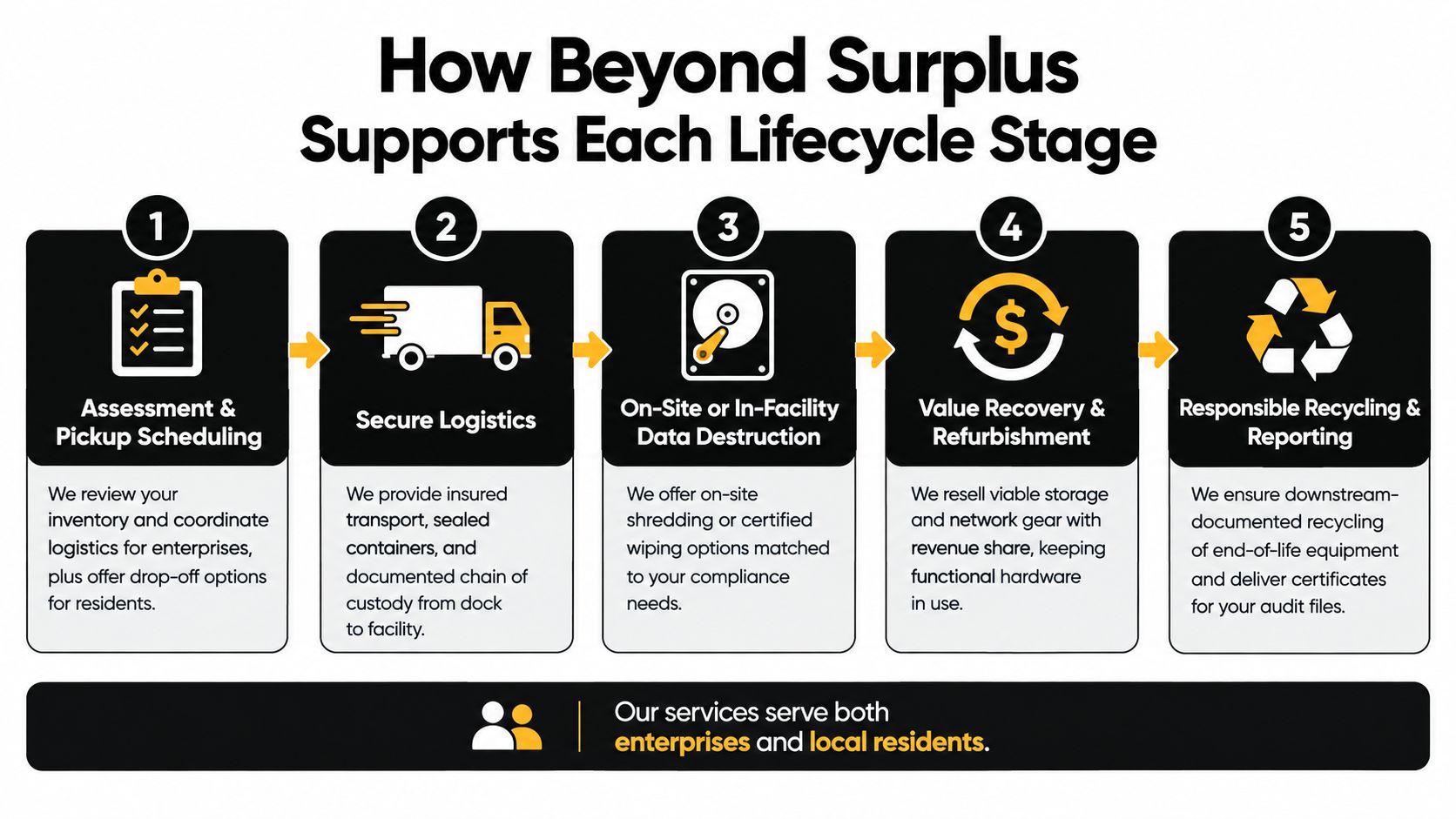
The intake begins with an equipment review and pickup plan. Asset tags, serial numbers, rack locations, drive counts, controller details, and requested disposition outcomes should be captured before removal. That preparation lets the project team separate items for certified wiping, on-site shredding, off-site destruction, buyback testing, redeployment, and recycling.
Secure logistics then preserves the record. Sealed containers, documented transfer manifests, controlled pickup, and GPS-tracked transport reduce uncertainty between the data center dock and the processing location. The provider should flag missing serials, damaged seals, or equipment that doesn't match the approved scope rather than hiding discrepancies.
Data destruction follows the media decision. Healthy devices may receive certified wiping where the organization can validate the result. Failed or uncertain drives, flash modules, and cache components may require physical destruction. Certificates of data destruction and recycling should identify the work performed and support the customer's audit file.
Beyond Surplus provides enterprise IT asset disposition services that include data center de-installations, secure data destruction, IT equipment disposal, electronics recycling, logistics coordination, and IT buyback for eligible storage and networking hardware. Its program can evaluate working equipment for recovery while directing end-of-life media through documented destruction and recycling channels. Organizations should confirm the exact service scope, certificate fields, transport arrangements, and processing method before scheduling a project.
Procurement checkpoint: Require the proposal to separate security services, logistics, recovery credits, recycling, and documentation. A clear commercial scope makes the final disposition easier to audit.
The right outcome isn't always the highest recovery quote. It may be a clean certificate, a controlled transfer, and a defensible destruction decision for equipment that no longer belongs in the secondary market. For current hardware, recovery can offset project costs. For failed or unsupported media, responsible recycling and documented destruction protect the business from a much larger liability.
Contact Beyond Surplus to arrange an asset audit, secure pickup, certified data destruction, storage and network equipment recycling, or IT buyback evaluation. Provide your equipment list and operating requirements so the team can match each component with the appropriate destruction, recovery, logistics, and certificate path.


