

An Atlanta data center refresh rarely ends with a clean row of identical equipment. More often, the racks contain Cisco switches from different generations, routers with undocumented configurations, firewalls awaiting replacement, optical modules, power supplies, and equipment from several vendors. The shutdown is scheduled, the loading dock is booked, and someone still has to decide what should go back to Cisco, what should be offered for resale, and what must be destroyed or recycled.
That decision affects data security, recovery value, environmental compliance, and audit readiness. Cisco's takeback program can be the right route for end-of-use equipment, but a local IT asset disposition provider may be more practical when the inventory includes mixed-vendor hardware or reusable enterprise networking assets. For organizations searching for Network Equipment Recycling Atlanta: Cisco, the correct answer isn't just “find a recycler.” It's to build a disposition path for every asset.
Table of Contents
- The Hidden Risks of Retiring Cisco Network Gear
- Auditing and Preparing Your Cisco Infrastructure
- Choosing Between OEM Takeback and Local ITAD Buyback
- Executing Secure Data Sanitization on Network Devices
- Securing Chain of Custody and Compliance Documentation
- Coordinating Logistics with Beyond Surplus in Atlanta
The Hidden Risks of Retiring Cisco Network Gear
A Cisco refresh can look routine from the outside. Engineers disconnect a Catalyst switch, remove an ASA firewall, replace an ISR router, and stage the equipment near the freight entrance. The risk appears when the team treats those devices as ordinary scrap instead of infrastructure that may contain configuration data, removable media, access details, and residual resale value.
A factory reset alone doesn't establish a defensible disposition record. Retired network equipment may retain routing tables, VPN settings, access control information, management credentials, flash storage, or proprietary topology details. The correct treatment depends on the device, its storage components, the sensitivity of the information, and whether the hardware is being reused, resold, or destroyed.
Why ordinary e-waste handling falls short
A generic electronics pickup may document weight without documenting individual serial numbers. It may also fail to distinguish between a working switch suitable for reuse and a damaged chassis that should enter material recovery. That approach can destroy value, weaken chain of custody, and leave the organization unable to demonstrate what happened to a particular asset.
The broader waste context makes disciplined processing more important. Global e-waste reached 62 million metric tons in 2022 and is projected to rise to 82 million metric tons by 2030, while only 22.3% was formally documented as collected and recycled, according to the Atlanta network equipment recycling analysis. Network gear is only one part of that stream, but enterprise hardware deserves tighter control because it combines electronic materials with information-security exposure.
For a practical review of the business consequences, see this guide to data security risks of improper computer disposal.
The compliance problem is broader than recycling
The organization remains responsible for its equipment until it can prove controlled transfer and final disposition. Depending on the business and the information involved, internal policies may also need to align with contractual requirements, privacy obligations, the FTC Disposal Rule, and environmental rules governing electronic waste.
Practical rule: If the receiving vendor can't identify the asset, explain the sanitization method, and provide final documentation, the process isn't complete.
The environmental outcome matters too. Cisco reported in its FY09 environmental waste disclosure that it recovered and reused or recycled more than 99% of returned electronic equipment in major markets worldwide. In the same year, Cisco reported that 0.44% of materials were sent to landfill and that its North American offices and facilities diverted 68% of operational waste from landfill in its operational waste program. Those figures come from Cisco's FY09 environmental waste disclosure, and they illustrate why reuse and controlled recycling are materially different from an undocumented scrap handoff.
Auditing and Preparing Your Cisco Infrastructure
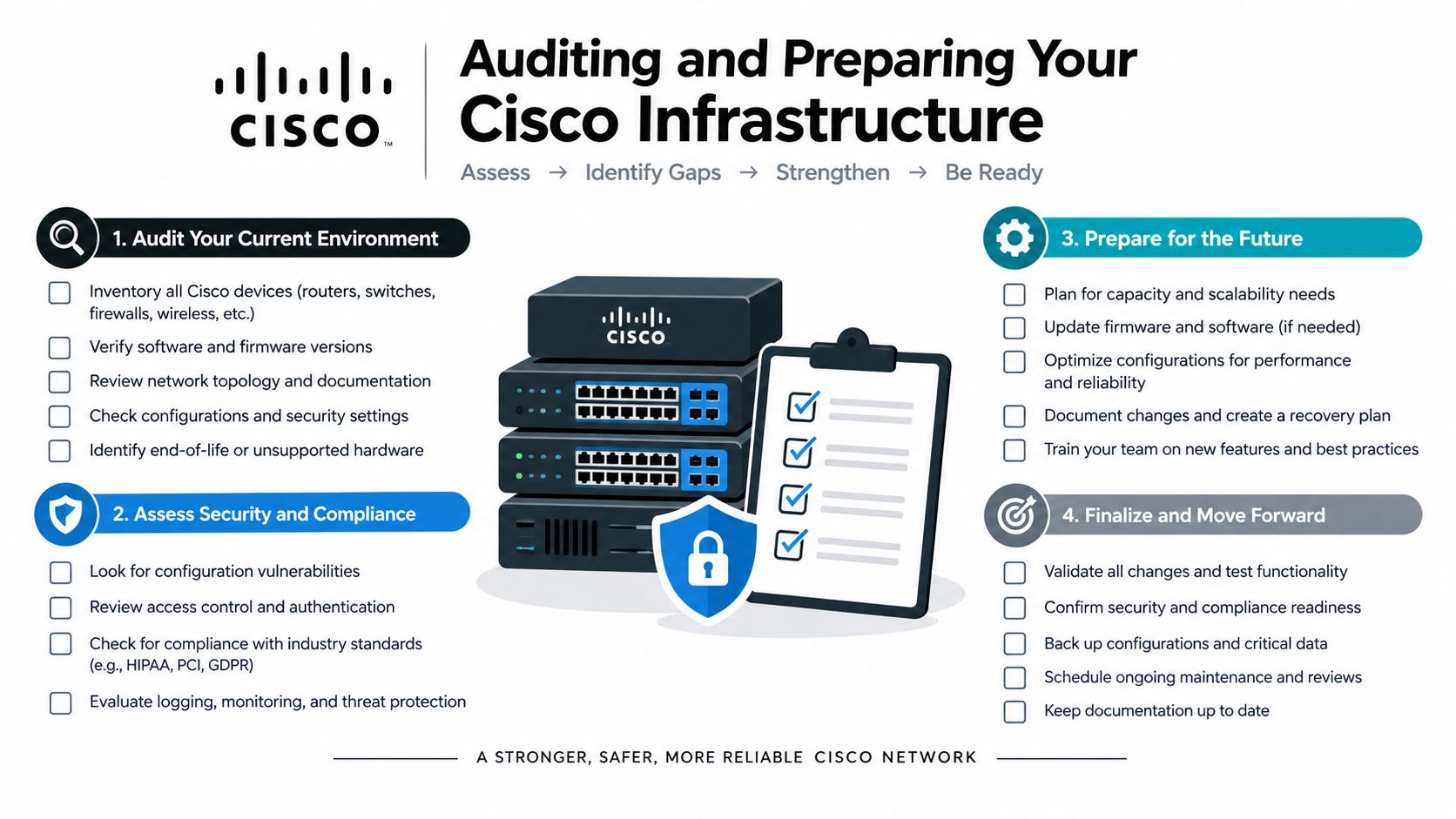
The strongest recycling project starts before anyone removes a cable. Build an asset register while the equipment is still installed, when serial numbers, locations, and relationships are easiest to verify. This gives the disposition team a reliable baseline for valuation, packing, data handling, and final reporting.
Start with a serialized inventory
Record the manufacturer, model, serial number, chassis condition, installed modules, power supplies, optics, and rack position. For Cisco equipment, capture the platform family and configuration details that affect secondary-market value. A complete chassis can be worth more than an incomplete unit, while line cards, supervisor modules, redundant power supplies, and supported transceivers may have separate buyers.
Don't combine everything under a description such as “Cisco switches.” That label isn't sufficient for a buyback quote or a Certificate of Recycling. Photograph labels and unusual configurations, then reconcile the photos against the inventory before removal.
De-install in a controlled sequence
Coordinate shutdowns with the network engineering team. Confirm dependencies, export any records that the business must retain, and document the approved maintenance window. Label fiber and copper connections before disconnecting them, especially where the rack contains active and retired systems side by side.
Use a staged sequence:
- Identify each asset: Match the physical serial number to the inventory and rack location.
- De-install safely: Power down according to the approved change plan, disconnect cables, and remove modules without forcing connectors.
- Protect components: Cap or separately package optical transceivers, line cards, and loose power supplies to prevent impact and electrostatic damage.
- Pack by disposition: Keep reusable equipment together, isolate damaged hardware, and maintain serialized records through staging.
- Arrange pickup: Confirm the count, access requirements, loading conditions, and documentation expected at handoff.
Cisco describes its customer workflow as identify the equipment, de-install and pack it, then arrange pickup. Returned units are handled through environmentally safe processes aligned with e-waste regulations, as described in Cisco's customer recycling brochure.
Triage before you pack
The wrong instinct is to send every device directly to shredding. Test whether the unit is complete, operational, supportable, and attractive to a secondary buyer. A recent-generation switch with intact modules may have recovery potential, while a damaged or obsolete chassis may be better suited to OEM recycling.
Asset recovery starts with identification, not transportation.
Record missing faceplates, damaged ports, failed fans, absent power supplies, and signs of corrosion. That information lets a provider separate IT asset recovery, resale, parts harvesting, and material recycling rather than applying one outcome to the entire rack.
Choosing Between OEM Takeback and Local ITAD Buyback
Cisco's free takeback route and a local ITAD engagement solve different problems. The OEM route emphasizes convenient return and controlled disposition. A local ITAD provider can evaluate mixed inventories, coordinate on-site removal, and assess whether equipment should be redeployed, remarketed, harvested for parts, or recycled.
Cisco's Product Takeback and Reuse or Customer Recycling Solutions lets owners return end-of-use equipment at no cost. Cisco also provides a separate eBin/Lab Scrap path for test equipment and orphaned office items, according to this Atlanta network liquidators resource.
Use the OEM route when simplicity is the priority
Cisco takeback is often sensible for orphaned lab equipment, low-value units, damaged devices, or a Cisco-only shipment where the organization mainly needs a controlled exit. Cisco says its program accepts all Cisco products, while non-branded products require pre-approval. The program can also provide recycling or destruction documentation, which helps compliance teams close the file.
The trade-off is that a no-cost return isn't the same as a market valuation. If equipment still has residual value, sending it away without an independent assessment may leave recovery potential unexplored. OEM return is also less convenient when the project involves Juniper, Arista, HPE, servers, storage, racks, and cabling in the same work area.
Use local ITAD when the inventory is mixed or value matters
A local provider can manage one coordinated project across vendors and asset classes. That matters in Atlanta facilities where the removal schedule, loading dock, security procedures, and freight requirements affect every asset, not only Cisco-branded equipment.
Beyond Surplus is one Atlanta-based option that provides data center equipment buyback guidance alongside ITAD, electronics recycling, data destruction, and logistics services. The practical question isn't which route sounds more convenient. It's whether the provider will evaluate each asset before assigning it to recycling.
| Feature | Cisco OEM Takeback | Local ITAD, Beyond Surplus |
|---|---|---|
| Primary use | End-of-use Cisco equipment return | Mixed-vendor disposition and value recovery |
| Cost model | Cisco states that eligible takeback returns are provided at no cost | Quote depends on scope, logistics, condition, and recovery potential |
| Inventory scope | Cisco products, with non-branded items requiring pre-approval | Cisco plus other enterprise IT and electronics equipment |
| Value assessment | Reuse may occur, but a separate buyback evaluation may be needed | Designed to assess resale, redeployment, parts recovery, and recycling |
| Site logistics | Customer follows the OEM return workflow | Local pickup, de-installation coordination, staging, and transport |
| Documentation | Certificates may be available for returned equipment | Serialized chain-of-custody and disposition reporting should be defined in the scope |
| Best fit | Cisco-only, low-value, damaged, or orphaned equipment | Mixed racks, larger refreshes, time-sensitive removal, and recovery-focused projects |
The practical decision tree is straightforward:
- Cisco-only and low residual value: Evaluate OEM takeback first.
- Working switches, routers, modules, or optics: Request a buyback or recovery assessment before recycling.
- Mixed-vendor racks: Use a provider that can manage the full inventory under one chain of custody.
- Lab and orphaned office equipment: Review Cisco's eBin or lab-scrap option alongside local ITAD.
- Sensitive or regulated environments: Compare sanitization procedures and certificates, not just pickup convenience.
Executing Secure Data Sanitization on Network Devices
Network equipment doesn't always resemble a server, so teams sometimes exclude it from the media-sanitization plan. That's a mistake. Routers, switches, firewalls, management modules, flash storage, and removable drives can all require specific treatment before resale or recycling.
A reset command may remove active settings without proving that every storage location has been sanitized. It also doesn't establish who performed the work, which asset was processed, or what happened when the first attempt failed.
Classify the device and its media
Begin with the configuration and hardware audit. Identify whether the asset contains removable hard drives, flash memory, compact flash media, USB storage, or other storage-bearing components. Treat those components as separate assets when the serial number or tracking method allows it.
The intended outcome matters:
- Internal reuse: Follow the organization's approved media-sanitization policy and verify the result.
- Remarketing: Use a documented method appropriate to the media and retain asset-level evidence.
- Recycling: Sanitize or destroy storage before the device enters downstream processing.
- Failed or inaccessible media: Escalate to physical destruction rather than relying on an incomplete software process.
Cisco says its data-wiping software is certified to meet U.S. NIST SP 800-88 Revision 1 guidelines for media sanitation. Cisco also states that if wiping fails, the equipment is repaired and wiped again or securely destroyed, as documented in its Takeback and Reuse FAQ.
Don't confuse reset, wipe, and destruction
A factory reset changes the device's operating state. It isn't automatically equivalent to verified sanitization. A compliant workflow should identify the method used, the asset processed, the verification result, and the final disposition.
For practical handling of switching and routing hardware, use this guide to recycle network switches and routers. The important operational point is to match the method to the media. A provider that uses one generic process for every Cisco platform may not be addressing differences between flash storage, removable drives, and failed equipment.
Build failure handling into the scope
Ask what happens when a device won't boot, a storage component can't be accessed, or a wipe report fails. The answer should be defined before pickup, not negotiated after the equipment is in transit.
Cisco states that customers remain responsible for removing data before returning equipment, even though its program also describes secure storage, data clearing from returned hard drives, and escalation when wiping fails. Your internal team should therefore complete its own pre-return review, revoke credentials, remove authorized access, and preserve only the records the business is required to retain.
Securing Chain of Custody and Compliance Documentation
A recycling receipt proves that something was collected. It doesn't necessarily prove which Cisco assets left the building, whether data was sanitized, or where the equipment went afterward. Enterprise disposition requires a record that follows the asset from the rack to its final outcome.
The chain should begin during inventory and continue through loading, transport, intake, testing, sanitization, resale, destruction, and recycling. Every handoff should have an accountable party and a matching manifest.
Specify the records before the project starts
At minimum, ask for documentation that connects:
- Asset identity: Manufacturer, model, serial number, and any internal asset identifier.
- Pickup details: Site, date, authorized representatives, count, and transport information.
- Condition and disposition: Reuse, resale, parts recovery, recycling, or destruction.
- Sanitization outcome: Method, completion status, exceptions, and escalation path.
- Downstream handling: Receiving facility and final processing route where applicable.
- Certificates: Certificate of Destruction and Certificate of Recycling, issued according to the actual outcome.
Cisco's fast facts say customers can request a Certificate of Destruction for returned equipment, and that the certificate indemnifies the customer against further liability for the equipment. Cisco's product-recycling steps also state that a Certificate of Recycling can be emailed to the pickup contact after recycling is completed, as described in its program fast facts.
Understand what each certificate proves
A Certificate of Destruction addresses the destruction of identified equipment or media. A Certificate of Recycling addresses material processing. They aren't interchangeable, and a recycling certificate shouldn't be accepted as proof that data was destroyed.
This distinction becomes important during audits, insurance reviews, customer inquiries, and internal investigations. If a provider can't explain which certificate applies to each asset, the project scope is incomplete.
For a deeper operational checklist, review the requirements for chain-of-custody documentation. The document set should be agreed before the first rack is dismantled, with exceptions reported rather than hidden inside a final summary.
The certificate is the endpoint of a controlled process, not a substitute for one.
Coordinating Logistics with Beyond Surplus in Atlanta
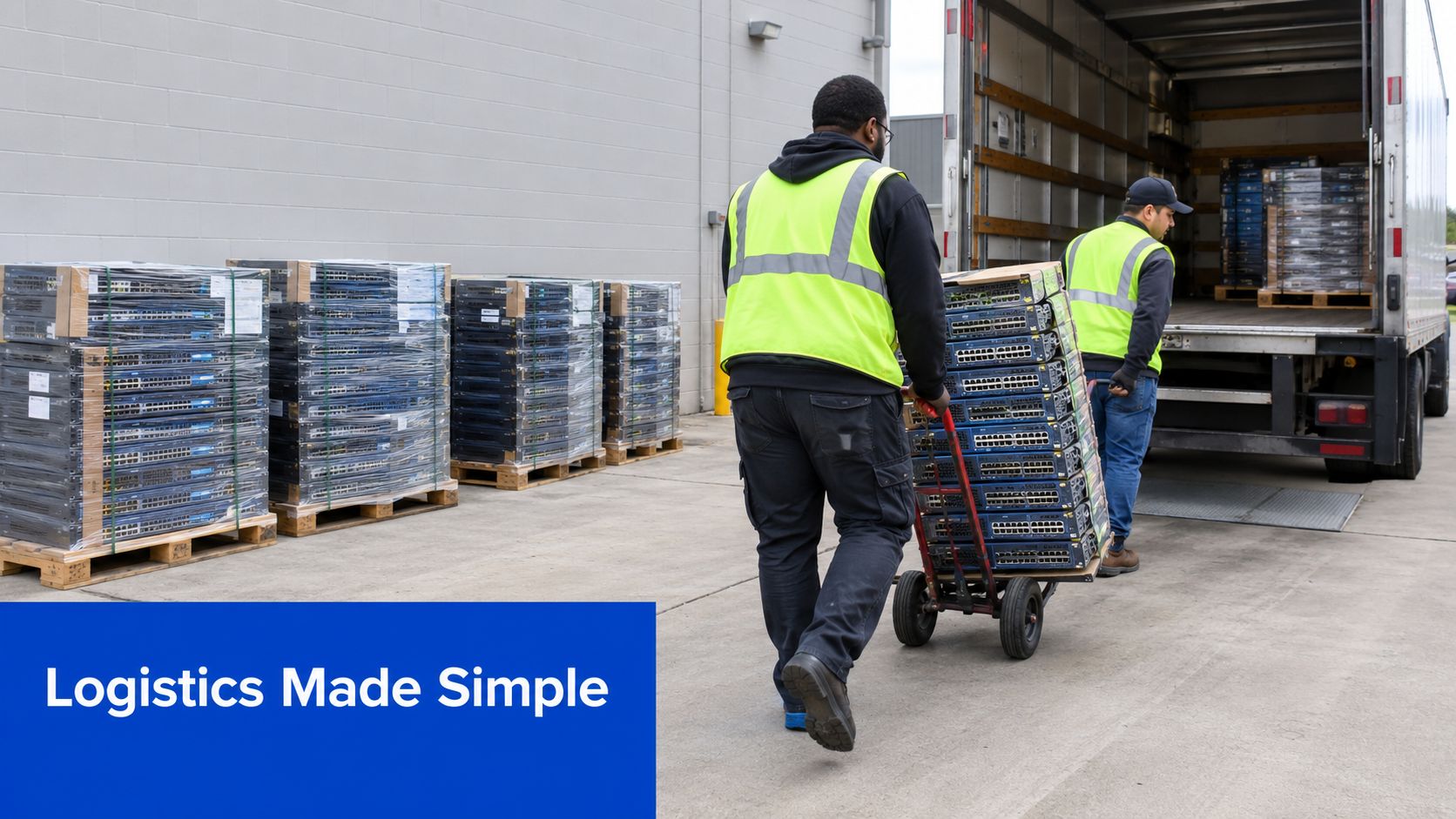
A Cisco recycling project succeeds or fails on execution. The disposition route must fit the facility's access rules, maintenance window, staging space, loading dock, security requirements, and equipment mix. A local Atlanta ITAD provider can also reduce the friction of coordinating a Cisco return with separate outcomes for servers, storage, telecom gear, and other network equipment.
Beyond Surplus offers business pickup, IT equipment disposal, secure data destruction, electronics recycling, buyback evaluation, product destruction, and data center de-installation services. Its Atlanta service page is the appropriate starting point for organizations planning local coordination, while business pickups can also be arranged beyond the Atlanta area.
Prepare the handoff
Before requesting a pickup, assemble the inventory and identify the preferred outcome for each category. Separate Cisco equipment that may qualify for OEM takeback from equipment that should receive a buyback review, then flag mixed-vendor assets for a unified ITAD scope.
Use this project checklist:
- Share the inventory: Include serial numbers, models, quantities, condition, modules, optics, and known storage media.
- Describe the site: Provide the Atlanta address, access restrictions, dock details, staging area, floor protection requirements, and security procedures.
- Confirm the work: Define whether the provider will only collect equipment or also de-install, pack, transport, sanitize, test, and process it.
- Request valuation: Ask for a preliminary recovery assessment before reusable assets are assigned to recycling.
- Set documentation requirements: Specify serialized manifests, chain-of-custody records, Certificates of Destruction, and Certificates of Recycling.
- Coordinate timing: Align engineers, facilities, security, transportation, and the receiving provider around the approved outage window.
That structure keeps the free OEM route available where it makes sense while protecting recovery opportunities in mixed or higher-value inventories.
Beyond Surplus can help Atlanta businesses coordinate Cisco network equipment pickup, secure data destruction, ITAD buyback evaluation, mixed-vendor rack removal, and certified electronics recycling. Visit Beyond Surplus to submit your equipment details and plan a documented disposition process before the next infrastructure refresh.


