ITAD services manage end-of-life IT assets through secure data destruction, certified recycling, and value recovery. The global IT asset disposition market is estimated at USD 17.5 billion in 2025, projected to reach USD 40.1 billion by 2035, with an implied 8.9% compound annual growth rate over that period (Grand View Research).
An IT manager facing a laptop refresh, a server-room closure, or a warehouse full of obsolete monitors has a practical problem, not just a recycling problem. The equipment may contain regulated information, retain business credentials, or carry resale value. Sending it through an undocumented disposal channel can create security exposure, compliance questions, and environmental liability.
Table of Contents
- Understanding the IT Asset Disposition Challenge
- What Are ITAD Services and Core Offerings
- Navigating Compliance and Regulatory Requirements
- Chain of Custody and Certification Importance
- Sustainability and Value Recovery Benefits
- How to Evaluate and Select an ITAD Provider
- Contact Beyond Surplus for Certified ITAD Solutions
Understanding the IT Asset Disposition Challenge
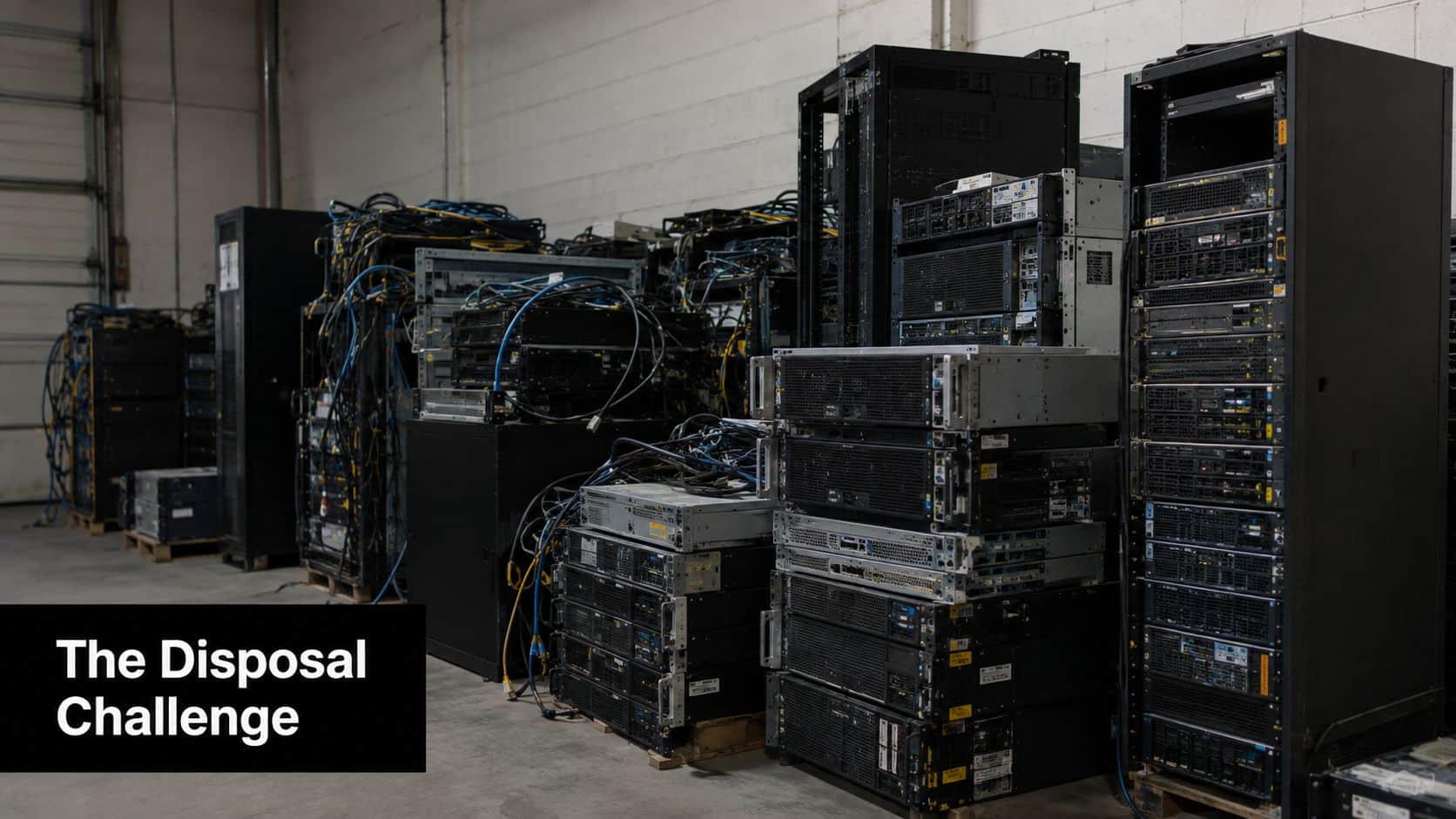
A typical decommission begins with a deadline. The lease ends, a data center moves, or employees receive replacement computers. Facilities teams need the equipment removed, while IT security wants proof that storage media has been sanitized. Finance wants recoverable value, and compliance wants records that will withstand an audit.
That combination makes informal disposal unsuitable. A recycler that only weighs electronics can't necessarily verify which serial-numbered drive was wiped, which was destroyed, or where the remaining equipment went. A reseller that focuses only on remarketing may also lack the controls required for sensitive data.
Why ordinary disposal falls short
The scale of the waste stream explains why businesses need a structured process. Global e-waste reached 62 million metric tons in 2022, and IT equipment represented about 7% of that total (ITAD industry statistics). In the United States, e-waste was estimated at 6.9 million metric tons in 2022, with 45% attributable to IT assets (the same industry summary).
Those figures don't tell a business what to do with a particular server or laptop. They do show why secure e-waste management must combine logistics, data protection, documented processing, and responsible material recovery.
A sound disposition plan starts before pickup. Identify asset classes, flag data-bearing equipment, define the acceptable sanitization method, and decide which items may be reused, remarketed, recycled, or destroyed. Business-focused electronics recycling services should then connect those decisions to manifests and final certificates.
What Are ITAD Services and Core Offerings
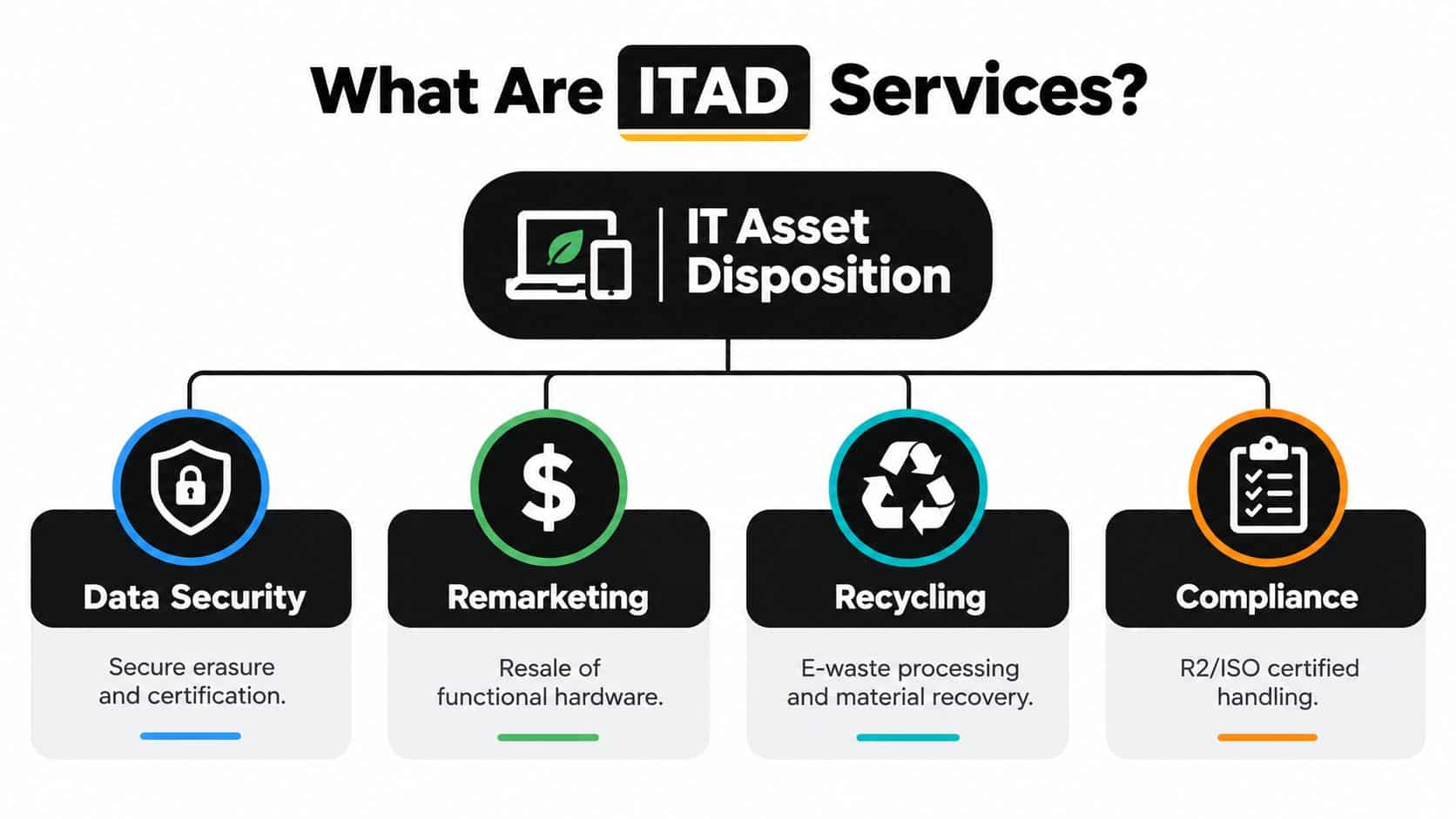
ITAD services are the controlled management of retired technology from collection through final disposition. The work includes asset identification, secure transportation, data sanitization, refurbishment or resale, electronics recycling, product destruction, and reporting.
The right method depends on the asset and its risk. A functional laptop with data that can be reliably cleared may be suitable for redeployment or remarketing. A failed drive containing regulated information may require physical destruction because software erasure isn't dependable when the media is damaged or inaccessible.
The operational components
- Asset assessment: Catalog serial numbers, model information, condition, and ownership. This creates the control record used for disposition decisions.
- Data wiping: Apply a documented software-erasure process when the media is accessible and the risk profile permits reuse. The result should be tied to the individual device or defined batch.
- Drive shredding: Physically destroy storage media when data sensitivity, media condition, or policy requires a destroy-level outcome.
- Decommissioning and pickup: Coordinate rack removal, equipment separation, packaging, loading, and transport so a site closure doesn't become an unmanaged handoff.
- Remarketing and recovery: Evaluate working equipment for resale or redeployment before sending it to material processing.
- Recycling and product destruction: Process unusable electronics through controlled downstream channels, with certificates that document the final outcome.
For teams building a policy, these secure IT asset disposal tips are useful alongside a provider's written procedures. The practical test is whether the vendor can translate policy into asset-level evidence. Businesses can review secure ITAD services when they need one workflow covering security, logistics, recovery, and recycling.
Navigating Compliance and Regulatory Requirements
Compliance isn't satisfied by a general statement that equipment was recycled. The organization needs to show that it took reasonable measures to prevent unauthorized access and that its chosen destruction method matched the media and information risk.
The FTC Disposal Rule applies to businesses that maintain consumer information in covered accounts. It requires reasonable measures to prevent unauthorized access or use during disposal, which is why documented wiping and destruction controls belong in an ITAD program (FTC guidance for protecting personal information).
Matching controls to the environment
Healthcare organizations must consider HIPAA obligations when devices contain protected health information. Financial institutions, public agencies, and other regulated organizations may have additional contractual, statutory, or internal requirements. The provider's certificate doesn't replace the customer's compliance program, but it gives the organization evidence that a defined process occurred.
NIST Special Publication 800-88 Rev. 1 is a core reference for media sanitization. It distinguishes sanitization outcomes and supports choosing among clear, purge, and destroy approaches based on media type and risk. A practical program should document the method, operator or system used, verification result, and final disposition. Providers should also explain how they handle mobile devices, solid-state storage, printers, removable media, and embedded storage.
Practical rule: A certificate is useful only when it connects the outcome to the specific assets processed.
Organizations operating across jurisdictions may also need privacy guidance beyond U.S. requirements. A resource to explore GDPR guidance can help teams identify questions for counsel and procurement. For audit readiness, retain compliance documentation with manifests, sanitization records, certificates, and exception notes.
Chain of Custody and Certification Importance
Chain of custody is the documented transfer trail from collection to final processing. It should show who accepted the equipment, what was collected, how it moved, where it was secured, and what happened to each serialized asset.
A weak process records only the number of boxes. A mature process captures serial numbers, timestamps, transport records, storage conditions, manifest verification, and final disposition. That level of detail helps establish liability transfer and makes it harder for an asset to disappear between pickup and processing (IT asset disposition guidance).
Destruction or recovery
Destruction is the clearer choice when data can't be reliably sanitized, the media is damaged, or policy requires a destroy-level result. It provides finality, but it eliminates the possibility of recovering value from that component.
Reuse or remarketing preserves more economic and environmental value when the equipment is functional and data can be securely removed. It also introduces a different control requirement. The provider must prevent residual data exposure, document the sanitization result, and maintain enough asset history to show what was sold or redeployed.
A provider should issue device-level or batch-level certificates of data destruction and recycling, with the scope clearly defined. The chain-of-custody process should support those certificates rather than exist as a separate logistics document.
Sustainability and Value Recovery Benefits
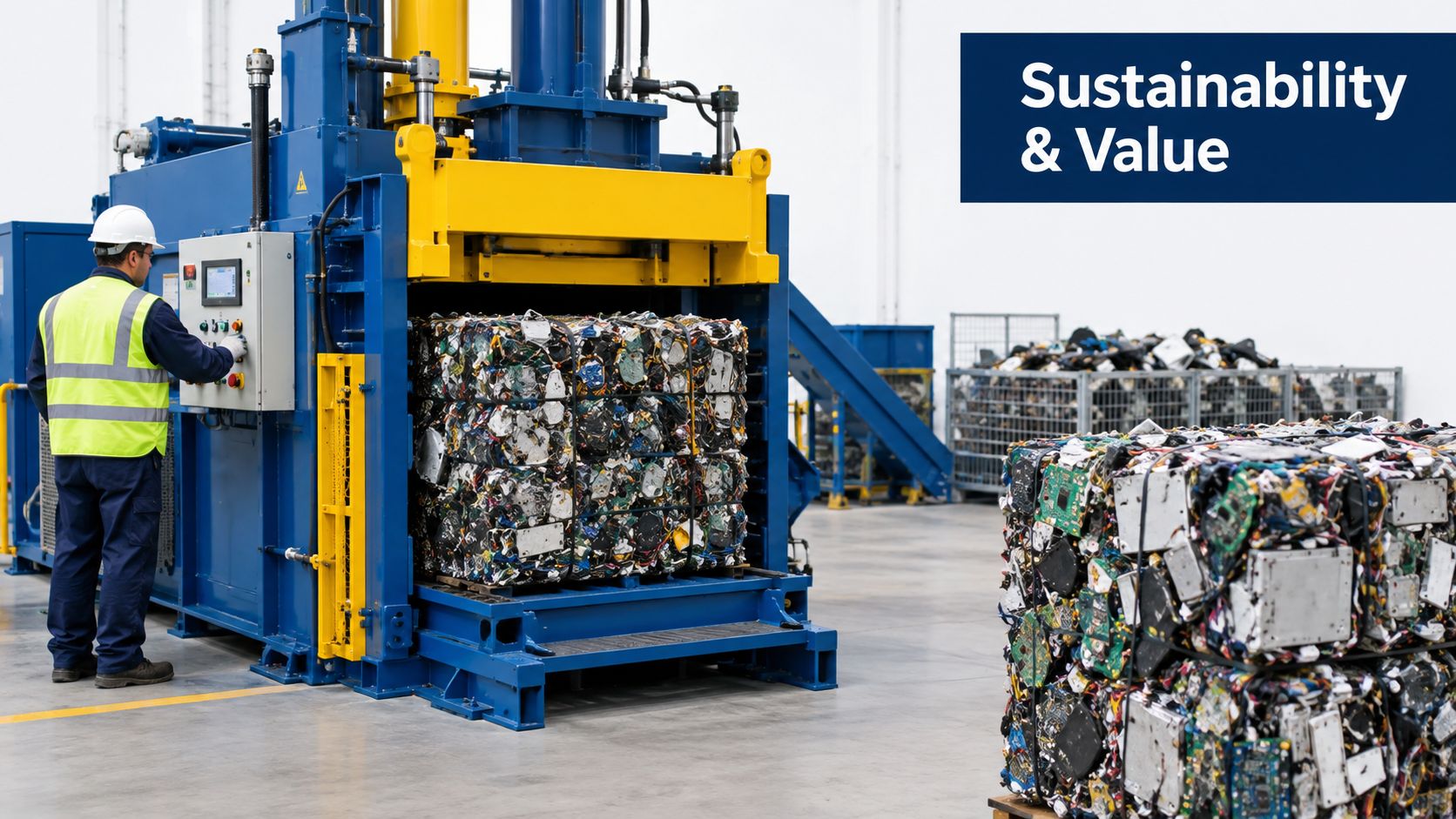
Sustainability and security aren't opposing goals, but they require deliberate sequencing. First protect the data. Then determine whether an asset can be redeployed, refurbished, remarketed, harvested for parts, or recycled. Sending every device directly to destruction may be simple, but it can discard recoverable value and usable equipment.
Formal processing matters because e-waste can contain materials that require controlled handling. The U.S. e-waste estimate of nearly 8 million tons in 2024, with only 15% recycled, illustrates the gap between discarded equipment and documented recycling outcomes (ITAD industry statistics). The useful business question isn't only how much equipment left the building. It's whether the organization can prove the route and outcome for each category.
Provider selection checklist
- Verify certifications: Ask whether the provider maintains relevant certifications such as R2v3 or ADISA, and request current documentation.
- Review the data process: Confirm how the vendor handles failed wipes, encrypted drives, solid-state media, and physical destruction.
- Test the inventory workflow: Require serial-number capture, manifest reconciliation, and exception reporting.
- Examine downstream controls: Ask where recyclable materials go and how the provider manages downstream partners.
- Define value recovery: Establish how functional equipment is assessed, priced, sold, and reported.
- Request final evidence: Make certificates specific enough for internal review, customer inquiries, and regulatory audits.
Asset reuse can support a circular-economy objective when it doesn't compromise security. Guidance on circular economy and enterprise IT equipment is relevant for procurement teams balancing recovery, sustainability reporting, and risk.
How to Evaluate and Select an ITAD Provider
The provider that collects office computers may not be equipped for a data-center de-installation. Start with the physical scope. Ask who disconnects racks, handles batteries, packs equipment, manages loading, and coordinates transport. A nationwide program also needs a repeatable process across locations, not just a capable local crew.
For an Atlanta-based business, Beyond Surplus offers business pickups in the contiguous United States and services that include certified wiping, hard-drive shredding, electronics recycling, buyback, product destruction, and data-center de-installations. That makes the relevant evaluation question practical: can the provider handle the actual fleet, locations, media types, and reporting requirements involved?
Questions procurement should ask
- How are assets identified at pickup? Look for serial-number capture and manifest reconciliation.
- Which sanitization standard governs the work? Ask how NIST 800-88 methods are selected and verified.
- What happens when wiping fails? The answer should include a documented escalation to purge or physical destruction.
- How is transport secured? Clarify vehicle controls, packaging, route management, and receiving procedures.
- Who performs downstream processing? Request visibility into subcontractors and material channels.
- What will the final report contain? Confirm certificates, asset status, resale results, recycling records, and exceptions.
A strong sales presentation isn't enough. Request sample documentation, validate insurance and certifications, and run a controlled pilot with representative equipment. The provider should be able to explain the difference between a laptop, a failed enterprise drive, a printer with embedded storage, and a rack of servers. If the answer is the same for all four, the process probably isn't risk-based.
Contact Beyond Surplus for Certified ITAD Solutions
Professional ITAD turns a complicated handoff into a controlled business process. The essential outcomes are clear: sensitive information is sanitized or destroyed using a documented method, equipment moves through a traceable chain of custody, recoverable assets are evaluated before destruction, and unusable electronics reach responsible recycling channels.
Beyond Surplus is based in Atlanta, Georgia, and provides commercial IT asset disposition and electronics recycling services for organizations that need secure data destruction, certified wiping, hard-drive shredding, pickup coordination, asset recovery, product destruction, and data-center de-installation. Its business logistics support pickups across the contiguous United States, while certificates of data destruction and recycling provide evidence for records and compliance workflows.

Before scheduling a project, prepare an inventory or approximate equipment list, identify locations, flag regulated data, and state whether the priority is reuse, destruction, recycling, or a combination. That information lets an ITAD provider design the right pickup, sanitization, reporting, and recovery workflow rather than treating every device as generic scrap.
Contact Beyond Surplus for certified electronics recycling, secure data destruction, and documented IT asset disposition. Visit Beyond Surplus to discuss business pickup, data-center decommissioning, value recovery, and compliance-ready certificates for your retired technology.


