

Your warehouse floor probably looks familiar right now. Retired 1U servers are still in racks because nobody wants to touch the drives, a stack of switches is mixed in with dead UPS gear, facilities needs the space back, and finance wants to know whether any of it still has value.
That's where most decommissions go wrong. Teams treat warehouse server and networking equipment recycling like a disposal job, when it's really a triage job with security, freight, and compliance consequences attached to every decision.
Table of Contents
- Why Warehouse Server and Networking Equipment Recycling Is a Strategic Decision
- Inventory and Three-Stream Sorting Before Anything Leaves the Warehouse
- Secure Data Destruction That Satisfies Compliance and Auditors
- Reuse First, Parts Harvest Second, Recycle Last
- Chain of Custody and Regulatory Compliance Documentation
- Pallet Discipline, Pickup Logistics, and Freight Planning
- Value Recovery, Buyback, and Scheduling Your Next Pickup
Why Warehouse Server and Networking Equipment Recycling Is a Strategic Decision
A warehouse decommission usually gets forced by something concrete: a lease event, a roof project, a consolidation, or a rushed space recovery order from facilities. At that point, the wrong call is to treat the retired servers, switches, rails, drives, and power gear as one disposal pile. The right call is triage. Reuse first, parts harvest second, shred last.
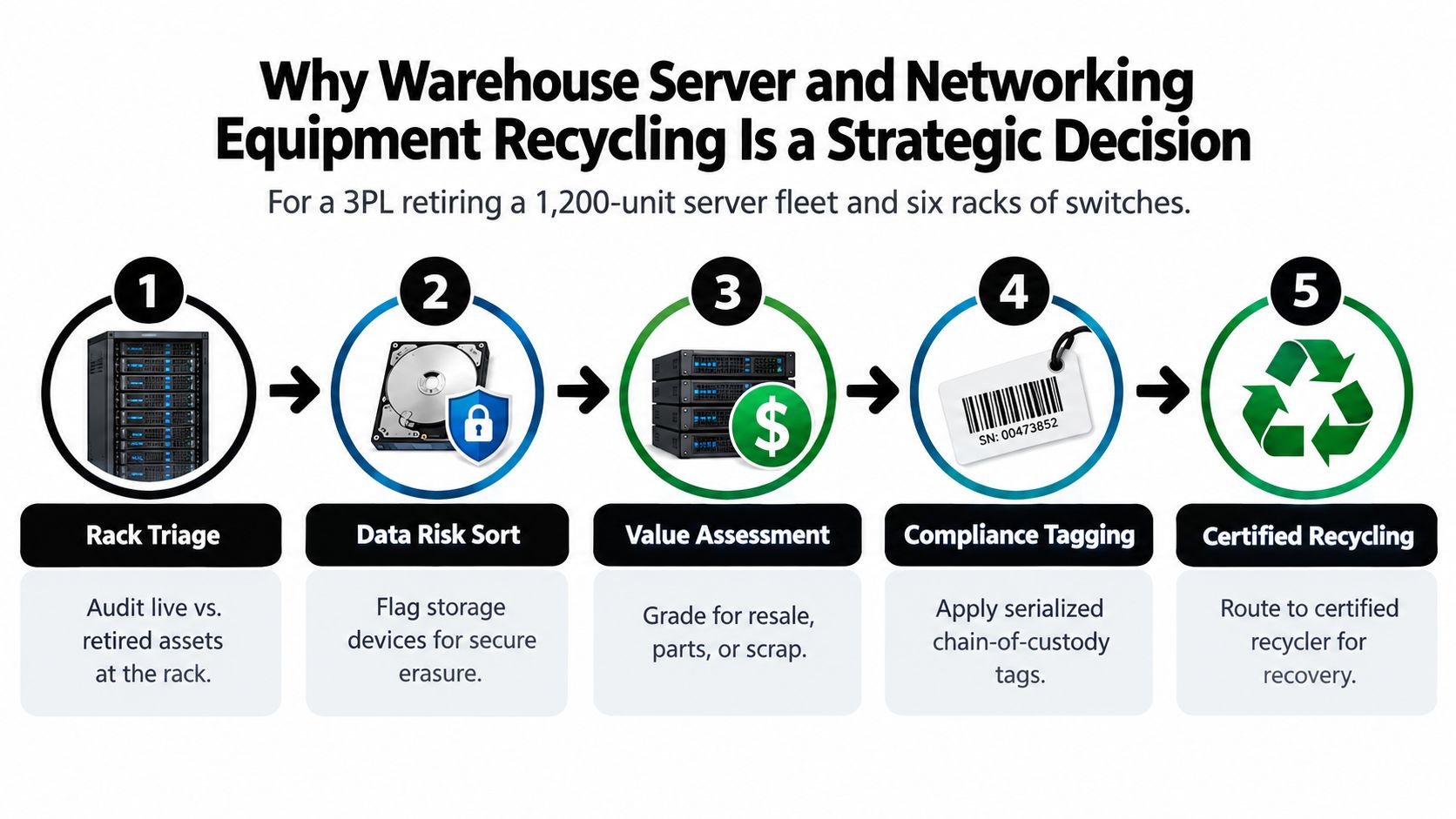
That order changes the economics immediately. A server with expired production life may still return value as a complete unit if it powers on cleanly and the drives can be sanitized. If the chassis is too old for resale, the CPUs, memory, NICs, rails, caddies, and power supplies may still justify harvest. Shredding has its place, but it is the last path because it ends any chance of recovery and turns freight into pure cost.
The money usually leaks in three places:
- Storage is destroyed before evaluation: Drives may need to be removed and destroyed, but the rest of the server often belongs in a different stream.
- Serialized network gear gets mixed with scrap: Switches, routers, firewalls, optics, and PDUs lose value fast once they are stacked loose with dead UPS units and metal scrap.
- Loads are built for convenience instead of outcome: Mixed pallets make it harder to prove chain of custody, harder to audit, and more expensive to move.
I tell clients to run quick recovery math before anything leaves the row. Estimate what can be resold as-is. Estimate what can be harvested for tested parts. Compare that against freight, labor, data destruction, and downstream recycling cost. That framing is the same one behind how businesses save money with IT asset recovery. It puts the decision where it belongs, on net recovery after secure handling, not on how fast a dock can be cleared.
Order matters for compliance too. One stray SSD in a scrap gaylord can create reporting and legal problems under the FTC Disposal Rule, HIPAA, and state data protection laws. Auditors will ask simple questions: which assets held data, who touched them, when were they sanitized or destroyed, and where is the supporting record? If the answer depends on memory, the process failed.
That is why a pre-move IT audit for offices applies to warehouse decommissions as well. Audit first. Separate data-bearing devices from non-data gear. Mark reuse candidates before teardown starts. Then move each asset through a documented path that matches its value and risk.
In practice, good recycling decisions are not really recycling decisions. They are disposition decisions with value-recovery math on one side and chain-of-custody requirements on the other.
Inventory and Three-Stream Sorting Before Anything Leaves the Warehouse
A warehouse decommission usually goes wrong in the first hour, not at final pickup. Crews start pulling gear to clear aisles, good servers land on the same pallet as scrap metal, and loose drives show up in a tote with transceivers and rails. At that point, resale value drops, parts go missing, and the asset trail gets harder to defend.
The fix is simple to describe and harder to enforce. Sort at the rack, record each asset before it moves, and route everything into three streams: reuse, parts harvest, or shred. That is a triage process, not a disposal task. If a switch can be redeployed, it should not be priced like scrap. If a server is complete but outdated, it may still return more as tested memory, CPUs, rails, and caddies than as whole-unit resale.
What to capture on every asset
Build the record before the unit leaves the row. One asset, one line item, one photo set.
| Field Group | Fields to Capture | Why It Matters |
|---|---|---|
| Identification | Asset tag, serial number, service tag, make, model | Confirms exactly what left the site |
| Configuration | CPU, RAM, drive count, drive type, RAID configuration | Sets resale potential and handling path |
| Security status | Encryption status, key availability, data-bearing yes/no | Flags what must be sanitized or destroyed |
| Condition | Cosmetic grade, missing parts, power-on result | Separates reuse candidates from harvest units |
| Routing | Stream assignment, pallet location | Keeps lot control intact during staging and loading |
| Imaging | Front photo, rear photo, serial close-up | Reduces serial disputes and substitution claims |
Teams that run multi-site decommissions usually benefit from a standardized inventory optimization process for IT assets, especially when different crews are grading, tagging, and palletizing in parallel.
A good inventory also supports value-recovery math. A complete 1U server with rails, bezel, and clean serials may belong in the reuse stream. The same chassis with missing caddies, failed boards, and no practical test path often belongs in parts harvest. Scrap is the last stream, not the default.
How the rack sort should run
Use a two-person check at the rack whenever possible. One person removes and tags. The second verifies serials, drive count, and stream assignment against the manifest.
On the floor, the process should stay boring and repetitive:
- At the rack: Assign the stream before removal and mark whether the unit is data-bearing.
- During pull-down: Count drives, SSDs, flash modules, and removable media separately from the chassis.
- At pallet build: Keep reuse, harvest, and shred on different pallets with visible pallet IDs.
- Before wrap: Verify that pallet contents match the manifest and photo record.
- After staging: Close the lot in the inventory file so freight and receiving teams work from the same record.
That discipline prevents an expensive mistake. A reusable firewall appliance buried in a scrap pallet loses its remarketing path. A loose SSD in a metal gaylord creates a compliance problem, not just a sorting problem.
Common errors that erase value
Mixed “miscellaneous IT” pallets are usually where money disappears. SFPs, power supplies, rack ears, rails, blanking panels, and memory get separated from the parent asset, then nobody can reconcile what was sold, harvested, or destroyed.
Crews also miss value when they grade too late. Once hardware is stacked, wrapped, and moved twice, it is harder to identify complete resale units versus good parts donors. The warehouse team should make that call while the gear is still in place and the configuration is visible.
Treat every pallet as a controlled lot. Label it. Photograph it. Tie it back to the manifest. That is how you protect chain of custody, preserve resale options, and keep the shred stream limited to equipment that belongs there.
Secure Data Destruction That Satisfies Compliance and Auditors
Media sanitization isn't a side task. NIST treats it as a formal security process, and its guidance explicitly includes physical destruction methods such as shredding for hard drives in suitable facilities with appropriate safety precautions in NIST SP 800-88 Rev. 1.
Picking the right sanitization path
The wrong habit is using one destruction method for everything. The defensible habit is matching the method to the media, condition, and encryption status.
| Media Type | Encrypted + Key Known | Unencrypted or Key Unknown | Audit Artifact Required |
|---|---|---|---|
| SSD in working server | Cryptographic erase or other validated purge path | Physical destruction if sanitization can't be verified | Serial, method, tech initials, timestamp |
| HDD in intact system | Purge if method is validated and successful | Destroy if data can't remain recoverable | Serial list and sanitization result |
| Failed HDD | Destroy | Destroy | Destruction log and certificate reference |
| Failed SSD | Destroy | Destroy | Destruction log and certificate reference |
| Removable flash from switch/router | Purge only if validated and complete | Physical destruction of flash media | Device serial and component handling note |
A deeper operational reference is NIST SP 800-88 guidance for business IT disposal, especially when you need to line up technician procedure with audit evidence.
Shredding, wiping, and degaussing in practice
Wiping makes sense when the media is healthy, the tool validates completion, and the drive can stay tied to a serial-matched record. Purge is the stronger option for intact environments where you can verify the method and preserve the audit trail.
Shredding is the safer call when media is failed, unencrypted, or leaving the physical site before sanitization can be proven. For network hardware, don't stop at a factory reset. Switches and routers can retain configs, credentials, and logs in flash storage that basic reset procedures may not fully address.
Audit view: If you can't prove the method used on a specific serial number, assume an auditor will treat that drive as unsanitized.
What the paperwork must show
For each drive or data-bearing component, keep:
- Serialized media list
- Sanitization method used
- Technician initials or operator ID
- Date and timestamp
- Certificate of Destruction or wipe report reference
That record is what turns a claimed process into a defensible one.
Reuse First, Parts Harvest Second, Recycle Last
The best warehouse server and networking equipment recycling programs don't start with shredders. They start with testing tables.
Large operators are already showing what the hierarchy looks like when decommissioning is structured correctly. In 2024, AWS reported that more than 99% of securely decommissioned racks sent to its re:Cycle facilities were diverted from landfill, Google said it harvested about 8.8 million components from retired data center hardware, and Microsoft reported a 90.9% reuse-and-recycling rate for cloud hardware, according to this summary of reported data from major operators in data center e-waste recycling coverage.
How the three outcomes differ
| Stream | What Qualifies | Typical Recovery Range | Best Use Case |
|---|---|---|---|
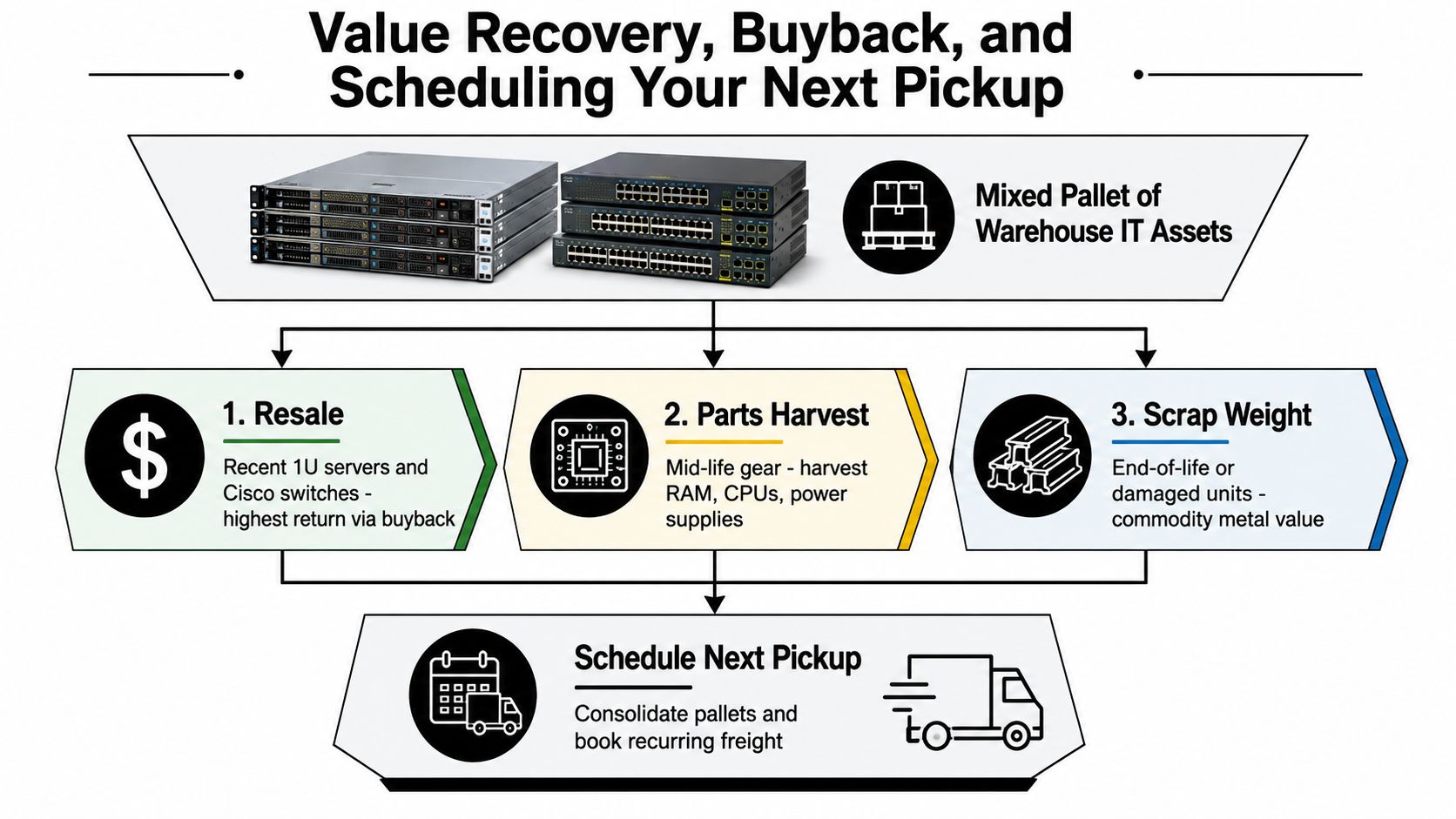
| Reuse | Passes POST or diagnostics, firmware can be cleared, cosmetics are acceptable | Highest relative value | Recent servers, storage, switches, and routers with market demand |
| Parts harvest | Whole unit isn't worth resale, but components still test good | Mid-level value | RAM, CPUs, PSUs, NICs, rails, fans, SFPs |
| Material recycling | Failed, incomplete, damaged, or obsolete beyond practical harvest | Lowest relative value | Scrap metal, boards, chassis, mixed commodities |
The big mistake is skipping the middle stream. Teams often recognize obvious resale units and obvious scrap, but they miss the harvest category where serviceable memory, processors, and power supplies keep producing value after the whole server no longer does.
When a unit moves down a stream
A good ITAD lead downgrades assets by evidence, not by age alone.
- A server that boots, tests clean, and can be sanitized stays in reuse.
- A server with board issues but healthy memory and CPUs moves to parts harvest.
- A stripped or physically damaged chassis with no useful components goes to material recycling.
If your team is evaluating switch stacks and routers, this guide on where to sell used network switches and routers is useful because it frames network gear as an asset class, not just surplus scrap.
Good triage protects two things at once. It protects data on the front end and residual value on the back end.
Chain of Custody and Regulatory Compliance Documentation
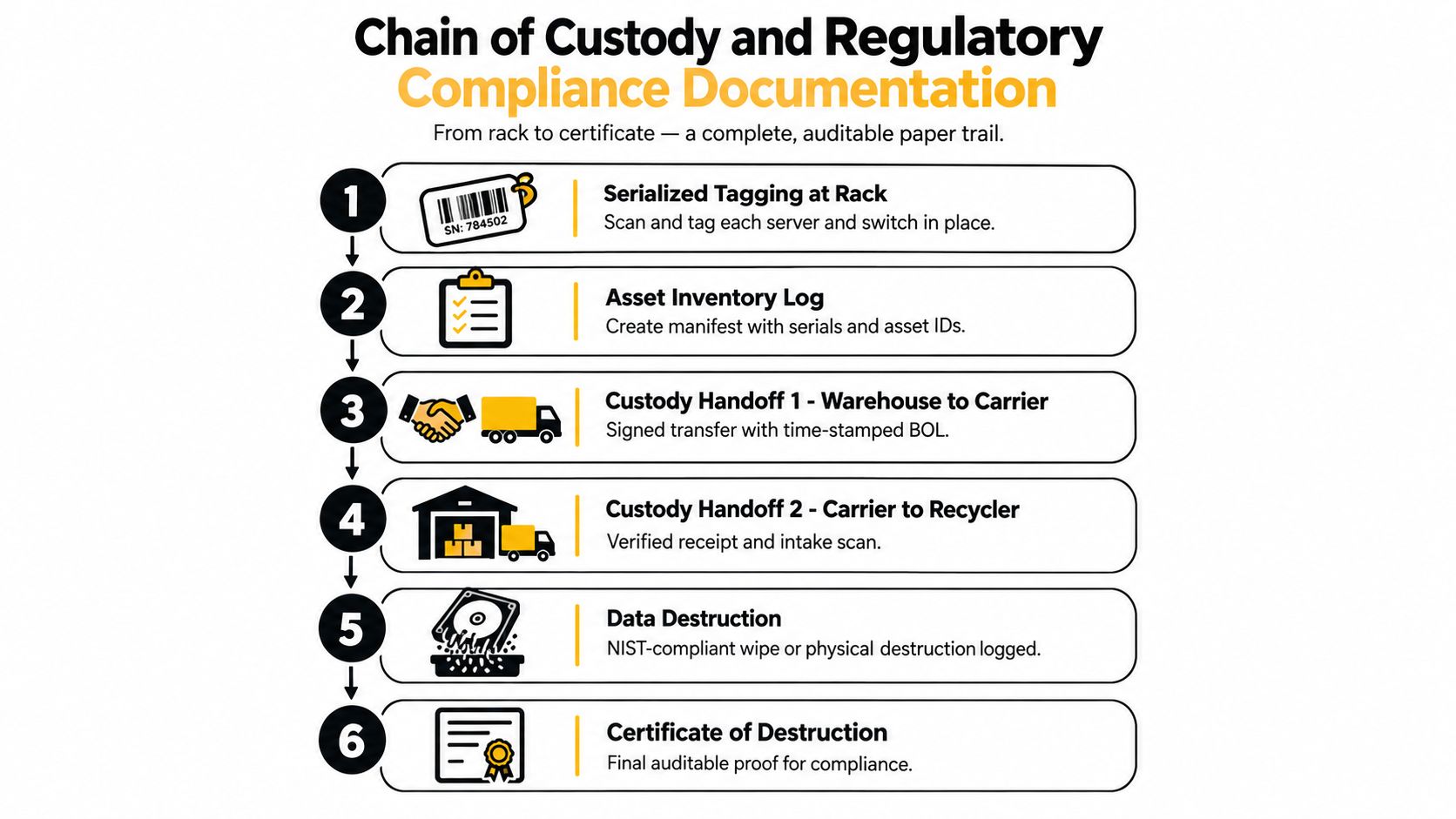
Auditors don't care that your recycler is reputable if your paperwork breaks halfway through the move. They care whether each handoff is documented, whether data-bearing assets stayed controlled, and whether the final disposition can be traced back to the original rack position.
The documents that should exist on every load
At minimum, the file for a warehouse decommission should include:
- Serialized asset inventory: Links the unit in the rack to the unit on the truck.
- Bill of lading: Records transfer from your dock to the carrier.
- Sanitization or destruction record: Ties media serials to method used.
- Receiving confirmation: Shows intake by the processor or ITAD vendor.
- Final certificate: Confirms destruction, recycling, or other final disposition.
- Downstream disclosure: Identifies who handled the material after intake.
For regulated organizations, this paper trail is what supports disposal obligations under HIPAA for protected health information, GLBA for financial data, the FTC Disposal Rule for consumer information, and state breach-notification statutes when devices contain personal data.
Why downstream proof now matters more
Regulated disposal is moving toward fuller disclosure on waste, electronics handling, diversion, and certified circular-economy participation. Industry coverage also shows more firms treating chain-of-custody records, serialized wiping or destruction certificates, and downstream authorization as baseline requirements rather than optional paperwork, as discussed in this review of sustainable data center ITAD compliance expectations.
If a vendor can't tell you where material went after pickup, treat that as a process gap. If they can't produce serial-matched data destruction records, treat it as a bigger one.
A simple custody standard
The strongest file is boring. Every handoff is signed, every serial is legible, every exception is documented, and nothing relies on memory.
That's the standard that survives an audit.
Pallet Discipline, Pickup Logistics, and Freight Planning
A warehouse decommission can stay clean on paper and still fail at the dock. The weak point is usually the physical handoff. Equipment gets pulled from rows, staged fast, stacked inconsistently, and loaded under time pressure. That is where resale value drops, parts get separated from parent assets, and custody records stop matching what left the building.
Good pallet discipline supports the triage decision you already made. Reuse candidates need protection because cosmetic damage and bent rails can push working gear out of resale. Parts-harvest lots need to stay grouped so NICs, caddies, rails, and PSUs do not get scattered across mixed pallets. Scrap-only material can be packed for density, but it still needs to be counted and tagged so the outbound manifest matches the trailer.
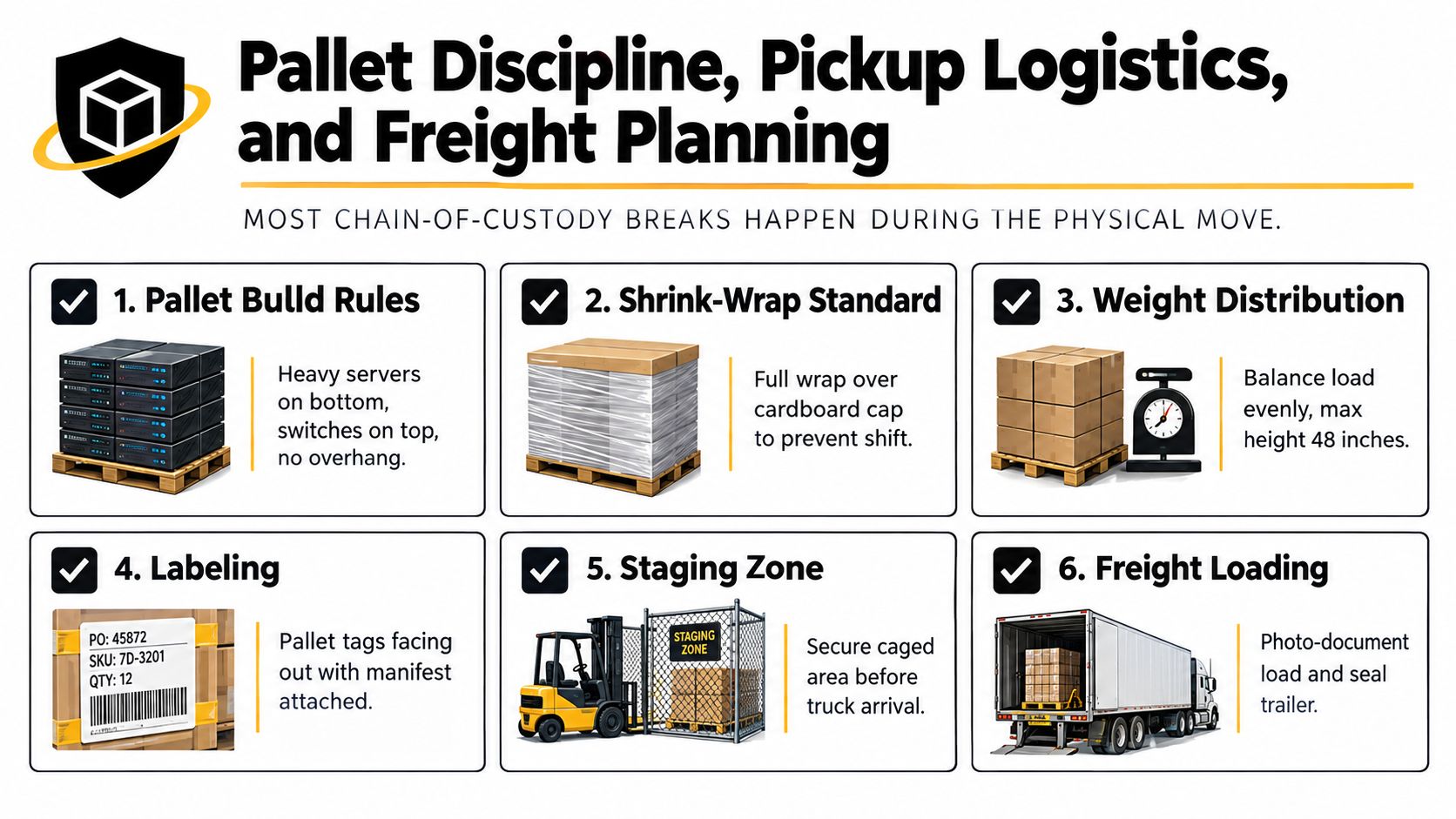
Use these floor rules:
- Build by disposition stream: Keep reuse, harvest, and shred loads on separate pallets.
- Heavy gear stays low: Put dense servers on the bottom, with protection under the first layer.
- Wrap over a cap: Use a cardboard top cap under shrink-wrap so edges do not shift.
- Keep labels visible: Pallet tags should face outward with the manifest attached or cross-referenced.
- Separate smalls from chassis: Bag and label optics, rails, caddies, and loose drives instead of burying them in server pallets.
Freight planning should match risk, not just weight. A dedicated truck usually makes sense for serialized assets, loose media, or regulated equipment because there are fewer handoffs to document. LTL can still be the right call for lower-risk lots or smaller pickups, especially when freight cost would wipe out recovery. The trade-off is simple. Every terminal touch adds another point where labels can tear, pallets can shift, or exceptions can go undocumented.
At pickup, require a dock process your team can repeat every time:
- Signed bill of lading at the dock
- Trailer or seal number captured in photos
- Pallet count verified against manifest
- Wide photos of the loaded trailer
- Close-up photos of labels on the last visible row
Set up a controlled staging lane before the truck arrives. Do not leave tagged pallets in an open traffic aisle next to active warehouse work. If a pallet can be moved, split, or stripped before the driver signs for it, the chain of custody is weaker than it looks.
Freight mistakes also hit the recovery math. One crushed pallet of newer switches can erase the margin you expected from the whole pickup. One box of loose drives loaded outside the serialized media plan can create a compliance problem under the FTC Disposal Rule, HIPAA, or state data disposal laws. Pallet discipline is not warehouse housekeeping. It is the last control point before value recovery and documented disposition leave your building.
Value Recovery, Buyback, and Scheduling Your Next Pickup
If you want better recovery, score each asset class before pickup. Don't ask for a single blended quote on “old IT equipment.” Ask what belongs in resale, what belongs in harvest, and what belongs in scrap.
Google's circularity reporting shows how broad the reverse flow has become. It says millions of assets and components pass through reverse supply chains each year, and its 2025 reporting says two data centers plus one warehouse achieved UL 2799 Zero Waste to Landfill validation, which points to a whole-site material approach rather than only server-box recycling in Google data center circularity reporting.
What a credible buyback quote includes
A useful quote doesn't stop at “we'll take it.” It should spell out:
- Per-unit or per-lot valuation
- What assumptions affect the final settlement
- How data destruction is handled
- Whether settlement is serial matched
- What liability transfers after pickup
For teams planning server and switch refreshes, this data center equipment buyback guide is a practical reference because it ties buyback value to condition, configuration, and disposition path.
What to have ready before you book
A pickup goes faster when the IT lead has three things assembled in advance:
- Asset list with serials and counts
- Sanitization status for all data-bearing media
- Dock contact and warehouse access details
One vendor option in this category is Beyond Surplus, which handles business IT asset disposition, secure data destruction, equipment recycling, and logistics coordination for organizations that need documented pickup and final disposition.
The last operational step is simple. Don't let retired hardware sit until the next facilities emergency forces a rushed removal.
Beyond Surplus helps organizations clear warehouse servers, switches, storage, and related IT gear with documented chain-of-custody, certified data destruction, and value-recovery options that fit reuse, parts harvest, or recycling. If your floor space is tied up by retired infrastructure, visit Beyond Surplus to schedule a pickup and turn the next refresh into a controlled decommission instead of a scramble.


