Your infrastructure refresh is complete, but the retired laptops are still stacked in a locked room, servers remain connected to old storage, and nobody can produce a reliable asset list. That isn't a recycling problem. It's an IT security, compliance, logistics, and value-recovery problem.
The right ITAD companies manage the entire retirement workflow, from inventory and secure pickup to data sanitization, resale, recycling, and final documentation. They help organizations dispose of computers, servers, mobile devices, medical equipment, laboratory equipment, networking hardware, and storage media without treating sensitive technology like ordinary scrap.
For procurement teams, the decision should focus on evidence. A vendor's website may promise secure destruction, but your organization needs verified processes, sufficient processing capacity, documented chain of custody, and a clear answer for lithium-battery-heavy equipment and modern data-center hardware.
Table of Contents
- The Strategic Role of ITAD Companies in Enterprise IT
- Core Services and Data Destruction Methodologies
- Navigating Regulatory and Compliance Requirements
- Vendor Evaluation Checklist and Industry Red Flags
- Documenting Chain of Custody and Comparing Quotes
- Local ITAD Logistics and Atlanta Pickup Operations
- Executing a Secure and Sustainable Decommissioning
The Strategic Role of ITAD Companies in Enterprise IT
An enterprise technology refresh creates a predictable conflict. IT wants equipment removed quickly, security wants every storage device controlled, finance wants residual value recovered, and facilities wants the space cleared. A general hauler may solve the last problem, but it won't necessarily solve the first three.
IT asset disposition has become a strategic service category, not a basic junk-removal function. The global ITAD market was estimated at USD 25.31 billion in 2024 and is projected to reach USD 54.54 billion by 2030, implying a 14.0% CAGR from 2025 to 2030, according to Grand View Research's ITAD market analysis. That expansion reflects shorter device lifecycles, stricter data handling, and more formal retirement programs for laptops, servers, storage arrays, and mobile devices.
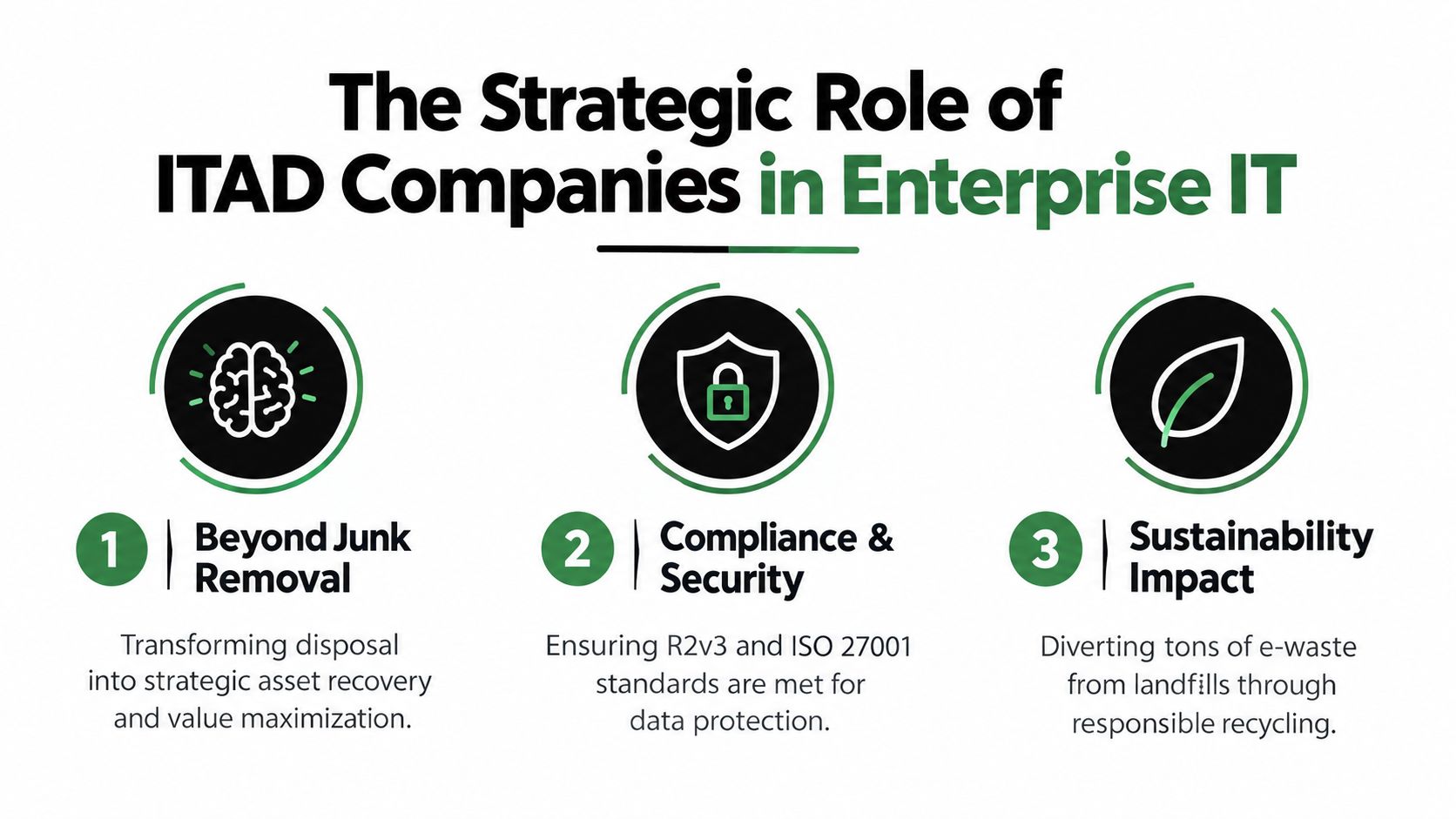
ITAD connects security, recovery, and sustainability
The environmental case is equally difficult to ignore. The Global E-waste Monitor 2024 reported 62 million tonnes of e-waste generated globally in 2022, equal to 7.8 kilograms per person. Only 22.3% was formally collected and recycled in an environmentally sound manner. The same source projects 82 million tonnes by 2030.
Those figures matter to business buyers because undocumented disposal creates operational and reputational exposure. A structured ITAD program first identifies equipment that can be reused or remarketed, then applies the appropriate destruction method to storage media, and finally routes materials through documented recycling channels.
A capable provider can support IT asset recovery, secure e-waste management, electronics recycling, computer recycling, product destruction, and data-center decommissioning. That makes vendor selection a procurement decision with consequences for legal, finance, information security, sustainability, and facilities teams. Organizations evaluating the model should start with what IT asset disposition means for business, then define measurable requirements before requesting quotes.
Procurement rule: Treat ITAD as the final controlled phase of the asset lifecycle, not as a facilities ticket opened after the technology has already left IT's custody.
Core Services and Data Destruction Methodologies
A serious ITAD scope has several distinct workstreams. Combining them in one statement of work prevents gaps between pickup, data destruction, resale, and recycling.
Start with inventory and secure logistics
The provider should receive an asset register containing serial numbers, asset tags, locations, device types, and data sensitivity. At pickup, the team should reconcile the physical equipment against that register and document the custody transfer.
Transportation must match the risk. Sensitive drives may require locked containers, controlled loading, vetted personnel, and direct delivery to a processing facility. A nationwide program also needs a consistent process across regional carriers, remote offices, warehouses, and data centers.
Match destruction to the hardware and risk
ITAD programs typically combine software-based data sanitization, cryptographic erasure, and physical destruction to prevent data recovery and support compliance documentation, as described by IBM's asset decommissioning guidance.
The decision should follow the condition of the device and the sensitivity of the data:
- Certified sanitization can prepare a functional laptop, server, or drive for reuse while documenting the completed process.
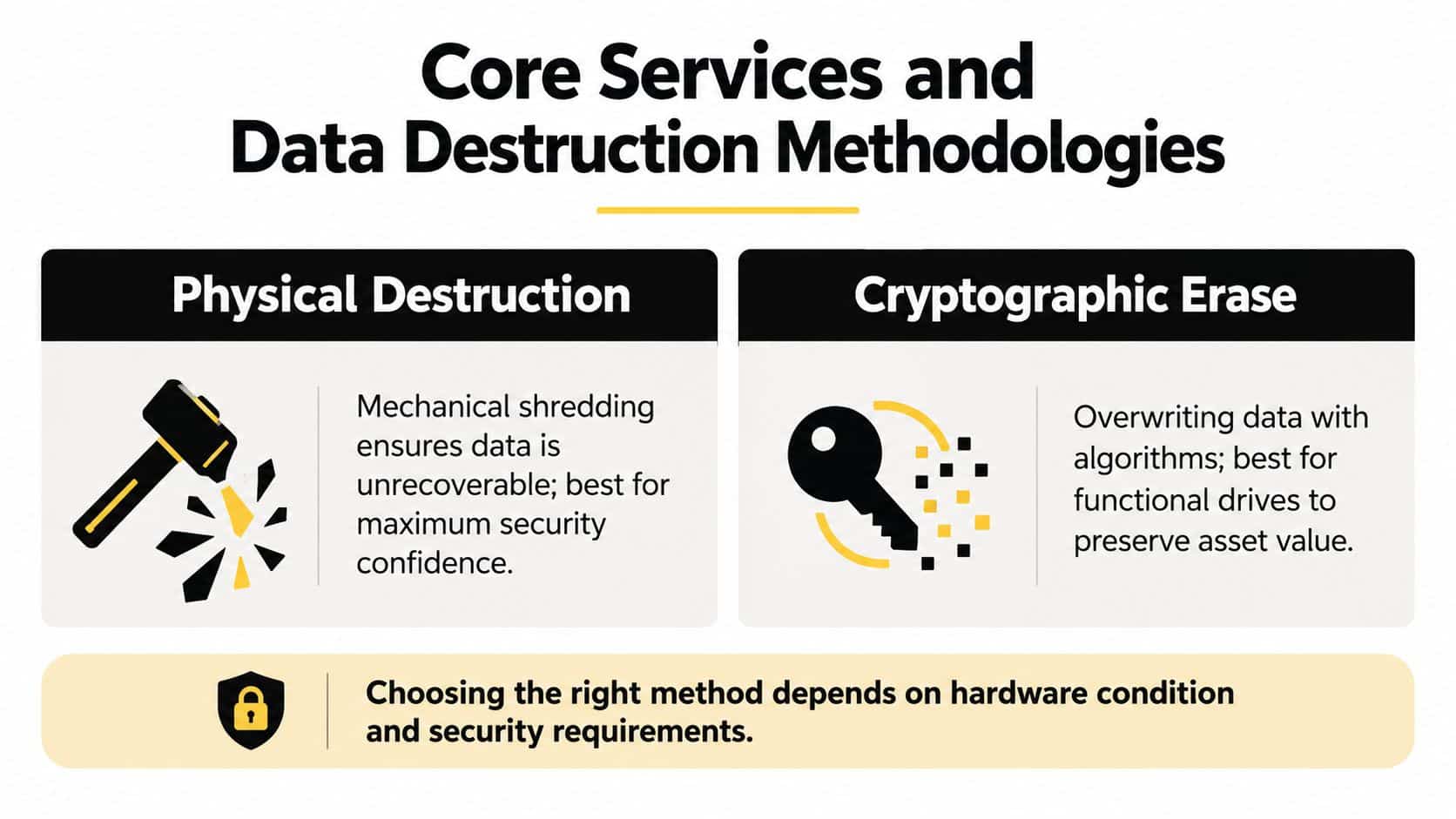
- Cryptographic erasure makes data inaccessible by securely eliminating the encryption keys protecting it. It can preserve hardware value when the drive and its encryption state meet the required conditions.
- Physical destruction uses methods such as shredding or crushing when a drive can't be safely sanitized, the media is damaged, or policy requires irreversible destruction.
The tradeoff is direct. Reuse-preserving methods can retain residual value, while physical destruction provides stronger certainty at the cost of eliminating the drive's resale potential. A provider that recommends shredding every device may be overspending your recovery opportunity. A provider that promises resale without explaining exceptions may be underestimating security risk.
Include value recovery and specialist handling
IT buyback and remarketing should be evaluated separately from destruction. Ask how the vendor grades equipment, handles title transfer, calculates proceeds, and reports the disposition of recovered assets. Recovery shouldn't weaken the security process.
Your scope may also include data-center decommissioning, rack removal, network equipment disposal, laptop disposal, medical equipment disposal, laboratory equipment disposal, and product destruction. These categories introduce different requirements for scheduling, lifting, packaging, power-down coordination, hazardous components, and site access.
Use Beyond Surplus ITAD services as one reference point when comparing service coverage, but judge every provider by its documented controls and ability to execute at your locations.
Navigating Regulatory and Compliance Requirements
Compliance doesn't end when a recycler issues a generic certificate. Your organization remains responsible for demonstrating that sensitive information was protected and that the final disposition followed applicable requirements.
The FTC Disposal Rule took effect on 1 June 2005 and is codified at 16 CFR Part 682. It requires covered businesses that maintain consumer information to take reasonable measures so that the information can't be read or reconstructed. Electronic media may be erased or destroyed, but the business must still be able to show that its process was reasonable and controlled.
Map obligations to evidence
Healthcare organizations should align ITAD with their handling of protected health information. Financial institutions need controls for customer information and retired storage. Government agencies, schools, manufacturers, and professional services firms may face contractual, state, or sector-specific requirements.
The practical mistake is asking only, “Are you compliant?” That question invites a marketing answer. Ask instead:
- What happens at pickup? Require an inventory reconciliation and signed custody transfer.
- How is data removed? Specify approved sanitization, cryptographic erasure, or destruction methods by asset class.
- How is completion verified? Require a certificate tied to each serialized asset.
- Where does equipment go next? Request final disposition records for reuse, resale, recycling, or destruction.
- Who can access the material? Review employee controls, facility security, subcontractor management, and escalation procedures.
Certificates must support an audit
A recycling certificate may confirm that material entered a recycling stream. It may not prove that a particular solid-state drive was sanitized before resale or that a damaged server disk was destroyed.
For organizations governed by formal security policies, the NIST 800-88 data destruction standards explained by Beyond Surplus can help procurement teams translate data-sanitization expectations into contract language. The vendor should explain how it records the asset identity, method used, verification result, operator, date, and final disposition.
Audit standard: If the vendor can't connect the certificate to the serial number, assume the evidence is incomplete.
Don't accept a vendor's certification as a substitute for transaction-level proof. Compliance is a shared liability, and your records must show what happened to each device.
Vendor Evaluation Checklist and Industry Red Flags
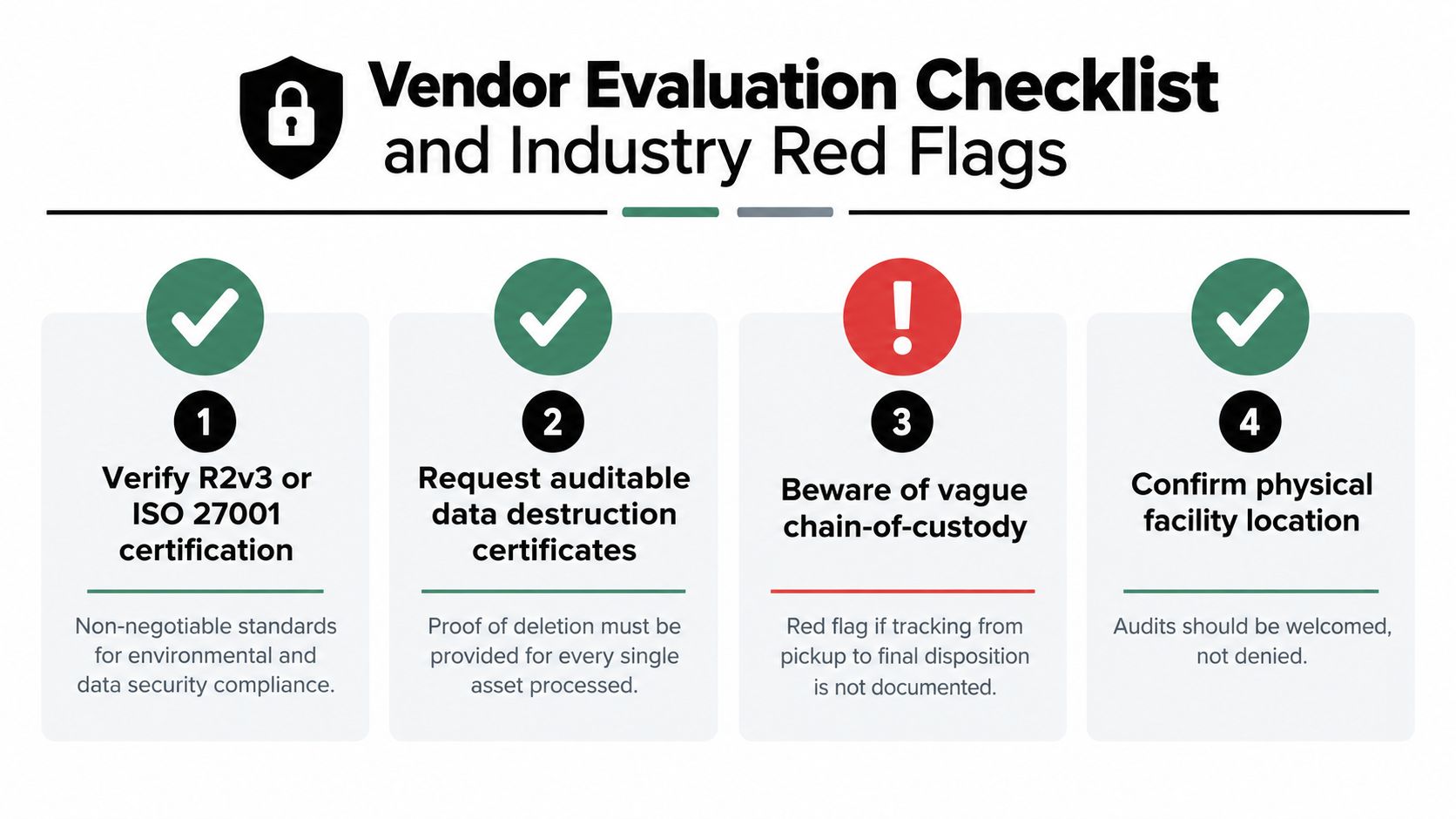
Certifications are useful filters, but they aren't a complete vendor evaluation. Common sector credentials include R2v3, ISO 27001, NAID AAA, ISO 14001, and ISO 9001, as summarized in Iron Mountain's ITAD guidance. Each addresses a different part of operational, environmental, quality, or information-security management.
Separate credentials from operating proof
Start with the certificate. Then test whether the provider can demonstrate how the certified process works at the asset level.
| Evaluation area | Evidence to request | Warning sign |
|---|---|---|
| Data security | Sample serialized destruction and erasure certificates | A generic certificate covering an entire pickup |
| Chain of custody | Inventory, custody transfers, access records, and final disposition | Verbal assurances without system records |
| Capacity | Staffing model, facility throughput, and peak-period plan | No answer for a large refresh or multi-site project |
| Environmental control | Downstream recycler details and material disposition reporting | Unclear subcontractors or undocumented exports |
| Insurance and accountability | Coverage details, contract liability, and incident process | Exclusions that leave your organization exposed |
Investigate the capacity bottleneck
Certified destruction capacity is becoming a practical constraint. Market coverage projects the North American ITAD market from USD 4.85 billion in 2025 to USD 5.35 billion in 2026 and USD 8.71 billion by 2031, while another report identifies a global shortfall of 12,000 to 15,000 NAID AAA-certified technicians, as reported by Mordor Intelligence.
This affects your schedule. A vendor may have an attractive price and a valid certification but lack the trained staff to process a data-center exit without creating a backlog. Ask how many technicians will work on your project, where processing will occur, what happens if volumes spike, and whether subcontractors handle any stage.
Lithium batteries create another red flag. Reports identify lithium-battery fire risk and insurance costs as restraints on the sector, while servers are described as a fast-growing ITAD asset category because of data-center modernization and AI infrastructure expansion, according to Persistence Market Research's ITAD coverage.
Check whether the vendor has written procedures for battery segregation, damaged equipment, UPS units, laptops, networking gear, and dense server racks. A provider that treats every asset as ordinary e-waste isn't ready for modern refresh programs.
For qualified destruction providers, NAID AAA certification information can be part of your comparison. It should sit alongside facility verification, sample records, insurance review, and an operational capacity assessment.
Documenting Chain of Custody and Comparing Quotes
The cheapest pickup quote can become the most expensive option if it leaves your team with missing assets, weak certificates, or unresolved downstream liability. Compare the total cost of risk, not just the line item for transportation.
A complete chain of custody should follow the asset through every handoff:
- Inventory confirmation: Match tags and serial numbers before equipment leaves the site.
- Pickup record: Record date, location, personnel, container count, and exceptions.
- Custody transfer: Identify the carrier, receiving employee, and time of handoff.
- Processing event: Record whether each asset was sanitized, cryptographically erased, shredded, crushed, remarketed, or recycled.
- Final disposition: Document the destination and retain the applicable certificate.
That structure follows business electronics recycling and chain-of-custody guidance, which emphasizes tracking serialized assets through inventory, pickup, custody transfer, sanitization or destruction, and final disposition.
Price the difficult assets correctly
Ask vendors to break out costs for data-center de-installation, on-site destruction, off-site processing, packaging, transportation, labor, battery handling, and downstream recycling. Require assumptions for mixed loads, incomplete inventories, damaged equipment, and restricted-access sites.
Lithium batteries deserve explicit treatment in the quote. Laptops, UPS units, mobile devices, and some networking equipment may need segregation, specialized packaging, and additional safety controls. Dense AI-era server refreshes can also involve heavier equipment, more complex rack removal, and tighter scheduling windows.
A vendor that excludes these issues may appear cheaper because it hasn't priced the full work. Ask for the incident-prevention plan, insurance implications, and escalation process before approving the statement of work.
Use Beyond Surplus's chain-of-custody explanation as a useful reference when defining the closeout package. Your contract should state the records required, the delivery format, the deadline for exceptions, and the process for reconciling missing or disputed assets.
Local ITAD Logistics and Atlanta Pickup Operations
The physical plan matters as much as the data-destruction policy. A regional business may need equipment collected from offices in Atlanta, consolidated through a secure facility in Smyrna, and coordinated with a national pickup schedule for other locations. The provider must make those handoffs visible rather than treating geography as an informal exception.
Atlanta operations typically begin with a site survey or inventory review. The ITAD team confirms loading access, elevators, dock restrictions, security requirements, equipment volume, and whether technicians must disconnect or de-install racks. Facilities and IT should agree on the pickup window before the vendor arrives, especially when servers, UPS units, networking equipment, or laboratory systems require specialist handling.
Choose the right transportation model
A dedicated fleet can provide tighter control for sensitive or high-value equipment. Vetted transportation partners can extend coverage when a project spans multiple states. Neither model is automatically superior. The deciding factor is whether the provider maintains consistent custody records and can identify every carrier and receiving location.
For smaller sensitive batches, a controlled local drop-off may be practical when the facility accepts commercial equipment under defined procedures. The same rules still apply. Equipment needs an intake record, serialized tracking, secure storage, and documented processing.
Beyond the Atlanta area, business customers should expect the vendor to coordinate pickups across the contiguous United States. Ask whether the provider manages scheduling directly, how it handles remote sites, and who owns exceptions when a carrier misses a collection or an asset count doesn't reconcile.
Operational test: Request a sample Atlanta pickup workflow and a sample nationwide exception report before signing a master services agreement.
A strong local footprint should support, not replace, national execution. Your organization needs one accountable program owner, consistent certificates, and a single reporting structure across offices, warehouses, data centers, schools, healthcare sites, and government facilities.
Executing a Secure and Sustainable Decommissioning
A defensible decommissioning program starts before equipment is unplugged. Create an asset list, classify data sensitivity, identify reuse candidates, select destruction methods, and define the evidence required at closeout. Then assign ownership across IT, security, procurement, legal, finance, facilities, and sustainability teams.
The operating sequence should be simple enough for site teams to follow:
- Prepare the inventory: Reconcile serial numbers, asset tags, locations, and ownership.
- Control the movement: Use secure pickup procedures and record each custody transfer.
- Sanitize or destroy: Apply certified erasure, cryptographic erasure, or physical destruction according to policy.
- Recover value: Route eligible equipment to refurbishment or resale only after data controls are complete.
- Recycle responsibly: Use documented downstream channels for equipment that can't be reused.
- Close the file: Retain certificates, exception reports, recovery statements, and final disposition records.
Sustainability doesn't mean choosing resale at any cost. It means preserving usable equipment where security and condition allow, recovering materials through responsible recycling, and destroying media when the risk requires it. That balance protects residual value without making environmental goals an excuse for weak information controls.
The best ITAD companies make the process auditable and operationally predictable. They can explain who handles the equipment, how they manage batteries and servers, how they protect data during transport, and exactly what your team receives after completion.
Begin with a controlled pilot at one site. Test the inventory reconciliation, pickup process, certificate format, exception handling, and reporting before expanding nationwide. If the vendor can't pass that test with a limited scope, a larger rollout will only multiply the weakness.
Beyond Surplus provides commercial IT asset disposition, secure data wiping, hard-drive shredding, electronics recycling, IT equipment disposal, product destruction, data-center de-installation, and value-recovery services with documented chain of custody. Visit Beyond Surplus to discuss a secure pickup and decommissioning plan for your business.


