A warehouse cleanout often starts with a familiar scene: retired laptops stacked beside scanners, servers waiting on a decision, loose cables in gaylords, and spare battery packs sharing a pallet with ordinary electronics. The dock team wants the space back, IT needs proof that data was handled correctly, and finance wants to know whether any value can be recovered. Treating the job as haul-away creates avoidable risk. Warehouse Electronics Cleanout Services work best as a controlled asset recovery, recycling, and documentation process.
Table of Contents
- Why Warehouse Electronics Cleanouts Need a Real Plan
- How to Scope and Inventory Everything Before You Move It
- Protecting Data and Handling Batteries the Right Way
- Staging Transportation and Chain of Custody That Holds Up to Audit
- How to Choose a Vendor and Understand Cost and Timelines
- Final Checks Reporting and Keeping Your Warehouse Clear
Why Warehouse Electronics Cleanouts Need a Real Plan
A warehouse rarely accumulates obsolete technology in one clean stream. Equipment arrives from failed deployments, office moves, facility upgrades, product returns, and data center work. Some devices still contain company information. Others contain lithium batteries, sealed lead-acid batteries, or components that need specialized handling. When all of it gets loaded together, the vendor may have to stop, open pallets, and resort material before processing can begin.
That delay is operationally expensive even when no invoice has been issued. Dock access stays occupied, active inventory routes become more complex, and employees lose time identifying equipment that should have been classified before pickup. The larger concern is accountability. A business needs to know what left the site, who accepted it, how data-bearing assets were processed, and which materials entered an environmentally sound recycling channel.
The scale of the global problem reinforces why a warehouse program needs structure. Global e-waste reached 62 million tonnes in 2022, equal to 7.8 kilograms per person, while only 22.3% was formally collected and recycled in an environmentally sound way, according to the Global E-waste Monitor 2024. The report projects annual generation will reach 82 million tonnes by 2030, with yearly generation rising by about 2.6 million tonnes. Those conditions make documented commercial recovery more important than informal disposal.

The outcome a business should expect
A properly managed cleanout produces more than an empty corner. It should deliver:
- Clear space: Equipment is removed without obstructing receiving, fulfillment, maintenance, or emergency access.
- Secure processing: Data-bearing devices follow an approved sanitization or destruction path.
- Material separation: Batteries, specialty equipment, reusable IT assets, and ordinary electronics are identified before transport.
- Value recovery: Eligible servers, laptops, networking equipment, and peripherals are evaluated for reuse or buyback.
- Audit evidence: Asset records, transfer receipts, recycling certificates, and data destruction certificates match the work performed.
The people involved should agree on the outcome before anyone schedules a truck. IT owns data decisions and serial records. Facilities controls access, staging space, dock timing, and building constraints. EHS reviews battery and hazardous-material concerns. Finance determines whether recovered value, disposal charges, or project codes need to appear in the final report. Sustainability and compliance teams may also need weight and processing summaries.
Practical rule: A cleanout isn't complete when the pallet leaves the building. It's complete when the business can explain what happened to every relevant asset.
How to Scope and Inventory Everything Before You Move It
The most effective pre-cleanout process starts with a map, not a pickup date. Walk the entire facility and mark every location where electronics may be stored, including mezzanines, maintenance cages, locked IT rooms, returns areas, offices attached to the warehouse, and overflow trailers. Include equipment that isn't visibly obsolete. A powered-down server or boxed scanner can still contain data or batteries.
The Global E-waste Monitor toolbox supports the broader need for structured e-waste management. Its relevance to warehouse work is practical: sorting and reporting reduce the chance that material leaks into informal or non-compliant channels. Mixed asset streams create a second problem because downstream processors may need to resort them manually.
Build separate streams before scheduling
Use physical zones, pallet labels, and a shared digital log. At minimum, create separate categories for:
- Data-bearing equipment: Servers, laptops, desktops, hard drives, solid-state drives, networking devices, multifunction printers, and removable media.
- Battery-rich or damaged items: Handheld scanners, spare battery packs, UPS units, powered tools, and devices with swollen, leaking, or crushed batteries.
- Standard electronics: Monitors, keyboards, cables, printers, power supplies, and ordinary peripherals.
- Potentially reusable assets: Working or repairable equipment that should be evaluated separately from material destined for destruction.
Record manufacturer, model, serial number where available, condition, location, and stream. Photograph pallets before movement, then capture the label after staging. If serial capture isn't practical for every cable or accessory, document the lot by pallet ID and item description, while preserving serial-level records for data-bearing assets.
Mark a pickup trigger so obsolete equipment doesn't wait indefinitely. A calendar-based cadence works for facilities with predictable accumulation. A volume-based trigger works better when projects produce irregular surges. Assign one local site owner who can resolve questions at the dock and prevent unapproved additions to the shipment.

Define the report before pickup
Ask finance, IT, EHS, and sustainability what they need to receive. A useful reporting package may include a serialized asset list, pallet or lot identifiers, weights, reuse or destruction disposition, certificates, and exceptions. Defining this early prevents a common failure: completing the physical removal and discovering afterward that nobody captured the information required for an audit.
The inventory optimization service can be evaluated when a business needs help organizing asset records before a commercial electronics pickup. The service decision should follow the site's needs, not the other way around. A clean inventory makes the physical move faster because workers aren't repeatedly opening pallets to determine where each item belongs.
Protecting Data and Handling Batteries the Right Way
Data security and battery handling deserve separate controls because the failure modes differ. A warehouse may contain a mix of magnetic hard disk drives, SSDs, laptops, removable media, and devices that are too damaged to power on. The right sanitization method depends on the media and the intended disposition. A single instruction such as “wipe everything” doesn't address every device class.
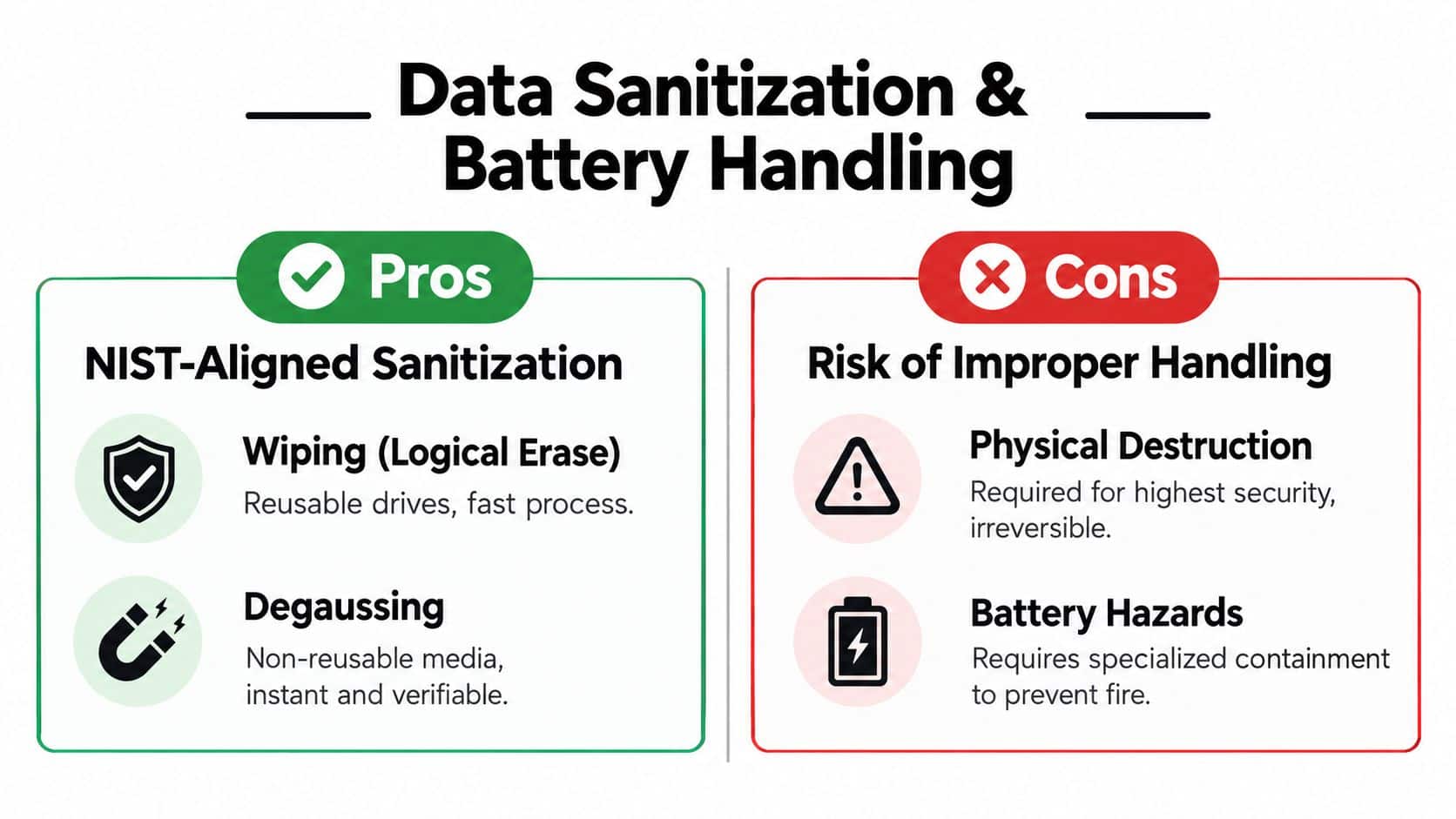
For data-bearing equipment, a NIST SP 800-88-aligned workflow begins with serial-level inventory and a documented decision. Reusable drives may be suitable for logical sanitization when the media and software support reliable verification. Degaussing applies to magnetic media, such as appropriate HDDs, but it doesn't sanitize SSDs and shouldn't be used as a universal solution for mixed piles. Physical destruction may be appropriate when reuse isn't allowed, the media is damaged, or the security requirement calls for irreversible processing.
Industry reporting cited in the ITAD statistics overview states that 99.9% of destruction requests met the NIST 800-88 standard when certified ITAD workflows were used, and that 92% of enterprises used certified ITAD for data sanitization compliance. The same source reports degaussing in 45% of HDD destruction processes. These figures don't eliminate the need to verify a vendor's actual procedure, but they illustrate why certified workflows and media-specific decisions matter.
Match the method to the media
A defensible process answers four questions:
- What is the device? Capture the serial number, media type, and condition.
- Can it be reused? If yes, use a verified logical sanitization process where appropriate.
- Is the media magnetic? Degaussing may fit qualifying HDDs, but not SSDs or mixed media.
- Does the risk require destruction? Physical destruction removes reuse potential but can provide an appropriate final disposition for sensitive or damaged media.
The NIST SP 800-88 data sanitization service provides a reference point for businesses defining these controls. Require certificates that connect the disposition to the device or lot. A certificate with no traceable relationship to the asset list is weak evidence.
Treat batteries as a material-handling issue
Battery-rich lots need their own staging area and escalation rules. Palletized scanners, loose lithium packs, damaged UPS units, and powered equipment shouldn't be tossed into a general electronics container. Workers should identify swelling, punctures, heat damage, leakage, exposed terminals, and crushing before consolidation. Damaged packs should be isolated using procedures appropriate to the battery type and site safety plan.
Whether batteries must be removed on-site depends on the device design, the processor's acceptance rules, worker qualifications, and the condition of the item. Don't force removal from a damaged unit just to make sorting easier. Record who made the handling decision, where the item was placed, how it was packaged, and which receiving processor accepted it.
Recent industry coverage identifies battery risk as a major force reshaping electronics recovery and reports that California is adding battery-embedded products to its recycling program beginning January 1, 2026. The e-scrap conference coverage provides context for the added sorting and documentation complexity. For auditors and insurers, photographs, exception logs, packaging records, and processor acceptance documentation are more useful than a generic statement that batteries were “handled safely.”
Staging Transportation and Chain of Custody That Holds Up to Audit
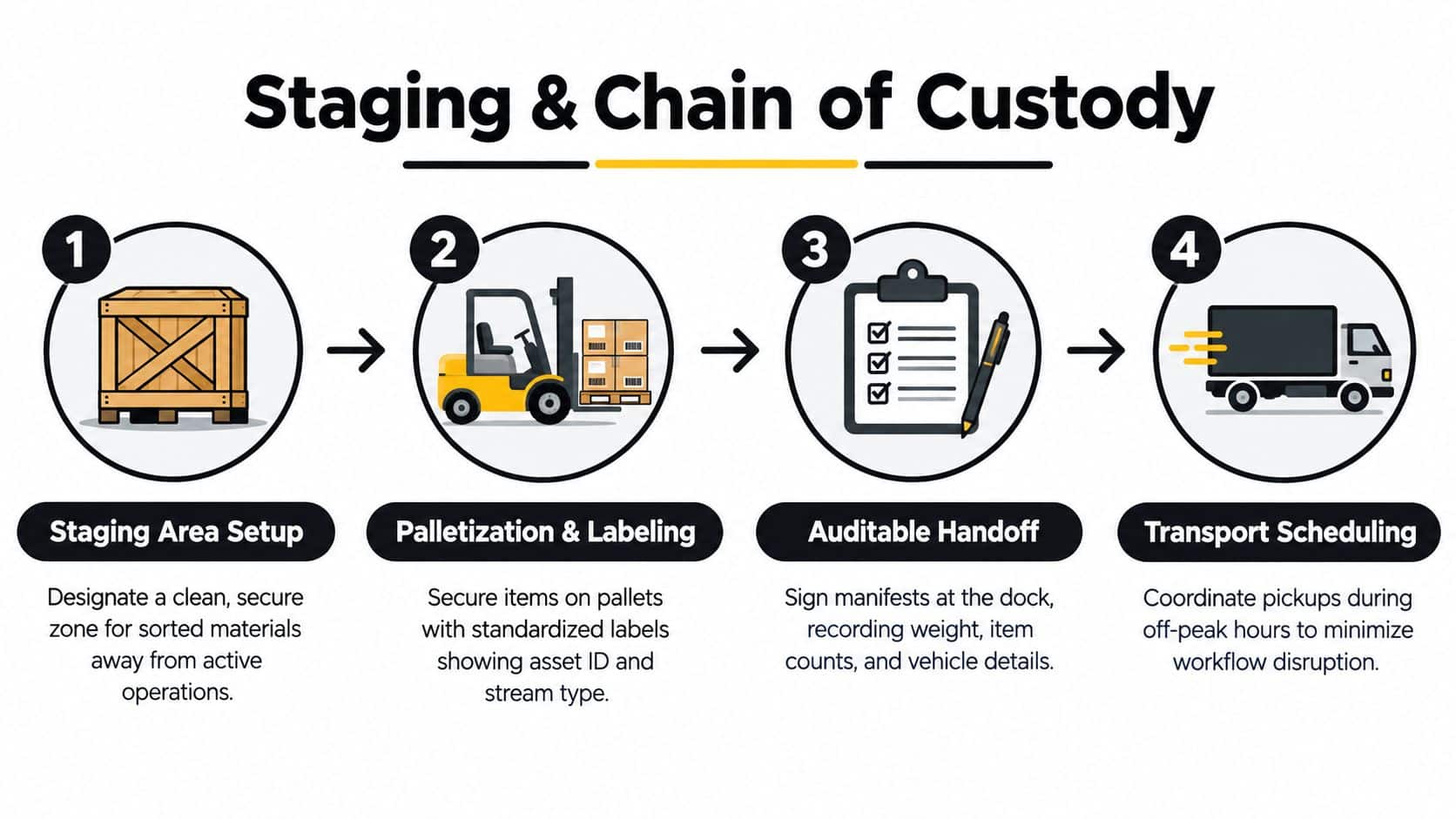
A warehouse can be technically ready for pickup and still lose time because the staging plan ignores daily operations. Select a clean, secure area away from active picking lanes, sprinkler obstructions, forklift conflict points, and emergency egress. The site owner should confirm access rules, dock hours, elevator limits, loading requirements, and whether a vendor needs labor to de-install equipment from racks, walls, or workstations.
Palletize by stream and keep labels visible on at least two sides. A useful label includes the site identifier, pallet or lot number, stream type, approximate contents, and whether the pallet contains data-bearing equipment or batteries. Stretch wrap protects the load, but it shouldn't conceal the label or prevent a count.
Put a record at every handoff
Chain of custody should follow the material from the warehouse floor through processing. At the dock, compare the staged inventory with the pickup manifest. Record the transfer date, sender, receiver, vehicle or shipment details, pallet counts, weights where available, and exceptions such as missing serials or damaged packaging. Retain signed transfer evidence rather than relying on an email saying the truck arrived.
The transport plan should also match the cargo risk. Use vetted carriers, secure vehicles, and tracking appropriate to the project. Schedule loading during a lower-impact operating window, but don't trade safety for speed. If a load contains batteries or regulated material, confirm packaging and transport acceptance before the truck arrives.
The chain of custody for IT asset disposal process gives teams a framework for aligning physical transfers with documentation. That record should continue through secure processing, where the business receives applicable certificates of data destruction and recycling.
Transportation risk deserves its own review when equipment moves between facilities or processors. Teams coordinating high-value loads may also benefit from this inland marine insurance guide 2026 from PTL Insurance Associates, Inc., particularly when internal insurance requirements differ from a carrier's standard coverage.
Coordinate the handoff across departments
IT should approve the data disposition. Facilities should release the dock and confirm labor access. EHS should review batteries and damaged items. Finance should receive the final disposition and value recovery information. A short pre-load meeting prevents the driver, warehouse crew, and project manager from working from different assumptions.
The United States has a patchwork of e-waste controls, and the 2024 monitor reports that only 81 countries, or 42% of countries worldwide, had an e-waste policy, legislation, or regulation in place, as summarized by Embedded Artistry's report discussion. Multi-site businesses should therefore confirm jurisdiction-specific requirements rather than assuming one facility's process applies everywhere.
How to Choose a Vendor and Understand Cost and Timelines
A low bid can exclude the work that makes a warehouse cleanout defensible. Compare vendors on process, documentation, material capability, and logistics before comparing price. Ask for a sample certificate, a sample serialized report, the proposed disposition flow, and a written explanation of how exceptions are handled.
| Evaluation Criteria | What to Ask | Why It Matters |
|---|---|---|
| Data destruction | Which methods are available for HDDs, SSDs, removable media, and damaged devices? | A media-specific process prevents incomplete sanitization. |
| Battery handling | How are loose, damaged, and embedded batteries segregated, packaged, and documented? | Battery-rich lots need controls beyond ordinary e-waste sorting. |
| Environmental processing | Which downstream processors receive each material stream? | You need a clear disposition path and responsible recycling evidence. |
| Logistics | Can the vendor palletize, de-install, load, and coordinate multi-site pickup? | Labor and transport gaps often create the biggest schedule delays. |
| Reporting | Will the final package include serial records, certificates, weights, and exceptions? | Complete records support finance, compliance, and sustainability reviews. |
| Value recovery | How are reusable assets tested, priced, and reconciled? | Reuse and buyback should be transparent, not an unexplained deduction. |
| Insurance and liability | What coverage applies during loading, transport, and processing? | Responsibility must be clear at every handoff. |
Understand what changes the estimate
Cost and timing depend on the device mix, total volume, weight, data-bearing ratio, battery condition, site access, travel distance, labor requirements, and reporting depth. A pallet of sorted monitors is a different project from a warehouse containing rack servers, loose drives, damaged UPS units, and equipment still installed in cages.
Request separate line items for de-installation, inventory, packing, transportation, data destruction, recycling, and value recovery. This structure makes competing bids easier to compare and exposes services that a low headline price may omit. It also helps the project owner decide whether to stage internally or pay the vendor for sorting labor.
For broader relocation planning, this business moving advice from Get n Go from Get n Go Removals Melbourne offers useful context on coordinating business moves, access, and scheduling. Electronics cleanouts need those same operational disciplines, with added controls for data and material disposition.
Use a written scorecard rather than relying on a polished sales call. The vendor due diligence checklist can help procurement and IT document the questions, evidence, and approvals required before award.
Final Checks Reporting and Keeping Your Warehouse Clear
The last truck departure starts the closeout, not the end of the project. Reconcile the pickup manifest against the final inventory. Investigate missing serials, added items, damaged packages, rejected batteries, and any difference between estimated and received material. A processor should explain exceptions in writing rather than changing the disposition without notice.
A complete closeout package may include:
- Final asset reconciliation: Match serials, pallet IDs, lot descriptions, and exceptions.
- Data destruction certificates: Connect the method and device population to the approved disposition.
- Recycling certificates: Identify the processed material and responsible downstream path.
- Weight records: Preserve tickets or processor summaries for environmental reporting.
- Value recovery records: Show tested equipment, accepted units, credits, or buyback results.
- Sustainability summary: Provide usable information for internal ESG and waste reporting.
The audit trail reporting service can be considered when a business needs a more consistent way to organize closeout evidence. Finance, IT, EHS, and compliance should review the package together. Each group sees a different failure: an unreconciled asset, an unsupported data disposition, an undocumented battery exception, or a report that can't support sustainability records.
Prevent the next accumulation
A clean warehouse stays clear when ownership continues after the project. Set quarterly sweeps or another practical review cadence, designate a labeled electronics staging area, and require departments to identify obsolete equipment before it spreads into active storage. A standing pickup schedule can be tied to calendar dates or agreed volume thresholds.
The 2024 monitor reports that global e-waste generation is growing five times faster than documented e-waste recycling, according to UNITAR's Global E-waste Monitor release. For business operators, that gap is a reason to maintain a repeatable process rather than wait for another emergency clearout.
Beyond Surplus offers nationwide business pickup, secure data destruction, electronics recycling, IT asset recovery, product destruction, data center de-installation, and chain-of-custody reporting, with Atlanta-area drop-off available for applicable materials. Schedule the next review before obsolete equipment consumes valuable space or creates an unmanaged liability.
Contact Beyond Surplus to plan a warehouse electronics cleanout with separate handling for data-bearing assets, batteries, reusable equipment, and general e-waste. Request a documented pickup, secure processing, value recovery review, and audit-ready certificates that help your team close the project properly.