
The lease return date is approaching, but the equipment list still lives in three places: the lessor's schedule, the CMDB, and a spreadsheet from the last office move. Some laptops are already in storage, a server has been replaced without an updated serial number, and nobody can confirm whether the drives were wiped or just reset. That's the point where end-of-lease IT equipment disposal stops being a shipping task and becomes an operational risk.
A reliable return protects four outcomes at once: compliance, security, cost control, and sustainability. The work starts with a defensible inventory, continues through a media-specific sanitization decision, and ends only when every handoff and certificate maps back to the right asset.
Table of Contents
- Why End of Lease Disposal Needs a Playbook Now
- Getting Your Inventory and Audit Ready Before Pickup
- Choosing the Right Data Sanitization Method for Every Device
- Building Chain of Custody and Compliance Proof
- Coordinating Timelines Logistics Value Recovery and Sustainability
- Your End of Lease Disposal Checklist and Next Steps
Why End of Lease Disposal Needs a Playbook Now
Lease returns create a compressed deadline that cuts across IT, procurement, facilities, finance, and the lessor. Procurement needs the equipment returned according to contract terms. Facilities needs racks, cables, and staging areas cleared. IT needs to protect data on every storage device. Finance needs a clear view of residual value, while compliance teams need records that can withstand an audit.
A casual electronics drop-off can't satisfy those requirements. It may remove hardware from the premises, but it doesn't prove which serial numbers left, who handled them, how data was sanitized, or where each unit went afterward. Lease-return work also includes equipment that may be reusable, eligible for buyback, required for return, or unsuitable for resale because of condition or data risk.
The scale of the wider waste problem makes disciplined disposition more important. The world generated a record 62 million tonnes of e-waste in 2022, up 82% from 2010, and the total is projected to reach 82 million tonnes by 2030, according to the Global E-waste Monitor 2024. Only 22.3% of the 2022 total was documented as formally collected and recycled in an environmentally sound manner, leaving more than three-quarters outside formal recycling channels. That stream contained an estimated US$62 billion in recoverable natural resources, which makes IT asset disposition both a control function and a value-recovery decision.

Operational standard: A successful return isn't complete when the truck leaves. It's complete when the lessor receives the correct equipment, every storage device has a defensible disposition, and the records show what happened to each asset.
The playbook protects the business from four common breakdowns:
- Security exposure: Unverified deletion can leave data accessible on retired HDDs, SSDs, servers, and mobile devices.
- Lease disputes: Missing or substituted units can create avoidable charges and reconciliation work.
- Lost value: Reusable equipment can be destroyed or recycled before anyone evaluates its recovery route.
- Environmental gaps: Hardware can leave the organization without a documented, responsible recycling path.
The strongest programs treat the return as a controlled chain of custody. Inventory determines the assets in scope. Sanitization intent determines the approved method. Handoff records connect physical movement to the asset register. Certificates close the loop.
Getting Your Inventory and Audit Ready Before Pickup
Start with the original lease schedule, not the storage room. The lease document defines what the lessor expects back, while the physical audit establishes what the organization has. Your CMDB or asset management platform provides a third view, and the return plan must reconcile all three.
Build one working asset register with a row for every unit. At minimum, capture:
- Identity: Manufacturer, model, serial number, asset tag, and lease ID.
- Location: Building, room, rack, staging area, or assigned department.
- Condition: Working status, cosmetic damage, missing parts, and visible security concerns.
- Configuration: Installed drives, memory, accessories, docking stations, power supplies, and rack hardware.
- Disposition path: Lessor return, resale review, recycling, or destruction.
- Data decision: Planned Clear, Purge, or Destroy outcome, with the reason for that choice.
Reconcile the register against the Beyond Surplus inventory optimization service or the organization's own inventory controls. The important point isn't the software brand. It's having one source of truth that drives pickup paperwork, sanitization records, certificates, and final reconciliation.
Resolve exceptions before the loading window
A serial mismatch discovered at pickup is expensive because the crew, lessor, and internal team are already operating under time pressure. Flag missing, damaged, substituted, surplus, and unlocated assets during the audit, then assign an owner to each exception.
Photograph equipment when condition could affect a return decision. Capture the serial label, asset tag, exterior condition, and any missing accessory. For servers and network equipment, record rack position and de-installation dependencies before anyone disconnects the unit.
Teams handling data center moves should also account for access controls, change windows, power-down sequencing, and removal hazards. A resource on risk management in data center migration can help frame those dependencies when the lease return overlaps with a broader infrastructure move.
Create a pickup-ready packet
The final pre-pickup packet should include the approved manifest, site contacts, access instructions, packing requirements, lessor return terms, exception list, and planned disposition routes. Give the pickup team a copy of the serial-level list and require a physical scan or manual verification at collection.
Don't bundle equipment by room alone. Bundle it by documented asset group, and keep accessories associated with the unit they support. A clean manifest prevents the most common failure in lease returns, the assumption that a full truck means a complete return.
Choosing the Right Data Sanitization Method for Every Device
A device-specific decision is safer than a universal wipe policy. NIST SP 800-88 Rev. 2 defines three disposal outcomes, Clear, Purge, and Destroy, and states that Destroy is appropriate for hard copy and most information storage media when reuse isn't required. The correct choice depends on the media, the intended next use, and the assurance level the organization requires.
The NIST SP 800-88 guidance should anchor the policy, but the asset register must translate that policy into an instruction for each serial number.
| Device Media Type | Reuse Intent | Recommended Method | Verification Proof |
|---|---|---|---|
| Magnetic HDD | Redeploy or return for reuse | Validated Clear or Purge method appropriate to the risk | Tool result, operator record, serial match, and certificate |
| SSD or NVMe drive | Redeploy or return for reuse | Cryptographic erase or manufacturer secure erase when supported and verifiable | Device identity, method output, verification result, and certificate |
| Self-encrypting drive | Reuse with encryption controls intact | Cryptographic erase, subject to verification and policy | Drive serial, encryption state, erase result, and reviewer record |
| Any storage media with failed verification | No trusted reuse path | Physical destruction | Serial-level destruction record and certificate |
| Mobile device | Redeploy after account removal | Approved device reset and sanitization process, with verification | IMEI or serial, reset confirmation, and disposition record |
| Paper or hard-copy media | No reuse | Destroy, including secure shredding where appropriate | Destruction log tied to the collection batch or asset record |
A generic “deleted” status isn't proof of sanitization. Basic formatting or an ordinary overwrite can be unsuitable for modern storage technologies, particularly when the organization can't verify how the device implements the operation. For SSDs, NVMe devices, and self-encrypting drives, cryptographic or manufacturer-supported erase may preserve reuse value, but only when the result can be verified and linked to the correct asset.
Physical destruction offers a clear endpoint, but it eliminates resale and reuse. Use it when the media can't be verified, the organization requires destruction, or the device is damaged and no longer suitable for redeployment. On-site destruction can reduce transport exposure, while off-site processing may provide greater equipment capacity and centralized reporting. The decision should follow risk and evidence requirements, not convenience alone.
Audit rule: Never record only “wiped.” Record the method, media class, operator or system result, verification status, date, and serial number.
Keep the sanitization record attached to the asset register. Certificates should identify the processed unit or a clearly controlled batch, and the batch must still reconcile to the serial-level manifest. This linkage is what turns a technical action into defensible compliance proof.
Building Chain of Custody and Compliance Proof
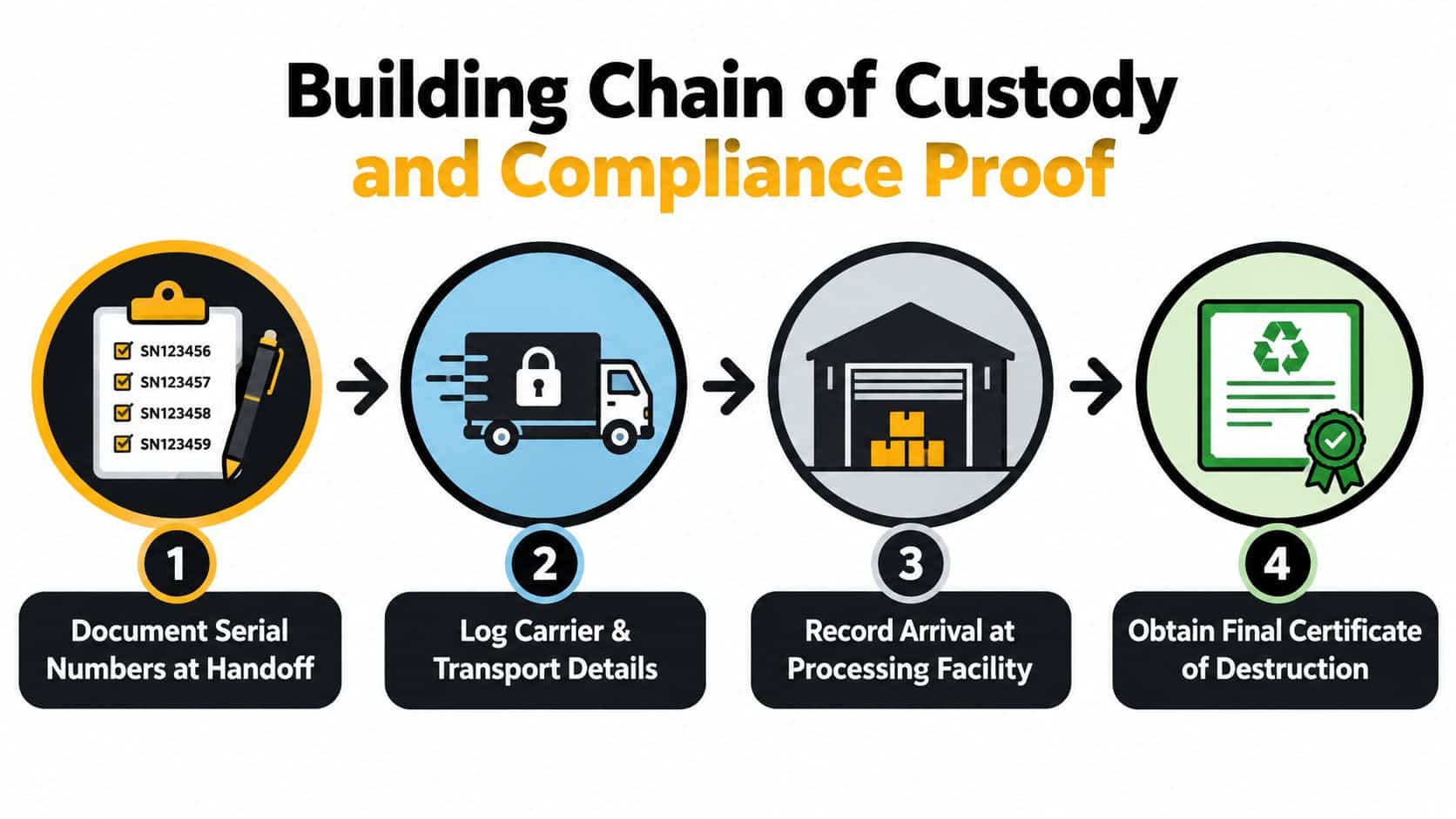
A lease return can fail after pickup if one serial number, handoff, or certificate does not reconcile. Chain of custody starts before equipment enters a truck. At collection, compare each unit with the approved manifest, confirm the serial number, record the transfer time and location, and document exceptions. The handoff record should name the releasing employee and receiving representative, plus carrier or vehicle details, container count where relevant, and visible damage.
Tamper-evident packaging helps maintain control between sites and makes unauthorized access or substitution easier to identify. It does not replace the manifest. Sensitive media also needs controlled staging, with access limited to personnel whose roles are documented.
Record every transfer
The processing facility should acknowledge receipt against the pickup manifest. Log missing, unexpected, or damaged items as exceptions immediately. Waiting for a later email thread creates gaps in the record. The receiving log should retain timestamps, personnel, shipment references, and the condition of the load.
The disposition record must then show the route assigned to each asset:
- Return: Equipment prepared for the lessor under its requirements.
- Reuse or resale: Equipment held for evaluation after verified sanitization.
- Recycling: Hardware sent to responsible electronics processing.
- Destruction: Media or products physically destroyed when reuse is not approved.
The Beyond Surplus chain-of-custody process shows the handoff structure business teams should expect from an ITAD provider. Paperwork matters only when it connects pickup, processing decisions, and the final certificate to the asset register.
Map records to the applicable rule
The FTC Disposal Rule requires covered businesses to take reasonable measures against unauthorized access to or use of consumer-report information during disposal. It recognizes methods including burning, pulverizing, shredding, and effective electronic processes, as described in this FTC Disposal Rule resource.
Healthcare organizations face more specific requirements. Under 45 CFR 164.310(d)(2), covered entities and business associates must maintain policies and procedures for final disposition of electronic protected health information and the hardware or electronic media storing it. HHS guidance requires ePHI to be unreadable, unrecoverable, and indecipherable before disposal, as summarized in this HIPAA disposal requirements guide.
PCI obligations, state privacy rules, contracts, and internal security policies may add controls. Build a documentation packet containing the approved manifest, transfer logs, sanitization results, destruction records, recycling certificates, exception resolutions, and final reconciliation. Keep e-waste reporting separate where applicable, using the e-waste data resource for that purpose. This asset-level mapping gives auditors evidence and gives procurement a clear record for lessor discussions.
Coordinating Timelines Logistics Value Recovery and Sustainability
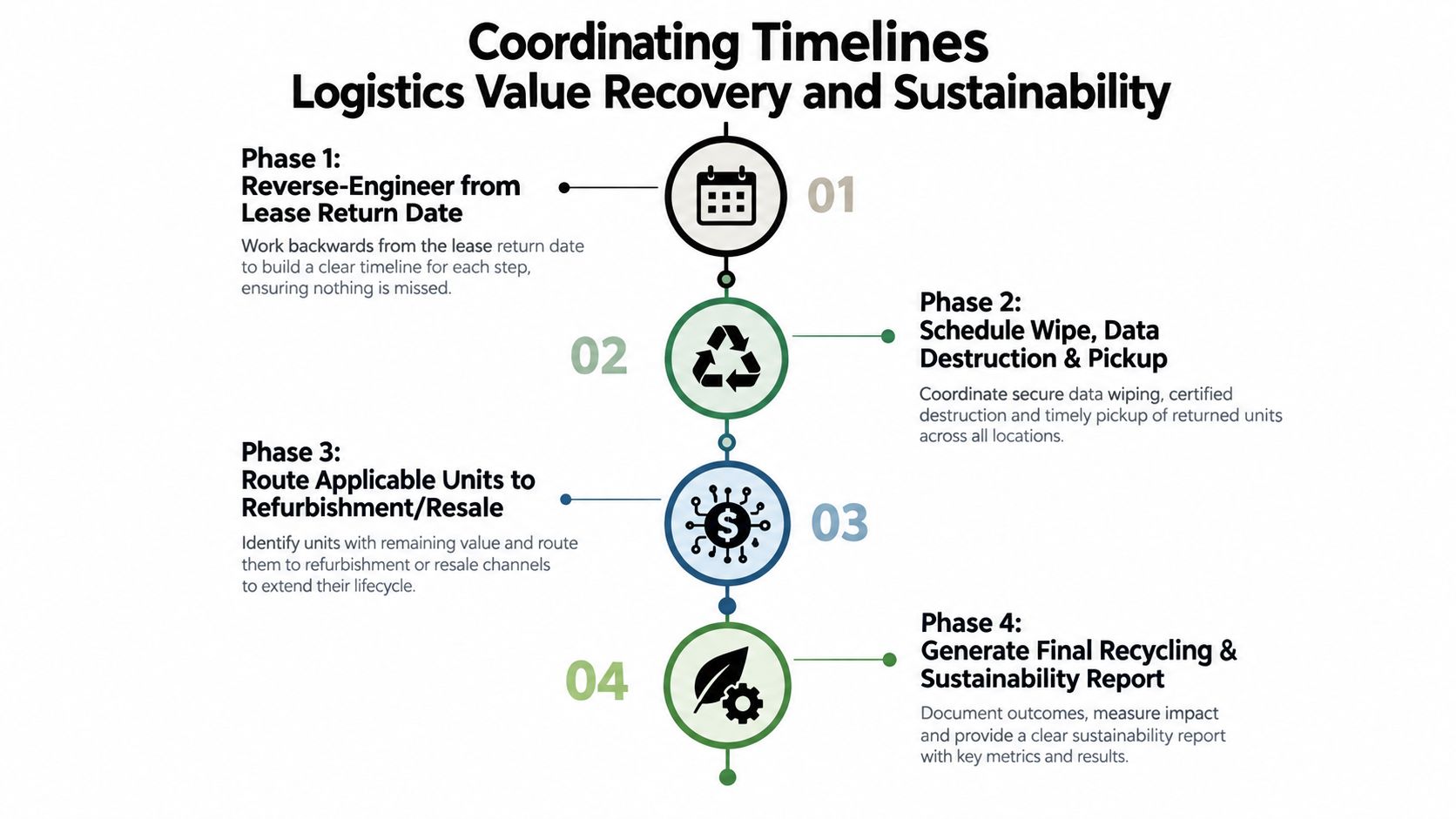
Work backward from the contractual return date. The reverse timeline should include internal approval, user collection, data-center de-installation, inventory reconciliation, sanitization, condition review, packing, pickup, lessor delivery, and certificate completion. Leave room for exceptions because a missing serial or failed erase can change the route for an entire asset group.
Schedule the physical work around business operations. Office laptops may require department-by-department collection, while servers and storage arrays require maintenance windows, dependency checks, and controlled shutdowns. A pickup appointment isn't a de-installation plan, and a packed pallet isn't proof that the lessor's requirements have been met.
Route assets according to value and risk
Don't send every unit down the same path. Working laptops, servers, networking equipment, and storage systems may qualify for resale or buyback after data sanitization and condition grading. Damaged equipment, obsolete peripherals, and media that can't be verified may need recycling or destruction.
That triage has a real trade-off. Destruction creates a decisive endpoint but removes recovery potential. Resale can recover value but requires more inspection, secure processing, and documentation. A lease return may also impose a different priority than a resale route, so the contract and asset register must govern the decision.
Treat sustainability as a reporting requirement
The e-waste stream is growing by about 2.6 million tonnes per year, and the Global E-waste Monitor projects 82 million tonnes by 2030, roughly 32% above the 2022 baseline. Those projections make formal recycling and recovery planning relevant to long-term IT operations, not just annual sustainability reporting, as documented by the Global E-waste Monitor projection.
Request reporting that distinguishes reuse, resale, recycling, and destruction. Environmental reporting should identify what was processed and through which approved route, while security reporting should identify what happened to data-bearing media. The sustainable IT asset management guidance can help teams connect disposition decisions with broader lifecycle practices.
Planning principle: The fastest route isn't always the cheapest route. A rushed pickup can create late-return exposure, missed recovery value, or an evidence gap that takes longer to repair than the original task.
Your End of Lease Disposal Checklist and Next Steps
A dependable return can be managed with a short, disciplined control list:
- Confirm the contract: Review return dates, equipment specifications, condition standards, accessory requirements, and delivery instructions.
- Reconcile the fleet: Match the lease schedule, CMDB, and physical inventory by serial number and asset tag.
- Resolve exceptions: Assign owners to missing, substituted, damaged, or unlocated equipment before pickup.
- Approve disposition routes: Separate lessor returns, reusable units, resale candidates, recycling, and destruction.
- Document sanitization: Assign Clear, Purge, or Destroy by media type and reuse intent, then retain verification evidence.
- Control handoffs: Record pickup, transport, facility receipt, processing, and final disposition.
- Close the records: Link certificates of data destruction and recycling to the asset register and resolve every variance.
Vendor selection deserves the same scrutiny as the equipment audit. Ask whether the provider supports on-site and off-site data destruction, has documented chain-of-custody controls, can manage business pickups across the required geography, and provides certificates that identify processed assets. Confirm how the provider handles data-center de-installation, laptop disposal, medical equipment disposal, laboratory equipment disposal, product destruction, electronics recycling, and IT asset recovery.
The business computer recycling checklist can help procurement and IT teams organize the questions before selecting a partner. Require transparent reporting, clear exception handling, and a defined escalation path for damaged or mismatched assets.
For nationwide business returns, Beyond Surplus provides IT asset disposition, electronics recycling, secure data wiping, on-site or off-site hard-drive shredding, product destruction, data-center de-installation, logistics coordination, and certificates of recycling and data destruction. Its business pickup service is available across the contiguous United States, with chain-of-custody documentation designed for enterprise records.
Contact Beyond Surplus to plan your next lease return with serial-level inventory control, certified data destruction, responsible electronics recycling, and coordinated business pickup. Their team can help route reusable equipment toward value recovery while documenting the final disposition of every asset.