

You've got a refresh underway, and a stockroom is filling with retired laptops, switches, and servers. A vendor has offered one attractive number, but it doesn't say what testing, data handling, transport, or recycling will cost. Don't approve a buyback on that headline figure. Run it as a configuration-level, time-sensitive decision that weighs net recovery against security evidence and chain of custody.
Table of Contents
- Why IT Equipment Buyback Has Become an Enterprise Priority
- Building an Asset Register That Actually Holds Up
- What Should Be in a Buyback Valuation
- Comparing Buyback Offers Without Getting Burned
- Data Sanitization and Chain of Custody
- Coordinating Pickups, Mail-Ins, and On-Site Destruction
- A Repeatable Buyback Playbook and Next Steps
Why IT Equipment Buyback Has Become an Enterprise Priority
IT equipment buyback belongs in the asset lifecycle plan, not at the end of a rushed decommissioning. The United Nations' Global E-waste Monitor reported that the world generated 62 million tonnes of e-waste in 2022, up from 34 million tonnes in 2010. Only 13.8 million tonnes, or 22.3%, were documented as formally collected and recycled in an environmentally sound manner. The report also estimated that US$62 billion in recoverable natural resources went unaccounted for that year. (Global E-waste Monitor 2024)
That gap matters to businesses retiring usable technology. A working laptop or server may still be suitable for refurbishment, resale, or redeployment. If it sits in storage until it's treated as scrap, the organization may lose recovery value while taking on additional handling and audit work. Buyback creates an earlier decision point: identify which assets can be reused, which need secure destruction, and which belong in responsible material recovery.
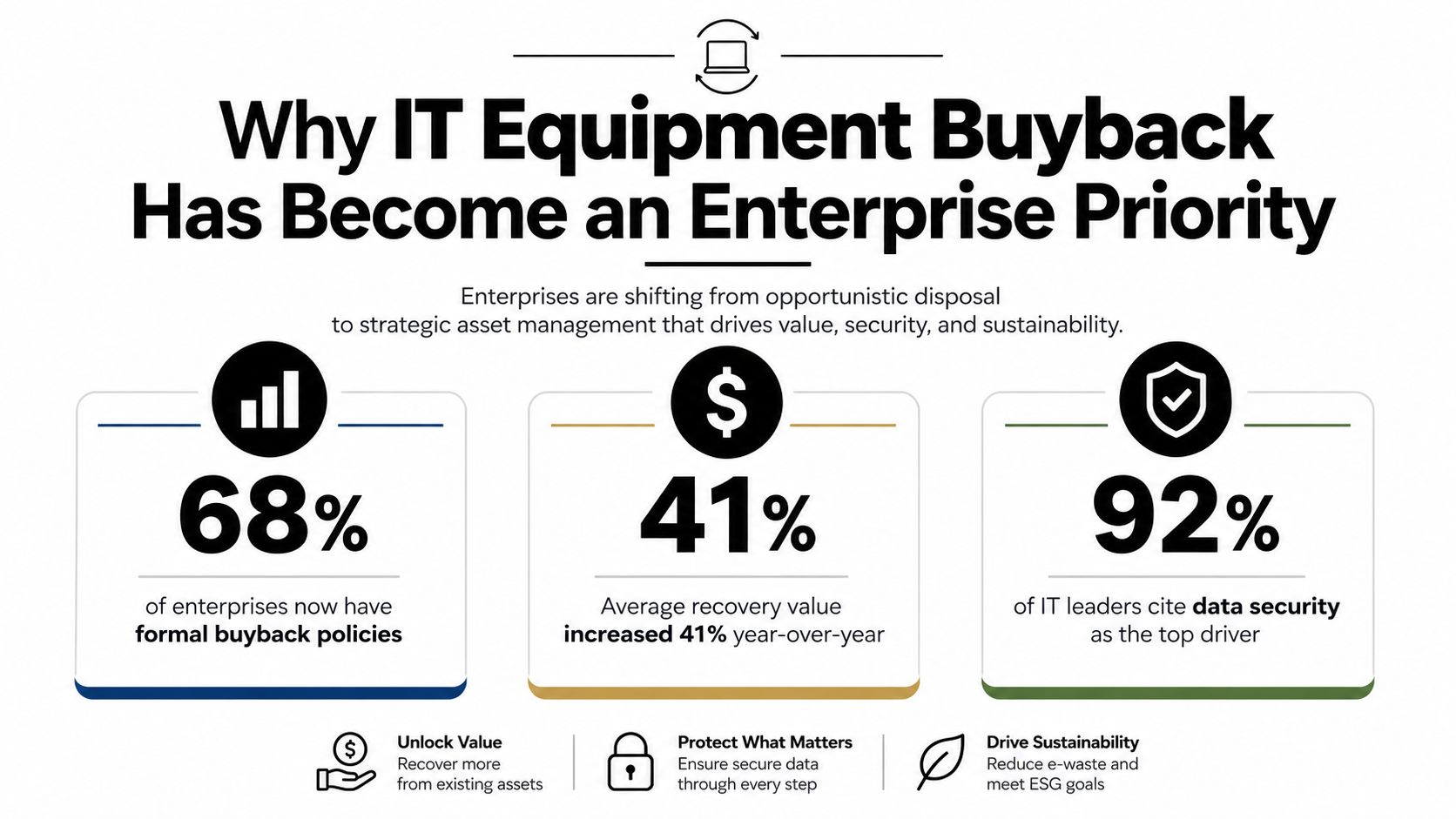
The information-and-communication-technology category, including laptops, phones, routers, and GPS devices, accounted for approximately 4.6 million tonnes of e-waste in 2022, but only 22% was documented as collected and recycled. The same monitor projects global e-waste generation could reach 82 million tonnes by 2030, while formal collection and recycling could fall to 20% under a business-as-usual scenario. (Global E-waste Monitor 2024)
Operational rule: Retire equipment into a controlled recovery process while it still has reuse potential. Don't let “we'll deal with it later” become your disposal policy.
A buyback program connects finance, IT, security, and sustainability. It can preserve residual value, create auditable records, and distinguish reusable hardware from equipment that must be recycled. That's a stronger control than treating the buyer's truck as the moment your responsibility ends.
Building an Asset Register That Actually Holds Up
A vendor can't price a fleet accurately from “a pallet of laptops” or “some server gear.” Build a configuration-level register before requesting bids. The goal is to give every buyer the same description of the same equipment, then reconcile each item through pickup, processing, and payment.
Start with the fields that affect usability and resale:
- Identity: Manufacturer, model, serial number, and asset tag.
- Configuration: CPU generation, RAM, storage type and capacity, GPU, and network interfaces.
- Completeness: Power supplies, rails, cables, drives, and other accessories.
- Status: Firmware or support constraints, physical condition, boot status, and quantity.
- Data considerations: Drive type, encryption status, and whether storage is failed, removable, or self-encrypting.
A serial-level record is essential. It helps resolve count disputes, spot missing devices, and tie sanitization evidence to the exact asset. A rough quantity may be useful for an initial conversation, but it's not a control. For inventory procedures that support asset tracking and retirement, use Beyond Surplus's IT asset management best practices.
Stage assets before requesting bids
Separate working equipment from damaged, non-booting, or incomplete units. Flag BitLocker, FileVault, and self-encrypting drive behavior so the data-sanitization plan can account for how each device is configured. Group assets by likely disposition, such as resale or redeployment, repair assessment, and material recycling. Don't mix untested and tested inventory under one broad description.
Photograph condition before packing, particularly for servers, storage arrays, and equipment with visible damage. Bundle accessories with the equipment they belong to, and record what's missing. Those simple practices make later inspection more defensible and help vendors price the same inventory you intend to ship.
A frozen register also gives your team a baseline for the receiving report. If a vendor's inspection changes the valuation, you can compare the revised condition and quantity against documented records rather than relying on memory.
What Should Be in a Buyback Valuation
A quote is not a payout. Compare gross offer, deductions, and realized net proceeds as separate figures, then examine what each vendor includes. Packing, transport, testing, sanitization, refurbishment, revenue sharing, and recycling can all affect the amount your organization recovers.
The comparison should also account for security and compliance costs. A higher offer may not be the stronger choice if it excludes failed-drive handling, offers weak sanitization evidence, or leaves your team to arrange documentation and logistics. Use a security-adjusted total-value model: evaluate proceeds alongside the cost and risk of handling data-bearing devices, documenting disposition, and managing equipment that can't be reused.
| Required Field | Why It Matters | What to Watch For |
|---|---|---|
| Gross offer by configuration | Shows how the buyer values each asset group | A single blended price that hides low offers for specific models |
| Deductions and fees | Reveals the path from offer to payout | Unspecified charges for testing, transport, or processing |
| Data-sanitization scope | Clarifies which devices receive which method | “Wiping included” without verification details |
| Failed-device disposition | Shows how non-working assets will be handled | No defined path for failed storage or incomplete systems |
| Net proceeds | Allows a true comparison across bids | A headline quote presented as guaranteed payment |
| Reconciliation and reporting | Connects the offer to final settlement | No serial-level record of received and processed assets |
For consistent condition descriptions and inspection expectations, see Beyond Surplus's equipment condition assessment. Require vendors to show the assumptions behind their quote, then compare equivalent scopes: tested versus untested, packed versus loose, and sanitization included versus separately priced.
Price against the market, not a static age table
A fixed depreciation schedule can miss demand shifts, especially for data-center equipment. Analysis of more than 2.5 million IT assets processed between 2019 and 2025 reported that server resale prices reached approximately 2.5 times their seven-year average during 2025. The same analysis reported average laptop resale value rising from $93.50 in 2024 to $125.31 in 2025, while desktop values increased from $38.54 to $44.41. (Server resale values in AI-driven secondary IT markets)
Those figures aren't a guarantee for your equipment. They do show why configuration, condition, and timing matter more than age alone. Don't hold assets indefinitely to chase a better quote. Storage, handling, security exposure, and changing demand can erase the expected upside.
Comparing Buyback Offers Without Getting Burned
Collect at least three bids and normalize them before comparing. Each vendor should price the same asset register, under the same assumptions for testing, packaging, transport, sanitization, failed devices, and recycling. If one bid assumes working equipment and another assumes untested stock, the totals don't belong side by side.
Set a minimum bid threshold before offers arrive. That gives procurement a clear escalation point when a quote falls below your internal expectation, without forcing a rushed acceptance. Ask bidders to explain how their offer changes if inspection finds missing accessories, damaged chassis, or failed storage.
Test the partner, not just the price
Request evidence of the vendor's data-destruction methods, certificates of data destruction and recycling, audit access, and downstream handling. Ask whether the counterparty is the buyer, a registered downstream reseller, or a broker. A broker may still be suitable, but your contract and records need to identify who takes possession and who performs each service.
Before award, get clear contract terms for:
- Serial-level reconciliation: The received inventory and final disposition must tie back to your records.
- Data liability: Define when custody and responsibility transfer, and what evidence the vendor supplies.
- Payment timing: Set a specific payment commitment tied to inspection and reconciliation.
- Failed equipment: Specify whether failed items are returned, destroyed, or routed to recycling.
- Scope changes: Require approval for material deductions or changes to the agreed processing plan.
Use these questions to ask before hiring an ITAD company to structure vendor due diligence. Then document why the selected offer won. The answer should reflect net recovery, security controls, and service scope, not just the biggest first number.
Data Sanitization and Chain of Custody
Don't accept a generic promise to “wipe everything.” NIST distinguishes three outcomes for information-bearing media: clear, purge, and destroy. Clear uses logical techniques to address user-accessible storage locations and protect against simple recovery. Purge aims to make recovery infeasible using state-of-the-art laboratory methods while potentially preserving the device for reuse. Destroy makes recovery infeasible and prevents the media from being used again for data storage. (NIST media-sanitization guidance)
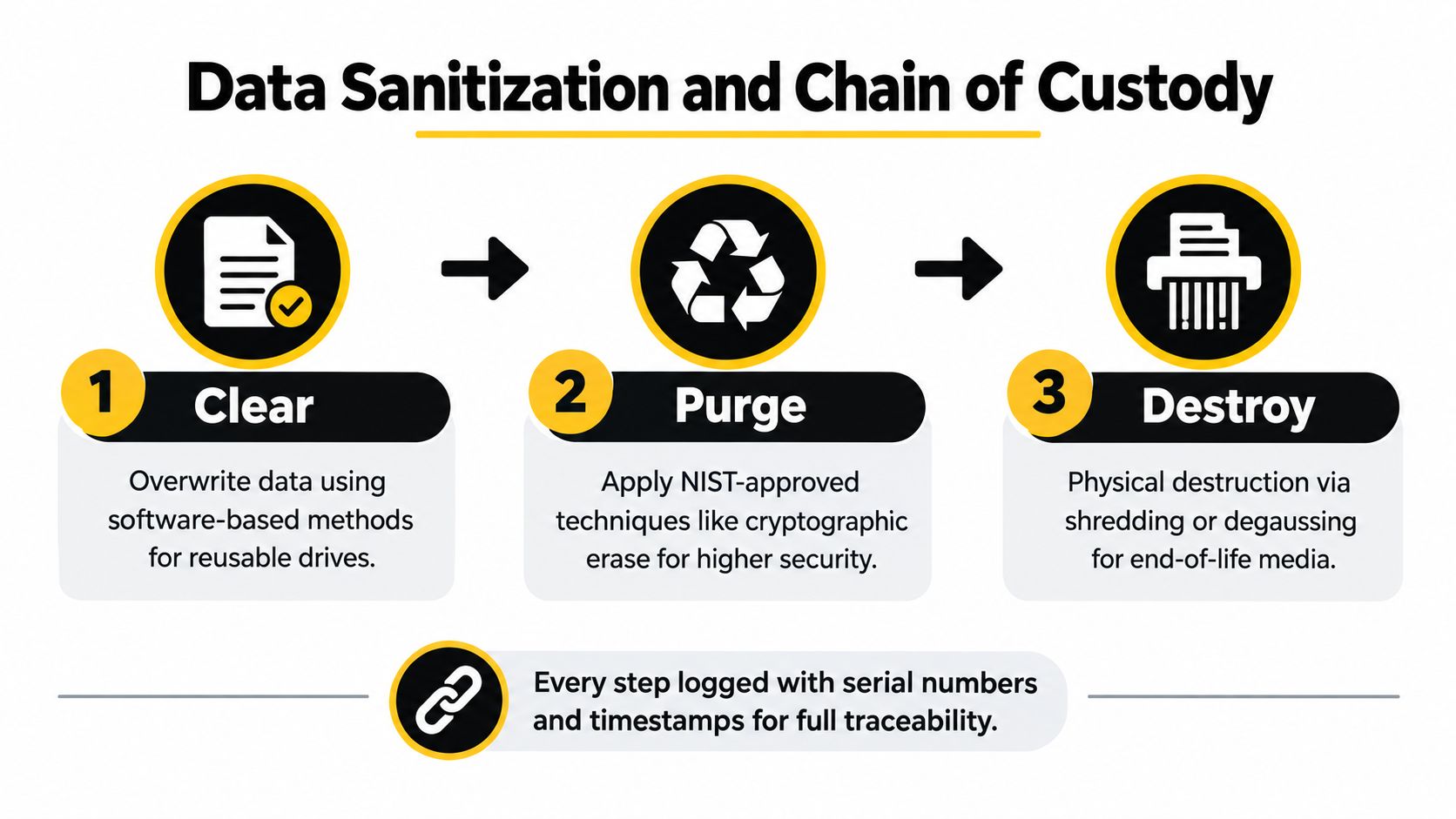
Choose the method by media type, device condition, intended reuse, and data sensitivity. Verified overwrite may suit supported magnetic media. Cryptographic erase may be appropriate when encryption and drive behavior make it technically valid. Physical destruction is the clear choice for failed drives or media that can't be reliably sanitized for reuse.
A single wipe standard across a mixed fleet is a common operational mistake. SSDs, hidden areas, remapped sectors, and failed drives can make conventional overwriting incomplete or impractical. NIST recommends verification after sanitization and a separate secondary check using a different tool, and where possible, personnel who weren't involved in the original process. For high assurance, verification can read all accessible addressable areas to confirm the expected sanitized value; if sampling is used, locations should be pseudorandom and span user-addressable and reserved areas. (NIST SP 800-88 Rev. 1)
Build evidence into the handoff
For organizations that use consumer-report information for business purposes, the FTC Disposal Rule under 16 CFR Part 682 requires reasonable and appropriate disposal practices to prevent unauthorized access or use. The FTC identifies destroying or erasing electronic files and media so information can't be read or reconstructed as an example of acceptable practice. (FTC Disposal Rule guidance)
Require a record for every data-bearing asset that includes its asset ID, serial number, sanitization method, operator, timestamp, verification result, disposition, and certificate. Store those records with the receiving and shipping documentation. For practical chain-of-custody expectations, consult Beyond Surplus's guide to chain of custody for IT asset disposal.
A resale credit doesn't compensate for unresolved data exposure. If a vendor can't prove what happened to a drive, don't treat the device as cleared.
Coordinating Pickups, Mail-Ins, and On-Site Destruction
Choose logistics based on asset volume, data sensitivity, site conditions, and the time available. On-site destruction keeps media destruction visible at your location and can suit high-sensitivity drives. Off-site shredding can work when you have a controlled handoff and auditable transport. Secure mail-in services may fit smaller, well-documented batches, but only when packaging and custody controls are appropriate for the equipment and risk.
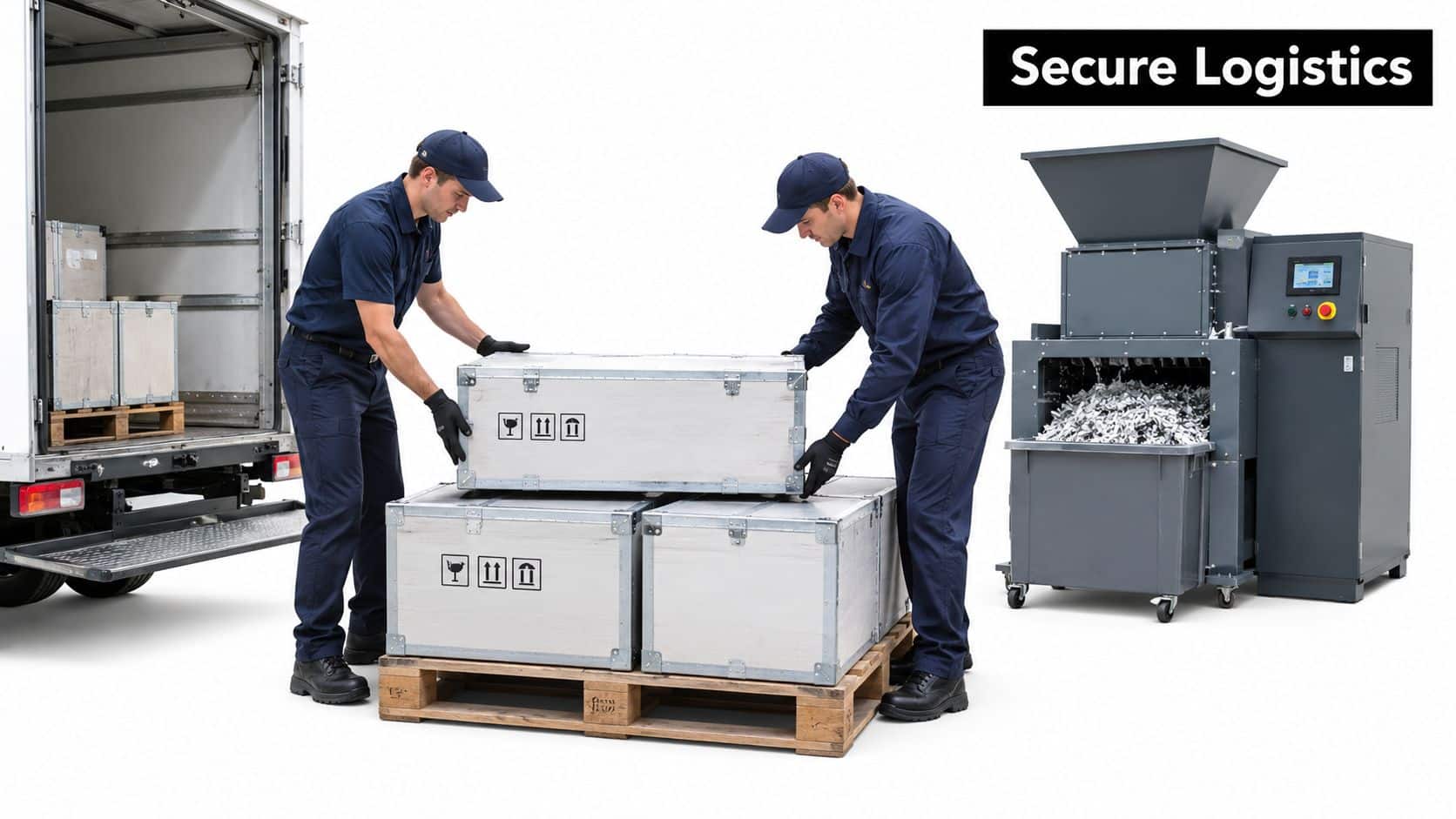
Before pickup, agree on the inventory manifest, container or pallet seals, tamper-evident packaging, custody signatures, and receiving process. A carrier bill of lading records transportation, but it doesn't by itself prove which serialized devices were in the shipment or what happened after delivery. Keep the asset list linked to pickup documentation and final processing records.
Schedule a collection window that won't interrupt active operations. Move retired equipment to a designated, access-controlled staging area, separate from assets still in use, and keep it under your organization's control until the carrier or buyer formally accepts custody. For a distributed organization, define one national process with local flexibility for sites that have stricter requirements.
Healthcare, finance, and government teams should confirm site-specific rules before choosing a method. A consistent partner and common documentation standard can make multi-site programs easier to manage without forcing every facility into the same physical collection setup. Beyond Surplus's nationwide ITAD services describe pickup coordination for organizations operating across multiple locations.
A Repeatable Buyback Playbook and Next Steps
Make buyback a standard part of each refresh, not a cleanup task after the project closes. Run the work in this order:
- Build a configuration-level asset register with serials and condition.
- Separate reusable, failed, and end-of-life equipment.
- Request at least three bids with matching scope and assumptions.
- Confirm sanitization methods, verification, and certificates.
- Schedule pickup or destruction with documented custody.
- Reconcile received serials, final dispositions, deductions, and payment.
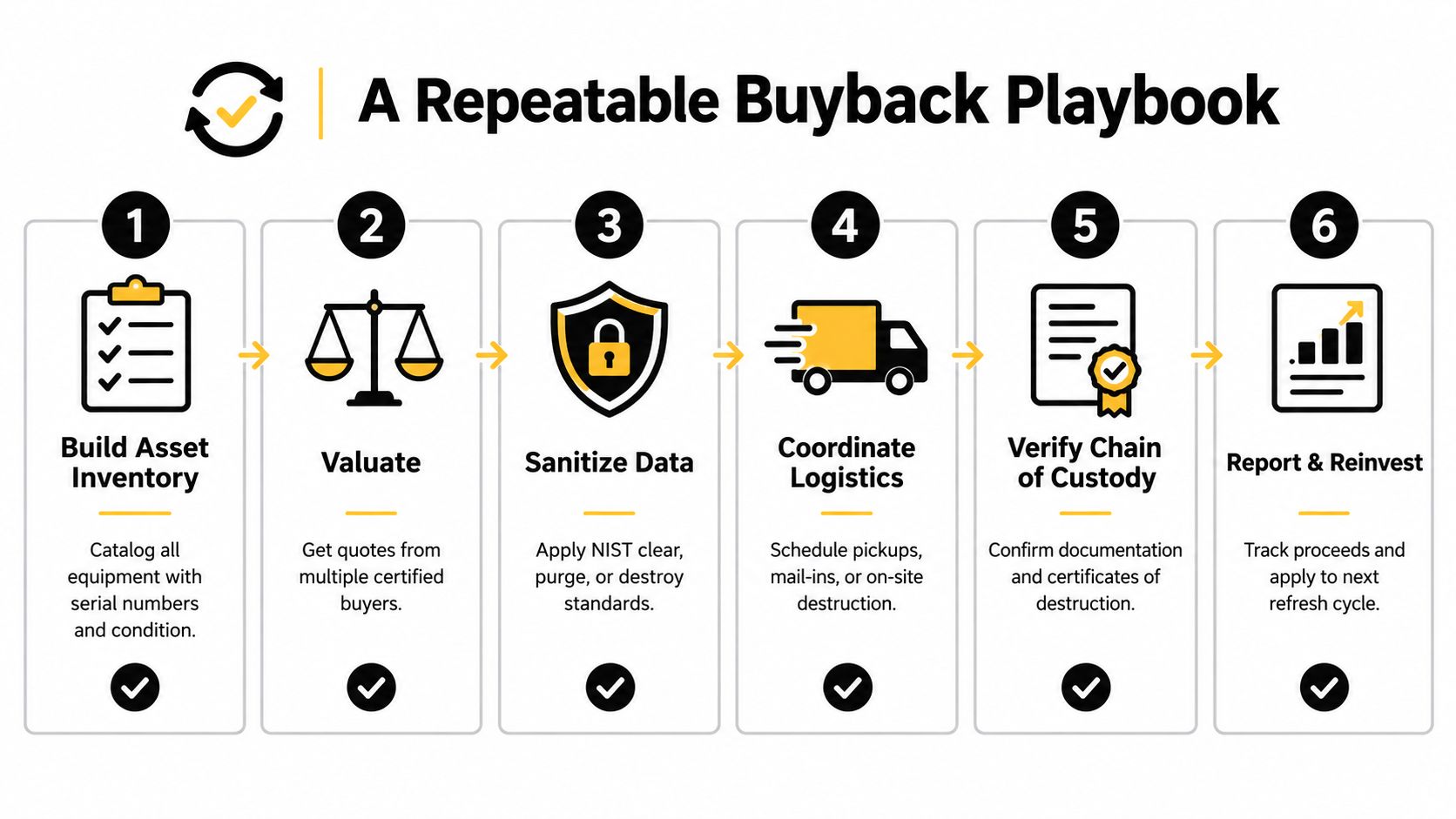
Measure success by net realized proceeds and complete sanitization evidence, not by the headline quote. Archive the inventory, bid comparison, custody records, certificates, and settlement report together so finance, security, and audit teams can review the same transaction trail.
Beyond Surplus provides commercial IT equipment buyback, secure data destruction, certificates of recycling and data destruction, on- or off-site hard drive shredding, and nationwide pickup. If you're preparing a refresh or decommissioning, share your asset inventory and requirements with Beyond Surplus to discuss a controlled recovery process.


