

The equipment closet usually becomes a problem slowly. A few retired laptops sit on a shelf after a refresh. Then old switches, failed drives, decommissioned servers, spare monitors, and phones start piling up. By the time someone asks facilities or IT to “get rid of it,” the problem isn't just clutter. It's untracked assets, unknown data exposure, and no clear record of what left the building.
That's where ITAD in Tucker stops being a recycling conversation and becomes an operational one. Businesses in Tucker sit inside a dense, practical service market, with 37,123 residents across 20.2 square miles and about 1,836.1 people per square mile according to Census Reporter's Tucker profile. For enterprise pickup scheduling, secure transport, and regional processing, that local concentration matters.
A Tucker company doesn't need a generic e-waste answer. It needs a repeatable process for retiring IT equipment without losing auditability, market value, or control of data-bearing devices. If you're evaluating Tucker computer and electronics recycling services, the right starting point is understanding how ITAD works on the ground.
Your Guide to ITAD in Tucker Georgia
A common Tucker scenario looks like this. An office relocates, a clinic upgrades workstations, or a regional business replaces network gear across several departments. The equipment is no longer in production, but it still contains drives, asset tags, configuration history, and possibly regulated data. Someone has to decide what gets wiped, what gets shredded, what can be remarketed, and what goes straight to recycling.
That decision gets harder when the inventory is mixed. Older desktops may have little resale value. Newer servers and storage may still have recoverable value if they're tested and sanitized correctly. SSDs raise a different question than spinning hard drives. A simple haul-off doesn't solve any of that.
Why local execution matters
Tucker isn't just a pin on the map. It's part of the broader Atlanta enterprise corridor, and it already has a direct ITAD footprint. SK tes lists a secure IT asset disposition facility at 5238 Royal Woods Parkway, Suite 110, Tucker, GA 30084, with services that include ITAD, data destruction, e-waste recycling, managed deployment, and data center decommissioning on its Atlanta location page.
That kind of local infrastructure changes the conversation. Shorter transport paths can simplify scheduling and tighten chain of custody. For businesses handling retired hardware at volume, local access supports faster pickups, cleaner documentation handoff, and fewer gaps between removal and processing.
Practical rule: If your team can't answer where each retired asset is, who touched it, and what happened to its data, you don't have disposition. You have exposure.
What ITAD Means for Your Tucker Business
ITAD isn't the same as recycling. Recycling is one downstream outcome. IT asset disposition is the managed retirement of business technology, with decisions around data security, documentation, logistics, reuse, resale, and final material recovery.
The simplest analogy is fleet management. When a company retires a vehicle, it doesn't just abandon it in a yard. It documents the unit, removes identifiers, transfers responsibility, and recovers any remaining value. IT equipment should be handled the same way. That includes desktops, laptops, servers, storage arrays, switches, mobile devices, and data center hardware.
For a plain-language overview, this primer on what IT asset disposition is is useful before you build a vendor checklist.
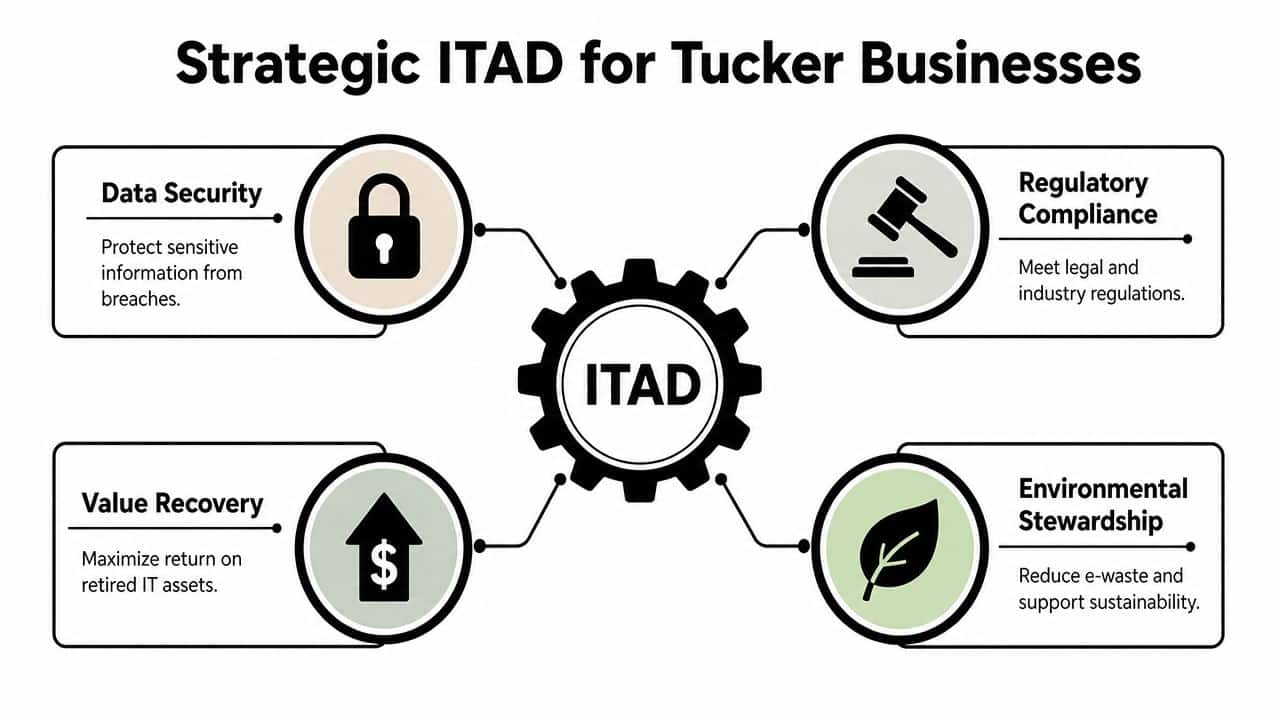
What a business is actually managing
When companies treat old hardware as scrap, they usually miss four separate obligations:
- Data risk. Drives, SSDs, phones, and embedded media can still hold sensitive information.
- Control risk. If serialized assets leave without logging, your audit trail breaks immediately.
- Financial loss. Functional equipment may have residual value before it becomes commodity scrap.
- Environmental handling. Non-reusable equipment still needs responsible downstream processing.
What works and what doesn't
What works is a staged process. Inventory first. Decide destruction method by media type and risk level. Separate reusable assets from end-of-life material. Keep records at the device level where needed.
What doesn't work is mixing everything together and calling it recycling.
The best ITAD programs are built upstream. By the time a pallet is on the truck, the key decisions should already be made.
That shift in mindset matters for Tucker businesses because many are balancing normal operations with compliance demands. The old gear in storage still affects security posture, insurance exposure, and procurement planning until it's retired correctly.
Core ITAD Services Available for Tucker Companies
Most enterprise projects in Tucker fall into a mix of four service tracks. The right provider doesn't push every asset into one bucket. It separates equipment by risk, reuse potential, and operational effort.
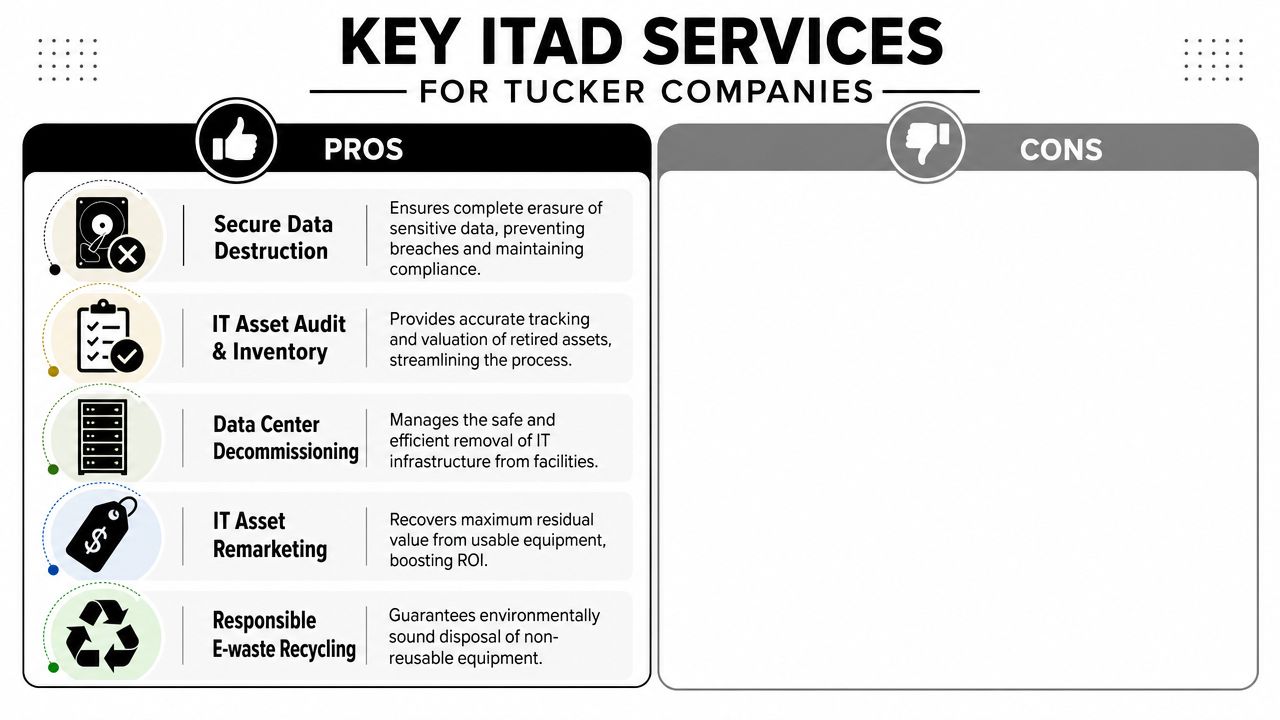
Secure data destruction
This is usually the first decision point. Some devices are candidates for certified data wiping, which preserves resale potential. Others should go to physical destruction, either because the media type is difficult to sanitize defensibly, the asset has no practical remarketing path, or the organization's risk tolerance is low.
Current standards discussions matter here. Buyers increasingly evaluate destruction methods against NIST 800-88 and IEEE 2883-2022, especially for modern media and stronger chain-of-custody expectations. A regulated organization isn't just asking whether destruction is possible. It's asking whether the method is defensible for that specific device and audit environment, as discussed in this industry explainer on modern sanitization standards.
Value recovery and buyback
How ITAD programs are executed frequently determines whether money is saved or wasted. Effective ITAD prioritizes value recovery before recycling. The workflow includes inventory logging, data sanitization, testing, and remarketing of viable servers, storage, and networking gear so recovered value can offset disposition cost, as described in ReluTech's ITAD service overview.
In practice, that means:
- Recent enterprise gear may justify testing and resale.
- Commodity endpoints may be worth processing only in larger batches.
- Obsolete or damaged assets usually move directly to destruction and recycling.
A lot of failed projects come from skipping this triage. Teams either destroy hardware that still had market value, or they spend too much labor trying to monetize equipment that no longer has a realistic secondary market.
Recycling for non-reusable equipment
Once reusable equipment is separated out, the remainder goes to responsible electronics recycling. This includes broken devices, low-value peripherals, end-of-life boards, cabling, and systems that aren't worth refurbishment.
The important point is sequencing. Recycling is the final channel for material that has already cleared the earlier decisions around logging, sanitization, and reuse potential.
Logistics and decommissioning
On-site removal is where chain of custody starts, not where it ends. A proper service plan should address:
- Pickup coordination for offices, clinics, warehouses, and multi-site projects
- Packing and palletizing so equipment moves without damage or mix-ups
- Serialized or batch logging based on the level of reporting required
- Data center decommissioning for racks, storage, network gear, and retired infrastructure
If a vendor talks mostly about recycling and barely mentions inventory control, they're describing commodity hauling, not enterprise ITAD.
Ensuring Compliance and Security with Certified ITAD
The most expensive ITAD mistake usually isn't a processing fee. It's weak documentation.
A business can remove equipment from a Tucker site and still carry the risk if it can't prove what happened next. That's why compliance-heavy organizations focus on chain of custody, serialized records, certificates, and standards-based handling for data-bearing assets.
Documentation is the control point
Modern ITAD requires more than a recycling receipt. Buyers increasingly expect device-level traceability and proof that data was handled according to standards such as NIST 800-88 or IEEE 2883-2022, with documentation that supports liability transfer, as noted by this ITAD documentation overview.
That changes what you should ask for after pickup. Not just “Did you recycle it?” but:
- What assets were received
- How each data-bearing device was processed
- Whether sanitization or destruction was performed
- What final documentation closes the loop
Why certifications and process discipline matter
The strongest ITAD providers make their process auditable. They don't rely on verbal assurances. They produce records that procurement, compliance, legal, and IT can all use.
If your team is evaluating certified vendors, this guide to R2 certified ITAD providers in Georgia is a good lens for comparing process maturity.
A solid compliance package usually includes a certificate of data destruction, a certificate of recycling where relevant, intake records, and itemized reporting when required. For some organizations, batch-level reporting is enough. For others, especially those with regulated data or strict asset governance, serialized documentation is the safer route.
Audits don't fail because a company meant well. They fail because the record set is incomplete.
The Beyond Surplus Process Step by Step
From the client side, a good ITAD engagement should feel structured and predictable. The process shouldn't require your team to invent the workflow as it goes.
A practical reference is how the ITAD process works, especially if you're coordinating across IT, facilities, and procurement.
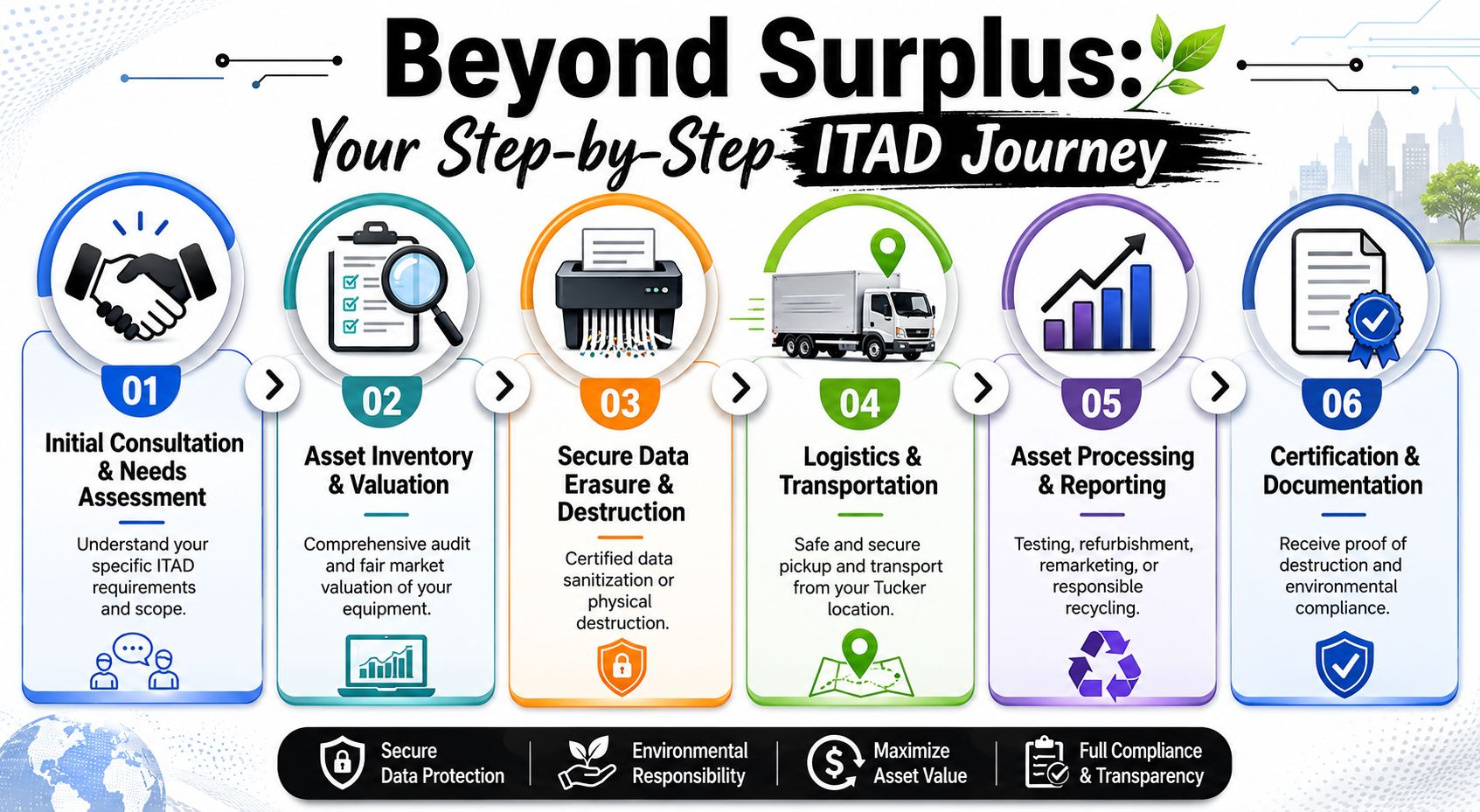
Typical project flow
-
Initial scope review
Start with the asset categories, estimated volume, site conditions, and whether the project includes servers, laptops, networking gear, drives, or mixed electronics. -
Inventory and service decisions
During this stage, the project gains clarity. Which assets need serialized tracking? Which media should be wiped, and which should be shredded? Which equipment has potential resale value? -
Pickup scheduling
Removal needs to fit building access rules, loading dock realities, and business hours. Multi-floor office pickups and active server room work need different planning. -
Secure transport and intake
Once assets leave the Tucker site, custody records should continue through transport and receiving. -
Processing and reporting
Equipment is sanitized, destroyed, tested for resale, or prepared for recycling based on the approved workflow. -
Final documentation and settlement
The client receives the closing records. If remarketing applies, that should be reflected in the final reporting.
Where clients make the process easier
The best internal prep is simple:
- Separate obvious keepers from retirement stock before pickup day
- Flag sensitive departments such as finance, HR, or clinical operations
- Provide known asset lists if they already exist
- Identify any on-site destruction requirement early, not after scheduling
Beyond Surplus handles secure ITAD, data destruction, electronics recycling, logistics coordination, and value-recovery services for organizations retiring business equipment.
ITAD Considerations for Key Tucker Industries
Industry requirements change the right ITAD method. The same retired laptop may be a remarketing candidate in one environment and a destruction candidate in another.
Healthcare
Healthcare organizations have the narrowest tolerance for documentation gaps. Devices may contain protected health information directly or indirectly through cached files, stored credentials, or connected workflow systems. Generic recycling isn't enough.
For healthcare-specific handling expectations, this page on HIPAA-compliant electronics recycling in Georgia is a useful benchmark.
Finance
Financial firms usually care less about the environmental language and more about evidentiary control. They want a defensible record showing who handled the asset, how data was removed, and when responsibility changed hands. That often pushes the program toward stronger chain-of-custody controls and tighter destruction criteria for drives and portable devices.
Education and public institutions
Schools and training organizations often deal with volume and variety at the same time. Labs, carts, classroom endpoints, networking gear, and administrative systems all age out differently. The challenge is less about one critical server and more about managing many asset classes without losing records.
For regulated industries, the key issue isn't simply whether data can be destroyed. It's whether the chosen method is defensible for that media type and backed by an audit trail.
That's why standards-based decision making matters. For SSDs and newer device classes, organizations increasingly look to NIST 800-88 and IEEE 2883-2022 as the framework for matching the method to the device and the risk profile, as discussed in the earlier standards reference.
Frequently Asked Questions about ITAD Services
How is ITAD different from standard electronics recycling
ITAD includes inventory control, data destruction, documentation, logistics, and potential value recovery. Recycling is only one end stage for material that can't be reused or remarketed.
Should every hard drive be physically shredded
Not always. Shredding is often the right answer for high-risk data, failed media, or assets with little resale value. Wiping can make more sense when the device is reusable and the sanitization method fits the media type and compliance requirements.
What should I ask an ITAD provider before pickup
Ask how they track assets, what reporting they provide, what destruction methods they use, how they manage chain of custody, and how they determine whether equipment is resold or recycled.
Can older servers and networking gear still have value
Sometimes, yes. Enterprise equipment may still have residual value if it can be tested, sanitized, and remarketed. The key is realistic triage. Not every device is worth the labor required to recover that value.
What documents should my company expect after service
At minimum, expect clear disposition records tied to the work performed. Depending on the project, that may include certificates for data destruction, recycling, or both, along with itemized reporting.
Is local service in Tucker enough for enterprise needs
Local presence helps with logistics and timing, but enterprise buyers should still evaluate process quality, documentation standards, and downstream handling. Convenience matters. Auditability matters more.
If your Tucker team needs a documented plan for retiring servers, laptops, storage, networking gear, or mixed electronics, contact Beyond Surplus to discuss secure IT asset disposition, data destruction, and electronics recycling for business operations.


