
You've just pulled the recall notice, and the stock is everywhere. Units are on the sales floor, in returns, on a demo rack, and already out on loan to a school or gym. Someone in the back asks the obvious question: can we just dumpster the lot and move on?
Don't. Recalled sporting goods destruction isn't a waste decision you make at the dock. It's a compliance-controlled disposition event, and the recall owner's written instruction, your quarantine count, and your final certificate have to line up unit by unit. If they don't, you can't prove the unsafe product stayed out of commerce.
Table of Contents
- Choose the Right Recall Disposition First
- Quarantine Recalled Stock Before Anything Moves
- Build a Chain-of-Custody Record for Every Unit
- Transport and Destroy Under Written Controls
- Verify Destruction and Confirm the Plan Before Pickup
Choose the Right Recall Disposition First
Destruction is one remedy among several, not the default. The recalling firm decides which route applies, often in coordination with the regulator, and your job starts only after that decision is on paper.
The CPSC recall handbook explicitly recognizes multiple disposition paths, including products that may be reworked, broken down for reclamation of critical components, returned, or destroyed. It also warns that recalled products must remain segregated throughout the distribution chain and that third-party destroyers should be monitored. That distinction matters for helmets, benches, connected fitness equipment, and anything with mixed materials like metal frames, composites, foam, textiles, batteries, or electronics.
Recall Disposition Routes and What Each Requires
| Disposition route | When it fits | Who must approve | Proof to keep |
|---|---|---|---|
| Return to recalling firm | Recall notice requires refund, replacement or return | Recalling firm | Carrier receipt and unit count |
| Manufacturer-approved repair or retrofit | Recall provides a verified fix | Recalling firm, with CPSC coordination where required | Repair log with unit identifiers |
| Component recovery | Parts cannot rebuild the recalled product | Recalling firm, in writing | Recovery log and photos of separated parts |
| Irreversible destruction | Product cannot be safely repaired or returned | Recalling firm; CPSC may witness or require affidavit | Destruction certificate listing units destroyed |
| Resale, donation or employee sale | Not permitted for recalled units | Not applicable | Prohibited under recall controls |
Destroy everything sounds responsible, but it isn't always the right environmental answer. Recycle it sounds better, but it isn't safe unless the recall owner authorizes that route and your processor can prove the product can't return to commerce. For smaller categories, our guide to recalled stroller disposal services shows the same approval logic at work.
Before you move a carton, settle four questions:
- Which notice applies: Confirm the models, lot codes, and date range named in the notice.
- What remedy is required: Check whether the notice requires refund, replacement, or repair instead of destruction.
- Is there a verified fix: Use only a manufacturer-approved repair, not a shop workaround.
- Is destruction approved in writing: Get a named instruction from the recalling firm before you schedule anything.
Routine inspection programs help teams spot damage before it becomes a disposition problem, and resources like paddleboard inspections with PADL show how structured checks create a usable history for fleet equipment. That history doesn't override a recall notice, but it does help you match units quickly.
Say a regional fitness retailer holds several hundred units of a recalled bench across two stores. The manager wants them shredded this week to free floor space. The notice, though, requires return to the recalling firm. Shredding them now would break the recall plan, even if the intent is good.
Practical rule: No written disposition, no movement. A phone call from a sales rep isn't approval.
I would request a written disposition instruction that names the units, lots, and approved route before anything leaves quarantine. That's the document every later record has to match.
Quarantine Recalled Stock Before Anything Moves
Quarantine is where most recall cleanups succeed or fail. If recalled units mix with returns or salvage for even one shift, your count stops being defensible.
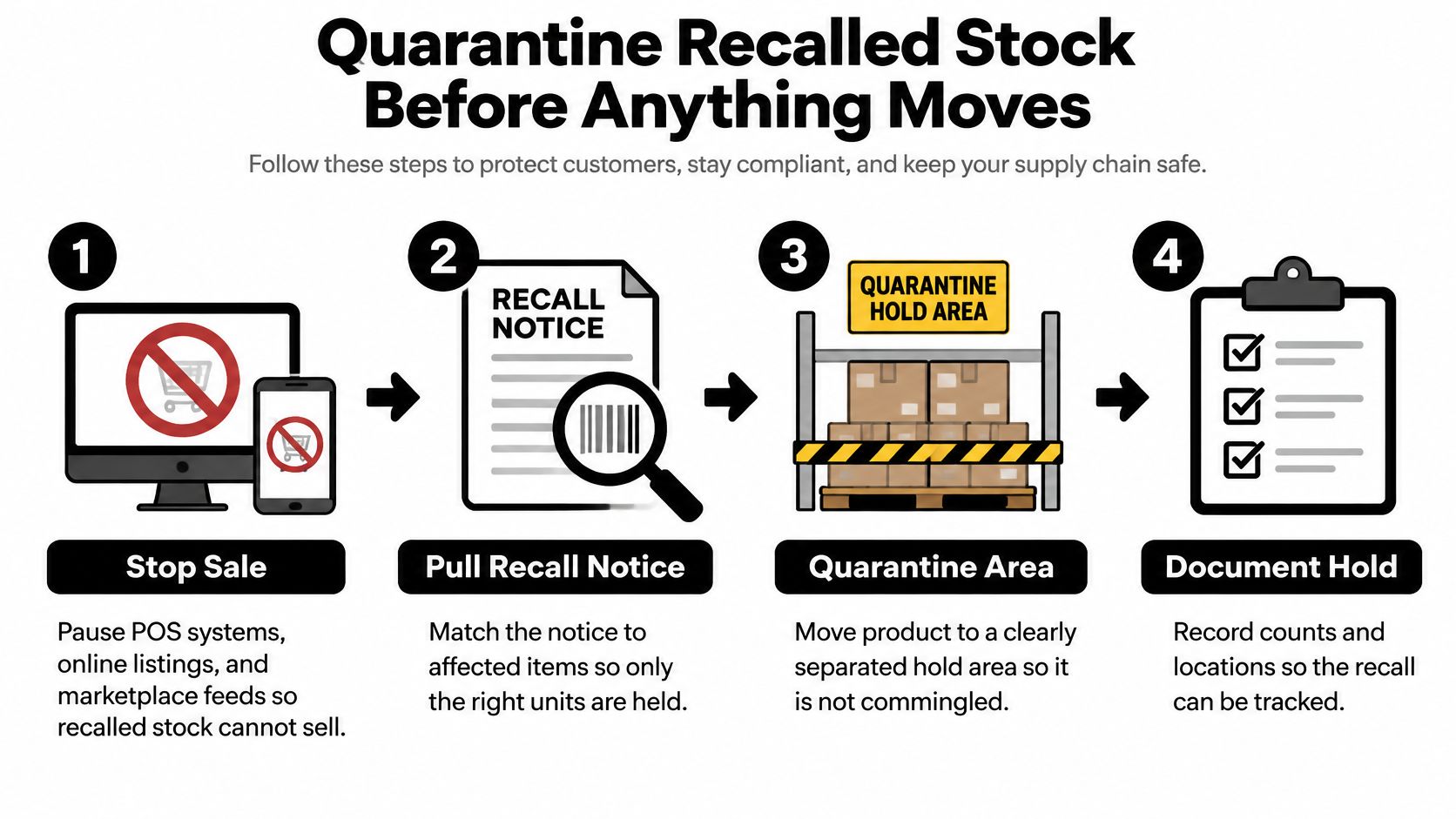
The workflow in the CPSC Regulated Products Handbook begins with an immediate stop-sale, inventory reconciliation, and physical quarantine segregated from normal returns, salvage, and saleable stock. It also calls for documenting product identifiers, quantities, locations, custody transfers, and the approved disposition route. Before destruction, disposal, or recycling, the firm should notify the CPSC. The agency may witness the process or require an affidavit and photographic evidence.
Six Steps That Lock the Stock Down
- Stop the sale everywhere. Pause point-of-sale systems, online listings, and marketplace feeds so a cashier or a web order can't sell a held unit.
- Match the notice to your inventory. Pull model, lot, and date codes from the notice and check them against labels, because lookalike unaffected stock must stay saleable.
- Count and reconcile all locations. Include stockroom, sales floor, returns, units in transit, and demo or loaner fleets, since auditors will ask where the missing units went.
- Move units to a locked, labeled zone. Keep that zone physically separate from salvage, returns, and saleable stock so staff can't grab the wrong carton during a busy restock.
- Tag every carton or pallet. Mark the recall identifier and a clear do-not-sell warning on each container, not just on the zone door.
- Restrict and log access. Limit keys or badge access and log every entry, which turns a vague hold into a controlled hold.
That separation also reduces the risk that defective helmets, protective equipment, exercise products, or accessories re-enter commerce through liquidation, employee channels, online marketplaces, or recycling streams. Warehouse teams handling larger pulls can apply the same zone discipline used in recalled product disposal for warehouses.
Edge Cases That Catch Teams
Units already in customers' hands need the remedy the notice specifies, not a store-level improvisation. Loaner equipment at schools or gyms needs retrieval calls with dates and names recorded. Online orders in transit need interception or return instructions before delivery turns into distribution.
Say your reconciliation is short by one unit. A second count finds a showroom model sitting in a returns cage, tagged as a customer return because it had a scuffed foot. Without the reconciliation step, that unit could've gone to salvage on Friday.
End this stage with a signed quarantine sign-off. Record the reconciled count, the zone location, and the date and time the zone was locked. That signature is the baseline your pickup manifest and destruction certificate must later match.
Build a Chain-of-Custody Record for Every Unit
A weak record creates a specific failure. Months after the load leaves, the recall owner asks which units were destroyed, and the only answer on file is a vendor receipt for a mixed load by weight. You can't answer the question. The recall stays open.
Your record is the evidence. A recall owner or regulator should be able to trace every unit from the sales floor to the final certificate without gaps, phone calls, or guesswork.
The CPSC Regulated Products Handbook frames that duty plainly: recalled goods stay isolated from sale, clearly marked, and tracked in inventory until the recall plan resolves them through return, remedy, or destruction. Destruction isn't automatically the right call. The recalling company first decides whether the product must be returned, and destruction may require CPSC coordination so an investigator can witness the event or approve another form of verification. Treat the disposition decision as a written input to your custody record, not a verbal agreement with the vendor.
Required Fields in a Recall Chain-of-Custody Record
| Field | What to record | Why it matters |
|---|---|---|
| Product description | Type, brand and size as printed on the label | Ties each unit to the recall notice |
| Model and lot or date code | Exact codes from the notice | Separates recalled from unaffected stock |
| Quantity received | Units counted at intake and verified by a second person | Basis for the destruction count |
| Storage location | Zone, shelf and container identifier | Shows units never left quarantine |
| Custody transfers | Date, carrier and signatures at each handoff | Proves an unbroken chain |
| Approved disposition | Route and approving party | Shows the action matches the recall plan |
| Destruction date, method and facility | Facility name, address and method used | Required on the final record |
| Responsible signatory | Name, title and signature | Establishes accountability |
How the Fields Connect
Model and lot codes must match the notice exactly, because a close-enough code lets unaffected units into the destruction stream or leaves recalled ones on the shelf. Quantities must match the reconciled quarantine count, since that signed baseline is what your intake record answers to. Each handoff needs a date, carrier, and signature. An unsigned transfer is a break in the chain even if the truck really did leave your dock. Structured product recall chain-of-custody services exist for exactly this linking work.
A reconciled count ties units to records. A weight ticket only shows mass.
Auditors press on exactly that difference. A scale ticket can't show whether the weight came from recalled benches, packaging, or unrelated scrap added at the facility.
Many businesses borrow the documented, reasonable, and verifiable mindset from the FTC Disposal Rule for their internal disposal records. Keep the scope straight, though. That rule governs consumer-report information only, so it's a useful parallel for verifiable disposal rather than the standard that applies to recalled sporting goods.
Say a school athletics office collects recalled protective gear from locker rooms and records counts by room only. Six weeks later, it can't show which model codes were destroyed because intake never captured them. The gear is gone, but the proof isn't there, and the owner can't close the recall.
Set up a single intake form that captures every field in the table before the first carton leaves quarantine. Ask the destroyer whether it will certify to unit level. Beyond Surplus issues a certificate of recycling and data destruction for every load it picks up, a contractual written guarantee that the equipment is disposed of responsibly. Whether your load needs a line-item certificate beyond that is a question to settle during contracting, not after the load is gone.
Transport and Destroy Under Written Controls
Transport is where a clean quarantine can still fall apart. Pallets get rebuilt, cartons get topped off with unrelated returns, and a driver leaves without a manifest. Written controls prevent that drift.
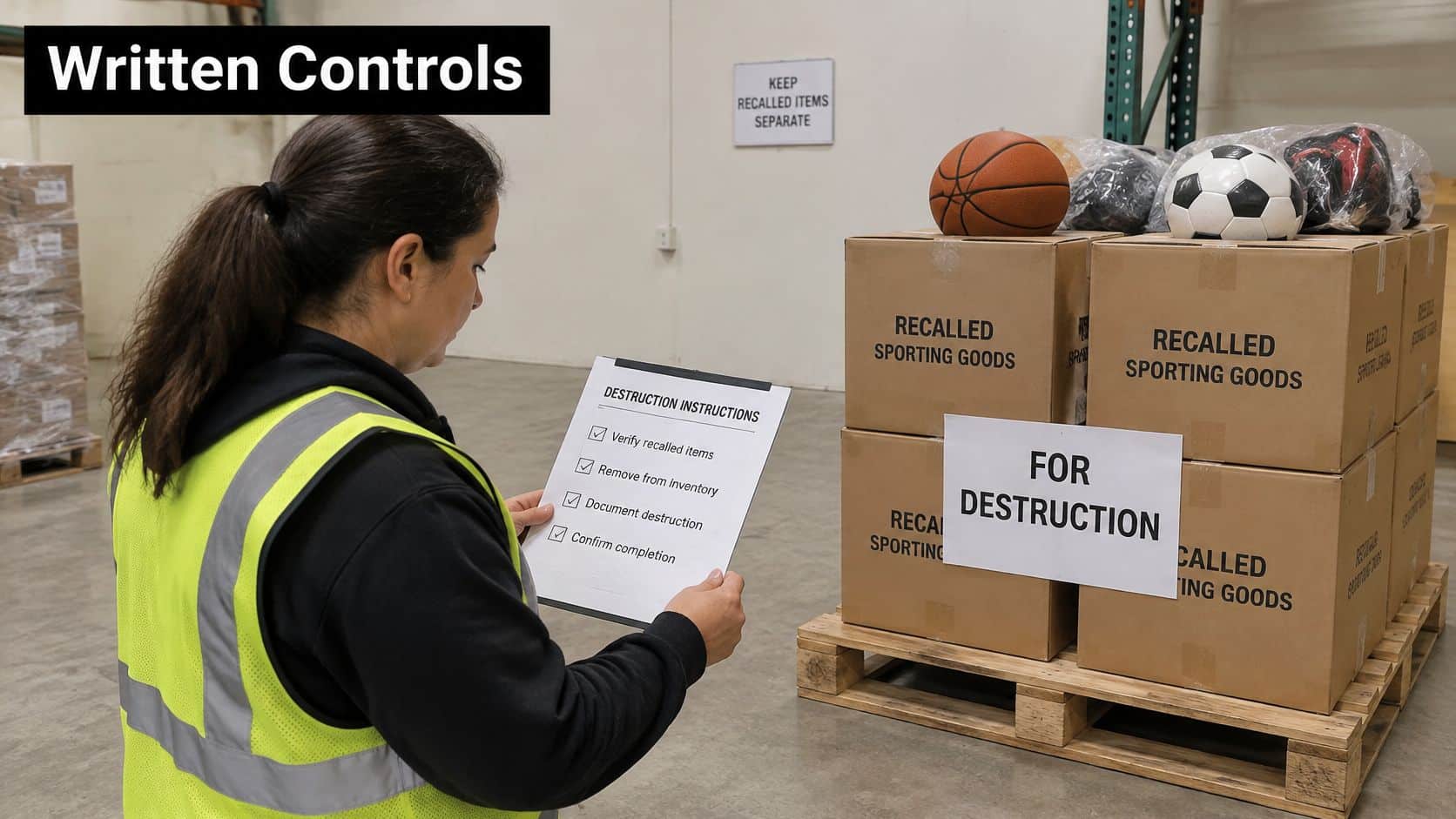
The worker checking cartons against a list before loading is doing the control that matters most at this stage.
Seven Controls From Dock to Destruction
- Issue written destruction instructions. Name the recalled items, prohibit commingling and resale, and specify the completion certificate you require, so the facility can't substitute its standard receipt.
- Seal and mark every container. Apply numbered seals to cartons or pallets and mark each one clearly, which lets the facility identify your load on arrival.
- Require a matching manifest. Use a carrier that issues a manifest matching your intake count, because that's your evidence during transit.
- Notify the CPSC before destruction. Do this before any destruction, disposal, or recycling, and allow time for the agency to witness the process or require an affidavit with photographic evidence.
- Witness or verify the event. Attend the destruction or obtain verification that names the specific recalled units, since a generic statement won't close the record.
- Route hazardous fractions separately. Send batteries, aerosols, and pressurized components through the controls required by state and local rules instead of shredding them with frames and foam.
- Reconcile the certificate on receipt. Compare the completion certificate against your quarantine count the same week, while staff can still resolve a discrepancy.
For coordinated pickups across sites, product recall reverse logistics services keep manifests and seal logs consistent from store to facility.
The Electronics Inside Sporting Goods
Connected treadmills, smart helmets, sensor-equipped gear, and motorized equipment carry boards, displays, and batteries that need controlled processing. The World Health Organization fact sheet on electronic waste) reports that global e-waste reached an estimated 62 million tonnes in 2022, while only 22.3% was documented as formally collected and recycled. It classifies e-waste as hazardous because it can contain toxic materials and generate toxic chemicals when recycled improperly, including lead, mercury, and dioxins.
That's why indiscriminate shredding is a poor plan for mixed loads. Our process handles that end point directly. Equipment that fails reuse standards, is unrepairable, old, obsolete, or not contractually permitted to be remarketed is recycled and completely destroyed by de-manufacture and/or physical shredding.
Say a distributor's pallets arrive at a facility without manifests. The facility can't confirm what it received, and you can't confirm what left your control. That should stop the pickup at your dock, not become a paperwork fix later.
Don't release a load until the manifest, seal log, and carrier details match your intake record. If they don't match, hold the truck.
Verify Destruction and Confirm the Plan Before Pickup
A receipt isn't proof. That assumption causes more open recall files than any shredder problem does, because teams file the receipt, close the ticket, and discover the gap only when the recall owner asks for unit-level evidence.
Start with the gap between recalled and destroyed. According to Home Recall Watch exercise-equipment recall records, from 1981 through 2026, 132 exercise-equipment recall notices covered at least 46 million units, and that figure represents recalled units, not necessarily destroyed units. A national count tells you the scale of exposure. It tells you nothing about how many units were removed, repaired, returned, or destroyed.
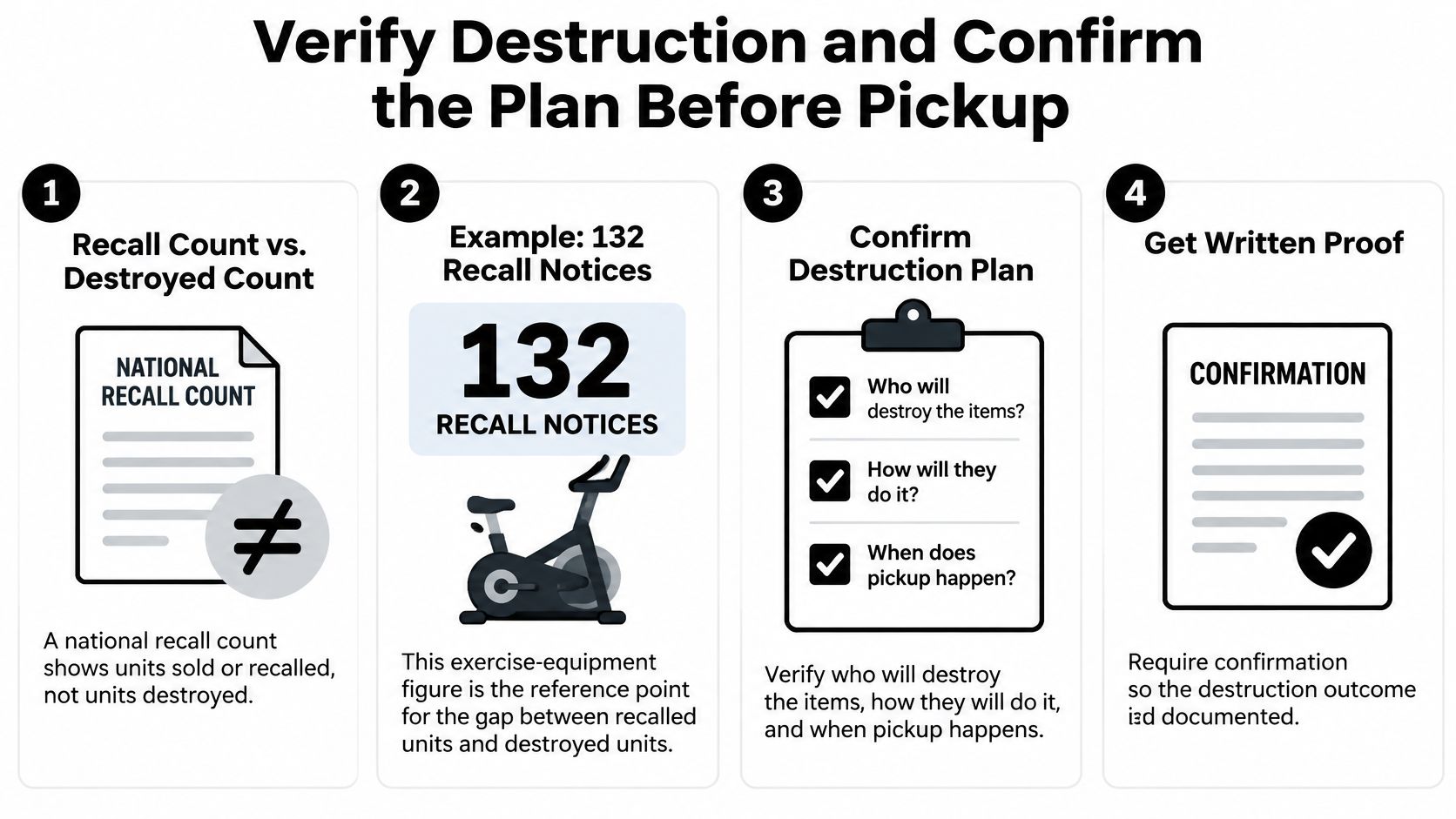
Your file has to close that gap for your own inventory. Intake count, pickup manifest, and destruction certificate should tell the same story, with the same product identifiers, in the same quantities.
Common Destruction Failures and How to Fix Them
| Failure | Why it happens | Fix |
|---|---|---|
| Weight ticket accepted as proof | Vendor sends only a scale receipt | Require a certificate naming the recalled units |
| Destroyed count does not reconcile | Count not checked at pickup | Reconcile intake, pickup manifest and certificate totals |
| Recalled stock reaches salvage or staff sales | Quarantine zone not separated | Separate the zone and audit it monthly |
| Destroyer subcontracts without disclosure | Contract lacks flow-down terms | Require disclosure of downstream processors and audit rights |
| Destruction starts before approval | Team acts on the notice without a written decision | Hold all movement until written approval is on file |
Each failure is preventable before pickup. None of them is fixable after the load is shredded and mixed with other material.
Due Diligence Before You Sign
Request the destroyer's audit reports and any recognized certification before contracting. Ask who performs the destruction, where it happens, what method is used, and which downstream processors receive separated fractions. Put disclosure and audit rights in the contract, not in an email thread.
Ask for a sample certificate with identifying details redacted. You're checking whether it names product descriptions, model or lot information, quantities, date, method, facility, and a responsible signatory. If the sample only shows a load weight and a date, it won't satisfy a recall owner. A proper certificate of destruction for recalls should let you reconcile totals without calling the facility for translation.
If a provider can't show you a sample certificate before pickup, don't expect a better one after pickup.
Beyond Surplus provides product destruction with documented chain of custody and sustainable material recovery built in. Every load receives a Certificate of Recycling and Data Destruction, and all liability transfers to Beyond Surplus. Whether you use that model or another provider, insist on the same evidentiary standard in writing.
Pre-Pickup Checklist
Run this check before you schedule the truck:
- Written disposition on file: The recall owner's instruction names the units, lots, and approved route.
- Reconciliation complete: The quarantine count matches the intake record, with shortages investigated and explained.
- Custody fields complete: Every carton or pallet carries identifiers that tie back to the notice.
- Certificate confirmed: The provider has agreed in writing that its certificate will name the recalled units destroyed.
- Hazardous fractions routed: Batteries, aerosols, pressurized components, and electronic fractions have a documented handling route.
- CPSC notification handled: Required notice is sent, with time allowed for a witness, affidavit, or photographic evidence.
- Manifest ready: Carrier details, seal numbers, and unit counts are prepared before the driver arrives.
I would send that checklist and the recall notice to the provider before confirming a date. Make the provider confirm that its certificate, custody documents, and destruction method meet the recall owner's written requirements. That short review prevents the most expensive outcome in recalled sporting goods destruction, which is destroying the right product in a way you can't prove.
If you're holding recalled sporting goods and need destruction you can document properly, Beyond Surplus can review your recall notice, written disposition, and quarantine records before pickup so the manifest, custody chain, and certificate align from the start. Contact our team to confirm the destruction method, hazardous fraction routing, and certificate details for your load, and schedule a pickup only once the paperwork supports the plan.


