

Disposal is rarely the remedy a recall notice orders, and booking a truck before you've read that notice is the fastest way to lose a refund and create a liability file you can't close. For business owners, facility managers, and procurement teams, recalled furniture disposal services should start with identification, segregation, and evidence, not with hauling. A desk, chair, crib, mattress, or cabinet that's under recall isn't ordinary bulky waste. It's a controlled asset until the manufacturer's remedy, your count reconciliation, and the final disposition record all line up.
Table of Contents
- Confirm the Recall Remedy Before You Dispose
- Quarantine, Log and Benchmark Recall Disposal
- Which Disposal Routes Are Allowed for Recalled Units
- How to Dismantle and Destroy Recalled Units Safely
- Certificates, Liability Transfer and Disposal Costs
- Vet the Vendor and Book a Compliant Pickup
Confirm the Recall Remedy Before You Dispose
Only 23 recalls, or 1.1%, were categorized as requiring disposal in the U.S. Consumer Product Safety Commission recall listings covering five years of remedy data, compared with 54.6% offering refunds, 26.4% repairs, and 16.9% replacements. That split changes your first move. You don't ask who can haul it. You ask what the notice tells you to do with this exact model, batch, and date code.
Match the Unit Before You Move It
Start with five checks. First, match the model number, date code, and batch on the label against the notice, because a recall can cover one batch rather than an entire product line. Second, stop use and pull the unit out of service. Third, locate purchase evidence such as invoices, purchase orders, or asset tags. Fourth, contact the manufacturer and get the remedy in writing. Fifth, check whether you must submit photographs proving the item was disabled or destroyed.
That paper check matters for money as well as safety. If a unit is still under a separate coverage claim, take time to understand your furniture warranty before you cut, dismantle, or surrender it, since warranty terms and recall remedies can point to different return paths. Photograph labels before anyone removes hardware or fabric. Once identifiers are gone, a school, landlord, hotel, or employer with multiple units can't prove which claim belongs to which item.
Recall remedy types and what to do next
| Remedy type | Share of recalls | What to do next |
|---|---|---|
| Refund | 54.6% | Keep purchase proof and follow the notice's return or refund steps |
| Repair | 26.4% | Hold the unit in quarantine until the repair is confirmed |
| Replacement | 16.9% | Return the old unit as instructed and document the swap |
| Disposal required | 1.1% (23 recalls) | Follow the destruction or disable steps and photograph the result |
The same discipline applies when furniture sits alongside other recalled categories in a warehouse cleanout, which is why teams handling mixed inventory often align the process with recalled baby product disposal requirements for evidence handling.
Practical rule: If the remedy isn't disposal, the unit stays quarantined until the manufacturer's written instruction arrives. Disposing early can cost you the refund or replacement.
I would not authorize destruction on a verbal assurance. Get the remedy, the photo requirement, and any return label instruction documented per model code. That's what turns a pickup into a defensible disposition.
Quarantine, Log and Benchmark Recall Disposal
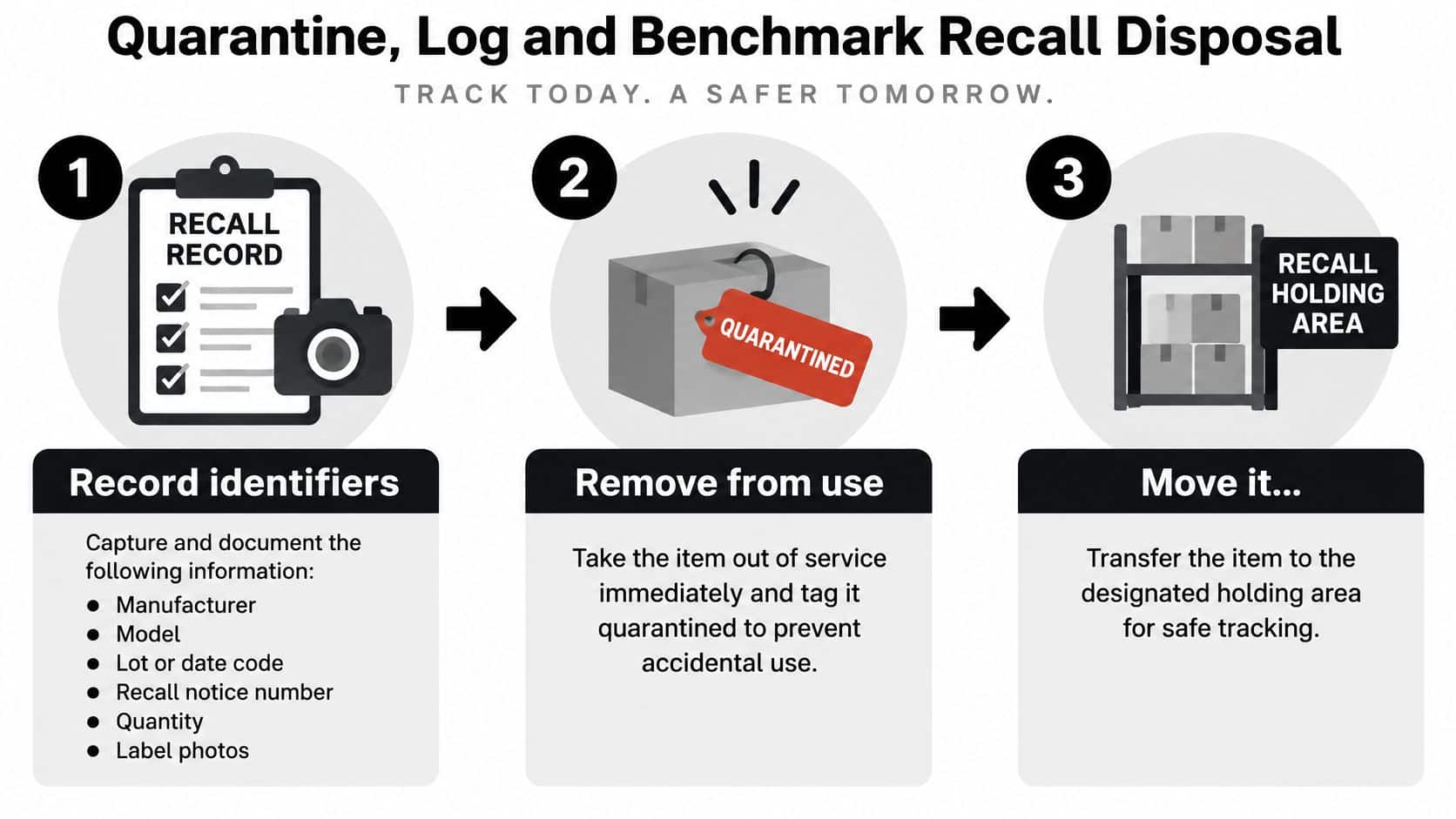
A compliant workflow starts with one unit handled correctly, then scales. The CPSC product safety warning listing supports a workflow built on product identification and hazard isolation, recording the manufacturer, model, lot or date code, recall notice, quantity, and photographs, then segregating the item from sale, donation, or normal reuse. Don't start the log at pickup. By then you've already missed the handoffs that matter most.
The Single Unit Procedure
- Record identifiers: Log manufacturer, model, lot or date code, recall notice number, quantity, and clear label photos.
- Remove from use: Take the item out of service immediately and tag it quarantined in a way that survives handling.
- Move to a segregated zone: Keep it away from sale stock, donation piles, and reusable inventory, and block access by children or other users.
- Log every handoff: Use a chain-of-custody sheet with name, date, and time for each person who moves or inspects it.
- Hold for the remedy path: Don't release the unit until the manufacturer's remedy is confirmed in writing.
- File everything together: Keep the notice, photos, purchase proof, and log in one packet per recall.
A tagged unit left in a general storage room often gets reissued by mistake. Someone sees a usable chair, doesn't see a small tag, and puts it back on a floor. Physical separation beats good intentions. Use tape on the floor, a locked cage, or a separate bay, and make the tag large enough to read from the doorway.
For destruction-only recalls, don't improvise. Some notices tell you to disassemble the product and cut fabric or pads before disposal, and they explicitly prohibit selling or giving the item away. Pay attention to detachable restraints, straps, hardware, and labels that could let someone reassemble it. Also check for batteries, chemical residues, or sharp components before dismantling, and route hazardous subcomponents under local requirements rather than general waste.
Scaling to a High Volume Project
For corporate, institutional, or property management recalls, treat the work as controlled reverse logistics. Build an item-level inventory and acceptance matrix covering dimensions, weight, access constraints, disassembly needs, and the mandated remedy for each model. The EPA bulky items guidance recommends setting quantity and size limits and scheduling bulky-item collection to avoid overcrowding and overwhelming limited storage capacity, and it notes transfer stations may impose size or quantity limits or additional fees for bulky items.
Schedule staged pickups so your quarantine zone doesn't become a fire lane problem. Use status labels that mean one thing only: quarantined, awaiting manufacturer remedy, destroyed, and released for permitted recycling. Teams managing warehouse-scale counts often model this staging on recalled product disposal for warehouses so pallets don't mix statuses.
Benchmarks for recall disposal projects
| Metric | Target | Why it matters |
|---|---|---|
| Serial or model-code reconciliation | 100% of units matched | Proves every unit was accounted for |
| Recall-remedy documentation | 100% of units with notice and remedy record | Supports refund, replacement or regulatory claims |
| Unauthorized resale or donation | Zero | Confirms recalled units stayed out of circulation |
| Pickup damage incidents | Every incident logged and reviewed | Protects the chain of custody |
| Days in quarantine | Tracked per unit and per status label | Shows where storage capacity is tied up |
| Diversion rate by material | Reported for each material stream | Shows what left the facility and where it went |
Watch the predictable failure points. Facilities underestimate floor space, mix recalled units with reusable inventory, ignore stairwell and elevator limits, and assume all furniture is recyclable. It isn't. Wood, metal, foam, textiles, and leather in one item can require special equipment for dismantling or compaction, and a downstream facility that accepts desks may refuse mattresses or upholstered seating.
Confirm pre-acceptance for the exact furniture type before you book. Retain weigh tickets, transfer records, photographs, and final disposition certificates for each load. At closeout, reconcile the original count to every final disposition, unit by unit. Keep escalation records for any missing or disputed unit instead of quietly adjusting the count. A defensible file explains the exception. A weak file hides it.
Which Disposal Routes Are Allowed for Recalled Units
Donation and resale aren't gray areas. They're closed routes for a recalled unit, even if the item looks perfect. Mixed bulky-waste collection is almost as risky, because an intact piece can be pulled, resold, or put back into use before it reaches a final site.
The baseline explains why you can't rely on your usual hauler. The EPA facts and figures report on materials and waste reported that furniture and furnishings generated 12.1 million tons of municipal solid waste in 2018, equal to 4.1% of total U.S. municipal solid waste, with 80.1% landfilled and 19.5% combusted for energy recovery. Most furniture already ends in managed disposal, not neat recycling. A recalled unit needs a route you can prove, not a route you assume.
Compare the Routes Before You Book
Disposal routes for recalled furniture
| Disposal route | Allowed for recalled units | When it fits | Records to keep |
|---|---|---|---|
| Donation or resale | No, prohibited by the recall | Never, even if the unit looks usable | Refusal or hold record only |
| Manufacturer return or remedy | Yes, when the notice specifies it | Refund, repair or replacement programs | Return receipts and purchase proof |
| Mixed bulky-waste collection | Only if the notice allows it | Rarely, and only after destruction | Pickup manifest and disposal receipt |
| Certified destruction with dismantling | Yes | Destruction-only recalls and units the notice says to destroy | Certificate of destruction, photos and weigh tickets |
| Recycling of separated materials | Yes, after the unit is rendered unusable | Wood, metal and fabric streams once destruction is complete | Transfer records and final disposition certificate |
Manufacturer return fits when the notice offers a refund, repair kit, or replacement and wants the old unit or a component back. Certified destruction fits when the notice says destroy, disable, cut, or render unusable, and you need dated photos tied to model codes. Material recycling can follow destruction, but it doesn't replace it. A metal frame can enter a metal stream only after the recalled product as a usable item no longer exists.
Material mix drives feasibility. A solid wood desk separates cleanly. An upholstered chair with foam, fabric, staples, and a gas lift doesn't. The same caution used for recalled toys disposal and destruction applies here, because mixed materials and small hazardous components change the downstream acceptance rules.
Follow the route the notice names first, then choose the downstream facility that can document that route in writing.
If a vendor can't tell you where the separated wood, metal, and foam will go, you don't have a disposal plan. You have a pickup.
How to Dismantle and Destroy Recalled Units Safely
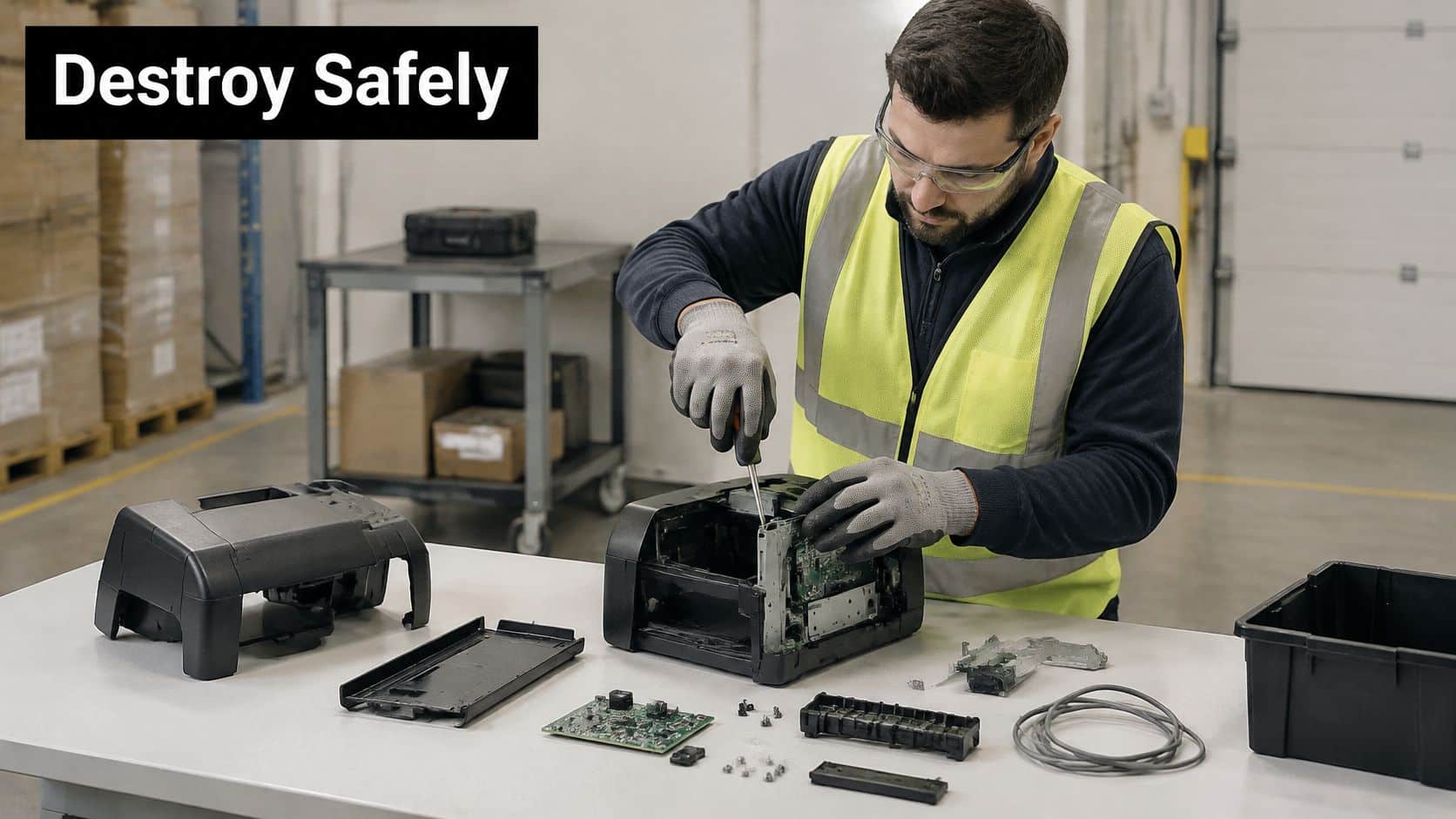
Destruction isn't cosmetic damage. A slash across a cushion while the frame, restraints, and hardware stay intact leaves a product someone can repair and reuse. The goal is a unit that can't function, can't be reassembled from its parts, and can't be mistaken for reusable stock.
Six Steps in Order
- Confirm the method: Read the notice for the exact destruction or disable steps and whether photographs of the destroyed unit are required for a refund.
- Remove restraints and identifiers first: Take off detachable restraints, straps, hardware, and labels after you've photographed them, so the unit can't be reassembled or its identifiers recovered for a false claim.
- Cut soft components: Cut fabric, padding, and foam where the notice calls for it, since intact pads and covers are the parts most likely to be reused or resold.
- Check for hazardous subcomponents: Look for batteries, adjustable motors, lighting, gas struts, and chemical residues, and route them under local hazardous waste rules rather than general waste.
- Separate material streams: Put wood, metal, plastic, and textiles into labelled containers so the downstream facility can accept or refuse each stream on its own merits.
- Photograph each stage: File photos of the label, the mid-destruction state, and the separated parts with the chain-of-custody log.
Say a hospitality operator finds a recalled sofa frame that looks intact after the cushions are removed. The team sends the frame to a donation pickup to clear the loading dock. That single decision breaks the recall, puts a hazardous product back in circulation, and leaves the operator with no proof of destruction if the manufacturer or an insurer asks later. Clearing space isn't a remedy.
Crew safety shapes the method too. Staples, broken springs, sharp brackets, and heavy solid wood components need gloves, eye protection, and the right cutting tools, not a box cutter and optimism. Powered recliners and adjustable beds add electrical components that your crew should disconnect and segregate before anyone starts cutting. If your in-house team doesn't have the equipment to dismantle and compact mixed furniture safely, that's a vendor task, not a maintenance task.
I would require a second person to verify destruction against the count sheet before parts leave the quarantine zone. One person destroys, another reconciles model codes to photos. That small check catches the unphotographed unit while you can still fix it.
Certificates, Liability Transfer and Disposal Costs
A generic pickup receipt proves a truck came. It doesn't prove a recalled unit was destroyed by an approved method. Your file needs records that connect a specific serial or model code to a specific disposition on a specific date.
What the Paper Trail Must Prove
A certificate of destruction should name each unit by serial or model code, state the destruction method, the date, and the processing site. Pair it with weigh tickets, transfer records, and photographs. The NIST SP 800-88 FAQ on media sanitization treats certificates and other evidence as operational controls, including certificates of sanitization, defined roles and responsibilities, and controls for tool configuration and testing. Apply the same standard here. Require a certificate tied to the approved method, not a blanket statement that a load was processed.
That's the standard behind a proper certificate of destruction for recalls, where the value is the unit-level link between the recall notice and the final record. Keep invoices and certificates in the same file as the notice and photos so an auditor doesn't have to reconstruct the story from three systems.
Liability transfer belongs in a signed contract, not in an email thread. Specify when title and responsibility pass from your business to the vendor, who bears damage during loading, and what indemnity and insurance cover handling and transport. Ask for written proof of the insurance limit before pickup. If a crew damages a freight elevator or a worker is injured moving a cabinet, you don't want to negotiate responsibility after the fact.
When you replace destroyed units, procurement choices affect the next disposal cycle too. Specifying repairable, separable materials helps, and resources on durable wood furniture for Florida homes illustrate how solid, single-material construction is easier to maintain, separate, and eventually retire than mixed composite pieces. For commercial buyers, that translates into asking vendors how a unit comes apart before you buy hundreds of them.
Build the True Per Unit Cost
Model every driver, not just the headline rate:
- Base pricing: Per unit or per load, confirmed for the exact furniture types in your count.
- Dismantling labour and equipment: Cutting fabric, foam, and hardware takes crew time and specialised tools.
- Access surcharges: Stairs, elevators, long carries, and after-hours loading docks.
- Storage days: Floor space tied up while units await a manufacturer remedy or photo approval.
- Facility fees: Transfer station charges for bulky items and any refused load fees.
- Repeat trips: Extra runs caused by miscounts, mixed statuses, or loads a facility rejects.
Compare vendors on the full per-unit figure with certificates included. The cheapest haul that leaves you without disposition proof is the most expensive option if a claim, audit, or injury report surfaces later.
Vet the Vendor and Book a Compliant Pickup
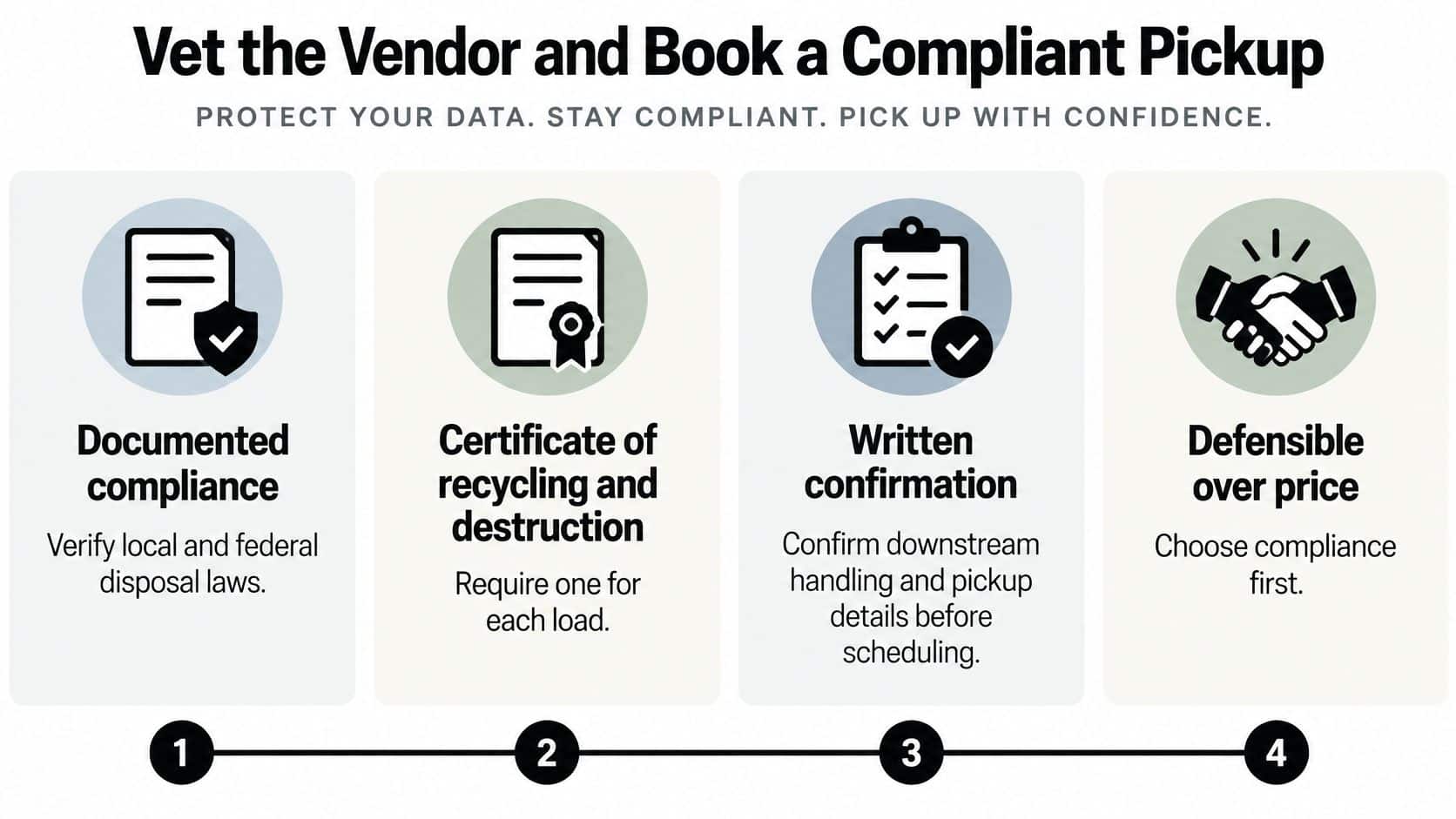
Judge a vendor on defensibility before price. A low quote from a hauler who can't document downstream handling, won't confirm furniture acceptance in writing, or treats a recall like a cleanout exposes you to exactly the resale and re-entry risk the recall was meant to stop.
Request These Items in Writing
- Documented compliance: Confirmation that disposal follows applicable local and federal disposal laws for your material types.
- Certificates per load: At Beyond Surplus, certificates of recycling and data destruction are available for each load of equipment picked up, and you should require the equivalent unit-level documentation for recalled items.
- Written furniture acceptance: Confirmation for the exact types you hold, including recalled desks, seating, and cabinets, since many ITAD or electronics recyclers don't accept furniture at all.
- Destruction method match: A method statement that matches the notice, including photo evidence if the manufacturer requires it.
- Chain-of-custody records: Weigh tickets, transfer records, and final disposition certificates you can file per recall.
- Pickup logistics: Minimum volume, regions served, access needs, and a confirmed pickup window.
- References: Similar clients such as property managers, schools, or hospitals who ran multi-unit recalls.
- Insurance and liability terms: Coverage for damage and injury during handling and transport, with limits in writing.
Acceptance comes first for a practical reason. A vendor built for servers and laptops may handle powered or electronic components well but refuse upholstered furniture or mattresses. Test Beyond Surplus against this checklist the same way you'd test any provider, especially where a recall includes powered recliners, adjustable beds, or other electronic components alongside the furniture. Free pickup is available for businesses with qualifying equipment, and we remove, pack, and transport the equipment to our facility, but you should still confirm that your specific furniture types qualify before you schedule.
For mixed loads that include bedding, check how the vendor handles that stream separately, and use references such as old mattress disposal options to understand why mattresses often follow different acceptance and fee rules than desks or cabinets. Don't let one unaccepted item type contaminate an otherwise compliant load.
Send a Complete Request Package
Send the recall notice, the model and batch list, the unit count, the site address, access details such as stairs or elevators, and label photos. Ask for written acceptance of each furniture type and a confirmed pickup window before loading begins. That package is the core of product recall reverse logistics services, because the vendor can't stage crews, containers, or downstream capacity from a vague count.
You can request a recycling pickup or drop-off by phone, by email, or by filling out the online form. Whichever channel you use, don't release units from quarantine until acceptance is confirmed in writing. Contact Beyond Surplus for certified electronics recycling and secure IT asset disposal, and receive documented chain-of-custody records for your file.
If you're holding recalled desks, seating, cabinets, or powered furniture and need documented destruction instead of a simple haul, contact Beyond Surplus to confirm acceptance for your exact unit types and book a compliant pickup. Send your recall notice, model list, count, and label photos so we can stage the right crew and return certificates and chain-of-custody records you can file with confidence.


