More than 22 million toys were recalled in 2024, according to ConsumerAffairs' 2024 year-end review. That scale changes how you should think about recalled toys disposal and destruction. Pulling stock from shelves isn't closure, and putting units on a truck isn't proof.
For a commercial retailer, distributor, warehouse, school or manufacturer, destruction is a reverse-logistics control. You identify every affected unit, quarantine it, get approval for the route, render it unusable and reconcile the final count against what you shipped, received and still can't find. If one number doesn't tie out, the recall isn't closed, it's just undocumented.
Table of Contents
- Identify Recalled Toys Against the Recall Notice
- Know the Legal Duties for Recalled Toy Disposal
- Choose the Disposal Route and Destruction Method for Each Toy Type
- Run the Quarantine and Destruction Workflow with Documented Records
- Reconcile Every Unit to Prove the Recall Is Closed
- Build Your Disposal Plan Before the Next Recall
Identify Recalled Toys Against the Recall Notice
Match each unit to the recall notice before assigning a disposal route. A similar model, a different production lot or a corrected version can sit in the same carton. Destroying unaffected stock wastes money, while missing even one recalled lot leaves a hazard in circulation. Treat identification as the first reverse-logistics control: the recall cannot be reconciled until the affected units are clearly defined.
Match the identifiers first
Check the same identifiers across every pallet, carton and loose unit. Record discrepancies for resolution rather than assuming a partial match is sufficient.
- Check the model or item number: Read it from the product label, carton or packaging, then compare it with the model list in the CPSC recall notice.
- Match the lot, batch or date code: Check the base of the toy or the carton label. A recall may cover a production range rather than every unit of a model.
- Confirm the SKU or purchase record: Trace the item in your warehouse system or purchase order so receiving, transfers and returns refer to the same product.
- Confirm the recall date and remedy: Use the notice to identify the stop-sale date and whether the stated remedy is a refund, replacement, return or disposal instruction.
- Photograph each identifier: Capture readable images during inspection and file them with the reconciliation records, where they can be retrieved by lot and SKU.
Record the toy type and any hazardous component alongside those identifiers. Flag lead-containing paint or coatings, button batteries, electronic boards, small magnets and treated materials. These details affect the safe handling and disposal route. Plush and other soft toys also need their material composition checked before anyone handles, cleans or opens them. For background on soft-toy materials, see how to care for plush toys.
| Identifier | Where to find it | Match against |
|---|---|---|
| Model or item number | Product label, carton or packaging | Model list in the CPSC recall notice |
| Lot, batch or date code | Base of toy or carton label | Lot range named in the recall |
| SKU or purchase record | Warehouse system or purchase order | SKU list in the recall notice or manufacturer letter |
| Recall date and remedy | CPSC recall notice | Stop-sale date and approved remedy |
| Hazardous component | Product safety data or packaging | Lead, button battery, electronic board or small magnet flags |
Hold rule: If an item matches only some identifiers, keep it in quarantine until the discrepancy is resolved. A partial match is not grounds for release.
Build a unit-level identifier table, or record each sealed carton with a verified unit count. List units by lot and SKU so the starting population is clear and can be reconciled against later records. For stock held at multiple sites, use a consistent reporting format for each location. The recalled product disposal process for warehouses can help align those records and prevent competing counts.
Know the Legal Duties for Recalled Toy Disposal
The baseline is simple and strict. Selling, offering for sale or distributing a recalled toy is illegal, and giving it away doesn't solve the problem. Donation, liquidation, employee giveaways and salvage transfers can all put the product back in a child's hands.
Treat resale and donation as prohibited unless a written corrective-action plan expressly permits a different outcome for that specific product. I wouldn't accept a verbal assurance from a buyer, broker or internal manager that the stock will be exported, stripped for parts or kept out of retail. If it isn't authorized in writing, it doesn't leave quarantine for commerce.
Make the hazardous-waste determination
Commercial holders aren't household generators tossing one toy in the trash. For discarded products, including lead-containing toys and recalled paint or coatings, your organization needs a hazardous-waste determination and then must manage storage, transport, treatment and final disposal under applicable federal, state and local rules. Batteries and electronic assemblies need the same local check, because a route that's acceptable for plain molded plastic may be wrong for a board, a button cell or a rechargeable pack.
Recall notices often push that detail to you. In the 2025 recall of 98,350 Evermore Surprise Eggs, consumers were instructed to destroy the toy airplanes and dispose of them according to local and state laws, according to KSNT reporting on the CPSC recall. For a business holding cartons, that language means you document which local rule you applied, rather than copying the consumer instruction into a work order.
Control continues through third parties
Your recall plan should explain how toys are removed from shelves, quarantined, returned, repaired, replaced or disposed of. Hiring a vendor doesn't transfer your duty to control the product through reverse distribution. You still monitor the vendor, confirm it understands separation and disposal requirements and check that its certificate matches your lots and quantities.
Keep a legal file that an auditor can follow without asking your team to reconstruct events. Include the recall notice, manufacturer letter, written approval, hazardous-waste determination, vendor contract terms and any state or local disposal rule you relied on. Manufacturers coordinating their own corrective action should align that file with their procedures for recalled product disposal for manufacturers, especially where retailers and distributors hold stock you don't physically control.
Choose the Disposal Route and Destruction Method for Each Toy Type
One method won't fit every recalled toy. Shredding a hard plastic vehicle is straightforward. Shredding a toy with an embedded battery, loose magnets or lead paint creates a different risk and a different record.
Start with the operating principle in the CPSC reseller guidance, which says recalled products should be destroyed rather than sold or given to another party, and where manufacturer instructions aren't available, a product should be made unusable before disposal, with examples including cutting power cords or removing and destroying computer boards for applicable powered equipment. For toys, that means the item must be incapable of continued use, kept out of commerce and supported by evidence showing what was destroyed and how.
| Toy type or condition | Required route | Destruction method | Records to keep |
|---|---|---|---|
| Lead-containing toy or recalled paint or coating | Controlled destruction with written manufacturer or CPSC approval; hazardous-waste determination under EPA rules | Shredding or crushing to unusable size | Destruction certificate, weight ticket, photographs |
| Toy with button battery or electronic board | Remove batteries first, dismantle, send electronics to a certified recycler | Component dismantling; cut power cords or destroy boards | Battery removal log, recycler certificate |
| Toy with small magnets | Destroy so magnets cannot be recovered; keep out of general waste | Shredding to the particle size in the approval | Destruction certificate, witness signature |
| Recalled stock returned by retailers or distributors | Quarantine, then destroy only after written approval; no resale or donation | Off-site certified destruction with labeled pallets | Lot or SKU reconciliation, destruction certificate |
| Toy with no hazardous component but on a recall list | Physical destruction that makes the item unusable | Crushing or compaction once batteries are removed | Destruction certificate or affidavit |
Match the method to the hazard
Shredding works well for hard plastic parts and small components at volume, provided the particle size matches your approval and magnets or batteries can't be recovered intact from the output. Ask the vendor to state that output size in writing before the load moves. A certificate that only says "shredded" gives you little to audit.
Crushing or compaction suits bulky plastic after batteries and electronics are removed. It doesn't suit a sealed powered toy, because crushing can damage a cell, expose a board or leave a recognizable product that someone pulls from a waste container. Remove the hazard first, then use force.
Dismantling is the right step for electronic toys and battery packs, and trained staff should do it with the right drivers, insulated tools, terminal protection and containers for removed cells. Where a related recall involves chargers or power banks, route those accessories through your plan for recalled charger and power bank disposal instead of treating them as loose toy parts. Photograph cut cords and destroyed boards by batch so the image evidence ties to a lot.
Off-site certified destruction usually makes more sense for large inventories spread across several locations, because you can standardize pallet labels, counts and certificates. On-site work can work for a small, contained quantity, but only with a witness and a record that's just as specific.
A route is only correct when the approval letter and the destruction certificate reference the same lot or SKU.
Write the chosen method into the approval request before work starts, and name the record each row must produce. For equipment that fails reuse standards, is unrepairable, old, obsolete or not contractually permitted to be remarketed, our process is recycling and complete destruction by de-manufacture and/or physical shredding. That same discipline applies here. Recycling is material recovery after the safety outcome is secured, not a substitute for rendering the toy unusable.
Run the Quarantine and Destruction Workflow with Documented Records
The CPSC Recall Handbook describes a documented corrective-action workflow that includes stopping sale and distribution, segregating units in a clearly marked quarantine area, reconciling physical inventory against lot, SKU and serial or batch data, obtaining written manufacturer and CPSC approval before destruction, preventing commingling, using a controlled method that makes the toy unusable and retaining a destruction certificate or affidavit. For off-site processing, it calls for written instructions to the vendor, clear labeling of boxes and pallets and a certificate of destruction. Run your workflow in that order.
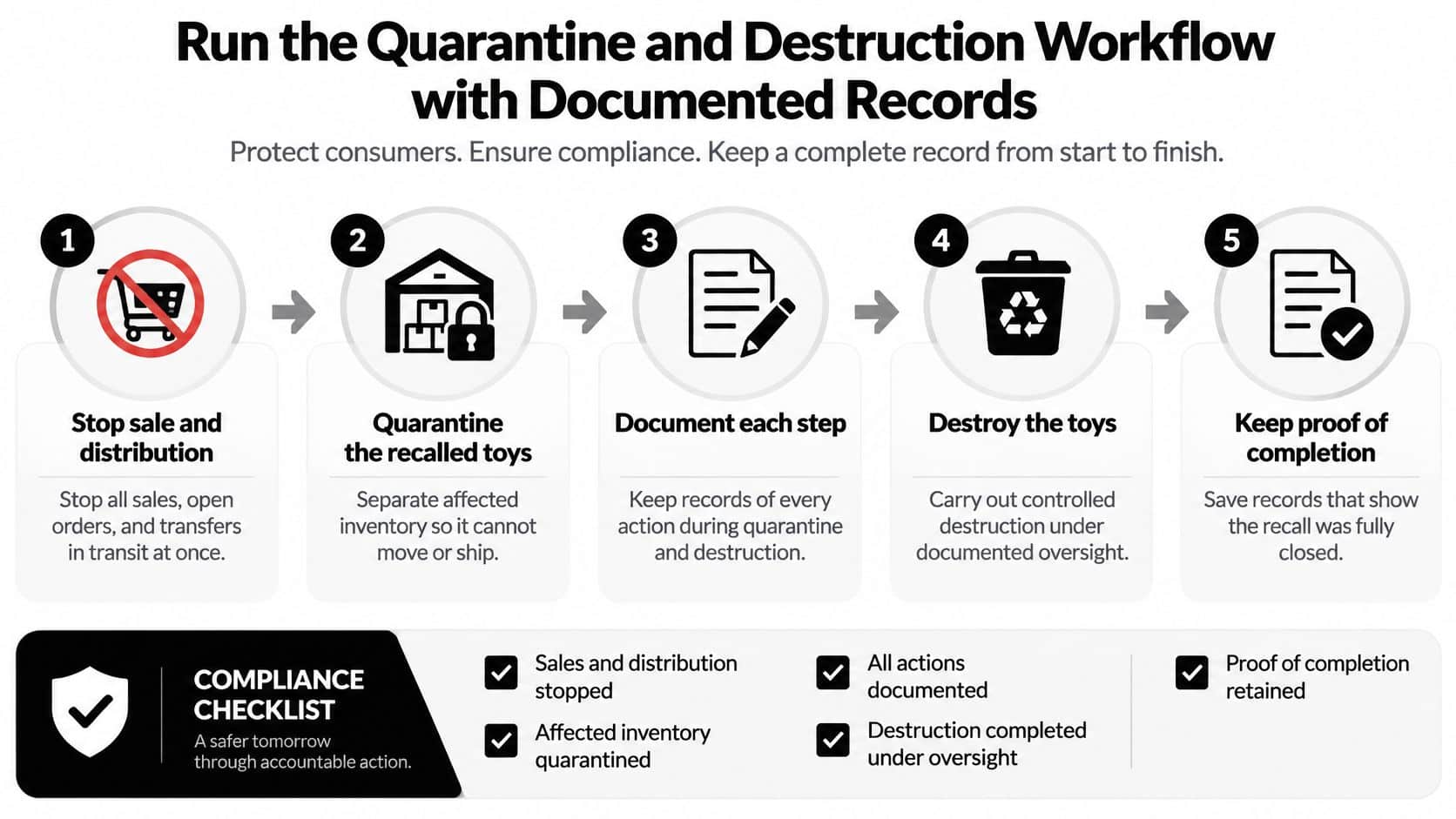
- Stop sale and distribution at once: Block the SKU, cancel open orders, stop transfers in transit and pull shelf and backroom stock. One shipment after the notice creates a new recovery problem.
- Move units to locked quarantine: Use a clearly marked area separate from returns, available stock and salvage. Log every entry, exit and internal move.
- Reconcile the physical count: Count units against lot, SKU and serial or batch data. The common slip is counting cartons and missing loose display units, samples and returns.
- Get written approval before destruction: Confirm the method, destination and evidence required. Don't destroy stock that must be held for testing, inspection or legal review.
- Prevent commingling: Label cartons and pallets by recall, lot and count. Don't top off a pallet with non-recalled goods to save freight.
- Destroy by the approved method: Record the product, quantity, date, employee performing the work and witness for on-site destruction.
- File proof and update inventory: Retain the certificate or affidavit, then write the units out of inventory by the same lot and SKU.
Control the space, not just the paperwork
The CPSC Regulated Products Handbook requires recalled products to be controlled throughout reverse distribution, with a plan explaining removal from shelves, quarantine, return, repair, replacement or disposal, and with recalled toys segregated so they can't be accidentally resold, redistributed or sent to salvage. It also puts the recalling firm in charge of monitoring a third party that performs disposal or destruction.
That control has a physical side. Limit keys or badge access, use tamper-evident seals on staged pallets and keep quarantine away from donation and liquidation staging. If you're short on secure internal space, planning ideas around layered security for on-site storage can help you think through locks, barriers and access control, but the container still needs recall labels, an access log and a named custodian.
Make the vendor record auditable
For off-site work, send written instructions that list the recall reference, SKUs, lots, quantities, approved method, prohibition on resale or salvage and the certificate fields you require. Photograph labeled pallets at loading, keep weight tickets and chain-of-custody logs and require the certificate to itemize quantities, dates, method and signatures.
We make certificates of recycling and data destruction available for each load of equipment picked up, and every load receives a Certificate of Recycling and Data Destruction, with all liability transferring to Beyond Surplus. Apply that same load-level expectation to toy destruction. A generic invoice marked "disposal" won't prove final disposition.
Where records fail: The count at quarantine, the count on the bill of lading and the count on the certificate don't match, and nobody documents why.
File everything in the recall file before you mark the recall closed. Photographs, weight tickets, chain-of-custody logs, approvals and final disposition records support the certificate and show that every affected unit stayed controlled from stop-sale to destruction.
Reconcile Every Unit to Prove the Recall Is Closed
A recall notice doesn't retrieve products by itself. During the 2007 U.S. toy-recall crisis, Mattel stated that only about 6% of its recalled toys were returned by consumers, and low-priced toys and trinkets often had return rates below 5%, so the disposal burden frequently shifted to households and local sanitation systems, as NPR reported on what happens to recalled toys. For stock still in your warehouse, stores, donation bins or resale channels, you can't blame that gap on consumers. You own the count.
That history also explains why verified end-of-life processing matters for returned units. Companies may hold products for testing, legal review, recycling or destruction, but storage isn't disposition. Until a unit is corrected under the approved remedy or destroyed with evidence, it remains an open exposure in your reconciliation.
Use more than one percentage
The GAO report on consumer product recalls found that only 61% of firms submitted required progress reports more than 75% of the time for recalls closed between February 2016 and May 2020, exposing a recurring documentation and governance weakness. It also notes that CPSC defines recall effectiveness around whether consumers received notice and took appropriate action, while the correction-rate metric counts units refunded, replaced or repaired. GAO cautioned that correction rates can understate effectiveness for inexpensive toys because consumers may discard them rather than request a refund or replacement.
So don't report a single destruction percentage and call it effectiveness. A high destruction count can still hide unconfirmed distributors, missing store returns or a pallet that never reached quarantine. A lower correction rate can also hide consumer disposal that you can't verify. Your file should separate what you proved from what you inferred.
| Metric | Source record | What a gap means |
|---|---|---|
| Units manufactured and shipped | Production and shipping records | Baseline for every other count |
| Units located and quarantined | Physical count and quarantine log | Stock outside the count is unaccounted for |
| Units returned, corrected or destroyed | Returns log and destruction certificates | Destroyed units must match certificates |
| Retailer and distributor confirmations | Written confirmations | Missing replies show where the notice stopped |
| Units still unaccounted for | Exception review | Must be investigated, not reported as destroyed |
Run periodic physical counts while the recall is open, not only at the end. Review exceptions by location, lot and SKU, and chase missing retailer or distributor confirmations while staff still remember where display stock, samples and returns went. Preserve evidence for at least the recall-management period and keep the dashboard with the file.
I would treat any unexplained unit as an investigation item, not a rounding difference. Check transfer orders, damage logs, donation records, salvage pickups and write-offs before you accept a gap. Then record the conclusion and who approved it.
Your closing evidence should make that review easy, including a certificate of destruction for recalls that ties quantities and methods back to the reconciled lots. A recall is closed only when manufactured, shipped, located, quarantined, returned, destroyed, corrected and unaccounted-for units reconcile with no unexplained remainder.
Build Your Disposal Plan Before the Next Recall
Write the plan before the next notice arrives, while you can still choose vendors and quarantine space without a stop-sale clock running. A plan written during the recall usually becomes a chain of emails, and that's where approvals, counts and pallet labels start to diverge.
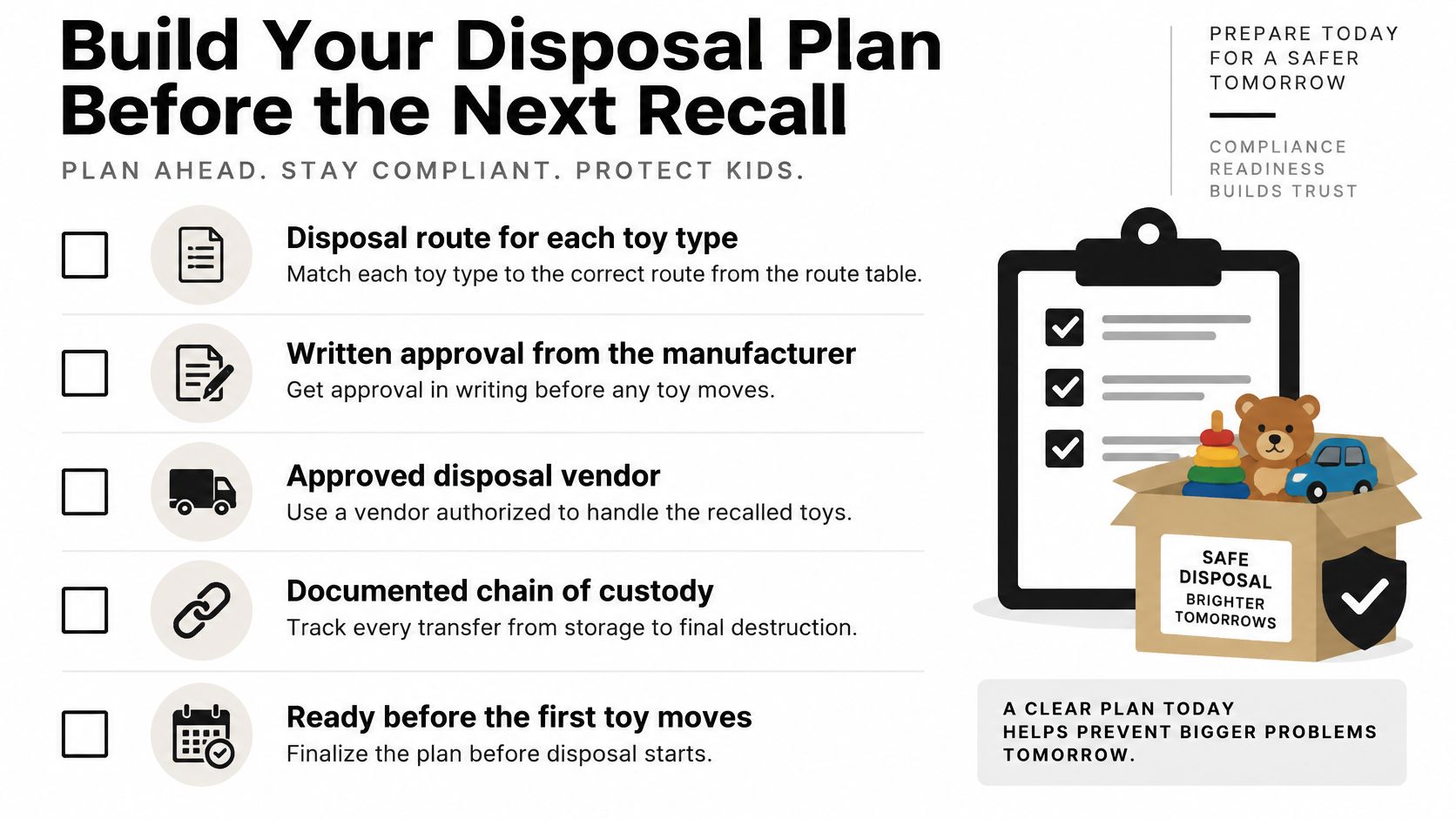
Confirm five points in writing before the first toy moves.
- Route by toy type: Pre-map lead paint, batteries, electronics, magnets and plain plastic to an approved route and method.
- Written approval: Name who requests manufacturer or CPSC approval and where the signed approval is filed.
- Quarantine location: Reserve a marked, access-controlled area with an entry and exit log at each site.
- Destruction method and vendor: State whether work is on-site with a witness or off-site with labeled pallets and certified destruction.
- Records to file: List the photos, counts, chain-of-custody logs, weight tickets and certificates required for closure.
Choose logistics by volume and location. On-site destruction can suit a small quantity at one facility if you have trained staff, a witness and secure staging. Off-site certified destruction suits large or multi-site inventories because one vendor can standardize labels, transport and certificates. For stock held across regions, review options for nationwide recalled product destruction and confirm how each pickup references the recall on its paperwork.
Ask each vendor in writing which recalled items it accepts, how it documents separation, what certificate it issues, who carries liability at handover and how it handles batteries or electronic assemblies. Confirm pickup timing, rejected-unit handling and whether subcontractors will touch the load. A vendor that can't answer those points before the recall won't produce a cleaner file during it.
Assign one owner for the recall file and set review dates to reconcile counts before closure. For related electronics work, we hold a strict zero landfill policy for all electronic waste, offer a no-contact electronics recycling drop-off service at the Atlanta warehouse during business hours for accepted equipment and take questions and recycling requests at 404-905-8235. Use the same discipline for toys. Approve the plan now, test the count process with a mock lot and contact Beyond Surplus for certified electronics recycling and secure IT asset disposal when recalled products include electronic assemblies that need controlled processing.
If your recalled inventory includes electronic toys, battery-powered products or mixed IT equipment that must be rendered unusable with documented chain of custody, Beyond Surplus can coordinate secure pickup, certified destruction and load-level proof for your recall file. Send your SKUs, lot counts, locations and approval requirements so we can scope the destruction method and records before the first pallet moves.