Only 1.1% of recalls in the five-year remedy dataset displayed by the U.S. Consumer Product Safety Commission specified disposal, compared with 54.6% offering refunds. That distinction matters for a warehouse, childcare operator, hospital, or retailer: destroying a recalled item isn't automatically the correct response.
Effective recalled baby product disposal services start with the approved remedy, then account for material hazards and custody requirements. The finished job should be a documented closeout, not an empty storage cage.
Table of Contents
- Which Recall Remedy Requires Disposal
- How to Identify and Quarantine a Recalled Unit
- Route Each Material and Avoid Costly Errors
- Records That Prove Destruction Happened
- Frequently Asked Questions and Official Resources
- Choose a Certified Destruction Partner
Which Recall Remedy Requires Disposal
The CPSC dataset lists 1,107 refund recalls, 534 repair recalls, 343 replacement recalls, and 23 disposal recalls. It also lists 12 recalls with no remedy available and eight providing new instructions. These counts describe the displayed recall set, not baby products alone.
Each remedy sets a different closeout path. A repair keeps the unit out of use until the work is complete. A refund or replacement may require the product, a component, or proof to be returned before anything is destroyed. A disposal instruction, by contrast, requires the product to be permanently removed from use, not redirected to another sales or donation channel.
Read the remedy before authorizing work
Search the CPSC recall database using the manufacturer and product name. This can help organizations find older inventory even when purchasing records are incomplete.
Then compare the notice with the product label, including model, lot, manufacturing dates, and sale dates where applicable. A matching brand name or similar photograph alone is not enough to confirm that a unit is affected.
Read the manufacturer's instructions before cutting straps, removing labels, or arranging processing. A refund might require a photograph, a returned component, or surrender of the complete product. Destroying an item too early can prevent the organization from completing those steps.
Practical rule: Permission to remove a product from service isn't permission to choose your own destruction method.
CPSC recall remedies and what to do first
The counts and reported shares below come from the CPSC dataset cited above. Remaining shares are approximate calculations from the listed category counts.
| Remedy | Recalls in set | Share | Do this first |
|---|---|---|---|
| Refund | 1,107 | 54.6% | Follow the return or proof steps before altering the product |
| Repair | 534 | 26.3% | Keep the unit quarantined until the repair is done |
| Replacement | 343 | 16.9% | Return or surrender the old unit exactly as the notice says |
| Disposal | 23 | 1.1% | Render it unusable as directed and retain proof |
| No remedy listed | 12 | Approximately 0.6% | Recheck the live notice before discarding |
| New instructions | 8 | Approximately 0.4% | Follow the updated notice, not an older screenshot |
Turn the notice into a work authorization
Give receiving, maintenance, and warehouse staff the same approved disposition instructions. Set a hold point for any missing manufacturer response or unresolved product identification. That keeps an uncertain item from entering a destruction load before its remedy is clear.
For example, a returned high chair awaiting a replacement decision should remain marked as pending, even if it takes up valuable floor space. Record its status, and keep destruction authorization separate from the collection request. The two records serve different purposes: one confirms what the manufacturer requires, while the other authorizes the physical work.
For bulk stock, recalled-product disposal for warehouses should begin with an identified inventory and an approved remedy, rather than a general instruction to clear the dock.
How to Identify and Quarantine a Recalled Unit
A recalled product can look clean, complete, and ready for service. Its appearance cannot confirm safety, and moving it to another room does not resolve the hazard.
The CPSC fiscal year 2023 annual report records 313 cooperative voluntary recalls, including 167 through Fast-Track. It also describes approximately 3.3 million Boppy newborn loungers recalled after reports of eight infant deaths associated with suffocation hazards. The Rock ’n Play sleeper, recalled in April 2019, was ultimately linked to roughly 100 infant deaths.
These cases show why a recall search must reach beyond current purchasing records. Older products can remain in classrooms, equipment closets, rental fleets, and return cages, even after purchasing staff have changed.
Run a controlled identification sequence
- Pull the live notice. Record the recall number, affected models, hazard, remedy, and manufacturer contact instructions. Assign someone to resolve uncertain matches.
- Locate every affected unit. Check active-use areas and stored inventory. Include items received through transfers or secondhand purchases, even if there is no purchase order.
- Count and photograph before alteration. Photograph the full item and readable labels. Assign each unit an intake reference so images can be matched to the inventory.
- Quarantine the units. Place them in a marked area apart from usable stock. Tag each item with the recall and a clear instruction not to use or release it.
- Stop outbound movement. Block sales, donations, transfers between sites, and marketplace listings. Notify inventory-system staff as well as employees handling physical goods.
- Complete the manufacturer's remedy steps. Submit any required claim, photographs, or return request. A pickup receipt may not satisfy the manufacturer's proof requirements.
- Disable only as authorized. Follow the method in the notice once the remedy permits it. Avoid improvised smashing, crushing, or disassembly.
- Assemble the disposition packet. Keep the notice, inventory count, photographs, authorization, and final status together.
Make responsibilities clear to staff, and give each held unit a status they can understand. A simple intake record works like a label on a library book: it ties the physical item to the instructions and evidence that govern its next step.
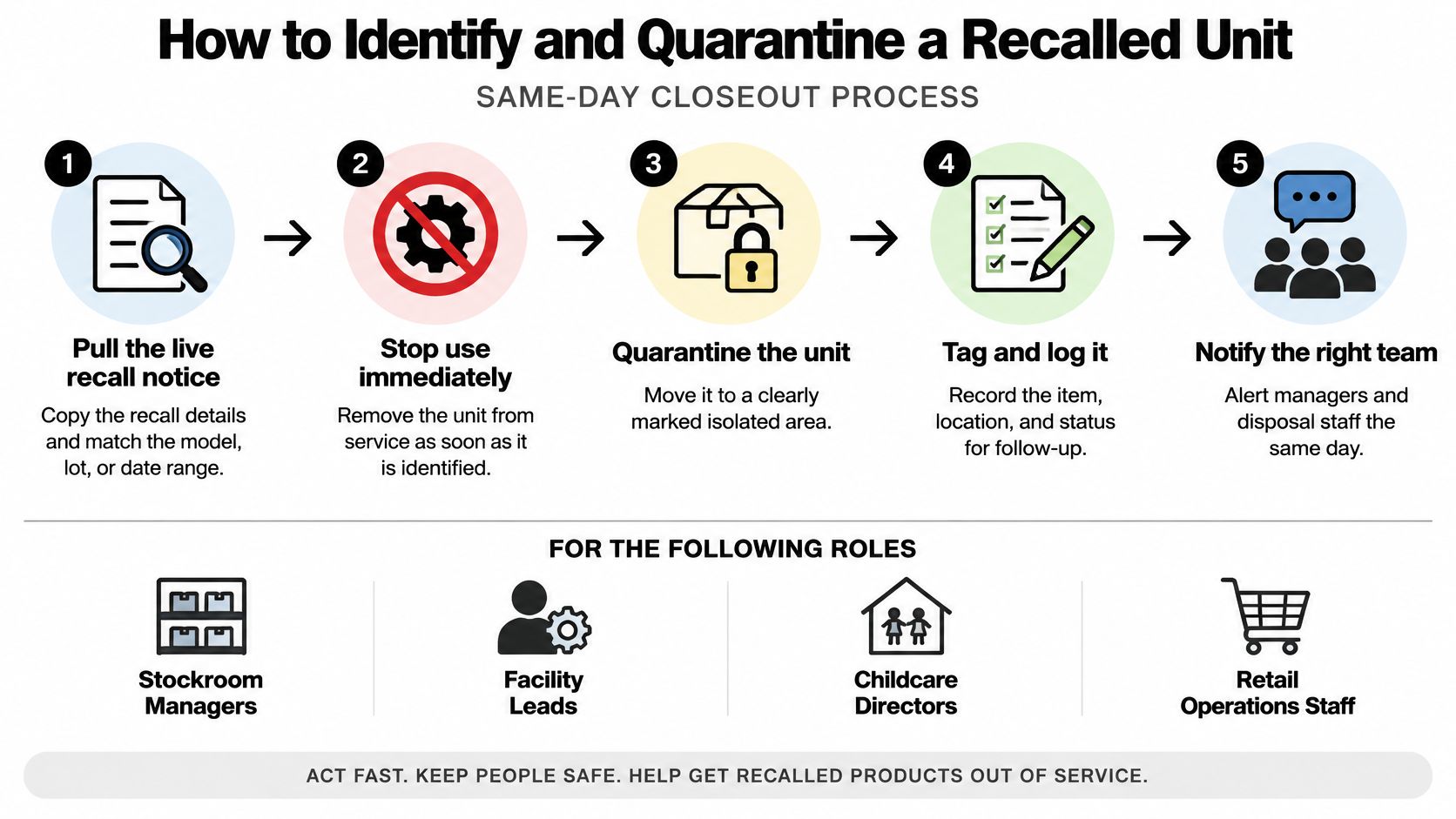
Make quarantine a managed status
A taped-off corner alone may not stop someone from returning a lounger to a childcare room. Name who can release held inventory, and require a documented disposition before that person changes its status.
Keep unidentified units on hold instead of guessing from upholstery color or packaging. If a label is missing, photograph the item and seek manufacturer identification before approving disposal. Record the location, condition, and handling restrictions for held stock before arranging any collection.
For staff training beyond a specific recall, toy safety advice from Playz can supplement routine equipment checks, but general guidance does not replace the live recall notice. A household photo and refund may close a single-item claim; a multi-unit destruction requires its own authorized method and records. Organizations can use this recalled-product quarantine guidance to inform their handling procedures without treating quarantine as permission to destroy.
Route Each Material and Avoid Costly Errors
A recalled stroller frame, lithium-powered monitor, and chemically contaminated toy shouldn't automatically enter the same processing stream. The recall remedy determines what must happen to the product; its materials determine how that work can happen safely.
The CPSC product-safety warning listing illustrates why product-specific instructions matter: notices can require destruction or disposal, while battery-containing products may need special handling. Recalled goods must not be sold, donated, or given away.
Match the method to the material
Start by completing any required remedy evidence. Then classify the load as bulky material, batteries or electronics, or potentially regulated waste. Finally, choose a disabling method that prevents reuse without creating a separate handling hazard.
Cutting mesh or restraint straps can be appropriate when the notice directs it. It isn't a universal instruction for every crib, stroller, or high chair. Staff should photograph identification first and account for exposed sharp edges after cutting.
Battery equipment needs a different assessment. Don't force open a swollen monitor housing or puncture a battery while trying to separate it from plastic. Keep damaged devices out of compactors and obtain handling instructions before loading them.
Disposal route by baby-product material
| Item type | Disable without new hazard | Downstream route | Do not |
|---|---|---|---|
| Crib, stroller, or high chair if notice allows discard | Photograph first; cut straps or mesh and mark the frame only as directed | Local bulky waste after the remedy step and facility acceptance | Donate, resell, or leave usable |
| Sleeper, lounger, or soft pad | Preserve required photographic evidence, then destroy per notice | Trash only if the notice and local rules allow | Give to another caregiver |
| Battery swing, monitor, or toy | Remove the pack only if safe; never crush or puncture cells | Approved battery collection; household hazardous-waste programs only where eligible | Use ordinary trash or a compactor |
| Lead or chemical-containing household item | Follow the label; don't dump leftovers | Household trash only where the recall and locality allow | Pour into drains or mix products |
| Daycare, school, retail, or manufacturer inventory | Segregate by recall identifier and count units | Appropriate permitted facility following waste determination | Assume the household exemption applies |
The household rows explain a boundary, not a disposal option for enterprise inventory. Commercial operators must establish which facilities can accept their particular load.
Don't apply household exemptions to business stock
The EPA guidance on recalled lead-contaminated children's products distinguishes qualifying household waste, generally excluded from federal RCRA hazardous-waste regulation, from commercial and institutional material; state and municipal requirements may be stricter. A school, retailer, daycare, or manufacturer shouldn't apply that household exclusion to its inventory.
For commercial loads, document the waste determination and confirm the receiving facility's authorization for the material. A clean-looking painted component can require a different route from an uncontaminated metal frame.
For mixed electronics, our universal-waste regulations guide provides context for identifying streams that need separate management. Don't assume that every electronic device or recalled component falls into the same regulatory category.
A product can be unusable and still be unsafe to transport. Destruction planning must address both conditions.
Correct errors before the load leaves
Operational mistakes are easier to fix while the inventory remains identifiable:
- Labels removed too early. Hold the affected items, compare photographs with receiving records, and rebuild identification before authorizing processing.
- Recalled stock on a resale rack. Remove it immediately and check whether matching units have already been released.
- Destruction scheduled before claim approval. Pause alteration until the manufacturer's evidence and return requirements are settled.
- Battery devices mixed into a compactor load. Isolate them without crushing or forcing disassembly, then arrange an accepted battery or electronics route.
- Chemical residues treated as ordinary rubbish. Keep containers closed and separate incompatible materials while obtaining local waste-management instructions.
Never pour hazardous leftovers into drains or mix products to reduce container volume. Contact the local solid-waste authority or relevant hazardous-waste program, identifying the material as business-generated.
For a mixed pallet, use separate packaging and descriptions for frames, soft goods, electronic assemblies, and regulated components. Separation supports safer handling, but it doesn't authorize recovery of components that the recall requires to be destroyed.
Records That Prove Destruction Happened
Safe disposal and verifiable destruction aren't interchangeable. A photograph can show a cut restraint without establishing which inventory it represents, who authorized the work, or where the remaining material went.
The CPSC Recall Handbook calls for segregation of recalled goods, monitoring of third-party disposal providers, written off-site destruction instructions, inventory updates, and certification of destruction. Firms may also need to notify CPSC before destruction so the agency can witness the work or request an affidavit, photographs, or other verification.
That doesn't mean every recalled crib requires a regulator on site. Review the recall program and consult counsel about agency notification, witness requirements, or evidence holds before scheduling commercial destruction.
Build a packet an auditor can follow
A simple manufacturer photo-and-refund process isn't the same assignment as reconciling institutional inventory. The following visual contrasts those closeout types; commercial operators need the organization-side record set.
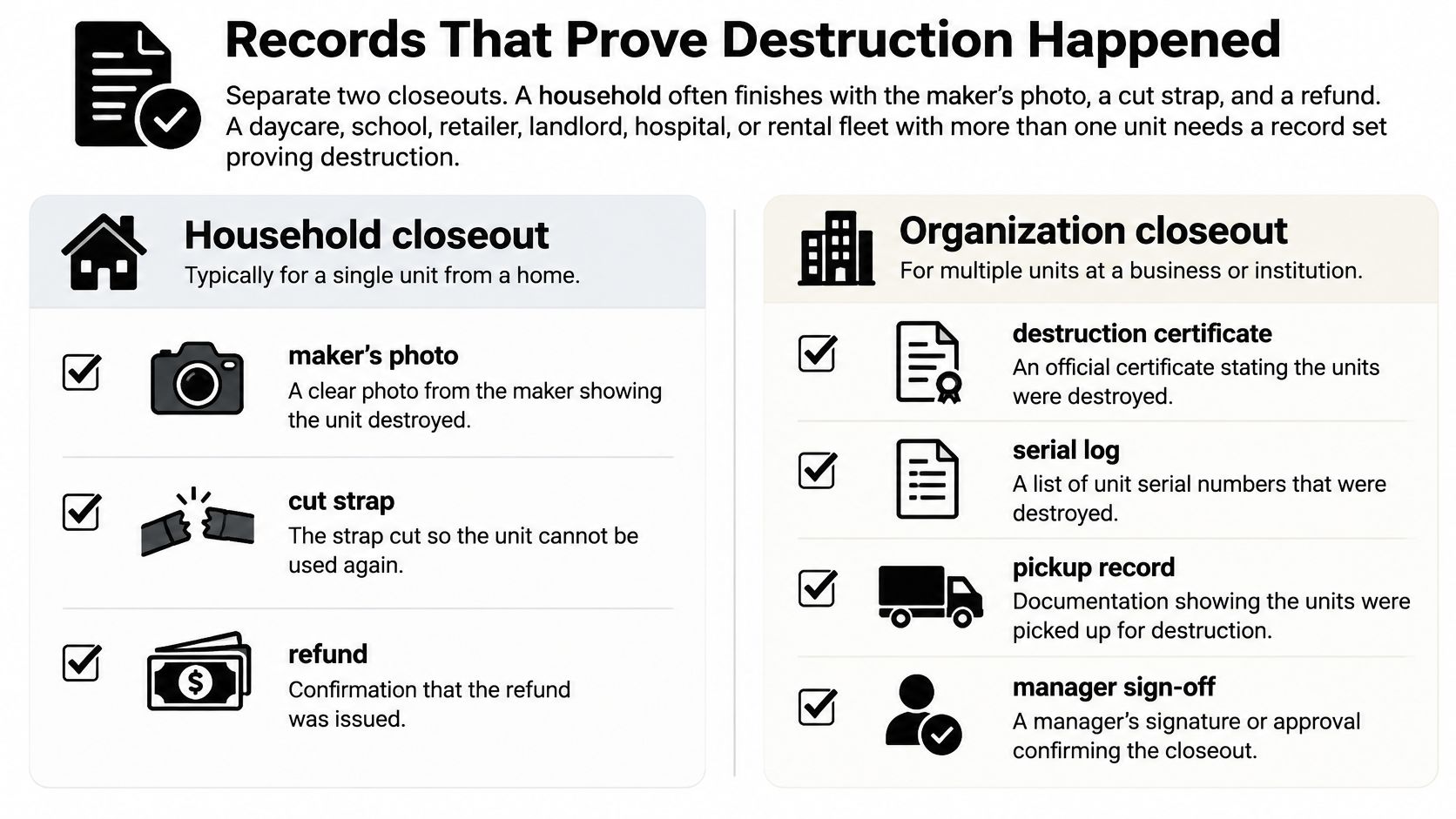
Arrange the business closeout packet in a consistent order:
- Authorization. Identify who approved disposal and the instruction they approved.
- Recall number. Attach the applicable notice and manufacturer correspondence.
- Product identity. Record model, serial numbers where available, or a counted quantity tied to intake references.
- Destruction date and site. State when and where the work occurred.
- Method. Explain how processing prevented reuse.
- Transporter. Preserve pickup documentation and custody transfers.
- Facility receipt. Identify the receiving operation and accepted load.
- Photographs. Tie before-and-after images to the recorded inventory.
Aim for unit-level reconciliation: each intake entry should have an authorized disposition and supporting downstream evidence. Investigate unexplained differences rather than adjusting the spreadsheet to match a certificate.
Distinguish product evidence from data evidence
Beyond Surplus provides product destruction with documented chain of custody and sustainable material recovery built in. Certificates of recycling and data destruction are available for each load of equipment picked up.
We hold NAID AAA certified data destruction, covering hard drive shredding and product destruction with chain of custody for every Atlanta pickup. That credential is relevant when storage media are included, but it doesn't replace recall-specific instructions or a product inventory.
For connected monitors or other data-bearing equipment, distinguish the product-destruction record from evidence that stored information was made unusable or inaccessible. A general recycling receipt shouldn't be treated as proof of either outcome unless it documents the work.
Use the certificate-of-destruction guidance for recalls to prepare the required fields before collection. Store the completed packet with the recall notice and the inventory adjustment approval.
Frequently Asked Questions and Official Resources
Does a sale or transfer end our disposal duty?
Not automatically when equipment contains covered consumer-report information. The FTC Disposal Rule applies to organizations using consumer reports for business purposes and requires reasonable measures to prevent unauthorized access or use.
That is a data-specific obligation, not a rule that every baby monitor contains consumer-report information. IT managers should identify the information stored before selecting erasure or physical destruction.
How long must disposal records be kept?
The FTC's explanation of its disposal standard doesn't establish a universal retention period or destruction technology; it directs covered organizations to consider information sensitivity, available methods' costs and benefits, and technological changes.
Have legal and records-management staff set the retention schedule for recall files. Account for manufacturer agreements, insurance requirements, investigations, and litigation holds rather than assuming the disposal rule supplies a deadline.
What if the notice lists no remedy?
Keep the item out of service and recheck the live notice. Ask the manufacturer or relevant agency for clarification before treating an absent remedy as permission for ordinary disposal.
Preserve the response in the authorization file. If an investigation or injury claim involves the product, obtain legal clearance before alteration.
Which official resource answers which question?
- CPSC. Use the recall notice for product identity, hazard, and remedy instructions.
- EPA and local waste authorities. Use applicable waste guidance to establish material classification and receiving-facility eligibility.
- FTC. Use the Disposal Rule when equipment holds consumer-report information covered by that rule.
Keep product safety, waste management, and information security as distinct decisions. A certificate addressing one doesn't automatically resolve the others.
Choose a Certified Destruction Partner
Hire a destruction provider when the assignment involves business quantities, mixed hazards, controlled custody, or data-bearing equipment. A simple disposal instruction doesn't eliminate the need to manage transportation, downstream acceptance, and evidence.
The FTC's Disposal Rule text identifies contractor due-diligence measures including independent audits, references, recognized trade-association certification, and review of information-security policies. For covered information, those checks help organizations evaluate a contractor rather than relying on a collection promise alone.
Define acceptance before dispatch
Put the required outcome in writing. A provider receiving recalled inventory should know that the job prohibits remarketing and requires a documented method that prevents reuse.
Agree on these operational details before release:
- Accepted scope. Identify products, batteries, damaged devices, and any regulated components.
- Handling instructions. Provide manufacturer requirements and any agency witness request.
- Custody controls. Establish counted intake, segregation, and documented transfers.
- Closeout evidence. Specify the product identifiers, quantity, date, site, and method needed in the final packet.
Our recalled-product disposal for manufacturers supports planning for controlled business disposition. We provide a certificate of recycling and data destruction for each load of equipment picked up, serving as a contractual written guarantee of responsible disposal.
Prepare the pickup request
Questions and recycling requests can be directed to 404-905-8235. Customers can request pickup or drop-off by phone, by email, or through the online form, and organizational pickup is available across the contiguous United States.
Send the recall number, model list, piece count, condition photographs, and any special handling or witness requirement before dispatch. Confirm acceptance of the specific load rather than assuming an electronics pickup covers every chemical or contaminated component.
After processing, reconcile the returned documentation against the intake record and resolve exceptions before marking the recall closed. If a manufacturer remedy remains available, submit it promptly; if business inventory requires destruction, authorize the approved route and keep the stock unavailable for release.
Beyond Surplus offers business product destruction with documented chain of custody, sustainable material recovery, and equipment recycling and data-destruction certificates. Visit Beyond Surplus to request a pickup assessment, providing your recall notice, inventory, and material hazards so the disposal plan supports a verifiable closeout.