

A recall notice lands while your facilities team is replacing treadmills in the employee fitness room. Procurement wants the old machines removed, the loading dock is booked, and someone suggests adding them to the next electronics recycling pickup. Before anything moves, you need to know whether the manufacturer wants those machines returned, repaired, or destroyed.
Recalled exercise equipment disposal starts with the recall remedy, not the truck. For a business, the job is to control access, preserve the right to an authorized remedy, and account for every affected asset through final disposition. A scrap receipt alone won't establish that a hazardous machine stayed out of circulation.
Table of Contents
- Choose the Disposal Route for Each Recall Notice
- How to Quarantine Recalled Units Safely
- Document Every Unit from Quarantine to Certificate
- Handle Batteries, Motors and Hazardous Parts
- Mistakes That Send Recalled Equipment Back into Use
- Arrange Pickup, Transport and Start Disposal
Choose the Disposal Route for Each Recall Notice
Disposal route by recall instruction
| Recall instruction | Who authorizes | Acceptable route | Proof to keep |
|---|---|---|---|
| Manufacturer refund or return | Manufacturer | Return through the recall program | Refund or return confirmation |
| Repair or replacement offered | Manufacturer | Keep out of use until the remedy is applied | Remedy record with serial number |
| Disposal named in the notice | Manufacturer or CPSC instructions | Certified recycling or destruction | Certificate of recycling and data destruction |
| No remedy available | Organization after manufacturer or CPSC confirmation | Certified recycling or destruction with no resale | Written confirmation and destruction certificate |
| Unclear or disputed status | Legal or compliance review | Hold in quarantine | Hold log and review notes |
The CPSC's recall-remedy data lists disposal as the remedy in 23 recalls, or 1.1%, over the five-year period shown. That makes destruction a route to verify, not a default response to an equipment recall.
A refund or return requires coordination with the manufacturer before collection. Preserve the identification labels and follow packaging or pickup instructions so the organization can demonstrate that the returned machine qualifies.
When repair or replacement is offered, don't let a planned renovation turn an eligible asset into unauthorized scrap. Keep it unavailable for use until the manufacturer's remedy is completed and recorded against its serial number.
When the notice explicitly names disposal, translate that instruction into written processor requirements. Establish whether the entire unit must be destroyed, whether specified components need treatment, and what evidence the manufacturer expects.
Resolve uncertainty before committing the asset
“No remedy available” needs confirmation, not an unanswered email. Escalate an unavailable manufacturer, conflicting instructions, or disputed model identification to the organization's compliance owner before authorizing destruction.
Reselling, donating, or releasing defective equipment into ordinary secondhand circulation can pass the hazard to another operator. A warehouse clearance instruction isn't permission to remarket recalled stock.
Our recalled-product disposal guidance for warehouses helps distinguish inventory clearance from controlled disposition. At Beyond Surplus, equipment that fails reuse standards, is unrepairable, old, obsolete, or not contractually permitted to be remarketed is recycled and completely destroyed through de-manufacture and/or physical shredding. For recalled equipment, the authorized remedy must be established before that policy is applied.
Decision gate: If the notice doesn't name disposal and no remedy has been confirmed in writing, keep the unit in quarantine until someone with authority confirms the route.
How to Quarantine Recalled Units Safely
Use the CPSC exercise-equipment recall listings to identify affected equipment and its specified remedy. Then put physical controls around the machines, rather than relying on an email telling employees not to use them.
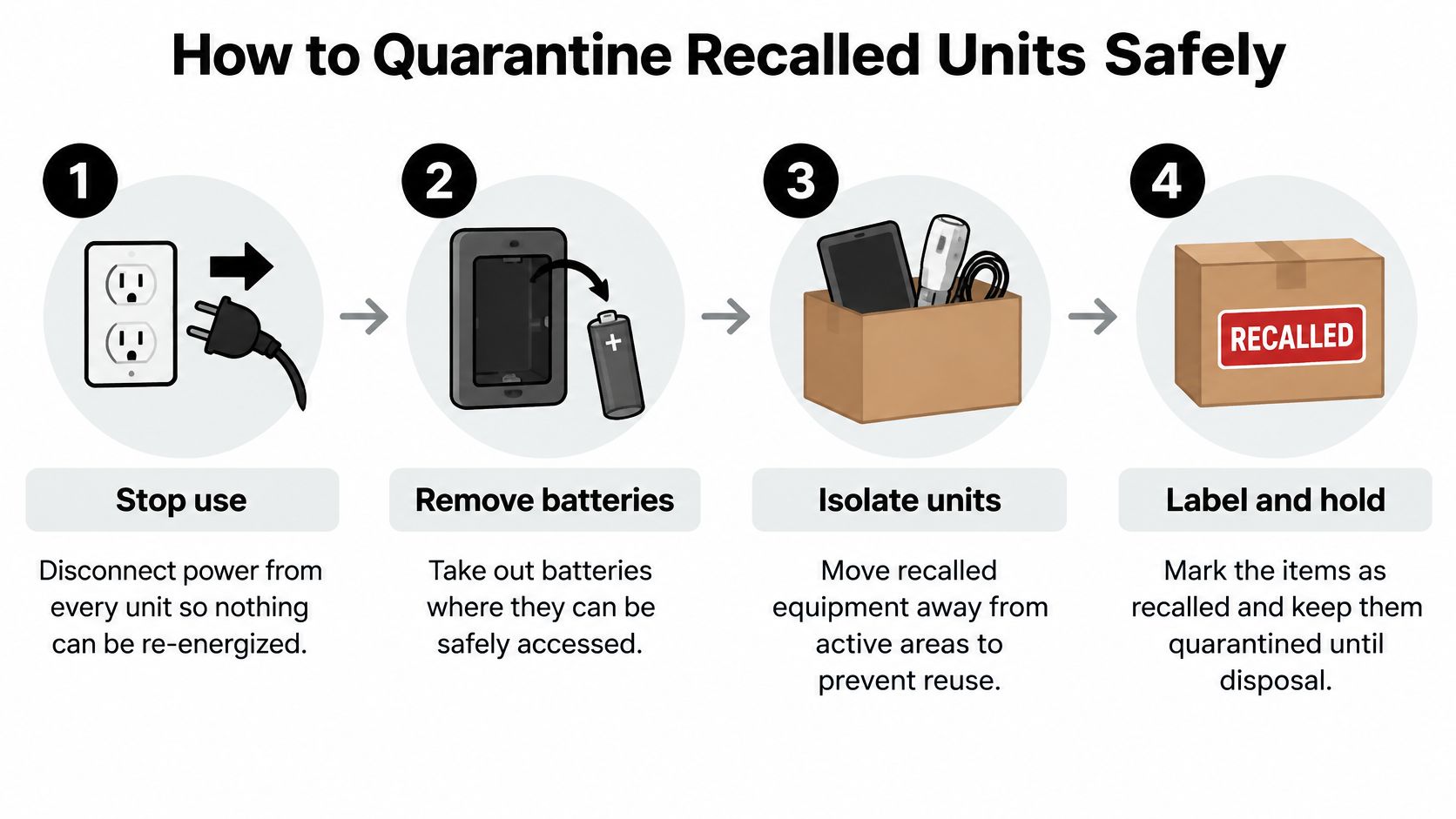
Stop use and disconnect power. Take every affected unit out of service and control access to plugs, keys, or other activation devices. Disconnecting the machine without controlling access leaves someone else able to reconnect it.
Remove safely accessible batteries. Follow the manufacturer's instructions and set removed batteries aside for separate assessment and handling. Don't open a sealed pack or damaged enclosure to complete this step.
Attach a conspicuous recall tag. Mark the machine DO NOT USE, RECALLED, with its asset ID and the responsible department. The tag should remain visible when the equipment is wrapped or moved.
Separate recalled units physically. Keep them away from saleable, reusable, and donation-bound inventory. A dedicated hold area prevents a stockroom or removal crew from treating them as ordinary surplus.
Verify and photograph identification. Match the manufacturer, model, and serial number to the notice, then photograph the identification plate and overall condition. This prevents a similar-looking but unaffected machine from being substituted during handling.
Leave dismantling to an approved method. Don't cut cables, remove guards, or break components merely to make the machine unusable. Partial dismantling can introduce pinch points, sharp edges, stored-energy hazards, and battery damage.
Control movement as carefully as access
For powered treadmills, bikes, and ellipticals, use two-person handling or suitable mechanical equipment. Secure decks, pedals, arms, and other moving parts before tilting or wheeling a machine, and assess the route before starting.
The Peloton Tread+ recall followed a child's death after being pulled beneath a treadmill. A machine left accessible in a storage room can expose another person to the same hazard even after staff consider it “retired.”
Use a designated owner and controlled location, consistent with the approach described in our recalled-product quarantine guidance. At audit, a quarantined unit should be tagged, photographed, logged, and physically separated, not absent from the fitness room.
Document Every Unit from Quarantine to Certificate
Record manufacturer, model, serial number, recall number, owner, location, photographs, and condition when the equipment enters quarantine. Keep the organization's asset ID as a separate field; an internal inventory label doesn't replace the manufacturer's serial number.
The CPSC Recall Handbook recommends clear written instructions for off-site vendors, separation from other inventory, conspicuous markings, and certification of destruction. It also distinguishes approved return or destruction procedures from releasing recalled goods into salvage.
Build a traceable disposition file
- Create the register. List every affected unit, including machines at satellite facilities and equipment already awaiting removal.
- Reconcile identification. Compare each serial number against the recall population and resolve missing, unreadable, or duplicate entries.
- Record release from quarantine. Enter the release date, responsible person, authorization reference, and intended destination.
- Prepare the transport manifest. Include asset ID, serial number, recall identifier, pickup date, carrier, destination, count or weight, and final treatment route.
- Obtain the processor's certificate. Match the recycling or destruction evidence to the load and its serial-number schedule.
- Close the file. Store the notice, authorization, manifest, certificate, and any refund or return confirmation together.
Follow the serial number, not just the shipment
Say a treadmill is logged under asset ID FITNESS-TM-A. Its photographed serial number should appear in the register, the quarantine release record, and the manifest attachment. The final certificate must identify that attachment clearly enough to connect the machine to its treatment.
A certificate stating only “mixed equipment” leaves a gap. Before release, confirm that the processor's documentation will name the recall identifier, every serial number in the load, treatment method, and signing party, and verify that the processor is authorized to handle the relevant electronics and batteries.
Beyond Surplus's IT asset disposal process includes full chain-of-custody documentation and compliant transportation. We provide certificates of recycling and data destruction for every load picked up, as contractual written guarantees that equipment will be disposed of responsibly.
Use our recall destruction certificate guidance when defining the evidence your file needs. Where physical destruction is required, make that requirement explicit rather than assuming a general recycling certificate proves it.
Hand an auditor a serial number and test whether the responsible employee can retrieve its full history within ten minutes. Treat that as an internal retrieval target, not a regulatory deadline.
Handle Batteries, Motors and Hazardous Parts
The recall notice decides whether a unit can be dismantled, returned, or must be destroyed. Until the manufacturer's remedy and handling instructions are confirmed, keep the equipment intact. Removing a battery or motor too early can create hazards and undermine the remedy process.
| Component | Main risk | Handling | Route |
|---|---|---|---|
| Lithium-ion battery packs | Thermal runaway and fire | Don't remove unless the recall instructions or an approved procedure authorize it. Disclose damage before movement. | Route through a provider that accepts the battery in its condition |
| Motors and capacitors | Stored energy and shock | Follow the authorized handling instructions before removal. | Electronics recycler that accepts the components |
| Steel frames and flywheels | Pinch points and sharp edges | Use controlled handling; dismantle only when authorized. | Scrap route after authorized dismantling |
| Displays and control boards | Electronic waste contents | Keep intact and segregated until the route is confirmed. | E-waste recycler |
| Aluminum and copper wiring | Cuts or exposure during separation | Separate only when authorized and safe to do so. | Metals recycler |
| Hydraulic cylinders | Pressurized fluid | Don't puncture or dismantle without specialist instructions. | Specialist handling route |
| Rubber belts and plastics | Material may not be accepted locally | Keep separate if dismantling is authorized; confirm acceptance first. | Recycling only where locally accepted |
Material composition and local acceptance rules affect downstream routing. The EPA's recycling guidance advises checking with the local provider because electronics generally don't belong in curbside recycling. A metal frame does not make the complete machine suitable for mixed-metal collection.

Assess hazards before separating materials
An unplugged treadmill can still present moving-part and entanglement hazards. Capacitors and hydraulic assemblies also require handling controls that ordinary scrap sorting does not provide. A damaged lithium-ion battery can enter thermal runaway.
The CPSC product-safety warning listing reported 11 fires involving Sperax walking pads and treadmills, including a burn injury and smoke-inhalation reports. Check the unit's electrical condition before arranging transport.
Disclose swelling, leakage, scorching, overheating, or fire exposure to the recycler and carrier before arranging movement. Confirm that the proposed route matches the manufacturer's remedy and any handling restrictions. The recalled battery-device disposal guidance provides further information about disposal considerations for battery-bearing equipment.
Keep damaged or overheated units in a location designated by the site safety lead, away from ordinary inventory and occupied work areas. Arrange appropriate specialist transport before further handling. Do not ask a general collection crew to improvise packaging or containment.
Mistakes That Send Recalled Equipment Back into Use
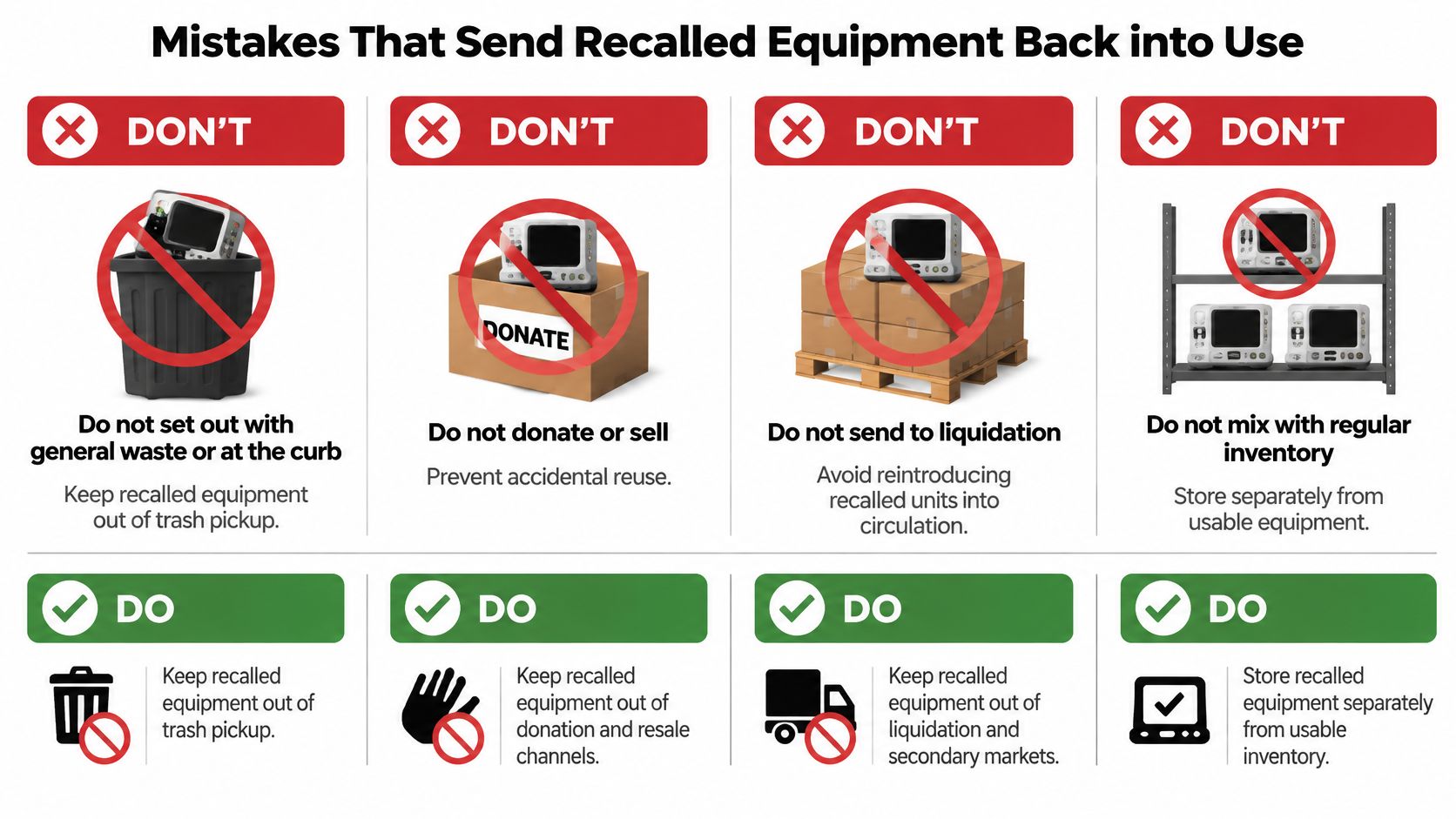
An expensive mistake is treating a recalled machine as an asset-recovery opportunity before confirming whether it can legally return to service. A liquidation instruction can move the equipment beyond your control faster than your team can correct the paperwork.
| Don't | Do instead |
|---|---|
| Set units out with general waste or at the curb | Keep them in controlled custody until authorized collection |
| Donate, sell, or send them to liquidation | Block resale and redistribution in the disposition instructions |
| Mix them with saleable inventory | Maintain a visibly separate recall hold area |
| Partially dismantle without authorization | Use an approved treatment method |
| Leave serial numbers off the register | Resolve identification before release |
| Rely on verbal permission | Retain written route authorization |
| Accept a collection receipt as destruction evidence | Obtain the required treatment certification |
The CPSC guidelines for retailers and reverse-logistics providers explain that federal law prohibits selling, offering for sale, manufacturing for sale, distributing in commerce, or importing products subject to a Commission-ordered recall or voluntary corrective action conducted with CPSC consultation. Liability can extend to firms distributing recalled products in commerce, and businesses are responsible for monitoring recalls.
Keep scheduling pressure separate from release approval
Closing a fitness area creates pressure to restore capacity. Operations staff can use Gym Membership Tips on class scheduling to plan around unavailable equipment, but scheduling decisions must remain separate from recall clearance.
Before a transfer for disposal, ask:
- Identity: Is this serial number on the recall list?
- Authority: Is there written authorization for this route?
- Evidence: Does the destination certify recycling or destruction in writing?
If any answer is no, keep the unit in quarantine. For manufacturer returns or repairs, retain the corresponding program confirmation instead of demanding destruction evidence for a machine that isn't supposed to be destroyed.
Arrange Pickup, Transport and Start Disposal
Drop-off suits small, accepted quantities confirmed in advance. Planned pickup suits bulky machines and recall batches. Don't load a vehicle until the destination has accepted the equipment type, recall status, component hazards, and intended treatment.
Beyond Surplus offers priority pickup for a full pallet of equipment, a 40″ × 48″ × 5′ pile. Smaller amounts can be dropped off or picked up when the truck is already in the area. Those logistics options don't replace advance assessment for heavy machinery or damaged batteries.
Run a controlled hand-off
Reconcile the load. Confirm the unit list, count, and recorded weight against the asset register. Resolve discrepancies before equipment leaves the hold area.
Check size and access. Confirm the pallet or pile dimensions and walk the removal route. Identify stairs, door clearances, loading docks, and any equipment needed to cross thresholds safely.
Load for the actual hazards. Use two-person handling or mechanical assistance, secure moving parts, and keep battery-bearing units separate from general loads. Damaged or overheated equipment needs a carrier equipped for its condition.
Seal and label the shipment. Apply asset IDs and the recall identifier to each load. Keep labels readable and use packaging that prevents loose parts from shifting or exposing handlers to sharp edges.
Sign the manifest. Have the releasing employee and carrier acknowledge the hand-off, and retain the carrier copy. Record exceptions immediately rather than correcting the file from memory later.
Confirm receipt and closure. Log destination receipt and establish how the recycling or destruction certificate will be delivered. Keep the job open until the documentation matches the equipment released.
Use the recalled-product pickup and destruction checklist to prepare the hand-off. Don't consolidate bulky recalled equipment with saleable stock merely to fill a vehicle.
Complete the opening actions in order
Pull the recall notice and select the authorized route. Quarantine and tag affected machines, build the serial-number register with photographs, and obtain written authorization where required before requesting a customized disposal plan through the contact page on our website.
Beyond Surplus builds that plan around the customer's equipment and compliance needs. Free data destruction is offered on qualifying enterprise pickups, so eligible retired equipment leaves the facility with its data already secured.
Keep the reopening checklist separate from disposition approval. WipesBlog.com's guidance on building member trust through cleaner gyms can support routine facility care, but cleaning doesn't resolve a recall defect or authorize reuse.
Beyond Surplus offers customized disposal planning, controlled transportation, and documented recycling or destruction for business equipment approved for that route. Visit Beyond Surplus with your recall notice, asset register, equipment condition, and access details to start planning the job. Contact Beyond Surplus for certified electronics recycling and secure IT asset disposal.


