
For businesses in Atlanta, GA, retiring old hard drives, servers, and IT equipment requires more than just hitting 'delete'. That action is like leaving sensitive company blueprints in a public recycling bin. True secure data destruction ensures that your corporate data is completely, utterly, and permanently unrecoverable. It is the final, critical step in protecting your Atlanta business from devastating data breaches long after your IT assets have been retired from service.
Why Data Destruction is a Critical Business Strategy
Viewing secure data destruction as a simple IT chore is a significant misstep for any modern enterprise. It is a core component of risk management, brand protection, and regulatory compliance. Every server, laptop, and storage device your business retires holds a detailed history—client lists, financial records, and valuable intellectual property. Without proper sanitization, these assets become a latent vulnerability that could be exploited years from now, compromising your operations.

This is not a hypothetical scenario; the financial consequences are substantial. The average cost of a data breach for a U.S. business can easily exceed USD 4.45 million. For companies in regulated sectors like finance or healthcare, that figure can climb past USD 6 million. These statistics underscore why forward-thinking companies invest in auditable, certified data destruction services that eliminate risk and satisfy regulatory requirements.
The True Cost of Inaction
Ignoring professional secure data destruction is a high-stakes gamble. The fallout from a breach can impact every facet of your organization, extending far beyond the initial data loss. Understanding these risks is the first step toward developing an IT asset disposal (ITAD) policy that provides genuine protection for your business.
Here is a breakdown of what is at stake when IT equipment disposal is handled improperly.
| Core Business Risks of Improper Data Disposal |
| :— | :— | :— |
| Risk Category | Description of Impact | Potential Business Consequence |
| Regulatory Fines | Non-compliance with data privacy laws like HIPAA, FACTA, or GDPR. | Significant financial penalties, mandatory audits, and potential legal action from government agencies. |
| Reputational Damage | A public data breach erodes customer and partner trust. | Loss of clients, negative media coverage, and a damaged brand image that can take years to rebuild. |
| Direct Financial Loss | Costs associated with managing the breach and its aftermath. | Expenses for incident response teams, credit monitoring for victims, and potential civil lawsuits. |
| Competitive Disadvantage | Loss of sensitive corporate secrets from improperly discarded hardware. | Stolen intellectual property, trade secrets, or client lists can provide competitors with an unfair advantage. |
These are not isolated incidents but interconnected threats that can inflict serious, long-term damage on a business's viability and market position.
Professional data destruction is your final and most critical line of defense against data breaches from retired IT assets. It transforms a potential liability into a verified, secure, and closed loop in your asset's lifecycle.
Proactive measures are essential. Our guide on how to protect your company from data breaches offers deeper insights into building a robust security posture. Partnering with a certified ITAD vendor ensures your end-of-life equipment receives the same rigorous security protocols as your live network, providing auditable proof of compliance.
Exploring the Methods of Secure Data Destruction
When it is time to retire old IT equipment, you must be certain the data is permanently erased. Simply using the "delete" key is insufficient. True secure data destruction involves processes that render information completely unrecoverable, ensuring compliance with strict industry and government standards. Understanding these methods is the foundational step toward implementing a secure and compliant IT asset disposal program for your business.
Think of it this way: deleting a file is like removing the table of contents from a book. All the chapters remain, just harder to locate. Secure data destruction is like putting that same book through an industrial shredder—the original content is obliterated forever.
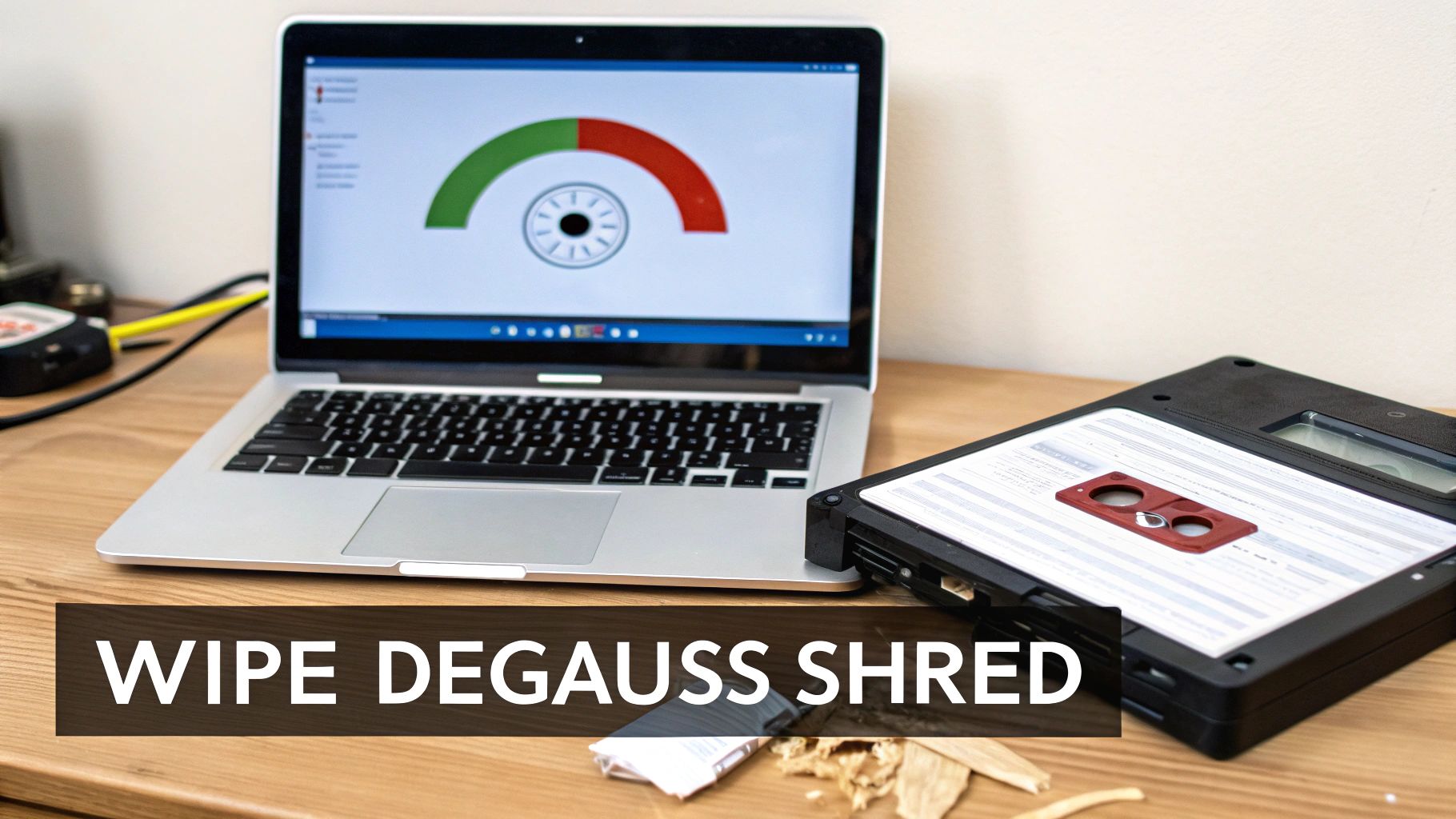
Certified ITAD professionals utilize three primary methods. Each is suited for different types of media and security requirements.
Data Wiping or Sanitization
Data wiping, also known as sanitization, is a software-based method. It functions by overwriting every bit of a hard drive with random ones and zeros. This process is repeated multiple times according to specific protocols, such as the NIST 800-88 guidelines, to ensure no residual data remains.
Imagine a whiteboard covered in sensitive corporate data. A quick erasure might leave faint traces. Secure wiping is like meticulously scrubbing the board clean, covering it with random patterns, and repeating the process until the original information is absolutely impossible to reconstruct.
Key Takeaway: Wiping is highly effective for traditional hard disk drives (HDDs) and offers a significant advantage: the drive can be reused. This supports a sustainable, circular economy approach to IT assets. It also generates a verifiable software report for your compliance audit trail.
Degaussing
Degaussing is a powerful, specialized technique applicable only to magnetic storage media, such as older HDDs and data tapes. A degausser emits an intense magnetic field that completely scrambles and neutralizes the magnetic particles on the drive's platters where data is stored.
Think of an old cassette tape. Exposing it to a powerful magnet renders the audio a garbled, irretrievable mess. Degaussing applies the same principle to a hard drive but on a much more powerful and complete scale.
This method is fast and thorough but has two critical limitations:
- It renders the drive useless: A degaussed hard drive becomes a non-functional piece of hardware. It can never be used again.
- It is ineffective on SSDs: Solid-state drives (SSDs) store data on flash memory chips, not magnetic platters, making them completely immune to degaussing.
Due to these constraints, degaussing is typically reserved for high-security scenarios involving older magnetic media already designated for destruction.
Physical Destruction
When absolute, undeniable certainty is required and asset reuse is not a consideration, physical destruction is the definitive solution. This process involves shredding, crushing, or pulverizing the storage device into small, unrecognizable fragments.
The method is straightforward. Feeding a hard drive into an industrial shredder is the digital equivalent of turning a sensitive document into confetti. The memory chips on an SSD or the platters of an HDD are physically annihilated, making data recovery entirely impossible.
This is the preferred method for SSDs and any other media that may have failed the software wiping process. It provides clear, visual confirmation that the data is gone forever. You can explore various common data destruction and disposal methods for a detailed comparison of these techniques.
Choosing the right approach depends on your device type, security requirements, and sustainability goals. A certified ITAD partner like Beyond Surplus can help your business design the most effective strategy, ensuring total compliance and peace of mind.
Navigating Data Destruction Compliance and Standards
Adhering to data destruction regulations is about more than avoiding fines; it is about building and maintaining the trust of your clients and partners. In the world of IT asset disposal, compliance provides the roadmap for executing processes correctly. It transforms complex legal requirements into a clear mandate: protect sensitive information at all stages, especially at the end of its lifecycle. This commitment distinguishes a professional ITAD process from simple e-waste disposal.
Understanding these standards is non-negotiable for any business handling sensitive information. Many regulations, like Sarbanes-Oxley (SOX) compliance, have specific rules for protecting financial data. Similarly, healthcare organizations are bound by HIPAA, and any company dealing with consumer credit information must comply with FACTA.
The Role of NIST 800-88
In the United States, one of the most important guidelines is NIST Special Publication 800-88, Guidelines for Media Sanitization. It is not a law but rather the gold-standard playbook from the National Institute of Standards and Technology. It has become the definitive industry benchmark for secure data destruction.
NIST 800-88 outlines three primary methods for permanent data removal:
- Clear: This involves overwriting data using standard commands. It is a solid defense against simple recovery techniques but may not withstand a dedicated forensic attack.
- Purge: This method elevates the security level, using advanced techniques like degaussing or cryptographic erasure. The objective is to make data unrecoverable even with state-of-the-art laboratory equipment.
- Destroy: This is the final stage—the physical destruction of the media itself. Methods like shredding, pulverizing, or incineration render the drive completely useless and the data impossible to retrieve.
Determining which method to use depends on the data's sensitivity and the type of device. A slip-up in this area can be devastating. Improperly retired hardware is a common starting point for data breaches, and statistics show that a high percentage of companies that suffer a major data loss cease operations within a year. That fact alone highlights the critical value of certified destruction.
The Certificate of Destruction: Your Proof of Compliance
How do you prove you have followed these procedures correctly? The key document is the Certificate of Destruction. This is not merely a receipt; it is a legally defensible document that serves as your official, permanent record of compliant data sanitization. It is the final, crucial component that provides a solid audit trail and proves due diligence.
A Certificate of Destruction is your formal proof that data-bearing assets were securely and permanently destroyed in accordance with industry best practices and regulatory requirements. It effectively transfers liability from your organization to your certified ITAD partner.
This document is your essential evidence during an audit. It must contain specific, verifiable details that trace an unbroken chain of custody, including:
- A unique serial number for tracking
- The date and location of the destruction
- A detailed list of every asset destroyed, including individual serial numbers
- The exact method of destruction used (e.g., shredded, wiped to NIST 800-88 standards)
- The signature of an authorized representative from the destruction company
Without this certificate, your organization remains exposed to significant legal and financial risks. It is the definitive proof that you took every necessary step to protect sensitive information, properly closing the loop on your IT asset lifecycle.
Choosing Between On-Site and Off-Site Destruction
A primary decision in your IT asset disposal plan is determining where the data destruction will occur. Should your sensitive data be destroyed before it leaves your facility? Or is it secure to transport it to a specialized, secure processing center? The correct answer depends on your organization's security policies, risk tolerance, and budget.
This is not just a logistical question; it is a core risk management decision. Both on-site and off-site services can achieve certified, compliant results, but they offer different levels of control, verification, and cost. Understanding these differences is key to selecting the right service for your business assets.
On-Site Destruction: Maximum Security and Witnessed Verification
For organizations that cannot tolerate any potential weak link in the chain of custody, on-site secure data destruction is the gold standard. A mobile destruction vehicle—a shredding facility on wheels—comes directly to your location. Your IT assets are processed on your premises, often while your team observes the entire procedure.
This method offers ultimate peace of mind.
- Immediate Verification: You can physically witness every hard drive, server, or tape being destroyed, confirming with your own eyes that the data is irretrievably gone.
- Unbroken Chain of Custody: Data-bearing devices never leave your control while they are still intact, completely eliminating the risk of loss or theft during transit.
- Ideal for High-Stakes Data: This is the preferred choice for healthcare, finance, government, and legal sectors where regulations demand the highest possible level of security.
The primary benefit is absolute, witnessed control from the server rack to the final pile of shredded metal. Businesses dealing with highly sensitive data often find the premium for on-site services is a worthwhile investment to mitigate massive risk. To see how this process works, explore our complete on-site hard drive shredding services.
Off-Site Destruction: Secure and Cost-Effective Logistics
Off-site destruction offers a highly secure and more budget-friendly alternative. In this model, a certified vendor collects your IT assets, loads them into locked and secured vehicles, and transports them to a specialized processing facility with controlled access and robust security measures.
Although the assets leave your property intact, a strict chain-of-custody process ensures their security throughout transit. This includes detailed asset tracking, GPS-monitored trucks, and destruction within a facility under constant video surveillance.
Off-site destruction is built on a foundation of trust and transparent, documented procedures. A certified vendor’s audited process delivers the security and compliance most businesses need, but at a much more accessible price point.
This simple decision tree can help frame your thinking around compliance.
Whether you choose on-site or off-site, the core principles remain the same: verify your regulatory needs, confirm the destruction method is appropriate, and always obtain certified proof.
Making the Right Choice: A Direct Comparison
Selecting between on-site and off-site services requires weighing several key factors. The best choice will align with your company's internal security protocols, compliance mandates, and budget. This side-by-side comparison can help clarify the decision-making process.
On-Site vs. Off-Site Data Destruction Decision Matrix
| Factor | On-Site Destruction | Off-Site Destruction |
|---|---|---|
| Security Level | Maximum. Assets are destroyed before leaving your premises, eliminating all transport risk. | High. Relies on a strict, documented chain of custody with secure logistics. |
| Verification | Immediate and direct. Your team can witness the entire process in person. | Certified and documented. Verification is provided through a Certificate of Destruction. |
| Logistics | Simple. The service comes to you, requiring minimal effort from your staff. | Requires coordination. Involves scheduling secure pickup and transport. |
| Cost | Higher. Reflects the premium for mobile equipment, dedicated staff, and travel. | More cost-effective. Centralized processing allows for greater efficiency and lower prices. |
Ultimately, there is no single "best" answer—only the best fit for your specific situation. A company decommissioning a data center with sensitive financial records may mandate on-site shredding. Conversely, a business refreshing employee laptops may find the robust security and value of off-site destruction perfectly match their needs.
The Importance of an Unbroken Chain of Custody
Secure data destruction is not just about the final act of shredding a hard drive. It is a complete, documented journey that starts the moment an IT asset is decommissioned. This entire process is managed through the Chain of Custody—a continuous, unbroken log that tracks your equipment from your facility to its final disposition.
Think of it like tracking a high-value, insured shipment. A gap in the tracking history would be a cause for concern. The same principle applies to your sensitive data. Every handover, movement, and storage location must be recorded to eliminate blind spots where a device could be lost, stolen, or mishandled. This documentation is the foundation of accountability in professional IT asset disposition.
This process is what differentiates a certified ITAD partner from a simple haul-away service. It transforms a potential risk into a transparent, verifiable procedure, providing complete assurance that every device is accounted for.
Core Components of a Secure Chain of Custody
A robust chain of custody is built on concrete actions that create a defensible audit trail. Each step is designed to eliminate uncertainty and confirm your assets are secure from start to finish. Without these elements, you are left with serious security vulnerabilities.
Key components include:
- Serialized Asset Tagging and Inventory: Before any equipment leaves your premises, every data-bearing device is inventoried. Each item receives a unique serial number or barcode, creating a master list that is reconciled at every stage.
- Secure, GPS-Tracked Transport: Your assets are transported in locked, secure vehicles equipped with GPS tracking. This provides real-time visibility and ensures the route to the destruction facility is monitored and direct.
- Controlled-Access Facilities: Upon arrival, your assets are moved into a highly secure, access-controlled area. These facilities are monitored by 24/7 video surveillance, and only authorized, background-checked personnel handle the equipment.
The strength of your data security is only as strong as the weakest link in its chain of custody. An unbroken, documented trail is non-negotiable for proving due diligence and ensuring compliance.
This rigorous documentation culminates in the final, crucial document. Understanding what a Certificate of Destruction includes is vital, as it is your official proof that the chain of custody was maintained and every asset was destroyed according to certified standards.
Why It Matters for Compliance and Risk Mitigation
An unbroken chain of custody provides the hard evidence that regulators and auditors demand. In the event of a compliance audit, you can present a detailed, serialized report showing precisely when each asset was collected, who handled it, its transit history, and the exact date and method of its destruction.
This level of detail is your best defense against claims of negligence. It proves your organization took every reasonable step to protect sensitive information, effectively transferring liability to your certified ITAD partner. Ultimately, it safeguards your business from significant fines and reputational damage, serving as the definitive proof of responsible IT asset management.
How to Select the Right Data Destruction Partner
Choosing a vendor for secure data destruction is a critical business decision that extends beyond a simple price comparison. You are entrusting a partner with your company's most sensitive information, making them an extension of your security and compliance team. A poor choice can lead to devastating data breaches, regulatory fines, and irreparable damage to your brand's reputation.
The vetting process requires a sharp focus on credentials, transparency, and a proven track record. The right partner will not only destroy your data but will also provide the legally defensible documentation to prove it, transferring liability from your organization and delivering genuine peace of mind.
Verifying Essential Certifications and Compliance
Before discussing services, the first step is to verify a potential partner's certifications. These are not merely logos for a website; they are hard-earned credentials proving that a third-party auditor has rigorously inspected their processes, security controls, and environmental practices. Without them, you are relying solely on their claims.
Look for these non-negotiable certifications:
- R2v3 or e-Stewards Certification: These are the gold standards for responsible electronics recycling. They guarantee that all downstream processes are environmentally sound and that hazardous e-waste is managed correctly, ensuring your old assets do not end up in a landfill.
- NAID AAA Certification: This certification is laser-focused on secure data destruction. Issued by the International Secure Information Governance & Management Association (i-SIGMA), it verifies that a vendor’s hiring practices, facility security, and destruction processes meet the highest industry benchmarks.
- Comprehensive Data Breach Insurance: Request proof of their insurance policy and confirm it specifically covers data breaches. This policy serves as your financial backstop in the unlikely event of an incident and demonstrates the vendor's confidence in their own security protocols.
Demanding Transparency and Detailed Reporting
A trustworthy partner operates with complete transparency. They should be able to provide clear, detailed, and verifiable reports for every step of the process. This documentation is your critical audit trail.
The quality of a vendor's reporting is a direct reflection of the quality of their service. Vague or incomplete documentation is a major red flag that points to a weak chain of custody and potential compliance gaps.
With over 60 million metric tonnes of e-waste generated globally each year and a formal recycling rate of only 17%, the risk of untracked devices is massive. This is a key reason why on-site destruction services are projected to capture a significant portion of the market share—businesses want to witness the destruction in real-time to close any security loopholes. You can discover more insights about these ITAD conference trends and how they are shaping security practices.
Always demand a serialized Certificate of Destruction as the final deliverable. This document is your ultimate proof of due diligence. It must list every asset by its serial number, detail the exact destruction method used, and be signed by an authorized representative. It is the final, essential piece of your compliance puzzle.
Common Questions About Secure Data Destruction
When retiring IT equipment, many questions arise for business owners and IT managers. Getting the right answers is key to developing a smart, compliant IT disposal strategy. Let's address some of the most common questions about destroying sensitive corporate data.
This is about having total confidence that when your assets leave your facility, your data does not go with them.
Is Formatting a Hard Drive Good Enough?
Absolutely not. Believing that a simple format protects your data is one of the most common and dangerous misconceptions in IT management. Formatting only removes the file pointers, which is analogous to tearing the table of contents out of a book. The actual data remains on the drive.
With basic recovery software, that information can easily be reconstructed. Secure data destruction is not about hiding data; it is about permanent elimination. This requires using specialized software for multiple-pass overwriting or physically destroying the drive to meet standards like NIST 800-88.
What Is a Certificate of Destruction and Why Is It Important?
A Certificate of Destruction is your official, legally-defensible proof that your data-bearing assets were properly destroyed. It is the final, critical component of your risk management and compliance strategy.
This is more than a simple receipt. It is a detailed audit trail that includes:
- Unique serial numbers for every device destroyed
- The exact destruction method used (e.g., shredding, wiping)
- The date and location of the destruction event
This document formally transfers liability from your company to your certified vendor. In the event of an audit, this certificate serves as your proof of due diligence.
How Do You Securely Destroy Data on Solid State Drives (SSDs)?
Solid State Drives (SSDs) require a different approach. Their flash memory architecture makes traditional methods like magnetic degaussing completely ineffective. Even software wiping can be unreliable due to features like wear-leveling and over-provisioning, which can leave recoverable data fragments behind.
When it comes to SSDs, you have two truly secure options: cryptographic erasure (if supported by the drive) or complete physical destruction. Shredding an SSD into tiny fragments obliterates the internal memory chips, making data recovery impossible. For SSDs, physical destruction is the only method that guarantees absolute certainty.
For a comprehensive and certified approach to managing your end-of-life IT assets, partner with Beyond Surplus. We provide secure data destruction, certified electronics recycling, and detailed reporting to ensure your business remains compliant and your data stays protected. Contact Beyond Surplus today to schedule a secure pickup.