In Atlanta, telecom gear tends to pile up the same way every infrastructure project does. A PBX refresh leaves shelves of Avaya handsets. A network cutover leaves Cisco switches, routers, SFPs, and cards in a staging room. A data center cleanup turns one cage into a holding area for equipment nobody wants to throw away, but nobody has time to sell one unit at a time.
That backlog is usually treated as a disposal problem. In practice, it's a value recovery project with security and compliance attached. If you need to sell telecom equipment Atlanta GA, the highest-return path usually isn't the fastest-looking option. It's the one that separates resale assets from scrap, documents condition before pickup, and keeps chain of custody intact from your site to final reporting.
The Opportunity in Your Surplus Telecom Gear in Atlanta
Atlanta is a strong market for telecom resale because refresh cycles are constant and secondary demand is active. Georgia's Electronic Part & Equipment Wholesaling industry expanded at an average annual rate of 4.4% from 2021 to 2026, according to IBISWorld's Georgia industry data. For an IT manager, that matters for one reason. There are buyers, brokers, refurbishers, and ITAD channels already working in this market.
Why idle gear costs more than it looks
Unused telecom hardware ties up space, slows facility projects, and tends to lose value when it sits untouched. Complete, identifiable equipment generally gets better attention from buyers than mixed pallets of unknown pulls. Once power supplies, handsets, rails, cards, licenses, or mounting pieces get separated, resale gets harder and pricing gets more defensive.
A lot of Atlanta companies wait until a move, merger, lease event, or audit forces action. That usually compresses the timeline and lowers the outcome. A better approach is to treat telecom disposition as part of the refresh itself, not the cleanup after it.
Working equipment with documented model numbers is an asset. Unsorted telecom debris is a cost center.
What performs better in the Atlanta market
The highest-value projects usually have three things in common:
- Clean inventory records that show make, model, quantity, and whether units are tested, working, or untested
- Logical lot separation so working phones, switches, routers, modules, and scrap aren't mixed together
- A local operating plan for pickup, warehouse intake, and downstream processing
If your team needs a practical starting point, how to sell surplus telecom hardware is the right frame. The point isn't just to remove equipment. It's to recover value without creating a data or audit problem on the back end.
Evaluating Your Telecom Assets for Maximum Value
Most payout problems start before the first quote. They start when the inventory list is thin, the lot is mixed, or nobody can tell what's complete and what's missing.

Build the inventory the way a buyer thinks
Buyers don't value telecom gear as a single pile. They value it by resale path. A tested Cisco switch with rails and power supplies sits in one category. Loose cards and unknown handsets sit in another. End-of-life scrap sits in another.
Start your internal audit with:
Manufacturer and model
Cisco, Avaya, Mitel, Polycom, ShoreTel, Nortel, Panasonic, and similar enterprise gear should be listed by exact model.Quantity by condition
Separate working, untested, damaged, refurbishable, and recycling-only units.Completeness
Note power supplies, handsets, rack ears, modules, faceplates, transceivers, and cords.Storage status
If equipment is still installed, staged on carts, boxed, or palletized, note that. It affects labor and pickup planning.
Don't mix premium gear with low-value material
Mixed lots hide the items that drive the offer. If high-demand switches are stacked with broken phones, cable scrap, and empty chassis, the buyer has to estimate sorting labor and risk. That pushes pricing down.
Use separate rows or separate tabs for:
- Network infrastructure such as routers, switches, firewalls, and access gear
- Voice systems such as PBX shelves, VoIP phones, gateways, and conference units
- Components including cards, modules, optics, and receivers
- Recycling-only material that has little or no resale path
Practical rule: if a technician can identify the resale item in seconds, valuation moves faster and with less discounting.
Resale usually beats scrap, but freight can erase the gain
There's a real trade-off in Atlanta. Refurbishing telecom gear can yield 3 to 5 times higher returns than scrap, but local disposition can make more sense than shipping smaller lots across the country because freight can eat too much of the value, as noted by Synergy Tel's discussion of selling telecom equipment.
That's why lot design matters. A local or regional handoff often works better for mixed enterprise telecom gear than trying to maximize theoretical resale on paper while logistics consume the spread.
What to send with the quote request
A useful quote package is simple:
- Asset spreadsheet with model, quantity, and condition
- A few photos of racks, pallets, or shelves
- Site notes on access, loading dock, elevator, or deinstallation needs
- Security notes if any gear contains drives, flash storage, or stored configs
If you skip that prep, the quote becomes vague. Vague quotes create deductions later.
Navigating Data Security and Compliance in Atlanta
Many telecom teams still assume the data risk sits only in servers and laptops. That's too narrow. Firewalls, routers, voice platforms, call recording systems, unified communications appliances, and even some handsets can hold configuration data, credentials, call information, or local storage.

Why disposal without documentation is risky
If your company operates in healthcare, finance, government, or any regulated environment, telecom hardware disposal isn't just an ops task. It's a compliance event. For Atlanta data center operators and compliance-heavy sectors, using an ITAD provider that offers NIST-compliant wiping or shredding and issues certificates for audits is critical because it transfers liability for data security under the FTC Disposal Rule, as described on Beyond Surplus secure telecom disposition guidance.
The key point is liability transfer. If equipment leaves your control without documented sanitization and chain of custody, your organization may still own the downstream risk.
Wiping versus shredding
The right method depends on the device and your policy.
When wiping fits
Wiping works when the storage media can be sanitized to your standard and the asset still has resale value after processing. That's common in enterprise hardware where reuse matters.
When shredding fits
Shredding makes sense when policy requires physical destruction, when media is damaged, or when the risk profile is too high to support reuse.
A provider offering secure data destruction services should be able to explain which path applies to which assets and document the result clearly.
Certificates matter because your auditor won't accept “the recycler said they handled it” as evidence.
What Atlanta IT managers should ask before releasing gear
Use these questions before approving pickup:
- How is chain of custody documented from your dock to final processing?
- Which assets are wiped, and which are shredded?
- What certificate do you receive after processing?
- How are non-resale devices handled if they contain storage or configs?
- Can the vendor support on-site needs for sensitive projects or decomm work?
If the answers are loose, assume the process is loose.
Choosing Your Sales Channel in Georgia
The sales channel changes the result as much as the equipment itself. Most Atlanta businesses have four realistic options.
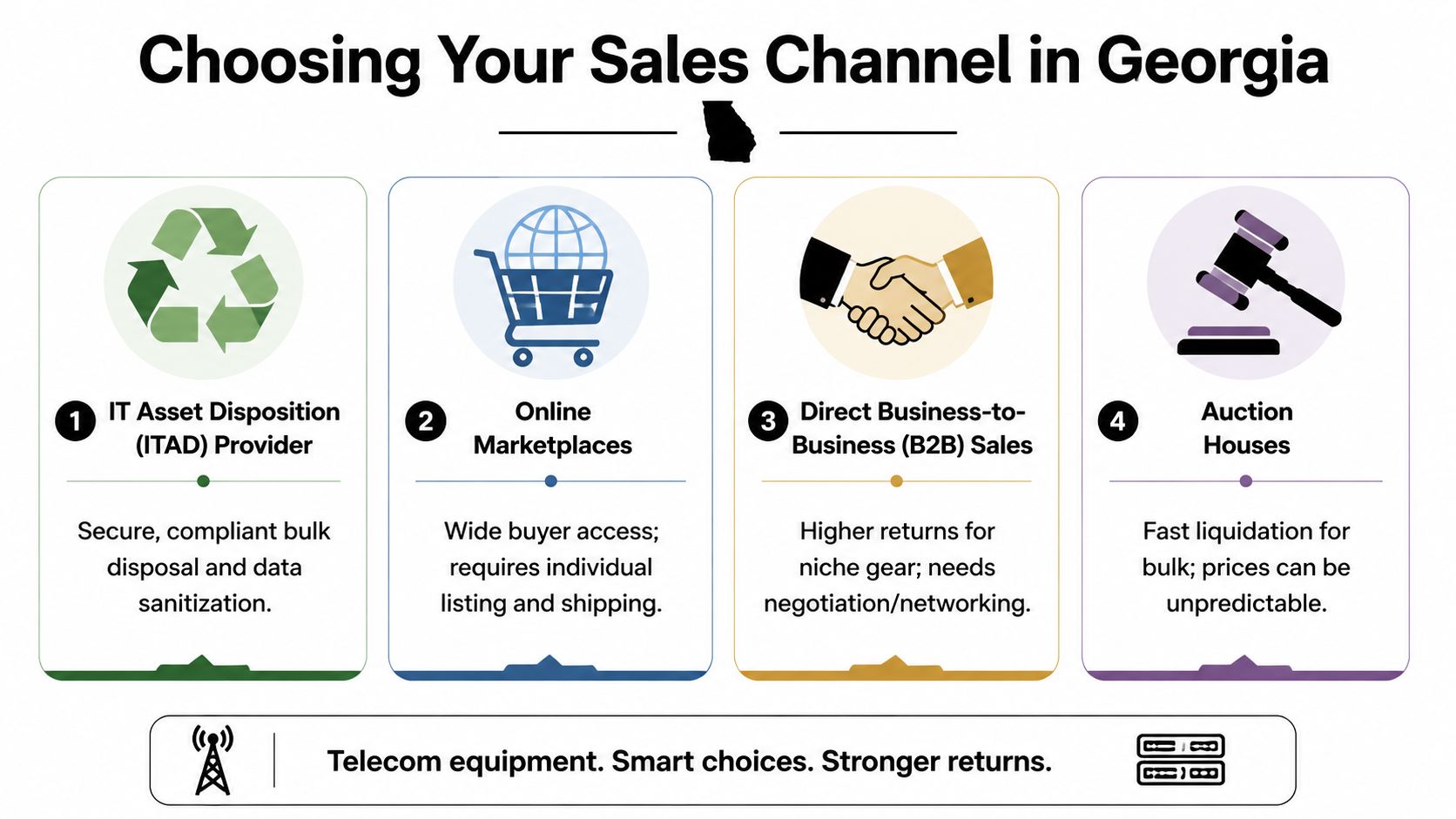
Side by side trade-offs
| Channel | Best use | Main advantage | Main drawback |
|---|---|---|---|
| ITAD provider | Bulk lots, secure projects, mixed enterprise gear | Handles logistics, compliance, and downstream processing | May not be ideal for one rare item you want to market manually |
| Online marketplaces | Small counts of easy-to-ship items | Broad buyer reach | Heavy labor, returns, packaging, fraud risk |
| Direct B2B sale | Niche systems with known buyers | Can work well for specialized gear | Requires network, time, and negotiation |
| Auction | Fast liquidation | Clears space quickly | Pricing can be unpredictable |
What usually works for enterprise telecom lots
If you have many units, mixed conditions, or compliance requirements, ITAD is usually the cleanest fit. The process aligns with how facilities and IT teams work. One pickup, one chain of custody, one settlement process.
For open-market selling, the friction is real:
- Listing burden grows quickly when every phone, card, and chassis needs its own treatment
- Packaging risk increases with fragile or partial units
- Buyer disputes show up when items are untested or incomplete
- Data handling remains your problem unless you solve it before sale
One option in this category is companies that buy telecom equipment, where a buyer takes enterprise lots through an ITAD process rather than through retail-style resale.
Local visibility matters when selecting a partner
A good vendor shouldn't just claim to serve Atlanta. They should be easy to verify locally, easy to contact, and clear about service scope. If you're evaluating providers and trying to understand why some firms appear stronger in local search than others, Circle Monkeys' Google ranking advice is useful context. It helps procurement and operations teams vet whether a local service company maintains a credible regional footprint.
The best sales channel is the one that protects net recovery after labor, freight, testing, and compliance are accounted for.
The ITAD Process from Quote to Pickup
A professional ITAD engagement shouldn't feel opaque. It should feel operational. The cleanest projects move in a predictable sequence and document each handoff.

Step one is the quote package
The fastest way to slow down a telecom liquidation is to send “misc network gear, old phones, some switches.” A structured process works better. The 5-step ITAD process starts with an inventory audit, then quote generation based on secondary market benchmarks, logistics, secure processing, and payment with itemized reports. Undocumented lots can reduce proceeds by 20 to 40%, according to telecom equipment resale process guidance from Beyond Surplus.
Send the buyer enough to price the project intelligently:
- Accurate asset list
- Condition notes
- Photos of the lot
- Pickup constraints
- Any sanitization requirements
If your team needs the broader framework behind that workflow, what IT asset disposition means in practice is the operating model.
What happens after the offer
A serious quote should show how non-working units are handled, not just highlight the best items. That's where many surprises begin. If the quote is too blended, ask for asset-level visibility or at least category-level treatment.
Then comes logistics. For Atlanta projects, that may mean dock pickup, site access coordination, labeled gaylords, palletization, deinstall support, or staged removals by floor or room.
Processing is where value and risk split apart
Once gear reaches the processor, several things happen in parallel:
Identification and audit reconciliation
The received lot is checked against your submitted list.Data handling
Wiping or shredding is completed per policy.Testing and triage
Working gear, refurbishable gear, parts harvest, and recycling streams are separated.Settlement and reporting
You get documentation, certificates, and payment based on final audited outcomes.
That's the point where an organized project outperforms a rushed one. The inventory quality you started with affects almost every downstream result.
Setting Pricing Expectations and Maximizing Payout
The right pricing question isn't “What is this equipment worth online?” It's “What's the net recovery after labor, logistics, testing, sanitization, and resale risk?”
What shapes the final payout
Telecom pricing is usually driven by a handful of practical factors:
Brand and model demand
Cisco, Avaya, Mitel, and other enterprise platforms don't all move the same way in secondary channels.Condition certainty
Tested pulls get stronger attention than unknown shelf stock.Completeness
A switch with the right power supplies and rails is easier to remarket than a bare chassis.Lot composition
Clean lots of similar equipment are easier to process than mixed cartons from multiple sites.
How to avoid value leakage
The biggest payout losses usually come from preventable mistakes.
- Find the missing pieces because power supplies, handsets, modules, and mounting hardware can move a device from “parts” to “resale”
- Keep premium units separate so they aren't buried in low-value material
- Label pallets and boxes clearly to shorten audit time and reduce exceptions
- Be honest about condition because overcalling the lot creates disputes after intake
There's a similar pattern in adjacent asset categories. If your facility team is also clearing furniture during a move or consolidation, this guide to selling used office furniture for maximum return is worth reading. The principle is the same. Sorted, documented, complete assets get better outcomes than mixed liquidation piles.
Think in net recovery, not wish pricing
It's easy to anchor on an online listing for one clean unit. That's not the same as selling a business lot with mixed conditions, pickup labor, secure handling, and reporting requirements. For Atlanta companies trying to sell used telecom equipment for cash, the best outcome usually comes from reducing friction before the gear leaves the site.
A realistic, well-documented offer is usually worth more than a higher headline number that falls apart after audit.
FAQs for Selling Telecom Equipment in Atlanta
FAQ Quick Answers
| Question | Answer |
|---|---|
| What should I do with a mixed lot of working and non-working telecom equipment? | Separate it before requesting quotes. Keep tested working units, untested pulls, damaged units, and recycling-only material in distinct groups. That improves valuation and reduces audit disputes. |
| Can an ITAD vendor handle data center telecom gear as part of a larger decommissioning? | Yes, if the provider handles enterprise pickups, chain of custody, and secure downstream processing. Confirm site access requirements, deinstall scope, and documentation before scheduling. |
| Do telecom systems need data destruction if they're not servers? | Often, yes. Routers, firewalls, voice appliances, and related systems may store configurations or other sensitive information. Treat them as security-relevant until assessed. |
| Is it better to sell locally or ship to a national buyer? | It depends on lot size, condition, and freight burden. Smaller or mixed lots often work better through a local operating model because logistics can absorb too much value. |
| What if some of the equipment is missing power supplies or accessories? | List those gaps clearly. Missing parts don't always kill the deal, but they do affect how the buyer categorizes the equipment and what resale path remains available. |
| How do I prepare for pickup in the Atlanta metro area? | Build a clean asset list, take a few photos, identify any storage media concerns, and note dock, elevator, or access limitations. That gives the buyer enough information to quote and plan accurately. |
| Can proprietary phone systems and modules still have value? | Sometimes. Value depends on demand, completeness, and whether the platform still has a service market. Document exact model numbers and included components. |
If your team needs to sell telecom equipment in Atlanta without sacrificing return or compliance, contact Beyond Surplus. They handle enterprise telecom buyback, secure data destruction, chain-of-custody documentation, pickups, and responsible downstream processing so surplus hardware leaves your site as a controlled value-recovery project rather than a disposal headache.