
A telecom refresh usually starts with a space problem. Old routers are stacked in a closet. Retired switches are still mounted in a rack. The PBX nobody wants to touch is waiting for a decision. For an Atlanta IT manager, that pile isn't just clutter. It's a mix of data risk, compliance exposure, logistics work, and missed recovery value.
That matters because the United States generates over 3.5 million tons of e-waste annually, and it's the fastest-growing segment of municipal solid waste, which shows how large the disposal problem has become for telecom and IT hardware in markets like Atlanta, according to Reworx Recycling's Atlanta e-waste overview. When that retired gear includes routers, switches, modems, server racks, VoIP phones, and office phone systems, disposal stops being a facilities task and becomes an asset management decision.
Your Guide to Responsible Telecom Equipment Disposal in Atlanta
Businesses dealing with telecom equipment disposal Atlanta issues usually face the same pressure points at once. Security needs one answer. Compliance needs another. Operations wants the gear gone without interrupting production. Finance wants to know whether any of it still has value.
The wrong approach is simple. Count a few boxes, call a hauler, and assume a factory reset solves the problem. That's how devices leave the building with weak documentation, unclear custody, and unanswered questions about what data still sits in embedded storage.
The approach that works is disciplined.
- Start with inventory: Every asset needs to be logged before removal.
- Identify hidden storage: Telecom hardware often stores credentials, call data, configs, and logs.
- Control handling: De-installation, pickup, and transport should be documented.
- Require proof: Data destruction and recycling records should match the inventory.
- Review resale options: Some retired telecom assets still belong in remarketing channels, not scrap streams.
Practical rule: If you can't match a serial number to a disposition outcome, you don't have a defensible disposal program.
Pre-Disposal Planning and Inventory Management
The first failure usually happens before pickup day. Teams underestimate how much telecom gear they have, or they inventory the obvious items and miss the gear with less visible risk.
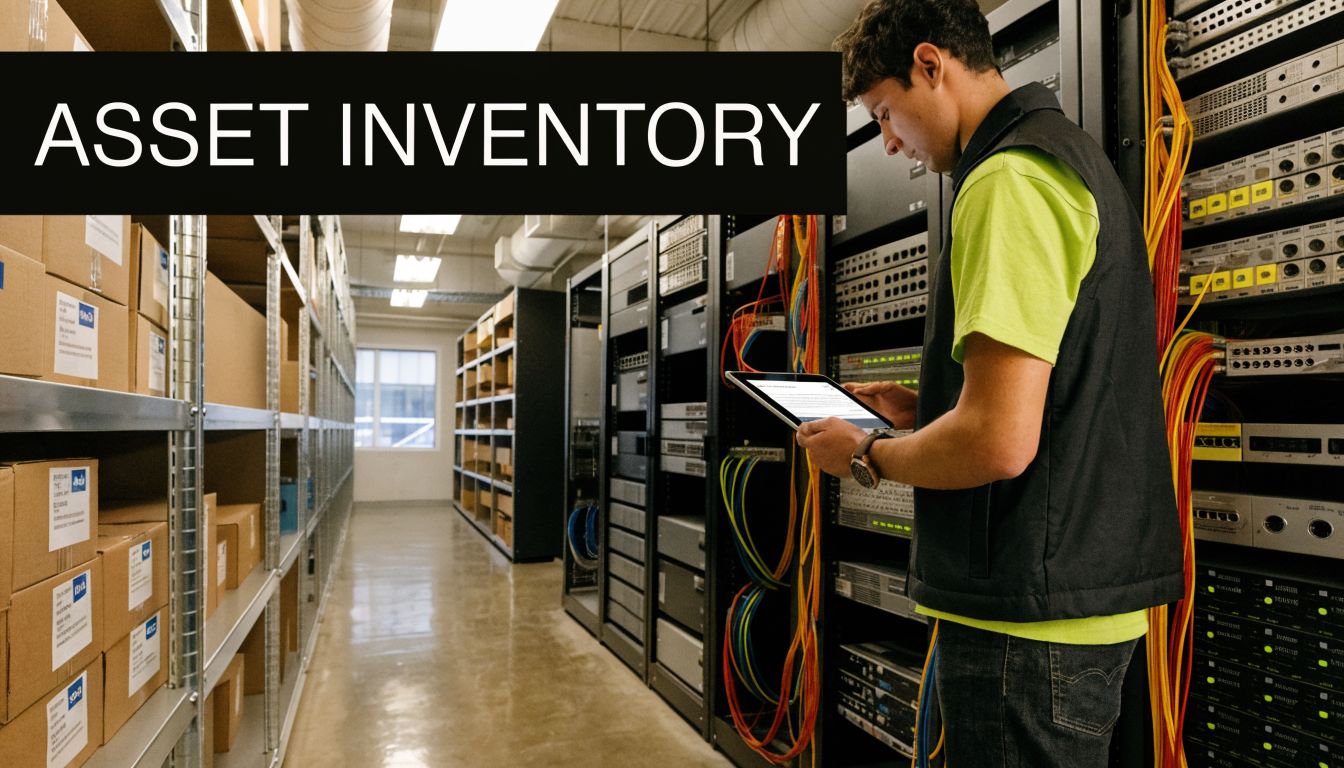
A solid asset list should include make, model, serial number, asset tag, physical condition, installed location, and whether the device may contain internal or removable storage. If your team is relocating or consolidating space at the same time, operational sequencing matters too. A practical reference like this essential 2026 moving handbook is useful for thinking through staging, access, and handoff timing when equipment removal overlaps with office or facility changes.
Build a serialized record first
For telecom environments, a spreadsheet alone often isn't enough unless someone owns data quality. Use a serialized log and verify assets against the rack, closet, or room where they sit. Don't rely on memory or an old procurement list.
A reliable inventory process should capture:
- Network core gear: Routers, switches, firewalls, load balancers, and wireless controllers
- Voice systems: PBX units, voicemail appliances, SIP gateways, and VoIP phones
- Supporting hardware: Patch panels, transceivers, modules, UPS units, and rack accessories
- Hidden media risks: SSDs, HDDs, flash modules, SIM cards, removable cards, and embedded storage
Flag what needs special handling
Not every item follows the same downstream path. Some assets are reusable. Some need sanitization before testing. Some should go directly to destruction because of policy, condition, or regulatory requirements.
That's where lifecycle discipline helps. A formal IT asset lifecycle management process creates a single record from deployment through retirement, so disposal isn't handled as an isolated cleanup event.
If a switch, PBX, or firewall was ever configured for production, treat it as a data-bearing asset until proven otherwise.
The companies that manage this well usually assign one owner for reconciliation. One person signs off on what's in scope, what's missing, and what must not leave the site until sanitization instructions are confirmed.
Securing Data on Retired Telecom Hardware
Many companies still assume the primary data risk lives in servers, laptops, and loose drives. That assumption is outdated.
A verified industry claim says a 2025 Gartner report notes that 65% of data breaches from disposed IT assets originate from non-traditional storage in networking and telecom equipment, with only 22% of ITAD firms offering telecom-specific audits, as cited in Beyond Surplus' telecom disposal services page. That tracks with what experienced IT teams see in the field. Routers, switches, firewalls, and PBX systems often retain configurations, credentials, call records, firmware-level settings, and administrative history.
What telecom gear can retain
The risk isn't just “files” in the usual sense. It's operational intelligence.
- Routers and firewalls: VPN settings, static routes, credentials, certificates, and network maps
- Managed switches: VLAN configs, SNMP strings, admin accounts, and logging settings
- PBX and voice platforms: Extensions, call routing rules, voicemail metadata, and user information
- Mobile and edge telecom devices: SIM data, provisioning details, and service credentials
A factory reset may help in some cases, but it isn't the same as a documented sanitization process. Consumer guides can be useful for understanding the difference between user reset and full wipe behavior. For example, this walkthrough on how to factory reset an iPhone in Australia is a reminder that “reset” and “secure erasure” are not interchangeable ideas. The same caution applies even more strongly to enterprise telecom hardware.
Match the method to the media
A defensible disposal workflow should follow a standard that addresses the media type and the asset's reuse decision. The NIST SP 800-88 guidance is the right benchmark to require when devices contain data-bearing components.
Use practical rules:
- If the device will be reused: Apply approved wiping or sanitization methods that fit the storage technology and document completion.
- If the device can't be reliably sanitized: Remove and physically destroy the storage component.
- If storage is embedded and inaccessible: Treat the entire unit as a destruction candidate if policy requires certainty.
Field advice: Ask your recycler to identify where the data lives on each telecom asset type. If they only talk about laptops and hard drives, keep asking.
What works and what doesn't
What works is asset-by-asset review, telecom-specific audit notes, and certificates that map to real inventory records. What doesn't work is bulk assumptions. “All phones are clean,” “those switches don't store anything,” and “we reset them already” are the kinds of shortcuts that create avoidable exposure.
For sensitive environments, insist that the disposition plan specifically calls out non-traditional storage in telecom gear. That one step closes a gap many businesses don't realize they still have.
Navigating Atlanta's Disposal and Compliance Landscape
Atlanta businesses can't treat e-waste like standard trash removal. Atlanta enforces strict bans on electronic waste in landfills across the city and Fulton County, driving demand for certified recycling services that handle telecom equipment responsibly, according to Beyond Surplus' overview of eco-friendly telecom disposal services.
That local rule matters because telecom closets and server rooms often contain a mix of regulated waste streams, data-bearing devices, batteries, cabling, and electronics that need documented handling. For many organizations, the compliance issue isn't just disposal. It's proving that disposal was managed correctly.
Liability doesn't disappear at pickup
A truck leaving your facility doesn't end your responsibility. It only shifts risk if the process is documented, the chain of custody is intact, and destruction or recycling records are issued in a form your auditors can use.
The FTC Disposal Rule is the core concern for many businesses with customer or employee information. Healthcare, finance, legal, and public-sector teams often add internal controls tied to privacy, records retention, and vendor oversight. If you also manage batteries, lamps, or other regulated streams alongside telecom gear, this universal waste guidance helps frame the broader compliance picture.
Documentation that protects your business
Ask for records that answer specific questions:
| Document | Why it matters |
|---|---|
| Serialized inventory | Confirms what entered the program |
| Pickup record | Shows when and where custody changed |
| Data destruction certificate | Supports security and regulatory review |
| Recycling certificate | Verifies downstream environmental handling |
Auditors don't want a verbal assurance. They want records that connect the asset list to the final disposition outcome.
A compliant vendor should also be clear about subcontracting. If another party touches the assets, you need to know who they are, what role they play, and how custody is tracked.
The End-to-End ITAD Process for Your Telecom Gear
The cleanest telecom disposal projects follow a controlled chain from site assessment to final reporting. When that process is well run, operations keeps moving, security signs off faster, and procurement has a clear view of what was recycled versus what entered recovery channels.
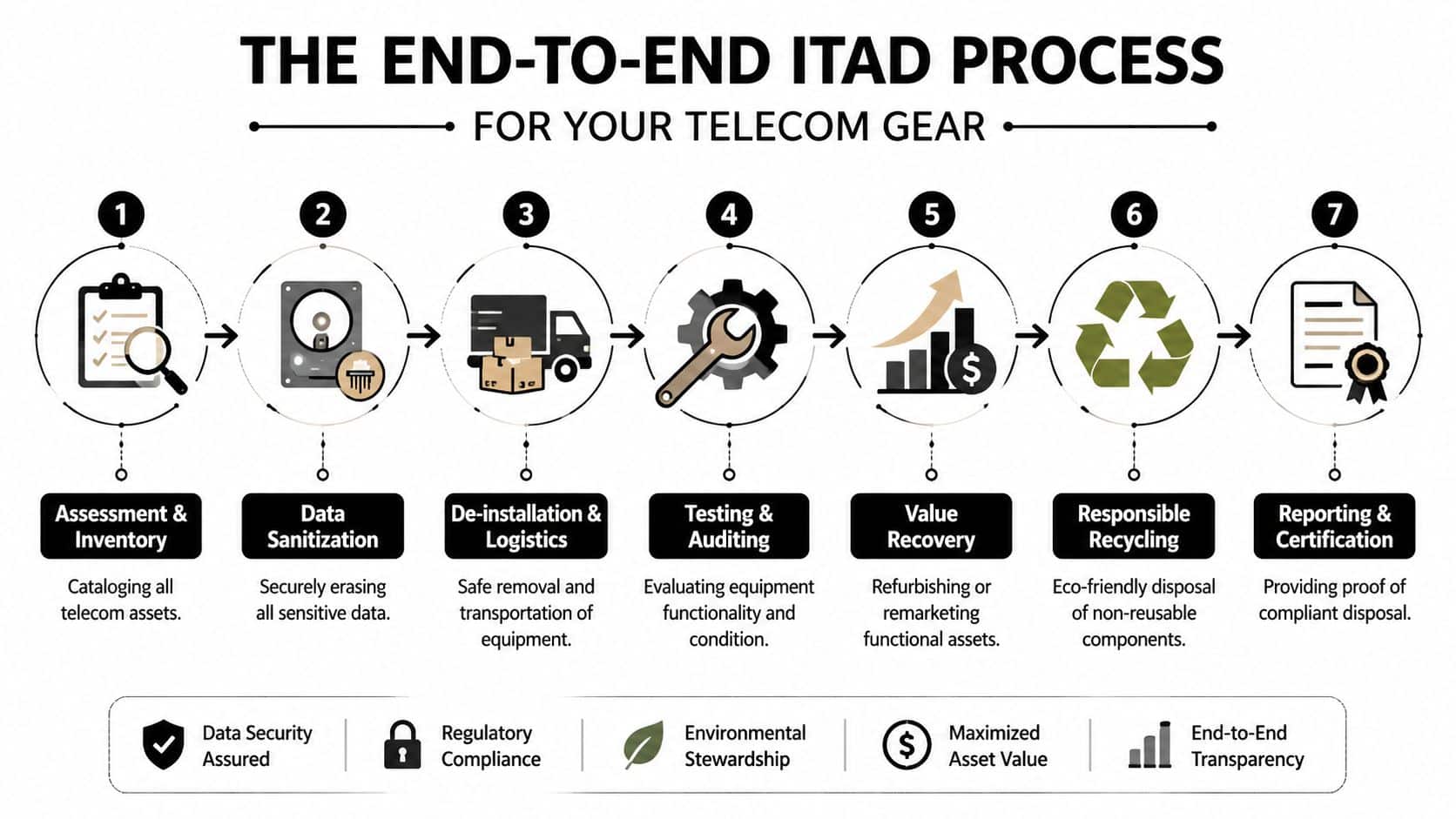
A verified methodology states that a robust ITAD process begins with inventory auditing and proceeds through secure de-installation, NAID AAA-certified data sanitization such as DoD 5220.22-M wiping, and R2/e-Stewards certified recycling, culminating in audit reports that document the entire chain of custody, as outlined in this telecom recycling methodology reference.
What pickup day should look like
The process should be controlled before anyone touches a rack.
Scope confirmation
The team verifies site access, asset list, and any equipment that must remain in place.De-installation
Technicians disconnect, label, and remove telecom hardware without mixing retained equipment with retired assets.Packaging and segregation
Reuse candidates, destruction candidates, and recycling-only material should be separated immediately.
What happens after removal
Once equipment is in custody, intake controls matter. Assets should be checked in against the inventory, exceptions should be documented, and data-bearing units should move into the sanitization or destruction workflow without delay.
A practical way to evaluate providers is to compare their process against a standard IT asset disposition workflow. You're looking for process discipline, not marketing language.
Here's what a complete downstream path usually includes:
- Verification at intake: Receiving staff reconcile counts and serials.
- Data handling: Wipe, shred, or otherwise sanitize based on policy and media type.
- Testing and triage: Reusable telecom assets are evaluated for remarketing.
- Recycling: Non-reusable units go to certified material processing.
- Final reporting: Certificates and disposition summaries are issued.
Where providers often differ
Some vendors are strong at freight and weak on documentation. Others can recycle material but don't understand telecom-specific de-installation. In Atlanta, one option businesses use is Beyond Surplus, which handles pickup logistics, de-installation, documented chain of custody, and data destruction for business equipment. The important point isn't the brand. It's whether the provider can run the full process without gaps.
A disposal project is only as strong as its exceptions handling. Lost serials, unlabeled pallets, and mixed asset categories create the biggest cleanup problems later.
Maximizing Value Recovery from Retired Telecom Assets
Disposal doesn't always mean scrap. That's where many companies leave money on the table.
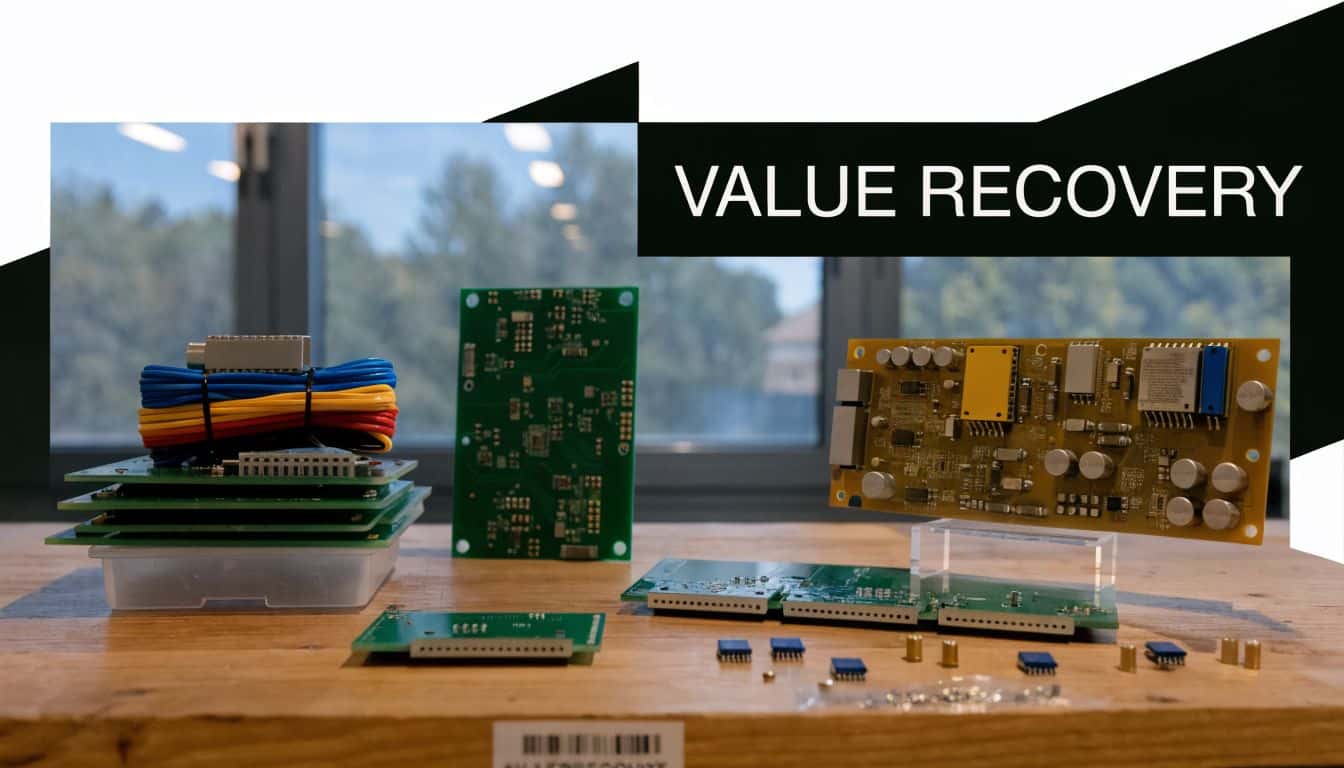
A verified market point says that 40% of telecom equipment retains 20-50% of its resale value if remarketed properly, based on a 2025 IDC ITAD study cited in PC Liquidations' Atlanta recycling page. For SMBs and multi-site companies, that value is often missed because the project is framed as free recycling instead of structured recovery.
Which telecom assets tend to recover value
Recovery usually depends on brand, age, condition, completeness, and demand in secondary channels. Enterprise networking gear, VoIP systems, expansion cards, and some data center telecom components often deserve testing before they're routed to commodity recycling.
A simple decision split helps:
| Asset condition | Best path |
|---|---|
| Clean, current, functional | Remarketing or buyback |
| Working but incomplete | Parts harvesting or selective resale |
| Damaged or obsolete | Commodity recycling after data handling |
How to improve recovery results
Businesses usually improve outcomes when they do three things well:
- Keep sets together: Power supplies, rails, handsets, modules, and licensing documentation can affect remarketing options.
- Separate damaged material early: Don't let broken scrap lower the handling quality of reusable inventory.
- Use a telecom-focused resale path: Generic e-waste channels often skip the evaluation needed for higher-value networking and voice gear.
If your goal includes offsetting refresh costs, a practical starting point is this guide on how to sell surplus telecom hardware. The key is timing. Assets tend to perform better in recovery channels when they're removed, tested, and marketed before they sit in storage for long periods.
Your Next Step for Secure Disposal in Atlanta
Telecom equipment disposal is rarely just about hauling away old hardware. The actual work is identifying every asset, securing data on non-obvious storage, keeping documentation intact, and choosing the right path for reuse, resale, or recycling.
If your team is planning a network refresh, office consolidation, voice migration, or data center decommission, build the disposal plan before the gear starts moving. That's how you reduce risk and avoid expensive cleanup after the fact.
If your business needs a documented process for telecom equipment disposal in Atlanta, contact Beyond Surplus for secure IT asset disposition, certified data destruction, and compliant electronics recycling for commercial environments.