

If you're shopping for telecom services in Los Angeles, you're probably not starting from a blank slate. You're dealing with dropped calls in one office, bandwidth complaints from another, aging switches in a closet no one wants to document, and a provider contract that no longer fits how the business runs. In Los Angeles, that gets harder because the market is dense, the building stock is mixed, and many companies need voice, data, wireless, and cloud connectivity to work together across multiple sites.
The part many teams miss is lifecycle management. A telecom upgrade isn't finished when the new circuit goes live. It's finished when the retired routers, switches, firewalls, handsets, and related hardware are inventoried, wiped, removed, and documented in a way that doesn't create a security or compliance problem later.
Decoding the Foundations of Business Connectivity in Los Angeles
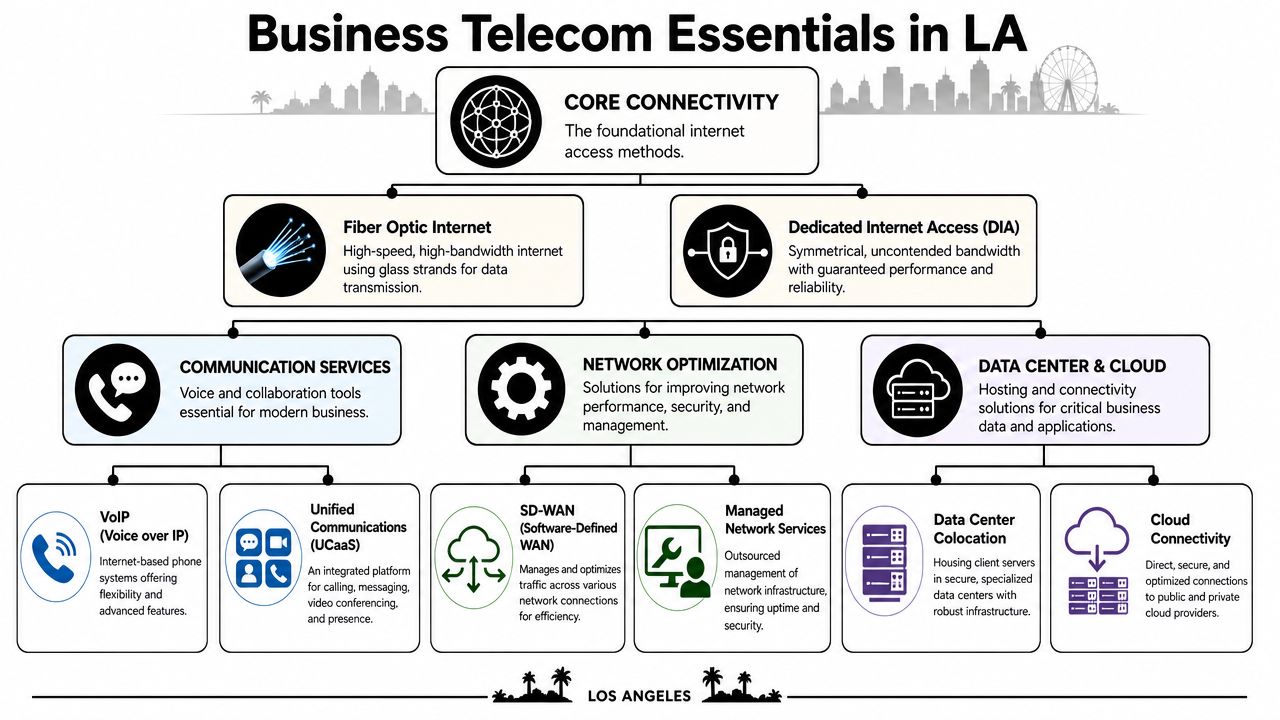
A growing business usually hits the same wall. Internet service that felt adequate when the company had one location starts breaking down once cloud apps, VoIP phones, security systems, guest Wi Fi, and remote access all ride the same connection. At that point, telecom services in Los Angeles stop being a utility purchase and become infrastructure planning.
The physical side matters more than many procurement teams expect. Los Angeles telecom deployments are commonly built on a layered plant that includes a fiber optic backbone, copper or fiber horizontal cabling, and managed active equipment. Fiber's practical advantage is simple. It supports higher throughput and longer runs than copper, which reduces repeaters and congestion in dense environments such as large offices, campuses, and industrial facilities, as outlined by GlobalSpec's overview of telecommunications infrastructure services.
Start with access, not features
For most businesses, the first decision is shared broadband vs. dedicated connectivity. Shared broadband is like using city streets. It works, it's accessible, and for light office use it may be enough. Dedicated Internet Access (DIA) is closer to reserving your own lane. It costs more, but performance is more predictable when uptime and application responsiveness matter.
Then comes voice. Legacy phone systems still exist, but most businesses now evaluate VoIP and broader UCaaS platforms. VoIP solves calling. UCaaS folds calling, messaging, meetings, and presence into one stack. If your teams move between desks, home offices, warehouses, and mobile devices, UCaaS usually fits better than bolting extra tools onto an old PBX.
Practical rule: Buy connectivity for the applications that make money, not for the lowest advertised speed tier.
Understand the WAN choices
The next layer is how locations connect to each other and to cloud resources. MPLS is the private highway model. Traffic moves across a controlled carrier environment. It's often chosen when firms want predictable routing between offices and strict separation from the open internet.
SD WAN takes a different approach. It uses software to steer traffic across available links based on policy and performance. Voice can take the cleanest path. Guest traffic can take a cheaper one. Cloud traffic can exit locally instead of hairpinning through headquarters. In practice, SD WAN often works well for distributed businesses that need flexibility more than a fixed private architecture.
A lot of teams also need help at the operational layer, not just the circuit layer. Managed monitoring, failover design, and coordinated hardware refreshes are key to the buying decision. If you need a starting point for the local vendor market, this Los Angeles telecom services resource is useful as a market reference.
Aligning Telecom Services with Your Business Objectives
The right service mix depends less on industry labels and more on what breaks when the network stalls. In Los Angeles, three business profiles show how different that can look.
Media and production environments
A post production team, creative studio, or content-heavy operation usually cares about large file movement, low delay, and predictable upstream performance. Shared broadband often disappoints here, especially when editors, cloud storage, review tools, and remote collaborators all compete for capacity.
These environments usually lean toward fiber-based access, dedicated bandwidth where budgets allow, and strong internal switching. If multiple sites need to share work in progress, MPLS or a tightly governed SD WAN design can make sense. The wrong move is buying a fast-looking internet circuit and ignoring internal bottlenecks such as old uplinks, weak patching, or unmanaged edge hardware.
Legal, finance, and compliance-heavy offices
A downtown law firm or regulated professional office usually values stability, segmentation, and accountability more than flashy throughput numbers. Voice quality matters. Secure remote access matters. So does understanding exactly who supports the service when an outage starts.
These organizations often do well with dedicated connectivity, redundant voice design, business-grade firewalls, and managed support with clear escalation paths. They don't need the most complex network on paper. They need a design that can be validated, supported, and audited.
Contract terms that look fine in procurement often become painful in incident response. Support structure matters as much as bandwidth.
Logistics, warehousing, and distributed operations
A logistics company with warehouses, dispatch points, and field users has a different problem. The network must connect many locations with different service availability, and each site may run scanners, cameras, Wi Fi, VPN traffic, and cloud applications at the same time.
SD WAN is often practical. It lets IT use mixed access types across sites while applying policy centrally. The main mistake is treating every location the same. A warehouse with cameras and always-on wireless has a different profile than a small administrative office.
Telecom Service Matching by Business Use Case in Los Angeles
| Service Type | Primary Use Case | Key Benefit | Ideal For |
|---|---|---|---|
| Fiber Optic Internet | High-capacity office or campus connectivity | Strong throughput and scalability | Media firms, large offices, multi-floor operations |
| Dedicated Internet Access | Mission-critical external connectivity | More predictable performance | Legal, finance, healthcare, enterprise HQ |
| VoIP | Business telephony over data network | Flexible calling and easier moves/adds/changes | Offices replacing legacy PBX |
| UCaaS | Integrated calling, chat, and meetings | One communications stack | Hybrid workforces and multi-site teams |
| MPLS | Private site-to-site transport | Controlled routing and separation | Firms with strict internal traffic requirements |
| SD WAN | Policy-based traffic steering across links | Flexibility and centralized control | Distributed businesses, logistics, retail, field operations |
| Colocation connectivity | Direct access to carriers and cloud ecosystems | Resilience and low-latency interconnection | Media, SaaS, ecommerce, performance-sensitive workloads |
How to Procure and Evaluate Telecom Providers in Los Angeles
A Los Angeles telecom project often looks fine until the first site walk. The quote is approved, the turn-up date is on the calendar, and then the provider finds a blocked riser, no usable power at the demarc, or an old firewall that nobody planned to retire. Procurement goes sideways when the buying team treats the new circuit as a standalone purchase instead of part of a full network refresh, including the removal and disposition of replaced equipment.
Provider evaluation starts with execution risk. Los Angeles has a deep hiring market for telecom and field infrastructure roles, and local postings reflect the mix of skills providers need in practice, including fiber work, routing and switching, wireless, VPNs, and SD WAN, as shown in current Indeed listings for telecom technician roles in Los Angeles. For buyers, that matters because the ultimate test is whether the provider can send people who can solve problems in a difficult building, during a late cutover, with your production traffic on the line.
Ask for the design package, not just the monthly rate
A serious RFP response should include enough detail to expose operational gaps before signature. Ask each provider for three items at minimum:
- A network diagram: Review handoff points, demarc ownership, failover paths, and any customer-managed dependencies.
- A site readiness review: Older Los Angeles properties often have riser constraints, conduit congestion, access restrictions, or power issues that affect installation dates.
- A support model: Confirm who handles after-hours incidents, where escalation goes, and whether the provider uses local technicians or a national dispatch queue.
Specificity matters. If the design is vague during procurement, the surprises show up during implementation.
Vet the field team and the handoff process
A clean install requires more than cabling. Ask who stages and commissions the edge hardware, who validates routing and voice performance, and who stays accountable after cutover if applications or failover do not work as expected.
These questions usually expose the weak point:
- Who commissions the edge devices? Split responsibility between cabling crews and network engineers often creates avoidable delays.
- Who performs validation testing? The provider should test the live circuit against the services you run, not just confirm link lights.
- Who owns post-cutover remediation? You need one accountable party when packet loss, QoS issues, or mis-tagged VLANs appear after go-live.
If the provider separates physical install from network validation, require a written handoff process.
Score providers on operational fit and hardware lifecycle
Price still matters, but operations matter more. A low circuit cost can become expensive if the provider cannot work within your maintenance windows, support your building access rules, or coordinate around existing firewalls, routers, and voice gear that must be removed from service.
That last point gets missed in a lot of telecom buys. New service often means old network equipment comes out of racks, closets, or branch offices. If the vendor discussion stops at turn-up, your team inherits the harder part later: collecting retired hardware, documenting chain of custody, wiping any stored data, and disposing of assets in a way that fits your retention policy and regulatory obligations. Multi-site companies should review this business telecom provider guide for comparing support and decommissioning responsibilities while evaluating service models.
The better procurement approach is to score vendors against a short list of practical criteria: building fit, implementation ownership, escalation quality, compatibility with your current environment, and their ability to coordinate with your ITAD process once legacy equipment is replaced. That is how you avoid buying a good circuit and inheriting a bad transition.
Understanding Pricing Models and Service Level Agreements
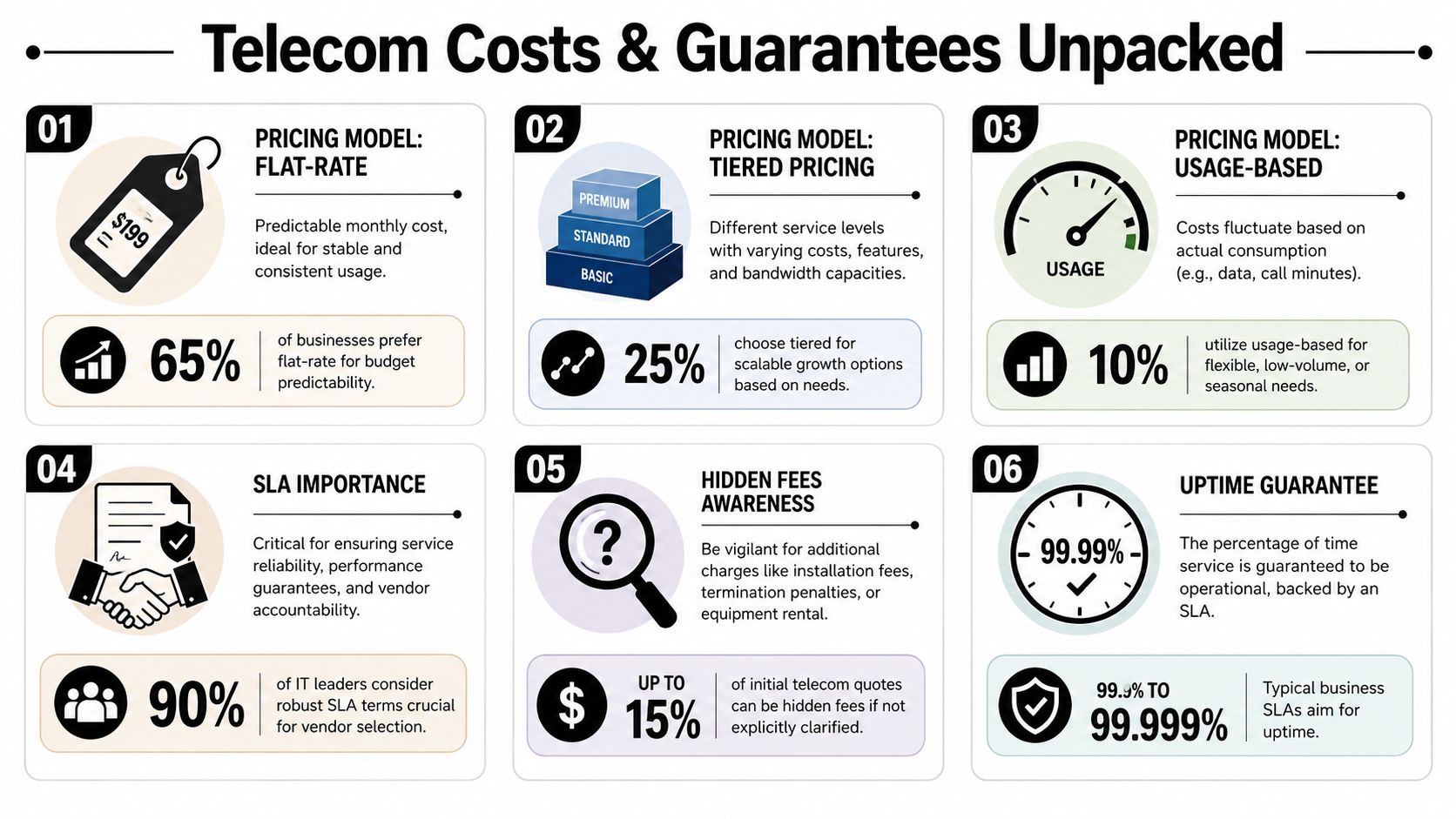
A Los Angeles telecom quote can look acceptable until the second page. The monthly circuit rate gets attention, but the actual cost often sits in install labor, provider-supplied hardware, cross-connect fees, support tiers, expedited dispatch, early termination language, and charges for adds, moves, and changes. In this market, pricing also reflects practical constraints such as building access, local plant conditions, and the provider's ability to field qualified technicians on your schedule.
Read the pricing model in operational terms
Flat-rate service is easier to forecast and usually fits a steady headquarters or core site. Tiered pricing can make sense for a company opening floors in phases or adding bandwidth on a known schedule. Usage-based billing has a place for temporary sites, failover circuits, or specialized transport, but it creates budget risk when traffic spikes or a backup link carries production workloads longer than planned.
Procurement teams often compare only the recurring rate. The better comparison is effective cost over the contract term, including one-time charges, managed equipment rent, truck rolls, and the cost of support delays when a provider misses your maintenance window.
Ask one more question before signing. Who owns the retired hardware, and when does responsibility transfer?
That matters because telecom refreshes rarely end with turn-up. If the provider replaces edge devices, voice gateways, or handoff equipment, your team may still be left with firewalls, switches, routers, or carrier gear that store configs, credentials, call data, or network diagrams. Pricing should reflect the full transition, including removal, inventory reconciliation, data sanitization, and documented disposition through your ITAD process.
What the SLA actually needs to say
A service level agreement has to do more than promise credits. It needs plain definitions, measurable thresholds, and language your operations team can enforce during an outage.
Focus on these points:
- Uptime definition: Specify what counts as service unavailability, what events are excluded, and where the measurement point sits.
- Latency, jitter, and packet loss: These metrics affect voice quality, video performance, VPN stability, and cloud application response.
- Response and restoration windows: Name the severity levels, response times, escalation path, and target for service restoration.
- Maintenance terms: Check notice periods, approved maintenance windows, and whether recurring after-hours work is excluded from SLA calculations.
- Remedies: Credits matter, but repeat failure, chronic missed dispatches, or long restoration intervals should trigger stronger contractual options.
A practical SLA review starts with business impact. If one provider supports phones, contact center traffic, badge systems, cameras, and remote access, a generic business SLA leaves too much room for dispute. Legal, healthcare, finance, and public sector teams should also confirm that outage handling, record retention, and disposal of replaced equipment fit internal policy and regulatory obligations.
Invoice credits do not restore lost operations.
For teams comparing contract structures across regions, this Houston telecom services comparison for multi-site buying patterns is a useful reference point for how providers package service terms, support scope, and related hardware responsibilities.
Leveraging the Los Angeles Data Center and Colocation Ecosystem
In Los Angeles, telecom strategy often improves when you stop thinking only about office circuits and start thinking about interconnection. A carrier-neutral data center isn't just somewhere to place equipment. It's a place to shorten the distance between your workloads, your providers, and your users.
That matters for businesses running cloud-heavy applications, content distribution, latency-sensitive workflows, or multi-site environments. Instead of backhauling everything through a single office, teams can place critical infrastructure in a facility with stronger carrier choice, cleaner cross-connect options, and better resiliency controls.
Why carrier neutrality changes the equation
A concrete sign of that trend came on December 11, 2024, when AT&T became a carrier at DataBank's LAX1 data center in Los Angeles. DataBank said the addition expanded cross-connect options, improved resilience, and supported lower-latency connectivity for enterprises and cloud workloads in the market, according to the DataBank announcement about AT&T at LAX1.
That kind of expansion gives IT teams more options. More carrier presence can mean better routing options, cleaner disaster recovery design, and less dependence on a single office address as the center of the network.
Colocation also affects hardware planning
Once infrastructure moves into colocation, hardware lifecycle management gets stricter. Devices are more likely to be standardized, documented, and retired on schedule because every rack unit, power feed, and remote-hands request has a cost. Migration planning and disposal planning intersect at this point. Teams moving out of older server rooms should build retirement workflows into the project plan from day one. This data center migration checklist is a useful operational reference for that handoff.
The Final Step Your Telecom Upgrade and Secure IT Asset Disposition
The highest-risk part of a telecom refresh often isn't the cutover. It's the week after, when old equipment sits in a branch closet, loading dock, or staging room with configs still intact. Retired telecom gear can hold more than people expect: VPN settings, stored credentials, call routing details, IP addressing schemes, firewall rules, wireless profiles, and management access information.
That's why disposal isn't a housekeeping task. It's a security control.
What a defensible retirement process looks like
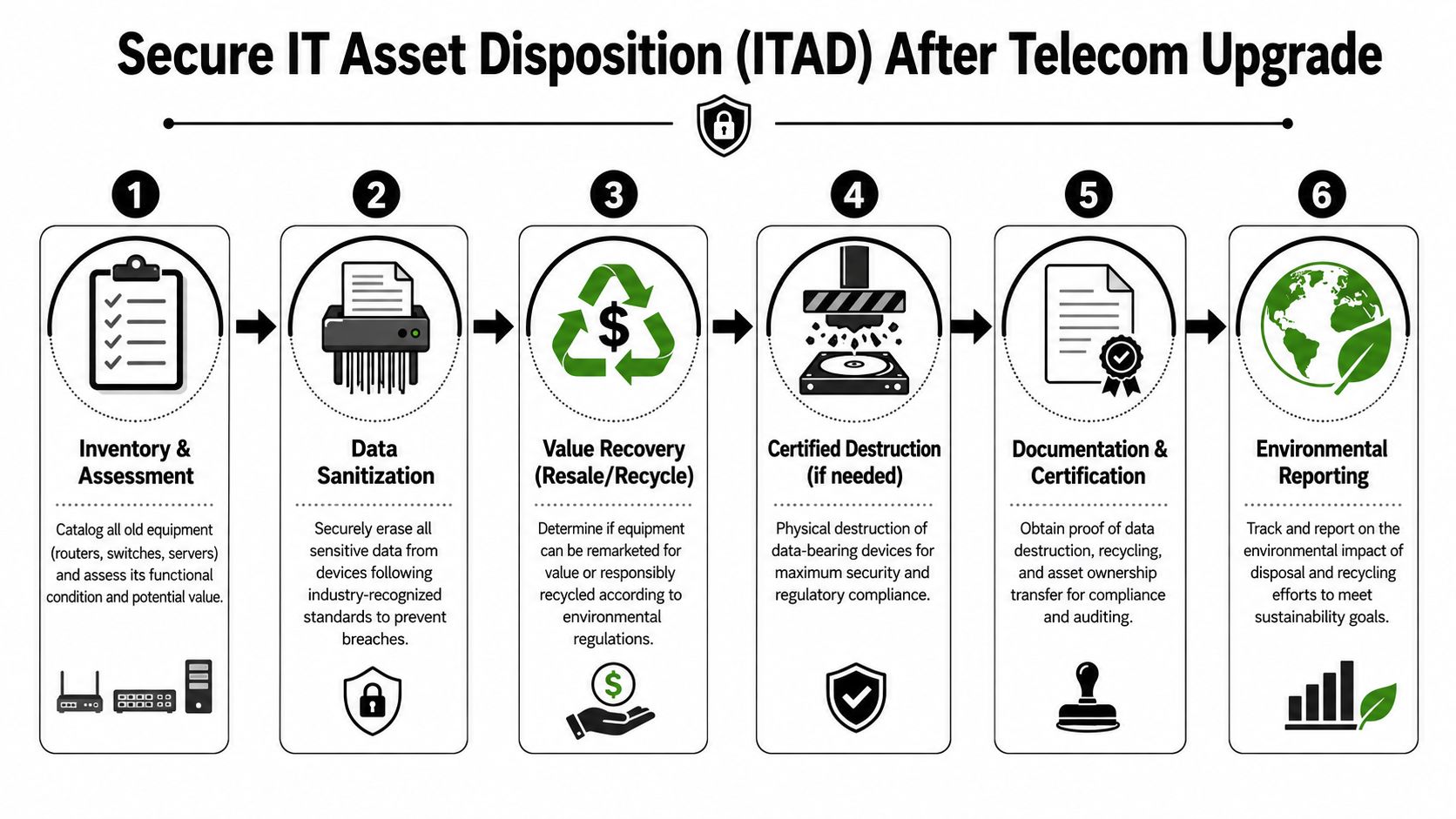
A proper ITAD workflow for telecom hardware usually includes:
- Inventory and chain of custody: Record what was removed, from which site, and who handled it.
- Data sanitization: Wipe or destroy data-bearing components using a documented process.
- Value recovery review: Some switches, phones, optics, and modules may still have remarketing value.
- Recycling and destruction records: Get certificates that document what happened to each asset class.
This is also where compliance risk shows up. If your organization is subject to privacy, records, or sector-specific requirements, undocumented disposal creates a gap auditors will notice. The FTC Disposal Rule is part of that conversation for businesses handling covered information, and the practical expectation is clear: sensitive data can't be discarded casually.
What doesn't work
A few disposal habits create unnecessary exposure:
- Closet storage with no owner: Gear stays powered off but not retired, and nobody knows what's on it.
- Informal resale: Hardware leaves the business without wiping, records, or liability transfer.
- Mixed recycling loads: Network hardware gets thrown into broader clean-out streams without data review.
Old network hardware doesn't become low risk just because it's unplugged.
For organizations that need a documented handoff, secure telecom equipment disposal services are one option to evaluate alongside your internal ITAD process and other qualified vendors. The core requirement is straightforward. Your provider should support inventory control, secure data destruction, environmentally responsible processing, and certificates that help close the audit trail.
A telecom lifecycle strategy in Los Angeles should cover procurement, deployment, support, and retirement with the same level of discipline. If you only manage the front end, the risk moves to the back end.
When your business is replacing routers, switches, VoIP systems, servers, or other retired network hardware, Beyond Surplus can support secure IT asset disposition, data destruction, electronics recycling, and documented chain of custody for commercial environments. Contact them if you need a structured end-of-life process that matches the operational demands of a telecom upgrade.


