

Remote work changed asset recovery from a shipping task into a business control problem. 71% of employees fail to return company equipment during offboarding, and remote and hybrid workers are nearly 17% more likely to withhold equipment than on-site staff, according to Teqtivity's reporting on remote equipment return risk. That one statistic reframes the future of remote employee equipment recovery and IT asset management. The issue isn't only lost laptops. It's missing chain of custody, exposed data, delayed deprovisioning, and assets that never reach a compliant end-of-life path.
The old playbook assumed people returned devices to an office. That model breaks when the workforce is distributed across homes, coworking spaces, and regional hubs. A modern program has to decide what to recover, how to secure what won't come back quickly, and how to document every disposition path well enough to satisfy security, finance, and compliance teams.
The Unseen Risk of the Distributed Workforce
Most companies still underestimate how quickly remote assets move from productive equipment to unmanaged liability. Once an employee exits, every day without a controlled recovery path increases the chance of loss, partial return, or unmanaged disposal.
Teqtivity also notes that over 80% of unused corporate devices never follow a compliant ITAD path, which is why offboarding belongs in the same risk conversation as access revocation and credential shutdown. If the endpoint is still in the wild, your exposure isn't finished when the account is disabled.
Why remote loss is different
Remote loss has three layers:
- Financial exposure: Devices disappear before remarketing, redeployment, or recycling decisions happen.
- Security exposure: Sensitive data may remain on abandoned endpoints.
- Compliance exposure: Audit trails break when the company can't prove return, sanitization, or lawful disposal.
A useful companion resource for workplace teams coordinating distributed operations is this guide for HR and facilities managers, especially where workspace policy intersects with offboarding logistics.
The practical lesson is simple. Equipment recovery can't sit at the edge of IT operations anymore. It has to be built into lifecycle management from the day the asset is issued, not improvised when someone resigns. That's also why many organizations are revisiting their remote employee laptop recovery approach for data security.
Operational reality: The companies that struggle most with remote recovery usually didn't fail at shipping. They failed at predefining ownership, return steps, and enforcement.
The market direction reflects that urgency. The United States IT Asset Disposition market reached USD 6.5 Billion in 2025 and is projected to grow to USD 12.9 Billion by 2034, with a CAGR of 7.51% during 2026 to 2034, according to IMARC's U.S. ITAD market outlook. Organizations are spending more attention and budget here because unmanaged assets create real downstream cost.
Pillars of Modern Remote IT Asset Management
A workable remote ITAM model rests on three pillars. Miss one, and the whole program becomes reactive.
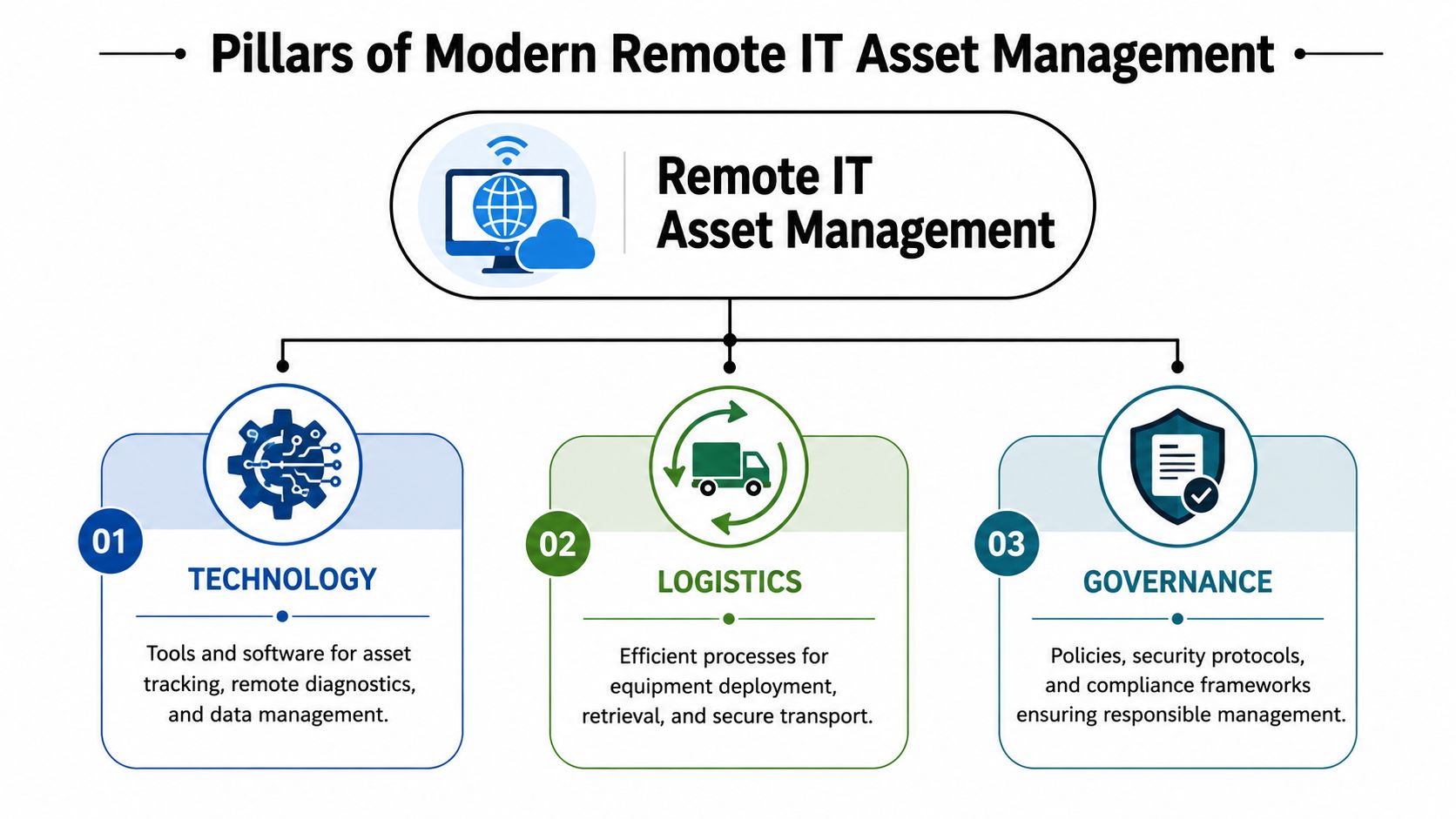
Technology
Technology provides visibility and control. That includes ITAM platforms, MDM or UEM tools, ticketing integrations, and asset status reporting. If the system can't tell you who has the device, what state it's in, and whether policy controls still apply, recovery starts blind.
Logistics
Logistics is where most programs break. Recovery depends on packaging, return routing, pickup coordination, transit monitoring, and intake workflows. Strong logistics remove friction for the departing employee and reduce manual chasing for IT.
Governance
Governance defines who approves exceptions, what must be recovered, when a remote wipe is acceptable, and what evidence proves compliant disposition. It also decides how legal, HR, IT, and finance handle refusal, nonresponse, or partial returns.
A mature program connects all three rather than treating them as separate projects. That's the difference between “we track devices” and “we control the asset lifecycle.”
What the pillars look like in practice
Here's the model I've seen work repeatedly:
- Technology owns visibility: asset records, enrollment status, and policy enforcement.
- Logistics owns movement: deployment, return kits, carrier flow, and intake handling.
- Governance owns decisions: retention rules, sanitization standards, and audit evidence.
Teams refining that structure usually benefit from a documented set of IT asset management best practices that ties operations to security and disposition.
The strongest remote ITAM programs don't ask employees to figure out returns. They remove decisions and present one clear path.
Emerging Technologies Shaping Equipment Recovery
The biggest shift in remote recovery is that retrieval no longer starts with an email. It starts with systems talking to each other. HRIS, identity tools, ITAM, and endpoint management platforms increasingly trigger actions the moment offboarding begins.
MDM and UEM as the first control layer
When a device goes dark or an employee stops cooperating, endpoint control matters more than reminders. According to Remote Retrieval's offboarding recovery guidance, 84% of IT professionals use Mobile Device Management to lock the device remotely when remote employees refuse to return it. That makes MDM more than a support tool. It's a recovery control.
Remote lock, encryption enforcement, and wipe commands reduce immediate data risk. They don't replace physical recovery, but they buy time and preserve control while logistics catches up.
Telemetry and asset intelligence
Modern asset programs also rely on telemetry. Battery health, last check-in, enrollment status, and network activity tell IT whether a device is active, abandoned, or noncompliant. That data changes the recovery decision.
A current laptop with healthy components and active connectivity may justify immediate retrieval and redeployment. An aging endpoint with poor condition signals may belong in a lower-cost path or direct disposal workflow after secure sanitization.
Workflow automation matters more than dashboards
Most organizations already have some visibility tool. The gap is orchestration. Offboarding should automatically create return tasks, trigger notifications, assign responsibility, and update the chain of custody as the device moves.
Practical examples include:
- HRIS-triggered workflows: employee termination or resignation starts the recovery sequence.
- Shipping automation: labels and packaging requests generate without manual rekeying.
- Disposition routing: devices move into repair, remarketing, redeployment, or recycling queues after intake.
That's where specialized providers fit. For example, automated logistics for remote laptop returns can connect notices, shipping steps, and reporting so IT doesn't manage every return by hand.
Practical rule: If your recovery process depends on one technician remembering to send a box, you don't have a process. You have a habit.
The near-term direction is clear. IoT tracking, API-driven workflows, and stronger endpoint telemetry will keep reducing manual work. The winners won't be the teams with the most software. They'll be the teams that connect the right systems and define automatic actions before an asset becomes a problem.
Ensuring Security and Compliance from Afar
Remote recovery often gets framed as a transportation issue. It's really a defensible evidence issue. If a company can't show what happened to data, who handled the device, and whether sanitization met policy, it has a compliance problem even if the equipment eventually comes back.
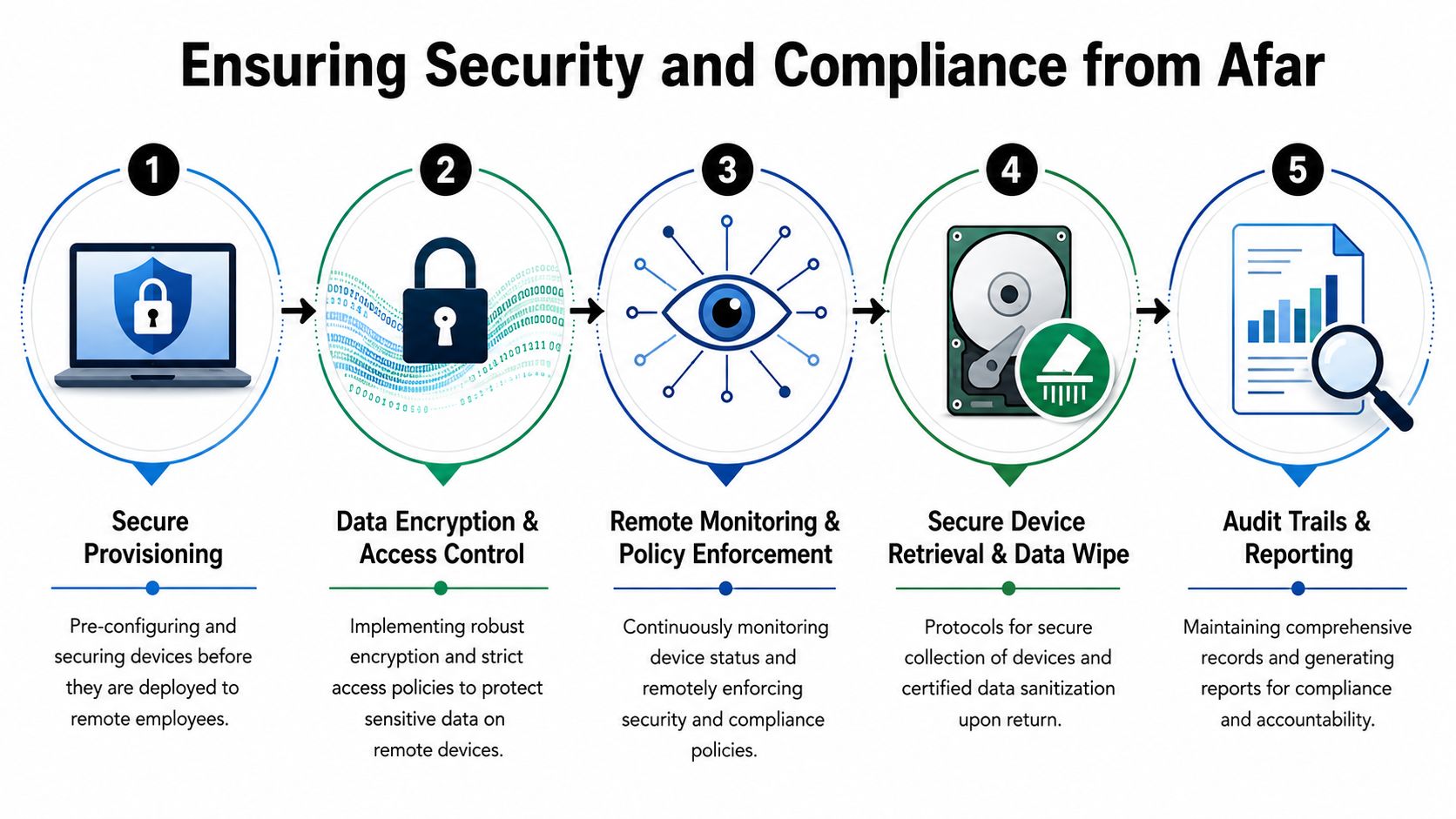
Remote wipe is not the whole answer
Remote wipe has value, but auditors and regulated organizations usually need more than a command history. They need proof tied to policy, asset identity, and disposition outcome. That's why secure destruction remains the center of enterprise ITAD demand.
Data destruction and sanitization services accounted for 38.20% of the North America IT Asset Disposition market in 2025, according to Mordor Intelligence's North America ITAD market analysis. Buyers prioritize secure information protection because that's the part with the most legal and reputational downside.
Building chain of custody without an office handoff
A distributed environment needs digital controls that replace the old front-desk dropoff model.
Use a chain that includes:
- Asset assignment records: serial number, user, policy set, and deployment date.
- Offboarding trigger logs: when retrieval started and who approved it.
- Transit evidence: shipment creation, carrier scans, and receipt confirmation.
- Sanitization proof: NIST-aligned wipe reporting or destruction certificate.
- Disposition record: redeploy, remarket, recycle, or destroy.
For many teams, the most useful upgrade is strengthening procedures for protecting sensitive data during remote laptop returns, especially where healthcare, finance, or government data is involved.
Standards matter at the endpoint
NIST-aligned sanitization, FTC Disposal Rule support, and documented downstream processing aren't administrative extras. They're the controls that let counsel, privacy teams, and auditors close the loop.
The more remote your workforce becomes, the more your compliance posture depends on whether you can prove these facts:
| Control area | What must be defensible |
|---|---|
| Custody | Who possessed the device at each stage |
| Data handling | How data was locked, wiped, or destroyed |
| Disposition | Whether the asset was reused, remarketed, or recycled properly |
If the evidence lives only in email threads, it won't hold up when a regulator or customer asks for proof.
Designing a Modern Recovery Program and Workflow
A strong remote recovery program is procedural. It shouldn't rely on heroics, exceptions, or a manager chasing boxes. The workflow needs to run the same way every time unless governance formally approves an exception.
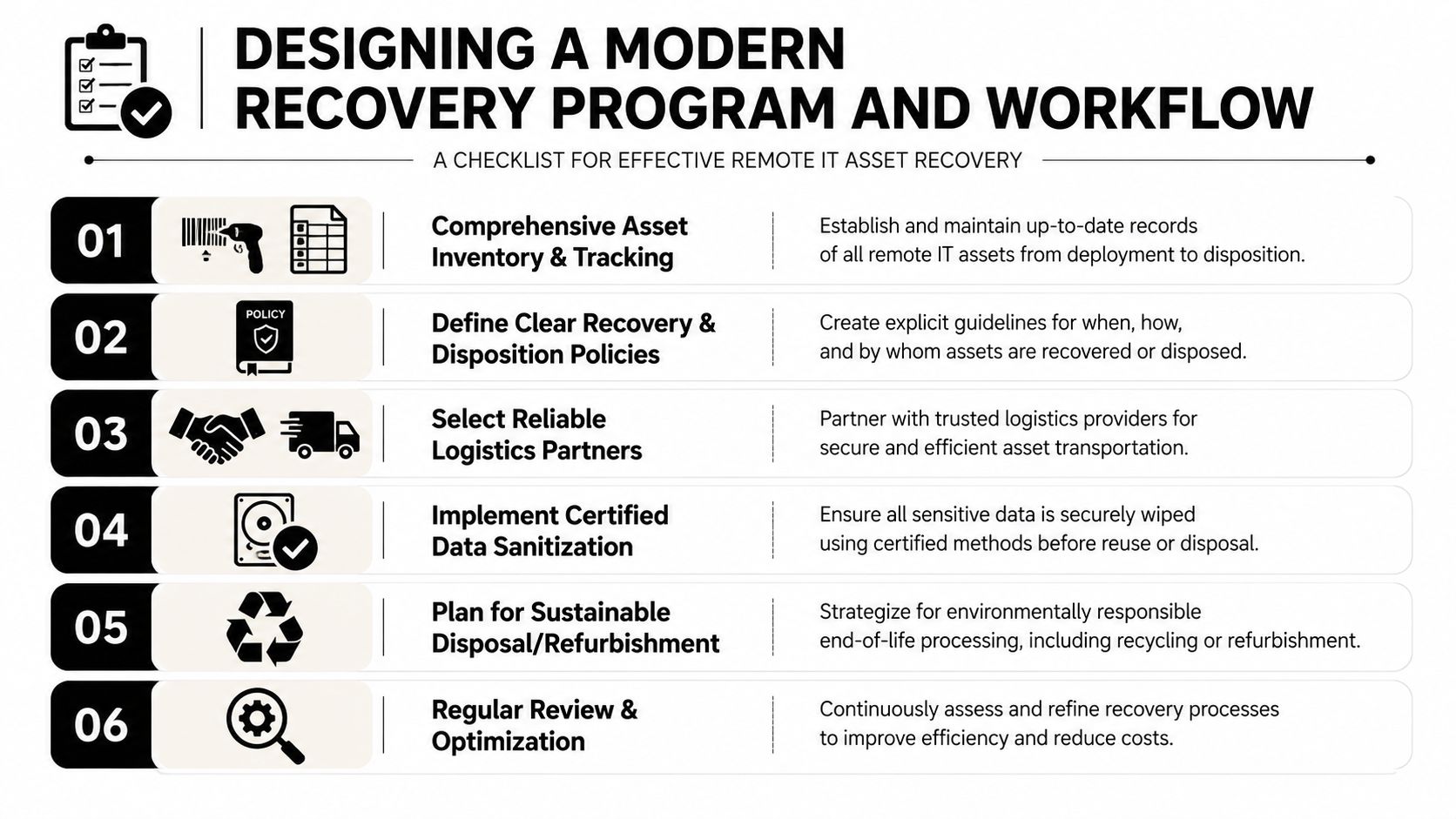
The core workflow
A practical sequence looks like this:
- Trigger recovery early: Start at notice of resignation or termination, not the final employment day.
- Freeze the inventory record: Confirm assigned assets, peripherals, and accessories.
- Issue return instructions: One communication, one deadline, one method.
- Send the return kit: Packaging and prepaid labels remove the biggest friction point.
- Lock or restrict as needed: If the employee delays or exits under adverse conditions, tighten endpoint controls.
- Process on arrival: Inspect, sanitize, classify, and route quickly.
According to Unduit's IT asset recovery guide, professional IT asset recovery strategies can boost recovery rates up to 90%, especially when tracking and certified data sanitization are part of the process. That's why operational discipline matters as much as policy language.
What good programs do differently
The best workflows are boring in the right way. Every handoff is documented. Every return path is predefined. Every exception has an owner.
Use these design rules:
- Pre-stage return materials: The most effective programs provide packaging and labels at issuance or can dispatch them immediately.
- Make IT the operating owner: Recovery falls mainly on IT in practice, so the workflow should reflect that.
- Set decision windows: Intake, sanitization, and next-step classification should happen on a defined timeline.
- Choose vendors with proof, not promises: Ask for data destruction documentation, chain-of-custody reporting, and remarketing or recycling records.
One example of a structured service model is this remote employee equipment return program framework. Beyond Surplus also coordinates remote recovery logistics, certified data sanitization, and disposition documentation for business assets, which is the kind of integrated workflow many distributed organizations now require.
Vendor screening criteria
When evaluating a partner, ask direct questions:
- Security controls: Can they document data destruction and custody end to end?
- Logistics capability: Can they support business pickups across dispersed locations?
- Disposition transparency: Will they show whether the asset was reused, remarketed, recycled, or destroyed?
- Reporting quality: Can finance, IT, and compliance each get usable records?
Optimizing Value with Smart Cost-Recovery Models
“Recover everything” sounds disciplined. In practice, it can waste money. A remote recovery program should optimize net value, not just return rate.
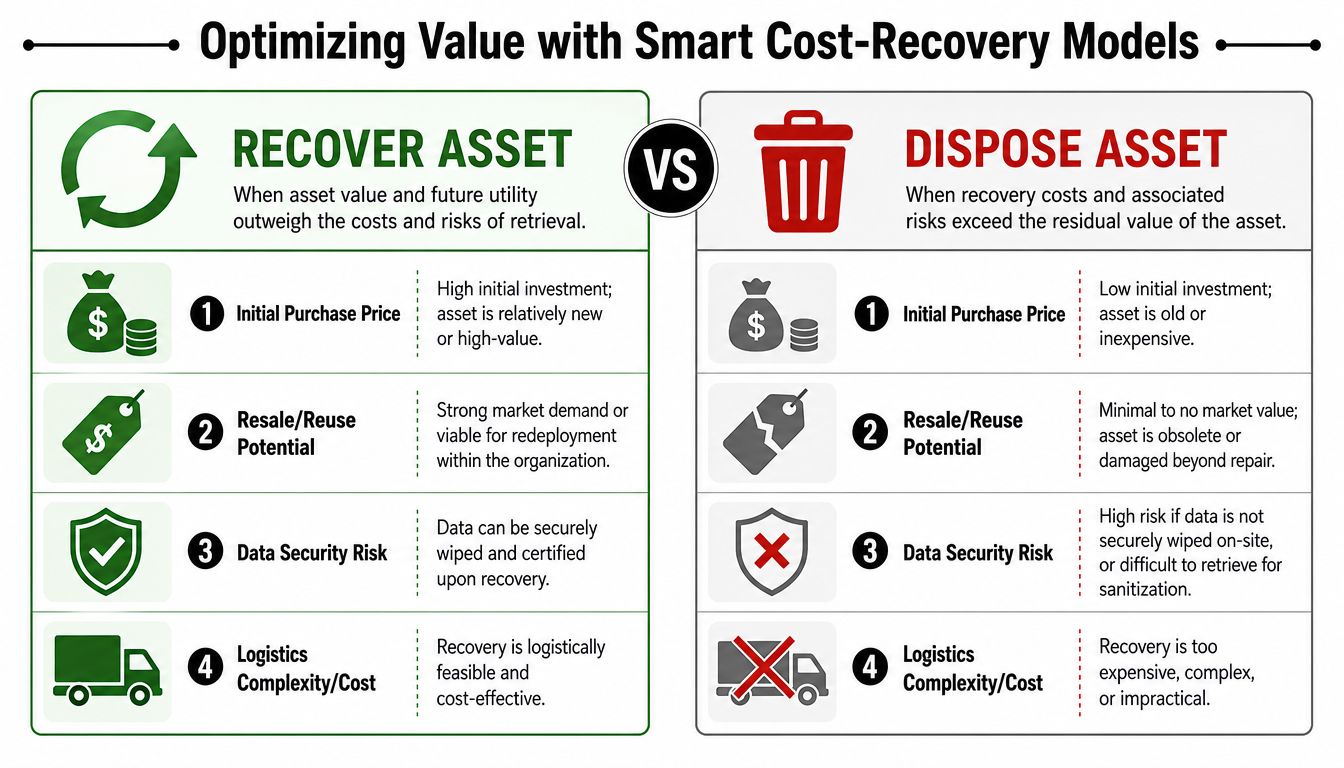
The overlooked issue is the low-value asset sitting far from your normal logistics lanes. Shipping, follow-up labor, packaging, and intake processing can cost more than the device is worth. That's not a recovery win. It's an accounting trick.
When recovery loses money
The hidden paradox is documented in the underserved ITAD discussion captured in this sysadmin thread on remote asset management trade-offs. 20% of recovered remote equipment costs more to retrieve than its resale value.
That doesn't mean companies should ignore those assets. It means they need a tiered decision model.
A practical decision framework
Use four filters before authorizing full retrieval:
- Residual value: Is the asset new enough or desirable enough to redeploy or remarket?
- Data sensitivity: Does the device hold regulated, client, or proprietary data?
- Logistics burden: Is the asset easy to retrieve within existing shipping patterns?
- Disposition alternative: Can a secure remote wipe and controlled local disposal meet policy?
A simple matrix works well:
| Asset profile | Recommended path |
|---|---|
| High value, high risk | Full recovery with tracked logistics and certified sanitization |
| High risk, low value | Prioritize data control first, then choose the lowest-friction compliant path |
| Low risk, low value | Consider write-off or local compliant disposal if policy allows |
Recovery rate is a useful metric. Cost per successful recovery and net value recovered are better management metrics.
The future of remote employee equipment recovery and IT asset management becomes more advanced. Mature teams won't treat every device the same. They'll classify assets by business value, data risk, and retrieval economics, then route them accordingly.
Frequently Asked Questions About Remote Equipment Recovery
What should IT do when a former employee won't return equipment
Start with endpoint controls and documented communication. Lock access, preserve logs, and escalate through the company's formal offboarding path. If legal action is considered, counsel needs a complete record of assignment, policy acknowledgment, and recovery attempts. Don't improvise deductions from final pay. That creates its own risk.
Can remote data wiping satisfy compliance by itself
Sometimes it helps reduce exposure quickly. It usually shouldn't be treated as the only control for regulated environments. Compliance teams generally want proof of sanitization tied to the asset and final disposition. If the device never returns, your records need to show what action was taken and why that path met policy.
How should companies handle international or out-of-region returns
Keep policy centralized and execution local where possible. Cross-border shipping, customs, and country-specific disposal rules can create delay and evidence gaps. Many organizations use regional logistics and approved downstream processors rather than trying to funnel every device back to one site.
Who should own remote equipment recovery
IT should own the operating workflow because the process ties directly to device control, data protection, and disposition. HR should trigger the event and support enforcement, but recovery becomes weak when accountability sits in too many places.
What makes a recovery program auditable
Three things matter most:
- Clear ownership: someone is accountable for each step
- System records: inventory, shipment, sanitization, and disposition are logged
- Consistent evidence: certificates and chain-of-custody records match the asset record
Is the future mainly about recovering more devices
Not by itself. The key shift is toward smarter routing. Companies will still push for strong return rates, but the more advanced programs will separate assets into recovery tiers and apply the right mix of security control, logistics effort, and value recovery strategy.
Remote asset recovery works best when security, logistics, and value recovery are planned together. If your team needs a documented path for pickup coordination, certified data destruction, and compliant IT asset disposition, contact Beyond Surplus for certified electronics recycling and secure IT asset disposal.


