

That distinction matters. Startup ecosystems become durable when they can support the full business cycle, from formation and fundraising to procurement, compliance, infrastructure, and eventual hardware refresh. In Atlanta, those pieces increasingly sit in the same metro area. Companies can recruit engineers, reach corporate customers, place equipment in nearby facilities, and retire aging devices without sending every operational task to another state.
The less visible consequence of tech growth is physical. A larger base of software firms, fintech platforms, health IT companies, data centers, and corporate innovation teams means more end user devices, test hardware, networking equipment, and storage systems entering and exiting service. As that installed base grows, IT asset disposition becomes a real operating requirement, not a back-office afterthought. Secure decommissioning, recycling, and data destruction help keep expansion compliant, lower security risk, and free up space and capital for the next deployment cycle.
That practical layer helps explain why Atlanta’s rise matters to more than founders. Businesses entering the market are not only choosing a talent pool. They are entering an ecosystem that increasingly depends on disciplined asset lifecycle management to keep digital growth credible in the physical world.
For operators assessing the region from a workforce angle, this guide to explore Atlanta tech job opportunities offers another view into how deep the local company base has become.
The Making of a Southern Tech Powerhouse
Atlanta’s position as a startup city is easier to explain through scale than branding. The metro has already reached the point where company formation, hiring, enterprise sales, and infrastructure decisions reinforce one another. That changes how founders assess risk. They are not entering an isolated startup scene. They are entering a market with enough technical labor, corporate demand, and operating support to keep a business moving when product plans, customer mix, or hiring needs shift.
Density changed the risk equation
Dense ecosystems reduce friction in ways that early-stage companies feel immediately. Hiring is faster when engineers, product managers, compliance talent, and enterprise sellers are already in market. Customer discovery is cheaper when target buyers are concentrated nearby. Partnerships form more easily when a startup does not need to build every outside relationship from scratch in another state.
Atlanta benefits from that kind of density because its tech base is spread across several commercial categories rather than one narrow specialty. A fintech company can recruit talent and meet potential banking, payments, or insurance customers in the same region. A health IT firm can sell into a different buyer set without leaving the metro. That diversification matters. It lowers dependence on a single funding cycle or industry trend and makes the local economy more resilient than startup hubs built around one dominant theme.
For professionals evaluating the market from a hiring perspective, this roundup of explore Atlanta tech job opportunities helps show how broad the employer mix has become.
A tech hub with physical operating consequences
The strategic significance of Atlanta’s growth is not limited to software valuations or office openings. Expansion in a tech market produces physical obligations. More startups, innovation teams, and scaled software companies mean more laptops issued to employees, more networking gear installed, more test devices rotated out, and more storage hardware retired under security and compliance rules.
That is one reason Atlanta now functions less like an emerging scene and more like a mature business system. Digital growth creates a parallel demand for decommissioning, recycling, and verified data destruction. In practical terms, secure IT asset disposition supports the credibility of the broader ecosystem. Companies can scale faster when they also know how they will retire hardware, protect data at end of life, and document those processes for customers, regulators, and internal audits.
A closer analysis of Atlanta’s growth as a Southeast tech hub points to the same conclusion. The city’s advantage is not hype alone. It is the accumulation of connected functions that make growth easier to sustain, including the less visible systems that handle aging equipment after the procurement cycle ends.
Building the Foundation for Tech Innovation
Atlanta didn’t assemble its tech identity overnight. It built one by connecting education, affordability, and enterprise access into a system that founders could practically use. The strongest startup ecosystems don’t rely on a single advantage. They layer advantages until the city becomes hard to ignore.
Universities helped turn talent into company formation
Georgia Tech and Emory University play different roles, but together they reinforce a steady flow of technical, research, and professional talent into the market. Georgia Tech feeds engineering, computing, and product development capacity. Emory strengthens the city’s healthcare, research, and life sciences orientation. That mix supports both software startups and companies building tools for complex institutional buyers.

Universities matter most when they don’t sit apart from the commercial economy. In Atlanta, they feed a broader cycle of recruiting, prototyping, and corporate collaboration. That gives early-stage companies a more practical environment than cities where academic talent and business demand remain disconnected.
Lower costs made experimentation more viable
Atlanta’s affordability is not a side note. It’s one of the core reasons the city keeps attracting founders and operators. According to Yahoo Finance’s reporting on Atlanta’s tech trajectory, experts assert that Atlanta must launch approximately 2,000 startups each year to secure a top-five national tech city rank, and that target is tied directly to the city’s lower cost of living, which reduces burn rates for new ventures.
That cost structure changes founder behavior. Teams can test ideas with less financial pressure. Early hiring decisions carry less downside. Office and operating costs leave more room for product work.
A practical side effect shows up in team building. When startups can stretch runway further, they can spend more attention on role design, sales execution, and cross-functional alignment. For companies trying to sharpen commercial performance while scaling, this guide to strategies for high-performing sales teams offers a useful lens on how structure affects growth.
- Affordability supports runway: Lower overhead gives founders more time to validate demand.
- Talent proximity supports speed: Hiring doesn’t have to begin with relocation packages.
- Corporate access supports testing: Enterprise relationships help startups pressure-test products earlier.
The city’s working environment reflects that same logic in physical form. Teams can move from coworking to larger space without the same cost shock seen in pricier hubs, which is why Atlanta coworking options for growing businesses have become part of the city’s broader startup playbook.
Following the Money Venture Capital and Accelerators
Atlanta startups raised $756.5 million in venture capital in 2025, up 23% year over year, according to Growth List’s report on Atlanta startups. That figure matters because venture capital usually arrives after a market has already shown repeatable company formation, credible founders, and enough customer demand to support multiple outcomes.
Atlanta’s funding picture suggests that threshold has been crossed. Investors were not betting on a single breakout story. They were allocating capital into a city with growing depth across FinTech, HealthTech, cybersecurity, and AI-oriented software, which lowers concentration risk and makes the market more attractive to firms building a regional portfolio.
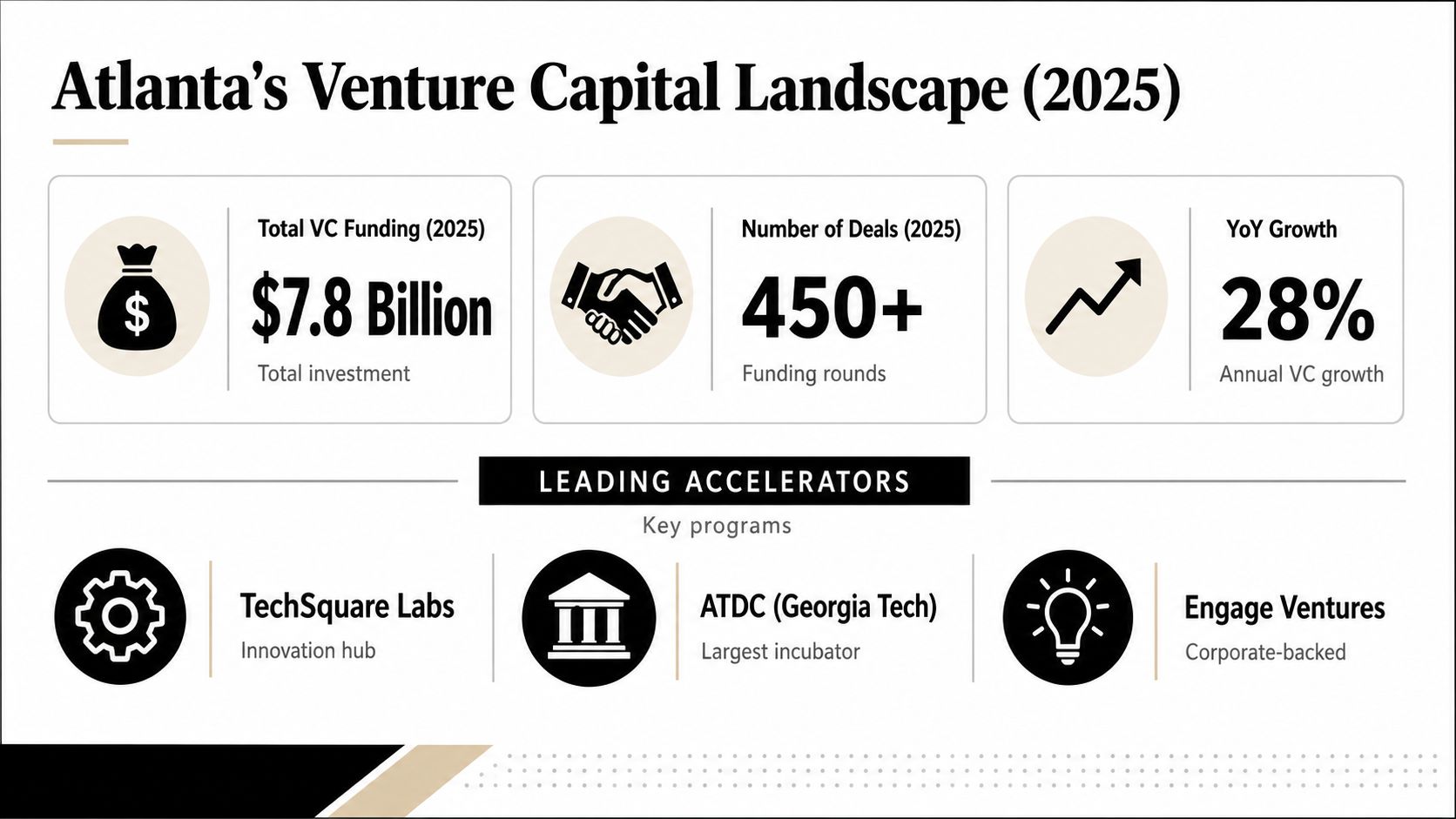
The more interesting shift is local. Firms such as BIP Ventures, Tech Square Ventures, and TTV Capital have helped reduce one of the biggest weaknesses in emerging startup markets: the gap between early conviction and available capital. When founders can raise from investors who understand Atlanta’s customer base, hiring market, and sales cycles, companies waste less time translating the city’s value to outsiders. That speeds up early decisions and keeps more firms headquartered locally as they scale.
Accelerators reinforce that effect by reducing early-stage friction. In a city built around B2B relationships, the best programs do more than offer mentorship. They connect founders to pilot customers, enterprise buyers, and experienced operators who know how to sell into regulated or operationally complex industries. Founders weighing program fit can compare accelerators with Credit for Startups, especially if they need customer access more than brand-name prestige.
This funding cycle also has a physical consequence that gets overlooked. More venture-backed companies mean more office buildouts, faster hardware refreshes, shorter device replacement cycles, and stricter expectations around data security when equipment is retired. As Atlanta adds startups, scales software teams, and supports more data-heavy operations, the city also creates more demand for disciplined IT asset disposition, secure data destruction, and electronics recycling. Capital does not just build apps. It expands the volume of laptops, servers, networking gear, and storage media that eventually have to be decommissioned correctly.
That matters for operators. A startup ecosystem becomes easier to scale when its support systems mature alongside it, including the less visible ones tied to compliance and infrastructure turnover. For founders, IT managers, and service providers tracking the market, Atlanta startup funding trends every entrepreneur should know are also a signal of downstream demand in ITAD, data handling, and asset recovery services.
Atlanta’s Signature Tech Industries
A startup city becomes more resilient when it isn’t dependent on one sector. Atlanta’s strength comes from a portfolio of industries that reinforce one another. The city doesn’t need every company to be the next consumer app success story. It has built domain depth in areas where enterprise demand already exists.
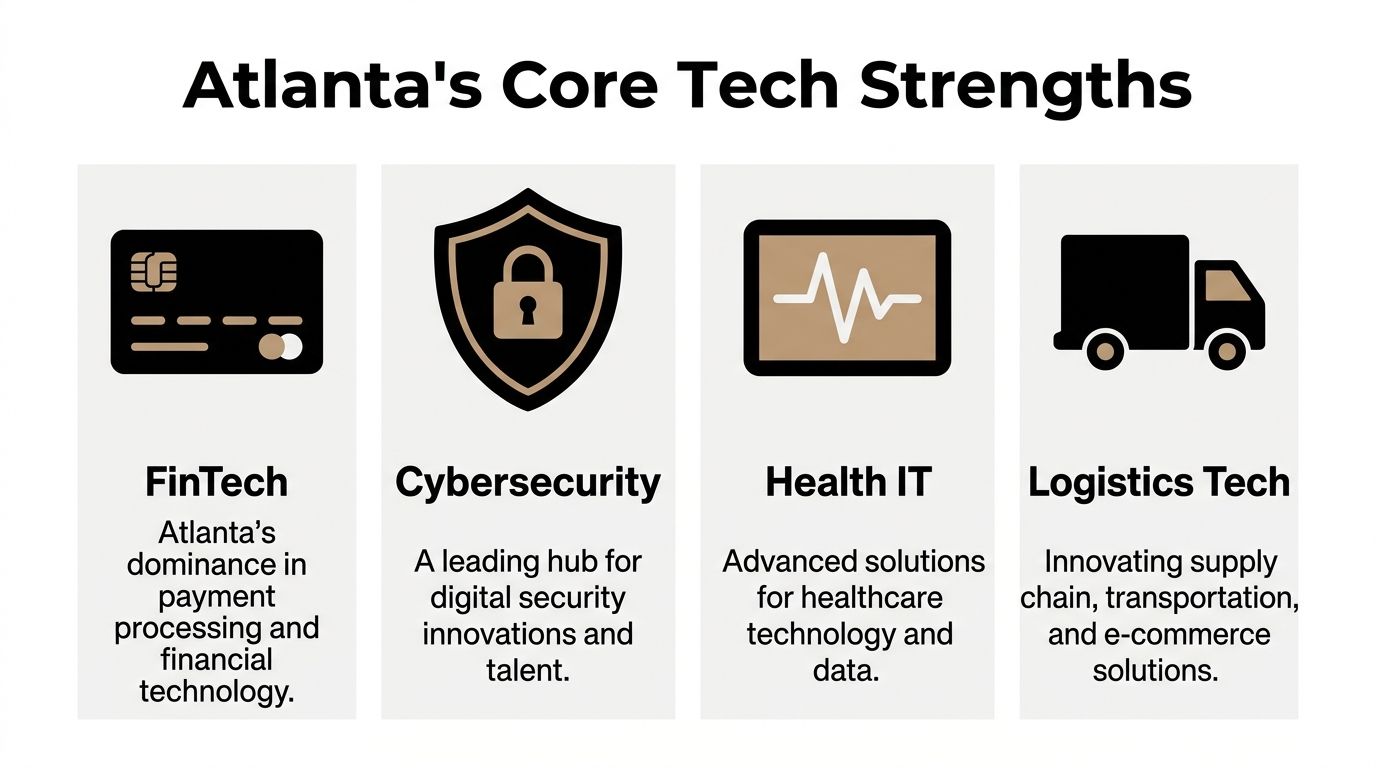
FinTech and Cybersecurity lead with business relevance
Atlanta has long been associated with payments and financial infrastructure. That gives FinTech companies a natural customer environment, access to experienced operators, and a workforce familiar with regulated transaction systems. This isn’t a trend imported from elsewhere. It’s a field that fits the city’s existing commercial DNA.
Cybersecurity also makes sense here. Startups in this category benefit when they can hire technical talent while staying close to enterprise IT buyers that care about data governance, fraud prevention, and compliance. That alignment makes Atlanta attractive to security-focused founders building for business customers instead of mass consumer adoption.
Health IT and Logistics Tech fit the city’s operating strengths
Health IT benefits from Atlanta’s broader healthcare and research presence. Startups in this space often need proximity to institutions, clinicians, data environments, and compliance-conscious buyers. Atlanta offers those ingredients in a way that supports practical product development.
Logistics Tech has a similarly natural foundation. Atlanta is a major transportation and distribution center, so startups serving supply chain, routing, fleet operations, and fulfillment don’t have to imagine the market. They can build around real operational complexity.
The strongest startup ecosystems don’t invent demand. They place founders close enough to real problems that product ideas get tested under pressure.
This sector mix matters because it stabilizes the ecosystem. If one category cools, the city doesn’t lose its whole identity. FinTech, security, healthcare technology, and logistics software create multiple lanes for company formation and investor interest. That diversity is one reason Atlanta looks less like a boomtown and more like an enduring business platform.
The Unseen Backbone Data Centers and Connectivity
Startup coverage often centers on founders, funding rounds, and office neighborhoods. But software markets run on physical systems. Atlanta’s rise also depends on connectivity, equipment density, and the ability to support data-heavy operations at scale.
Infrastructure is a growth enabler, not a footnote
For cloud platforms, AI-driven SaaS companies, security vendors, and transaction-heavy businesses, digital growth depends on physical reliability. Fiber availability, data center capacity, and transport access shape how quickly companies can deploy systems and support customers. In Atlanta, that infrastructure has become part of the city’s competitive position.
This is especially important for enterprise startups. They don’t just need coders and capital. They need environments where hardware can be installed, replaced, secured, and retired without operational chaos.
Hardware churn follows software growth
Every expanding technology market generates a less glamorous but unavoidable consequence: more infrastructure turnover. Data center equipment gets refreshed. Office fleets get replaced. Networking hardware ages out. Failed prototypes, backup devices, and retired endpoints all accumulate.
That hardware churn creates a real business layer beneath the digital economy:
- Data centers decommission equipment as systems change
- IT teams rotate laptops and servers to support growth and security needs
- Facilities groups manage storage and removal for obsolete technology
- Compliance teams require documented handling of data-bearing devices
The more a city depends on technology, the more it depends on disciplined end-of-life processes. That’s one reason Atlanta’s role as a connectivity and infrastructure market matters beyond startup headlines. Companies building in the region need both digital capacity and operational discipline, particularly in environments tied to colocation and enterprise hardware. Why Atlanta is a prime data center hub becomes more relevant when you look at the city through that business lens.
Navigating Growing Pains and Future Challenges
CBRE ranked Atlanta among North America’s leading data center markets in recent inventory and construction activity, a useful signal that the city’s tech economy is scaling into more power-intensive and infrastructure-dependent territory. Growth at that level changes the risk profile for founders and operators. The question is no longer whether Atlanta can attract startups. It is whether the region can support larger, more hardware-heavy, compliance-sensitive businesses as they mature.
Capacity matters more once startups become operating companies
Early-stage software firms can tolerate some market inefficiencies. Later-stage companies cannot. As headcount rises and customer commitments tighten, founders start evaluating power availability, network redundancy, facility costs, procurement lead times, and the practical work of retiring equipment that no longer belongs in production.
That is where Atlanta’s next set of constraints becomes more visible. Large data center markets across the U.S. are contending with utility bottlenecks, construction delays, and rising demand for power dense workloads. CBRE’s North America Data Center Trends H1 2024 report places Atlanta in that broader pattern by showing substantial market growth alongside active development pressure. For companies building AI systems, fintech platforms, or enterprise SaaS products with strict uptime requirements, market momentum alone is not enough. They need proof that capacity, resilience, and service vendors can keep pace with expansion.

Scaling pressure extends beyond capital
Capital remains part of the equation, especially for companies crossing from startup to established operator. But the less discussed friction is operational. A fast-growing company may add employees, open offices, expand cloud and colocation usage, refresh employee device fleets, and replace test and production hardware within a short period. Each of those actions creates physical asset risk alongside financial and technical risk.
That has a direct implication for Atlanta’s business environment. Markets that want to keep scaling companies local need more than investors and talent pipelines. They also need reliable support for decommissioning, storage, redeployment, recycling, and certified data destruction. Firms evaluating the region should treat that process as part of core infrastructure, not a cleanup task left for later. A practical starting point is a Georgia end-of-life IT asset management guide that outlines how organizations can handle retired equipment without creating security or compliance exposure.
The next phase of Atlanta’s tech rise will be operational
Atlanta has already proved it can generate startup formation and attract major technology investment. The harder test is retention at scale.
If local companies can secure power, connectivity, later-stage support, and disciplined IT asset handling in the same market, Atlanta strengthens its position as a place where firms can start and stay. If those systems lag, growth companies will keep customer teams or headquarters in Atlanta while shifting sensitive infrastructure and asset-intensive operations elsewhere.
The IT Asset Lifecycle Opportunity in a Tech Hub
Atlanta’s tech rise has a direct physical consequence. More startups, more enterprise tech offices, and more data-intensive operations mean more equipment entering and exiting service. That’s where the startup narrative meets business operations.
IT asset disposition becomes strategic in a dense tech market
In a market with heavy technology use, IT asset disposition isn’t a back-office cleanup task. It’s part of risk management. Devices leaving service may still contain sensitive data. Decommissioned servers must move through documented custody. Retired laptops, networking gear, and other electronics need secure, compliant handling.
That need is backed by local processing capability. According to Atlanta IT service guidance on electronics recycling and data destruction, Atlanta commercial recyclers adhere to R2 standards, which require certified data destruction and transparent chain-of-custody, and major local processors handle over 150 million pounds of electronics annually. That scale shows the city’s e-waste and ITAD infrastructure is built for enterprise demand, not occasional small-batch disposal.
Why this matters for operators
For IT managers, facility leaders, and procurement teams, the practical implications are clear:
- Security matters: Data-bearing devices need certified destruction.
- Compliance matters: Documentation supports liability transfer and audit readiness.
- Value recovery matters: Some newer equipment may still carry resale value.
- Logistics matter: Fast-moving companies can’t let retired hardware pile up in storage rooms.
In Atlanta, the digital economy and the hardware lifecycle now move together. A city that can launch and scale tech companies also needs disciplined systems for retirement, recovery, and recycling of the infrastructure those companies depend on. That’s why end-of-life IT asset management in Georgia has become a more important operating topic for businesses across the region.
Businesses scaling in Atlanta, Georgia need more than a strong tech market. They need secure, documented ways to retire IT equipment, destroy data, decommission infrastructure, and manage electronics recycling without adding compliance risk. Beyond Surplus provides certified electronics recycling and secure IT asset disposal for commercial organizations. Contact Beyond Surplus for certified electronics recycling and secure IT asset disposal.


