

62 million tonnes of e-waste were generated worldwide in 2022, and the number is still climbing faster than documented recycling can keep up with Global E-waste Monitor 2024. For Atlanta organizations, that makes electronics recycling more than a facilities task. It's a measurable ESG lever when you track retired laptops, servers, and network gear as assets with outcomes, not as anonymous junk.
That's the core mistake most ESG programs make. They talk about diversion, then stop at pickup. Auditors, investors, procurement teams, and internal risk owners want the evidence trail, asset counts, weights, reuse versus shred decisions, and certificates that prove what happened after collection. If you can't show those records, you don't have an ESG story. You have a claim.
Atlanta teams already have enough local activity to make this real. The live challenge data from Live Thrive shows that electronics can be collected at scale, and global recovery remains far behind disposal, with only about 22.3% of e-waste formally collected and recycled in the 2024 monitor data Live Thrive reporting. The opportunity is obvious. The difference between a weak program and a defensible one is documentation.
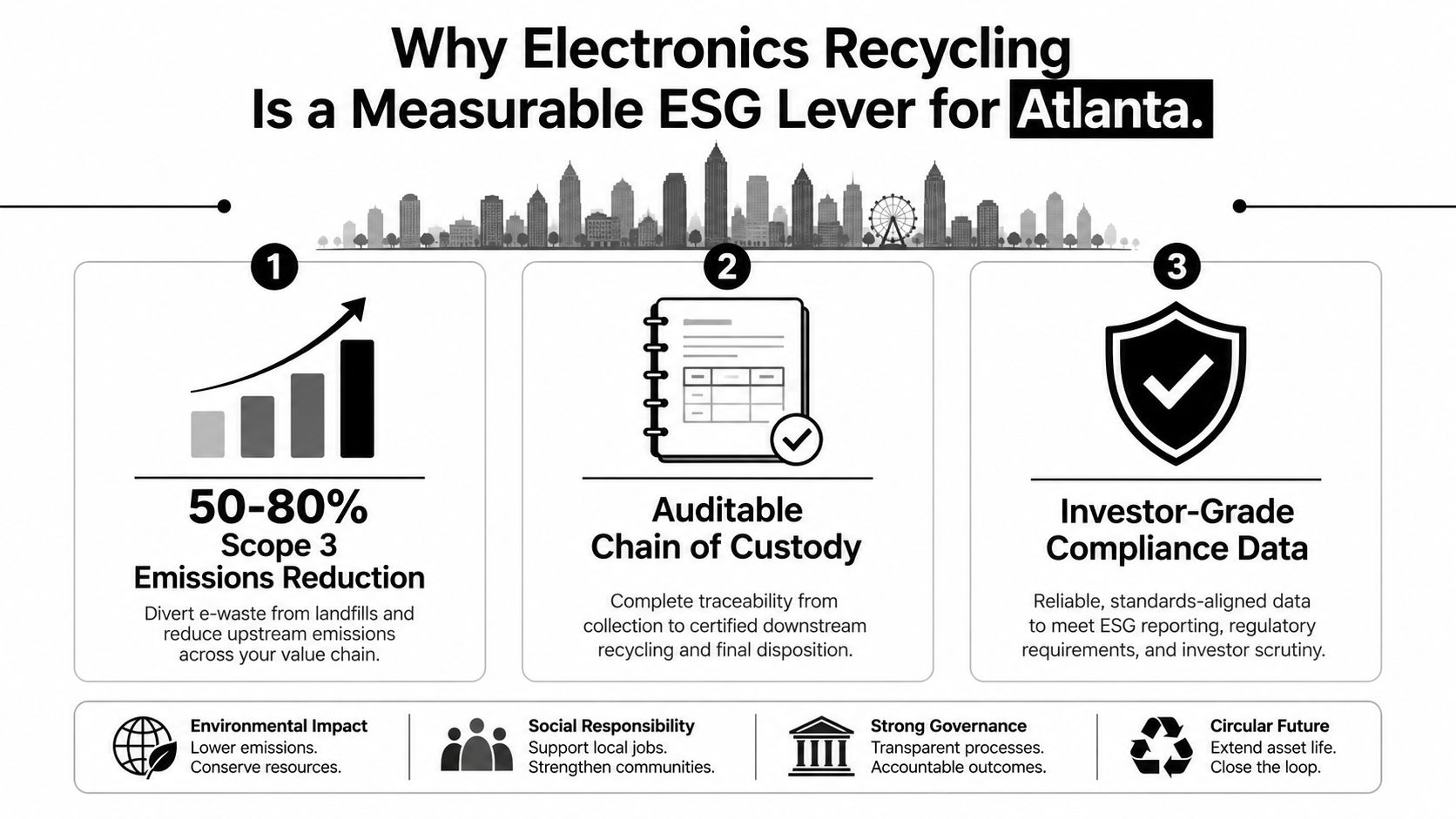
Why Electronics Recycling Is a Measurable ESG Lever for Atlanta
Atlanta organizations should stop treating electronics recycling like a feel-good sustainability gesture. It is a reportable control point. The Global E-waste Monitor 2024 shows the scale of the problem plainly, and that scale is why enterprise teams cannot rely on vague environmental claims.
The right unit of measure is the asset, not the pickup
A pickup receipt is not ESG proof. An asset list is. When an organization tracks retired devices by count, weight, and final disposition, it can show whether equipment was reused, remarketed, securely wiped, shredded, or downstream recycled. That turns a broad statement about sustainability into evidence that can be checked in an audit packet.
Practical rule: If the record does not show what happened to each device, the recycling event will not carry much weight in ESG reporting.
Electronics still hold value at end of life. They contain metals and plastics that can be recovered and kept in circulation rather than lost to disposal. They also hold data, which means the environmental and governance sides of ESG move together. A program that only counts pounds hauled away misses both the circularity story and the compliance story. A program that documents asset outcomes can support both.
Atlanta buyers need proof, not slogans
Investors and customers want documentation, not participation language. That is especially true in major markets like Atlanta, where enterprise teams are expected to show how operations line up with ESG commitments. Beyond Surplus's ESG-focused guidance reflects the same logic. The strongest reports do not say, “We recycled electronics.” They say how many assets were redeployed, what weights left the site, and which certificates close the loop.
That is the standard to aim for. It is straightforward, and it is tougher than most marketing copy. It is also the only standard that holds up when procurement, finance, security, and audit all look at the same file.
Designing an Atlanta Recycling Program Around Serialized Asset Inventory
A defensible electronics-recycling program starts before anyone moves a cart to the dock. It starts with a serialized asset inventory. Every device needs a record for type, serial number, condition, user group or department, and intended disposition path. Without that structure, ESG reporting turns into guesswork, and security teams lose control of data-bearing assets.
A good program also starts with the right sequence. Inventory comes first, then sorting, then disposition. That order keeps the asset record tied to what happens on site, which is what audit reviewers look for.
Separate the sensitive devices first
The first decision is simple. Data-bearing equipment must be separated from non-sensitive hardware before pickup. Laptops, drives, tablets, and servers should not move out with miscellaneous surplus. Segregation is not clerical neatness. It is the control that protects both value and data.
The inventory should sort assets into clear buckets:
- Reuse candidates: equipment that can stay in service with another user or team
- Resale or remarketing assets: devices with remaining market value
- Certified wipe candidates: items that can be sanitized under documented controls
- Destruction-bound devices: hardware that must be physically destroyed
- Downstream recycling only: items with no reuse path left
That distinction matters because ESG, finance, security, and audit teams should pull from the same record set. If sustainability works from one spreadsheet, IT from another, and the recycler from a third, the year-end report will need cleanup. The source of truth has to be the asset inventory, and it has to stay current from retire decision through final disposition.
Build the handoff trail before the truck arrives
Every handoff should be captured. Pickup, weigh-in, sorting, testing, wiping, destruction, and final processing all need custody records. That chain shows where the asset went, who handled it, and what happened next. It also tells you whether the asset had a reuse path, whether it was processed for recovery, or whether it had to be destroyed. Inventory optimization guidance from Beyond Surplus points in the same direction, inventory first, disposition second, and reporting last.
Practical rule: If a device leaves your site without a serial-level record, the audit trail is already weakened.
Disciplined inventory management pays off because it removes arguments later. IT knows what was retired. Facilities knows what left the building. Security knows what needed control. Sustainability knows what counts toward diversion. One record set serves all four functions, and that is what keeps the program clean when volume rises.
Resolving the Security vs Circularity Trade-off for Sensitive IT Assets
Too many recycling programs default to shredding everything. That is bad security theater and bad circularity. It destroys recoverable value, and it weakens the ESG case because fewer devices are reused, refurbished, or remarketed. Atlanta healthcare, finance, education, and public-sector teams need a harder line. Protect information, but do not destroy usable equipment unless the risk profile demands it.
Choose the least-destructive compliant option
The disposition decision should start with the device class, the media type, and the data sensitivity. A workstation that handled regulated data is not the same as a conference-room display. A branch laptop is not the same as a lab controller. Classify first, then choose the least-destructive compliant path.
Use this sequence:
- Reuse or refurbishment when the device still has useful life and no data risk remains
- Certified wiping when the media and policy allow it, with documentation attached
- Physical destruction when compliance, sensitivity, or policy requires it
- Specialized downstream handling for equipment with regulated components or unusual form factors
For data-bearing devices, Atlanta buyers should be direct about the rule set. Separate those assets from non-sensitive items, and treat regulated data with 100% of data-bearing assets require certified destruction with no exceptions Atlanta zero-landfill guidance. That is a security control, not a sustainability penalty.
Examples change the decision
A hospital retiring diagnostic workstations should not process those systems like office printers. A bank decommissioning branch laptops should separate media before anything leaves the site. A school clearing classroom Chromebooks may have a different reuse path than a finance team's endpoint fleet. The disposition matrix has to reflect those differences.
The common mistake is assuming circularity always means more reuse. It does not. Sometimes the least-destructive compliant option is certified wiping followed by reuse. Sometimes it is shredding. The job is to avoid crushing recoverable hardware just because that path is easier to process and easier to explain.
Security first, circularity second, but never circularity blind. If you do not classify assets before pickup, you will over-shred and under-report reuse.
Atlanta buyers should also expect a recycler to prove its controls, not just talk about them. The benefits of choosing an R2-certified electronics recycler in Atlanta are practical, because certification discipline is what keeps sensitive IT assets from turning into audit problems.
Selecting an Atlanta Recycling Vendor That Holds Up Under Audit
Vendor selection is where credibility is won or lost. An Atlanta buyer should not choose a recycler on pickup convenience alone. The vendor has to prove it can handle chain-of-custody, security controls, and downstream tracking without hand-waving. If the paperwork is vague, the ESG claim will be vague too.
Start with the evidence, not the pitch deck. Ask for recognized certifications such as R2v3, e-Stewards, or ISO 14001. Then verify whether the vendor can document custody from pickup to final disposition, not just collection at the dock. Certificates of recycling and certificates of data destruction should be issued per lot or per serial range, not as a meaningless aggregate for the whole month.
Look for the records that survive review:
- Downstream transparency: names of downstream processors, not anonymous “partners”
- Secure logistics: the vendor's own fleet or vetted transportation partners
- Specialized handling: medical equipment, lab equipment, and data center de-installations
- Witnessed destruction: on-site or off-site, if your policy requires it
The red flags are easy to spot. A vendor that cannot name downstream processors is asking you to accept blind trust. A vendor that only offers one blanket certificate is giving you paperwork that will not support a real audit. A vendor that refuses witnessed destruction when your policy requires it is forcing security to give up control in exchange for convenience.
The audit packet should do the talking. Manifests, certificates, transfer records, and downstream references need to line up with the original asset list, serial by serial or lot by lot. Security, finance, and ESG should all be able to use the same file without reconciling different stories.
That is why vendor due diligence has to be documented before the first pickup. Use this vendor due diligence checklist to pressure test custody controls, downstream disclosure, and destruction records before you approve a contract.
A practical shortlist should include vendors that can support secure ITAD, decommissioning, and product destruction under one chain of custody. Beyond Surplus is one option in that category, because it provides electronics recycling and documented data destruction for business equipment. Compare any provider against the same standard, and do not let a slick website substitute for a real audit trail.
Measuring ESG Impact With KPIs That Survive Scrutiny
Most Atlanta content gets lazy here. It says recycling supports ESG, then stops. That's not enough. If you want the numbers to survive investor, auditor, or procurement review, you need the right KPIs and you need to separate them cleanly. Reuse is not recycling. Resale is not destruction. If those lines blur, the environmental claim inflates fast.
Track the KPIs that matter
The reporting set should include:
- Diversion rate to show what left landfill-bound streams
- Reuse rate to show what stayed in circulation
- Weight recovered by material stream to show how the load was processed
- Assets redeployed versus shredded to show circularity, not just collection
- Certificates issued to show that the disposal path is documented
- Downstream processor location to show where the final work occurred
The point of these metrics is not to create more paperwork. It's to stop overstating impact. A pallet of laptops sent for recycling doesn't mean all of them were recycled. Some may have been redeployed. Some may have been wiped and resold. Some may have been destroyed. Those outcomes are different, and your report should say so.
| ESG Reporting KPIs for Atlanta Electronics Recycling Programs | What It Measures | Source Data |
|---|---|---|
| Diversion rate | How much equipment stayed out of landfill-bound disposal | Asset inventory and final disposition records |
| Reuse rate | How many devices were redeployed or resold | Serialized asset list and disposition codes |
| Weight recovered by material stream | What quantities of metals, plastics, and mixed materials were processed | Weigh tickets and downstream processing records |
| Assets redeployed versus shredded | The split between circular use and destruction | Final outcomes matched to serial numbers |
| Certificates issued | Whether the program produced evidence for audit packets | Certificates of recycling and data destruction |
| Downstream processor location | Where the final processing occurred | Vendor downstream documentation |
Keep the narrative honest
The measurement gap in Atlanta ESG content is real. Most programs mention chain-of-custody and certificates, but they stop short of saying which KPIs to track or how to distinguish reuse from recycling in reporting. That gap is what hurts credibility. If a CFO or auditor asks what happened to a retired server fleet, “we recycled it” is too thin. “Here are the serial numbers, the disposition codes, the weights, and the certificates” is defensible.
Carbon-offset thinking for electronics recycling should never replace actual outcome tracking. Use the records first, then interpret the environmental benefit carefully.
A 30-Day Plan to Stand Up or Audit Your Atlanta Program
A serious program can be launched or audited in about a month if the work is sequenced correctly. Don't start with vendor calls. Start with internal alignment, then inventory, then vendor review, then a pilot pickup. That order keeps the process from collapsing into cleanup later.
Week 1 gets the decision-makers in the room
Bring IT, security, finance, facilities, and sustainability together. Agree on what counts as reuse, what counts as destruction, and what documentation the team needs before anything leaves the site. If those definitions aren't settled, the rest of the month will be noisy.
Week 2 is inventory cleanup
Build or clean the asset list. Add serial numbers, conditions, user groups, and disposition paths. Flag every data-bearing device and separate it physically from non-sensitive hardware. If you skip this step, you'll end up with a pickup that looks efficient and reports that don't reconcile.
Week 3 is vendor scoring
Issue an RFP or grade your current vendor against the criteria above. Demand certificates of recycling and data destruction. Ask how they handle chain-of-custody, downstream tracking, and special streams like lab gear or data center equipment. If they can't answer clearly, move on.
Week 4 is the pilot and the first report
Run a small pickup, reconcile certificates against the original asset list, and publish the first internal ESG summary. Watch for the usual failures, aggregate certificates, missing serials, and under-reported reuse because IT never told sustainability which devices were redeployed.
Practical rule: If your first report can't be tied back to the asset list, it isn't ready for leadership review.
Turning Your Atlanta Program Into a Reporting-Ready ESG Asset
The organizations that get this right do three things consistently. They maintain a serialized inventory with disposition codes. They choose vendors that document chain-of-custody and certified destruction. They report reuse separately from recycling and name the downstream outcome. That's the difference between ESG theater and ESG evidence.
The pressure to prove outcomes isn't going away. Investors want cleaner disclosure. Procurement teams want more specific vendor proof. Security teams want tighter controls. That means electronics recycling should sit inside the Atlanta ESG playbook as a permanent operating process, not a once-a-year cleanout project. The more your records look like an audit packet, the stronger your program becomes.
Use the checklist below as the standard:
- Inventory first: serial numbers, device type, condition, and user group
- Classify carefully: reuse, resale, wipe, destruction, or recycling
- Separate sensitive assets: don't mix data-bearing devices with generic surplus
- Require documentation: certificates, custody records, and downstream details
- Report accurately: reuse is reuse, recycling is recycling, destruction is destruction
Atlanta organizations don't need softer language. They need tighter records. If you want electronics recycling to support ESG goals, stop treating it like a disposal job and start treating it like a controlled asset process.
Contact Beyond Surplus for certified electronics recycling and secure IT asset disposal. If your Atlanta team needs chain-of-custody records, certificates of recycling, and data destruction documentation that can go into an ESG packet, start at Beyond Surplus. Their business-focused ITAD and electronics recycling services are built for organizations that need secure handling, defensible reporting, and a clear path from retired equipment to audit-ready records.


