

Georgia's healthcare technology future is already being built on a sizable base, not an empty slate. Georgia's digital health ecosystem includes 200+ companies, $20.7 billion in economic impact, $11.8 billion in statewide revenue, and over 44,000 jobs by 2019, with employment up from 34,000 in 2010 to more than 44,000, a 31% increase over nine years (Technology Association of Georgia digital health report). For healthcare executives, that scale matters because it means the next wave of AI, telehealth, interoperability, and secure infrastructure will land in a mature market with real vendors, real talent, and real operational pressure.
The practical question isn't whether Georgia will adopt more healthcare tech. It's whether organizations will modernize in a way that improves care, protects data, and avoids creating a trail of obsolete hardware, exposed drives, and messy decommissioning work.
Table of Contents
- Georgia's Healthcare Technology by the Numbers
- AI and Telehealth Transforming Clinical Workflows
- Interoperability and the Health Information Exchange Gap
- The Rural Access Reality Behind Digital Health Expansion
- Secure IT Asset Disposal and Data Destruction for Healthcare
- Actionable Steps for Healthcare IT Leaders in Georgia
- Building a Sustainable and Secure Healthcare Technology Future
Georgia's Healthcare Technology by the Numbers
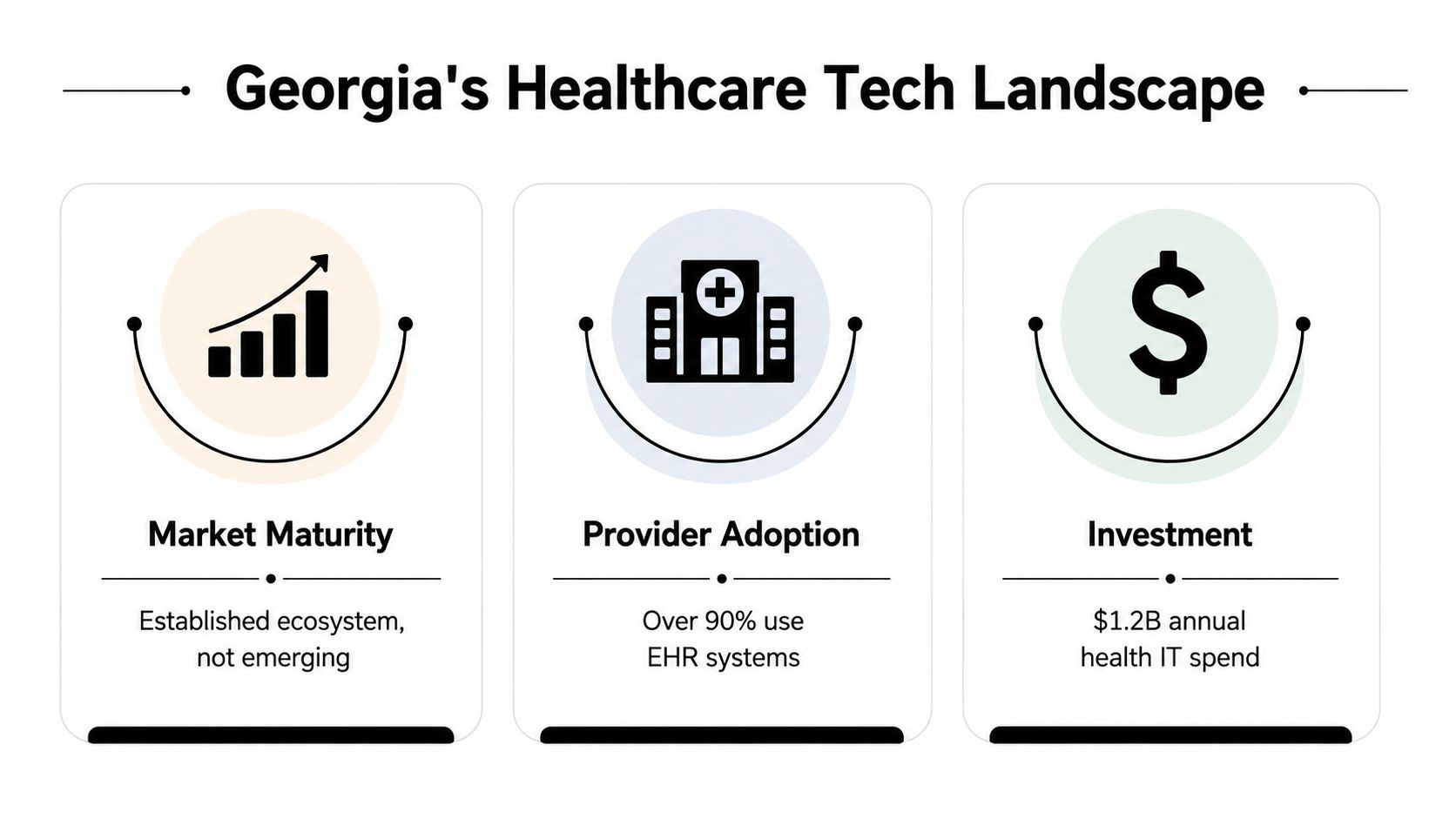
Georgia's healthcare technology base is large enough to shape vendor strategy, workforce planning, and procurement cycles. The state's digital health report counted 200+ digital health companies and estimated a $20.7 billion economic impact, $11.8 billion in statewide revenue, and over 44,000 jobs by 2019. Those figures point to a commercial ecosystem with enough depth to support long-term investment in clinical software, connected devices, analytics, and infrastructure.
Why the ecosystem already has momentum
A separate Georgia health technology source says the state has 225+ health IT companies and about 17,000 employees, while another Georgia report again places the ecosystem at 200+ digital health companies with $20.7 billion in economic impact. The exact headcounts differ by source and methodology, but the direction is consistent. Georgia has a dense healthcare-tech market, and that density shortens the distance between buyer needs and vendor response.
Practical rule: In a market this concentrated, procurement is rarely just about software features. It is about whether the vendor can integrate, support, and secure the stack without creating more work for the IT team.
The state's scale also explains why healthcare technology planning cannot stop at new systems. Every new platform eventually produces end-of-life hardware, retired servers, surplus laptops, and storage devices that need documented disposal. For healthcare organizations, the future of technology in Georgia includes the future of IT asset disposition, because every upgrade creates a compliance event as well as an operational one. That matters in Atlanta too, where health systems comparing local partners often look beyond software to the full operational stack, including established providers such as Beyond Surplus healthcare systems and hospital resources in Atlanta.
The talent base matters too. One Georgia health IT brochure says the sector is among the strongest in the U.S. and the largest in the nation, with more than 200 companies employing approximately 30,000 people, and that Atlanta has close to 15,000 technology companies employing 166,500 high-tech professionals. That concentration gives hospitals and health systems a better chance of finding local help for interoperability, cybersecurity, data exchange, and workflow automation. It also raises the bar. Vendors in a mature market need to prove they can operate in real production environments, not just demo rooms.
AI and Telehealth Transforming Clinical Workflows
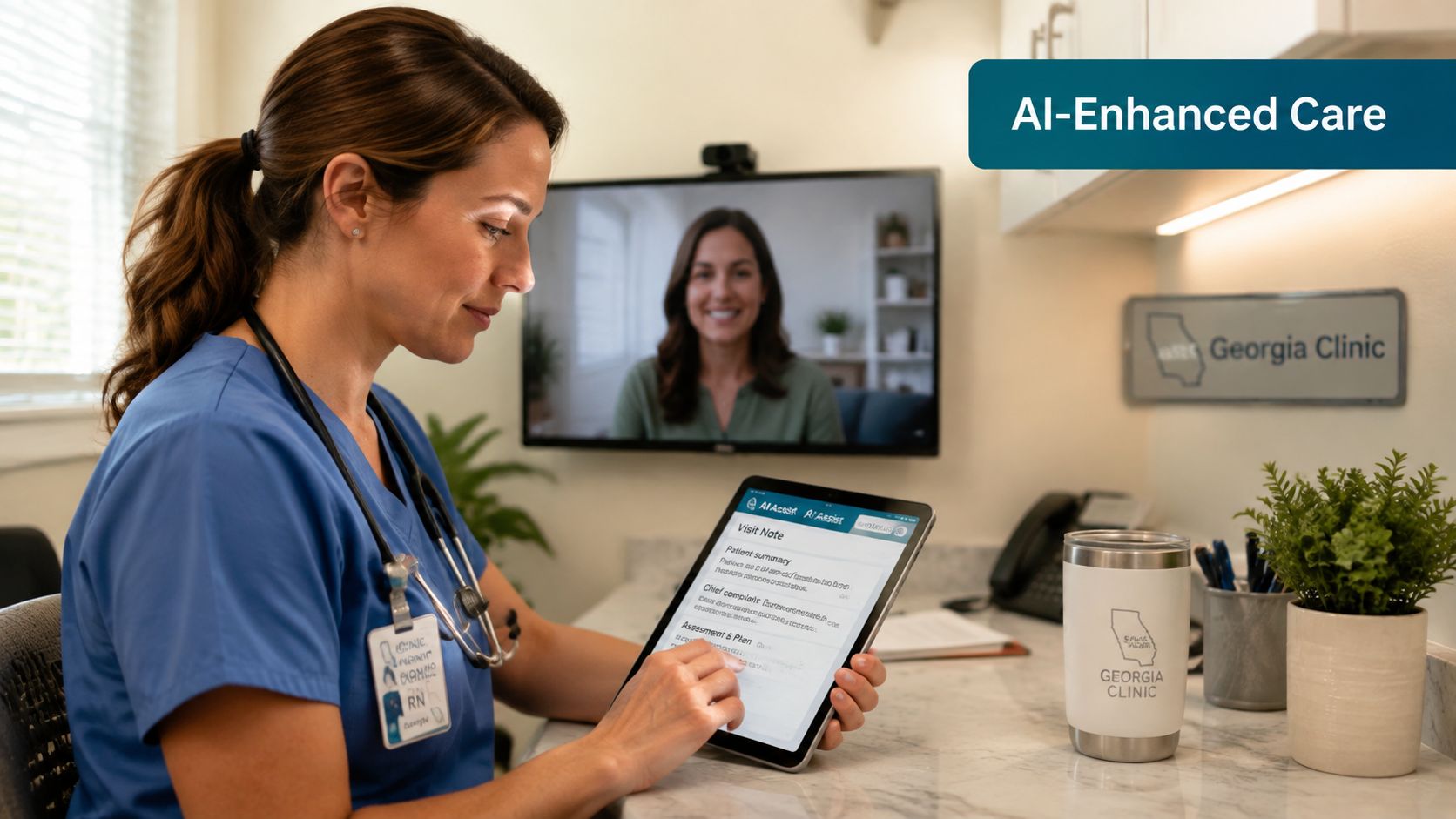
Georgia healthcare leaders are already using AI where it can relieve pressure fastest, documentation, triage, and claims. A Georgia-focused industry report describes hospitals using generative AI to summarize long records and guidelines, predictive AI to prioritize emergency-room patients, and Medicare piloting AI for prior authorization. That deployment pattern is the one IT directors should expect. AI is not replacing the clinical chain of command. It is reducing the administrative drag that slows it down, as reflected in the broader shift described in how AI is transforming Georgia's economy and in the Georgia Trend AI healthcare report.
What's viable now in clinical operations
The same report notes the FDA has approved 1,000+ AI-enabled radiology devices, plus hundreds more in surgery and specialty care (Georgia Trend AI healthcare report). That points to a shift from experimental tools to regulated clinical infrastructure. For health systems, the practical lesson is straightforward. AI works best when it is tied to a narrow, measurable task, such as image interpretation support, record summarization, or queue prioritization. It struggles when organizations expect it to fix broken workflows without changing intake, governance, or escalation rules.
Telehealth follows the same pattern. It helps when the organization already has scheduling discipline, a clean referral path, and a reliable way to get patients to labs, imaging, or follow-up visits. It frustrates teams when virtual care is bolted onto fragmented operations.
A video visit is only as useful as the workflow behind it. If the patient still has to guess where to go for tests, the digital front door becomes a dead end.
For executives, the right question is where these tools reduce burden without adding risk. That includes evaluating how data is stored, who can see it, how long it stays in systems, and what gets retired when a pilot ends. Georgia's healthcare future will reward organizations that treat AI as part of infrastructure, not as a side project, and that plan early for the hardware, storage, and data destruction work that comes with every new deployment.
Interoperability and the Health Information Exchange Gap
Georgia's digital adoption is high, but adoption is not the same as exchange. A statewide survey found nearly 99% of providers used digital health tools, 70.8% were connected to the state Health Information Exchange, yet only 39.9% were using it (Georgia digital technology survey). That gap is where a lot of wasted time lives. Staff still rekey data, chase records, and reconcile mismatched charts even after the expensive systems are in place.
The operational problem is bigger than software adoption. Data may be stored in multiple systems, but if clinical teams cannot move it cleanly from one workflow to another, the HIE becomes another login screen instead of a working exchange layer. Health systems that have invested in modern platforms still lose time when interfaces break at the edges, when departments use different data fields, or when referral information arrives in a format no one can trust without manual review.
Closing the gap without adding more manual work
The practical fix starts with workflow, not more software. Organizations need to map where data enters, where it breaks format, and where staff manually patch the gap. If the EHR, lab system, referral platform, and billing system do not share a common structure, the HIE becomes another place people log in, not a real exchange layer.
Georgia's strategy documents also push statewide expansion of electronic prescriptions and broader reforms that aim to reduce out-of-pocket healthcare costs from 57% of total health expenditure in 2015 to below 30% by 2030 (Georgia digital technology survey). That policy direction matters because interoperability is not only a technical standard. It affects how quickly systems can move data, how much staff time gets lost to reentry, and how much old hardware, storage, and duplicate records have to be retired when organizations modernize. For executives comparing modernization options, the practical view is the same one reflected in Atlanta's healthcare innovation push, including work profiled by Beyond Surplus on Atlanta's healthcare innovation hub. New systems add value only when the organization can also manage the cleanup around them.
Practical rule: If clinicians still need to call, fax, or retype what the system already knows, interoperability is not working, it has just been renamed.
A health system trying to improve HIE use should start with three checks. First, confirm whether interfaces are live or only technically connected. Second, identify which departments are still relying on manual import. Third, make sure discharge summaries, medication histories, and referral notes move cleanly enough to support care coordination. These are not abstract IT metrics. They determine whether the organization can scale without burning out staff.
The broader lesson for Georgia is clear. The state has the digital foundation. The next gain depends on making records move as easily as care does.
The Rural Access Reality Behind Digital Health Expansion
Telehealth looks like a clean answer until you look at transportation, broadband, and device access together. Recent Georgia-focused reporting and policy discussion point to persistent digital divides in rural and underserved areas, and the Georgia House Study Committee said three out of four Georgia counties are health transportation shortage areas (Augusta University coverage of the digital divide study). That matters because a virtual visit doesn't help much if a patient can't get the imaging, lab work, or physical follow-up that the visit triggers.
Why access still depends on infrastructure outside the clinic
The common mistake is to treat telehealth as a substitute for physical access. In reality, it often becomes one more layer on top of existing barriers. Patients in rural communities may still struggle with broadband quality, device availability, and the logistics of visiting a lab or specialist site. That means technology can improve access for some residents while leaving others behind.
Georgia health leaders should ask who benefits most from digital expansion. Patients with reliable internet, stable housing, and easy transportation tend to gain the most. Patients who lack any one of those things often face the same bottleneck, just with a different interface. That's the equity problem hidden inside a lot of digital transformation plans.
The answer isn't to abandon telehealth. It's to pair it with practical supports, scheduling that assumes travel constraints, referral pathways that don't collapse when a video call ends, and local partners who can handle testing and imaging. Health systems that ignore those realities end up measuring access by appointment volume instead of by completed care.
Beyond the clinic wall, the same operational discipline applies to equipment retirement and site closures. If a rural outreach site, mobile program, or satellite clinic shuts down, the devices can't just be boxed up and forgotten. They need secure handling, inventory control, and documented disposition. That's where digital strategy meets real-world operations.
A useful perspective on the business side of statewide connectivity is Beyond Surplus's how Atlanta's economy is driving growth across Georgia. The same metro-to-rural imbalance that fuels growth also shapes who gets the best access to digital care.
Secure IT Asset Disposal and Data Destruction for Healthcare
A hospital can finish a technology rollout and still leave exposure behind if the old gear is not handled correctly. In Georgia, that risk shows up in laptops, servers, storage arrays, scanners, and specialty devices that may hold protected data long after they are powered down.
The main problem is incomplete erasure, weak chain of custody, and gaps during decommissioning. For organizations that handle ePHI, secure IT asset disposition belongs in the project plan from the start, not as a cleanup task at the end. Certification, documented recycling, and data destruction records help transfer liability and support compliance with rules such as the FTC Disposal Rule. Georgia healthcare teams also need to keep HIPAA workflows in view any time retired devices may still contain patient information.
What to do before equipment leaves your control
A disciplined process should include inventory, serial number tracking, device classification, certified wiping or shredding, and final destruction documentation. Hard drives and SSDs need different treatment depending on condition and reuse status. Networked devices, endpoint laptops, and decommissioned servers all need review before they leave the building.
For teams that want a practical benchmark on compliance and record handling, secure lab notes with Verbex shows how security works as a workflow issue, not just an IT policy issue. That same lens applies to healthcare asset disposal. If the chain of custody breaks, the paper trail breaks with it.
A retired asset is still a live risk until the last drive is verified, recorded, and released.
Beyond Surplus fits into this operational category as one option for certified IT equipment disposal, secure e-waste management, data center decommissioning, and data destruction. In healthcare, those services matter because old technology often sits at the intersection of compliance, logistics, and physical security. Medical systems are especially sensitive because they can include embedded storage, specialty peripherals, and transport concerns that standard office IT does not have.
Healthcare teams also need a vendor that understands HIPAA-compliant handling from pickup through final disposition. A useful reference is Beyond Surplus's guide to HIPAA-compliant ITAD services in Georgia, which fits the operational realities of state healthcare systems. That kind of planning reduces the chance that retired assets become a compliance gap.
The safest approach is to treat every retired device as active risk until the last component is verified, recorded, and released. That mindset protects patients, lowers audit exposure, and keeps disposal from becoming an afterthought.
Actionable Steps for Healthcare IT Leaders in Georgia
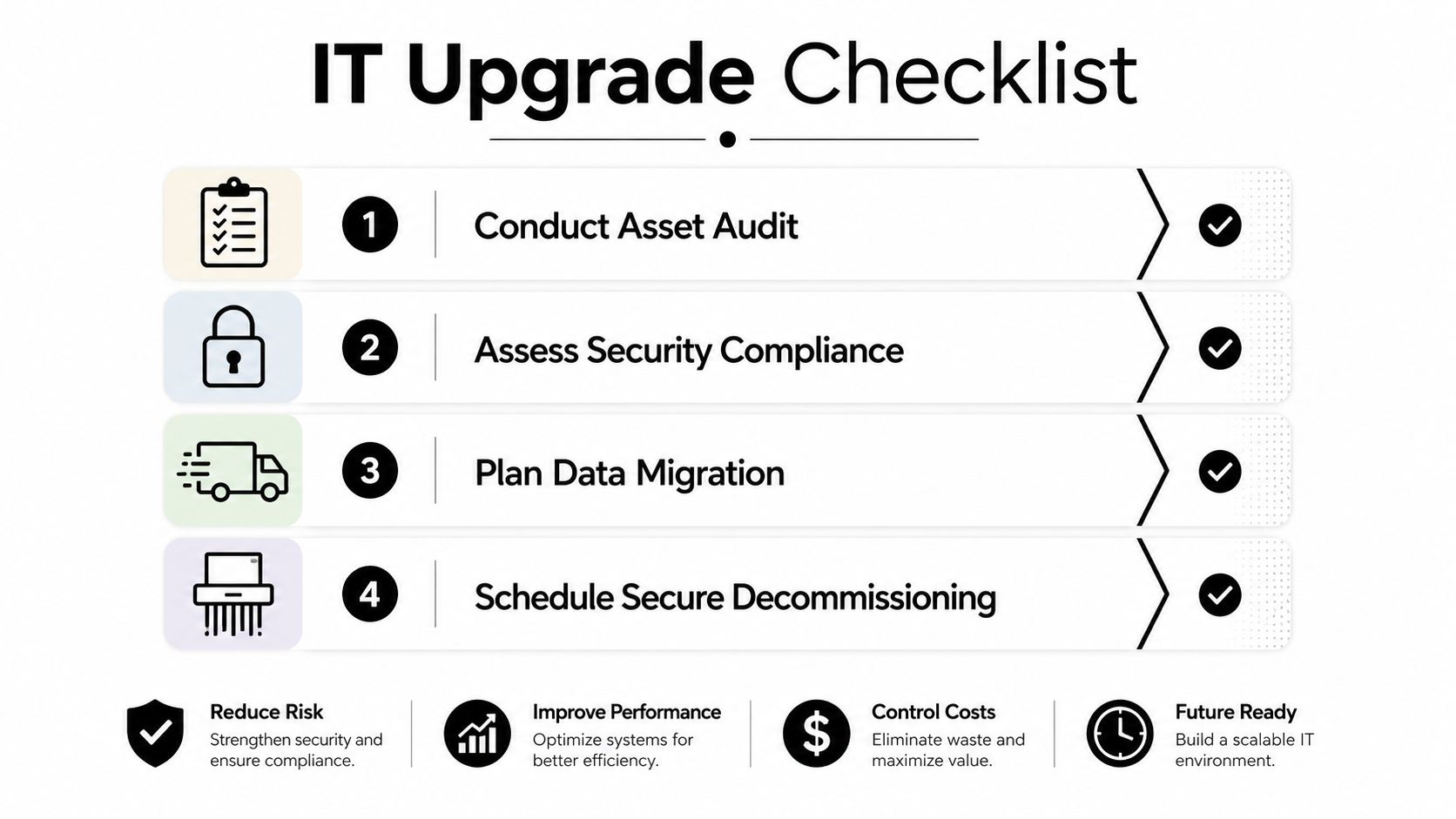
Start with the asset list. If you don't know what you own, you can't modernize safely. Separate active equipment, end-of-life devices, and systems that are still running only because nobody has signed off on replacement. That includes servers, user endpoints, network gear, imaging peripherals, and any medical technology with storage attached.
A practical upgrade and decommissioning checklist
- Conduct an asset audit. Match physical devices to ownership, location, and data sensitivity before any replacement order goes out.
- Assess security compliance. Verify who can access the system, what data it stores, and whether it needs certified wiping or hard drive shredding.
- Plan data migration. Move patient, billing, and operational data before equipment is retired, not after the refresh has already started.
- Schedule secure decommissioning. Coordinate pickup, chain-of-custody documentation, and final certificates so the site isn't left with orphaned devices.
A multi-site health system should also coordinate timing with facilities, compliance, and procurement. Procurement often focuses on replacement cost, but budget pressure shows up in labor, downtime, and disposal logistics. If a clinic upgrade happens without disposal planning, old systems sit in closets, and closets become risk pools.
Value recovery can help, but only after security is handled. IT buyback works best when devices are still within a usable lifecycle and can be wiped, tested, and redeployed. Once an asset is too old or too sensitive to reuse, the priority shifts to destruction and compliant recycling.
Georgia organizations should also evaluate vendors by their documentation, not just pickup promises. Certificates of recycling, certificates of data destruction, and clear transportation records matter because they turn disposal into evidence, not trust.
Building a Sustainable and Secure Healthcare Technology Future
Georgia's healthcare future will be shaped by two forces at once, more digital capability and more operational accountability. AI, telehealth, and interoperability will keep moving forward because the state already has the workforce and market depth to support them. But the organizations that win will be the ones that manage the whole lifecycle, from deployment to decommissioning, with the same seriousness.
The operational burden doesn't end with software adoption. It extends to secure storage, equipment refreshes, lifecycle planning, and verified disposal. The healthcare organizations that treat IT asset disposition as part of infrastructure planning will have fewer surprises, cleaner audits, and better control over risk.
For a broader industry view on how healthcare services are being organized around technology and operational demands, Ekipa AI's healthcare industries page is a useful reference point. In Georgia, the advantage will belong to teams that connect clinical modernization with security, logistics, and responsible retirement of old assets.
If your Georgia healthcare organization is planning a refresh, a site closure, or a data center decommissioning project, Beyond Surplus can help with certified electronics recycling, secure IT asset disposal, and documented data destruction. Visit Beyond Surplus to schedule service and line up a disposal plan that protects patient data while clearing out retired equipment responsibly.


