

Atlanta's healthcare innovation story is easier to understand when you start with the scale behind it, not the branding around it. Georgia's digital health sector had 200+ digital health companies, 44,578 jobs, an estimated $20.7 billion economic impact, and $11.8 billion in statewide revenue in the 2019 report from the Technology Association of Georgia, while employment grew from 34,000 jobs in 2010 to over 44,000 by 2019, a 31% increase over nine years (Technology Association of Georgia report). That makes Atlanta's rise look less like a recent surge and more like a structural buildout that has been compounding for more than a decade.
For hospital executives and IT directors, that distinction matters. A market with durable company formation, deep healthcare employment, and institutional gravity creates better conditions for deployment, procurement, and clinical validation than a market powered only by conference chatter. It also explains why Atlanta is no longer just chasing healthcare innovation, it's helping define what a functional regional ecosystem looks like.
Table of Contents
- The Scale of Atlanta's Digital Health Economy
- Institutional Density and Ecosystem Architecture
- Translational Infrastructure Moving Research to Market
- 5G Testbeds and Next-Generation Clinical Infrastructure
- The Equity Gap in Healthcare Innovation Access
- Building a Real Commercialization Pipeline
- IT Asset Disposition and Compliance for Healthcare Organizations
The Scale of Atlanta's Digital Health Economy
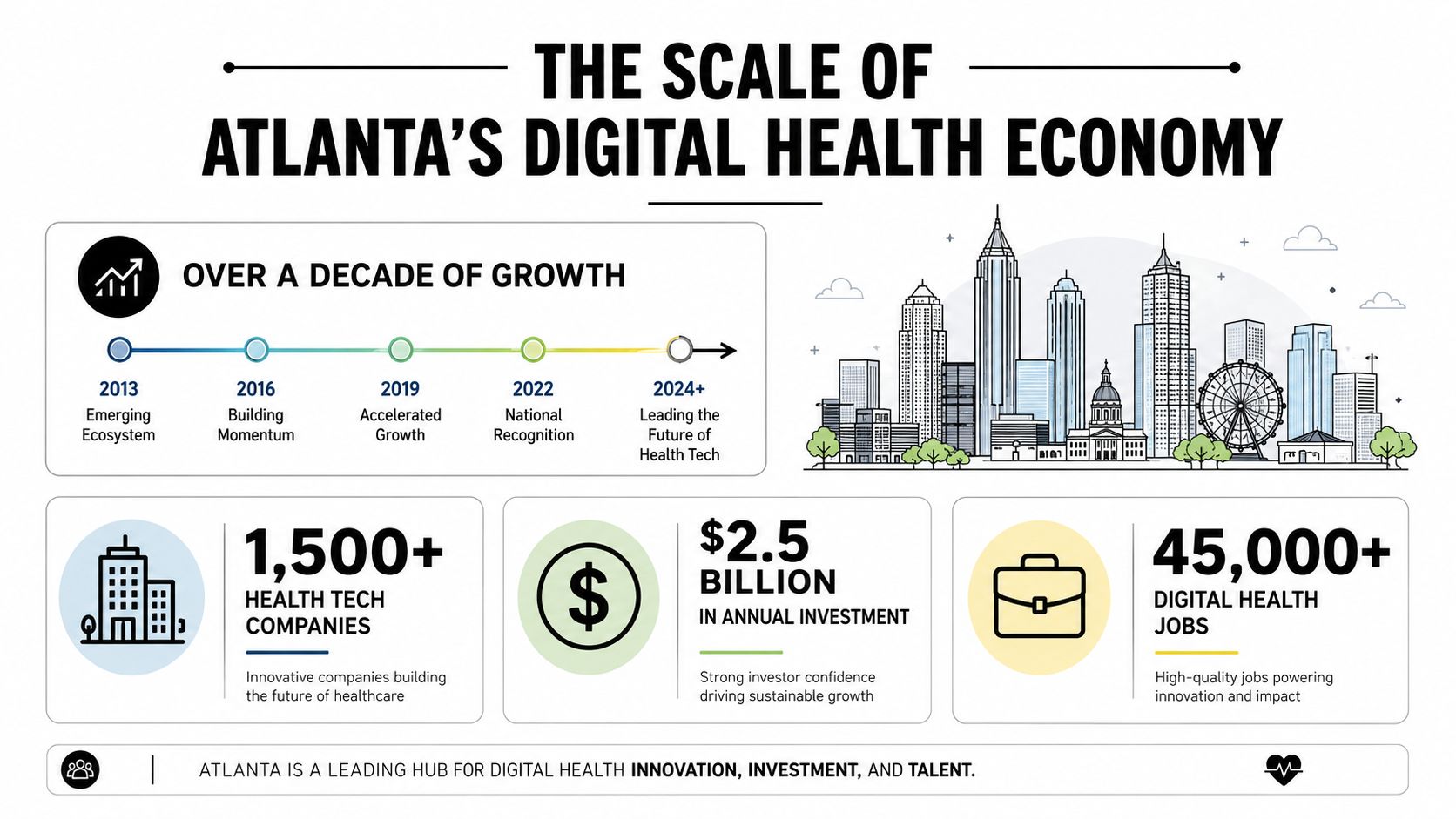
Atlanta's healthcare momentum rests on a broad digital health base, not a single flagship campus. As noted in the TAG ecosystem report above, Georgia's digital health sector had 200+ digital health companies, 44,578 jobs, $20.7 billion in economic impact, and $11.8 billion in statewide revenue, which gives the region a scale advantage that many emerging markets never reach. Employment growth from 34,000 jobs in 2010 to over 44,000 by 2019 points to a cluster that has been building over time, not a short-term surge tied to a single market cycle.
What that scale means for buyers
A market this dense changes vendor behavior. Software firms, device makers, and services companies can sell into hospitals, life sciences groups, and startup customers without leaving the same metro area, which shortens feedback loops and makes pilot-to-procurement conversations more realistic. It also gives IT teams more local partners to compare, test, and pressure before adopting new systems.
Practical rule: In a market like Atlanta, ecosystem maturity shows up in repeatable buying patterns, not just public announcements.
The regional pattern matters for capital and execution as well. Companies can hire locally, pilot with nearby health systems, and find investors who already understand the market, which reduces the distance between product development and clinical use. That also helps explain why Atlanta keeps appearing in national conversations about health technology, especially when viewed alongside the rise of Atlanta's technology startup ecosystem.
The harder question is whether that activity is converting into durable clinical adoption and broader access outside the core innovation districts. The answer is mixed. Atlanta has enough density to support experimentation and vendor competition, but buyers still have to separate local brand momentum from deployments that change workflows, reach patients, and survive procurement scrutiny.
Institutional Density and Ecosystem Architecture
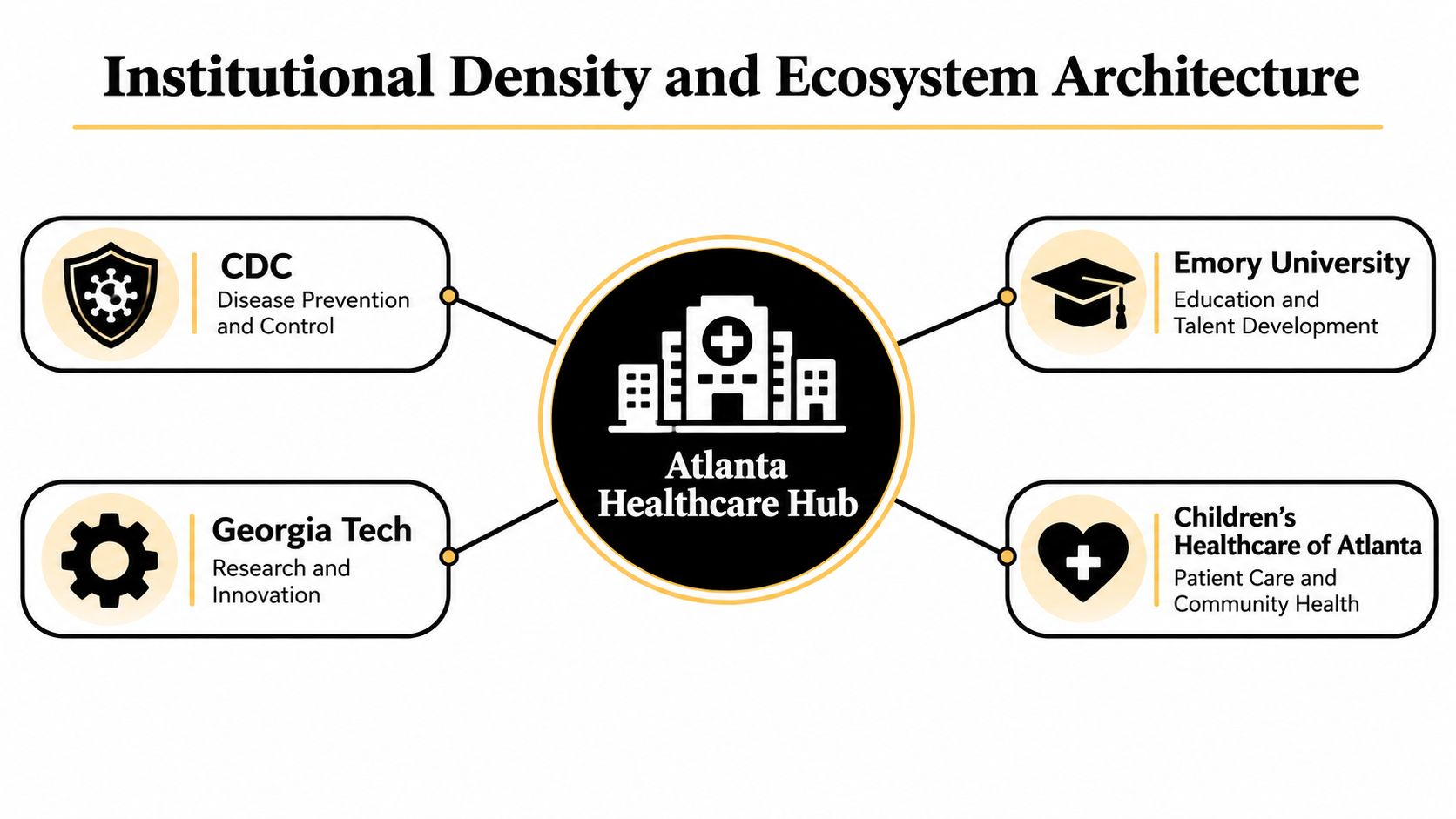
Atlanta's advantage isn't just that it has healthcare institutions, it's that they sit close enough to create a usable innovation network. Georgia has 230 hospitals, 247,000+ healthcare practitioners and technical occupations, 225 health IT companies employing 30,000+ specialists, and 20+ startup hubs, incubators, accelerators, and coworking spaces that support innovation (AltexSoft health IT overview). Metro Atlanta also has eight companies among Healthcare Informatics’ top 100 health IT vendors, with combined revenues of almost $5 billion, a useful proxy for the region's commercial depth.
Anchor institutions create the talent and validation layer
The city's ecosystem includes the CDC, two medical schools, Georgia Tech's biomedical engineering program, and major health systems like Emory Healthcare and Children's Healthcare of Atlanta. The Georgia Center for Medical Innovation has argued that these assets are on par with established hubs like Boston and the Bay Area, and that comparison makes sense when you look at how many organizations can support research, training, procurement, and clinical testing in one metro area (GCMI).
That density matters because healthcare innovation rarely fails for lack of ideas. It usually fails because teams can't access clinicians, test sites, regulatory knowledge, or buyers quickly enough. Atlanta reduces those frictions by keeping talent, patients, and decision-makers close together.
A dense ecosystem doesn't guarantee better products. It does make bad ideas easier to kill early and viable ideas easier to validate.
Why proximity changes commercialization math
Atlanta's institutional architecture creates multiple entry points for innovators. A startup can begin with university research, move into a hospital pilot, and then meet enterprise buyers without leaving the region. That's a structural advantage because each handoff, from lab to clinic to procurement, gets simpler when the partners already know one another.
The local network also raises the quality of competition. Providers can compare vendors against each other, against in-house teams, and against research partners, which tends to push product maturity higher. For health technology leaders, that means Atlanta is not merely a place to source innovation, it's a place to pressure-test whether innovation is operationally real.
The institutional map is visible in local innovation corridors as well, including Atlanta Tech Village, where cross-sector startup activity helps connect healthcare ideas with broader commercial support. In practice, that kind of adjacency matters because health tech doesn't scale on science alone. It scales when science sits next to engineering, product, legal, and capital.
Translational Infrastructure Moving Research to Market

Georgia Tech's Medical Innovation Hub sits at the intersection of engineering, bioscience, and medicine, with a mandate to move faculty research into deployable solutions in diagnostics, therapeutics, and medical devices, including work in wearable sensors and AI-driven diagnostics (Georgia Tech Medical Innovation Hub). For health system executives, the significance is practical. Too many programs produce credible prototypes but never clear the gap to clinical validation, procurement review, or routine use.
Georgia Tech's Medical Innovation Hub and Science Square
The 2025 expansion of Georgia Tech and Emory into Science Square adds another layer of translational capacity. Seven medical and biomedical labs are moving into the district, which concentrates research density and makes shared instrumentation, cross-disciplinary staffing, and faster iteration more realistic. The district also creates a clearer path for teams that need to move from bench work to clinical conversations without losing momentum. For leaders assessing where Atlanta's innovation story is real, this is one of the stronger signals.
The operational value is in the coordination costs it reduces. Engineers can get clinical feedback sooner, clinicians can shape design earlier, and commercialization staff can identify regulatory or manufacturing issues before they become expensive delays. For startups, that can mean better evidence and cleaner diligence. For hospitals, it can mean fewer pilots that stall after initial enthusiasm.
Why co-location matters to operators
Metro regions that integrate research districts usually generate more patentable biomedical IP and faster startup formation than fragmented markets because every transaction takes less time and effort. That same logic applies to hospital systems deciding whether to participate in pilots. A shorter feedback loop gives the system more room to learn, compare vendors, and reduce implementation risk before committing scarce clinical resources.
The more important question is whether that infrastructure produces funded companies and adopted workflows, not just visible buildings. Atlanta has the ingredients to move research into market, but the commercial path still depends on capital, regulatory planning, and the ability to win internal champions inside health systems. Startup teams that want to convert lab activity into a company formation strategy often need to find Georgia business planning counsel early, because compliance and entity structure shape how fast a pilot can become a contract.
For IT and innovation leaders, translational infrastructure should be treated as part of the procurement environment. Lab space, clinical adjacency, and commercialization support influence which vendors survive long enough to become enterprise-grade. Atlanta startup funding trends every entrepreneur should know helps explain why that middle layer matters, since a city with research but weak financing tends to produce announcements, while a city with research, capital, and operator access produces companies.
5G Testbeds and Next-Generation Clinical Infrastructure
Emory Healthcare and Verizon launched the nation's first 5G healthcare innovation lab in Sandy Springs, using Verizon 5G Ultra Wideband and mobile edge computing to support connected ambulances, robotic-assisted surgery, remote physical therapy, next-generation medical imaging, AR/VR training, telemedicine, and remote patient monitoring (Emory Healthcare innovation hub). The point is not that 5G is faster. The point is that high bandwidth, ultra-low latency, and edge processing make some clinical workflows possible in real time.
What low-latency healthcare really enables
Some applications can tolerate delays. Others can't. Point-of-care imaging from ambulance to ER, remote device control, and other time-sensitive workflows need network behavior that older Wi‑Fi or 4G architectures can't reliably support at scale. That's why Atlanta matters to IT leaders. It's becoming a live test environment for clinical IoT and telehealth architectures before broader rollout.
Operational insight: If a workflow depends on near-instant device response, network design becomes a clinical issue, not just an IT issue.
That changes how hospitals should evaluate vendors. The right question isn't only whether a tool works in a demo. It's whether it performs under network conditions, device loads, and latency constraints that mirror actual care delivery. Atlanta's 5G healthcare lab gives regional providers a place to test those assumptions in a more realistic environment.
Procurement signals for IT leaders
The existence of a 5G healthcare testbed suggests where procurement cycles may go next. Hospitals will likely keep looking for solutions that integrate device telemetry, remote monitoring, mobility, and edge compute, because those are the categories that benefit from the underlying network model. The result is a more demanding standards environment for vendors and a more technical evaluation process for buyers.
For organizations planning infrastructure refreshes, the implication is clear. Network, device, and application decisions can't be separated as cleanly as they once were. Atlanta's testbed environment is teaching that lesson in public, and vendors that can't handle it will struggle when they move from pilot to production.
A useful planning resource for organizations building that kind of program is find Georgia business planning counsel, especially when new deployments touch governance, contracting, and operational risk. The legal and technical sides of healthcare infrastructure are moving together now, not separately.
Telecom services in Atlanta sit in the background of these decisions because next-generation clinical workflows depend on the network underneath them. In Atlanta, the network is becoming part of the care model.
The Equity Gap in Healthcare Innovation Access
The sharpest test of Atlanta's healthcare innovation boom is whether it reaches South and West Atlanta. Recent reporting says neighborhoods such as West End, East Point, Collier Heights, and Lakewood still lack access to medical facilities, specialty physicians, hospitals, and dental care (Rough Draft Atlanta). That leaves the city's innovation narrative incomplete if it celebrates Midtown's density while people in other parts of the city still travel farther for basic care.
Innovation districts versus neighborhood access
Midtown district-building can look impressive on paper while leaving access gaps in place. As reported earlier, Project Robin's proposed $800 million expansion and a separate $1.35 million mobile-clinic launch show the scale of the access problem, even as public and institutional leaders try to reverse systemic disinvestment. The issue for executives is straightforward. Innovation is happening downtown, but the measure that matters is whether it changes care delivery in neighborhoods that have been underserved for years.
Access should be part of the design brief, not an afterthought. If new hubs do not reduce travel time, improve emergency coverage, or bring specialty services closer to patients, then the ecosystem is still concentrating value where it is already easiest to create.
Why access should be part of the KPI set
Hospital systems, investors, and civic leaders should ask a simple question of every innovation initiative. Who benefits, and how quickly? If the answer centers only on research prestige or mixed-use development, the project may still have value, but it is not solving the full healthcare problem.
Good metric: Track whether innovation projects change the patient journey, not just the skyline.
Atlanta's healthcare future will be judged in neighborhoods as much as in conference rooms. If access does not improve, the region risks building a world-class innovation district around a still-uneven care map. That gap will determine whether the hub story becomes durable or stays mostly aspirational.
Building a Real Commercialization Pipeline
Atlanta's healthcare story gets too much credit for announcements and not enough scrutiny on outcomes. Coverage has noted that the city historically lacked specialized lab space, industry-specific venture capital, and collaboration infrastructure for R&D-heavy startups, even as Science Square, the Global Health Innovation District, and Emory-linked programs expand (Hypepotamus). That's why the right test of hub status is not visibility. It's whether research becomes funded companies, clinical adoption, and durable jobs.
District launches are not the same as outcomes
The Center for Global Health Innovation's Midtown district launch in a 47-story tower added innovation center, collaborative office, and lab space across four floors, plus 75,000 square feet in an adjacent building as a conference center. It was backed by a coalition of 60 Atlanta global health leaders and 200 community volunteers, which makes it a serious institutional project rather than a loose branding effort (CGHI district launch).
Emory Healthcare's Innovation Hub, launched in 2018 as a 10,000-square-foot program in Executive Park, later added partners including Konica Minolta Healthcare, Novo Nordisk, Philips, and Stryker, showing that large operators do see value in keeping innovation close to clinical systems (Metro Atlanta Chamber corporate innovation centers). That said, partnership announcements still don't answer the harder question of how many pilots become procurement contracts.
What executives should measure instead
The metrics that matter are not glamorous. They're startup formation, grant capture, licensing, pilot conversion, and the number of ideas that move from pilot to procurement. If a district can't show movement on those measures, it's still just real estate with a mission statement.
A practical scorecard for healthcare leaders would include:
- Clinical adoption: whether a tool survives beyond one pilot site.
- Funding follow-through: whether companies can raise enough capital to keep building.
- Operational purchase: whether hospitals commit to actual procurement, not perpetual trials.
- Talent retention: whether researchers, clinicians, and builders stay in the region.
Atlanta has the raw ingredients for a commercialization pipeline. The open question is whether the city turns those ingredients into repeatable throughput. That's where the hub claim either becomes durable or starts to fade.
IT Asset Disposition and Compliance for Healthcare Organizations
Healthcare innovation has a hidden operational consequence. Every new imaging workflow, monitoring platform, AI tool, or network upgrade leaves older equipment behind, and that equipment has to be retired securely. For IT directors and facility managers, the risk isn't only storage clutter. It's exposure from sensitive data, chain-of-custody gaps, and noncompliant disposal processes.
A practical disposition process starts with inventory, then data destruction, then documented handoff. Certificates of recycling and data destruction matter because they transfer liability and create an audit trail, which is exactly what healthcare organizations need when legacy laptops, servers, networking gear, or diagnostic equipment leave the active environment. That process aligns well with healthcare privacy and disposal expectations, and it should be built into the refresh plan before the new system goes live.
Operational rule: Don't wait until decommission week to decide how sensitive assets will be wiped, packed, tracked, and reported.
Healthcare teams should also separate two workstreams. One is technical retirement, which covers hard drive shredding, certified data wiping, and device remarketing where appropriate. The other is compliance tracking, which documents who handled the asset, when it left the site, and where it went. For organizations managing regulated inventories, compliance tracking for distributors is a useful reference point for how documented workflows reduce blind spots.
Atlanta providers, research institutions, and data-heavy operations often need more than a simple pickup. They need scheduled de-installations, secure transport, and environmentally responsible downstream processing for equipment that still contains sensitive information or components that require specialized handling. That's where structured ITAD programs fit into the healthcare innovation lifecycle. Beyond Surplus's HIPAA-compliant ITAD services in Georgia are one example of the kind of service model organizations can use when they need secure disposal, value recovery, and documentation in the same workflow.
If your organization is upgrading clinical networks, refreshing endpoint fleets, or decommissioning legacy equipment in step with Atlanta's healthcare innovation cycle, talk to a disposal partner that can handle both security and logistics. Visit Beyond Surplus to review certified electronics recycling, secure IT asset disposition, and healthcare-ready data destruction options for your next project.


