

Every Atlanta IT director I know has lived this scene. A cloud project starts as a clean modernization move, then the old servers, storage arrays, laptops, and backup devices all come due at once, and suddenly the workload is retirement, data destruction, and compliance paperwork. Cloud computing trends for Atlanta businesses in 2026 aren't just about where apps run, they're about how you keep control when the hardware underneath those apps starts aging out.
Atlanta makes that problem harder, not easier. Cloud adoption is already mainstream here, with 68% of Georgia businesses using cloud services and nearly 70% integrating cloud solutions overall, while Atlanta surveys show over 78% of businesses have already implemented cloud or plan to within 12 months, and 40% of small businesses still haven't adopted cloud accounting software, so the market is mature but uneven. That means a lot of local IT teams are moving workloads faster than they're planning the exit path for the boxes those workloads leave behind.
Table of Contents
- Why Atlanta IT Leaders Are Rethinking Cloud Right Now
- Atlanta's Cloud and Data-Center Backdrop
- Hybrid, Multi-Cloud, and Edge Architecture Choices
- AI Workloads, Serverless, and FinOps as One Cost Story
- Where Cloud Strategy Meets End-of-Life Hardware
- Sustainability, Zero Trust, and Compliance for Regulated Buyers
- Designing for Exit Before You Design for Entry
- A 30-60-90 Day Plan for Atlanta Cloud and ITAD Decisions
Why Atlanta IT Leaders Are Rethinking Cloud Right Now
A hospital IT director in the metro does not worry about cloud in the abstract. She worries about the imaging archive split across two environments, the retired storage shelves sitting in the loading dock, and the compliance memo asking who signed off on chain-of-custody. That is the practical shape of Cloud Computing Trends for Atlanta Businesses in 2026, and it is why the old lift-and-shift mindset feels stale.
The playbook changed
A few years ago, too many teams treated cloud as a migration project with a finish line. Move the workload, shut down the rack, and call it modernization. That worked until the local environment got more complicated, more regulated, and more expensive to ignore.
Atlanta's enterprise base is now operating inside a broader cloud market where analysts at Bain found public cloud spending continuing to take a larger share of IT budgets, while Georgia's own adoption story, including the widely cited 68% of businesses using cloud services, shows how far the shift has already gone. That is the backdrop for any Atlanta IT leader pretending cloud is still a fringe modernization topic. It is not.
Practical rule: If a cloud project does not include retirement, data destruction, and offboarding, it is not finished.
That is why 2026 feels different from 2022 or 2024. Atlanta buyers are no longer asking whether to adopt cloud, they are deciding where to place workloads, how to avoid lock-in, and how to retire assets without creating security or compliance exposure. The decision set is wider too, hybrid, multi-cloud, edge, AI, serverless, sustainability, compliance, and end-of-life all sit in the same stack now. If you are mapping that stack in Atlanta, start with the city's data-center strength and the physical reality behind it, as outlined in this overview of Atlanta's data-center hub status.
Atlanta's Cloud and Data-Center Backdrop
Atlanta is a market where cloud decisions run into power, interconnection, and retirement logistics fast. If you are running IT here, you are not just buying compute, you are planning around constrained facilities, dense network routes, and the cost of getting old gear out of circulation without creating a security problem.
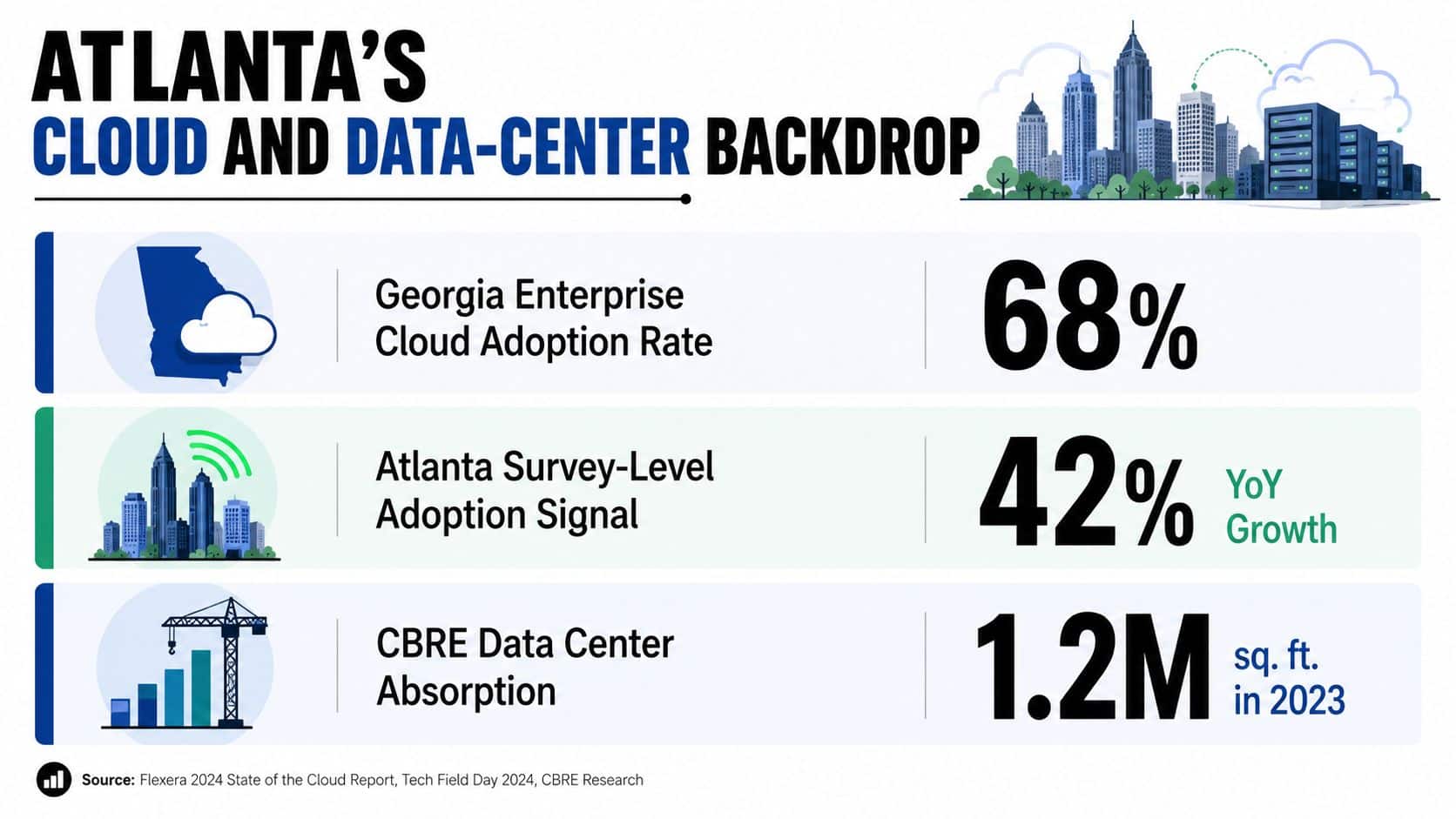
The state's cloud usage is already mainstream, and the local market has the scale to prove it. A 2026 estimate puts 68% of businesses in Georgia using cloud services and nearly 70% integrating cloud solutions overall. Georgia's cloud sector has also drawn over $450 million in investments and generates about $320 million in revenue. That is the backdrop for Atlanta IT leaders who still treat cloud as a side project. It is the operating environment now, and the asset retirement plan has to sit beside it from the start.
CBRE's Atlanta data-center figures make the physical pressure obvious. The market ended 2025 with 1,459.2 MW of total inventory, up 458.8 MW year over year, recorded 456 MW of net absorption, and sat at just 2% vacancy. That combination points to a tight market for power and space. It affects pricing, redundancy planning, refresh timing, and how quickly retired equipment can leave a site before it becomes a storage and exposure problem.
Digital Realty's Atlanta coverage adds another layer. The city supports subsea cable landings and one of the largest inland network ecosystems in the Southeast, which is why low-latency connectivity and regional redundancy keep coming up in architecture reviews. If your operation is in healthcare, finance, government, or logistics, the cloud decision is tied to proximity, resiliency, and physical capacity, not just monthly spend. That is also why device retirement matters here. Cloud migration often leaves a trail of servers, storage arrays, and edge gear that still need verified data destruction and documented offboarding, and teams that ignore that step create avoidable risk. The same discipline applies when field devices are part of the picture, which is where the Evright Industrial device guide is relevant for identifying what should be retired, reassigned, or destroyed.
Atlanta's data-center base is strong for a reason, and this overview of Atlanta's data-center hub status explains the market forces behind it. For local IT leaders, the practical question is simple. Keep enough optionality for the next refresh cycle, and make sure cloud exit, hardware retirement, and destruction are already part of the plan.
Hybrid, Multi-Cloud, and Edge Architecture Choices
I do not buy the idea that every workload belongs in one cloud model. Atlanta IT teams get better results when they place each system where the economics, risk, and operational burden fit, then write that decision down so the architecture does not turn into folklore. That is why hybrid and multi-cloud keep winning, and why edge keeps showing up in real architecture reviews.
Match the workload to the place it belongs
A regional bank's disaster recovery stack does not belong in the same bucket as a marketing site. A hospital's imaging workflow has different latency and compliance requirements than a manufacturer's plant-floor telemetry. Treat those as interchangeable and you will overpay somewhere, then leave a gap somewhere else.
Here is the placement matrix I would use with Atlanta teams.
| Architecture | Best-fit Atlanta workload | Cost pattern | Compliance posture |
|---|---|---|---|
| Public cloud | Customer-facing apps, analytics, bursty workloads | Variable, usage-driven | Strong if policy is disciplined |
| Private cloud | Sensitive datasets, controlled environments, regulated workloads | Higher fixed base | Easier to tailor |
| Hybrid cloud | Core systems plus cloud-native services | Mixed, often the most balanced | Good for phased governance |
| Multi-cloud | Resilience, bargaining power, vendor diversification | More complex to run | Useful when control matters |
| Edge | Plant-floor telemetry, imaging, local inference | Distributed and selective | Helpful for latency and locality |
For device-heavy environments, the asset-identification discipline described in the Evright Industrial device guide is a useful reminder that edge only works if you know exactly what is deployed, where it lives, and who owns it.
Portability starts with classification. If you cannot name the workload, the data class, and the recovery target, you cannot place it correctly.
The practical point is simple. Cloud-first is too blunt for Atlanta's mix of regulated sectors and distributed operations. Hybrid keeps the core steady, multi-cloud keeps vendors honest, and edge handles the cases where delay or locality matters more than centralization. For a tighter Atlanta-specific look at deployment trade-offs, see Beyond Surplus's colocation vs cloud analysis.
AI Workloads, Serverless, and FinOps as One Cost Story
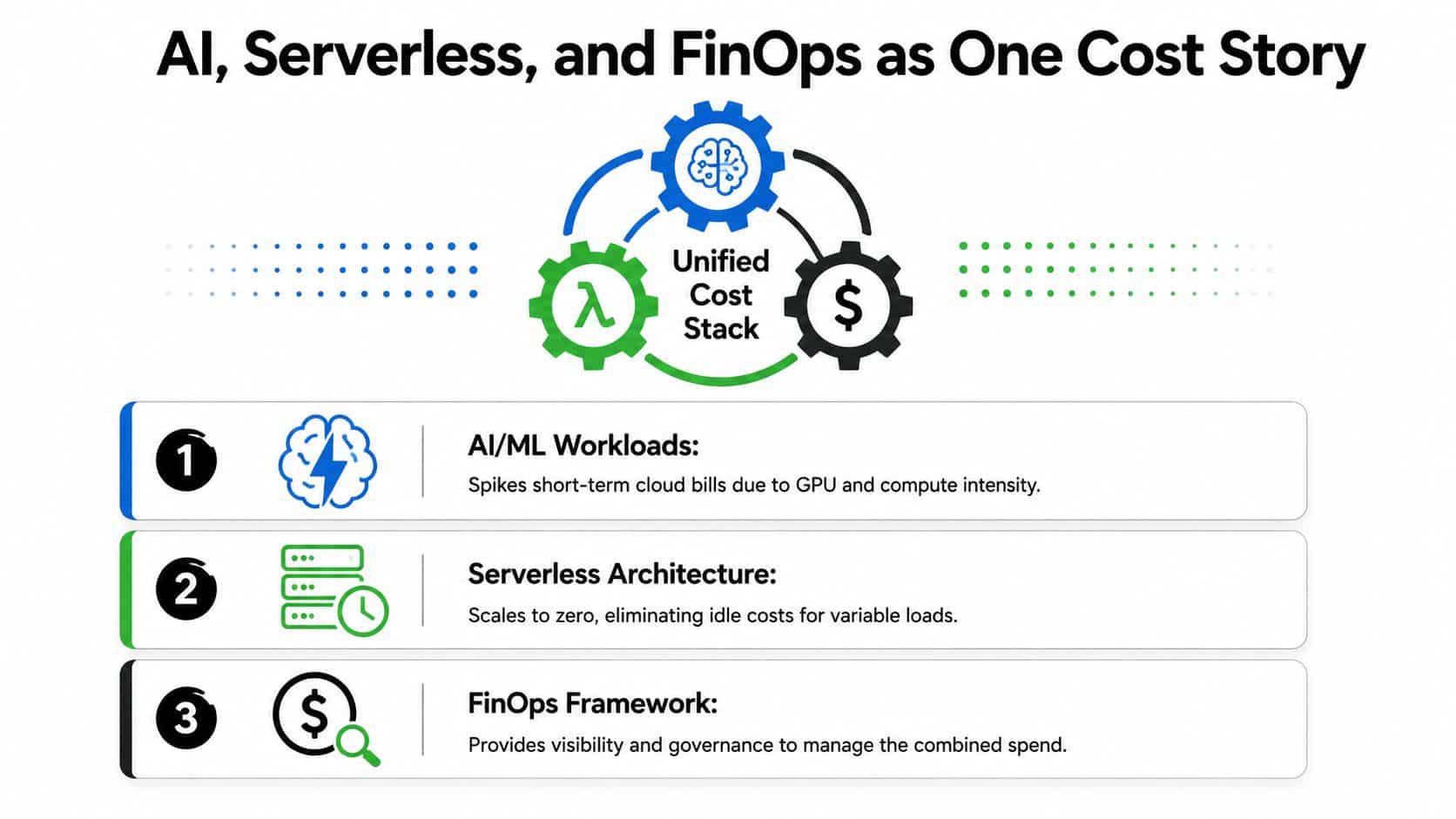
AI, serverless, and FinOps get discussed like separate trends. They're not. They're one cost-control system, and Atlanta teams that miss that link will spend too much, too fast, and with too little visibility.
Treat AI as a spend accelerator
Forrester's 2026 cloud outlook says AI infrastructure will materially raise short-term cloud costs and operational complexity, and that's exactly how it manifests. AI and ML workloads pull on compute hard, especially where GPU demand and data movement stack up. If your finance team still expects cloud spend to behave like last quarter, the budget will blow up in a hurry. See Forrester's 2026 cloud predictions for the broader pattern around AI-driven cloud pressure.
Serverless helps, but only in the right places. It's a strong fit for bursty internal apps and variable demand, not for steady data pipelines that run all day and all night. Too many teams force a serverless pattern onto workloads that want predictability, then act surprised when the spend curve looks strange.
Put FinOps controls in first
Flexera's 2024 State of the Cloud Report points to cloud complexity pushing organizations toward managed service providers and dedicated FinOps teams, because spend governance is no longer optional. Atlanta leaders should start with a tight control set:
- Tagging discipline: Tie every workload to an owner, cost center, and environment.
- Commitment review: Audit reserved capacity and savings plans before renewals roll over.
- Rightsizing cadence: Trim idle instances and abandoned storage on a fixed schedule.
- Alerting thresholds: Trigger action before cloud cost becomes a finance surprise.
- Region resilience review: Avoid concentrating critical workloads in a single hyperscaler region or service.
That last point matters in a market where CBRE says Atlanta vacancy is just 2%. Capacity pressure and AI growth together make overdependence a bad bet. A resilient cost model isn't just about lowering bills, it's about keeping performance predictable when demand spikes or an upstream service wobbles.
Where Cloud Strategy Meets End-of-Life Hardware
Cloud migration does not end the asset lifecycle. It speeds it up. That's the part too many Atlanta teams under-plan, then scramble when the old gear still sitting in a cage needs to be wiped, hauled, and documented.
Retirement gets more complicated after migration
When a workload leaves an on-prem server, three things happen fast. The hardware loses value, the data on it still matters, and someone has to prove it was handled correctly. That turns a simple decommission into an ITAD event, and it's where data destruction, chain-of-custody, and logistics stop being back-office chores and become risk controls.
For Atlanta businesses, secure hard-drive shredding, certified data wiping, and documented equipment disposition belong in the cloud plan, not after it. A move to Azure, AWS, or colocation can create more retirement events in a shorter window, especially when storage refreshes, endpoint swaps, and data-center de-installs all pile up together. The operational burden rises, even if the footprint shrinks.
The Beyond Surplus server recycling guide for Georgia businesses fits this reality because server retirement is now part of cloud execution, not a separate cleanup project. Beyond that, the issue is bigger than servers. Every migration changes what gets wiped, what gets repurposed, and what must be destroyed.
If your cloud project doesn't map retired assets to disposal certificates, you haven't closed the loop.
That's the mindset I want Atlanta procurement teams to adopt. A cloud-first plan still needs a retirement-first companion plan. Otherwise, the old equipment sits around longer than it should, exposure lingers, and the compliance file is incomplete.
Sustainability, Zero Trust, and Compliance for Regulated Buyers
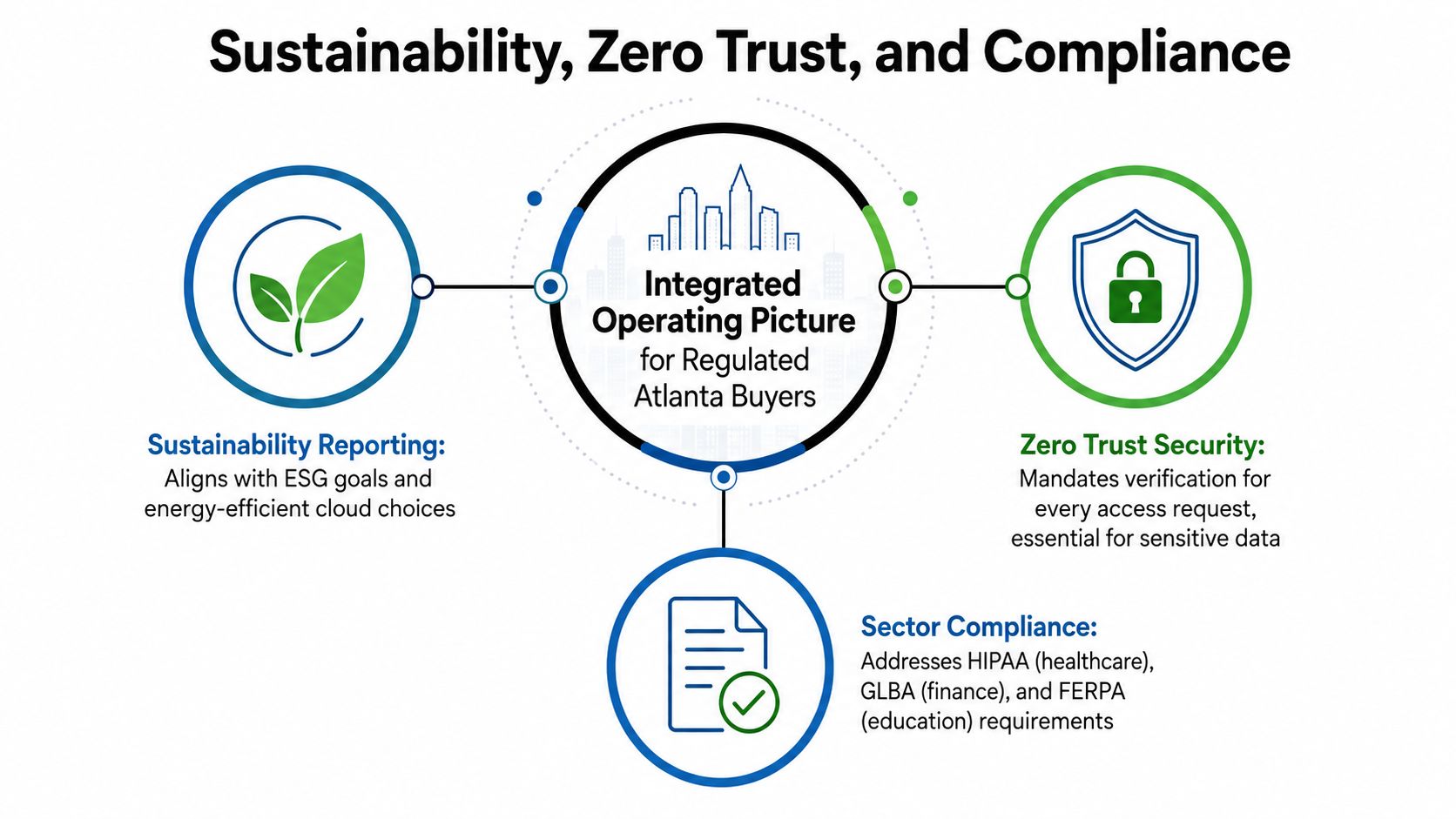
Regulated Atlanta buyers keep getting pushed into the same conversation from three directions at once. Security wants zero trust. Leadership wants sustainability reporting. Compliance wants proof. Those pressures overlap more than most slide decks admit.
Documentation is the bridge
If you're in healthcare, finance, education, or government, sustainability claims can't be hand-wavy anymore. They need downstream evidence, especially when retired hardware leaves the building. That's where certified ITAD vendors become strategic, because chain-of-custody records and destruction certificates turn disposal into auditable documentation instead of a vague promise.
The Beyond Surplus ESG overview for Atlanta is relevant here because the cloud story doesn't end with efficient workloads, it extends to what happens when equipment is retired. If the documentation trail is weak, the sustainability story is weak too.
Zero trust should shape the cloud design
Zero trust isn't a slogan. It means verifying every access request, segmenting privileges, and limiting lateral movement so a compromised credential doesn't become a broad breach. NetSuite's 2026 cloud-trends overview also places zero trust, cloud-based disaster recovery, and AI/ML integration among the major strategy categories shaping enterprise cloud decisions. That combination is exactly why cloud architecture, security policy, and ITAD workflow need to be aligned instead of managed in separate silos.
For Atlanta's regulated buyers, the practical controls are boring but necessary. Identity governance, access reviews, encryption policy, and verified disposal records matter more than splashy vendor claims. If the auditors show up, nobody cares how elegant your architecture diagram was.
Designing for Exit Before You Design for Entry
Portability is not an abstract insurance policy. It's an advantage. In Atlanta, where infrastructure is in demand and options can tighten quickly, the ability to move workloads is a negotiation asset, not a theoretical nice-to-have.
Build the escape route early
Most lock-in happens in the identity layer, the data egress path, and the policy stack. That's where the switching costs live. If you standardize those pieces early, you keep your options open without turning every app into a science project.
Use these portability moves first:
- Adopt multi-cloud or hybrid patterns early so one provider doesn't control your roadmap.
- Containerize what can move, because packaging apps cleanly makes migration far less painful.
- Use cloud-agnostic infrastructure as code so deployments can be repeated elsewhere.
- Document workload mobility so the business can act when pricing, compliance, or service quality changes.
The Beyond Surplus page on Atlanta cloud and data-center trends is a useful reminder that local market conditions affect bargaining power. The tighter the market, the more valuable it is to keep exit options alive.
Portability pays back fastest where the business feels pain first, not where the architecture diagram looks prettiest.
That means data egress, identity, and shared services deserve the most attention. If you get those right, the rest of the stack gets easier to move when the time comes.
A 30-60-90 Day Plan for Atlanta Cloud and ITAD Decisions
Start with inventory. In the first 30 days, list every workload, map the retired hardware tied to it, and schedule pickups or drop-offs with a certified ITAD partner. In days 31 to 60, review hybrid, multi-cloud, and edge placement, then put FinOps controls around the spend. By days 61 to 90, lock in portability, exit planning, and reporting for sustainability and compliance. If you need a straightforward way to retire equipment while your cloud plan matures, Beyond Surplus handles business IT asset disposition, secure data destruction, and electronics recycling.
If your Atlanta team is sorting out cloud migration, hardware retirement, or data destruction at the same time, stop treating those as separate projects. Visit Beyond Surplus to line up certified electronics recycling and secure IT asset disposal with the rest of your infrastructure plan.


