

Sustainability isn't a cost center when it's tied to operating decisions, it's a financial lever. The firms that embed it into strategy, execution, and measurement tend to hold up better over time, because they improve how capital gets used, how risk gets managed, and how growth gets funded. The core question isn't whether sustainability sounds good, it's whether leaders are willing to run it like any other core business discipline.
Table of Contents
- Why Sustainability Drives Financial Performance
- Running a Materiality Assessment to Find High-Value Levers
- Embedding Sustainability into IT and Data Center Operations
- Balancing Near-Term Costs Against Long-Term Value
- Measuring What Matters with Rigorous ESG Metrics
- Building Governance and Execution Systems That Last
Why Sustainability Drives Financial Performance
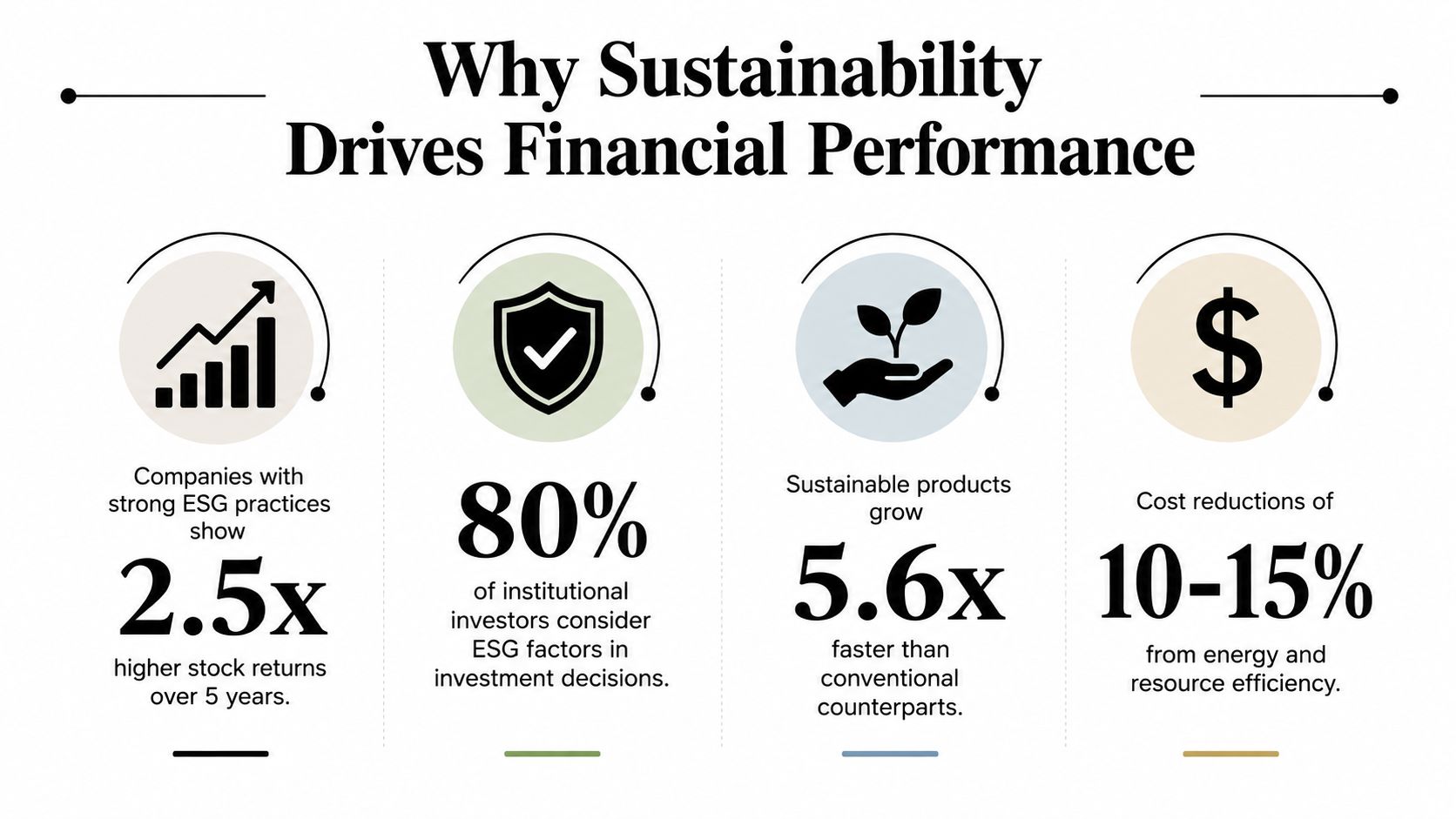
Sustainability improves financial performance when it is built into the operating model. A widely cited Harvard Business School analysis found that so-called high sustainability firms delivered 4.8% higher ROE and 2.1% higher ROA over an 18-year period than comparable firms that were less sustainability-focused, while an IBM-linked summary reported that businesses embedding sustainability across operations were 52% more likely to outperform competitors in profitability and had 16% higher revenue growth (Harvard Business School analysis summary).
That matters because boardrooms do not fund virtue, they fund durable returns. If sustainability lowers waste, reduces avoidable risk, and improves how teams allocate energy, materials, and time, then it shows up in EBITDA, cash conversion, and the quality of future growth. The mistake I see most often is treating sustainability as a side project with no line of sight to margin, asset utilization, or customer retention.
What CFOs should actually care about
The practical test is whether the initiative changes how the business earns, spends, or protects money. That includes energy intensity, procurement discipline, asset recovery, downtime avoidance, and the reputational cost of sloppy execution. In IT-heavy organizations, that also means understanding the environmental impact of electronic waste, because hardware refresh cycles, recovery rates, and disposal choices affect both cost and risk. Sustainability also intersects with culture, because cross-functional coordination gets easier when teams share a clear operating standard, much like the thinking behind fostering inclusive culture in business.
Practical rule: if a sustainability effort cannot be mapped to a financial line item, a risk category, or a performance metric, it is probably not ready for core-budget approval.
Long-term shareholder value is the point, not a slogan. McKinsey's work on sustainable growth found that only 25% of companies achieve sustainable growth over time, but those that do are rewarded with about 7 percentage points more annual TSR than peers, and adding ESG integration lifts the outperformance to 7 points (McKinsey). In practice, the strongest business case is not “we should be greener.” It is “we should use sustainability to build a sturdier growth model.”
Running a Materiality Assessment to Find High-Value Levers
The fastest way to waste money on sustainability is to fund everything. The better way is to identify the few issues that matter to your business, then connect them to measurable value. McKinsey's value-creation approach starts with a materiality assessment, peer benchmarking, identification of a small set of high-value levers, and quantification of both offense and defense (McKinsey).
Start with the business, not the banner
Materiality works when teams ask, “Where do we create value, and where are we exposed?” For an IT-heavy organization, that might mean data center energy use, end-of-life hardware recovery, supplier risk, or secure destruction of obsolete devices. For a manufacturer, the pressure points may look different, but the logic is the same. You don't start with a generic ESG checklist, you start with the value chain.
A useful pattern is to sort each issue into two buckets:
- Offense levers, such as new sustainable products, growth premiums on existing offers, resource-efficiency gains, and employee productivity or morale.
- Defense levers, such as reduced market decline, lower regulatory exposure, and less reputational damage.
The point isn't to create a perfect taxonomy. The point is to stop treating sustainability as one blob of activity with no financial baseline.
Benchmark ambition against peers
McKinsey's guidance also stresses comparing metrics like energy, water, and emissions against peers, then setting a real ambition level rather than a vague “do better” target (McKinsey). That's where many programs stall. Leaders approve broad goals, but nobody defines what top quartile means for a specific facility, product line, or asset class.
A materiality review should end with a short list, not a mood board.
For a business with large electronics turnover, asset disposition planning becomes strategic. You might decide that reuse, refurbishment, and resale matter more than broad recycling campaigns because the economics are better and the operational risk is lower. In Georgia and other operational hubs, that kind of prioritization is exactly where a service like Beyond Surplus's ESG recycling partner page can fit into a broader execution plan, not as a slogan, but as a disposal and recovery workflow.
The strongest materiality process is blunt. It identifies the few levers that matter, sets a business case for each one, and ignores the rest until the numbers justify attention.
Embedding Sustainability into IT and Data Center Operations
IT and data center leaders need a tighter operating model, not a new slogan. Sustainability starts paying off when procurement, refresh cycles, decommissioning, and data destruction are managed through one workflow. That is where value recovery, risk control, and waste reduction start working together instead of competing for attention.
Make disposition part of the lifecycle
The default mistake is waiting until a device is obsolete, then scrambling for a disposal path. A better model starts at purchase. Procurement should ask whether the equipment can be refurbished, resold, or harvested for parts later, because the end-of-life plan affects the total cost of ownership long before retirement day arrives.
That same logic applies in data centers. Decommissioning is a coordinated sequence, not a teardown job. It includes inventory validation, media handling, chain-of-custody records, and asset routing. Organizations that treat those steps as part of standard project management usually avoid the mess that comes from ad hoc storage rooms full of untracked hardware.
Secure destruction and circular recovery belong together
Secure data destruction and circular IT practices can sit in the same program without conflict. Teams separate reusable hardware from devices that need physical destruction, then document each path properly. The security side supports compliance, while refurbishment and component recovery can extend useful life and reduce the volume sent downstream.
A practical example is predictive maintenance, where operators use monitoring to decide what should be repaired, replaced, or retired. The discipline behind DUCHENG Industrial on predictive maintenance applies here, because the same kind of tracking helps facilities avoid premature replacement and plan disposition more cleanly.
Good ITAD functions as a controlled handoff between security, operations, and finance.
That handoff should also live inside the disposal workflow itself. For organizations that need outside support, Beyond Surplus's data center ITAD service is one example of how secure processing, equipment recovery, and logistics coordination can be tied together. The vendor is not the point. The operating model is. Sustainable IT work gets better results when disposition, security, and reuse are governed as one process.
Balancing Near-Term Costs Against Long-Term Value
The toughest objection is usually the right one. A sustainability project can raise near-term cost, add coordination work, or slow a rollout while teams learn a new process. That doesn't make the project wrong. It means the business case has to be honest about timing.
Run two timelines at once
One timeline captures this quarter's pressure. The other captures the multi-year value. Leaders who collapse those timelines into one spreadsheet often kill promising initiatives too early, because they judge a structural improvement by a short-term expense spike. Better operators accept that some benefits land later, then manage the bridge with clear milestones.
A strong approach is to use scenario planning with explicit A/B/C pathways, triggers, thresholds, and quarterly reviews, which is consistent with the sustainable-growth guidance from Seeking Succession. That same source recommends evaluating growth with EBITDA as a cash-earnings proxy and keeping two-deep coverage for critical roles, which matters because execution risk can erase the value of a good idea if too few people know how to run it.
Put the project inside capital allocation
The biggest mistake is ring-fencing sustainability as if it were separate from normal business decisions. It should sit inside the same investment committee, the same procurement review, and the same operating cadence as any other capex or process change. That forces trade-offs into the open, which is uncomfortable but useful.
A facility upgrade that reduces energy use may also require temporary downtime or higher upfront expense. A hardware recovery process may extend the life of some assets while slowing a refresh cycle. Those trade-offs are real, and leadership needs to decide whether the net effect supports the company's longer-term margin, resilience, and service levels. For a practical parallel on timing and replacement decisions, the logic in AC repair vs replacement is similar, because the cheapest short-term choice isn't always the smartest lifecycle choice.
If the quarter looks worse but the operating model gets stronger, the real question is whether management can explain that trade honestly.
That's the level of candor stakeholders respect. Not every initiative should survive the filter, but the ones that do should be funded as business decisions, not moral gestures.
Measuring What Matters with Rigorous ESG Metrics
Measurement is where most sustainability programs either become part of day-to-day management or slide into reporting theater. If the metrics are not decision-useful, comparable, and tied to material risk, they turn into decoration. Strong measurement makes the business easier to run because it shows managers where waste, exposure, and value recovery are happening.
Use standards, not improvisation
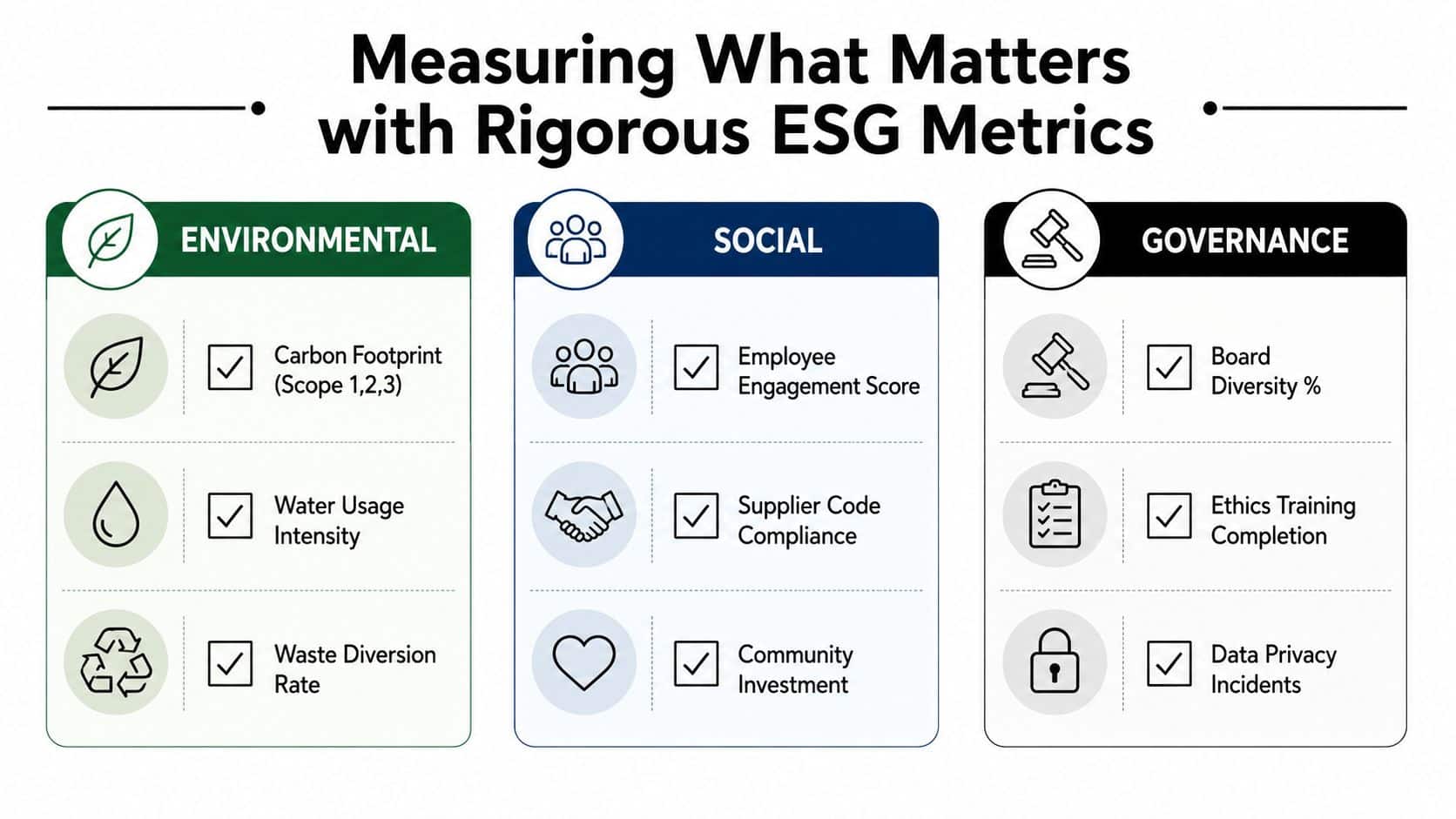
The best starting point is to anchor reporting in standardized frameworks such as GRI and SASB, then combine financial, environmental, and social indicators into one dashboard. That does not mean every team tracks everything. It means the organization uses a common language for the measures that matter most.
In IT-heavy operations, a few indicators deserve special attention:
- Waste diversion rate, because it shows whether equipment is being reused, recovered, or responsibly processed.
- Asset recovery value, because it connects disposition to financial return.
- Data center energy efficiency, because it reveals whether operating improvements are sticking.
The recent business literature also points to better data quality, material-risk analysis, and the use of tools like AI, blockchain, and IoT for real-time monitoring, especially where manual tracking is weak (Mandala Nursa journal article). The useful part is not the buzzwords. It is the discipline of making the data harder to fake and easier to act on.
For teams working through adoption and peer benchmarking, how Georgia businesses are meeting ESG goals shows how local execution can translate broad ESG aims into practical operating choices.
Build a dashboard that leaders can use
A reporting package should answer three questions. What changed? Why did it change? What did the business do next? If a metric cannot support those questions, it is probably not decision-grade.
That is where tighter governance around chain-of-custody records, vendor documentation, and asset movements becomes more than an audit concern. It directly affects whether leaders can trust the numbers enough to use them in capital planning, procurement, and disposition decisions.
The dashboard should also carry the right level of detail for different audiences. Finance needs to see cost, recovery, and avoided spend. Operations needs to see process losses, utilization, and exceptions. Leadership needs one view that ties those pieces together without hiding the trade-offs.
For business audiences, the test is simple. If the dashboard helps you decide whether to repair, recover, redeploy, or retire an asset, it is useful. If it only helps you publish a nicer report, it is not.
Building Governance and Execution Systems That Last
Sustainable growth survives when the organization can run it without heroics. That means governance, roles, review cycles, and accountability need to be built into the operating rhythm. The 2023 MIT Sloan review identified eight evidence-based factors that support sustainable business practices, including a practical sustainability vision, materiality prioritization, cross-functional embedding with KPIs, business-model innovation, a clear business case, board support, a shareholder value-creation story, and stakeholder collaboration (MIT Sloan Review).
Make the operating system visible
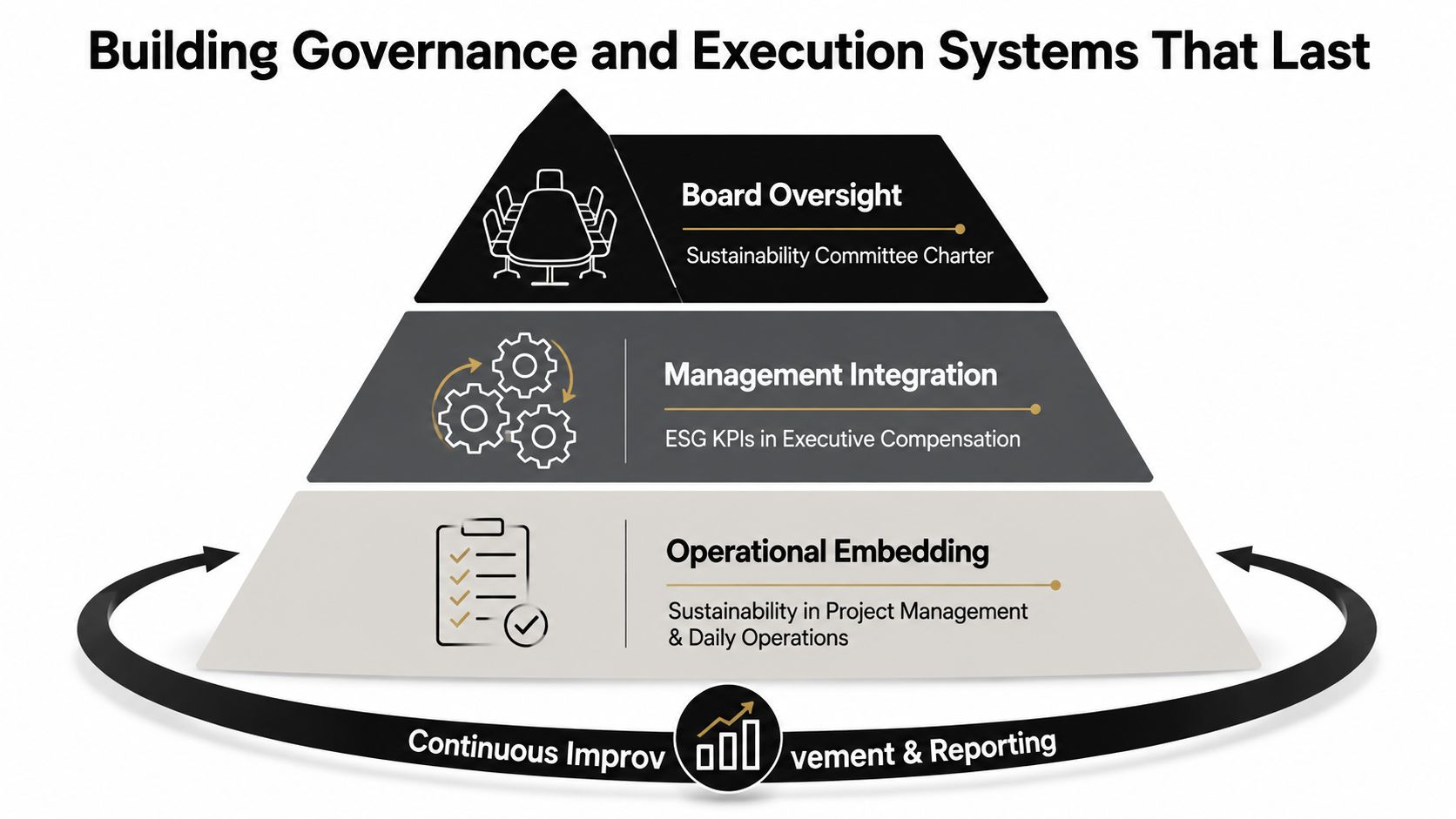
The best structures are boring in the right way. Board oversight sets direction. Management owns execution. Operations turns goals into daily tasks. If those layers don't talk to each other, sustainability turns into a reporting exercise nobody can steer.
Two-deep coverage matters here too. Critical sustainability roles should never sit with one person alone, because turnover, vacation, or workload spikes can stall the program. The same is true for quarterly reviews. A cadence only works when someone owns follow-up, escalation, and closure.
Tie execution to incentives and decision rights
The hardest part isn't writing a policy. It's deciding who can approve exceptions, who reviews supplier behavior, and whose KPIs include sustainability performance. That's where cross-functional teams earn their keep, because procurement, finance, operations, and compliance each see a different part of the risk.
A simple governance stack looks like this:
- Board oversight, which approves the sustainability charter and monitors material risks.
- Management integration, which ties ESG KPIs to executive scorecards and operating reviews.
- Operational embedding, which pushes sustainability into project management, asset disposition, and daily workflows.
A strong shareholder story helps the whole thing survive budget season. McKinsey's sustainable-growth work showed that companies that achieve sustainable growth earn about 7 percentage points more annual TSR than peers (McKinsey). That gives leaders a clear way to explain why sustainability belongs inside the growth narrative, not beside it.
Beyond Surplus helps businesses handle electronics recycling, secure IT asset disposition, data destruction, and value recovery with the chain-of-custody discipline this topic demands. If you need a practical partner for decommissioning, pickup, and compliant end-of-life processing, visit Beyond Surplus and start with the service that fits your operational schedule.


