

In the United States, the EPA recognizes two accredited electronics recycling standards, R2 and e-Stewards, and the strongest procurement programs begin with those frameworks. ISO certifications can strengthen a vendor's management system, but they don't replace an electronics-specific certification.
A procurement team usually asks this question after a technology refresh has already started. Decommissioned laptops are sitting in a storage room, a data center is being dismantled, or healthcare equipment is waiting for disposition. The immediate need is a vendor that can move the equipment, protect information, and produce evidence that will survive an internal audit.
That makes recycling certification a purchasing control, not a sustainability badge. The certificate should tell you which facility was audited, which standard and version apply, what services fall within scope, and how the provider controls downstream processing. The U.S. EPA reported that more than 550 U.S. electronics recycling facilities were certified to R2, e-Stewards, or both by December 2015, while SERI reported that R2 passed 1,000 certified facilities in July 2023. That progression shows how certification became a mainstream compliance benchmark, not a niche marketing credential. SERI's account of R2 reaching 1,000 certified facilities documents that development.
By the end of this guide, you'll know how to compare R2 and e-Stewards, decode the ISO references on a certificate, and run a practical vendor verification pass. You'll also have contract language and audit questions that turn a certificate into usable procurement evidence.
Table of Contents
- Why Your ITAD Partner's Certificate Matters More Than Their Sales Pitch
- What Recycling Certification Actually Requires
- R2 vs e-Stewards and Which One Fits Your Program
- How ISO Standards Connect to Recycling Certification
- Turning Certification into Procurement and Compliance Leverage
- Traps That Make a Certified Recycler Less Than They Seem
- A Practical Vetting Sequence for Certified ITAD Partners
Why Your ITAD Partner's Certificate Matters More Than Their Sales Pitch
A business doesn't need a vague promise of “green disposal.” It needs a defensible record for every device that leaves its control. That could mean a laptop fleet, network hardware from a data-center decommissioning, medical equipment from a clinical site, or laboratory instruments with embedded storage.
Without credible certification, the buyer carries more uncertainty. The recycler may use undocumented downstream processors, apply inconsistent data-destruction procedures, or lack records that demonstrate where equipment went. Those gaps can complicate an audit, weaken a company's ability to support responsible recycling claims, and increase reputational exposure if a device or component is mishandled.
The compliance issue is practical. Businesses must maintain reasonable procedures for disposing of sensitive consumer information under the FTC Disposal Rule. Healthcare, financial-services, payment-processing, and government organizations may also have contractual or regulatory expectations for documented handling, access control, and chain of custody. A pickup receipt alone won't answer those questions.
Treat the certificate as a gate
Start with the EPA's position that R2 and e-Stewards are the two accredited electronics-recycler certification standards in the United States. The EPA's certified electronics recycler guidance is the right starting point for procurement teams.
Use certification as a gate before comparing price, pickup speed, recovery value, or marketing claims. Ask for the actual certificate, not a logo. Then check:
- Issuing body: Identify the certification body and its accreditation.
- Facility: Match the physical processing site to the certificate.
- Scope: Confirm that the certificate covers the services you're buying.
- Version: Record the exact standard and version.
- Evidence: Require records tied to your equipment and each disposition event.
Procurement rule: If a vendor can't provide a current, site-specific certificate and explain its scope, the evaluation should stop.
Beyond Surplus publishes information on electronics recycling certification that can help business buyers frame this review. The important shift is simple: don't ask whether a company “cares about recycling.” Ask what an independent auditor has verified and what documents you'll receive.
What Recycling Certification Actually Requires
Recycling certification is an independently audited operating system for electronics processing. It requires more than a written environmental policy. A qualified certification body evaluates the recycler against a published standard, reviews documented procedures, examines operational controls, and checks whether the organization continues to conform over time.
The structure resembles a financial audit. Management operates the business and maintains the records. An independent auditor tests selected evidence against defined requirements. The resulting certificate gives the buyer a basis for reliance, although it doesn't eliminate the need for contract controls and direct due diligence.
What auditors examine
A certification audit can reach across the facility's entire operating model. Auditors may review intake records, asset identification, data-sanitization procedures, worker training, health and safety controls, environmental management, storage areas, emergency planning, downstream vendors, and disposition records.
They also examine whether the documented process matches what employees do. A policy that says every device receives a unique identifier is weak evidence if the operator can't produce a traceable inventory record. A downstream-management procedure has little value if the recycler can't show approvals, contracts, or monitoring records for the processor receiving materials.
That's why a buyer should understand what is a chain of custody before reviewing an ITAD proposal. Chain of custody connects possession, movement, processing, and final disposition into an auditable sequence.
Accreditation matters
The certification body should itself operate under a recognized accreditation structure. NSF, for example, states that it's accredited by ANAB to certify organizations to R2, RIOS, ISO 9001, and ISO 14001. NSF's e-waste recycling certification overview illustrates how certification is delivered through an accredited third party rather than self-declared by the recycler.
A legitimate certificate gives your team evidence to present to internal auditors, customers, and regulators. It doesn't prove that every possible service is covered, but it creates a defined verification point. Buyers should use that point to test the provider's site scope, service scope, current status, and recordkeeping.
For a plain-language explanation of one major framework, see Beyond Surplus's guide to what R2 certification means.
R2 vs e-Stewards and Which One Fits Your Program
R2 and e-Stewards are the two standards most enterprise buyers should compare first. They overlap in their focus on responsible electronics processing, but their program structures and emphasis differ. Your customer commitments, regulatory environment, data-security requirements, geography, and downstream policy should determine the fit.
SERI administers R2, while the Basel Action Network administers e-Stewards. SERI reported that R2 was being used in 41 countries by 2025, demonstrating that the framework has an international footprint. The e-Stewards program emphasizes ethical and responsible reuse, recycling, and disposition of electronic equipment and information technology.
| Dimension | R2, R2v3, 2023 | e-Stewards, V4.1, February 2022 |
|---|---|---|
| Program focus | Responsible electronics recycling with defined management and process controls | Ethical and responsible reuse, recycling, and disposition of electronics and IT |
| Management-system connection | EPA materials identify ISO 14001, OHSAS 18001, or RIOS as accepted foundations for R2:2013 | Environmental management backbone such as ISO 14001 or RIOS |
| Data-security connection | Verify the provider's specific data-sanitization scope and evidence | NAID AAA Certification required for e-Stewards as of July 1, 2022 |
| Geographic footprint | SERI reported use in 41 countries by 2025 | International program with strong emphasis on responsible global downstream practices |
| Buyer's main test | Confirm modules, facility scope, and services included | Confirm license, certification body, site scope, environmental system, and data-security coverage |
When R2 makes sense
R2 is often the practical default for broad enterprise programs because buyers can evaluate its process controls alongside an accepted environmental, safety, or recycling management system. It can suit organizations managing varied hardware streams, nationwide logistics, IT asset recovery, data-center equipment, and materials recovery.
That doesn't mean the R2 logo answers every question. Ask which R2 modules apply, whether data sanitization is inside the certified scope, and which downstream vendors handle components after the primary facility.
When e-Stewards deserves priority
e-Stewards deserves closer attention when your procurement policy places heavy weight on restricted downstream practices, environmental governance, and tightly controlled data handling. Its requirements include an environmental-management foundation and, as of July 1, 2022, NAID AAA Certification. The e-Stewards V4.1 standard provides the governing reference.
My recommendation is direct. Start with the standard named by your customers, regulators, or contract requirements. Then evaluate the other framework for gap coverage instead of assuming one certificate is universally superior. Buyers comparing regional service options can also review the benefits of choosing an R2-certified electronics recycler in Atlanta.
How ISO Standards Connect to Recycling Certification
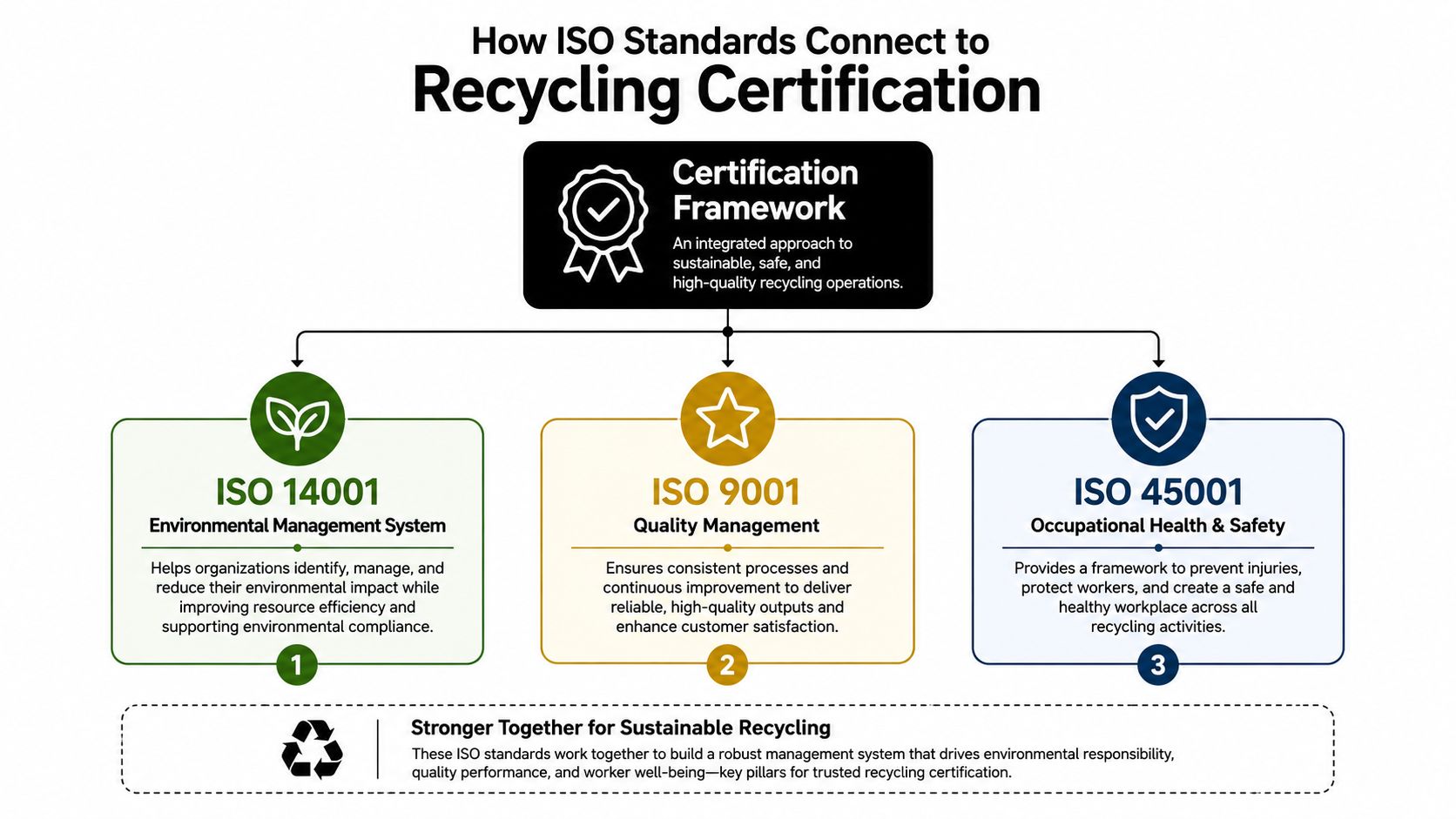
ISO references on an ITAD certificate often confuse buyers because they sound interchangeable. They aren't. Each framework addresses a different management concern, and an electronics-recycling standard uses those systems as part of a broader control structure.
ISO 14001 governs an environmental management system. It helps an organization identify environmental aspects, establish controls, monitor performance, and improve its processes. ISO 9001 addresses quality management, including consistent procedures, corrective action, and customer-focused process control.
OHSAS 18001 was an occupational health and safety framework that appears in earlier EPA R2 materials. Buyers may also encounter ISO 45001, its modern occupational-health-and-safety successor. RIOS is a recycling-industry integrated management system that combines relevant quality, environmental, and safety practices for recycling operations.
Read the certificate as a layered system
Think of the recycling standard as specialty coverage and the management system as the organization-wide framework supporting it. R2:2013 requires ISO 14001, OHSAS 18001, or RIOS, according to EPA certification materials. That requirement connects electronics processing to formal environmental, safety, or integrated recycling controls.
EPA guidance also notes that e-Stewards V1 requires ISO 14001, while R2:2013 accepts ISO 14001, ISO 18001, or RIOS. These references demonstrate why buyers should read the certificate and supporting documentation rather than treating every ISO logo as proof of electronics-specific competence.
Ask what sustains compliance
ISO 14001 alone doesn't prove that a recycler can sanitize a drive, manage a downstream processor, or issue a complete disposition record. ISO 9001 alone doesn't establish responsible electronics processing. The relevant question is how the management system supports the electronics standard and the services in your statement of work.
For readers building an environmental management review, this ISO 14001 certification Australia guide offers useful background on the environmental-management framework. Use it for context, but evaluate your ITAD vendor against the electronics-specific requirements that govern your assets.
Turning Certification into Procurement and Compliance Leverage
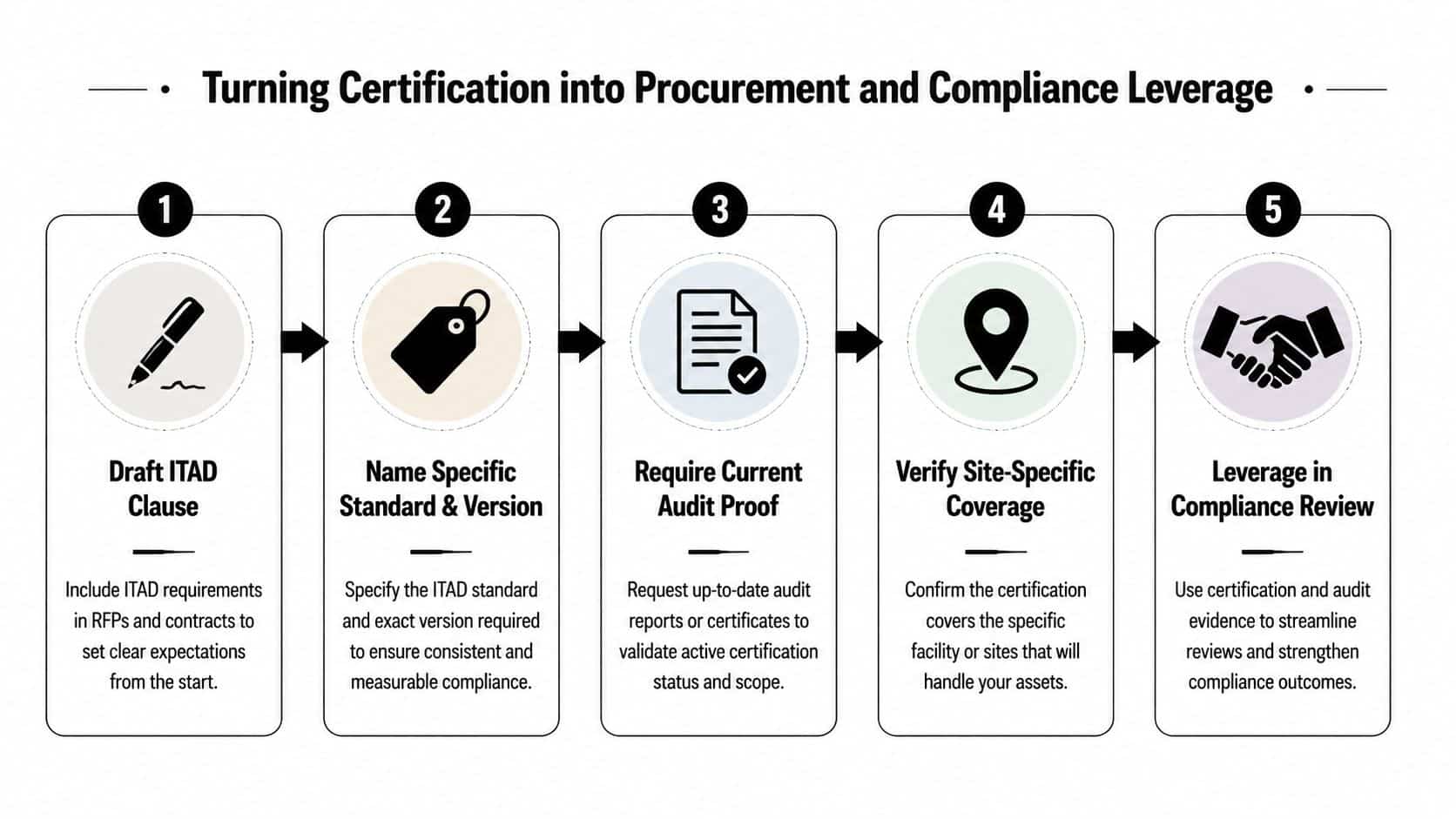
A certificate becomes valuable when your contract makes the vendor use it. Don't leave certification buried in a supplier presentation. Put the standard, version, facility, service scope, evidence requirements, and notification duties into the master services agreement.
Write the clause around evidence
A practical certification clause should require the provider to:
- Name the standard and version: Identify R2 or e-Stewards and the exact version on which the provider relies.
- Maintain active status: Require the certificate to remain current throughout the engagement and require prompt notice of suspension, withdrawal, or material scope changes.
- Identify processing sites: List the facilities that may receive your equipment, including addresses and certified activities.
- Match services to scope: Confirm coverage for logistics, data sanitization, materials recovery, reuse, resale, product destruction, or other purchased services.
- Deliver records per pickup: Require certificates of recycling and data destruction, inventory reconciliation, and disposition reporting tied to the specific load.
The FTC Disposal Rule makes reasonable procedures for disposing of sensitive consumer information a business responsibility. Industry requirements involving HIPAA, GLBA, and PCI DSS can also make documented custody and destruction evidence central to a compliance review. Certification supports that evidence, but the contract should define what the supplier must produce.
Liability-transfer test: Liability transfer is meaningful only when the recycler can prove what happened to each device.
A certificate of recycling should connect to an asset list, while a data-destruction certificate should identify the applicable method and completed equipment. Procurement teams should also retain the vendor's certification documents, approval records, and exceptions.
Operational teams can use OnRoute compliance solutions for broader documentation practices, then apply the same discipline to ITAD records. Beyond Surplus's vendor due-diligence checklist can help organize the evidence request before a supplier is approved.
Traps That Make a Certified Recycler Less Than They Seem
A logo on a website is not a complete answer. Certification is evidence about a defined organization, facility, scope, and time period. It doesn't automatically extend to every warehouse, broker, subcontractor, or service line connected to the brand.
The most overlooked issue is facility specificity. A company with multiple locations may have mixed compliance even when one site holds a valid certificate. The e-Stewards FAQ states that companies under the same ownership and management that process electronics must become certified within 18 months of the first certified site, but buyers still need to verify which locations are approved and what each location does.

Four questions expose most gaps
- Which facility handled the equipment? A corporate certificate isn't enough if the pickup went to a different warehouse.
- Which version applies? e-Stewards V4.1 was published on February 22, 2022, according to the program's certification guidance. Ask whether the provider's certificate aligns with the version named in the contract.
- Does scope include data destruction? A materials-recovery scope may not cover drive wiping, shredding, or media destruction.
- Who audited the operation? Verify the certification body, accreditation, certificate status, and any applicable surveillance findings.
Watch for scope drift
A broker may arrange transportation, send equipment to a primary processor, and rely on other downstream vendors for components. That model can work, but the buyer needs a documented chain of custody and clear controls over every downstream step.
Push back when a sales representative answers a site-specific question with a company-wide slogan. Ask for the certificate number, site address, covered activities, current status, and evidence that the downstream path matches the vendor's certified process. If the provider won't share enough information to verify those points, treat the claim as incomplete.
A Practical Vetting Sequence for Certified ITAD Partners
A procurement or IT manager can run a disciplined review without turning it into an open-ended sustainability project. Start with documents, then test the documents against the proposed operating model.
Run the document check first
Request the current certificate before discussing final commercial terms. Confirm that an accredited certification body issued it, then compare the legal entity, facility address, standard, version, scope, and expiration or status information against the proposal.
Next, map the certificate to your actual requirements. If the project includes laptop disposal, data-center decommissioning, medical equipment disposal, laboratory equipment disposal, product destruction, or IT asset recovery, ask the vendor to identify where each activity occurs and which controls apply.
Use this sequence:
- Verify the issuer: Confirm the certification body and its accreditation.
- Match the facility: Check every address that may receive or process assets.
- Map the scope: Tie data sanitization, logistics, reuse, recovery, destruction, and downstream processing to documented coverage.
- Request audit evidence: Ask for the most recent surveillance-audit summary and corrective-action status that the vendor can disclose.
- Test the deliverables: Require certificates of recycling and data destruction for each pickup, with asset-level reconciliation.
Put ongoing controls in the agreement
The contract should name the standard and version, require continuous certificate currency, define notice obligations for suspension or scope changes, control downstream vendors, and preserve your right to audit relevant records. It should also specify who may approve a change in processing location and how exceptions are documented.
The certificate is a starting point, not the entire vendor program. Interview the operations lead, inspect sample reports, and ask how the provider handles mismatched serial numbers, failed wipes, damaged equipment, batteries, and assets that cannot be economically recovered.
For a Georgia-focused procurement workflow, Beyond Surplus's guide on how to choose an ITAD vendor in Georgia provides an additional evaluation reference. Beyond Surplus offers commercial electronics recycling, secure data destruction, IT equipment disposal, product destruction, data-center de-installation, logistics coordination, and certificates of recycling and data destruction. Review the certificate, confirm the processing scope, and select a partner that can turn every pickup into auditable evidence.
Contact Beyond Surplus to coordinate certified electronics recycling, secure data destruction, IT asset recovery, or commercial IT equipment disposal. Ask the team to map your facilities, asset types, data requirements, and documentation needs into a defensible ITAD plan.


