

An IT director can do everything that appears operationally correct, retire the equipment, hire a destruction vendor, and still fail an audit. The problem usually isn't the shredder. It's the missing evidence between decommissioning and final destruction.
Hard drive destruction compliance requirements are best treated as an evidence-management program. Auditors want to see how each asset was identified, secured, transferred, processed, and reconciled. A generic certificate helps, but it rarely proves the entire chain by itself. The practical standard is a defensible record that connects every serialized drive to an approved method and a documented final outcome.
Table of Contents
- Why Compliance Goes Beyond the Shredder
- Key Regulations Governing Hard Drive Destruction
- Physical Destruction Versus Verified Data Erasure
- Documentation and Chain of Custody Essentials
- Cross-Border E-Waste Rules That Affect Compliance
- Choosing Between On-Site and Off-Site Destruction
- Building an Audit-Ready Destruction Program
Why Compliance Goes Beyond the Shredder
An IT director at a financial services firm is facing a regulatory examination. The examiner asks for proof that 400 decommissioned hard drives containing customer personally identifiable information were destroyed under an approved process. The director produces a one-page certificate from a third-party vendor.
The certificate confirms destruction, but it doesn't list the drive serial numbers. It doesn't show who collected the assets, where they were staged, or when custody changed. It also contains no vendor due diligence file. The examiner has no way to connect the certificate to the specific drives removed from the firm.
That gap changes the audit conversation. The organization may have physically destroyed every drive, yet it can't demonstrate that the listed equipment is the same equipment that left its facility. It can't show that unauthorized access was prevented during transport or storage. The destruction event is documented, but the process is not.
The evidence trail is the control
The IT asset disposition process should begin when equipment is designated for retirement, not when a vendor issues a certificate. The record should follow each asset through inventory, internal release, secure staging, transport, receipt, sanitization, destruction, recycling, and final reconciliation.
The FTC Disposal Rule became effective in the United States on June 1, 2005 and requires businesses that maintain consumer report information to use disposal practices that are reasonable and appropriate to prevent unauthorized access or use. The FTC specifically includes destroying or erasing electronic files or media so they can't be read or reconstructed, and permits organizations to use a destruction contractor after performing due diligence. FTC Disposal Rule guidance makes clear that disposal controls aren't limited to paper records.
Practical rule: If an auditor can't reconcile the asset inventory to the destruction record, treat the destruction file as incomplete.
A missing custody log can create exposure even when no breach occurred. Regulators may question whether the organization exercised appropriate safeguards, while internal legal teams may need to assess notification and contractual obligations. A reliable hard drive destruction program therefore treats serial-number tracking, custody records, vendor qualification, and certificates as one control package.
Key Regulations Governing Hard Drive Destruction
The regulatory requirements differ by sector, but the operational expectation is consistent. Organizations must select a suitable sanitization method, prevent unauthorized access during disposal, and retain records that show the control operated as designed.
The federal baseline and technical framework
The FTC Disposal Rule under FACTA applies to businesses and individuals that maintain or possess consumer reports or related records for a business purpose. It requires appropriate measures for disposing of sensitive information derived from those records. The rule doesn't prescribe one universal machine or process. It establishes a risk-based expectation, which means an informal dumpster, unsecured staging area, or undocumented vendor handoff is difficult to defend.
NIST SP 800-88 Rev. 1 supplies a widely used technical vocabulary: Clear, Purge, and Destroy. Clear uses logical techniques to protect data against ordinary recovery. Purge applies stronger sanitization methods intended to make recovery infeasible using standard techniques. Destroy renders the media unusable and makes data recovery infeasible using state-of-the-art laboratory techniques. The guidance lists shredding, disintegration, pulverizing, melting, and incineration as destruction methods and says destruction is appropriate for hard copy and most information storage media. See NIST SP 800-88 media sanitization guidance for the framework and method definitions.
NIST SP 800-88 Rev. 2 was published in 2025, and its public draft was updated in 2026, confirming that media sanitization remains an active standards area. Organizations should therefore map their internal policy to the revision their contracts, regulators, or auditors require. Beyond Surplus's explanation of NIST 800-88 data destruction standards can help IT teams translate the framework into operating procedures.
For organizations handling European personal data, the practical question may extend beyond destruction mechanics. A resource on whether an organization needs to register with the ICO can help clarify a separate governance issue, but it shouldn't replace legal review of the applicable data-processing obligations.
Sector rules require control alignment
Healthcare teams must address disposal safeguards for protected health information under HIPAA. Financial institutions should align disposal procedures with GLBA safeguards and applicable contractual requirements. Public companies may need to reconcile asset destruction with SOX-related retention and control evidence. Organizations subject to GDPR or CCPA should document deletion decisions and demonstrate that personal data was handled according to the applicable request, retention, and disposal obligations.
| Regulation | Scope & Applicability | Destruction Requirement | Non-Compliance Risk |
|---|---|---|---|
| FTC Disposal Rule | Consumer report information held for business purposes | Reasonable and appropriate disposal controls | Regulatory scrutiny and enforcement exposure |
| NIST SP 800-88 | Technical media sanitization guidance | Select and verify Clear, Purge, or Destroy | Weak technical evidence and failed audits |
| HIPAA | Protected health information handled by covered organizations and business associates | Dispose of PHI so unauthorized access is prevented | Privacy, contractual, and regulatory exposure |
| GLBA | Customer information held by financial institutions | Apply safeguards through the information lifecycle | Financial-sector compliance and examination risk |
| GDPR and CCPA | Personal information governed by applicable privacy laws | Support defensible deletion and disposal decisions | Data-protection investigations and contractual risk |
These frameworks converge on one requirement: the method must match the data, and the records must support the decision. Vendor due diligence is part of that decision, not an administrative afterthought.
Physical Destruction Versus Verified Data Erasure
Physical destruction and verified erasure can both support a compliant program, but they solve different operational problems. The right choice depends on the media type, data sensitivity, verification capability, reuse goals, and downstream environmental controls.
Clear is generally suited to data that can be reliably sanitized through logical methods and verified with appropriate records. Purge uses stronger controls, including validated cryptographic or device-specific techniques, where ordinary clearing isn't sufficient. Destroy eliminates the media's future storage function and is the clearest choice when erasure can't be reliably verified.
Compare the practical trade-offs
Shredding, disintegration, and pulverizing provide strong physical assurance because the storage medium is no longer usable. They also eliminate resale or reuse value and create a material stream that must be handled through responsible electronics recycling. Degaussing can work for magnetic media, but it isn't a universal answer. It doesn't address modern SSDs in the same way because SSDs store data electronically rather than on magnetic platters.
Verified erasure can preserve hardware value and support IT asset recovery, but only if the organization can prove the process worked for the specific device. Failed drives, damaged firmware, unsupported interfaces, and incomplete logs weaken that proof. Cryptographic erasure can be appropriate where encryption and key management are controlled, but the evidence must show why the method was valid for that asset.
The operational decision should be explicit rather than driven by vendor habit.
| Situation | Preferred method | Evidence required | Reuse outcome |
|---|---|---|---|
| Data can be reliably sanitized and the device remains functional | Verified Clear or Purge | Device identity, tool result, operator, date, and exception handling | Potentially preserves value |
| Encryption and key controls are documented | Verified Purge | Encryption state, key disposition, device record, and validation | May preserve value |
| Media is failed, unsupported, or impossible to verify | Destroy | Serial number, approved method, witness or process record, and certificate | No hardware reuse |
| Highly sensitive data requires maximum physical assurance | Destroy | Full custody trail and destruction evidence | No hardware reuse |
For a practical comparison of the approaches, review hard drive shredding versus data wiping. The important point is simple: physical destruction isn't automatically more compliant, and erasure isn't automatically adequate. Compliance depends on the documented match between risk, method, and proof.
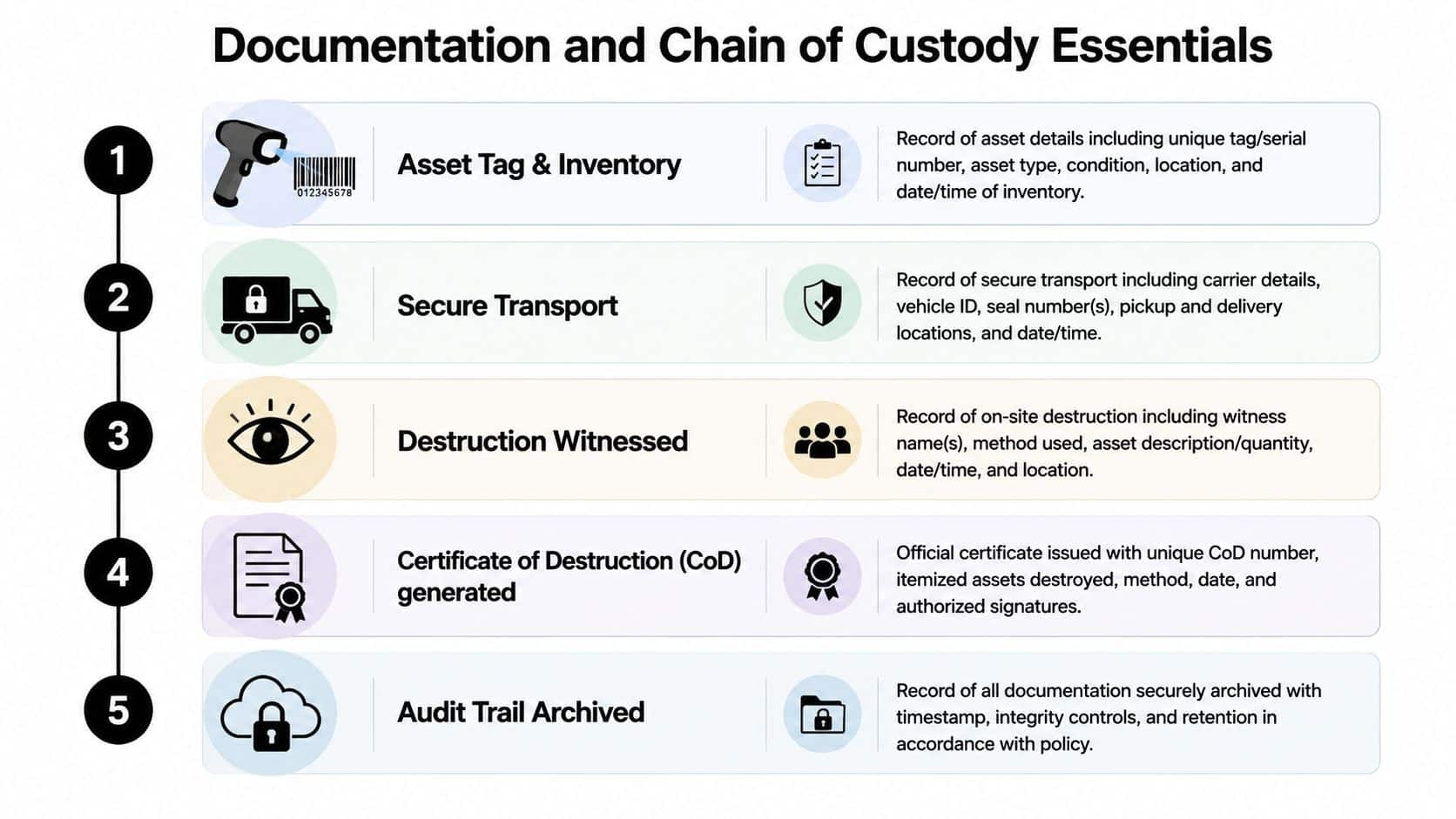
Documentation and Chain of Custody Essentials
A certificate of destruction is the final page of the file, not the file itself. Auditors typically test whether the certificate can be reconciled to the organization's asset register and whether every custody transfer is accounted for.
Build the record around the device identity
Start with a serialized inventory. Record the manufacturer, model, serial number, internal asset tag, location, status, and disposition instruction. If a drive lacks a readable serial number, assign a controlled identifier and document the exception with photographs or another approved verification record.
The custody log should then capture each handoff:
- Internal release: Identify the employee or team releasing the drive, the receiving party, the date, and the count transferred.
- Secure staging: Record the secured location, container identifier, access controls, and reconciliation results.
- Transport: Document the carrier, vehicle or shipment reference, seal or container number, departure, receipt, and any discrepancy.
- Vendor intake: Require the vendor to confirm received serial numbers and report missing, substituted, or damaged assets.
- Processing: Record whether the drive was cleared, purged, destroyed, recycled, or placed into an exception workflow.
Define what the certificate must prove
A useful Certificate of Destruction should include the serial number or controlled asset identifier, destruction method, destruction date, destruction location, vendor identity, authorized signatory, and disposition status. It should also identify exceptions rather than omitting them.
Vendor due diligence belongs in the same compliance file. Retain the contract, insurance evidence, security procedures, facility controls, audit rights, and relevant certifications such as NAID AAA or R2v3, where applicable. Healthcare arrangements may require a signed Business Associate Agreement. Privacy-related processing may require a Data Processing Agreement.
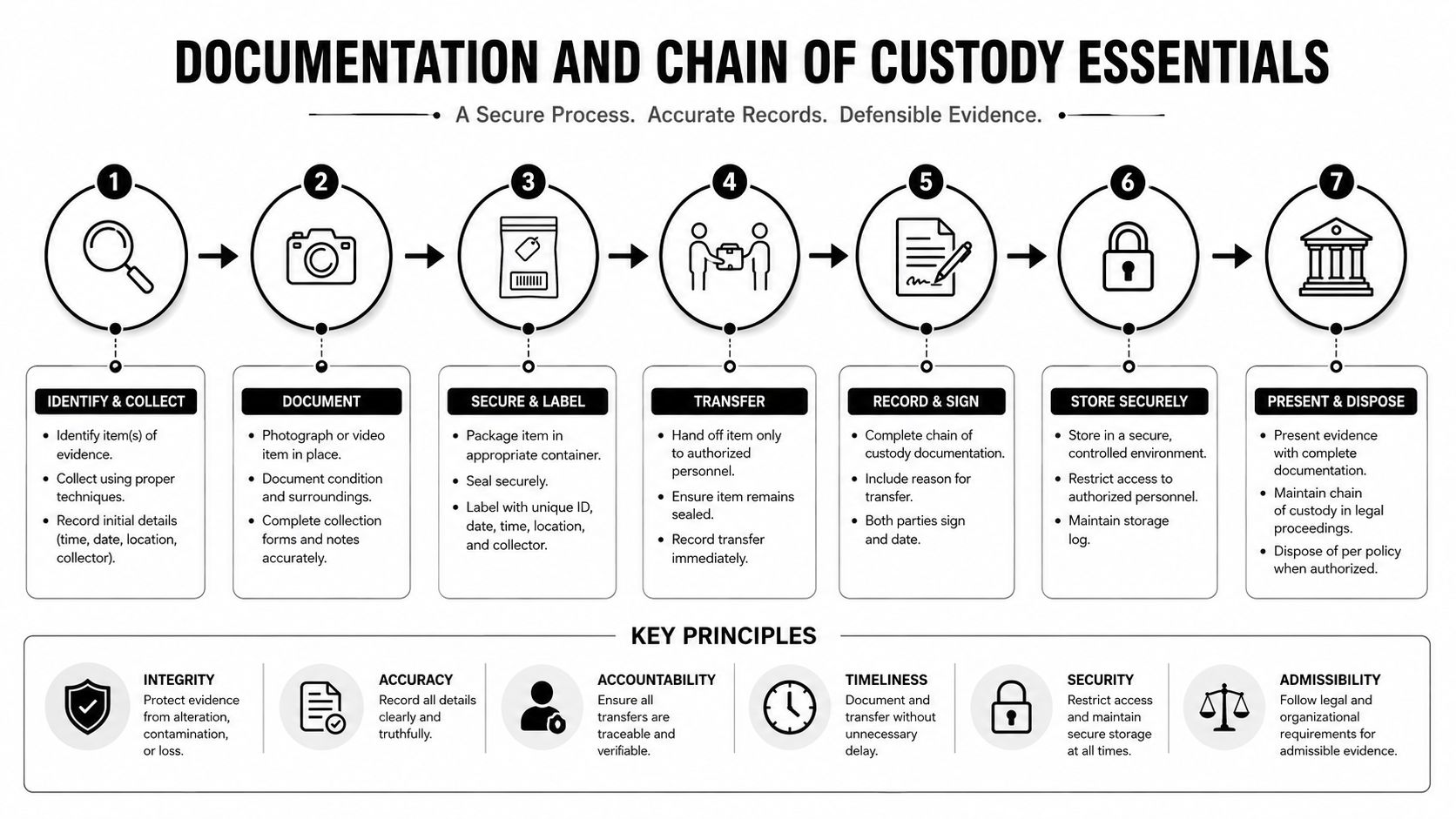
A certificate answers “what happened.” The custody file answers “which asset, handled by whom, under what controls, and when.”
The most common weakness is the gap between pickup and destruction. A vendor may provide a polished certificate while the customer retains no evidence of sealed containers, transport custody, intake reconciliation, or staging access. Chain-of-custody practices for IT asset disposal should be evaluated before assets leave the site, not after an auditor asks for records.
Cross-Border E-Waste Rules That Affect Compliance
Data security isn't the only compliance issue created by retired drives. Once equipment or shredded remnants enter an international recycling network, environmental and shipment rules can apply independently of the destruction certificate.
The Basel Convention rules now place tighter controls on international e-waste shipments. The U.S. Environmental Protection Agency states that, beginning January 1, 2025, shipments of electrical and electronic waste for recovery or disposal require prior written consent from the importing country and any transit countries. The Basel system identifies hazardous e-waste as A1181 and non-hazardous e-waste as Y49, as explained in the Basel Convention e-waste amendments FAQ.
A domestic ITAD provider doesn't automatically eliminate downstream risk. The provider may use a recycling partner, consolidate material, or route components through another jurisdiction. Your contract should disclose those pathways and prohibit unauthorized export. Ask where destruction occurs, where material is processed, which party holds title during transit, and which records prove lawful shipment.
Coordinate privacy and environmental controls
If drives contain data associated with people in another jurisdiction, cross-border transport can create a separate privacy analysis. Data protection requirements may apply to the movement, processing, and destruction of those assets, even when the final objective is disposal. Legal, procurement, privacy, and infrastructure teams should approve the route together.
| Regulation | Jurisdiction | Key Requirement | Compliance Risk if Ignored |
|---|---|---|---|
| Basel Convention e-waste controls | International | Obtain required consent for covered recovery or disposal shipments | Shipment violations and downstream liability |
| EPA implementation rules | United States | Follow applicable export and transit requirements | Environmental enforcement and documentation gaps |
| EU e-waste classification system | European Union and connected shipment networks | Classify covered hazardous and non-hazardous e-waste correctly | Misclassification, rejected shipments, or regulatory action |
| Data protection rules | Relevant data jurisdictions | Control personal-data movement and disposal processing | Privacy investigations and contractual exposure |
Require the vendor to provide destination records, processing certificates, and export documentation where applicable. A destruction certificate without a lawful downstream disposition record is only half a compliance file.
Choosing Between On-Site and Off-Site Destruction
On-site destruction minimizes custody transfers. The vendor brings the equipment and process to your facility, your team can witness the event, and the destruction record can be reconciled before the material leaves. The trade-off is operational. You need appropriate space, trained personnel, equipment controls, safety procedures, and a plan for managing the resulting material.
Off-site destruction can provide controlled facility processes and greater operational capacity. It also introduces transit and intake risk. The vendor must prove that sealed containers, transport controls, facility access, and receipt reconciliation protect the drives between pickup and destruction.
Use a vendor scorecard
For off-site services, require answers to these questions before signing:
- Facility access: Can your organization audit the processing location and review relevant controls?
- Transport security: Does the provider use tracked transport, tamper-evident containers, and documented seal reconciliation?
- Witnessing: Can your authorized representative witness destruction remotely or in person?
- Exception handling: What happens when serial numbers don't match, a drive fails intake, or a container seal is broken?
- Evidence delivery: Will the provider return device-level records rather than only a batch summary?
A hybrid model often works well. The customer serializes and seals the drives on-site, records the handoff, and sends them to a qualified facility for processing. This preserves a strong initial custody record without requiring every customer to operate industrial destruction equipment.
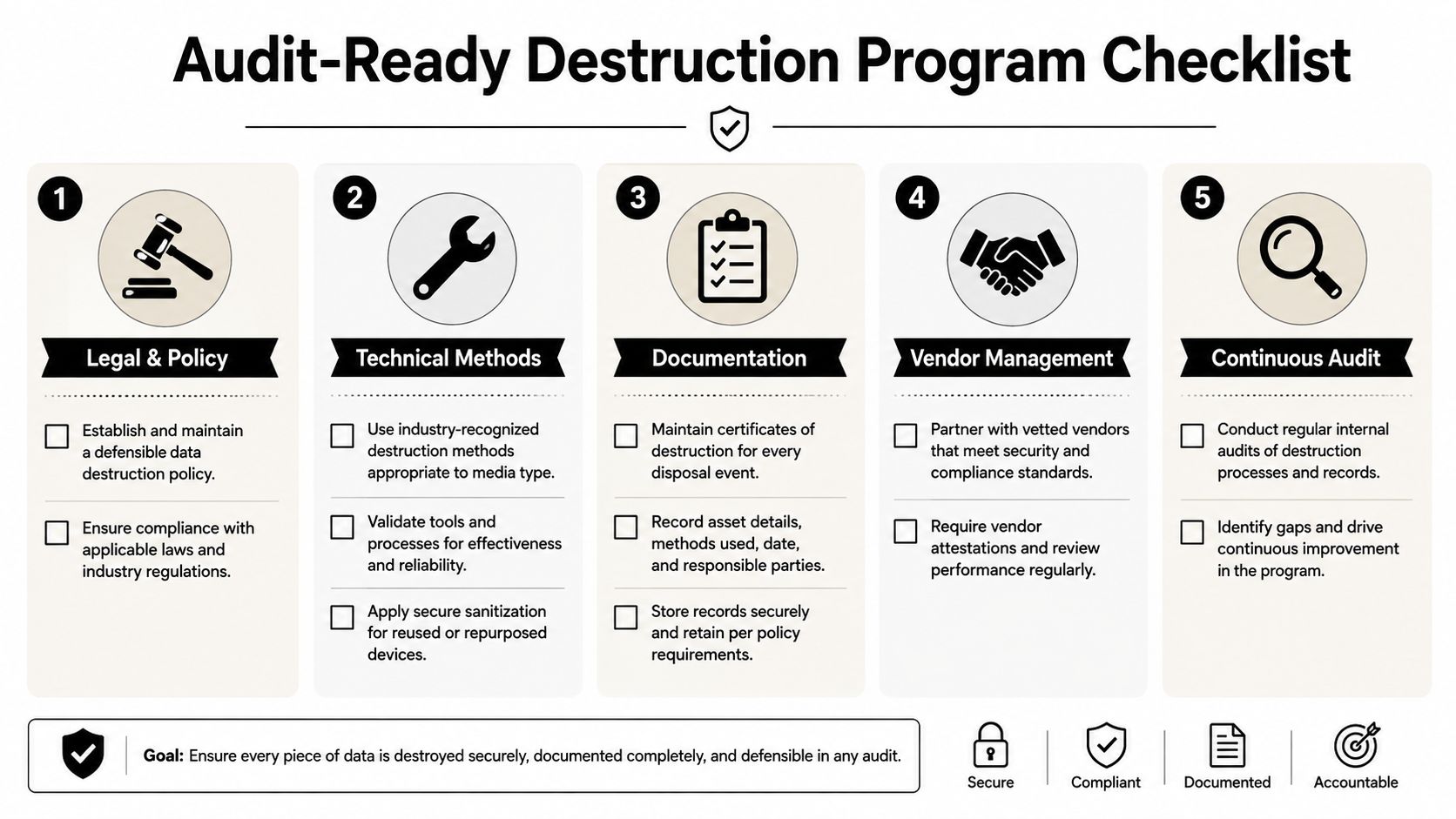
For highly regulated data, including healthcare information or classified government information, on-site destruction may better match the organization's risk tolerance. For standard corporate data, off-site certified processing can be acceptable when custody transfers, method verification, and vendor oversight are documented. On-site versus off-site ITAD services provides a useful operational comparison, but the final decision should come from your data classification and control requirements.
Building an Audit-Ready Destruction Program
An audit-ready program gives an IT director a clear yes-or-no answer for every control. Use the following checklist during internal reviews.
Verify the governance file
- Policy alignment: Does the written policy address the FTC Disposal Rule, NIST sanitization outcomes, and sector-specific obligations? Evidence should include an approved policy, ownership, review history, and exception process.
- Data classification: Does the procedure connect data sensitivity to Clear, Purge, or Destroy? Evidence should show the rationale for the selected method.
- Authorized disposition: Does each batch have an approved retirement or destruction instruction? Retain the request, asset list, business owner approval, and retention decision.
Test the technical and custody evidence
- Device reconciliation: Can the asset register, pickup list, vendor intake report, and final certificate be matched by serial number or controlled identifier?
- Method verification: Does the record identify the tool, process, operator, result, and failed-device treatment?
- Transfer controls: Does every handoff identify the releasing party, receiving party, time, location, container, and seal condition?
- Certificate completeness: Does the Certificate of Destruction identify the assets, method, date, location, vendor, and authorized signatory?
- Vendor oversight: Are contracts, insurance, certifications, BAAs or DPAs, audit rights, and subcontractor disclosures retained?
- Environmental disposition: Can the organization show where destroyed material went and whether international shipment requirements were satisfied?
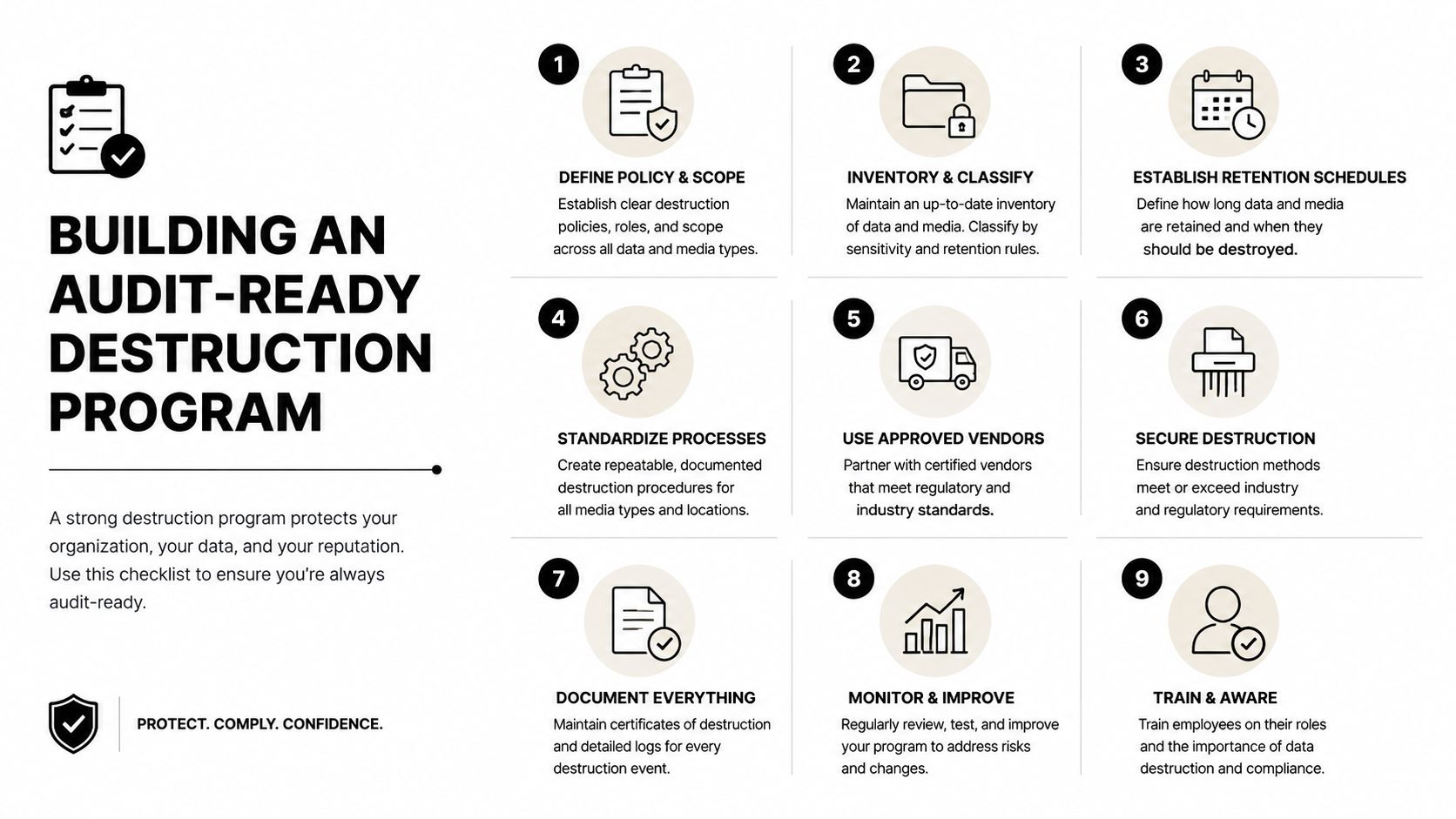
Auditors evaluate the totality of the program, not isolated certificates. A single missing transfer record can undermine an otherwise sound destruction event because it leaves an unverified period in the asset's history.
Run an internal review at least quarterly, using the same checklist against completed batches and vendor files. That cadence helps identify documentation drift, inconsistent serial tracking, expired certifications, and undisclosed downstream changes before an external examiner finds them.
Beyond Surplus provides serialized hard drive shredding, certified data wiping, electronics recycling, and IT asset disposition services with documentation designed to support audits and regulatory records. Visit Beyond Surplus to discuss an on-site, off-site, or hybrid destruction program for your organization.


