A government IT manager can clear a storage room and still leave the agency exposed. Retired laptops, monitors, network equipment, medical devices, and laboratory hardware may be physically gone, yet the agency still needs to prove who handled each asset, how data was sanitized, where materials went, and whether the downstream processor operated lawfully. That's the practical meaning of Government Electronics Recycling Requirements. They're less about arranging a truck and more about maintaining control of assets and records from decommissioning through final disposition.
Consumer drop-off programs rarely solve that problem for public entities. Pennsylvania's Department of Environmental Protection states that public entities, including schools and local government offices, aren't covered by its consumer electronics recycling program and must make their own arrangements. Pennsylvania DEP's guidance for public entities makes the operational point clearly: agencies need a documented commercial or institutional disposition path.
Table of Contents
- The Compliance Problem Most Agencies Underestimate
- What Government Electronics Recycling Requirements Actually Cover
- The FTC Disposal Rule and NIST 800-88 in Practice
- R2 and e-Stewards Standards Compared
- State E-Waste Laws and What They Mean for Agencies
- Procurement and Contracting as the Real Control Point
- An Audit-Ready Checklist for Government IT Disposal
- How a Certified ITAD Operationalizes These Requirements
The Compliance Problem Most Agencies Underestimate
Maria, a municipal IT manager, inherited a storage room after a department merger. It held retired laptops, monitors, switches, and other network equipment. The equipment looked like a routine recycling pickup, but the inventory was incomplete, storage devices weren't clearly identified, and no one could show which vendor had handled earlier assets.
The first assumption was simple: get a recycler to haul everything away. The questions came later. Which serial number belongs to which certificate? Was each drive sanitized before resale or reuse? Did a subcontractor receive the equipment? Can the agency answer a public-records request or state audit inquiry without reconstructing the chain from memory?
The four control points
Government electronics recycling requirements become manageable when the agency treats disposal as four connected controls:
- Data destruction: Personally identifiable information, taxpayer records, law-enforcement data, and other sensitive content must be rendered unrecoverable through a documented process.
- Recordkeeping: Every serialized asset needs a traceable file showing what happened, when it happened, who received it, and which method was used.
- Liability transfer: The contract and signed acceptance records should establish when the vendor assumes responsibility for custody, environmental handling, and agreed data-security obligations.
- Certified downstream processing: The primary recycler needs accountable, verifiable downstream relationships, not an opaque promise that materials will be handled responsibly.
Practical rule: If an agency can't connect an asset serial number to a sanitization record, custody record, and final disposition, the file isn't audit-ready.
Federal facilities still have to follow personal-property management rules when disposing of electronics, even though electronics sent for reuse or recycling aren't regulated as hazardous waste under the federal framework described by the EPA. EPA's federal electronics stewardship guidance identifies R2 and e-Stewards as the two accredited recycler certifications recognized for responsible electronics recycling. That distinction matters. The agency's exposure often comes from weak documentation and poor asset control, not from a hazardous-waste classification.
What Government Electronics Recycling Requirements Actually Cover
The four pillars are easier to apply when translated into ordinary administrative tasks. Data destruction is the digital equivalent of shredding a paper file so nobody can reconstruct it. Recordkeeping is the asset file that answers what, when, who, and how. Liability transfer is the documented handoff that makes vendor responsibility enforceable. Certified downstream processing means the recycler can show that its own operations and material flows meet an auditable standard.
Data destruction starts before pickup
The agency should classify each device by data risk before it leaves controlled space. A laptop with an encrypted drive, a server containing case files, and a monitor with no storage capability shouldn't receive the same treatment or appear as anonymous lines on a weight ticket.
Records must follow the asset
A useful file contains the asset tag and serial number, location, custody events, sanitization method, verification result, acceptance date, and final disposition. A batch certificate can be efficient, but it shouldn't erase the relationship between the batch and the individual devices.
Vendor certification is an operating requirement
The EPA identifies R2 and e-Stewards as the two accredited certifications it recognizes for responsible electronics recycling in federal stewardship guidance. The EPA's electronics stewardship regulations page also explains a specific CRT rule under 40 CFR 261.4(a)(22), showing why unusual equipment streams require attention to the applicable regulatory treatment rather than a one-size-fits-all recycling label.
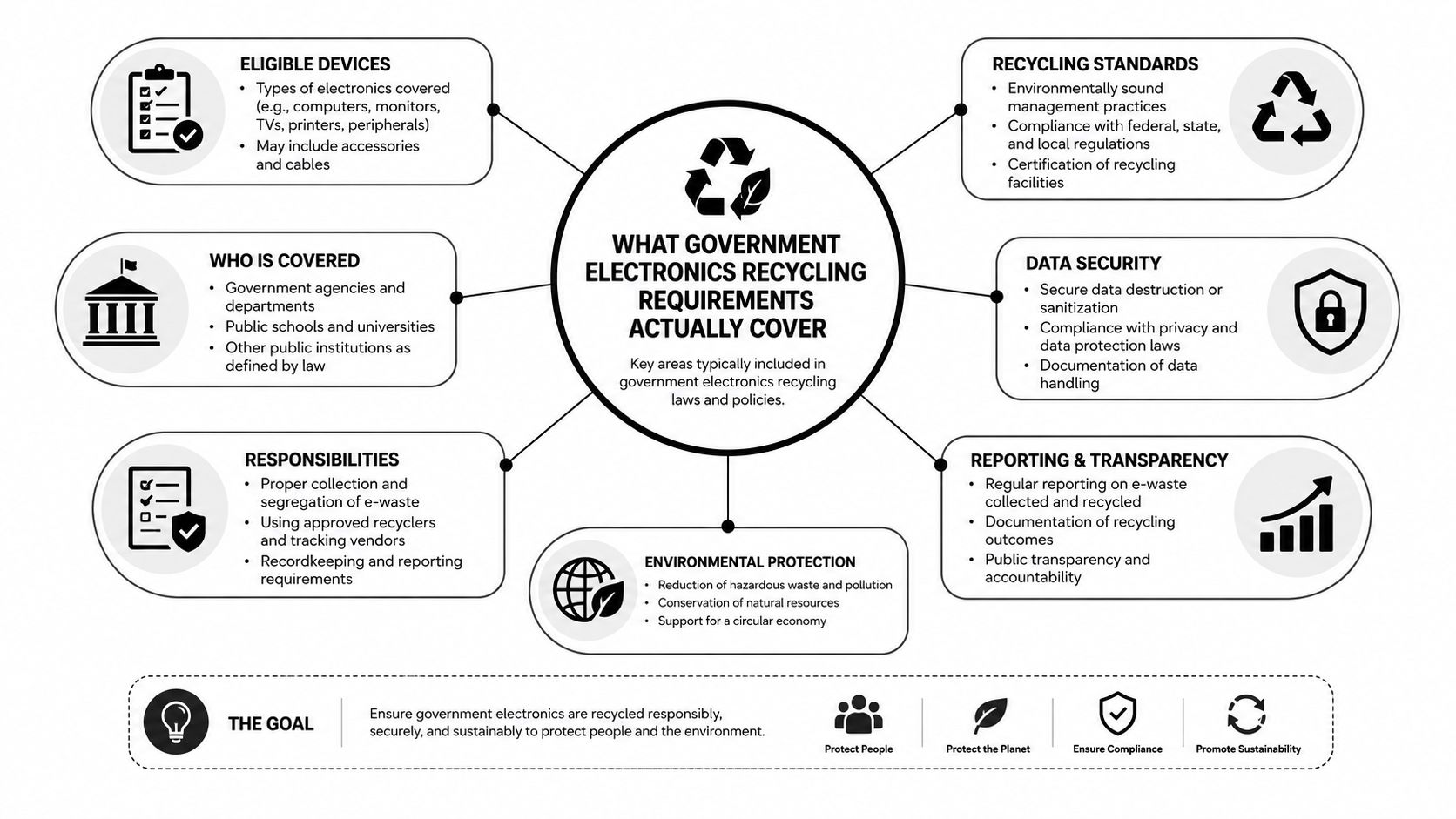
State programs sit on top of these controls, but they don't replace them. An agency should treat free consumer take-back options, retailer acceptance, and producer responsibility systems as possible channels only when the program expressly accepts institutional equipment and supplies the records the agency needs.
The FTC Disposal Rule and NIST 800-88 in Practice
The FTC Disposal Rule requires businesses covered by the rule to take reasonable measures to dispose of consumer information so it can't be read or reconstructed. For a government agency, that principle belongs in the disposition workflow, not just in a privacy policy. The vendor should receive a device only after the agency has identified its data-bearing media and selected an appropriate sanitization outcome.
NIST SP 800-88 Rev. 1 provides the vocabulary procurement officers should require. Clear addresses logical techniques intended for continued use within the same organization. Purge applies when the media is reassigned outside the organization and stronger protection is needed. Destroy applies when the media will leave operational control permanently and reuse isn't appropriate.
Turn each decision into evidence
The agency's file should show the decision, method, verification, and responsible party. Don't accept “wiped” as a method. Require the NIST term, the device identifier, the date, the operator or system record, and the verification result.
The NIST SP 800-88 resource from Beyond Surplus can help procurement and IT teams align contract language with the standard's terminology.
| Media Type | Recommended NIST Method | When to Apply | Required Audit Artifact |
|---|---|---|---|
| Reusable internal storage | Clear | The device remains within the same agency's controlled environment | Serialized asset record, method, verification result, and approving employee |
| Storage reassigned outside the agency | Purge | The media leaves the agency's control but remains technically reusable | Certificate naming the purge method, device serial number, date, and verification |
| Failed, obsolete, or non-reusable media | Destroy | The agency won't permit future use of the media | Certificate of destruction, physical-destruction method, serial number, and date |
| Encrypted storage with an approved key-management process | Purge or another applicable NIST outcome | The agency's policy and media condition support cryptographic sanitization | Record of the approved process, key disposition, verification, and asset linkage |
Cryptographic erasure, degaussing, and shredding aren't interchangeable labels. They become defensible audit evidence only when the record identifies the actual technique using accepted NIST terminology and connects it to the specific media. The custody log should begin with the pre-collection inventory and continue through the secure cage, transport, processing, and final disposition.
R2 and e-Stewards Standards Compared
R2v3 and e-Stewards 2.0 both give agencies a stronger vendor-screening foundation than an uncertified recycling promise. The important difference is how each standard structures reuse, recycling, downstream control, and environmental accountability. e-Stewards is generally the more restrictive choice for agencies that want tighter limits around hazardous exports and downstream relationships, while R2v3 provides controlled reuse and recycling requirements within its certification framework.
The procurement mistake is treating the logo as the deliverable. A certificate should identify the certification standard, certification scope, processing location, downstream partners where applicable, asset identifiers, data-destruction method, and final disposition. If the vendor can't provide that information, certification alone doesn't create a complete agency record.
| Requirement Area | R2v3 | e-Stewards 2.0 |
|---|---|---|
| Reuse | Permits controlled reuse when data sanitization and processing requirements are met | Permits responsible reuse within a stricter overall downstream framework |
| Downstream control | Requires documented controls and approved processing relationships | Places especially strong emphasis on accountability throughout downstream handling |
| Export posture | Allows controlled flows subject to the standard's requirements | Restricts hazardous e-waste exports to developing countries |
| Procurement value | Broadly useful for documented reuse, recycling, and material management | Useful where the agency wants a more restrictive environmental and export posture |
| Contract requirement | Name certification scope, facilities, methods, and downstream processors | Name certification scope, facilities, methods, and downstream processors |
A dual-certified vendor can simplify an agency's file, but it doesn't remove the need to read the certificate. The contract should require notification before downstream changes, inspection rights, current certificates, and serial-level tracking. Beyond Surplus's certified electronics recycling service illustrates the type of service category agencies should evaluate, but the buyer still needs to verify the exact certification scope and contract terms.
State E-Waste Laws and What They Mean for Agencies
State electronics laws vary, and public entities often fall outside consumer-oriented programs. Pennsylvania provides a direct example. Its DEP states that public entities such as schools and local government offices must arrange their own electronics recycling rather than use the state's consumer program.
Illinois provides a different warning. The state says covered devices are banned from landfills for households, businesses, schools, and government agencies beginning January 1, 2026. EPA's electronics donation and recycling guidance also advises removing batteries from electronics because batteries may require separate recycling. An agency that sends mixed equipment without identifying batteries, specialty devices, or restricted components can create a preventable compliance failure.
Build a state-law file, not a state-law assumption
For each project, procurement should identify:
- Covered equipment: List computers, displays, networking equipment, medical devices, laboratory equipment, batteries, and accessories separately.
- Agency eligibility: Confirm whether the state program accepts institutional equipment and whether fees, registrations, or vendor arrangements apply.
- Disposition evidence: Retain serialized asset lists, weight tickets, custody records, processor credentials, and final certificates.
- Landfill restrictions: Confirm whether any device category is prohibited from disposal through ordinary solid-waste channels.
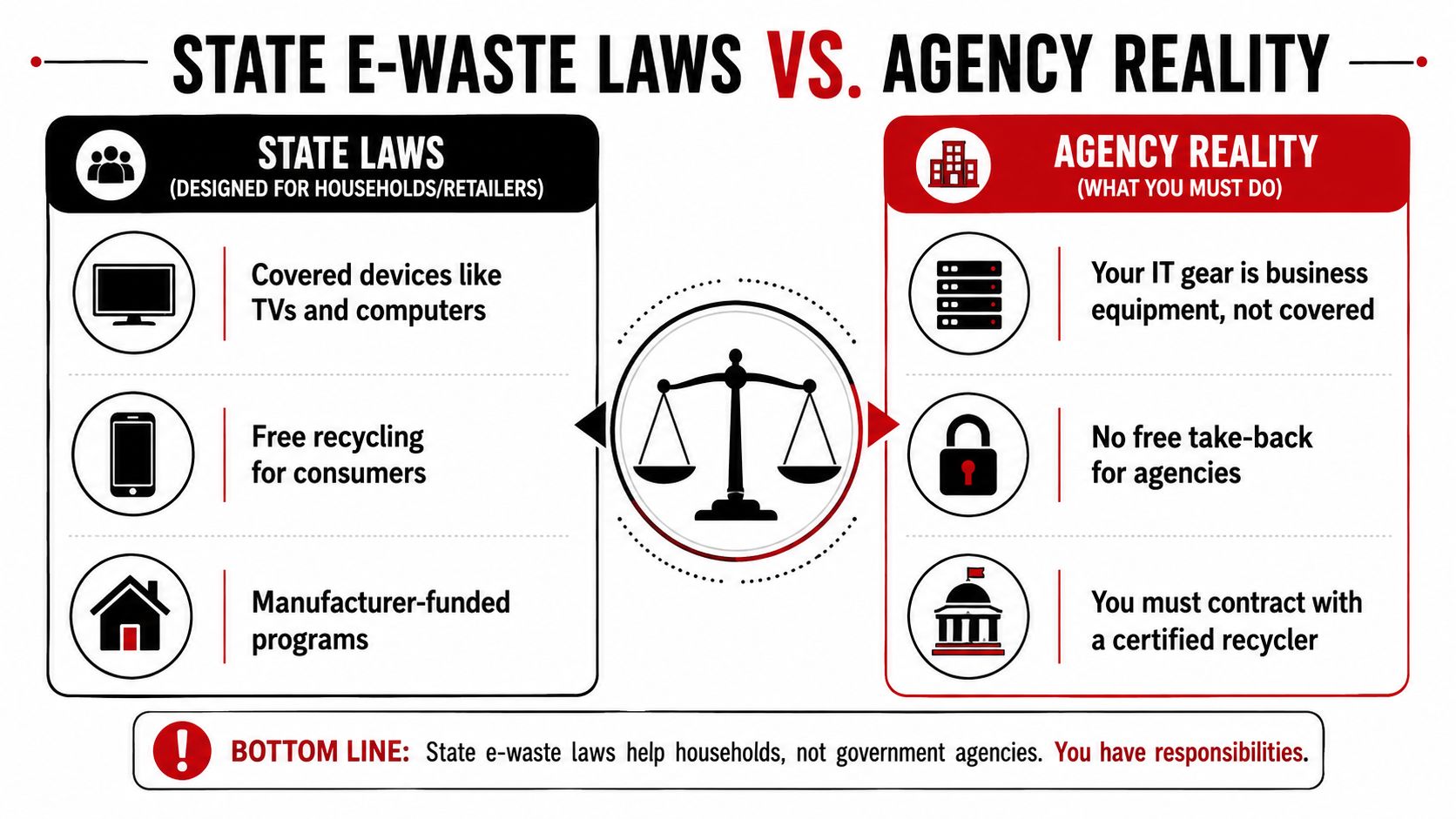
State law is the floor. Federal property rules, contract clauses, privacy obligations, and the agency's own records schedule may impose more demanding controls. The EU illustrates the broader direction of regulation. Under the recast WEEE Directive, member states had to meet a 45% collection rate from 2016, rising to 65% from 2019, or an alternative rate based on WEEE generated. Article 7 of the WEEE Directive shows how governments turn disposal into measurable obligations, even though U.S. agencies must apply their own federal and state frameworks.
Procurement and Contracting as the Real Control Point
The loading dock doesn't enforce compliance. The solicitation and master services agreement do. If an RFP says only “recycle obsolete electronics,” the agency has purchased a pickup, not a defensible disposition program.
Clauses that belong in the solicitation
Require the vendor to provide:
- Certification: Current R2v3 or e-Stewards certification, including scope, facilities, and expiration details.
- Sanitization: NIST SP 800-88 terminology and a certificate for every data-bearing asset or defined batch.
- Custody: Serialized transfer records from agency possession through final processing.
- Downstream disclosure: Names and locations of downstream processors, with advance notice of material changes.
- Responsibility transfer: Clear language addressing custody, environmental handling, data exposure, subcontractors, and indemnification after acceptance.
- Audit access: Rights to inspect records, facilities, certificates, insurance, and downstream evidence.
- Certificate format: Asset identifiers, weight where relevant, disposition method, destination, certificate number, date, and authorized signature.
- Insurance: Coverage appropriate to data breach, environmental liability, transportation, and general operations.
Vendor discovery can start with resources such as find environmental agencies on Bidwell, but classification isn't qualification. NAICS 423930 and UNSPSC 76111500 may help identify relevant suppliers in procurement systems, yet the agency still has to test actual processing capability and documentation quality.
Cooperative purchasing vehicles such as NASPO and Omnia can reduce administrative effort, but they don't cure weak terms. The underlying contract must still contain the sanitization, custody, downstream, liability, and audit provisions the agency needs. Teams can use Beyond Surplus's vendor management best practices as a reference point when building evaluation questions and service-level requirements.
An Audit-Ready Checklist for Government IT Disposal
Give a new hire a checklist that asks for evidence, not assurances. The employee should be able to open a project folder and show how every device moved from agency control to final disposition.
Five records buckets
Pre-disposal inventory and classification
- Match asset tags and serial numbers.
- Identify laptops, servers, drives, medical devices, and other data-bearing equipment.
- Record the data category and approved disposition outcome.
- Evidence: Signed inventory, exception list, location record, and disposal authorization.
Sanitization
- Apply Clear, Purge, or Destroy according to the approved decision.
- Record the NIST method and verification result for each applicable asset.
- Separate batteries and unusual media before shipment.
- Evidence: Certificate of destruction or sanitization report tied to serial numbers.
Downstream verification
- Confirm current R2v3 or e-Stewards status and certification scope.
- Review named downstream processors and material destinations.
- Confirm secure transportation and controlled receiving.
- Evidence: Certificates, processor credentials, custody signatures, and shipment records.
Records retention
- Store certificates, weight manifests, custody logs, exception reports, and disposition summaries.
- Apply the agency's records schedule instead of relying on a vendor's default retention period.
- Preserve the original signed documents and an accessible digital copy.
- Evidence: Indexed project folder and retention disposition record.
Annual vendor review
- Recheck certification, insurance, contacts, downstream partners, and contract performance.
- Compare delivered documents with the original RFP requirements.
- Correct recurring exceptions through written corrective action.
- Evidence: Annual review form, current certificates, audit notes, and remediation closure.
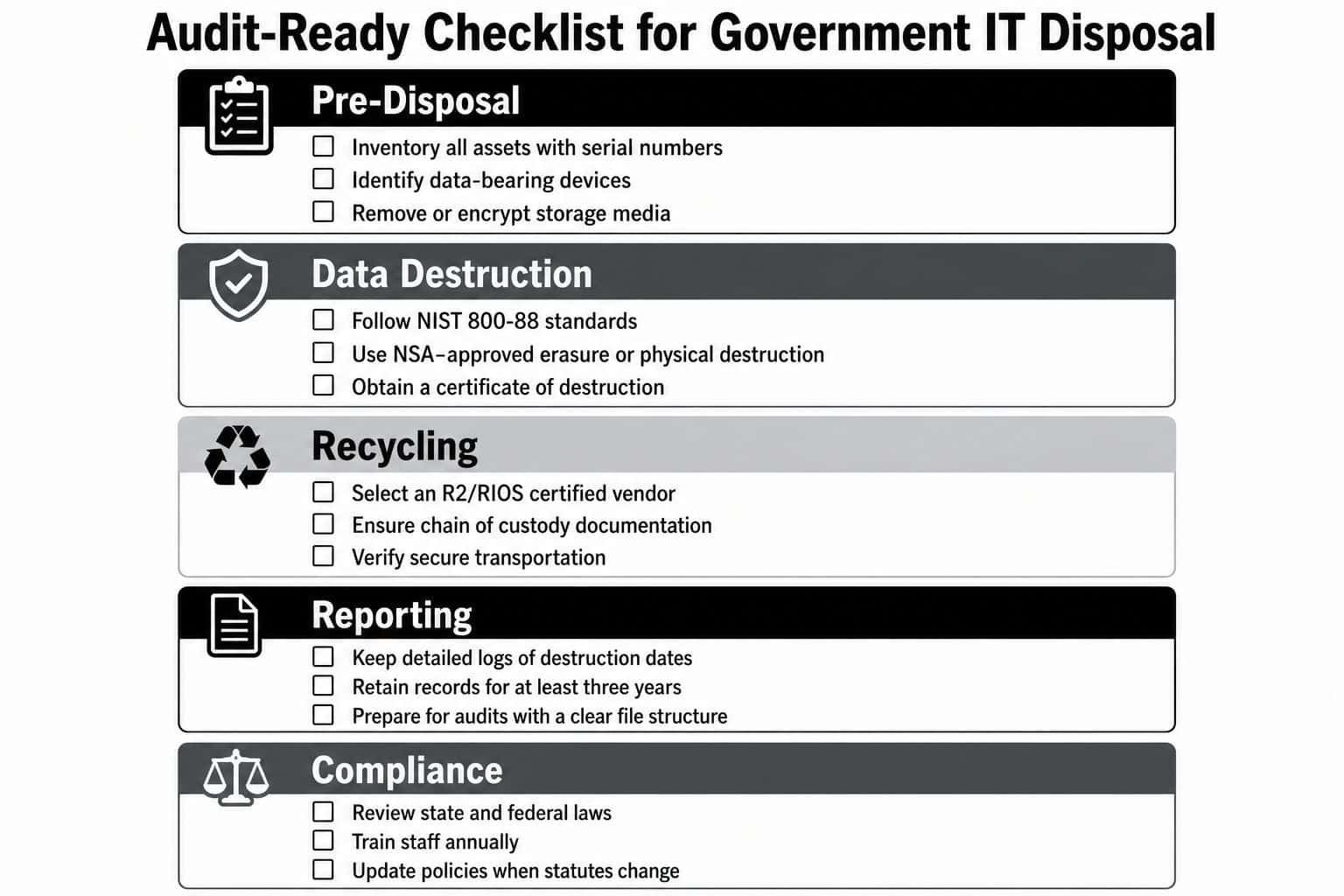
The most common file failures are mundane. A certificate is unsigned, or the recycler names no downstream processor. Beyond Surplus's compliance documentation service represents the kind of documentation workflow an agency should demand, with the final standard being a complete, searchable record rather than a generic recycling receipt.
How a Certified ITAD Operationalizes These Requirements
A certified ITAD partner should function as the operational layer between agency policy and audit evidence. That means the provider doesn't just remove equipment. It receives the asset inventory, confirms the custody handoff, applies the approved sanitization path, records the result, and reports final disposition in the format required by the contract.
Beyond Surplus can be evaluated in that role for secure IT asset disposal, electronics recycling, data destruction, product destruction, and equipment logistics. Its secure ITAD services are relevant to agencies that need a controlled process for equipment leaving offices, schools, healthcare facilities, data centers, or other public-sector locations.
The deliverables should be concrete
The agency should receive a project folder containing:
- A serialized asset list that reconciles to the pickup.
- The sanitization method and verification result for each data-bearing device.
- A custody record showing acceptance, transport, processing, and exceptions.
- Weight information and downstream destination details.
- A signed certificate with certificate number and date.
- A final disposition report that distinguishes reuse, resale, component recovery, recycling, and destruction.
Federal stewardship guidance places reuse ahead of recycling and treats incineration or landfilling as least preferred. EPA's end-of-life electronics questions and answers also states that federal facilities don't need to route recycling through GSA, while GSA guidance supports transfer, donation, sale, manufacturer take-back, and certified recycling routes rather than landfill or incineration.
The practical test is simple. Can the ITAD provider hand the agency a folder that survives an FOIA request, a federal contract review, or a state inspector's walkthrough?
Choose the vendor that can prove the chain, not the vendor that offers the fastest removal. Require the records before the first pickup, make certification scope part of the award decision, and reject certificates that don't identify the assets and method.
Beyond Surplus provides secure data destruction, certified electronics recycling, IT equipment disposal, product destruction, and ITAD logistics for government and commercial organizations. Visit Beyond Surplus to arrange a documented disposition program built around serialized custody records, NIST-aligned sanitization, and certificates that support audit readiness.