
The trucks are booked, the migration window is closing, and your data center floor is about to become a liability. A decommission can involve racks of servers, switches, storage arrays, laptops, and other electronics that must leave the building without a breach, audit finding, or safety incident. The physical move is only one part of the job. Your team also needs proof of what left, who handled it, how data was sanitized, and where every asset ended up.
White Glove IT Asset Removal Services treat that challenge as an engineered risk-control workflow. Secure pickup, technical handling, transportation, data sanitization, value recovery, recycling, and final documentation operate as one accountable process. That distinction matters to business owners, IT managers, facility leaders, and procurement teams responsible for commercial electronics recycling and enterprise IT equipment disposal.
Table of Contents
- What White Glove IT Asset Removal Services Actually Mean
- The End-to-End Removal Process From Pickup to Disposition
- Chain of Custody and Secure Data Destruction as Compliance Pillars
- Wiping Versus Physical Destruction and When Each Fits
- What Drives Pricing for Enterprise White Glove Projects
- How to Evaluate and Select the Right Provider
- Value Recovery Sustainability and Common Use Cases
- Practical Takeaways and Next Steps for Your Team
What White Glove IT Asset Removal Services Actually Mean
A data center shutdown rarely fails because nobody can move a server. It fails when the inventory doesn't reconcile, a drive changes hands without a signature, equipment is packed unsafely, or the final certificate can't be connected to a specific serial number.
White glove IT asset removal begins before the first rack is touched. A technical team reviews the scope, identifies data-bearing equipment, plans the removal sequence, protects the facility, and assigns custody controls to each transfer. The provider is accountable for the physical work and the record that proves the work happened correctly.
That makes the service fundamentally different from a standard electronics hauler. A general hauler may collect equipment and deliver it somewhere. A white glove provider uses technician-led de-racking, serialized inventory, controlled packing, insured logistics, restricted processing, verified sanitization, and disposition reporting. The output isn't just an empty room. It's an audit-ready asset file.
What the service includes
A mature engagement typically combines:
- Secure pickup: Technicians arrive with an approved scope, access credentials, equipment, and loading plan.
- Technical removal: Servers, switches, storage devices, laptops, and peripherals are disconnected, handled, and packed according to their physical and operational requirements.
- Chain of custody: Barcodes, serial numbers, handoff signatures, seals, and intake scans preserve control from origin to final processing.
- Data destruction: Each data-bearing asset receives a Clear, Purge, or Destroy decision based on its sensitivity and intended end state, following the logic in NIST SP 800-88 Rev. 2.
- Disposition reporting: Certificates of destruction, recycling records, inventory reconciliation, and value recovery results close the project file.
This model isn't dumpster-fed e-waste pickup, broker-only resale, or a self-managed move that leaves security and procurement teams assembling evidence after the fact. If the provider can't show custody and disposition at asset level, the removal is incomplete. A useful overview of the broader discipline is IT asset disposition and ITAD.
Practical rule: Treat the final report as a required project deliverable, not paperwork that appears if someone remembers to request it.
The End-to-End Removal Process From Pickup to Disposition
A defensible process follows a chronological control path. Every phase should produce an action, an owner, and a record that the next phase can verify.
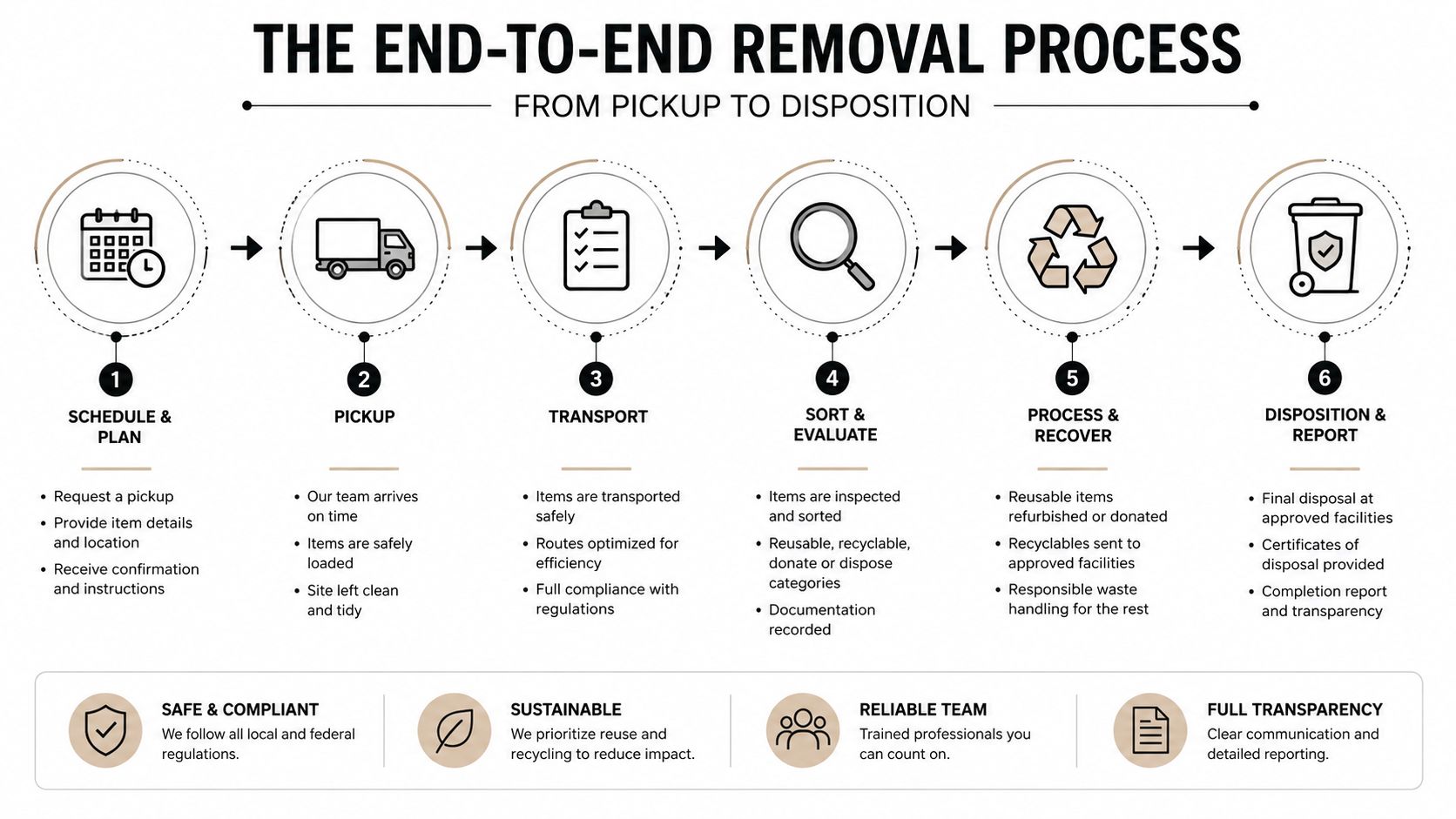
1. Scope and inventory reconciliation
Start with the approved asset list, site maps, rack elevations, equipment categories, and access requirements. The removal team should compare the planned inventory with an on-site scan, recording manufacturer, model, serial number, barcode, condition, and data-bearing status. Differences get resolved before loading begins, not after equipment reaches a processing facility.
2. Schedule and route the move
The project manager sets the work window, loading sequence, elevator access, dock requirements, and transport route. Where a facility needs temporary staging capacity, teams may evaluate flexible portable storage units as part of a controlled logistics plan. Storage doesn't replace custody controls, but it can help separate approved staging from active work areas.
3. Validate technicians and prepare the site
Technicians should arrive with documented authorization, badges, personal protective equipment, packing materials, and the approved work order. Before de-racking, the team confirms power-down status, cable and component handling requirements, floor protection, and the location of locked containers.
4. Remove, pack, and record
Servers, switches, storage, and laptops need different packing approaches. Anti-static materials, rack-safe handling, shock protection, and labeled containers reduce physical damage and substitution risk. At the loading dock, staff capture serial numbers, match them to packing lists, apply tamper-evident seals, and obtain a signed transfer.
5. Transport and intake
Locked cages or sealed containers, controlled access, and GPS-tracked transport create evidence during transit. At arrival, the processing facility scans the shipment, checks seals, records exceptions, and places assets into a restricted-access holding area. The intake record should reconcile to the loading-dock record before sanitization or destruction begins.
6. Sanitize, recover, recycle, and report
Assets move into the appropriate queue. Reusable equipment may be sanitized and assessed for remarketing, while non-reusable or sensitive media may be physically destroyed. Downstream processing then separates resale, parts recovery, and certified recycling, with certificates and reconciliation reports issued only after asset-level records are complete. End-to-end ITAD services should make this entire sequence visible in one project file.
Chain of Custody and Secure Data Destruction as Compliance Pillars
Chain of custody proves control. Data sanitization proves that information is no longer accessible. Neither pillar is sufficient alone.
The custody record starts with the originating asset tag and continues through every transfer point, signature, transport scan, facility intake, processing event, and final reconciliation. A receipt showing that equipment was collected doesn't establish what happened to each drive. An accurate destruction certificate without a trustworthy custody trail doesn't prove that the certificate relates to the asset that left your facility.
Sanitization follows the asset's end state
NIST defines sanitization as making access to target data infeasible for a given level of effort. Its decision logic distinguishes Clear, Purge, and Destroy, with the appropriate method depending on data sensitivity, reuse plans, organizational control, and media type. Federal guidance favors purging when sensitive media will leave organizational control, while media that won't be reused may require destruction. See the chain-of-custody requirements for IT asset disposal for the operational record this decision requires.
| Asset Class | Recommended Sanitization Action | Resulting Certificate | Typical Audit Trigger |
|---|---|---|---|
| Reusable laptop | Clear or Purge, verified against the selected standard | Asset-level data sanitization record | Device leaves organizational control |
| SSD or NVMe drive | Purge using a method appropriate to the media, or Destroy | Purge attestation or destruction certificate | Storage media is remarketed or transferred |
| Server storage array | Purge or Destroy based on sensitivity and reuse | Serial-level certificate tied to the array and drives | Data center decommission |
| Non-reusable hard drive | Destroy when reuse isn't permitted | Certificate of destruction | Media can't be reliably reused |
| Mobile device | Clear or Purge, followed by verification | Device-level sanitization record | Device enters resale or donation stream |
The FTC Disposal Rule requires anyone who maintains or possesses consumer information for a business purpose to take reasonable measures against unauthorized access or use during disposal. For electronic media, that can include destroying or erasing the media so information can't practicably be read or reconstructed, as stated in the FTC Disposal Rule.
The same evidence supports broader privacy and sector controls, including HIPAA, GLBA, PCI DSS, and applicable state breach notification obligations. Certificates carry practical legal weight only when they map back to identifiable assets through an intact chain.
Wiping Versus Physical Destruction and When Each Fits
Wiping and physical destruction solve different problems. The right choice depends on the media, the data, the intended disposition, and whether the organization can accept reuse.
Software-based wiping is generally appropriate for laptops, desktops, and storage devices that retain resale or redeployment value and can be sanitized using a validated process. The provider should verify the result and record the method, technician, timestamp, and asset identifier. A factory reset alone isn't an adequate enterprise control because it may not address all recoverable areas of the media.
Degaussing applies to compatible magnetic media, not every modern SSD or NVMe device. Shredding and crushing provide a physical endpoint when media can't be sanitized reliably, when reuse isn't allowed, or when the sensitivity of the information outweighs residual value. On-site destruction is particularly appropriate for high-security environments that can't release media before destruction.
| Asset Class | Recommended Method | Data Sensitivity Fit | Certificate Artifact |
|---|---|---|---|
| Reusable laptop | Verified software purge | Sensitive data with approved reuse | NIST-aligned purge attestation |
| Reusable SSD | Media-appropriate purge | Data may be released after verification | Serial-level purge record |
| Legacy magnetic media | Degaussing or shredding | Higher sensitivity or uncertain reuse | Destruction or degaussing certificate |
| Non-reusable drive | Physical destruction | Any data that must not leave control | Certificate of destruction |
| High-security rack media | On-site destruction | Regulated or exceptionally sensitive data | Witnessed destruction log |
Every certificate should identify the asset, serial number, sanitization method, responsible technician, timestamp, and reconciliation status. The hard drive shredding versus data wiping comparison is useful when procurement and security teams need to document the trade-off.
Decision rule: If the device has meaningful post-use value and the data is software-purgeable, wipe and remarket it. If the data outlives the device's useful life or carries regulated sensitivity, destroy it at the rack.
What Drives Pricing for Enterprise White Glove Projects
Enterprise removal pricing reflects risk, labor, logistics, documentation, and recovery value. A quote based only on device count hides the variables that determine the actual workload.
The first drivers are asset density and equipment class. Server racks, storage arrays, and networking hardware require different labor, packing, lifting, staging, and transportation resources than laptops. A multi-site project adds route planning, scheduling coordination, regional labor, and reconciliation across locations.
Data sensitivity changes the service design. On-site destruction, dual witnessing, restricted staging, specialized containers, and expanded reporting cost more than a basic pickup. Packing and crate engineering also matter when equipment must be returned under lease, moved between facilities, or protected for redeployment.
Documentation scope should appear as a line item. Ask whether the quote includes inventory reconciliation, serialized custody records, certificates, downstream reporting, value recovery statements, and exception handling. Those records reduce internal rework and help legal, security, finance, and sustainability teams close the same project.
Residual value can offset project costs when laptops, servers, networking equipment, or parts remain suitable for resale. That offset should be shown transparently, with asset-level valuation logic and a clear treatment for equipment that goes to recycling instead.
Be cautious with headline “free removal” offers. They may monetize recoverable equipment while providing little visibility into fees, downstream partners, data handling, or the final disposition of low-value assets. Build a budget around labor, transport, security controls, reporting, and expected recovery rather than choosing the lowest initial number.
How to Evaluate and Select the Right Provider
A truck and a recycling license don't qualify a provider for enterprise white glove work. Data center decommissioning requires technical labor, controlled logistics, secure processing, environmental accountability, and documentation that withstands scrutiny.
Verify certifications and liability coverage
Request current evidence of relevant credentials and registrations, including R2v3, RIOS, NAID AAA, ISO 14001, and state-level e-waste registration where applicable. Confirm the certification scope, site coverage, expiration status, and downstream requirements. Insurance limits should match the value of the equipment, the sensitivity of the data, the facilities involved, and the contractual liability profile.
Ask operational questions that expose gaps
Use a written checklist rather than accepting a polished capabilities deck:
- Pickup staffing: Who performs the work, and are technicians trained, background-checked, and badged?
- On-site controls: Can the provider de-rack, pack, seal, inventory, and destroy media on-site?
- Certificate fields: Do certificates include serial numbers, methods, dates, technicians, and custody references?
- Reconciliation: How are dock records matched to facility intake and final disposition?
- Downstream accountability: Which processors, refurbishers, exporters, or recyclers receive assets?
- Exception handling: What happens when a serial number is missing, a seal is broken, or inventory doesn't match?
- Insurance: What coverage applies during removal, transport, storage, and processing?
- References: Can the provider supply commercial references that have undergone audits?
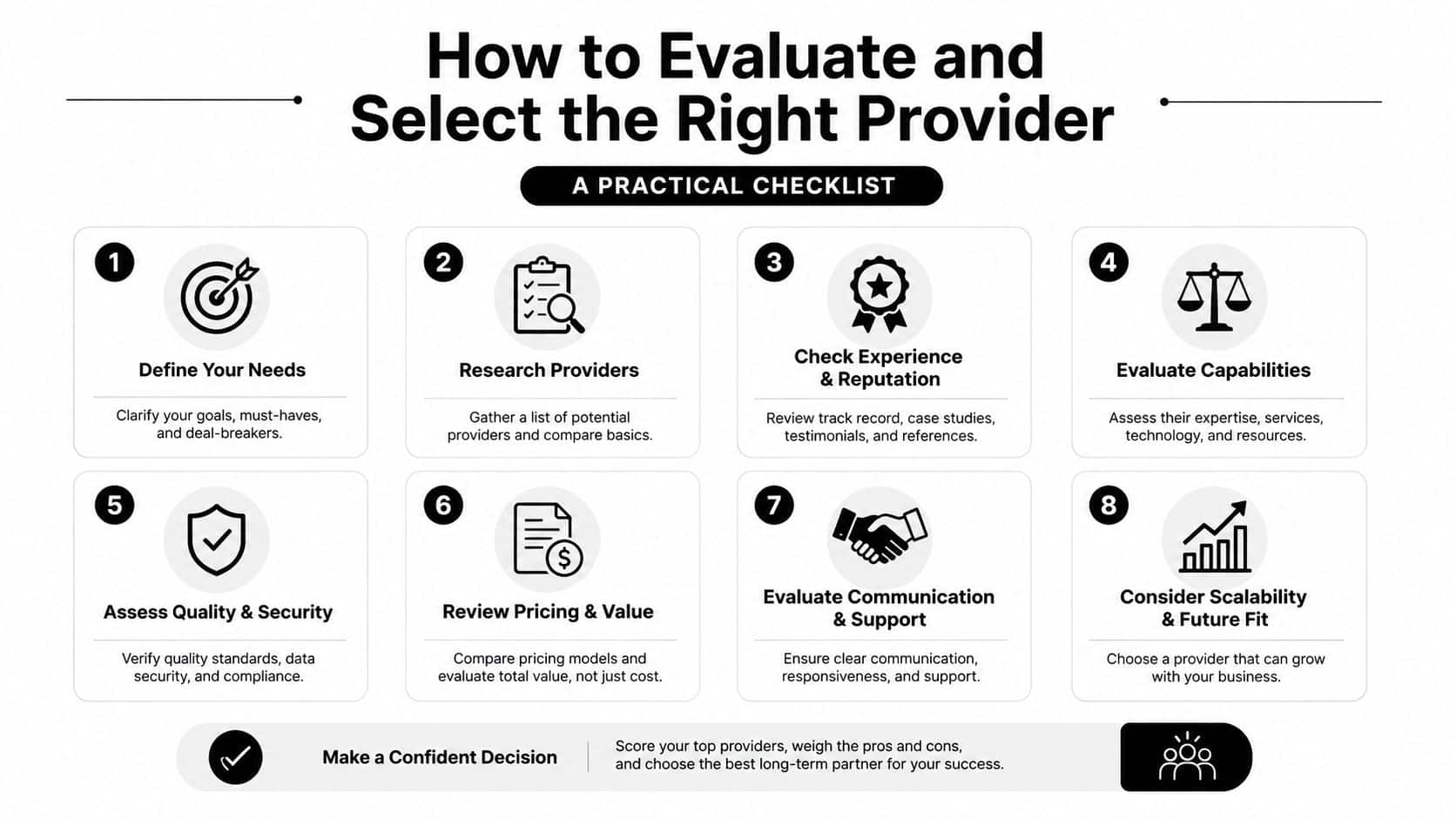
Red flags include vague certificates, a refusal to permit witnessing, unclear subcontracting, no serial-level reconciliation, and a proposal that treats data-bearing equipment like mixed scrap. Ask for a sample certificate and a sample final report before awarding the work. The vendor due diligence checklist can help procurement standardize that review.
Value Recovery Sustainability and Common Use Cases
A secure record also protects financial and environmental value. Once each asset is identified and its data disposition is controlled, the provider can decide whether to redeploy, remarket, donate, harvest for parts, or recycle it through an accountable downstream channel.
Consider an Atlanta or Smyrna pickup coordinated with nationwide logistics. The client may see one scheduled project window, while the provider manages site access, regional transportation, processing queues, resale decisions, and recycling documentation. That invisible coordination is useful for data center decommissioning, office refreshes, end-of-lease returns, merger migrations, and compliance-driven hardware replacement.
One mixed fleet, several outcomes
A mixed fleet of 500 assets shouldn't receive one automatic disposition. Laptops may retain resale value after verified sanitization. Servers and networking gear may be redeployed, sold for parts, or recycled depending on condition and market demand. Damaged or obsolete equipment should move through certified recycling, while selected items may support an approved donation program.
| Asset Class | Resale/Redeploy | Donation/Parts | Certified Recycling | Typical Notes |
|---|---|---|---|---|
| Laptops | Suitable units can be sanitized and remarketed | Some units may support donation or parts recovery | Damaged units require recycling | Condition and data status determine the branch |
| Servers | Working systems may be redeployed or sold | Components can support parts recovery | Obsolete systems move to recycling | Configuration and market demand matter |
| Networking gear | Usable equipment may retain recovery value | Parts or approved donation may fit | End-of-life units require recycling | Model, condition, and supportability affect disposition |
| Storage media | Reuse only after approved sanitization | Parts recovery may be limited | Destroyed media follows certified processing | Sensitivity can override recovery value |
| Peripherals | Selected items may be reused | Donation or parts may be appropriate | Mixed low-value items enter recycling | Inventory and downstream controls remain necessary |
The Global E-waste Monitor reports that global e-waste reached 62 million tonnes in 2022, equal to 62 billion kilograms and about 7.8 kilograms per person worldwide. Only 22.3% was formally collected and recycled in an environmentally sound manner, and the report projects annual generation to reach 82 million tonnes by 2030. That trajectory makes certified downstream processing a core enterprise sustainability and risk control, not a cosmetic reporting exercise. Global E-waste Monitor 2024 provides the underlying data.
Practical Takeaways and Next Steps for Your Team
Before scheduling pickup, require your team and provider to answer these questions:
- Scope: Has every site, rack, device class, and remote asset been included in the asset census?
- Sanitization: Is each media type assigned Clear, Purge, or Destroy based on sensitivity and final disposition?
- Custody: Will barcodes, serial numbers, seals, signatures, transport records, and intake scans remain linked?
- Certificates: Will destruction and recycling documents identify each applicable asset and downstream outcome?
- Recovery: Will the provider separate redeployable, remarketable, donation, parts, and recycling candidates?
- Compliance: Have you reviewed certifications, registrations, insurance, subcontractors, and sample reports?
- Pilot: Can the provider demonstrate the workflow on a controlled portion of the project before a multi-site rollout?
Request sample certificates before signing. Ask for a written exception process. Have security, facilities, procurement, legal, and sustainability stakeholders approve the control design, not just the price.
The correct outcome is more than an empty data center. It's an audit-ready record, a defensible data destruction decision, recovered value where appropriate, and a sustainability record your organization can stand behind.
Beyond Surplus provides commercial white glove IT asset removal, secure data wiping, hard drive shredding, electronics recycling, value recovery, and data center de-installation with documented custody and disposition. Visit Beyond Surplus to scope your project, request a quote, and evaluate the controls needed for a secure enterprise removal.