A storage room full of retired laptops may look like an end-of-life problem. It may be an asset-management problem. In 2022, the world generated a record 62 million tonnes of e-waste, but only 22.3% was formally collected and recycled in environmentally sound systems according to the Global E-waste Monitor. For enterprise IT, the more revealing question is what happens before equipment reaches a recycler.
Many organizations keep functioning laptops, desktops, network devices, laboratory equipment, and medical technology in closets, staging areas, warehouses, or former employee homes. The strongest circular-economy opportunity often sits there, waiting for accurate inventory, secure data handling, and a clear triage decision.
Table of Contents
- What the Circular Economy Means for Enterprise IT Equipment
- Why IT Leaders Are Adopting Circular IT Strategies
- Compliance and Reporting Requirements for Retired IT Equipment
- Business Models for Circular Enterprise IT
- Building Your Enterprise Circular-IT Roadmap
- KPIs and Cost Models That Prove the Program Works
- How a Real Enterprise Runs a Circular IT Program
- Next Steps to Start Your Circular IT Program
What the Circular Economy Means for Enterprise IT Equipment
An office laptop that still boots shouldn't automatically go into a disposal pallet. A device may be too old for one employee but suitable for a lower-demand role, a temporary workstation, a training room, or a spare pool. That shift in thinking captures the practical meaning of Circular Economy and Enterprise IT Equipment.
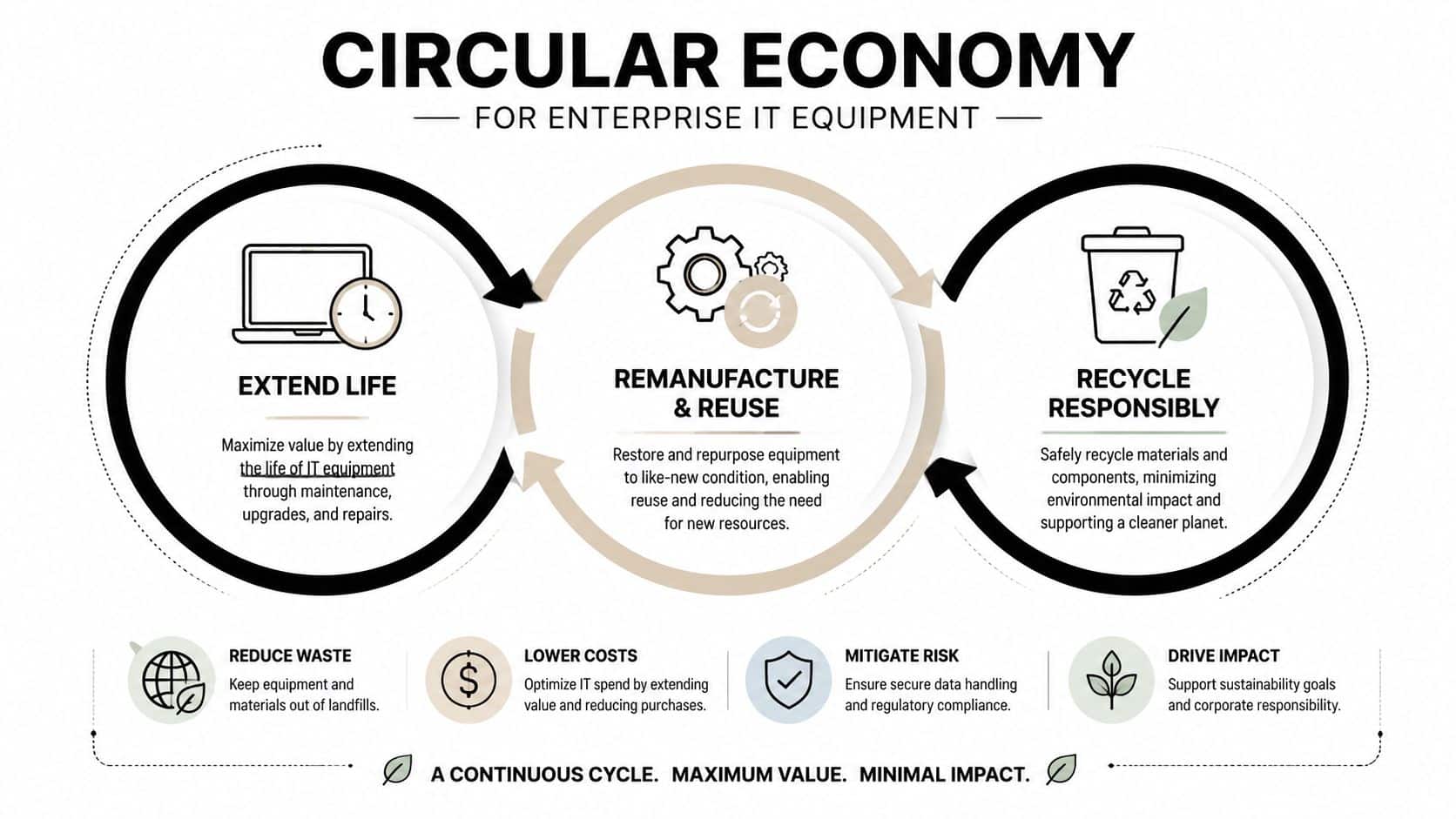
The circular economy replaces the linear pattern of buy, use, and discard with managed loops:
- Keep equipment in service longer. Repair, upgrade, or reassign a device when its performance and security remain acceptable.
- Refurbish and reuse it. Securely erase data, test the hardware, replace worn components, reset the software environment, and redeploy it internally or through a controlled resale channel.
- Recover materials when reuse isn't appropriate. Certified recycling separates metals, plastics, circuit boards, and other materials through accountable downstream processing.
The laptop test
Suppose a four-year-old laptop has a working display, keyboard, battery, and solid-state drive. The device may no longer meet the requirements of a software engineer, but it could serve a call-center employee, a seasonal worker, or a conference-room role. A responsible process first checks security support, condition, configuration, and demand. Recycling becomes the final route, not the default route.
This order matters because manufacturing usually creates the largest share of a device's lifecycle emissions. One independent assessment found that refurbishing a laptop could avoid up to about 280 kg of CO2e per unit, and refurbishing and reusing it twice could avoid up to about 560 kg of CO2e according to the cited assessment.
For an IT director, circularity means treating each asset as a decision rather than a waste item. That decision may involve redeployment to another department, certified refurbishment, parts harvesting, resale, or material recovery. This guide to improving ESG through IT recycling provides additional context for connecting those actions with broader business objectives.
The central insight is simple: the largest recoverable value may be trapped inside the organization before retirement logistics even begin.
Why IT Leaders Are Adopting Circular IT Strategies
Circular IT gives leaders a way to connect sustainability with familiar operating concerns. A redeployed laptop can reduce pressure on procurement. A documented disposition record can support an audit. A functioning server sent through controlled remarketing can return value instead of occupying secure storage.
The environmental case is also concrete. The small IT and telecommunications category, which includes laptops, mobile phones, routers, and GPS devices, generated 4.6 million tonnes of e-waste in 2022, while only about 22% was documented as collected and recycled in the global reporting from the International Telecommunication Union. That gap represents equipment moving outside formal reuse, refurbishment, and recycling channels.
Three concerns, one operating model
| Benefit Category | IT Leader Concern | Representative Metric | Linear Disposal Baseline |
|---|---|---|---|
| Cost control | Can we avoid unnecessary replacement purchases? | Redeployment value and avoided procurement | Buy new when idle assets remain unidentified |
| Sustainability | Can we reduce the impact of manufacturing and disposal? | Reuse, refurbishment, and material-recovery outcomes | Retire equipment without separating reuse from recycling |
| Risk reduction | Can we prove where devices went and how data was handled? | Certificate completeness and chain-of-custody exceptions | Untracked assets in storage or informal disposal channels |
Circular IT also exposes hidden costs that ordinary disposal reports miss. Idle inventory consumes storage space, creates security concerns, and may cause teams to buy replacement equipment because nobody can locate or trust existing stock. A poorly controlled retirement program can leave serialized assets absent from records, data destruction unsupported by evidence, and downstream treatment unclear.
Practical rule: Treat reuse, resale, and recycling as separate outcomes in your disposition data. If every device is labeled only as “disposed,” finance and sustainability teams can't see what the program achieved.
Lifecycle guidance for IT and data-center equipment separates pre-use, use, and post-use impacts. That distinction helps teams report whole-device reuse, component reuse, and recycling separately rather than treating all diversion as equivalent as described in industry lifecycle guidance. Circular IT is therefore more than a sustainability initiative. It's a financial, operational, and security discipline.
Compliance and Reporting Requirements for Retired IT Equipment
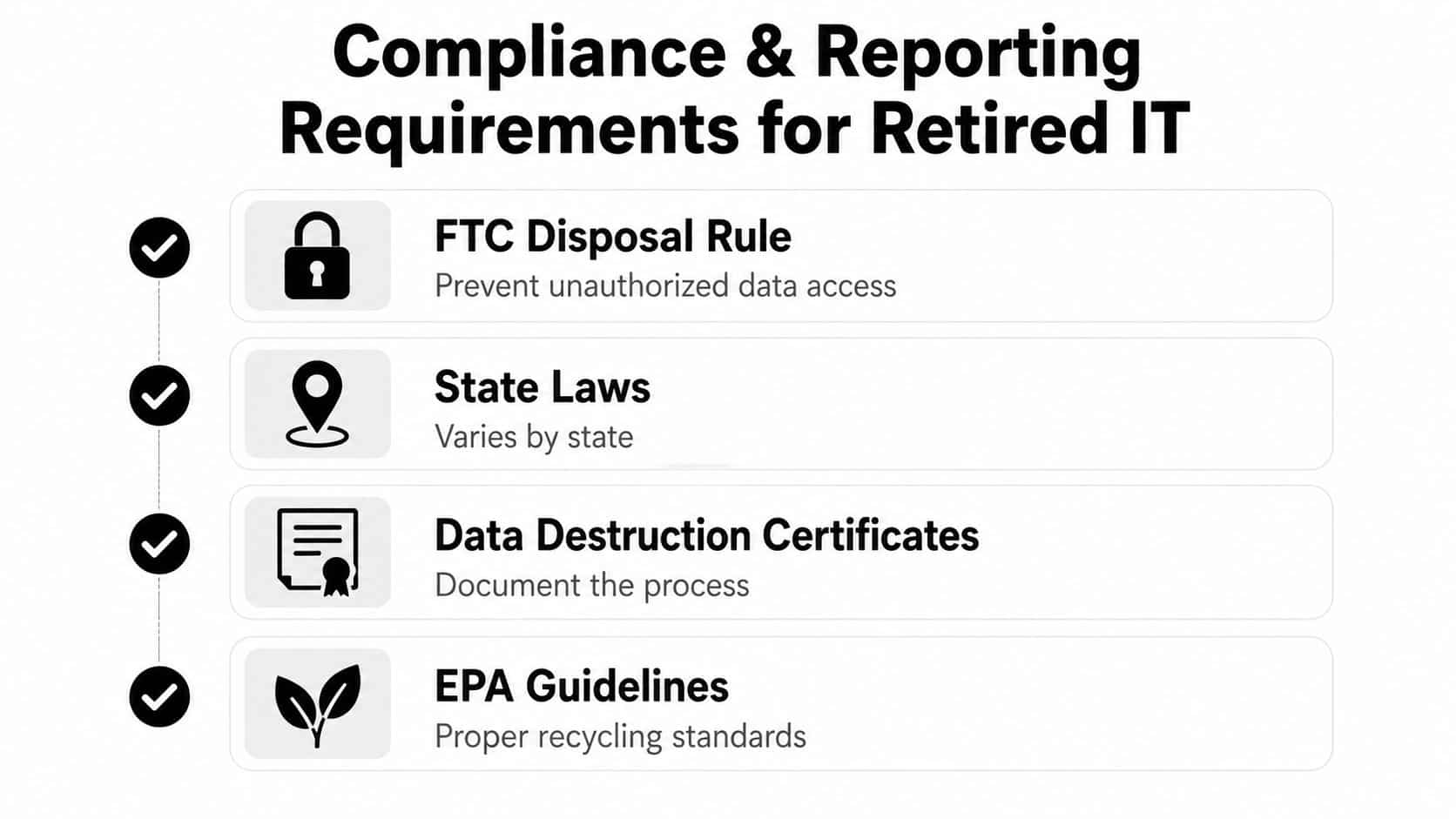
Retired equipment can contain customer records, employee information, credentials, proprietary files, or regulated data. In the United States, the FTC Disposal Rule requires businesses and other covered entities to take reasonable measures to protect consumer report information from unauthorized access or use during disposal. The rule applies to paper, electronic, and other records containing that information as explained in the rule background.
That requirement doesn't prescribe one universal workflow. It does require a defensible one. Your organization should know which assets were collected, who handled them, what sanitization method was used, and what happened afterward.
What a defensible record contains
A practical compliance file usually connects:
- Serialized asset records: Device serial number, asset tag, model, location, assigned user, and disposition status.
- Sanitization evidence: The method used, the date, the operator or system, and the result. Devices intended for reuse need a method appropriate to their storage media and risk profile.
- Chain-of-custody logs: Pickup details, transfer points, transport records, receiving confirmation, and final disposition.
- Downstream accountability: The identity and role of processors, refurbishers, resellers, and recyclers handling the equipment.
- Reporting fields: Reuse, component recovery, recycling, destruction, and value-recovery outcomes for internal sustainability and financial reporting.
European operations face another layer of expectations. The recast WEEE Directive 2012/19/EU entered into force on 13 August 2012 and established collection targets of 45% from 2016 and 65% from 2019 onward. Eurostat reports that the EU WEEE collection rate reached 40.1% in 2022, calculated against the average weight of equipment placed on the market during the prior three years, while equipment placed on the EU market grew from 7.6 million tonnes in 2012 to 14.4 million tonnes in 2022 in official Eurostat metadata.
Compliance is only the floor
State e-waste requirements, privacy obligations, and sector rules can change the handling requirements for a specific asset class. Healthcare organizations, financial institutions, government agencies, and companies operating across borders should map their data categories before choosing a disposition route.
Common audit failures include missing devices, incomplete sanitization certificates, and vendors that resell equipment without clear certification or downstream evidence. A documented compliance documentation process helps turn individual certificates into a repeatable control system.
Business Models for Circular Enterprise IT
Organizations can build circular IT around several commercial models. These models overlap, but they don't solve the same problem.
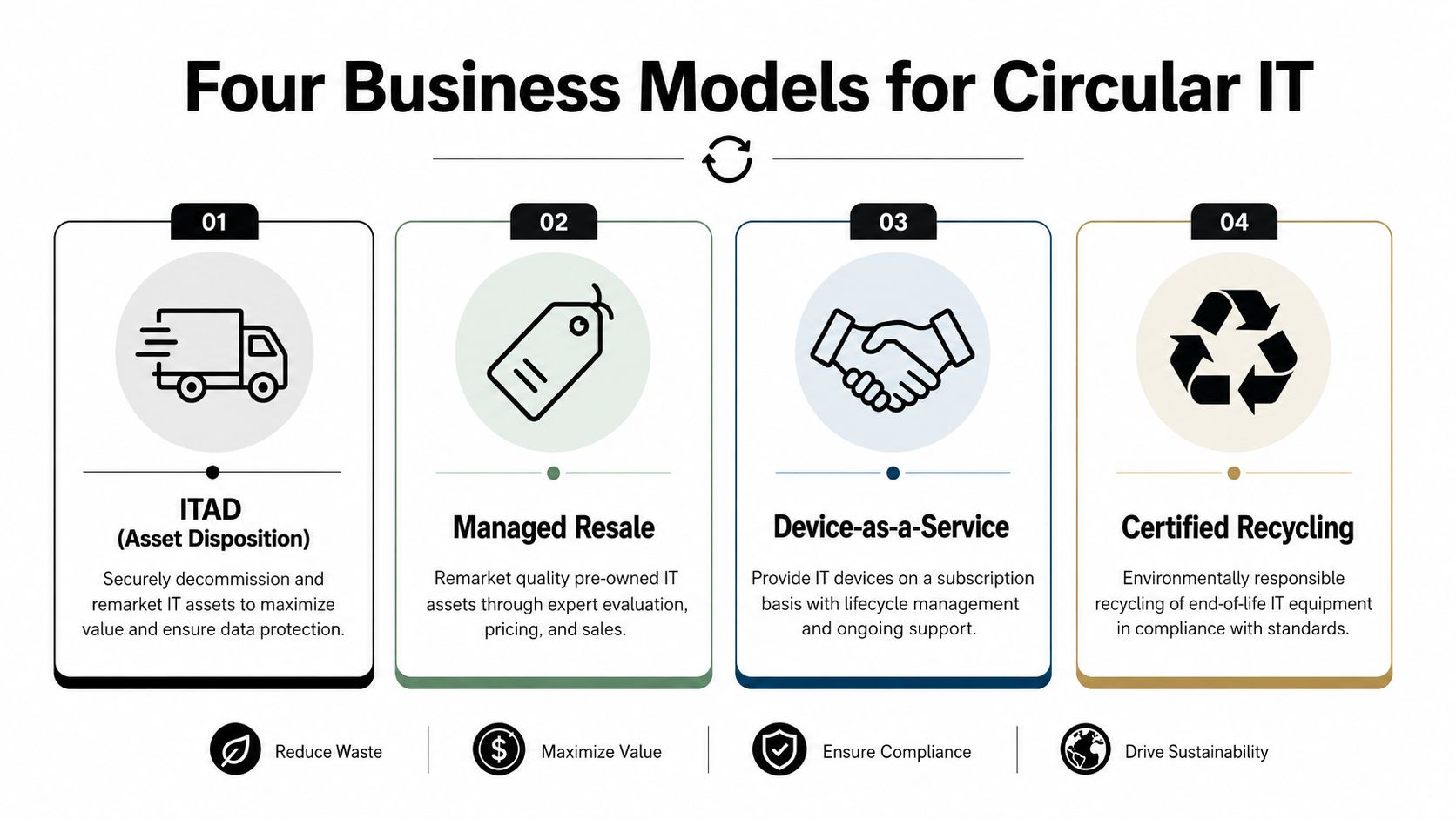
IT asset disposition, or ITAD, manages collection, secure data destruction, valuation, remarketing, and certified recycling. It's useful when an organization has mixed equipment, multiple locations, or a major refresh requiring coordinated logistics.
Refurbishment and redeployment focus on extending useful life. A provider may test hardware, replace components, reset software, grade condition, and return equipment ready for another user. This model fits organizations with standardized laptop fleets and predictable internal demand.
Buyback and trade-in offer a faster path to value recovery. The contract should define title transfer, data-erasure responsibility, failure adjustments, payment terms, and the treatment of equipment with no resale value. A guaranteed offer may be easier to budget than a later market-dependent payment.
Leasing and device-as-a-service shift some lifecycle responsibility to a provider. These arrangements can simplify refresh planning, although they may reduce direct control over the underlying assets and disposition decisions.
Compare the operating choices
| Model | Primary purpose | Typical value | Key control | Best fit |
|---|---|---|---|---|
| ITAD | Manage the full retirement process | Reuse, resale, and material recovery | Chain of custody and final reporting | Mixed enterprise fleets |
| Refurbishment | Prepare equipment for another use | Extended service life and internal availability | Testing, grading, and secure reset | Standardized laptops |
| Buyback | Convert eligible equipment into proceeds | Cash or trade-in value | Contract terms and valuation transparency | Planned refreshes |
| Device-as-a-service | Transfer part of lifecycle management | Predictable refresh operations | Provider accountability and asset visibility | Organizations prioritizing subscription operations |
| Certified recycling | Recover materials from non-reusable equipment | Material recovery and risk control | Environmental processing and downstream records | Failed or obsolete assets |
Remarketing also requires channel governance. Teams selling refurbished products through marketplaces can use Amazon refurbished channel control tips to think through condition descriptions, inventory accuracy, packaging, and customer expectations. The same principles apply when an enterprise sells through a managed partner.
Internal redeployment should generally come before external resale, followed by certified material recovery when reuse isn't practical. Organizations comparing laptop recovery options can use a business laptop buyback program guide as part of their evaluation.
Building Your Enterprise Circular-IT Roadmap
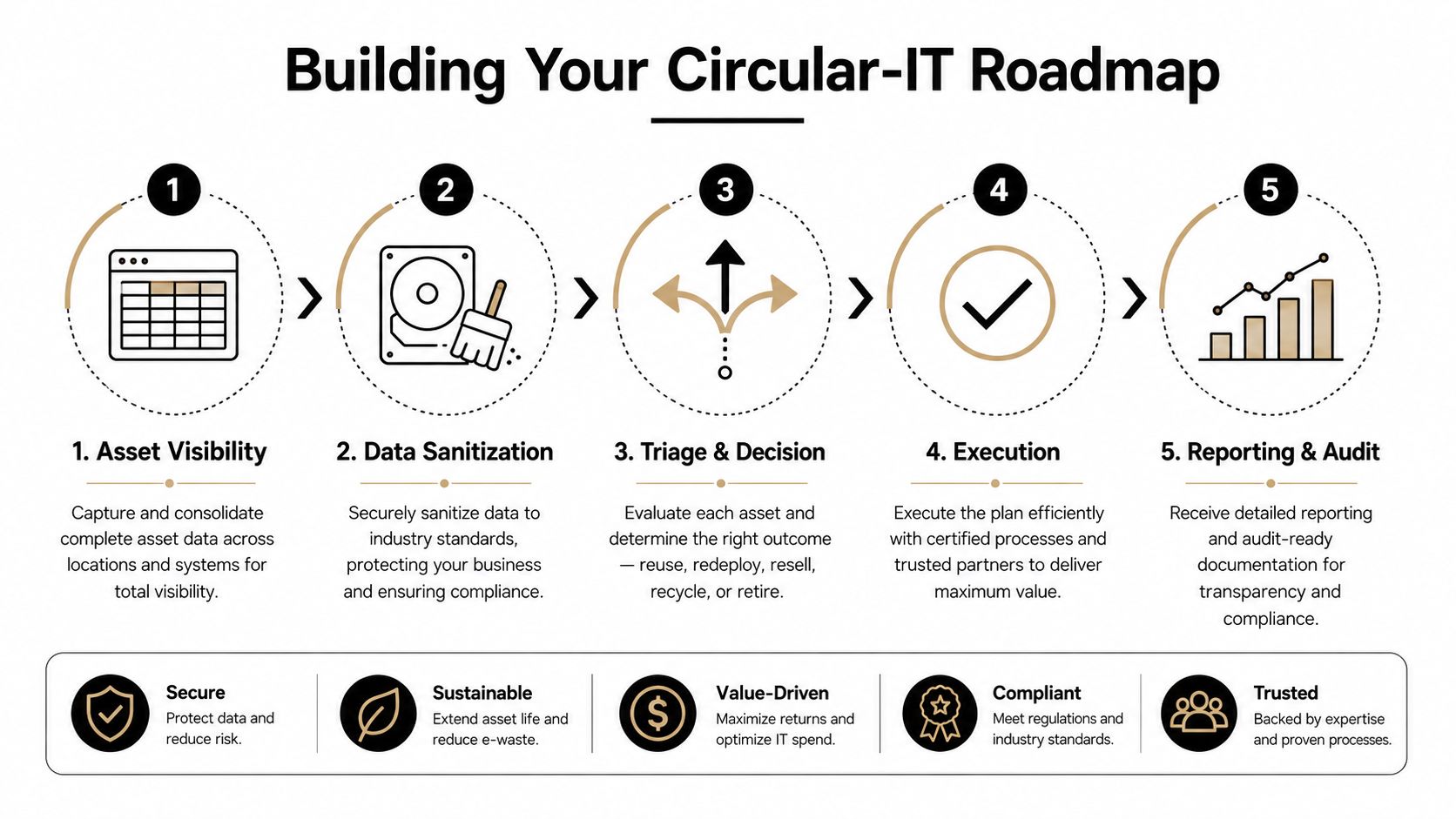
Start with visibility, not a pickup appointment. An organization can't redeploy equipment it can't locate, and it can't prove responsible disposition when its inventory records stop at “sent to recycler.”
Create one connected inventory for each relevant device. Useful fields include the serial number, asset tag, assigned user, physical location, configuration, finance record, security status, warranty or lease terms, and expected refresh date. Reconcile that inventory against procurement records, endpoint-management tools, identity systems, warehouse lists, and data-center records.
A practical sequence
- Discover the fleet. Include offices, storage rooms, staging areas, remote workers, laboratories, clinics, and data centers.
- Classify condition and risk. Separate working, repairable, incomplete, obsolete, damaged, and data-sensitive assets.
- Apply triage rules. Decide whether each item should be repaired, redeployed, allocated to another business unit, sold, donated where permitted, harvested for parts, or recycled.
- Control execution. Use approved transport, documented handoffs, secure sanitization, and serialized disposition records.
- Review outcomes. Compare the result with procurement, finance, security, sustainability, and compliance requirements.
Make the rules operational
Your end-of-life policy should address purchase approval, maintenance, redeployment standards, data wiping, transport, title transfer, destruction certificates, and exceptions for medical, laboratory, or specialized equipment. Vendor reviews should test certification status, subcontractor controls, audit rights, insurance, environmental practices, erasure methods, and report detail.
| Stage | Core action | Output |
|---|---|---|
| Asset visibility | Reconcile records and locate equipment | Trusted inventory |
| Data sanitization | Apply an approved method based on risk and reuse intent | Sanitization evidence |
| Triage and decision | Select reuse, resale, parts recovery, or recycling | Disposition assignment |
| Execution | Collect, process, and document each asset | Chain-of-custody record |
| Reporting and audit | Review results with IT, finance, and sustainability teams | Circular-IT scorecard |
Pilot the process with one device category and one region. Correct missing fields, unclear approvals, and vendor handoff problems before expanding across business units. A structured IT asset lifecycle management approach keeps procurement, use, maintenance, and disposition connected.
KPIs and Cost Models That Prove the Program Works
A circular-IT program needs two scoreboards. The first measures asset recovery. The second measures control quality. A high resale result doesn't compensate for missing data-destruction evidence, and a perfect certificate file doesn't reveal whether the organization unnecessarily purchased replacement equipment.
Track inventory coverage, located-device rate, utilization, idle time, redeployment rate, repair turnaround, post-redeployment failure, resale yield, recycling rate, erasure pass rate, certificate completeness, and chain-of-custody exceptions. Group results by device type and age so a laptop fleet isn't compared directly with servers, desktops, or networking equipment.
Separate value from cost
The financial model should distinguish recovered income from avoided expenditure. Potential value sources include resale proceeds, buyback payments, lease credits, warranty recovery, and avoided purchases through internal redeployment. Program costs include labor, repair, refurbishment, storage, collection, logistics, sanitization, vendor management, and compliance administration.
A defensible formula is:
Net annual benefit = resale income + avoided purchase, storage, and disposal costs, minus collection, repair, sanitization, logistics, and vendor fees.
Don't count gross resale value as contribution until preparation costs are included. A device that sells for a strong amount may still produce limited net value if it requires extensive repair, shipping, testing, or storage.
| Category | KPI or formula | Evidence needed |
|---|---|---|
| Visibility | Located assets divided by recorded assets | Inventory reconciliation and scan records |
| Reuse | Redeployed devices divided by eligible devices | Assignment records and redeployment approvals |
| Recovery | Net value per processed asset | Valuation, repair, logistics, and payment records |
| Security | Passed sanitizations divided by sanitization attempts | Erasure logs and exception records |
| Accountability | Complete certificates and custody records | Serialized certificates and transfer logs |
| Sustainability | Reuse, component recovery, and recycling by weight or unit | Processor reports and disposition files |
Finance and IT should agree on asset grades, assumptions, evidence standards, and treatment of avoided costs before benefits enter a business case. A well-maintained inventory optimization program can supply the data needed to identify idle equipment before teams buy more.
How a Real Enterprise Runs a Circular IT Program
Consider Northstar Mutual, a fictional insurance company with 8,000 employees. At the start of its fiscal year, the IT team found 4,200 laptops in active use, 1,150 idle laptops in storage rooms and home offices, and 600 desktops marked for disposal.
The discovery changed the project scope. Instead of sending every device to a recycler, the team added user demand, security status, condition, configuration, and location to the triage file. Managers identified new hires, temporary teams, and lower-demand roles that could accept existing equipment.
From idle stock to controlled reuse
The team redeployed 680 idle laptops, avoiding $1.1 million in procurement. The remaining idle devices required different decisions. Some needed repair, some lacked power adapters, and some failed the security or performance requirements for internal reassignment.
Northstar sent 420 retired but functional devices to a refurbishment partner. After testing, secure data handling, grading, and remarketing, those devices generated $310,000 in resale. The company recorded the preparation costs separately so the reported result reflected net recovery rather than gross proceeds.
| Disposition Channel | Devices | Outcome | Value or Impact |
|---|---|---|---|
| Internal redeployment | 680 | Laptops assigned to new hires and other users | $1.1 million in avoided procurement |
| Refurbishment and resale | 420 | Functional devices tested and remarketed | $310,000 in resale |
| Certified ITAD | 600 | Desktops processed through documented disposition | Material recovery and controlled retirement |
| Secure destruction subset | 180 | Devices holding customer data processed with serialized certificates | Evidence of destruction and chain of custody |
The 600 desktops moved through certified ITAD. Of those, 180 devices held customer data and received serialized certificates of destruction or sanitization appropriate to the selected route. Remaining equipment went through material recovery rather than informal disposal.
Northstar's reporting linked every endpoint to its original user, location, custody transfer, sanitization result, and final outcome. That connection let security teams verify data handling, finance teams review recovered value, and sustainability teams distinguish redeployment from recycling.
The lesson isn't that every enterprise will produce the same result. The lesson is that the outcome became visible only after Northstar combined inventory control with triage. Without the initial discovery, the idle laptops would have remained a storage problem and the company might have purchased equipment it already owned.
Next Steps to Start Your Circular IT Program
The first ninety days should produce a working control loop, not a perfect enterprise-wide transformation. Focus on finding internal value, protecting data, and creating evidence that leadership can review.
Days one through thirty
Begin with a fleet audit across offices, warehouses, data centers, laboratories, clinics, and remote-worker locations. Reconcile endpoint-management records with procurement, finance, warehouse, and security data. Classify devices by age, condition, configuration, data sensitivity, ownership status, and likely demand.
Look specifically for assets that are powered off, unassigned, awaiting repair, held after an employee departure, or separated from their accessories. Mark those items as candidates for redeployment, not automatic waste.
Days thirty-one through sixty
Write the operating policy. It should define who approves retirement, who confirms data sensitivity, which sanitization methods are acceptable, how assets move between locations, what documentation vendors must provide, and how the organization handles product destruction, medical equipment disposal, laboratory equipment disposal, and data-center decommissioning.
Select partners using evidence rather than price alone. Review certification, insurance, downstream controls, chain-of-custody practices, reporting samples, data-erasure methods, and the treatment of equipment that has no resale value. A focused pilot for one laptop category can reveal process weaknesses without exposing the entire fleet to an untested workflow.
Days sixty-one through ninety
Institutionalize the program with a small scorecard. Start with measures such as:
- Redeployment rate: Shows how much eligible equipment returns to internal use.
- Resale recovery: Separates gross proceeds from preparation and logistics costs.
- Landfill diversion: Distinguishes reuse, parts recovery, and certified recycling.
- Sanitization evidence: Shows whether each data-bearing asset has a complete record.
- Inventory accuracy: Identifies whether the organization can locate and explain its equipment.
Connect disposition results to finance, security, procurement, and sustainability reporting. Present the first quarterly review with unresolved exceptions, not just favorable totals. Leaders need to see missing records, stalled repairs, idle inventory, and vendor issues because those findings determine where the next operational improvement belongs.
Circular Economy and Enterprise IT Equipment becomes practical when the organization follows a repeatable order: discover, triage, recover value, sanitize securely, and dispose responsibly. The approach applies to business laptops, servers, routers, medical technology, laboratory equipment, products awaiting destruction, and complete data-center retirement projects.
Beyond Surplus supports business IT asset disposition through secure pickup, data destruction, asset value recovery, certified recycling, product destruction, and documented chain of custody. Visit Beyond Surplus to discuss a circular-IT program that starts with idle equipment visibility and ends with accountable reuse or disposal.