
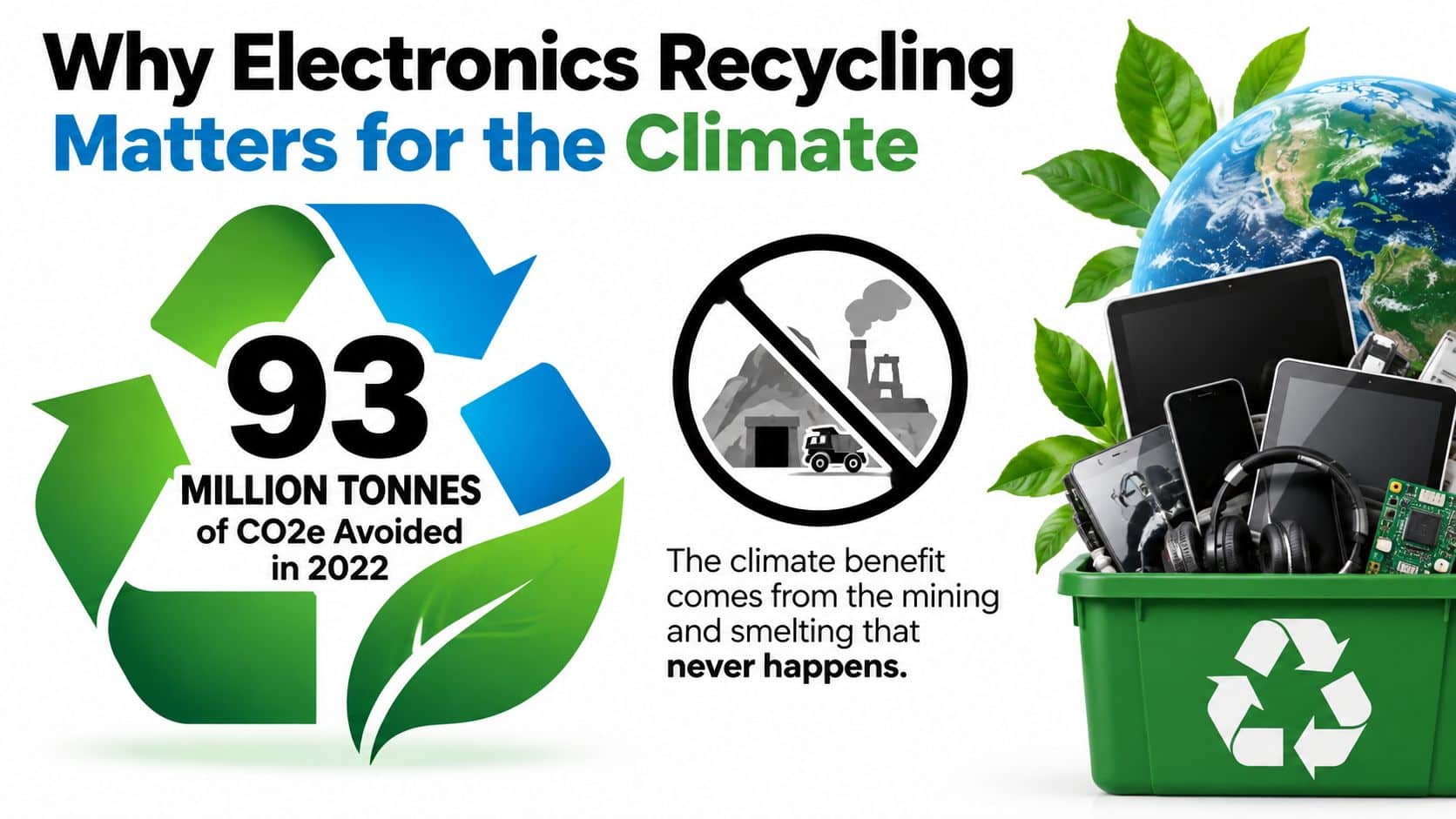
Formal e-waste recycling avoided 93 million tonnes of CO2e in 2022. The largest climate benefit comes from the mining, smelting, and manufacturing that recycling helps displace, not from the recycling plant alone.
For an IT director, that distinction changes the disposal decision. A retired server, laptop, monitor, or medical device isn't merely a waste item. It can become a source of recovered metals, a candidate for reuse, or a missed opportunity to avoid virgin-material production. The quality of the IT asset disposition, or ITAD, contract determines which outcome occurs.
Table of Contents
- Why Electronics Recycling Matters for the Climate
- The Four Mechanisms That Cut Carbon Emissions
- The Numbers Behind the Impact
- Reuse Repair or Recycle the Smarter Choice
- Building an ITAD Program That Lowers Emissions
- Turning Recycling Into Reportable Carbon Savings
- A Practical Path Forward for Your Organization
Why Electronics Recycling Matters for the Climate
Electronics recycling includes collecting, sorting, dismantling, processing, and recovering discarded electrical and electronic equipment. For enterprises, the stream can include laptops, desktops, servers, networking hardware, laboratory and medical devices, displays, and data center infrastructure.
The scale makes disposal a climate decision. The International Telecommunication Union reports that 62 billion kilograms of e-waste were generated in 2022, while only 22.3% was properly collected and recycled. The same report records 93 million tonnes of CO2-equivalent emissions avoided through formal recycling in 2022, including 41 million tonnes from recaptured refrigerants and 52 million tonnes from avoided metal-mining emissions. These figures place electronics recycling within procurement and ITAD planning, not only facilities management.
The benefit sits upstream
A recycling facility consumes fuel and electricity and can create process emissions. Its larger climate value comes from activities recovery can displace, such as mining ore, refining metals, manufacturing feedstock, and releasing refrigerants that remain in cooling equipment.
The result depends on what happens after collection. Formal processing creates controlled material streams and documented downstream routes. Landfilling leaves recoverable resources buried, while uncontrolled dismantling can release hazardous substances and place valuable components outside accountable recovery systems.
Decision lens: Every retired asset either reinforces demand for virgin materials or helps displace it. The ITAD workflow determines that outcome before the device reaches a processor.
For enterprise teams, the mechanisms connect operational choices to carbon results. Material recovery supplies secondary metals, avoided extraction reduces embodied emissions, and efficient processing can reduce the energy needed for new production. Regional routing and responsible logistics also limit unnecessary transport. A secure, documented program converts those mechanisms into a result that procurement and sustainability teams can evaluate, rather than a vague recycling claim.
The Four Mechanisms That Cut Carbon Emissions
The answer to how electronics recycling helps reduce carbon emissions isn't just “keep devices out of landfills.” The stronger explanation follows the material from the retired asset to the next product or process.
1. Material recovery preserves concentrated resources
Circuit boards contain recoverable copper and precious metals, while servers may contain copper busbars, aluminum, steel, and high-value components. A processor that separates these streams can return usable feedstock to manufacturing instead of sending companies back to extract the same resources from ore.
That distinction is important for ITAD buyers. A mixed load sent to an unknown outlet may produce a weaker recovery result than a serialized, sorted shipment handled by a verified downstream processor. The practical question isn't only how much equipment was collected. It's what materials were recovered and where they went.
2. Avoided extraction replaces virgin production
Mining and primary refining require substantial industrial processing. Recycling aluminum and steel avoids some of that primary production, while recovering plastics and glass can reduce demand for new feedstock. A laptop's aluminum chassis, a server's steel frame, and a monitor's glass are therefore carbon-relevant materials, not incidental scrap.
The recycled electronics process should identify these streams before destruction. A business that destroys a working laptop without testing may lose both its reuse value and the opportunity to recover materials in the most suitable way.
3. Energy savings follow material substitution
Secondary production generally avoids parts of the energy-intensive route used to make material from raw resources. Refrigerant recovery adds another dimension. Server-room chillers and cooling equipment can contain substances with high climate impact, so controlled capture can prevent those emissions while supporting compliant equipment retirement.
The result depends on process quality. A recycling operation isn't automatically low-carbon because it handles e-waste. It must control dismantling, capture relevant substances, and document the recovered output.
4. Logistics can strengthen or weaken the result
Regional ITAD processing, consolidated pickups, parts harvesting, and refurbishment can reduce unnecessary movement. A specialist that coordinates data center decommissioning, warehouse staging, and electronic waste pickup can route assets more deliberately than a series of ad hoc shipments.
Reuse-for-resale also changes the material flow. A functioning laptop or network appliance may serve another user, while a failed unit can supply parts before final recycling. These four mechanisms connect directly to enterprise decisions about testing, sanitization, consolidation, vendor selection, and downstream verification.
The Numbers Behind the Impact
Lifecycle benchmarks help IT buyers estimate the value of a project, but they must be used as modeled indicators rather than direct smokestack readings.
An Australian life-cycle assessment found that recycling one tonne of mixed television and computer waste saved 2,071 kg of CO2e, roughly equivalent to planting 34 tree seedlings and growing them for 10 years. The EPA WARM electronics documentation assigns electronics recycling a net benefit of -1.47 metric tons of CO2e per short ton recycled. These figures use different system boundaries and units, so an IT director shouldn't combine them into a single universal factor.
A separate ICT life-cycle analysis found that end-of-life recycling reduced a smartphone's footprint by about 0.8 kg CO2e per year, with a modeled total saving of about 1,640 g CO2e per recycled smartphone. The same analysis reported recycling emissions of about 1.01 g CO2e per gram of aluminum and 0.85 g CO2e per gram of steel recycled. See the life-cycle analysis of ICT products for the modeled boundaries.
Use benchmarks without overstating precision
The evidence doesn't support inventing a universal carbon value for every laptop, rack server, workstation, or monitor. Device weight, composition, condition, recovery route, transport, and the chosen factor all change the result.
| Material | Virgin production | Recycled production | Avoided emissions |
|---|---|---|---|
| Aluminum | Not specified in the verified data | 1.01 g CO2e per gram recycled | Not specified |
| Steel | Not specified in the verified data | 0.85 g CO2e per gram recycled | Not specified |
| Circuit boards | Not specified in the verified data | Not specified | High-value recovery can drive substantial avoided primary production |
| Refrigerants | Not specified in the verified data | Controlled recovery prevents release | A major share of global avoided emissions |
The evidence does support a clear ranking principle. High-metal-content equipment and refrigerant-bearing systems deserve careful routing, while a low-material device may deliver less recovery value. The 2026 field study reported an average reduction factor of 2.865 tonnes of CO2e per ton in 2022, with refrigerants contributing 40.7%, circuit boards 33.0%, and metals 18.3% of the total reduction. It also recorded recycling emissions, so the benefit is real but not free. That is why carbon-offset electronics recycling in Georgia should be evaluated through audited weights, process records, and downstream evidence.
Reuse Repair or Recycle the Smarter Choice
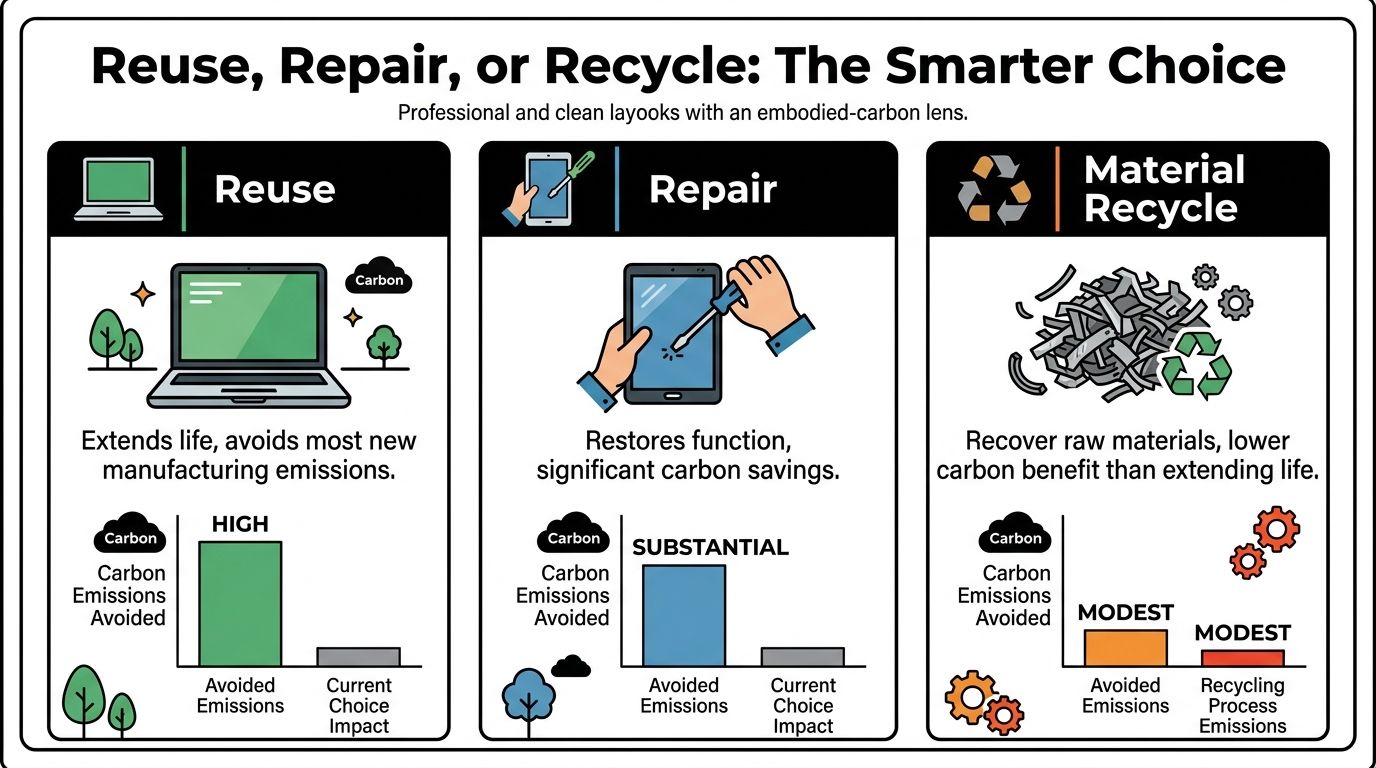
Recycling is often the right end-of-life route, but it isn't automatically the first climate choice. Manufacturing new electronics carries a large embodied burden, and a 2022 global assessment found that embodied emissions from selected ICT devices reached about 580 million metric tons of CO2e in 2020, after increasing 53% between 2014 and 2020. The study projected about 852 million metric tons annually by 2030 without intervention, as reported by the University of California, Irvine study.
The same evidence base found that new-product embodied carbon accounted for 67% ± 15% of total lifetime emissions, with mining, manufacturing, and supply-chain transportation as major sources. For an enterprise, keeping a secure, functional device in service can therefore avoid more upstream emissions than dismantling it immediately for material recovery.
Apply a triage sequence
A practical disposition sequence starts with condition, security, and business need.
- Test working assets first. Devices that pass diagnostics and data sanitization should be considered for redeployment, resale, or controlled donation through an approved business program.
- Repair selectively. Failed laptops, servers, and networking devices may justify component-level repair when replacement parts and secure testing are available. Resources such as computer parts in Sheffield illustrate the broader parts-reuse market.
- Harvest usable components. A device that can't return to service may still contain processors, memory, power supplies, boards, or chassis materials with practical recovery value.
- Recycle the remainder. Non-functional equipment should go to a verified processor with documented material recovery and responsible downstream handling.
The exact age threshold shouldn't be treated as a universal rule. A relatively new device with obsolete software, damaged batteries, or failed security controls may be unsuitable for reuse, while an older system can remain useful in a controlled role. Logistics also matters. Shipping equipment across continents when a qualified regional processor can handle it may erode part of the benefit.
The circular economy approach to electronics gives ITAD teams a useful operating principle: preserve product value first, component value second, and material value third. Recycling becomes the correct route when reuse and repair no longer protect data, safety, performance, or business requirements.
Building an ITAD Program That Lowers Emissions
A lower-emissions ITAD program starts with security and accountability. If a business can't prove where a device went, it can't confidently claim that the recovered material displaced virgin production or that sensitive data was destroyed.
Build the control layer first
Use a documented sanitization standard such as NIST 800-88 for storage media. The workflow should record the asset identifier, serial number, sanitization method, operator, date, disposition, and certificate. For devices that require physical destruction, the process should connect the destruction record to the original asset record.
A serialized chain of custody then follows the equipment from collection through transport, processing, resale, parts harvesting, or recycling. Certificates of data destruction and recycling support compliance and give sustainability teams evidence they can reconcile against asset inventories.
Audit the downstream route
Ask whether the final processor operates under R2v3 or e-Stewards certification, and verify the scope rather than relying on a logo alone. Vendor reviews should address subcontractors, insurance, environmental controls, data security, export restrictions, and the handling of batteries, refrigerants, displays, and medical equipment.
A specialist ITAD partner can consolidate pickups, improve truck utilization, and coordinate data center decommissioning with asset processing. The emissions benefit won't be credible if a vendor reports only total equipment weight while hiding mixed downstream routes.
Practical rule: Require the same level of evidence for carbon reporting that you require for data destruction.
A shared dashboard should bring IT, sustainability, procurement, finance, and compliance together. Useful fields include serialized asset counts, material weights, reuse outcomes, destruction certificates, recycling certificates, rejected loads, transport records, and downstream audit status. Sustainable IT asset management practices can help teams turn those controls into a repeatable operating model.
Turning Recycling Into Reportable Carbon Savings
A defensible carbon calculation begins with a weight ticket, not a marketing estimate. The ITAD provider should report the mass of each relevant stream, identify the factor applied, and preserve the certificate or audit document that supports the input.
For mixed electronics, the Australian benchmark of 2,071 kg CO2e avoided per tonne can provide a planning reference when its assumptions match the project. EPA WARM provides another factor framework, including the reported -1.47 metric tons of CO2e per short ton for electronics recycling. The organization should select one appropriate methodology for a defined reporting boundary rather than blending factors from unrelated studies.
Keep the evidence chain intact
A quarterly reporting file can connect each calculation to a source document:
- Asset inventory: Serialized equipment list, pickup manifest, and disposition status.
- Material weight: Processor weight ticket or certificate of recycling.
- Emission factor: Documented EPA WARM or applicable life-cycle factor.
- Recovery route: Reuse, repair, parts harvesting, recycling, or destruction record.
- Verification: Downstream audit, processor certification, and exception log.
| Activity | Data input | Emission factor source | Scope 3 category |
|---|---|---|---|
| Reuse or redeployment | Asset count, condition, destination | Applicable product life-cycle method | Purchased goods and services, or capital goods where relevant |
| Material recycling | Weight by material stream | EPA WARM or selected LCA | End-of-life treatment of sold products, where applicable |
| IT equipment disposal | Weight, route, processing record | Documented end-of-life factor | Waste generated in operations |
| Transport to processor | Shipment records and distance | Approved transport methodology | Upstream or operational transport boundary, as applicable |
The category depends on the organization's inventory boundary and accounting method. Don't double count avoided emissions from recovered material with recycled-content credits in new procurement. Likewise, don't report a gross recycling factor as a net benefit if the methodology excludes transport or process emissions.
CSRD, SEC climate disclosures, and CDP submissions each require careful boundary decisions. An auditor should be able to trace a reported figure from the annual disclosure to a quarterly ledger, then to a certificate, weight record, factor source, and downstream processor.
A Practical Path Forward for Your Organization
An IT director can put this approach into motion during the next quarter without waiting for a full sustainability transformation.
Start with a controlled inventory
Classify retired assets by condition, data sensitivity, safety, and likely route. Separate working laptops, servers, monitors, medical equipment, laboratory equipment, networking hardware, and damaged units before pickup. That initial sort prevents reusable assets from entering a shred stream and flags items that need specialized handling.
Contract for evidence, not slogans
Shortlist an ITAD provider that can demonstrate:
- R2v3 or e-Stewards processing: Confirm certification scope and downstream controls.
- NIST 800-88-aligned sanitization: Require method-specific records for every storage device.
- Serialized custody: Match each asset to collection, processing, and final disposition.
- Weight-based reporting: Request material-stream weights and the emission factor methodology.
- Secure logistics: Define pickup, staging, transport, and data center decommissioning controls.
- Quarterly reconciliation: Compare certificates with procurement, finance, and asset ledgers.
Prioritize reuse whenever a device passes security, performance, and safety checks. Route repairable equipment to component-level assessment. Send only assets that fail those tests to certified recycling, with special attention to refrigerants, circuit boards, batteries, and high-metal-content equipment.
The final control is reconciliation. Review certificates of recycling, destruction records, resale documentation, and weight reports against the original inventory every quarter. Beyond Surplus offers secure data destruction, electronics recycling, IT equipment disposal, IT buyback, product destruction, and data center de-installation services for business customers, with chain-of-custody documentation and downstream processing controls.
Contact Beyond Surplus to plan secure electronics recycling, IT asset disposition, data destruction, and data center equipment removal for your organization. Request a documented workflow that separates reuse, repair, parts recovery, and recycling while producing the certificates and weight-based records your compliance and sustainability teams need.