
An IT manager has a storage room full of retired laptops, servers, monitors, networking equipment, and drives. The replacement project is complete, but disposal can't be treated as a truck-and-go task. The business still needs to know who collected each asset, whether sensitive data was removed, which equipment can return value, and where every remaining material went.
That's the practical purpose of e-waste recycling for ITAD buyers. A properly managed program combines secure logistics, data sanitization, reuse decisions, material recovery, and documentation that stands up to internal review. The environmental outcome matters, but so do chain of custody, compliance transfer, and recoverable asset value.
Table of Contents
- Why E-Waste Recycling Matters for Business
- The E-Waste Recycling Workflow Explained
- Regulatory Compliance in Electronics Disposal
- Chain-of-Custody and Documentation Requirements
- Choosing the Right ITAD Vendor
- Maximizing Value Recovery and Sustainability
Why E-Waste Recycling Matters for Business
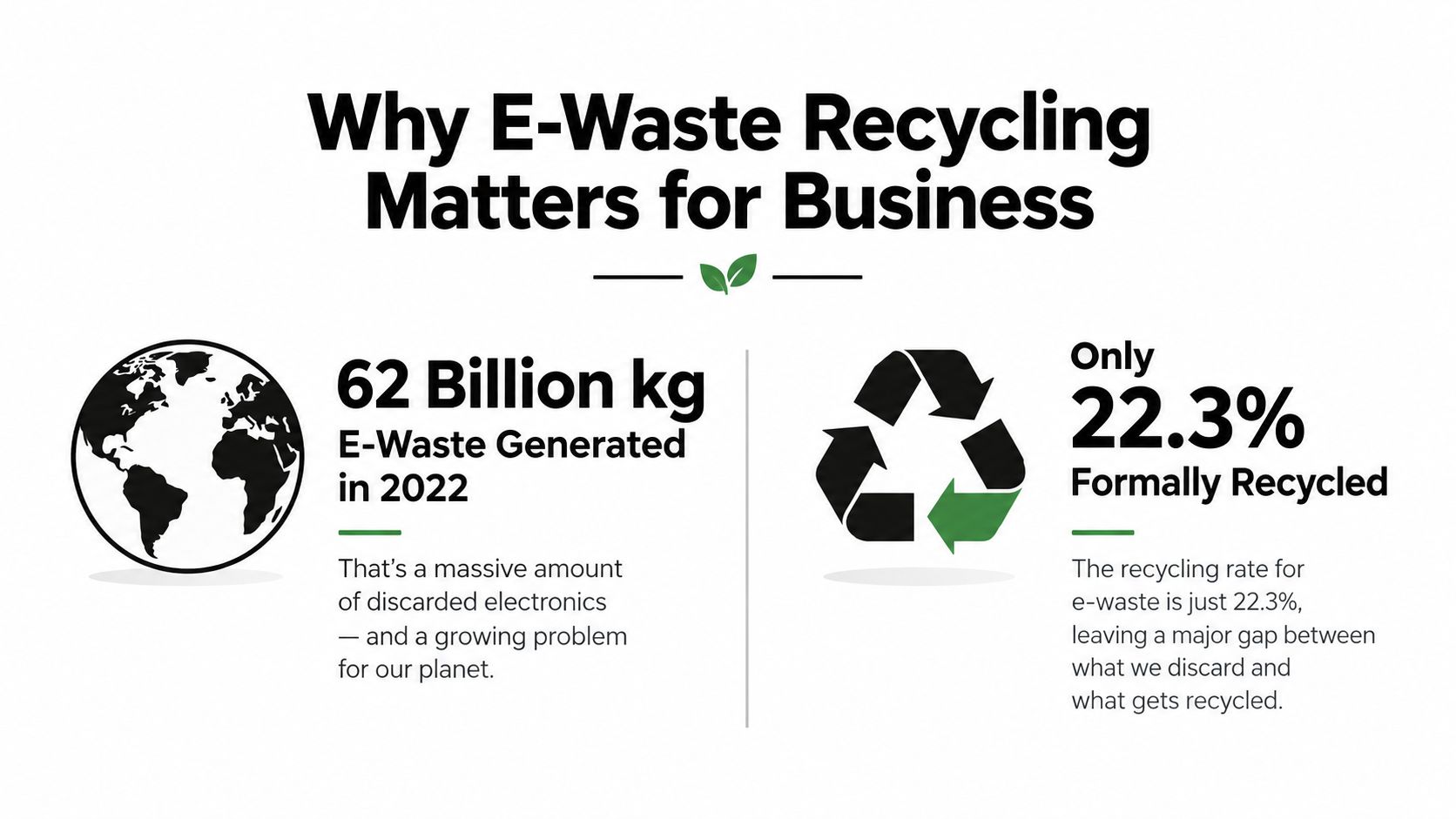
The scale alone should change how companies think about retired technology. In 2022, the world generated 62 billion kilograms of e-waste, while only 22.3% was documented as formally collected and recycled in an environmentally sound manner, according to the Global E-waste Monitor 2024. For a business, that gap represents more than an environmental concern. It creates uncertainty about downstream handling, data exposure, regulatory obligations, and lost equipment value.
A facilities manager may see obsolete electronics as clutter that needs removal before a lease inspection. An IT director sees a mixed inventory with different risk profiles. A working network switch might be suitable for resale. A server may require verified sanitization before redeployment. A damaged monitor may need controlled material processing. Treating all of it as anonymous scrap removes the decisions that protect the company.
Waste is only one possible outcome
Businesses should separate disposal from asset disposition. Disposal focuses on getting equipment out of the building. ITAD evaluates what should be redeployed, refurbished, remarketed, destroyed, or recycled, then records the result.
That distinction affects both risk and economics. A basic haul-away receipt may confirm that a vendor picked up boxes. It doesn't prove that storage media was sanitized, that equipment stayed within an approved downstream network, or that recoverable hardware wasn't mixed into a low-value stream.
Practical rule: If your vendor can't identify the asset, document its custody, and state its final disposition, you don't have a defensible recycling record.
The long-term trend makes process discipline more important. Global e-waste generation increased from 34 billion kilograms in 2010 to 62 billion kilograms in 2022, while documented formal recycling increased from 8 billion kilograms to 13.8 billion kilograms over the same period, as reported by the Global E-waste Monitor 2024. Formal processing has expanded, but it hasn't kept pace with the volume of equipment entering end-of-life channels.
For procurement and IT teams, the opportunity is straightforward. A repeatable secure e-waste management program reduces uncontrolled storage, improves audit readiness, and gives the business a structured route to recover value from equipment that still has a market.
The E-Waste Recycling Workflow Explained
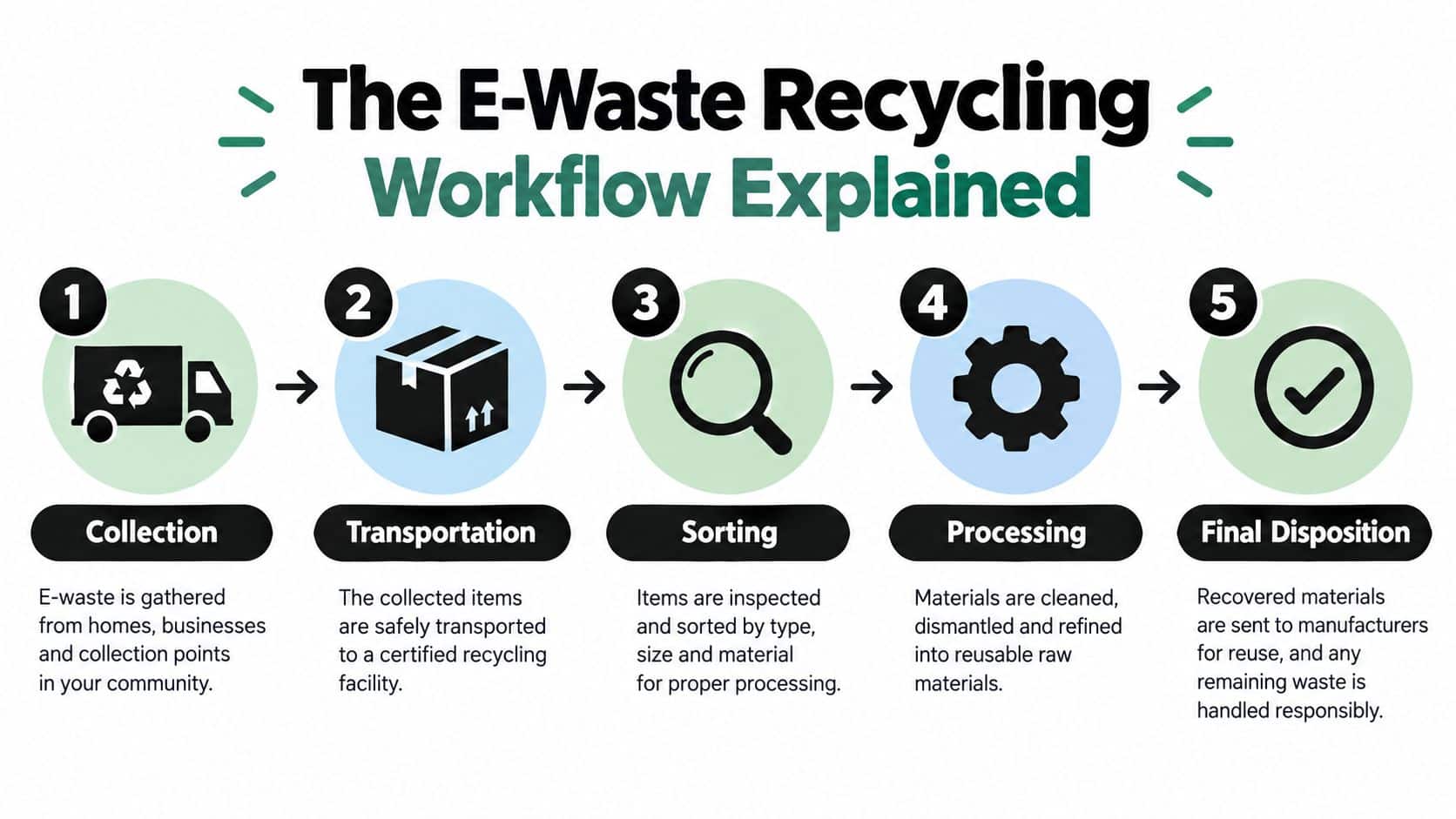
Commercial e-waste recycling should operate as a controlled chain of decisions, from pickup through final disposition. For business buyers, the objective is to preserve custody, protect data, route usable equipment toward the highest practical value, and produce records that support compliance reviews.
Collection and transportation
Build the manifest before pickup. Record the equipment type, serial number where available, location, condition, ownership status, and any known data-bearing components. The scope may include laptops, desktops, servers, drives, monitors, printers, phones, networking equipment, laboratory electronics, and medical devices, provided the processor is qualified for each category.
At collection, the vendor should reconcile the physical load with the manifest. Packaging, palletization, vehicle controls, and named custody transfers reduce uncertainty during transport, when assets can be lost, damaged, or diverted. A scheduled electronic waste pickup should identify what left the site, when it left, and who accepted it.
Sorting and data destruction
The receiving facility separates assets by condition, device type, data risk, and likely disposition. Storage media needs a documented decision before resale or material processing. Depending on the storage technology and information sensitivity, the approved method may be certified wiping, physical shredding, or another sanitization process.
For U.S. organizations, NIST Special Publication 800-88 guidance defines three sanitization categories, Clear, Purge, and Destroy. The selected category should reflect the information and storage technology, rather than whether the device still powers on.
Recovery, refurbishment, and processing
Usable equipment may move through testing, repair, refurbishment, redeployment, or resale. Assets that fail refurbishment can still yield components and materials. Printed circuit boards can contain 100 to 250 parts per million of gold and 5 to 10 parts per million of palladium, according to the Global E-waste Monitor 2024 technical review.
Recovery results depend on the material and processing method. The same review reports roughly 80% to 95% of copper and zinc and 40% to 80% of precious metals in the bioleaching approaches examined, while global rare-earth recovery from e-waste remains below 5%. Buyers should therefore ask which downstream processor handles each stream and what disposition evidence is returned.
A commercial program should connect these stages through business electronics recycling services. Final reporting should show whether each asset was reused, remarketed, destroyed, or materially recycled, allowing procurement and IT teams to verify both custody and value recovery.
Regulatory Compliance in Electronics Disposal
Electronic disposal compliance isn't one universal rule. Requirements depend on the data stored on the equipment, the industry involved, the type of device, and the jurisdictions connected to the transaction. A vendor that handles office laptops may not have the controls needed for clinical equipment, financial records, or government systems.
Match the control to the exposure
The FTC Disposal Rule is relevant when consumer information is stored in company records or on retired media. In practice, the business needs reasonable measures to protect that information during disposal. That means controlling access, using an appropriate sanitization method, and retaining evidence that the process occurred.
Healthcare organizations have a different exposure. HIPAA requires covered entities and business associates to protect protected health information, so a retired workstation, server, diagnostic system, or removable drive can't enter an untracked recycling stream. The disposal workflow should align with the organization's risk assessment and contractual responsibilities.
State electronic waste laws add another layer. Definitions, covered equipment, accepted processing routes, and reporting expectations can differ by state. A national company should avoid assuming that a process approved for one facility automatically satisfies every location.
Documentation is part of the control
A compliance-ready vendor should be able to explain:
- Data handling: Which devices require wiping, purge, or destruction, and how the method is selected.
- Custody records: How the vendor tracks assets from pickup through processing.
- Processing evidence: Which certificates, reports, or downstream records are issued.
- Subcontractor controls: Whether transportation or material processing involves other parties.
- Exception handling: What happens when a serial number is missing, a device fails testing, or a material stream changes.
A certificate isn't a substitute for a sound process. It has value when it connects to an inventory, a defined method, an accountable processor, and a retained record. Buyers comparing legal and operational risk can use business e-waste laws and disposal considerations as a starting point, then confirm obligations with their counsel and compliance team.
Chain-of-Custody and Documentation Requirements
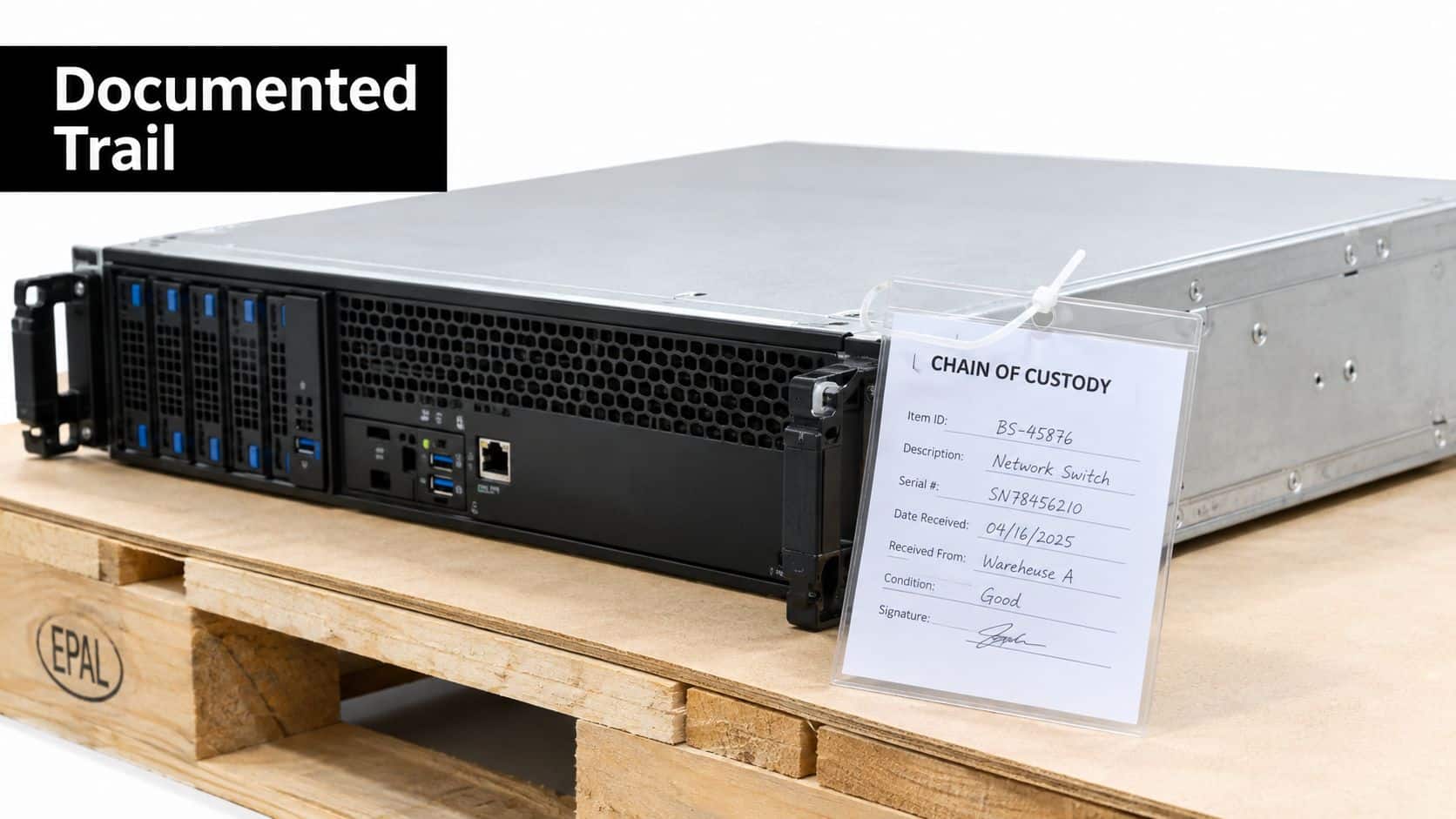
A chain of custody is the documented trail between possession and final disposition. It should answer four questions without guesswork: what asset moved, who controlled it, what work occurred, and where it ended.
A basic pickup receipt and a complete ITAD record aren't equivalent. The first may show that a vendor collected equipment. The second can connect asset identifiers, locations, custody changes, sanitization results, resale or destruction decisions, and recycling certificates.
Compare the common approaches
Untracked removal is fast, but it leaves the buyer with weak evidence. It may be acceptable for low-risk material only when the organization has already confirmed that no sensitive data or recoverable assets are involved. That scenario is narrower than many teams assume.
Bulk recycling with a general certificate provides a disposition statement, but it may not identify individual devices or explain how storage media was handled. The approach can reduce clutter while leaving audit questions unresolved.
Managed ITAD adds inventory controls, data destruction records, condition grading, resale decisions, and downstream reporting. It requires more coordination, but it supports liability transfer and gives procurement teams evidence to evaluate vendor performance.
Require records that match your risk
Before authorizing a pickup, ask for an asset manifest, custody process, data destruction certificate format, recycling certificate format, and escalation path for exceptions. For high-risk environments, require approval before any device is resold or sent to a downstream processor.
The chain-of-custody process for IT assets should be specific enough that an internal auditor can follow one asset from the loading dock to its final disposition. If the vendor's report can't do that, the organization is relying on trust where documentation should exist.
Choosing the Right ITAD Vendor
Price matters, but it shouldn't be the first filter. The lowest quote can become expensive if the vendor lacks secure data controls, provides weak reporting, or sends valuable equipment into a low-recovery channel.
Use a consistent evaluation process. Ask each vendor to describe the same pickup, sanitization, remarketing, destruction, and recycling scenario. Then compare the evidence, not just the sales presentation.
Evaluation criteria that hold up in practice
| Criteria | What to Verify | Why It Matters |
|---|---|---|
| Certification status | Confirm current R2 or e-Stewards credentials and the scope of covered operations. | Certifications can support environmental, safety, and downstream-control reviews. |
| Data security | Review wiping, purge, and destruction methods, including exception handling. | Data risk continues until storage media is securely sanitized or destroyed. |
| Geographic coverage | Confirm service for every facility, including multi-site and nationwide pickup needs. | Inconsistent local handling creates gaps in process and reporting. |
| Reporting quality | Request sample manifests, certificates, inventory reports, and disposition summaries. | Clear records support audits, compliance reviews, and internal reconciliation. |
| Value recovery | Ask how equipment is graded, priced, remarketed, or routed to parts recovery. | Transparent decisions help the business capture available value. |
A practical vendor interview should also cover insurance, employee screening, facility access, transportation partners, downstream processors, and how the vendor handles medical or laboratory equipment. Don't accept “we recycle everything” as an answer. Different equipment types require different testing, handling, and processing routes.
Red flags buyers should reject
Be cautious when a provider won't identify its downstream network, can't show a sample certificate, offers no asset-level reconciliation, or treats data destruction as an optional add-on. A vendor that focuses only on weight diverted from disposal may not be measuring the outcome your IT department needs.
Use this ITAD vendor question checklist before issuing a request for proposal. Beyond Surplus is one provider that offers commercial electronics recycling, secure data destruction, IT buyback, product destruction, and data center de-installation services, with documentation for recycling and data destruction.
Maximizing Value Recovery and Sustainability
The best disposition decision isn't always “recycle.” A working laptop may retain more value through testing and resale than through material processing. A failed device may yield usable components. A damaged board may belong in a controlled recovery stream. The buyer's job is to preserve the highest responsible outcome while keeping data and compliance risks under control.
Global e-waste contained approximately USD 91 billion in embedded metals in 2022, while only USD 28 billion was recovered as secondary raw materials through urban mining, according to the Royal Society of Chemistry analysis. Those figures describe the global system, not a guaranteed return for an individual company, but they show why blanket scrap treatment can destroy value.

Build a disposition hierarchy
Start with secure redeployment when the device meets the user's technical and security requirements. Next consider refurbishment or remarketing, followed by component harvesting and material recovery. Use product destruction when contractual, brand, safety, or data concerns make resale inappropriate.
This hierarchy links sustainability to financial control. Reuse keeps equipment productive, remarketing can create a buyback payment, and material processing recovers commodities that would otherwise be lost. None of those paths should bypass sanitization or documented custody.
Measure the outcome buyers can defend
Track more than total weight. A useful program reports assets collected, data-bearing devices sanitized, equipment resold, items destroyed, material streams processed, and exceptions resolved. That information supports sustainability reporting while giving IT and procurement a clear view of operational performance.
The used business IT asset value recovery process can help teams separate financial recovery from final recycling. The result is a program that treats e-waste as a controlled business process, not a last-minute removal project.
Contact Beyond Surplus for secure electronics recycling, data destruction, IT equipment disposal, and documented chain-of-custody support for commercial assets. Visit Beyond Surplus to arrange a pickup and build a disposition workflow that protects data while recovering value from retired technology.


