

Your payment environment passed its last review, but the evidence is already aging. A retired point-of-sale terminal is sitting in a storage room, a former administrator still has a dormant account, and a vendor's destruction certificate is buried in an email thread. That's the operational reality behind many PCI programs: the controls may exist, but ownership, scope, and evidence drift apart.
Learning how to achieve PCI compliance means building a repeatable operating model, not preparing documents for a single audit. The practical path combines accurate scoping, defensible remediation, strong technical controls, appropriate validation, and certified disposition of equipment that handled cardholder data.
Table of Contents
- Why PCI Compliance Is an Ongoing Operating Model in 2026
- Scoping and Minimizing the Cardholder Data Environment
- Running a Gap Assessment That Produces Real Evidence
- Implementing the Core Technical Controls
- Choosing the Right Validation Track for Your Business
- Closing the Disposal Gap with Certified IT Asset Disposition
- Maintaining Compliance After the Initial Pass
Why PCI Compliance Is an Ongoing Operating Model in 2026
PCI DSS began under the Visa brand in 2004, and its modern revision cycle shows why compliance can't remain a static checklist. PCI DSS v4.0 was released on 31 March 2022, with an implementation effective date of 31 March 2025, according to Verizon's history of PCI compliance. The future-dated requirements are now part of the operating expectation for organizations working under the standard.
The performance history reinforces the point. Verizon reported that 27.9% of organizations achieved full compliance in 2019, compared with 36.7% the previous year, before the figure improved to 43.4% in 2020. The earlier peak was 55.4% in 2016. These figures don't describe a one-time failure. They show how difficult it is to keep access controls, segmentation, vulnerability management, and evidence collection aligned over time. Read the trend in Verizon's PCI compliance history.
The operating cadence auditors expect
A QSA doesn't only want a policy document or a clean screenshot from assessment week. They want to see that control owners perform recurring reviews, investigate exceptions, approve changes, and retain evidence that connects the activity to the cardholder data environment.
A practical program has four phases:
- Scope the environment. Identify where cardholder data moves and which connected systems can affect its security.
- Assess the gaps. Test each applicable requirement against actual configurations, records, and operating behavior.
- Implement and remediate. Assign owners, fix control failures, and document accepted residual risk.
- Validate and monitor. Complete the appropriate assessment while continuing scans, reviews, testing, and evidence collection.
Small and mid-sized teams often stall because PCI work competes with infrastructure changes, application releases, and daily support. A useful SME-oriented perspective appears in Sambapay's guide for SMEs, particularly for organizations trying to turn compliance responsibilities into manageable routines.
Retiring equipment deserves the same discipline as deploying it. A documented IT asset lifecycle management process helps connect procurement, ownership, transfer, sanitization, and retirement records instead of leaving the final evidence gap to facilities staff or an informal vendor handoff.
Scoping and Minimizing the Cardholder Data Environment
Scoping errors create expensive downstream work. Start with a data-flow exercise, not a network diagram copied from an old architecture review. Trace cardholder data from capture through authorization, storage, support access, reporting, backups, integrations, and disposal.
Include systems that store, process, or transmit cardholder data. Then assess connected systems that could influence the security of the CDE, even when they don't directly handle account data. A jump server, identity platform, administrative workstation, monitoring service, or change-management pathway may affect the environment's security and therefore require careful treatment.
Reduce exposure before buying more controls
Segmentation can reduce the number of systems subject to direct PCI controls, but only when the separation is technically enforced and documented. Common options include:
- Dedicated VLANs: Separate payment systems from corporate traffic, then verify firewall rules and routing behavior.
- Jump hosts: Restrict administrative access through controlled intermediary systems with strong authentication and logging.
- Microsegmentation: Apply narrowly defined workload-to-workload policies where cloud or virtualized environments change frequently.
- Tokenization: Replace account data with tokens so downstream business systems don't need to handle the original value.
- Point-to-point encryption: Protect payment transmission, while preserving a clear record of which systems perform encryption, decryption, or key management.
Encryption alone doesn't remove systems from scope. The PCI SSC explains that systems performing encryption or decryption, systems managing keys, and encrypted data located with its keys remain in scope in the circumstances described by its encrypted-data scope FAQ. PCI DSS Requirement 4 covers strong cryptography for transmission across open, public networks, while stored data protection maps to Requirement 3, as outlined in the council's payment security guidance.
Scope reduction techniques
| Technique | Scope Impact | Cost | Complexity | Best Fit |
|---|---|---|---|---|
| Hosted payment page | Can reduce direct handling of card data | Moderate | Low to moderate | Merchants with standard checkout flows |
| Tokenization | Limits storage of original account data | Moderate | Moderate | Applications needing payment references |
| Dedicated VLAN | Separates payment infrastructure | Moderate | Moderate | Traditional data centers |
| Jump host | Centralizes privileged administration | Moderate | Moderate | Teams with controlled administrator access |
| Microsegmentation | Limits lateral movement between workloads | Higher | High | Dynamic cloud and virtualized environments |
| Point-to-point encryption | Protects payment transmission | Varies | Moderate to high | Distributed payment networks |
Your scope package should include current network diagrams, data-flow maps, asset and service inventories, segmentation rules, payment-provider responsibilities, and a written justification for every system treated as out of scope. Keep the rationale tied to evidence. A claim that “the vendor handles it” won't withstand review unless contracts, responsibilities, and technical boundaries support it.
For broader governance practices that support this work, use IT asset management best practices to keep ownership and lifecycle records connected to the systems in scope.
Running a Gap Assessment That Produces Real Evidence
A useful gap assessment reads like an investigation, not a questionnaire exercise. For each applicable PCI DSS v4.0 requirement, identify the expected control, the accountable owner, the evidence that proves operation, and the condition that would cause the control to fail.
Start with the requirement, then test reality. Review configuration exports, access reviews, vulnerability results, security policies, incident tickets, change records, training logs, and vendor attestations. Interview the person who performs the control, not only the manager who approved the policy. If the policy says access is reviewed regularly but the administrator can't show the review record, the control isn't operating as documented.
Turn findings into work people can complete
Avoid findings such as “logging needs improvement.” That language doesn't tell an engineer what to change or an executive what risk remains. A stronger finding identifies the affected system, the missing evidence, the applicable requirement, the business impact, the owner, and the target date.
Prioritize findings using practical categories:
- Critical exposure: A control failure could allow unauthorized access to cardholder data or prevent detection of a serious event.
- Material weakness: The control exists inconsistently, lacks coverage, or produces unreliable evidence.
- Process deficiency: The technical safeguard works, but approval, review, or retention records are incomplete.
- Accepted residual risk: The organization documents why remediation is deferred, who approved the decision, and which compensating measures reduce exposure.
Field operations offer a useful parallel. A risk assessment approach for field teams shows why clear ownership and structured evidence matter when work happens across locations rather than inside one controlled office.
The remediation register should function as a management tool. Include the requirement, finding statement, affected assets, severity, owner, dependency, due date, verification method, and risk-acceptance language where applicable. Store evidence in a controlled repository with a naming convention and retention rule. An audit trail reporting process can help connect actions, asset records, and supporting documentation when a QSA asks how a control operated across the assessment period.
Practical rule: If a finding can't be assigned to a person and verified through a named artifact, it isn't ready for remediation tracking.
Implementing the Core Technical Controls
Technical remediation works best when teams build from identity outward. Strong authentication and access governance determine who can reach the CDE. Network controls restrict what that identity can reach. Detection and testing then reveal whether the design continues to work.
Start with identity and privilege
Assign each user a unique identity. Remove shared administrator accounts wherever possible, and apply role-based access based on business need. Review privileged access after role changes, departures, vendor offboarding, and major application changes.
Multi-factor authentication is mandatory for all access into the CDE under PCI DSS v4.0. The PCI SSC change summary identifies MFA as a best practice until 31 March 2025, after which it became required, as documented in the v3.2.1 to v4.0 summary of changes. Apply it to administrative, remote, and other applicable access paths, not only the VPN login.
Make network and cryptography decisions explicit
Use deny-by-default rules where appropriate, restrict inbound and outbound paths, and review firewall changes through a documented process. Internal traffic deserves attention too. Teams often secure the public edge while leaving service-to-service traffic, backup paths, or administrative interfaces weakly controlled.
Protect stored cardholder data with approved cryptographic methods and protect transmissions across open, public networks with strong cryptography. Don't assume an internal hop is safe just because it stays inside the organization. Document key ownership, rotation, access, storage, and recovery procedures separately from the application encryption design.
Centralize detection and test continuously
Send authentication events, privileged activity, file-integrity changes, security alerts, and payment-flow anomalies to a SIEM or equivalent monitoring platform. Retain enough history to support the applicable requirement and investigate events without relying on individual device logs.
Vulnerability management must cover the full CDE inventory, including internet-facing assets, appliances, cloud workloads, and forgotten test systems. Use authenticated scanning where the assessment method requires it, remediate serious findings according to defined timelines, and document exceptions with compensating controls and approval.
| Control Area | PCI DSS 4.0 Requirement | Implementation Checkpoint | Evidence Artifact |
|---|---|---|---|
| Identity and access | Requirements 7 and 8 | Unique IDs, least privilege, MFA, timely removal | Access review, identity report, termination ticket |
| Network security | Requirements 1 and 2 | Segmented paths and secure configurations | Firewall review, network diagram, configuration baseline |
| Cryptography | Requirements 3 and 4 | Protected storage, transmission, and key handling | Key-management record, TLS inventory, data-flow map |
| Logging | Requirement 10 | Centralized collection, review, and alert handling | SIEM report, alert ticket, review record |
| Vulnerability management | Requirements 6 and 11 | Scanning, patching, testing, exception control | Scan result, remediation ticket, test report |
| Media disposal | Requirement 9 | Controlled storage, transfer, and destruction | Chain-of-custody log, destruction certificate |
Physical media controls are part of the technical evidence story. NIST SP 800-88 guidance gives teams a recognized framework for selecting sanitization methods based on media type and disposition requirements.
Choosing the Right Validation Track for Your Business
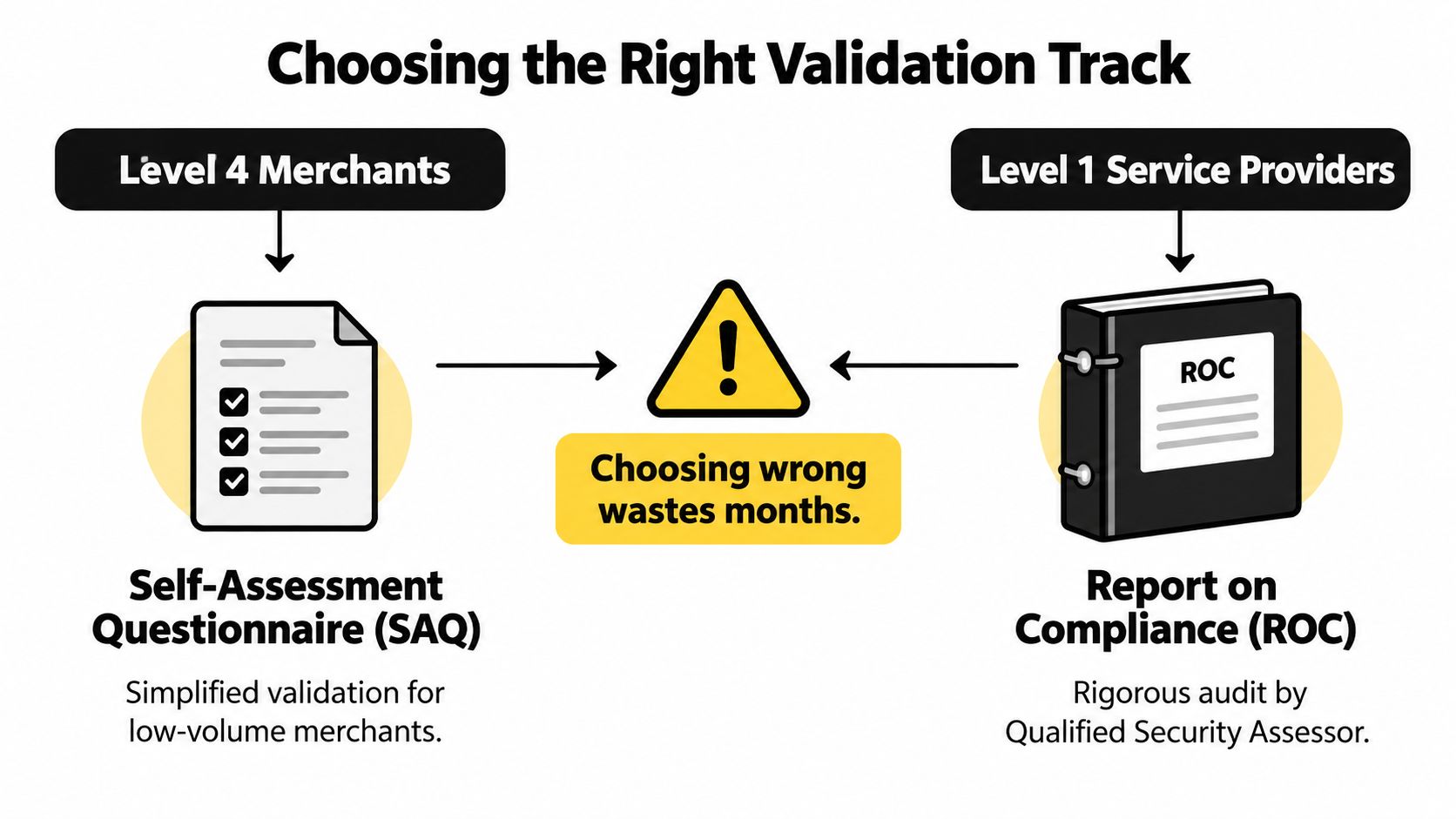
Validation starts with your merchant or service-provider classification and payment integration model. Don't select an SAQ because it's shorter. Select it because your actual environment matches its eligibility criteria and your acquirer accepts that pathway.
Level 4 merchants may use SAQ A, SAQ A-EP, SAQ D-Merchant, or another applicable questionnaire depending on whether payment processing is fully outsourced, hosted, embedded, or integrated. Service providers use the relevant service-provider pathway. Organizations processing more than 300,000 transactions annually per card brand, or service providers handling cardholder data for others, complete a ROC through an on-site QSA under the stated validation model.
Compare the two paths
| Path | Typical deliverable | Strength | Common mistake |
|---|---|---|---|
| SAQ | Self-Assessment Questionnaire and applicable attestation | Efficient for eligible, well-scoped environments | Choosing a questionnaire that doesn't match the payment flow |
| ROC | Formal Report on Compliance prepared by a QSA | Independent, detailed validation | Entering the audit without stable evidence and ownership |
| ASV testing | External vulnerability scan results | Recurring view of externally exposed weaknesses | Treating a passing scan as proof of complete compliance |
| Penetration testing | Documented security testing and remediation | Tests segmentation and attack paths | Testing only the perimeter while ignoring relevant CDE paths |
Quarterly ASV scans are a recurring control identified in PCI compliance summaries, and testing obligations depend on the applicable track and environment. Don't confuse a scan with a penetration test. A scan identifies known vulnerabilities through an approved process. A penetration test evaluates exploitability, segmentation, and attack paths.
Revalidate the path annually and whenever payment integrations, vendors, hosting arrangements, or transaction patterns change. A previously suitable SAQ can become inaccurate after a checkout redesign or a shift from outsourced processing to an integrated payment flow.
Closing the Disposal Gap with Certified IT Asset Disposition
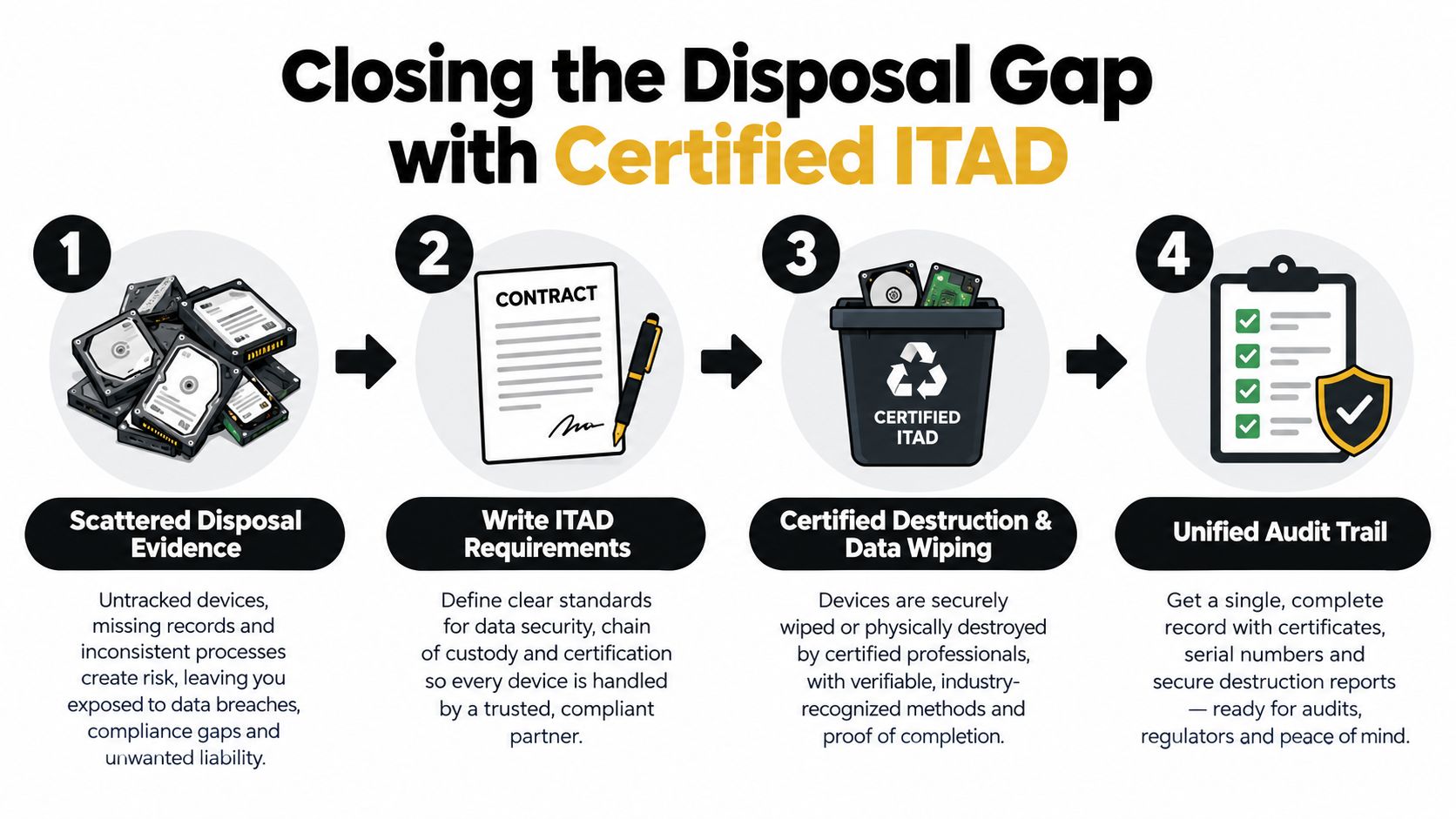
Retired hardware frequently exposes the weakness between security policy and physical operations. A laptop may leave the CDE months before anyone records its final disposition. A POS terminal may move between stores without a complete handoff. A failed storage device may sit in a locked cabinet while the destruction record remains with a vendor that can't identify the serial number.
Write IT asset disposition requirements directly into the PCI policy. Include laptops, servers, POS terminals, switches, removable media, and storage devices that handled or could access cardholder data. Require serialized records that connect the asset to its owner, location, transfer event, sanitization method, final disposition, and certificate.
Build a chain of custody that a QSA can follow
For magnetic media, select a sanitization method consistent with the media and risk profile, such as a NIST SP 800-88 Purge or Destroy approach. For SSDs and other flash media, use an appropriate Clear or Purge method where technically valid. Physically shred drives that can't be reliably wiped, and record who performed the work, when it happened, which method was used, and how the media was handled before destruction.
The certificate matters, but it's only one part of the evidence package. A defensible record includes:
- Asset identity: Serial number, asset tag, device type, and associated business owner.
- Custody history: Pickup, transport, storage, and processing events.
- Sanitization detail: Clear, Purge, Destroy, wiping software, or physical destruction method.
- Final disposition: Recycling, resale, component recovery, or product destruction.
- Approval record: Authorization from the responsible IT, security, or compliance owner.
Retain certificates and related audit trail logs for at least one year past equipment retirement, and make them retrievable promptly when a QSA requests them. Requirement 9.5 and related media-handling controls are easier to validate when the disposal record is connected to the asset inventory rather than stored as an isolated PDF.
Organizations can use a qualified internal program or an external provider. Beyond Surplus offers business IT asset disposition, certified data wiping, on-site and off-site hard-drive shredding, chain-of-custody records, and serialized certificates for retired equipment. Its PCI DSS data destruction best practices provide a reference point for connecting ITAD records to PCI evidence.
Maintaining Compliance After the Initial Pass
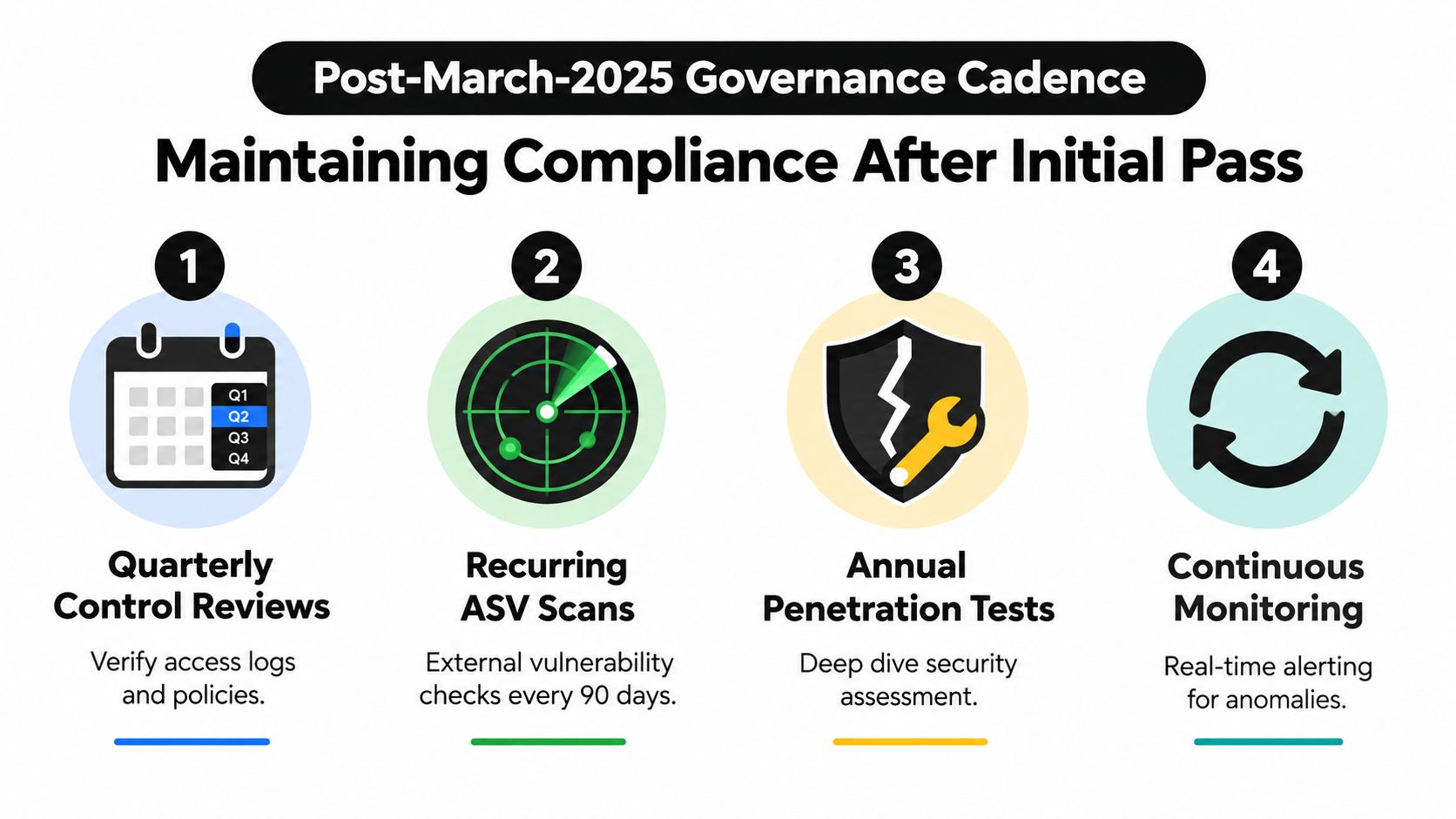
A completed SAQ or ROC is a checkpoint, not a maintenance plan. After the March 2025 effectiveness date for future-dated v4.0 requirements, teams need an operating rhythm that catches drift before the next validation cycle.
The failures that appear first are usually mundane. Firewall rules accumulate without review. Vendor accounts remain active after a contract ends. Asset inventories stop matching cloud and endpoint reality. Engineers bypass change tickets during urgent releases, leaving no record that the CDE impact was assessed.
Use a practical maintenance calendar
Monthly
- Review privileged and vendor access changes.
- Reconcile the CDE asset inventory against discovery and procurement records.
- Confirm security alerts have owners and documented disposition.
- Check certificate, key, and logging health.
- Sample change tickets for scope and approval evidence.
Quarterly
- Complete the required ASV scanning cycle through an Approved Scanning Vendor.
- Review segmentation rules and significant configuration changes.
- Test evidence collection with control owners.
- Reconcile retired assets with destruction certificates.
- Report unresolved exceptions to the accountable risk owner.
Annually
- Reassess scope and payment flows.
- Refresh policies, roles, vendor responsibilities, and risk assessments.
- Complete required penetration testing and track remediation.
- Select and complete the correct SAQ or ROC pathway.
- Confirm that evidence retention and retrieval work under time pressure.
Some service providers may need scoping reviews more frequently after organizational changes, including a six-month cadence in applicable circumstances. That makes change management part of compliance, not a separate IT process. Acquisitions, new payment channels, platform migrations, and major network changes should trigger a documented scope review.
Compliance is continuous evidence production. The audit only reveals whether your operating model produced that evidence consistently.
Assign every recurring activity to a named owner and a backup. Store results where security, IT, finance, facilities, and the QSA can locate them without reconstructing the history from inboxes. If a control fails, record the decision, containment, remediation, and verification. That discipline turns PCI from an annual scramble into a measurable security practice.
Beyond Surplus provides business-focused IT asset disposition, certified data wiping, hard-drive shredding, chain-of-custody records, and serialized destruction certificates for equipment that has handled sensitive data. Visit Beyond Surplus to arrange secure retirement services that support your PCI evidence trail and reduce disposal risk.


