

The FTC Disposal Rule and NIST SP 800-88 Rev. 2, not Georgia state law, set the practical standard for secure business IT disposal, making chain-of-custody documentation the key compliance deliverable for Atlanta organizations. The world generated 62 billion kg of e-waste in 2022, but only 22.3% was documented as properly collected and recycled, so a pickup alone doesn't prove responsible disposition.
Your company may be clearing a server room after a migration, replacing laptops across departments, or emptying a storage area filled with drives and peripherals. The truck leaving your facility feels like the end of the project. From a risk perspective, it's only the point where accountability becomes harder to see.
For Atlanta businesses, IT equipment recycling should produce an evidence trail that shows which assets were collected, how data-bearing media was sanitized, where equipment went, and what happened to reusable hardware versus true e-waste. That distinction separates a defensible IT asset disposition process from a simple hauling service.
Table of Contents
- Understanding IT Equipment Recycling Compliance and Liability Transfer
- Navigating Georgia State Rules and Federal Obligations
- Choosing Between On-Site and Off-Site Data Destruction
- Building a Verifiable Chain of Custody and Certificate Trail
- Logistics, Pickup Options, and Local Processing in Atlanta
- Maximizing Value Recovery Through IT Asset Disposition
- Preparing for Secure IT Recycling and Vendor Selection
Understanding IT Equipment Recycling Compliance and Liability Transfer
An end-of-life laptop creates two separate decisions. The organization must decide whether the hardware can be reused, and it must decide how to make the information on that hardware unreadable or unrecoverable. Treating both questions as “recycling” is how gaps appear in an otherwise orderly decommissioning project.
The FTC Disposal Rule requires covered entities to take reasonable measures so consumer information can't be read or reconstructed. The practical implication is clear. Deleting files, reformatting a drive, or running a factory reset isn't the same as documented sanitization. For technical handling, NIST SP 800-88 Rev. 2 guidance and current documentation practices provide a useful reference point for selecting a method based on media type and intended outcome.
What a defensible process produces
A credible business IT recycling workflow normally includes:
- Asset identification: Record the manufacturer, model, asset tag, and serial number before equipment leaves the site.
- Data classification: Separate laptops, hard drives, solid-state drives, servers, and removable media according to their data risk and condition.
- Method selection: Use verified wiping when the device is suitable for reuse. Use physical destruction when the media can't be sanitized to an auditable standard.
- Disposition evidence: Request a device-level Certificate of Destruction or Certificate of Recycling that connects the outcome to the recorded asset.
The certificate isn't decorative paperwork. It supports the claim that a specific device was wiped, destroyed, reused, or recycled through an identified process. Without serialized records, “everything was recycled” leaves too much uncertainty about what happened to individual drives.
Practical rule: If a vendor can't connect the final certificate to your asset list, the document may confirm a service occurred, but it doesn't give you strong device-level proof.
Liability transfer also depends on vendor controls after pickup. Ask whether downstream processors are audited, how material movement is recorded, and which organization remains responsible at each handoff. The buyer question isn't merely whether the recycler collected your equipment. It's whether the recycler can prove what happened afterward.
Navigating Georgia State Rules and Federal Obligations
A pickup truck leaves an Atlanta office with laptops, servers, batteries, and damaged monitors. The legal exposure does not end at the loading dock. Georgia does not require ordinary businesses to recycle electronics statewide, and it has no statewide producer-responsibility or mandatory commercial takeback program for standard business e-waste. Businesses still need a documented process that shows who handled the equipment and where each material stream went.
The Resource Conservation and Recovery Act framework applies to regulated components. Batteries, CRT-related materials, and other hazardous items may require controlled handling instead of entering a general recycling load. This overview of electronics recycling laws and ITAD compliance in Georgia helps separate Georgia program availability from federal duties affecting business disposal decisions.
Georgia's lack of a statewide commercial mandate shifts the work to operational controls. Those controls may arise from federal requirements, customer contracts, industry expectations, and internal security policy. They should also support a defensible liability transfer, not merely a completed pickup.
A project file should make four points easy to verify:
- What left the organization? Asset records should identify the devices and media included in the shipment.
- Who controlled the load? Pickup and transport records should show each handoff, timing, and responsible party.
- What happened to the data? The selected wiping or destruction method should be documented for the relevant media.
- Where did the material go? The recycler should identify downstream processing and provide final disposition evidence.
The FTC Disposal Rule treats data destruction as a compliance control. Environmental handling adds another responsibility when a mixed fleet includes batteries, CRT components, or damaged equipment that cannot follow the same route as reusable laptops.
Local drop-off programs can serve limited needs, but they are voluntary and may not provide inventory reconciliation, media certificates, or downstream reporting. Use a managed ITAD process when records must withstand customer reviews, internal audits, regulatory scrutiny, or a security incident investigation. The practical test is simple: can the vendor prove what happened after collection, or only confirm that equipment was taken away?
Choosing Between On-Site and Off-Site Data Destruction
The right destruction method is determined before the truck arrives. Review the media condition, reuse potential, equipment volume, and the level of physical control required before assets leave the facility. The decision should support a certificate trail that identifies what happened to each data-bearing device.
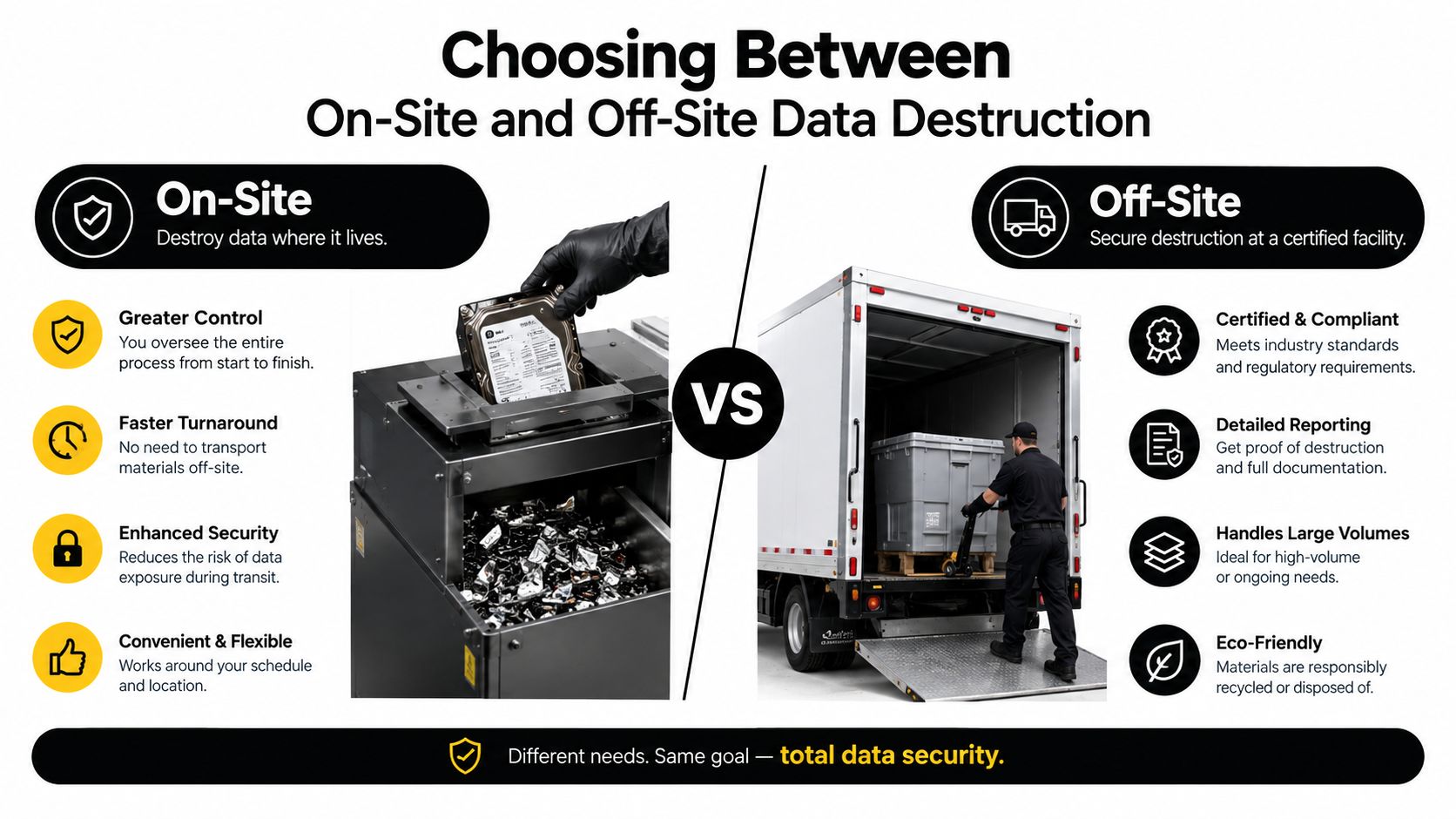
On-site destruction keeps selected media at your location until shredding is completed. It fits organizations with strict physical-control policies, sensitive drives that should not travel intact, or equipment that cannot leave the building before destruction. A mobile shredding process can destroy hard drives and other media during pickup, with records tied to the assets processed.
Off-site destruction sends equipment to a controlled processing facility. Technicians can inspect, inventory, wipe, shred, and sort the load there. This approach often suits larger projects, mixed fleets, and programs that may recover value from reusable equipment. Transport controls and custody records then carry more weight, because the assets leave your premises before final processing.
Media classification should drive the choice. A functioning hard drive intended for reuse may be wiped when the method is verified and the device remains operational. A failed drive, damaged solid-state drive, or medium with an uncertain sanitization history may require physical destruction. Factory resets and ordinary deletion do not establish a defensible result because forensic tools can recover information handled that way.
Classify the load before scheduling:
- Reusable laptops and servers: Test condition, record serial numbers, and verify sanitization before resale or redeployment.
- Failed hard drives: Use physical destruction when wiping cannot be validated.
- Solid-state media: Confirm that the process addresses the storage technology rather than applying a hard-drive assumption.
- Mixed equipment: Separate data-bearing devices from peripherals so each outcome can be documented accurately.
A useful comparison of on-site and off-site ITAD services in Georgia can support the policy decision, but the project record should state the chosen method and its reason. Convenience is not a control. A documented method, applied to a known asset and matched to a certificate, is what helps transfer liability after collection.
Building a Verifiable Chain of Custody and Certificate Trail
A truck leaving your loading dock does not transfer liability by itself. The record must connect the equipment you released with the processor's intake, the disposition decision, and the final certificate. If the starting inventory is incomplete, every later document becomes harder to defend.
Start with a serialized inventory. Record serial numbers, asset tags, device type, location, and disposition status. For a data center decommissioning, add rack position or system grouping when it helps teams reconcile equipment. For a laptop refresh, identify the business unit and collection batch, while keeping unnecessary sensitive information out of the recycling record.
The project file should answer five questions:
- Who released the equipment? Name the person or team authorizing removal and identify the assets included.
- How did it move? Record the carrier, vehicle or shipment reference where applicable, departure, and receipt.
- What did the processor receive? Confirm that the facility accepted the same serialized equipment.
- What happened to each item? Record whether it was wiped, destroyed, remarketed, recycled, or otherwise dispositioned.
- Which documents support the result? Retain the certificate and supporting report with the project file.
The chain-of-custody process for IT asset disposal clarifies why a pickup receipt is not an outcome record. A certificate of destruction supports a destruction claim for a specific device. A certificate of recycling supports responsible processing for equipment that entered a recycling stream. Keep those records distinct rather than combining them into a generic receipt.
NIST SP 800-88 Rev. 2 was published in September 2025. Current practice places greater emphasis on device-level records, media-specific method selection, and certificate details such as serial numbers and timestamps. Retain the inventory, pickup documentation, sanitization results, destruction records, recycling certificates, and downstream evidence together.
The strongest vendor relationship is one where your audit file can answer the same question as your operations team: what happened to this exact asset?
Ask about downstream accountability before approving the vendor. Who processes commodities after the primary facility? Are downstream vendors audited? Can the provider identify material destinations instead of relying on a broad “responsibly recycled” statement? Clear answers show whether the certificate trail supports actual liability transfer or only documents collection.
Logistics, Pickup Options, and Local Processing in Atlanta
Atlanta businesses usually choose among three fulfillment models: a scheduled pickup from the workplace, delivery to a local facility, or a coordinated program that combines regional handling with nationwide transportation. Each can be appropriate, but the logistics plan should preserve the same custody controls as the processing plan.
A local drop-off near Atlanta or Smyrna may work for a small, staged business load when the organization can maintain control of the equipment until acceptance. It isn't automatically suitable for a data center move, a healthcare replacement program, or a multi-site fleet. Those projects need scheduled removal, loading oversight, inventory reconciliation, and documented receipt.

Select the route by operational need
Local pickup reduces internal handling and can simplify scheduling for Atlanta-area offices. Confirm whether equipment must be palletized, whether loading is included, and when the processor issues an intake report.
Facility drop-off gives a smaller organization control over the delivery window. The business should still receive an acceptance record, especially when the load contains drives or other data-bearing media.
Nationwide coordination helps enterprises consolidate equipment from multiple offices. The contract should define how each site records assets, who manages local transport, and how the provider combines records into a single reporting package.
Georgia's recycling network includes vendors serving Atlanta, Marietta, Alpharetta, Dawsonville, and other cities, so the market isn't limited to a single facility or municipal route. That broader ecosystem can help organizations plan regional collection points, but geographic coverage doesn't replace proof of downstream processing.
Transport also affects cost and timing. Loose equipment may require extra labor to stage safely. Mixed loads may slow intake because reusable hardware, hazardous components, and commodity material need different handling. Give the provider an accurate equipment profile before pickup, then require the final report to reconcile what was collected with what was processed.
Maximizing Value Recovery Through IT Asset Disposition
Recycling isn't always the best first destination for retired business technology. A functioning laptop, server, or network device may retain resale value, while damaged or obsolete equipment may have no practical reuse path. Sending both categories into the same stream can destroy recoverable value and increase unnecessary processing costs.
Start separation before the truck arrives. Create a remarketing group for newer laptops, working servers, storage systems, and networking equipment. Create a recycling group for broken devices, obsolete peripherals, damaged screens, and media that must be destroyed. This simple classification gives the processor a clearer decision tree.
Recovery requires disciplined data handling
A resale pathway doesn't reduce the need for secure sanitization. The device must be wiped to a verifiable standard before it is remarketed, and the record should connect the wipe to the serial number. If the media can't be sanitized reliably, destroy the media and document that outcome instead of prioritizing a possible resale return.
The economics are uneven because equipment value depends on model, age, condition, demand, configuration, and the cost of testing and handling. “Free recycling” may be convenient for a mixed load, but it doesn't tell you whether the provider evaluated assets for buyback or remarketing. It also doesn't explain whether destruction costs will apply to items with limited recovery potential.
The business IT asset recovery process should connect three outcomes:
- Reuse: Functional equipment is prepared for redeployment or resale after verified sanitization.
- Material recycling: Non-reusable hardware enters an appropriate downstream stream.
- Secure destruction: Unrecoverable data-bearing media is physically destroyed when wiping isn't defensible.
The Global E-waste Monitor reported roughly US$62 billion in recoverable natural resources unaccounted for in documented recycling channels in 2022, according to its 2024 global e-waste findings. For an individual business, the practical lesson isn't to predict a particular return. It's to ask whether the disposition process distinguishes recoverable assets from waste before value disappears.
Preparing for Secure IT Recycling and Vendor Selection
Preparation determines whether an IT recycling project ends with a clean certificate trail or a folder of unresolved exceptions. Start before the equipment reaches the loading area.
Pre-pickup checklist
- Build the inventory: Record serial numbers, asset tags, device types, quantities, and locations.
- Separate media: Identify hard drives, solid-state drives, backup cartridges, removable media, and devices that held sensitive information.
- Mark disposition intent: Flag assets for reuse, destruction, recycling, or evaluation for recovery.
- Stage equipment safely: Keep loads organized, protect loose media, and prepare pallets or containers if the provider requires them.
- Assign an owner: Name the person who approves release, witnesses loading when needed, and receives the final report.
Then send prospective ITAD partners a concrete request. Ask them to describe their wiping and destruction methods by media type, explain their transport controls, identify downstream processors, state whether those vendors are audited, and provide sample Certificates of Destruction and Recycling with serial numbers and timestamps. Request the retention period for certificates and the process for resolving an inventory mismatch.
The provider should also explain how it handles data center decommissioning, medical or laboratory equipment, product destruction, laptop disposal, and mixed enterprise loads if those services are part of your project. Don't accept “we recycle everything” as an answer to a question about liability. Ask what evidence you receive for each asset category and what happens when equipment can't be wiped or resold.
For Atlanta organizations, Beyond Surplus offers business electronics recycling pickup, IT asset disposition, secure on-site or off-site data destruction, certificates of recycling and data destruction, IT buyback, product destruction, data center de-installations, and logistics coordination, with nationwide pickup available for organizations. Visit Beyond Surplus to discuss a documented disposition plan for your Atlanta facility or distributed fleet.


