

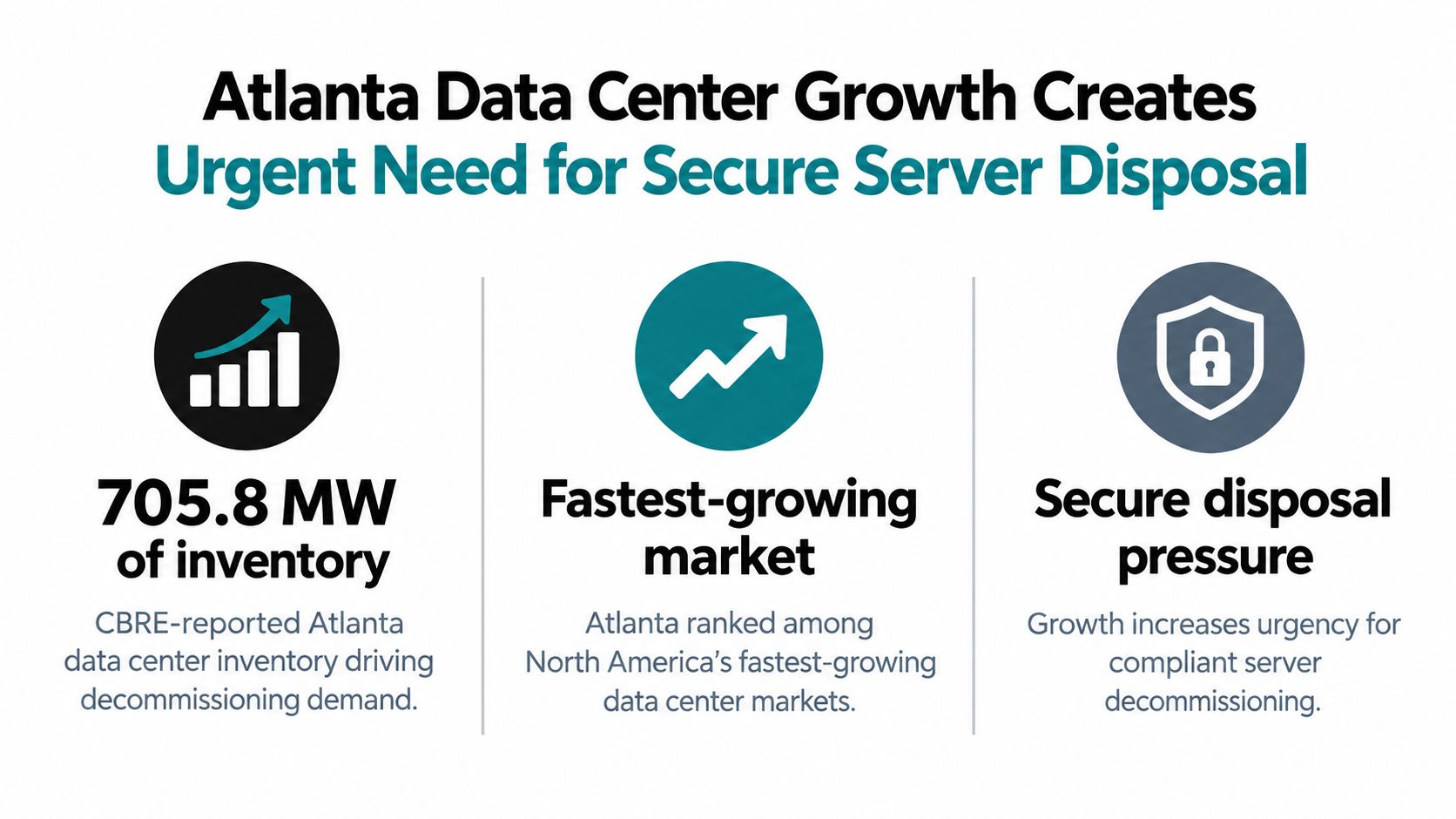
Atlanta has become one of North America's fastest-growing data center hubs, with 705.8 megawatts of positive net absorption in 2024. That expansion is creating urgent demand for secure server decommissioning, especially where organizations must decide whether to wipe, reuse, resell, or destroy retired equipment.
A facilities manager may be looking at a row of servers scheduled for removal while the IT team is still validating migrations, finance is asking about residual asset value, and compliance wants proof that every storage device was handled correctly. In Atlanta, that pressure is intensified by a market expanding faster than many internal retirement processes can adapt.
Table of Contents
- Atlanta Data Center Growth Creates Urgent Need for Secure Server Disposal
- Phased Server Decommissioning Workflow from Inventory to Disposition
- Data Sanitization Options for Wiping Versus Shredding for Server Security
- Regulatory Compliance Requirements for Atlanta Server Decommissioning
- Logistics and Chain of Custody for Atlanta Server Removal
- Value Recovery and Sustainable Recycling Options for Decommissioned Servers
- Selecting the Right Vendor for Atlanta Server Decommissioning Services
Atlanta Data Center Growth Creates Urgent Need for Secure Server Disposal
Atlanta's data center growth changes the practical meaning of server retirement. CBRE reported 705.8 megawatts of positive net absorption in 2024, and the market had only 2% vacancy by March 2026, according to its Atlanta data center market report. Those figures describe more than construction activity. They indicate a market where facilities are filling quickly, infrastructure is being refreshed, and older systems are being removed under tighter scheduling pressure.
Consider a common Atlanta transition. A cloud infrastructure operator expands capacity, migrates workloads to newer hardware, and needs to clear legacy racks for another tenant or deployment. The equipment may still have resale value, but every drive also represents a potential data exposure. Removing the hardware quickly without a serialized inventory can leave the operator unable to prove what left the rack, which media were sanitized, or where each component ended up.
Growth turns retirement into an operational program
Atlanta's total data center inventory reached about 1,459.2 megawatts by the end of 2025, an increase of 458.8 megawatts from the prior year, according to Atlanta Tech News coverage of the metro's data center expansion. The same report noted roughly 1,803 megawatts of capacity in the market by September 2026, with more space under construction than currently operational.
For IT directors, this scale means server decommissioning increasingly accompanies facility turnover, migrations, rack teardowns, and infrastructure replacement. It's no longer an occasional disposal task assigned after the technical work is finished. It needs its own project plan, approvals, security controls, logistics schedule, and final disposition record.
Atlanta organizations in healthcare, finance, government, and technology should treat server removal as a controlled risk-management activity. A qualified Atlanta data center decommissioning service can support that process, but the customer still needs to define data classifications, dependencies, approval points, and acceptable recovery paths before the first server is unracked.
Phased Server Decommissioning Workflow from Inventory to Disposition
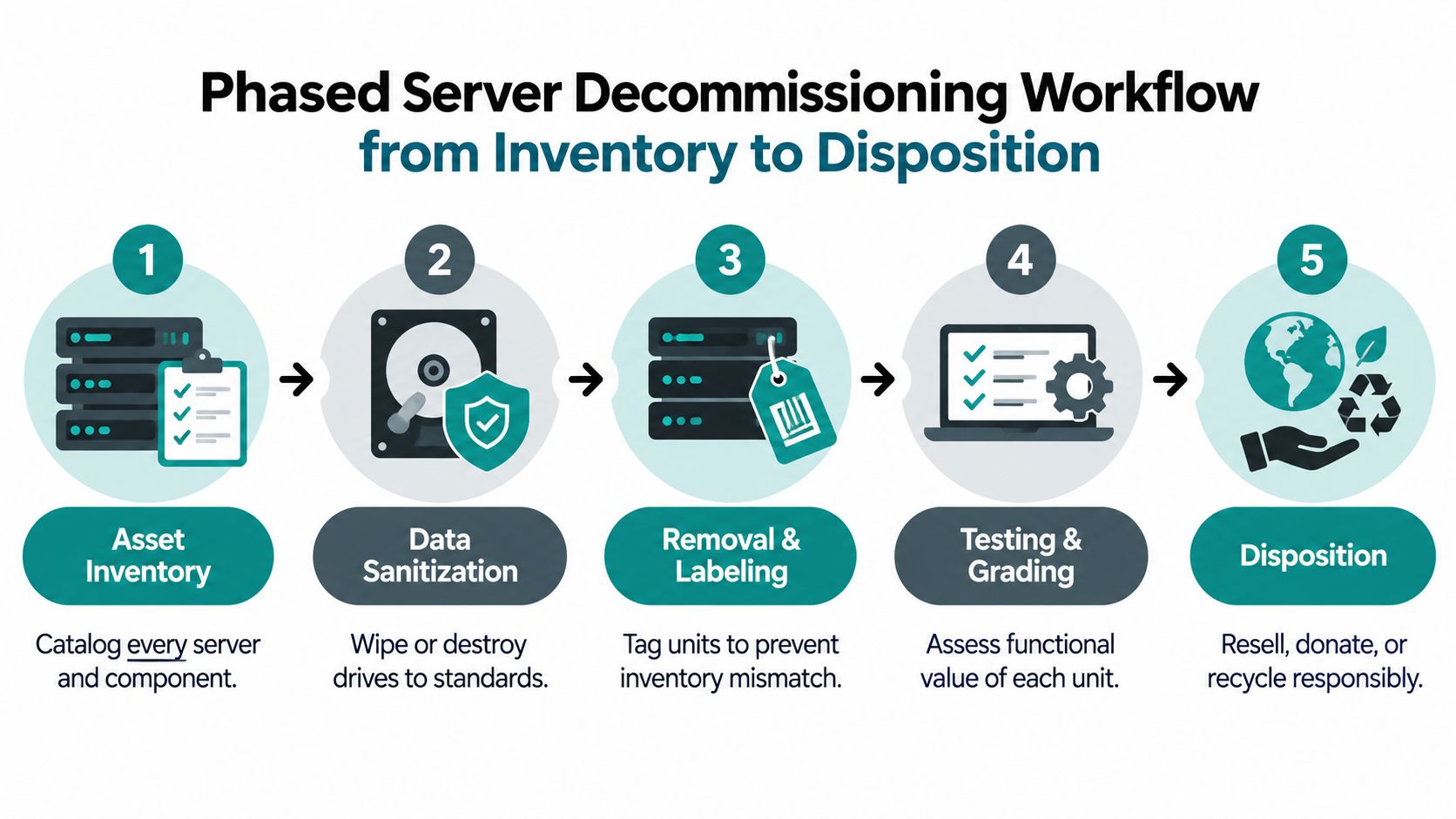
A reliable server retirement starts at the rack, not at the recycling dock. The most serious operational failure is an inventory mismatch between the equipment scheduled for removal and the equipment that leaves the facility. Once serial numbers are missing or labels become detached, security verification and financial reconciliation become harder.
Capture the physical record before shutdown
Begin with asset discovery and serial capture while each unit is still installed. Record the host unit, chassis, installed drives, storage arrays, network equipment, asset tags, rack position, and visible condition. Photographing labels can support the written inventory, but photographs shouldn't replace a structured record.
Then confirm dependencies with application owners and infrastructure teams. A server that appears idle may still support a backup job, monitoring function, management interface, or an undocumented service. Workload migration and backup validation must be completed before power-down approval.
A practical sequence looks like this:
- Discover and reconcile: Compare the approved retirement list with the physical rack inventory. Flag every discrepancy during unracking, not after transport.
- Map dependencies: Confirm applications, databases, network paths, authentication services, backups, and monitoring relationships.
- Migrate and validate: Move workloads, test replacement systems, and verify recoverable backups before isolating production equipment.
- Sanitize media: Apply a NIST-aligned method to every data-bearing drive or storage component. Record the method and verification result per serial number.
- Remove and transport: Label equipment, protect components, document handoffs, and maintain custody through the final destination.
- Close the record: Record testing, grading, reuse or destruction decisions, and final disposition in an audit-ready report.
Make every serial number defensible
Each device record should identify the method, operator, timestamp, verification result, and final disposition. The host serial and the serial number of each storage medium should be associated with one another, particularly when drives are removed from a server for separate processing.
Practical rule: If a drive fails verification, it shouldn't enter resale or reuse inventory. Route it to physical destruction and preserve the corresponding evidence.
The server rack decommissioning best practices guide reflects the discipline required for controlled removal. Per-serial certificates should be retained, and any discrepancy found during unracking should be escalated immediately rather than corrected informally later.
Data Sanitization Options for Wiping Versus Shredding for Server Security
The wipe-versus-shred decision should follow the intended disposition, the media condition, and the organization's risk tolerance. A reusable server with verified, economically useful drives may justify logical sanitization. A damaged drive, failed verification, or media that can't be reliably processed should move to physical destruction.
Wiping supports reuse when verification succeeds
Sector-verified overwriting paired with serial-number capture of both the host unit and its media provides a strong benchmark for drives intended for reuse or remarketing. The process should produce a certificate of sanitization or destruction aligned with NIST 800-88-style controls, rather than a simple statement that the drive was “wiped.”
On-site wiping can reduce unnecessary movement of sensitive media and lets the customer observe or approve the work at the facility. It can also preserve more resale value when drives and servers remain functional. The trade-off is operational complexity. The vendor needs appropriate equipment, trained operators, a controlled work area, and a process for isolating exceptions.
Off-site sanitization may be efficient when the facility has limited workspace or when a specialized processing center can handle volume consistently. It introduces another custody transfer, so the transport record, receiving scan, processing log, and certificate must connect without gaps.
Shredding removes reuse potential but simplifies the decision
Physical shredding is appropriate when the media is damaged, fails verification, carries an unacceptable residual-data risk, or has no realistic recovery value. It provides a clear destruction path, but it eliminates the possibility of recovering value from that drive. For highly sensitive environments, on-site destruction may reduce exposure during transport, although it requires suitable equipment and site coordination.
| Method | Best fit | Main advantage | Main trade-off |
|---|---|---|---|
| Verified wiping | Functional media approved for reuse | Preserves potential recovery value | Requires complete verification and logging |
| Off-site sanitization | Controlled batch processing | Access to specialized processing capacity | Adds custody and transport controls |
| Physical shredding | Failed, damaged, or high-risk media | Removes reuse uncertainty | Destroys residual asset value |
The hard-drive shredding versus data wiping comparison is useful because the answer is not “always wipe” or “always shred.” A mature program triages each medium, verifies the selected method, and documents why the final path was chosen.
Regulatory Compliance Requirements for Atlanta Server Decommissioning
Atlanta's data center market creates pressure to recover value from servers quickly, but compliance evidence must support every disposition decision. NIST SP 800-88r2 provides a formal framework for media sanitization. It defines sanitization as making access to target data infeasible for a given level of effort, then organizes actions into Clear, Purge, and Destroy categories based on risk and intended reuse.
Match the method to the media and outcome
Clear and Purge can support reuse when the technique fits the media and verification succeeds. Destroy is the direct option when reuse is unacceptable or the media cannot be sanitized reliably. NIST requires verification for each Clear and Purge technique except degaussing, so a completion record should identify more than the operator's initials.
NIST also calls for a certificate of media disposition for each storage medium that has been sanitized. In practice, the evidence package should connect the server, individual media, processing decision, and final outcome:
- Asset identity: Host serial, media serial, asset tag, and location.
- Sanitization method: The action applied and the relevant procedure.
- Execution record: Operator, timestamp, and processing location.
- Verification result: Pass, exception, or failed verification.
- Disposition decision: Reuse, resale, recycling, or destruction.
- Custody evidence: Handoffs, transport details, and receiving confirmation.
This documentation preserves the reasoning behind wipe-versus-shred decisions. It also helps distinguish recoverable equipment from media that requires destruction, rather than treating every server the same.
Apply the FTC disposal standard
The FTC Disposal Rule guidance requires reasonable and appropriate practices to prevent unauthorized access to or use of consumer report information. Its examples include burning, pulverizing, or shredding paper records so information cannot be read or reconstructed, as well as destroying or erasing electronic files or media for the same result.
The rule permits due diligence and the use of a document destruction contractor. For enterprise server retirement, that supports vendor qualification, written procedures, and records showing that the contractor completed the agreed service. The organization still must select a suitable method and retain supporting evidence.
Georgia businesses handling equipment across jurisdictions should account for cross-border movement, as explained in the Atlanta e-waste laws and business compliance guide. The Basel Convention e-waste amendments took effect on 1 January 2025, making transboundary movements of hazardous and non-hazardous e-waste subject to Prior Informed Consent. The Basel Convention overview explains that international shipments for recovery or disposal require prior written consent from importing and transit countries.
Logistics and Chain of Custody for Atlanta Server Removal
A server isn't secure merely because it has been unplugged. The risk continues through labeling, staging, loading, transport, receiving, processing, and final disposition. Every handoff should connect the physical asset to the same serial-level record created during inventory.
Plan the removal window around facility conditions
Coordinate with the data center operator, security desk, loading dock, facilities team, and application owners before scheduling a pickup. Confirm access rules, escort requirements, freight elevator availability, staging space, packaging needs, and whether equipment will be removed from live or recently isolated racks.
Protect servers and drives from impact, moisture, and uncontrolled handling. Use labels that remain attached during movement, and separate equipment by disposition path when possible. Reusable assets shouldn't be mixed with destruction-bound media in a way that confuses the processing team.
Verify each custody transfer
A sound transport record identifies the releasing employee or contractor, receiving carrier or technician, date and time, asset count, serialized exceptions, destination, and receiving confirmation. GPS-enabled vehicles and status updates can add useful visibility, but technology doesn't replace accurate asset records.
Ask prospective providers direct questions:
- Who controls transport: An owned fleet, a dedicated carrier, or an unnamed subcontractor?
- How are exceptions handled: What happens if a serial number doesn't match at pickup?
- Where is staging performed: Is equipment stored in a controlled facility before processing?
- When does custody transfer: At the rack, loading dock, receiving point, or destruction location?
- What closes the job: Which report confirms final disposition and unresolved exceptions?
The chain-of-custody guidance for IT asset disposal provides a useful standard for evaluating whether a provider's paperwork follows the equipment rather than arriving as an unsupported summary after the project.
Value Recovery and Sustainable Recycling Options for Decommissioned Servers
A retired server isn't automatically waste. It may be suitable for redeployment, refurbishment, resale, parts recovery, or material recycling, but those paths only make sense after security controls and condition assessment are complete.
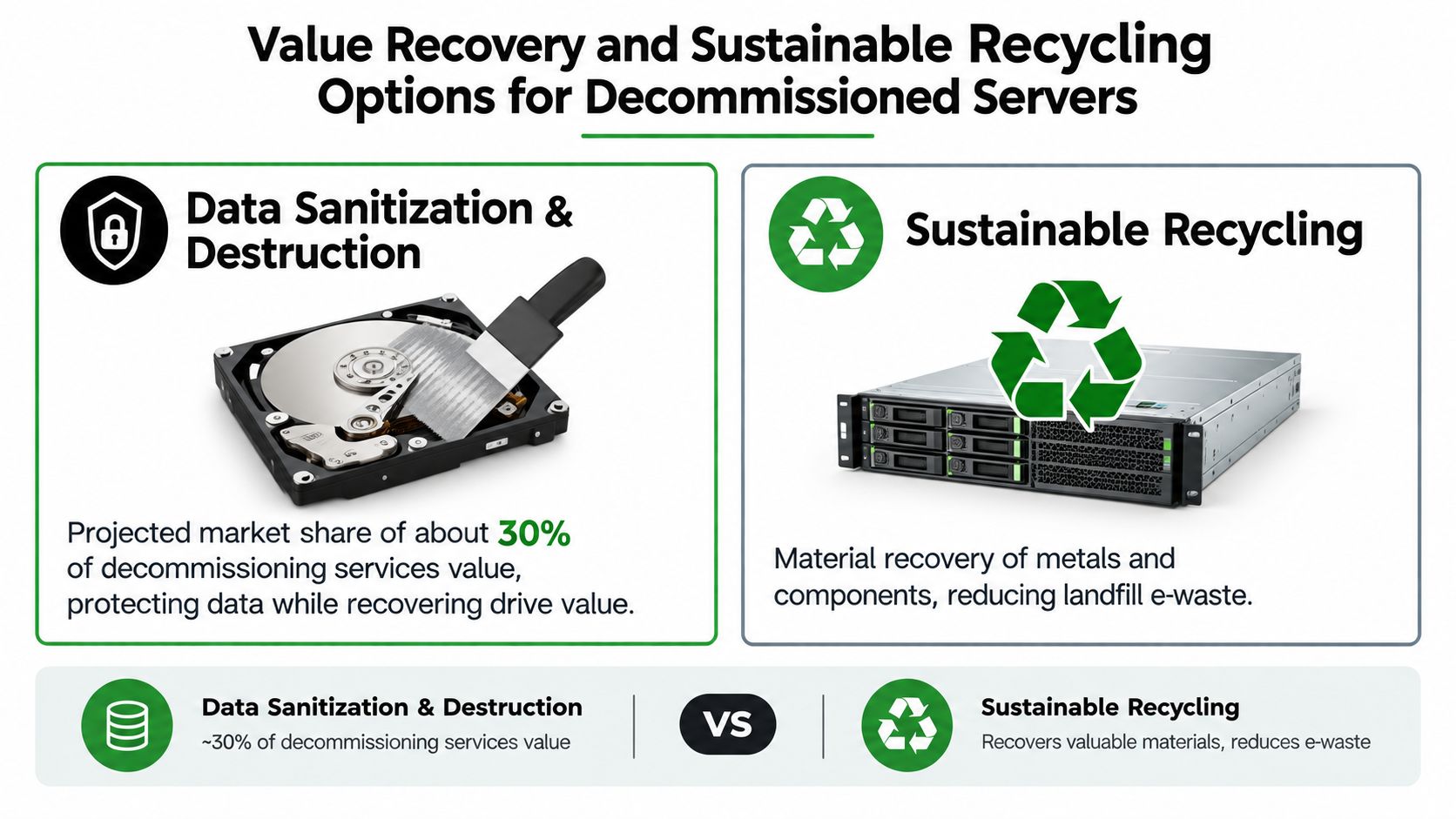
Market research projects data sanitation and destruction to represent about 37.8% of the data center ITAD market in 2026, according to Persistence Market Research's data center ITAD analysis. The same research identifies refurbishment demand, cloud refresh cycles, and circular-economy initiatives as forces shaping the market. That creates a real tension for Atlanta operators: destroying everything may simplify risk decisions, while destroying usable equipment may discard recoverable value.
Use triage rather than a single disposition rule
A practical triage separates security decisions from economic decisions without treating them as competing priorities.
- Reuse path: Functional servers and verified media move toward redeployment or controlled resale when policy allows.
- Parts path: Equipment with useful processors, memory, power supplies, or chassis components can be evaluated for component recovery.
- Destruction path: Failed verification, damaged media, or equipment with no approved recovery route goes to secure destruction.
- Recycling path: Remaining materials go through responsible electronics recycling with documented downstream handling.
The decision should be recorded per asset. A disposition report can show why one server was sanitized and resold while another was shredded or recycled. That level of detail supports sustainability reporting, finance reconciliation, and an explanation to auditors or internal risk teams.
Sustainability isn't served by remarketing equipment without adequate sanitization, and security isn't improved by shredding every asset without considering recoverable value. The strongest program protects data first, then evaluates condition, marketability, environmental route, and liability transfer.
Selecting the Right Vendor for Atlanta Server Decommissioning Services
Price is only one part of a server decommissioning decision. A low quote can become expensive if the provider misses serials, outsources custody without disclosure, offers only generic wipe reports, or lacks a clear route for failed media.
Test the provider's operating model
Ask for a sample serialized inventory report, certificate of sanitization, certificate of destruction, chain-of-custody form, and final disposition report before signing. The documents should agree on asset identity and show how exceptions are resolved.
A credible evaluation should cover:
- Sanitization depth: Can the provider perform on-site and off-site processing, and does it verify Clear or Purge techniques where required?
- Destruction controls: Are failed or high-risk drives routed to physical destruction instead of resale?
- Inventory discipline: Does the team scan and reconcile serials at the rack, pickup, receiving, processing, and disposition stages?
- Sector experience: Has the provider handled controlled environments in healthcare, finance, government, or other regulated operations?
- Logistics ownership: Can it explain who transports the equipment and how custody is recorded?
- Recovery analysis: Will it assess reuse and resale without weakening data-security controls?
- Environmental documentation: Can it provide recycling evidence and explain downstream disposition?
Watch for weak answers
Be cautious when a vendor promises “certified destruction” without showing what each certificate contains. A certificate that lists only a shipment total doesn't prove that a particular drive was processed. The same concern applies to a wipe log without a verification result or a resale report that doesn't connect the buyer-facing asset to the original serial record.
Beyond Surplus provides business IT asset disposition, Atlanta data center de-installation, secure data wiping, hard-drive shredding, electronics recycling, asset tracking, logistics coordination, and certificates of recycling and data destruction. For an Atlanta server project, those services can be evaluated against the same requirements as any qualified provider: serialized records, controlled transport, verified sanitization, appropriate destruction, and documented final disposition.
The right vendor doesn't force every server into one outcome. It makes the security decision first, then documents whether reuse, recovery, destruction, or recycling is justified.
Build the scope before requesting proposals. List the facilities, rack groups, host and media inventory, migration status, preferred sanitization methods, pickup constraints, reporting requirements, and approval contacts. Then ask each vendor to explain its exception process in writing, because discrepancies and failed verification are where a polished plan is tested.
Beyond Surplus supports Atlanta server decommissioning with serialized asset tracking, controlled removal, certified data wiping, hard-drive shredding, electronics recycling, and documented value recovery paths for eligible equipment. Visit Beyond Surplus to discuss a secure decommissioning plan for your Atlanta facility, enterprise refresh, or multi-site IT asset disposal project.


