

A server refresh is on the calendar, retired laptops are collecting in a locked room, and procurement wants the old equipment moved before the next audit. The question isn't whether the files were deleted. The question is whether your Atlanta organization can prove that unauthorized recovery is infeasible, identify who handled each asset, and show why the chosen method matched the media and risk.
NIST 800-88 data destruction in Atlanta turns that concern into an operating process. For an IT manager, the standard connects technical sanitization decisions with pickup scheduling, asset tracking, vendor controls, certificates, electronics recycling, and responsible IT asset disposition across the Atlanta metro area.
Table of Contents
- Understanding NIST 800-88 Compliance Standards
- The Three Media Sanitization Categories Explained
- Mapping Sanitization to Legal Compliance Requirements
- Choosing the Right Method for Different Media Types
- On-Site Versus Off-Site Data Destruction Logistics
- Building an Effective Data Destruction Policy
- Next Steps for Atlanta IT Asset Disposal
Understanding NIST 800-88 Compliance Standards
Rev. 2 treats sanitization as an enterprise program, not a per-drive checklist. For an Atlanta IT manager, that means connecting technical decisions with asset records, vendor controls, verification, and chain-of-custody paperwork. NIST SP 800-88 Rev. 2 was published in September 2025, superseding Rev. 1, published on December 17, 2014. The revision adds validation-focused security assurance and addresses logical sanitization in cloud and virtualized storage. Use NIST SP 800-88 Rev. 2 as the compliance and operations benchmark, alongside this guide to what data sanitization means as an operational baseline.
NIST defines media sanitization as a process that makes access to target data infeasible for a given level of effort. Deleting a file, emptying a recycle bin, or formatting a volume may leave data in other areas of the media. The selected method must account for how the device stores information and what happens after it leaves your control.
Separate wiping from destruction
A wipe is a logical or hardware-based sanitization action intended to keep the device usable. Destruction makes the media permanently unusable. The choice affects resale, internal reuse, recycling, evidence, and cost.
A laptop planned for employee redeployment may need a validated process that preserves the machine. A failed storage device sent to an Atlanta ITAD vendor may require a purge or destruction decision if ordinary software commands cannot address inaccessible areas. The vendor's paperwork should match that decision, including the asset identifier, method, verification result, custody transfers, and final certificate.
Set the workflow before equipment moves:
- Data classification: Record whether the media held ordinary business information, regulated records, credentials, or highly sensitive material.
- Media inventory: Capture the asset tag, serial number, device type, storage technology, and condition.
- Disposition intent: Identify whether the equipment will be reused, remarketed, recycled, or destroyed.
- Evidence requirements: Define the verification record, chain-of-custody entries, and certificate required for each outcome.
Rev. 2 also requires program owners to address storage that is provisioned or decommissioned without a simple physical handoff. For cloud and virtualized environments, document who controls logical sanitization, how validation occurs, and what evidence the provider or internal team retains.
Practical rule: A completed software command is an event. A documented, validated workflow is a sanitization program.
The Three Media Sanitization Categories Explained
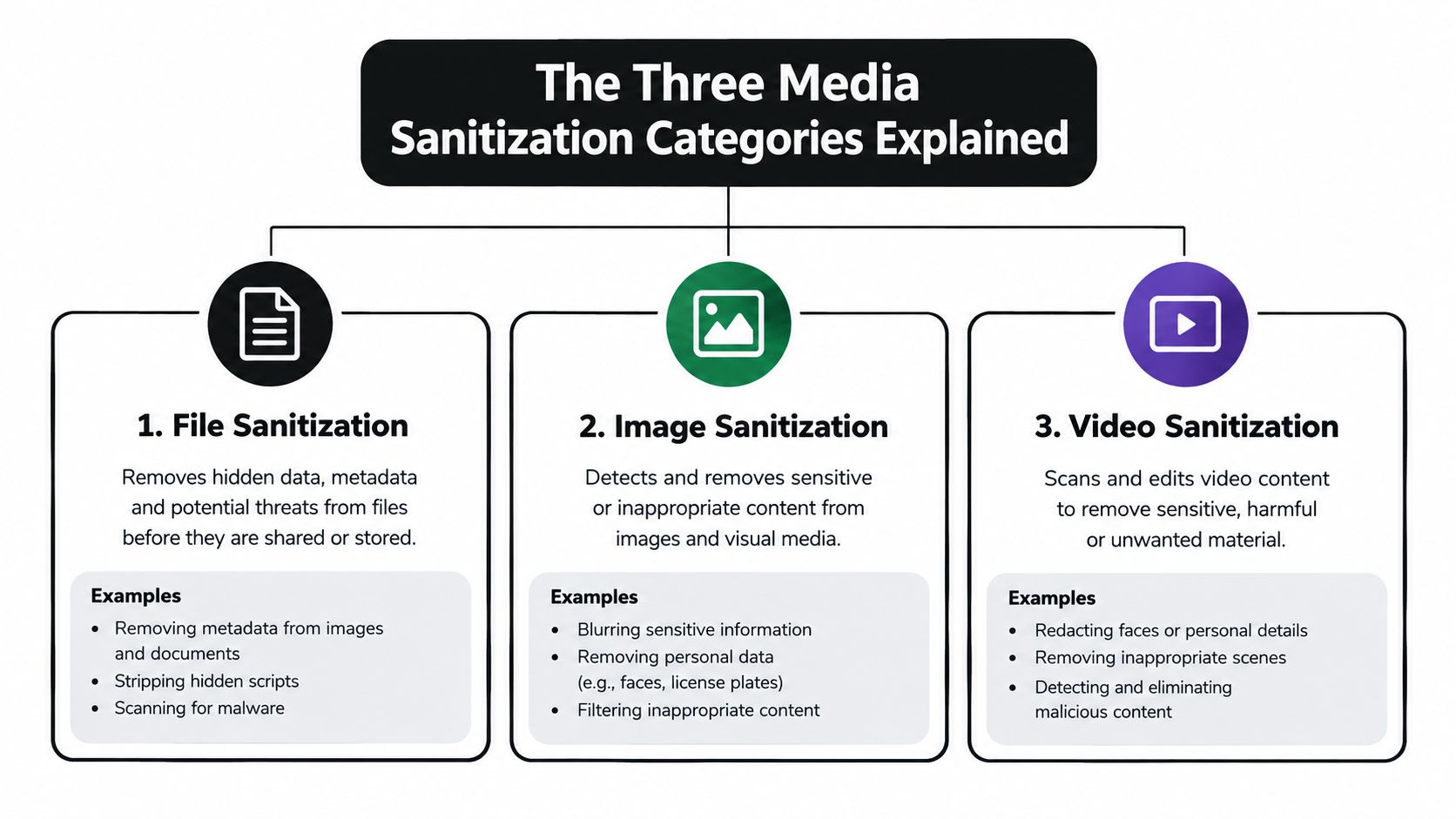
NIST uses three outcomes, Clear, Purge, and Destroy. Think of them as different levels of control matched to the device, the data, and what happens next.
Clear uses logical techniques on user-addressable storage. It can suit rewriteable media when the organization has determined that the accessible storage area is the relevant sanitization target and the device remains suitable for use. It isn't a universal answer for damaged media, non-rewriteable devices, or storage with areas ordinary commands can't reach.
Purge uses physical or logical methods intended to make recovery infeasible even with state-of-the-art laboratory techniques. It can preserve the device for reuse, but the method must fit the media. A secure erase command, an appropriate cryptographic erase process, or another approved technique may be relevant depending on the device and its controls.
Destroy is reserved for media that won't be reused. The result is a permanently unusable device and data recovery that is infeasible. NIST's current guidance emphasizes that destruction methods should be selected when the media will not be reused, rather than treating physical destruction as the default for every retired asset.
Match the outcome to the business decision
The categories aren't a ranking where Destroy is always the safest and therefore always correct. Destroy eliminates reuse and can reduce recovery value. Clear may preserve value but can be unsuitable where inaccessible storage areas remain. Purge can offer a stronger outcome while preserving the device, but only when the technique and prerequisites are appropriate.
| Outcome | Business use | Main limitation |
|---|---|---|
| Clear | Reuse when the media and risk target support logical sanitization | Doesn't address every retained area on unsuitable or damaged media |
| Purge | Transfer or reuse where stronger recovery resistance is required | Requires a media-appropriate method and validation |
| Destroy | Media that must never be reused | Permanently removes the device from the reuse stream |
A vendor should record the selected outcome for each asset rather than applying one generic “wipe complete” status to a mixed shipment. That distinction is especially important during data center decommissioning, where servers, SSDs, arrays, removable media, and failed drives may enter the same logistics workflow.
Mapping Sanitization to Legal Compliance Requirements
A retired server leaving an Atlanta loading dock creates a compliance handoff, not just a transportation task. NIST 800-88 does not replace legal advice, but it gives IT managers a defensible method for selecting and documenting disposal controls. The FTC Disposal Rule calls for reasonable and appropriate practices that prevent unauthorized reading or reconstruction of consumer information. NIST's focus on making recovery infeasible supports that technical objective, as described in the NIST media sanitization guidance.
The paperwork must follow the asset from internal release to final processing. Before pickup, reconcile serial numbers and asset tags against the retirement list. At the loading dock, record who accepted the equipment, the time of transfer, and the destination facility. Require the Atlanta ITAD vendor to preserve those identifiers through sanitization, verification, and certificate issuance.
A certificate of media disposition should make five points clear:
The asset identifies the serial number, asset tag, manufacturer, model, and media type.
The action records whether the vendor used Clear, Purge, or Destroy, along with the specific technique.
The responsible party names the technician, organization, or processing facility that performed the work.
The result records the verification or validation outcome and processing date.
The audit trail connects pickup, transport, transfer, authorization, and final disposition records.
This evidence matters when one shipment contains working laptops, failed drives, removable media, and servers from a data center closure. A single “wipe complete” status cannot show that the chosen method matched each device or that every handoff was controlled.
Keep the certificate with the asset register, vendor agreement, pickup documentation, and exception records. If a drive could not be processed, the file should show who approved the alternate treatment and how the remaining risk was addressed. Georgia-specific obligations should be reviewed with counsel and compliance staff. Operations teams can also use Georgia electronics recycling and ITAD compliance guidance when organizing vendor selection and disposal records.
A certificate is evidence, not the control itself. The control is the documented process that makes each device's final disposition reviewable.
Choosing the Right Method for Different Media Types

An Atlanta IT asset disposal batch may contain working laptops, failed drives, SSDs, removable media, and legacy servers. Treating them all as if they respond to the same wipe command creates a control gap. NIST Rev. 2 states that Clear, Purge, and Destroy must be selected according to the media type and residual-risk target. It also warns that overwrite cannot address every retained area on non-rewriteable or damaged media.
Match the method to the device
A functioning rewriteable device may qualify for Clear when the organization has confirmed that user-addressable space is the relevant target and the equipment will enter an approved reuse process. A successful operating system reset does not establish that decision. The work order should identify the media type, approved method, and condition that would require escalation.
SSDs require a different assessment. Wear leveling, spare areas, and controller behavior can leave data outside the reach of a conventional overwrite. Use a media-appropriate Purge method or Destroy when the device design, configuration, or risk decision does not support reliable sanitization. Failed drives and legacy equipment need the same caution. A tool can report completion even when it could not access every storage area.
For encrypted media, Cryptographic erase provides a separate control path. It sanitizes the device by destroying the encryption keys, leaving ciphertext behind and preventing read access. That approach depends on correctly enabled encryption, controlled keys, and satisfied key-management prerequisites. Encryption by itself does not prove that sanitization occurred.
Before an Atlanta ITAD vendor starts work, put these decisions in the service scope:
- SSDs and flash storage: Require a process that accounts for controller-managed areas instead of relying on unsuitable overwrite.
- Failed drives: Specify when the vendor must route a device to Purge or Destroy because software access is unreliable.
- Servers and arrays: Require identification and treatment of each storage component, not only the enclosure.
- Encrypted media: Confirm key ownership, key destruction, and the evidence the vendor will return.
- Recovery exceptions: Define approval for media that cannot be read, powered, or identified.
If a drive's condition is unclear, consult a qualified recovery specialist for nationwide hard drive recovery before deciding between sanitization and destruction. For enterprise disposal, compare the proposed workflow with secure SSD destruction methods before processing begins. Attach the selected method and any exception decision to the vendor's work order so the final paperwork explains why each media type received its treatment.
On-Site Versus Off-Site Data Destruction Logistics
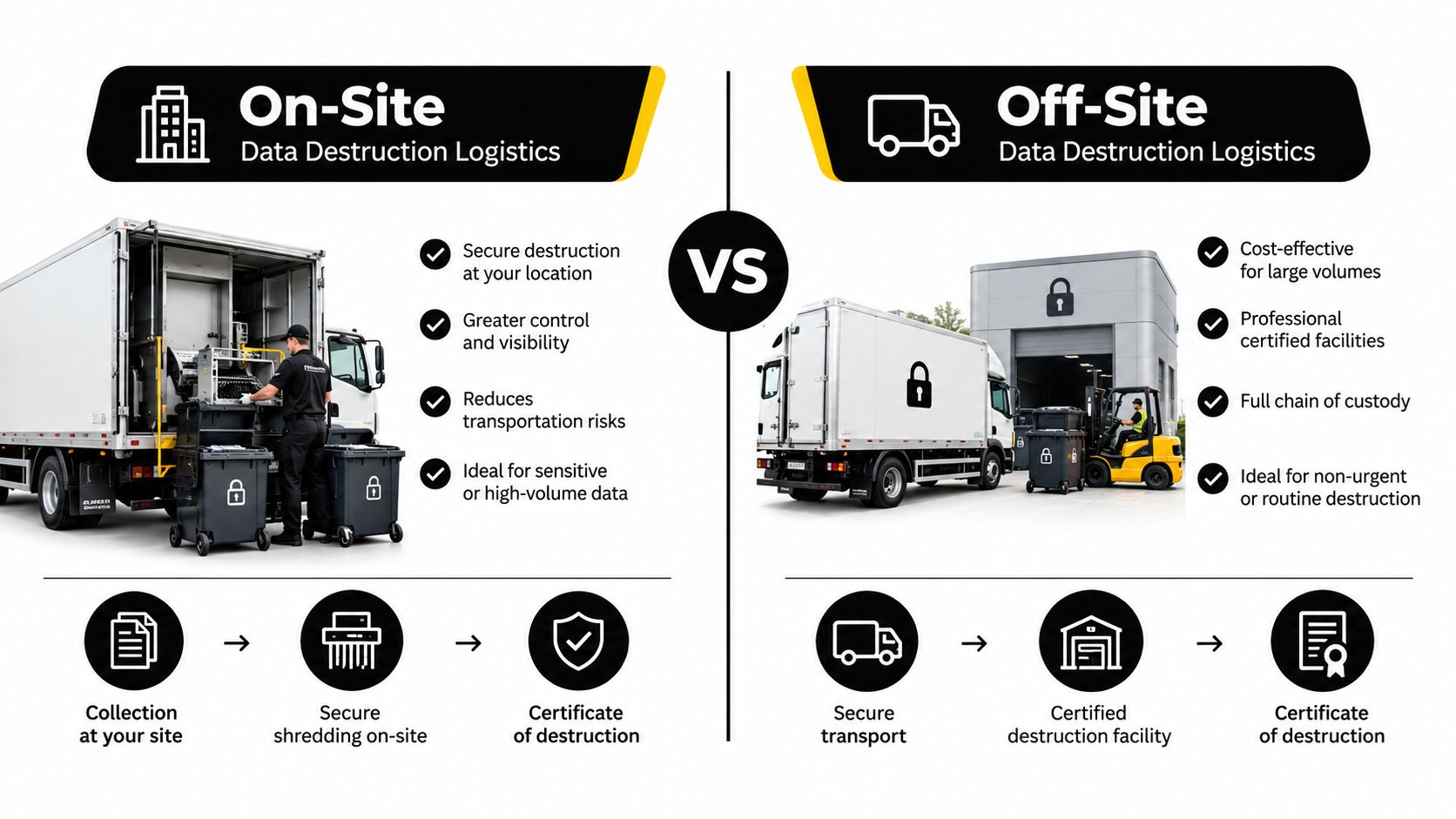
An Atlanta office may have a locked loading area, limited staging space, and employees working beside the equipment scheduled for destruction. Those conditions can determine whether on-site or off-site processing is practical, even when both options meet the required NIST 800-88 outcome.
On-site service keeps media at your facility until the physical action occurs. It gives security staff direct visibility and reduces transportation steps, but the vendor still needs a suitable work area, controlled access, scheduling coordination, and equipment that will not interfere with critical operations. Confirm where the truck can park, who may enter the work zone, and how each asset will be identified before processing.
Off-site service transfers the equipment to a controlled facility for triage, testing, wiping, destruction, recycling, refurbishment, or value recovery. It can handle mixed inventory and larger decommissioning projects more efficiently. The trade-off is a longer custody chain. Require documentation for pickup, sealed transport, facility intake, inventory reconciliation, processing, and final disposition. The vendor should also state how it isolates damaged, unidentified, or disputed devices.
Use the project's risk and operating constraints to make the choice:
- On-site: Suitable when physical visibility, facility control, or witnessed destruction drives the decision.
- Off-site: Suitable when equipment needs testing, refurbishment, resale, recycling, or specialized processing.
- Either model: Requires an asset reconciliation, recorded custody transfers, an appropriate sanitization method, and evidence of disposition.
The paperwork should match the physical workflow. For an on-site job, retain the work order, asset list, processing record, and destruction evidence. For an off-site job, verify that the pickup inventory matches facility intake and that the final report accounts for every asset.
Review on-site versus off-site ITAD services in Georgia against the project's risk, volume, timing, facility rules, and recovery objectives. The lowest transportation cost may create more supervision or documentation work. Choose the process your Atlanta team can control, reconcile, and defend.
Building an Effective Data Destruction Policy
A usable policy tells employees what to do before equipment reaches a recycler or ITAD vendor. It should apply to laptops, desktops, servers, storage arrays, mobile devices, laboratory equipment, medical equipment, and any other asset that may contain data. It should also cover data center decommissioning, office moves, hardware refreshes, employee offboarding, and product destruction.
Write the decision rules first
Start with a short rule that connects data classification and disposition intent to the NIST outcome. For example:
“The organization will select Clear, Purge, or Destroy according to media type, data sensitivity, device condition, and whether the media will be reused. No asset may leave organizational control until the selected sanitization outcome and custody record are complete.”
Then assign ownership. IT decides when equipment is retired and identifies the media. Information security or compliance defines risk requirements. Facilities controls access and loading procedures. Procurement confirms vendor obligations. Finance or asset management reconciles the final disposition and any value recovery.
The operating procedure should include:
- Tag the asset: Capture the serial number, asset tag, owner, location, and media type.
- Freeze the handoff: Keep the device in a controlled staging area until the inventory is reconciled.
- Select the outcome: Record Clear, Purge, or Destroy and the reason for the choice.
- Transfer custody: Document who released, transported, received, and processed the asset.
- Verify the result: Require the applicable validation or verification record.
- Close the asset: Attach the certificate of media disposition and update the asset register.
Audit the vendor before the pickup
Ask for a sample certificate, a sample chain-of-custody form, the escalation process for failed media, and a description of how serial numbers are reconciled. Review whether the vendor supports on-site destruction, certified data wiping, responsible electronics recycling, IT asset recovery, and secure e-waste management where those services fit your policy.
Beyond Surplus is one Atlanta-based option that provides on-site and facility-based data destruction, electronics recycling, IT equipment disposal, and certificates documenting data destruction and recycling for business workflows. Treat the vendor's documentation as part of your control design, not as an administrative afterthought.
Next Steps for Atlanta IT Asset Disposal
Start with the equipment already waiting for disposition. Build a working inventory, separate storage media from non-data-bearing equipment, and flag failed, encrypted, SSD, legacy, and mixed-array assets for a specific method decision.
Then ask prospective vendors five practical questions:
- Can you reconcile every serial number and asset tag at pickup and intake?
- Which process do you use for Clear, Purge, and Destroy outcomes?
- How do you handle failed drives and inaccessible storage?
- What verification and certificate records will my audit team receive?
- Can you support on-site destruction, off-site processing, recycling, and value recovery within the required schedule?
Keep the answers with the project record. If the current policy doesn't define custody, media-specific methods, or certificate retention, update it before the next hardware refresh. For an Atlanta-focused starting point, review secure IT asset disposition services in Atlanta and use the requirements above to evaluate the workflow.
NIST 800-88 data destruction isn't just about making a device unusable. It helps an enterprise show that the right outcome was selected, the media stayed controlled, and the final disposition can withstand operational and compliance review.
Beyond Surplus provides Atlanta-area businesses with secure data wiping, on-site and off-site hard drive shredding, electronics recycling, IT equipment disposal, and documented chain-of-custody records. Visit Beyond Surplus to discuss a media-specific ITAD plan for your next equipment refresh, data center decommissioning, or enterprise disposal project.


