

Extending IT hardware life by one year can reduce its carbon footprint by up to 30%, but only if the device's energy efficiency hasn't significantly improved. The practical answer is to pair lifecycle extension with verified data sanitization, so reusable equipment stays in service while high-risk media is destroyed responsibly.
An IT manager rarely gets a clean end-of-life moment. A server refresh overlaps with a lease expiration, laptops arrive from a reorganized department, or medical equipment is removed while compliance teams are still asking where its storage media went. The decision is not just whether to recycle. It's whether the organization can protect sensitive information, recover asset value, and reduce environmental impact with evidence.
Beyond Surplus approaches that intersection through secure data destruction, certified wiping, IT asset recovery, electronics recycling, and documented chain of custody. The strongest programs don't treat sustainability and security as opposing priorities. They use security controls to preserve equipment for reuse whenever the risk profile allows it.
Table of Contents
- Navigating IT End-of-Life With Purpose
- Understanding Regulatory and Market Drivers
- The Global E-Waste Challenge and Opportunity
- Balancing Hardware Lifecycle and Efficiency
- Implementing Secure Data Sanitization Standards
- Building a Closed-Loop Disposition Program
- Integrating Sustainability With Vendor Partnerships
Navigating IT End-of-Life With Purpose
A regional business has a familiar problem: a data center refresh is scheduled, dozens of laptops are being replaced, and facilities wants the equipment removed quickly. The IT team wants every drive sanitized. Procurement wants recovery value. The sustainability lead wants to avoid unnecessary recycling. A generic haul-away service may solve the space problem, but it won't necessarily prove what happened to each serialized asset.
The end-of-life decision is strategic
Responsible IT asset disposition, or ITAD, begins before equipment reaches a loading dock. Teams should classify devices, identify data-bearing components, assess whether each item can be redeployed, and define the downstream destination for assets that cannot be reused. That process applies across commercial laptops, servers, networking equipment, laboratory instruments, medical equipment, batteries, and office electronics.
The wrong default is “destroy everything.” Physical destruction may be appropriate for failed drives or highly sensitive media, but destroying a functional laptop that could be securely wiped eliminates its remaining service life and creates demand for replacement equipment. The opposite mistake is just as serious, sending storage devices to an unknown processor without asset-level documentation.
Practical rule: Decide the data-sanitation method and the environmental destination together, not in separate workflows.
A closed process produces certificates of data destruction, recycling records, serialized inventory reconciliation, and clear evidence of reuse or material recovery. Teams evaluating broader sustainability practices can also see how HighFlow Energy helps organizations connect operational decisions with environmental responsibility.
The result is more than a cleaner storeroom. It's a defensible record showing who handled the equipment, what happened to the data, which assets were recovered, and which materials entered controlled processing.
Understanding Regulatory and Market Drivers
Environmental impact reduction has moved from a general corporate aspiration to a measurable operating requirement. UNEP reports that global greenhouse-gas emissions reached approximately 57.1 gigatonnes of carbon-dioxide equivalent in 2023, an increase of 1.3% from 2022. Under current policies, 2030 emissions are projected to remain around 57 gigatonnes. The UNEP 2024 Emissions Gap Report estimates that emissions must fall 42% below 2019 levels by 2030 for a 1.5°C pathway, compared with a 28% reduction for a 2°C pathway.
Those targets make technology lifecycle decisions relevant to climate planning. Energy use, procurement, logistics, buildings, cloud infrastructure, and equipment replacement all create measurable sources of impact. A distant net-zero statement isn't a substitute for a baseline covering the assets an IT department controls.
Security obligations apply at disposal
The FTC Disposal Rule applies to businesses and individuals that use consumer reports for a business purpose. It requires disposal practices that are reasonable and appropriate to prevent unauthorized access or use of the information. For electronic assets, the FTC identifies destroying or erasing electronic files or media so the information can't be read or reconstructed as an appropriate control.
That scope reaches lenders, insurers, employers, landlords, government agencies, automobile dealers, attorneys, and service providers that maintain consumer-report information. A laptop containing applicant records, a drive from a healthcare environment, or a server used by a financial institution can't be treated as ordinary scrap.
The practical control is documentation. A compliant workflow should define approved sanitization methods, chain-of-custody checkpoints, processor responsibilities, and evidence retention. Businesses building an environmental governance program can also review how IT recycling supports ESG, provided the operational claims are supported by actual disposition records.
The Global E-Waste Challenge and Opportunity
The e-waste stream is a resource-management problem as much as a disposal problem. The world generated 62 billion kilograms of e-waste in 2022, while only 22.3%, or 13.8 billion kilograms, was documented as formally collected and recycled in an environmentally sound manner, according to the Global E-waste Monitor 2024.
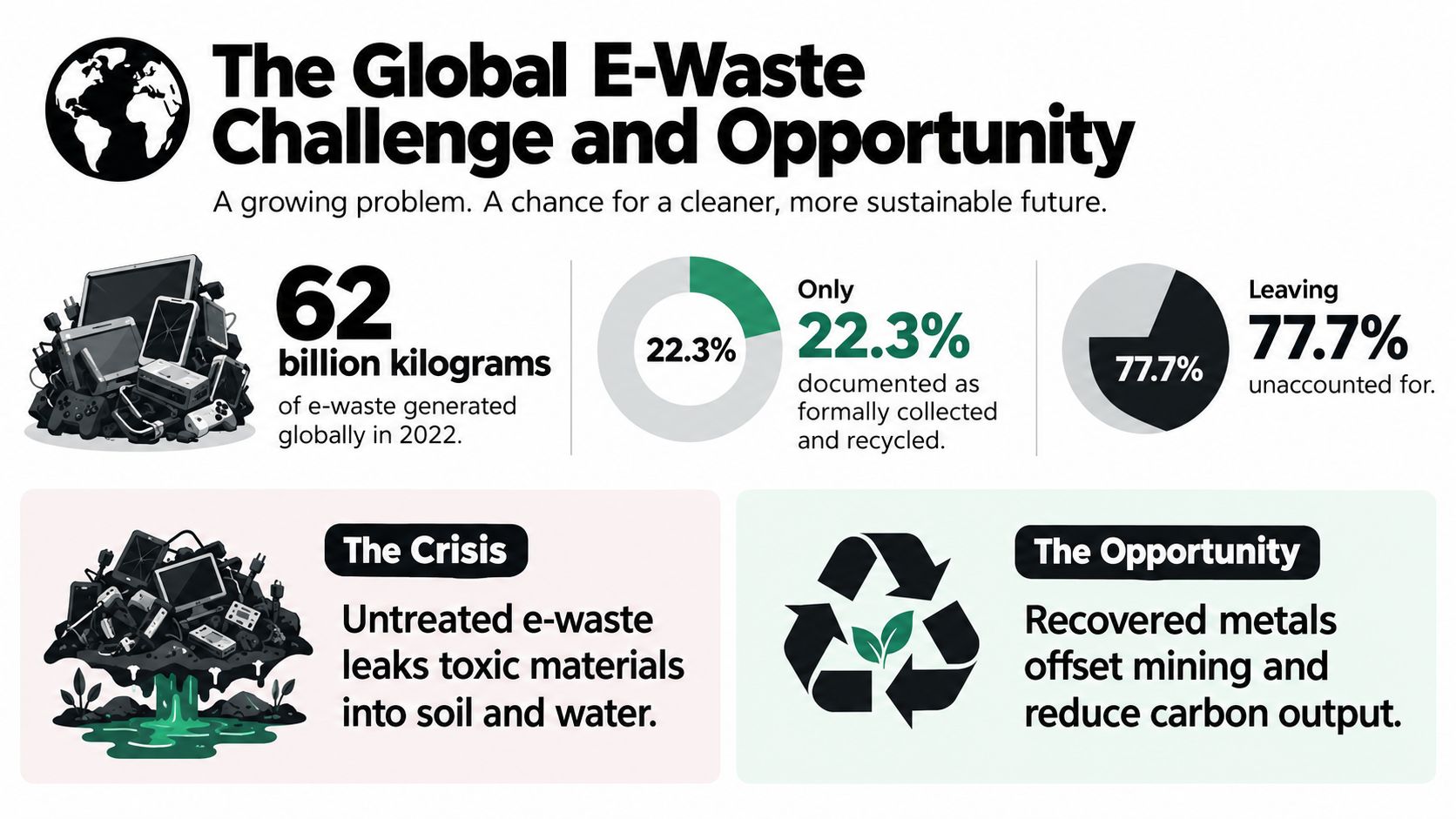
Recovery requires proof, not a pickup receipt
That waste stream contained approximately 31 billion kilograms of metals, including 2.1 billion kilograms of copper, 3.9 billion kilograms of aluminum, and 24 billion kilograms of iron or steel. Documented management avoided an estimated 900 million tonnes of primary ore extraction and 93 million tonnes of carbon-dioxide-equivalent emissions, including avoided metals mining and recaptured refrigerants.
For an enterprise, those figures point to a specific audit question: can the recycler show what happened after collection? A truck scale ticket is not enough. Procurement and sustainability teams should request weights, commodity categories, downstream processor details, and evidence of environmentally sound treatment.
Non-compliant processing creates pollution exposure. The same source estimates that improper e-waste management releases approximately 58,000 kilograms of mercury and 45 million kilograms of plastics containing brominated flame retardants annually. A business that lacks downstream visibility can't credibly claim responsible electronics recycling.
Turn the waste stream into operating metrics
A useful ITAD dashboard tracks:
- Reuse rate: The share of functional equipment redeployed, refurbished, or resold.
- Material recovery: Copper, aluminum, steel, plastics, and other categories recovered through documented processing.
- Mass balance: The relationship between collected weight and final destinations.
- Avoided impact: Estimated primary-material demand and carbon-dioxide-equivalent emissions avoided.
This is the distinction between secure e-waste management and a simple recycling activity. Businesses comparing environmental consequences across technology and other resource-intensive sectors may find Cascoin reviews environmental costs useful as broader context, but IT teams still need asset-specific evidence. Enterprise electronics recycling becomes meaningful when every claim can be reconciled to equipment, weight, and destination.
Balancing Hardware Lifecycle and Efficiency
Extending hardware is often the lower-impact choice, but it isn't automatically the right choice. Recent lifecycle analysis indicates that manufacturing can represent 30% to 70% of an IT device's lifetime carbon footprint, according to the analysis cited in Sustainable Computing. That makes reuse, repair, component upgrades, and redeployment powerful tools for environmental impact reduction.
The counterargument is operational energy. Newer equipment can consume up to 30% less energy for the same operations, so replacement may make sense for continuously running, energy-intensive workloads. A server that operates around the clock in a facility with significant cooling demand should be evaluated differently from a lightly used desktop stored in an office.
Compare lifecycle impact against workload reality
| Decision | Environmental advantage | Main risk |
|---|---|---|
| Redeploy existing equipment | Avoids manufacturing demand and extends useful life | Older equipment may use more electricity or lack support |
| Repair or upgrade | Preserves the platform while addressing a specific failure or bottleneck | Parts, firmware, and security support may be limited |
| Replace with efficient equipment | Can lower operational energy for demanding workloads | Manufacturing and logistics create new embodied impact |
| Recycle immediately | Recovers materials when reuse isn't viable | Destroys remaining product value and service life |
The right answer depends on workload utilization, electricity mix, cooling overhead, equipment age, cybersecurity support, and the embodied impact of manufacturing. A database server with low utilization may be a redeployment candidate. A heavily loaded, inefficient server cluster may justify replacement if measured energy savings outweigh the manufacturing burden.
Make refresh policy evidence-based
A refresh policy should require a lifecycle comparison rather than a blanket age threshold. Record current energy demand, utilization, maintenance condition, software compatibility, security support, and expected service life. Then compare those conditions with the proposed replacement, including the environmental cost of manufacturing and the destination of the retired equipment.
That method resembles the broader discipline discussed in this water sector LCA jobs guide, where lifecycle assessment helps decision-makers examine impacts across an asset's full existence. For IT leaders, the practical output is a documented decision: extend, upgrade, redeploy, or replace, with reasons that operations, security, finance, and sustainability teams can review. Sustainable IT asset management should make that decision repeatable across laptops, data centers, medical devices, and laboratory equipment.
Implementing Secure Data Sanitization Standards
Secure wiping is an environmental control because it determines whether equipment remains reusable. If an organization destroys every drive by default, it may achieve a strong security outcome while discarding equipment that could have supported another user. If it relies on an unverified reset, it may preserve the hardware while exposing confidential information.
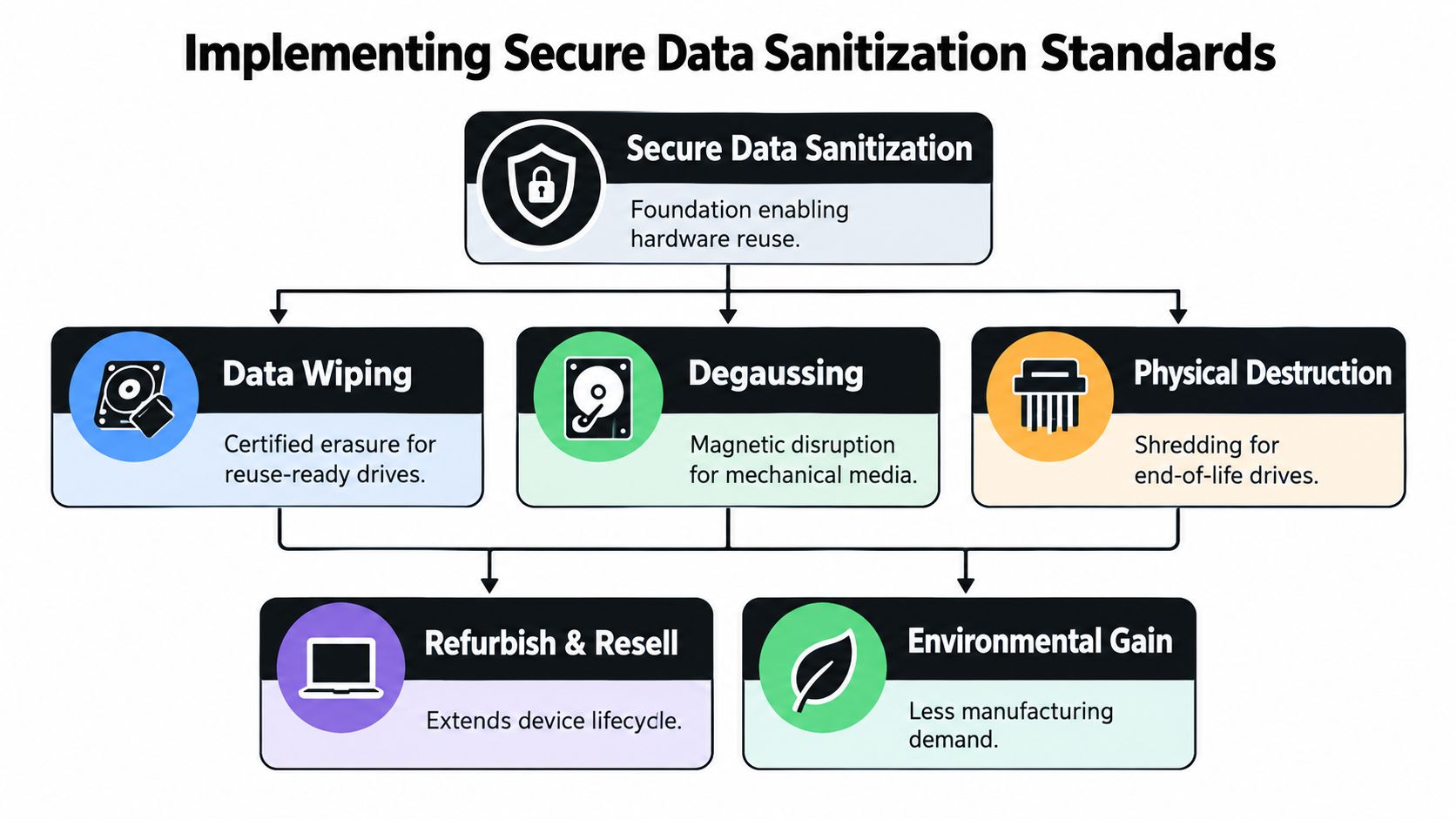
Match the method to the risk
NIST Special Publication 800-88 defines three outcomes:
- Clear uses logical techniques, such as standard read/write commands or a manufacturer factory reset, to address user-accessible storage locations and protect against simple, non-invasive recovery attempts.
- Purge uses physical or logical techniques intended to make recovery infeasible with state-of-the-art laboratory techniques while potentially preserving the media for reuse.
- Destroy makes recovery infeasible with state-of-the-art laboratory techniques and prevents the media from being reused for data storage.
The NIST SP 800-88 revision notes that purge should be preferred over clear when possible, while destruction is appropriate for many information-storage media. The standard doesn't turn one method into a universal answer. It supports a risk-based decision tied to the media, information, recovery threat, and reuse objective.
Build evidence into each handoff
A practical workflow starts with serialized inventory and data classification. The technician identifies the drive, selects the approved sanitization outcome, records the method and verification result, and issues an asset-level certificate. Equipment approved for reuse can move to testing, refurbishment, resale, or internal redeployment. Failed drives, incompatible media, or assets requiring irreversible control can move to physical destruction.
The IRS guidance also distinguishes disposal, clearing, purging, and destroying. It identifies overwriting as an example of clearing, the ATA Secure Erase command for compatible ATA drives, and degaussing as an example of purging for suitable magnetic media. Physical methods include disintegration, incineration, pulverizing, shredding, and melting, and destroyed media can't be reused for its original purpose. These details are summarized in the NIST-aligned sanitization service guidance.
Security and sustainability work together: preserve the device when validated sanitization makes reuse safe, and destroy only the media that requires an irreversible outcome.
Building a Closed-Loop Disposition Program
A closed-loop program starts with an inventory that follows the asset, not just the truck. Consider a company retiring a mixed batch of laptops, network equipment, servers, batteries, and monitors. The team records serial numbers, separates functional equipment from failed units, identifies data-bearing components, and assigns each asset a disposition path before pickup.
Use a controlled triage sequence
Functional laptops might be wiped and redeployed to another department. Servers may be tested for resale or parts recovery. Failed storage media may be destroyed, while non-reusable equipment moves to certified material recovery. Medical and laboratory equipment may need additional handling based on embedded batteries, hazardous components, or specialized decommissioning requirements.
The program should reconcile four records:
- Asset inventory: Serial number, model, location, owner, and condition.
- Sanitization evidence: Method, verification, technician, date, and certificate.
- Logistics evidence: Shipment, weight, custody transfer, and receiving processor.
- Disposition evidence: Reuse, resale, component recovery, destruction, or recycling.
The strongest performance indicators aren't the number of boxes collected. They include reuse rate, recovery rate by material, documented downstream yield, avoided primary-material demand, and estimated carbon-dioxide-equivalent emissions avoided.
Treat recycling capacity as a business issue
The Global E-waste Monitor estimates that raising collection and recycling to 60% by 2030 could produce benefits exceeding costs by more than USD 38 billion, while current trends could reduce the documented rate to about 20% by 2030 as generation grows faster than recycling capacity. That projection reinforces the value of specifying downstream processing before a refresh begins. The Global E-waste Monitor recycling analysis provides the economic context.
A closed-loop specification should require serialized reconciliation, mass-balance documentation, certified downstream processors, and clear treatment for reusable and irreparable assets. Guidance on circular economy practices for enterprise IT can help teams translate those requirements into procurement language and vendor scorecards.
Integrating Sustainability With Vendor Partnerships
A vendor should be evaluated as an extension of the organization's control environment. Ask how it handles laptops, servers, drives, batteries, medical equipment, laboratory equipment, and data-center decommissioning. The answer should distinguish reuse, product destruction, component recovery, and recycling rather than placing every asset in one disposal category.
Require evidence at the asset level
A capable partner should provide certificates of data destruction and recycling, maintain chain-of-custody records, document downstream destinations, and support on-site or off-site services where the risk profile requires them. Consolidated logistics can simplify large refreshes, but convenience shouldn't replace serialized reporting.
Beyond Surplus provides commercial ITAD services including certified data wiping, hard-drive shredding, electronics recycling, IT equipment disposal, IT buyback, product destruction, data-center de-installations, and logistics coordination. Its business programs support organizations that need documented security and environmental handling across the contiguous United States.

The right partnership connects three outcomes: protected information, recovered asset value, and measurable environmental impact reduction. Put those outcomes into the statement of work, require evidence for each one, and review the results after every refresh or decommissioning project.
Contact Beyond Surplus for certified electronics recycling, secure data wiping, hard-drive shredding, IT asset recovery, and documented IT equipment disposal. Visit Beyond Surplus to plan a compliant disposition program that protects sensitive data while keeping reusable equipment and recoverable materials in productive circulation.


