

Stop chasing the highest resale quote. That's the most popular advice in IT asset remarketing Atlanta circles, and it's how IT managers lose money on equipment that looked profitable on a spreadsheet. A strong gross price means nothing after testing, wiping, freight, channel fees, returns, and warranty claims eat the margin, and it means even less if you can't prove what happened to the data on every drive.
If you're retiring laptops, servers, networking gear, or storage in Atlanta, Georgia, judge every exit by two tests. Does it produce positive net recovery after all handling costs, and can you defend it with serial level evidence? If a route fails either test, it isn't value recovery. It's deferred risk.
Table of Contents
- Why Remarketing Is Not Automatically the Smartest Exit
- Building the Asset Register and Triaging Devices for Atlanta Recovery
- Applying NIST Sanitization and FTC Disposal Rule Controls
- Choosing the Right Channel for Resale, Parts, and Recycling
- Logistics and Chain-of-Custody That Survive an Audit
- Vetting an Atlanta ITAD Partner With a Decision Scorecard
- Putting the Atlanta Remarketing Playbook to Work
Why Remarketing Is Not Automatically the Smartest Exit
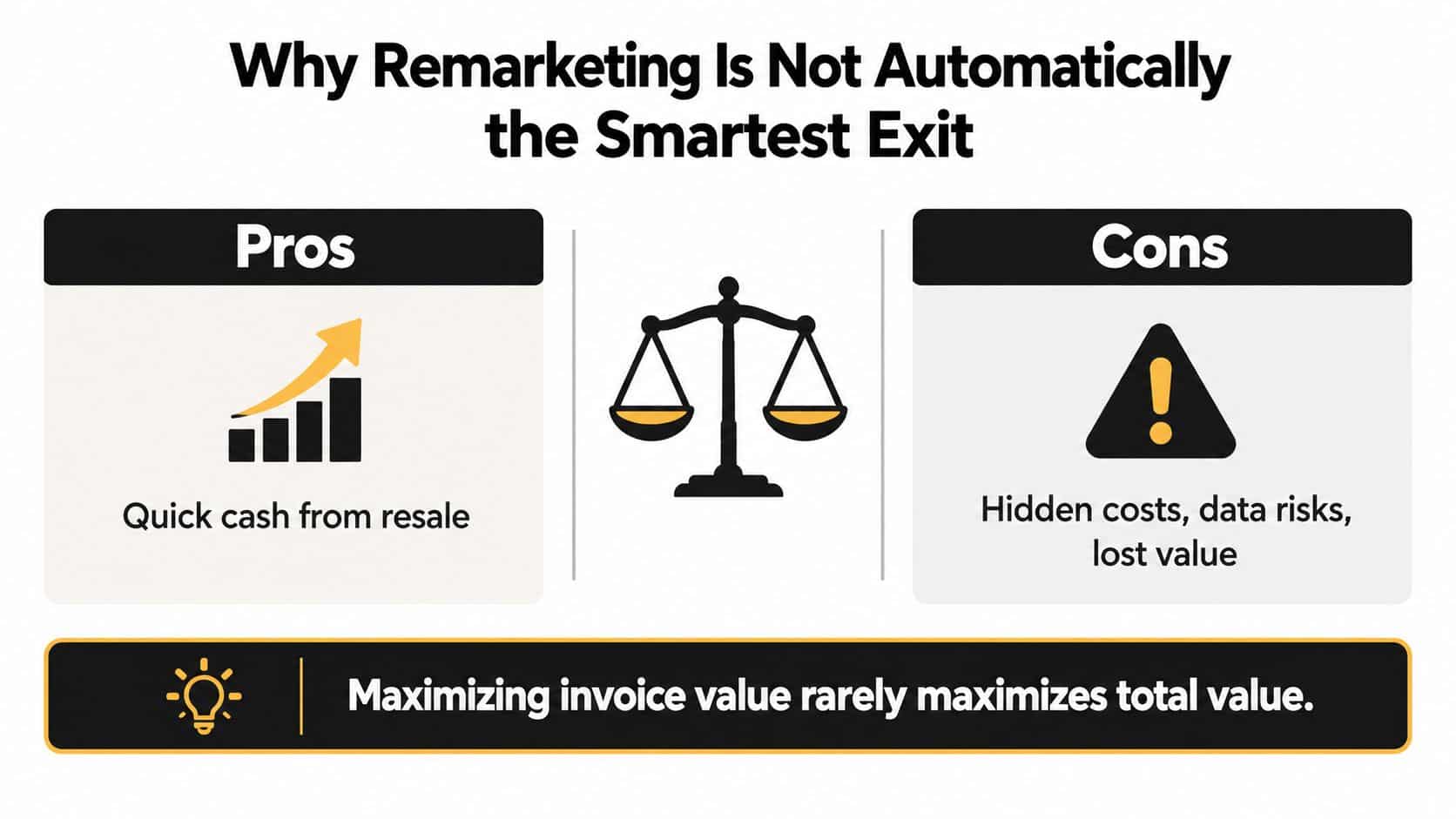
Resale is not always the best outcome. Maximizing invoice value rarely maximizes total value, because the invoice ignores the labor to test and grade, replacement batteries and parts, secure sanitization, storage while inventory sits, freight, broker or marketplace fees, and the cost of returns when a buyer rejects cosmetic grade or firmware version.
Run the math. Net recovery is sale proceeds minus testing, labor, refurbishment parts, data sanitization, storage, freight, marketplace or broker fees, warranty exposure, and expected return losses. If that number is lower than parts recovery or documented recycling, resale is the wrong call even if the headline price looked attractive.
The scale of the problem makes lazy decisions expensive. The Global E-waste Monitor 2024 reported 62 million tonnes of e-waste generated in 2022, with only 22.3% documented as formally collected and recycled and about US$62 billion in recoverable value unaccounted for. Dumping functional gear into undocumented channels wastes that value. Forcing marginal gear into resale wastes your team's time.
When Resale Loses
Age, battery condition, software support, and data sensitivity stack the deck quickly. A laptop needing a battery, keyboard, and screen repair may sell, but parts and labor can erase the return. A server with an unsupported processor generation may attract a broker quote that collapses once freight dimensions and return risk are priced in.
Local redeployment, donation to a school or nonprofit that can use the equipment, parts harvesting, or documented recycling can beat a low margin resale after risk is included. Don't treat that as failure. Treat it as triage working as intended.
Practical rule: Approve resale only when expected net recovery clears a threshold you set before you get quotes, not after a broker flatters you with a gross number.
The Four Tests That Matter
Evaluate every fleet retirement on net recovery, data defensibility, time to disposition, and environmental documentation. A channel that pays well but can't produce per device sanitization evidence fails. A channel that's compliant but leaves equipment in a cage for months while value decays also fails.
Small businesses, schools, and nonprofits feel this most because they lack volume to negotiate separate channels for each device class. They need one controlled process that routes each asset correctly, not a blanket promise to remarket everything. That's the standard for serious Atlanta electronics recycling services and secure e-waste management.
Building the Asset Register and Triaging Devices for Atlanta Recovery
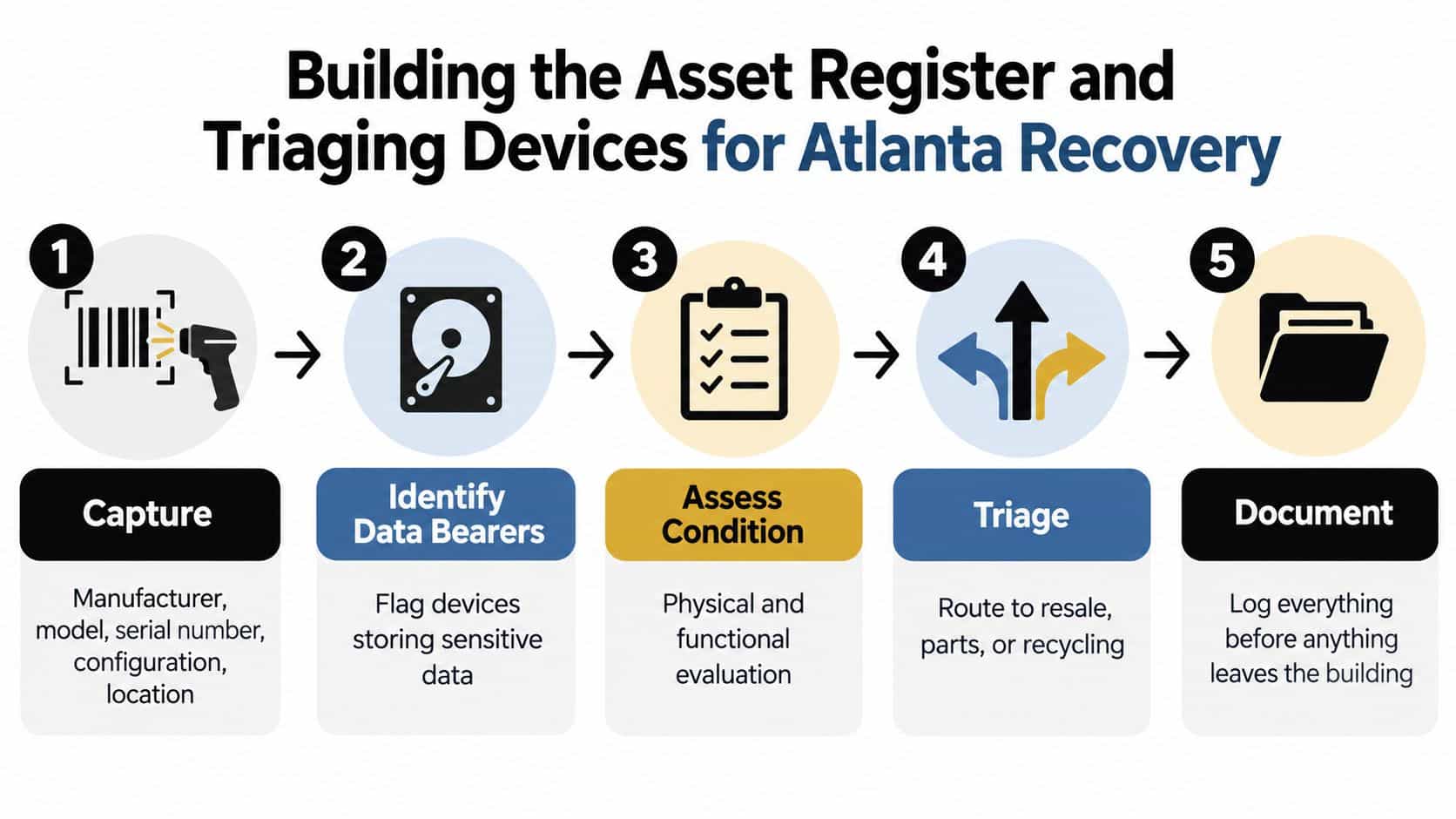
Don't let anything leave the building until you've frozen the inventory. Your asset register is both your valuation tool and your audit defense, and you can't rebuild it accurately after a truck pulls away from a Midtown office or a Smyrna warehouse.
Capture manufacturer, model, serial number, configuration, location, and every data bearing component for each unit. Configuration means processor, memory, storage type and capacity, and installed cards, not just chassis model. Buyers price components, and auditors track drives.
A Triage Rule You Can Run This Week
Classify each device on five factors before you discuss price with anyone.
- Functional condition: Does it power on, pass diagnostics, and hold charge or complete workloads without errors?
- Age and support: Is firmware still supported, and does the operating system path still exist for the next user?
- Market demand: Is this configuration buyers want, or a custom build only your team valued?
- Configuration value: Are RAM, storage, and processors worth more installed, harvested, or neither?
- Media eligibility: Can the storage be sanitized and verified, or does it need destruction?
That last question changes economics fast. A laptop that's resale ready with its original SSD becomes a different asset if the drive must be destroyed and replaced. Price both versions before you commit.
Use a formal equipment condition assessment at intake so grading is consistent across laptops, servers, networking, storage, and peripherals. Inconsistent grading creates return losses later, and returns are where thin remarketing margins disappear.
Measure Recovery Rate, Not Anecdotes
Track recovery rate quarterly. It's net dollars recovered divided by original acquisition cost, segmented by servers, networking, storage, laptops, and peripherals. Segmenting matters because a blended average hides which classes you're mishandling.
Timing drives the result. Available market commentary indicates enterprise equipment can retain about 35-45% of original value at two years, 25-35% at three years, and 15-25% at four years when remarketed within six months of retirement, while five year or older hardware commonly falls to single digit percentages. Those are benchmarks, not guarantees, and they assume you move quickly.
Equipment sitting in storage isn't neutral. It's depreciating, occupying space, and drifting toward parts or recycling value whether you've decided that or not.
Pitfalls That Quietly Kill Value
Don't strip high value RAM or drives without recording the new configuration. Don't price by chassis when installed components drive the quote. Don't delay disposition until a refresh project ends if the first retired racks can move now. Each delay pushes data center assets down the value curve and increases handling touches.
Freeze configuration details at decommissioning, photograph condition where cosmetic grade matters, and reconcile the register to physical count before pickup. If the counts don't match in your building, they won't match on a certificate later.
Applying NIST Sanitization and FTC Disposal Rule Controls
Pick the sanitization outcome per device, based on data sensitivity and whether you intend to reuse the media. A blanket wipe policy for everything is lazy, and a blanket destroy policy for everything destroys resale value you could have kept safely.
NIST SP 800-88 defines three outcomes. Clear uses logical techniques against simple, non invasive recovery. Purge aims to make recovery infeasible even with laboratory methods while potentially preserving the device for reuse. Destroy makes recovery infeasible and leaves media unusable. The NIST SP 800-88 framework for clear, purge, and destroy outcomes gives you the language to specify exactly what you require in a contract, instead of accepting vague promises about wiping.
NIST Sanitization Outcomes Matched to Atlanta ITAD Scenarios
| Outcome | Best For | Reuse Eligible? | Evidence Required |
|---|---|---|---|
| Clear | Low sensitivity devices staying under your control or low risk redeployment | Yes | Per device completion log |
| Purge | Resale bound laptops, servers, and storage with sensitive data | Yes, if verified | Tool output, timestamps, pass or fail result |
| Destroy | Failed, damaged, or unverifiable media, highest sensitivity data | No | Serial level destruction record |
Match the table to your data classification levels in writing. If your Atlanta healthcare, finance, or government team can't state which classification requires purge versus destroy, your vendor will decide for you, and that's backwards.
Review NIST 800-88 data destruction standards explained with your security team before the next retirement, not during pickup week. Method selection is a policy decision, not a dock decision.
Verification Is Not Validation
NIST separates two ideas teams constantly blur. Verification checks whether the selected technique completed successfully. Validation decides whether that result provides acceptable assurance for your risk level. A wipe can verify as complete and still fail validation if the method was wrong for the sensitivity involved.
Require evidence at both levels. NIST SP 800-88r1 recommends verification after each sanitization operation and secondary verification of a randomly selected subset using a different tool, with sampling guidance of at least 20% of sanitized media. Retain tool output and timestamps per device, and escalate failed or unsupported media to destruction. Never route a failed wipe into recyclable inventory and hope it gets sorted out downstream.
Also drop outdated habits. NIST treats multi pass overwriting as unnecessary under current guidance, and its program controls emphasize defined roles, training, evidence retention, and tool calibration and maintenance. Sanitization is a program, not a software button.
Why the FTC Rule Still Bites on Resale
Selling equipment doesn't end your obligation. Disposal under federal rules includes sale, donation, or transfer of computer equipment storing consumer information, so IT asset recovery is a regulated disposal event. Sanitize or destroy first, document it, then transfer.
Build a short control checklist and attach it to every project.
- Classification alignment: Each data level maps to clear, purge, or destroy.
- Role definition: Named staff approve method, exceptions, and release for resale.
- Evidence retention: Serial level logs, tool output, timestamps, and certificates stored together.
- Tool control: Sanitization tools configured, tested, and maintained on a schedule.
- Exception handling: Failed, encrypted but unverifiable, or damaged media destroyed, not resold.
Choosing the Right Channel for Resale, Parts, and Recycling
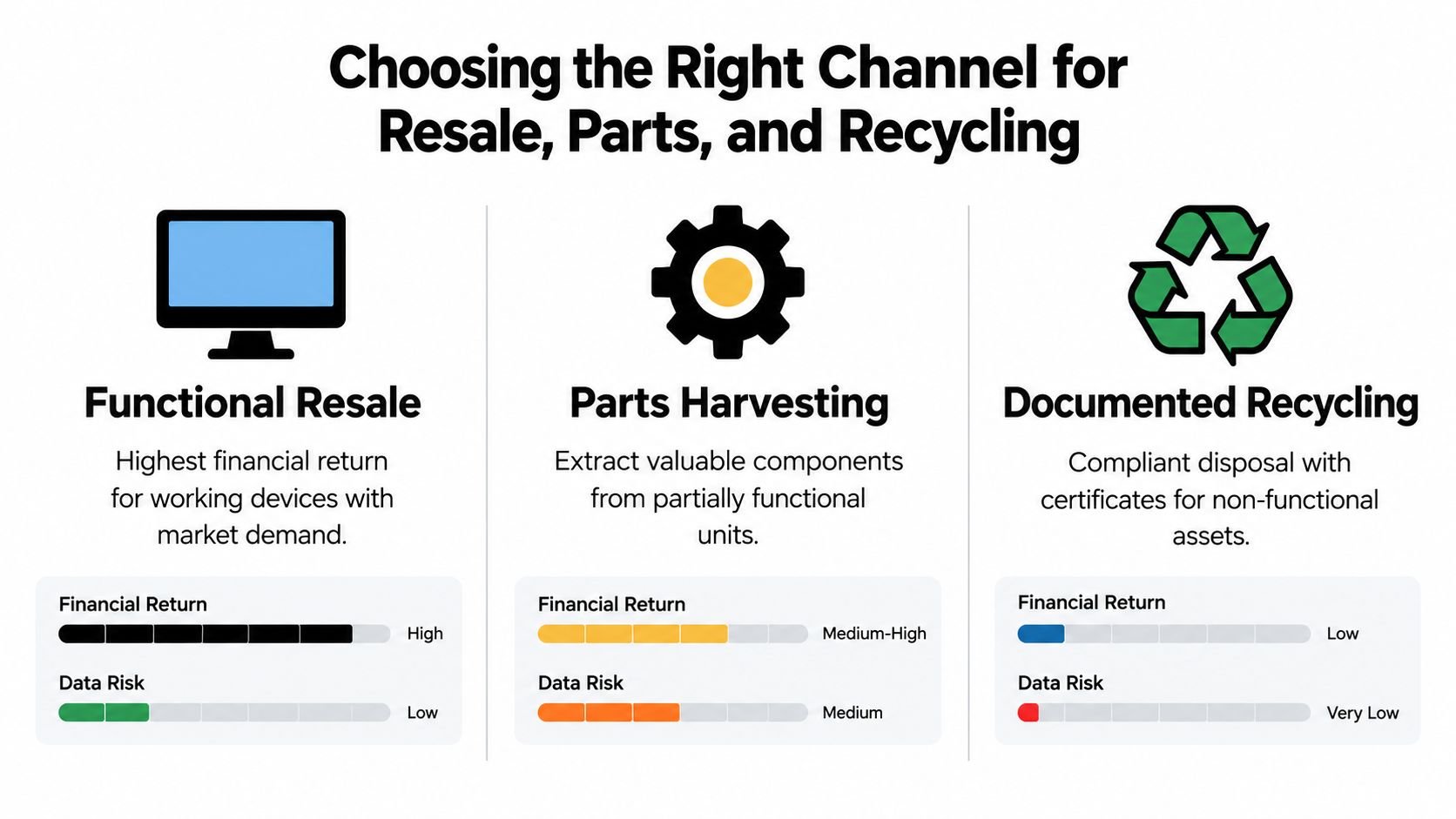
Route by device class and net economics, not by habit. Functional resale, parts harvesting, and documented recycling are three different businesses, and forcing every asset through one channel guarantees you'll misprice a third of your fleet.
Functional Resale
Resale works when the device is functional, supported, cosmetically acceptable, and in demand in its current configuration. Direct resale gives you price control but puts testing, listing, warranty, and returns on your team. Broker marketplaces move volume faster but take fees and push price down. OEM trade in is simple but rarely tests true market value. An ITAD partner resale program bundles sanitization, testing, and channel access, which suits teams without internal refurbishment capacity.
When you're comparing broker marketplaces and direct channels, it helps to find the right marketplace for your brand based on fees, buyer reach, and return terms rather than headline commission alone. Channel fit changes net recovery as much as device condition does.
Get multiple channel quotes on the frozen configuration. If quotes vary widely, someone is pricing components the others missed, or someone hasn't factored in freight and returns.
Parts Harvesting
Older servers often beat resale as parts. Processors, memory, storage, and power supplies can carry value after the chassis and platform lose support. The same applies to networking gear with desirable modules and to storage arrays with healthy drives that pass verification.
Harvesting only works if you recorded configuration at retirement. If your team already pulled components informally, you've lost both valuation accuracy and chain of custody. Control parts removal like any other disposition step, with serial tracking for data bearing components.
Documented Recycling
Recycle when repair cost, battery condition, lack of support, or failed sanitization makes reuse indefensible. Documented recycling through Atlanta electronics recycling services should still produce serial level records and weight reporting, not just a lump sum certificate.
Before you default to recycling, test the resale option against your net recovery threshold, and weigh computer buyback vs recycling for each class rather than making one decision for a mixed load. Never recycle functional hardware untested, and never resell hardware just because it powers on.
Routing rule: Resell what's supported and verified, harvest what's valuable in pieces, recycle what's failed or obsolete, and document all three the same way.
High volume, low margin channels deserve special skepticism. Freight dimensions on servers and storage, brokerage fees, and a handful of returns can wipe out a channel that looked profitable at gross price. Model warranty exposure before you sign, especially on laptops with aging batteries.
Logistics and Chain-of-Custody That Survive an Audit
A certificate alone does not prove your process is defensible. If you can't connect that certificate to a specific serial number, a specific sanitization method, and a specific custody path, you don't have a control. You have a piece of paper.
Auditors don't ask whether you recycled responsibly in general. They ask what happened to this asset, who transported it, whether its drive was wiped, purged, or destroyed, and whether the pickup manifest reconciles to the final record. Answer those questions before pickup, not after an inquiry arrives.
What Defensible Custody Looks Like
Tag assets at the rack or desk, sign a pickup manifest listing serial numbers, seal and track transport, reconcile intake by serial number at the processing facility, and tie the final certificate back to that exact list. Each transfer gets a name, a timestamp, and a count that matches the prior step.
Follow a documented chain of custody for IT asset disposal so electronic waste pickup in metro Atlanta, Smyrna area drop off, and nationwide multi site pickups all produce the same evidence standard. Different logistics shouldn't mean different levels of proof.
The Legal Baseline You're Audited Against
This isn't optional paperwork. The FTC Disposal Rule, effective June 1, 2005 under the Fair and Accurate Credit Transactions Act, requires reasonable measures to prevent unauthorized access to consumer report information during disposal, including sale, donation, or transfer of computer equipment. It applies to large and small organizations that use consumer reports, including lenders, insurers, employers, landlords, government agencies, and service providers.
Reasonable measures for electronic media include destroying or erasing files or media so information cannot be read or reconstructed, and doing due diligence on a destruction contractor. Your custody records are how you show those measures happened for each asset. Healthcare, finance, government, and cloud operators face breach response exposure from custody gaps, not just from improper recycling.
Verification Moves Your Team Should Own
Don't outsource reconciliation. Your team, or an independent reviewer, should perform these checks on every project.
- Manifest to certificate reconciliation: Every serial number picked up appears in a final disposition record, with no orphans.
- Tool output review: Pass or fail evidence and timestamps exist per device, not just a summary count.
- Exception escalation: Failed or unsupported media show a destruction record, not a resale record.
- Hidden storage check: Reserved or inaccessible storage areas weren't silently skipped during sanitization.
- Segregation control: Unverified media were never mixed with verified, resale ready inventory.
If a vendor can't reconcile your pickup manifest to individual final records within one business request, don't give them regulated equipment.
Treat pickup, transport, and documentation as one control. The weakest link usually isn't the shredder or the wipe software. It's the untracked pallet, the unsigned transfer, or the generic certificate nobody can trace.
Vetting an Atlanta ITAD Partner With a Decision Scorecard
Score vendors, don't just compare price per pound or promised resale splits. The cheapest pickup and the highest resale promise are both unreliable if documentation, sanitization, and contract terms are weak.

Non Negotiables on the Scorecard
Weight these categories and require evidence, not slideware.
- Certifications: R2v3, e-Stewards, NAID AAA, and ISO 14001 where relevant to the services claimed.
- Sanitization evidence: Serial level logs, NIST method documentation, per device tool output, and a clear failed wipe policy.
- Destruction options: On site or witnessed destruction for media that can't leave your premises unverified.
- Reporting transparency: Weight and commodity reporting for recycling, plus asset level resale reporting net of fees.
- Logistics coverage: Atlanta metro pickup, Smyrna area drop off, and nationwide fleet or partner transport for multi site enterprises.
Documentation capability isn't a back office detail anymore. Recent market reporting identifies automated asset tracking, certified processing, and compliance reporting as major ITAD trends. Score it as a core control because your audit will.
Use a structured vendor due diligence checklist so procurement, IT, and compliance score the same criteria. Beyond Surplus, for example, provides Atlanta area IT asset disposition with secure data destruction, certificates of recycling and data destruction, and buyback and remarketing evaluation for qualifying business equipment. Treat it as one scored option among your shortlist, judged on the same evidence as every other bidder.
Contract Terms That Change Net Recovery
Read the economics clauses closely. Revenue share percentage means little without definitions of gross versus net, pass through fees, freight deductions, return and warranty handling, and how long unsold inventory sits before price reductions or return to recycling. Pin down environmental provisions and downstream handling too, so recycled fractions don't become your liability later.
Ask five questions in every finalist meeting. Does your certificate reconcile to individual assets? Can you produce per device tool output on request? What happens to failed wipes, step by step? Who transports our equipment, and how is it sealed and tracked? Show us a redacted final report from a comparable project. Hesitation on any of these tells you more than a capabilities deck.
Score the answers, keep the scorecards, and file them with the disposition records. That file is your due diligence evidence if a regulator or customer asks why you chose that partner.
Putting the Atlanta Remarketing Playbook to Work
You don't need a bigger resale promise. You need a repeatable decision rule your team runs the same way for a Buckhead office refresh, a data center decommissioning project, and a school laptop retirement.
Start at decommissioning. Freeze configuration, build the asset register, and triage before logistics enters the conversation. Teams that book the truck first end up discovering drives, configurations, and sensitivity levels on the dock, which is where mistakes happen.
The Decision Rule in One Pass
- Freeze and register: Manufacturer, model, serial number, configuration, location, and data bearing components captured in your building.
- Classify and sanitize: Clear, purge, or destroy matched to data sensitivity, with verification evidence per device.
- Route by net recovery: Functional resale, parts harvesting, redeployment, donation, or documented recycling chosen against a preset threshold.
- Reconcile everything: Pickup manifest, intake count, sanitization logs, and final certificates tied together by serial number.
- Score the partner: Certifications, evidence quality, logistics, and contract economics evaluated before award, not after problems.
Set your minimum recovery rate by device class and review it quarterly against actual net dollars recovered. If laptops keep missing the threshold, change timing, channel, or refurbishment scope. Don't keep approving the same losing route because resale sounds better than recycling in a meeting.
The win isn't selling used technology. It's recovering value you can prove, from equipment you can trace, with data you can show was handled correctly.
For IT directors, procurement leads, and facility managers across Atlanta, that's what IT asset remarketing Atlanta should mean in practice. Secure IT asset disposal, IT equipment disposal, computer recycling, laptop disposal, and data center decommissioning all run through the same disciplined playbook, whether the final route is resale or recycling. Run it consistently and value recovery stops being a gamble on broker quotes.
Contact Beyond Surplus for certified electronics recycling and secure IT asset disposal in Atlanta, including IT asset remarketing, buyback evaluation, NIST aligned data destruction, and documented chain of custody for business fleets of any size. Visit Beyond Surplus to schedule a pickup or discuss a structured remarketing program that recovers value from your used technology while keeping your disposition records audit ready.


