
FDA recalls cover drugs, medical devices, food, cosmetics, and other regulated goods. The FDA's overview of product recalls explains that recalled products may be returned, repaired, relabeled, reconditioned, or destroyed. When destruction is the remedy, certified destruction for recalled products requires a record showing which units were identified, segregated, removed from commerce, and rendered unusable.
For IT directors in Atlanta, GA, electronics expose gaps that a certificate alone cannot resolve. A crushed chassis may conceal an intact drive, while a pallet count may miss a serial number that never arrived. The record should reconcile each recalled unit with its disposition and supporting evidence. A vendor certificate can document the destruction event, but it rarely closes the file without unit-level reconciliation. Regulators may continue monitoring retrieved products to confirm they are not accidentally redistributed, so keep records that connect each unit to its final disposition.
Table of Contents
- Evidence Each Regulator Expects in a Destruction Record
- Choosing Between On-Site and Off-Site Destruction
- Vetting an ITAD Partner or Recycler Before You Sign
- How to Run a Recalled-Product Destruction Workflow
- Cost and Timeline Drivers to Plan For
- Audit Gaps That Break a Destruction Trail
- Start Your Recall Destruction File This Week
Evidence Each Regulator Expects in a Destruction Record
Businesses in Atlanta follow the same federal recall rules as businesses elsewhere. State and local requirements also apply, so confirm them with the Georgia Environmental Protection Division before arranging destruction.
The evidence file depends on the regulator and the recalled product. A vendor's certificate alone rarely closes the file: reconcile the units and retain records that support the requirements for the specific recall.
| Regulated scope | Notice before destroying | Verification | Typical record contents |
|---|---|---|---|
| CPSC-regulated consumer products | Email CPSC staff before destroying, disposing of, or recycling | CPSC may witness destruction or require an affidavit with photographic proof | Product descriptions and quantities, dates, responsible personnel, witness details, and any requested affidavit or photos |
| FDA-regulated products (drugs, devices, food, cosmetics) | Notify the FDA recall contact before destruction or reconditioning | The agency may witness; retain relevant documentation even when destruction is unwitnessed | Destruction memo or certificate recording the date, quantity, and method |
| Hazardous recalled pharmaceuticals | Obtain written disposition instructions from the approving agency before proceeding | Hazardous-waste rules govern storage, transport, and disposal | Manifests and treatment or disposal records |
| Consumer report data on storage media (FTC Disposal Rule) | No agency notice required | Assess contractor due diligence and document reasonable disposal steps | Records that help demonstrate the disposal process and contractor due diligence, such as asset identification, the method used, and contractor documentation |
What each row actually demands
For consumer products, the CPSC Regulated Products Handbook says destruction must follow state and local rules and be conducted under supervision of a CPSC or U.S. Customs and Border Protection officer or employee. Email CPSC staff before destroying, disposing of, or recycling. Staff may observe the process or require an affidavit with photos, so retain the notice and any evidence requested.
FDA procedures treat a destruction memo or certificate recording the date, quantity, and method as relevant documentation. Firms should notify their FDA recall contact first. For hazardous recalled pharmaceuticals, special provisions apply after FDA approves destruction under an approved strategy, or after CPSC accepts a corrective-action plan and approves destruction. Once destruction is directed, comply with Resource Conservation and Recovery Act duties for generator status, storage, transport, treatment, and disposal.
The FTC Disposal Rule requires businesses holding consumer report information to take reasonable steps to prevent it from being read or reconstructed. It does not prescribe a fixed set of record fields. Documentation should instead support the disposal steps taken and due diligence on the contractor. The FTC Disposal Rule guidance gives examples of due diligence, including an independent audit, references, trade-association certification, and review of information-security procedures.
Practical rule: Check the issuing agency and hazard class on the recall notice. They determine which evidence applies before a truck is booked.
Reconcile item descriptions, quantities, serial or lot numbers, dates, facility or vendor identity, and chain of custody. Use a compliance documentation package to map the relevant fields and supporting records before the first pallet moves.
Choosing Between On-Site and Off-Site Destruction
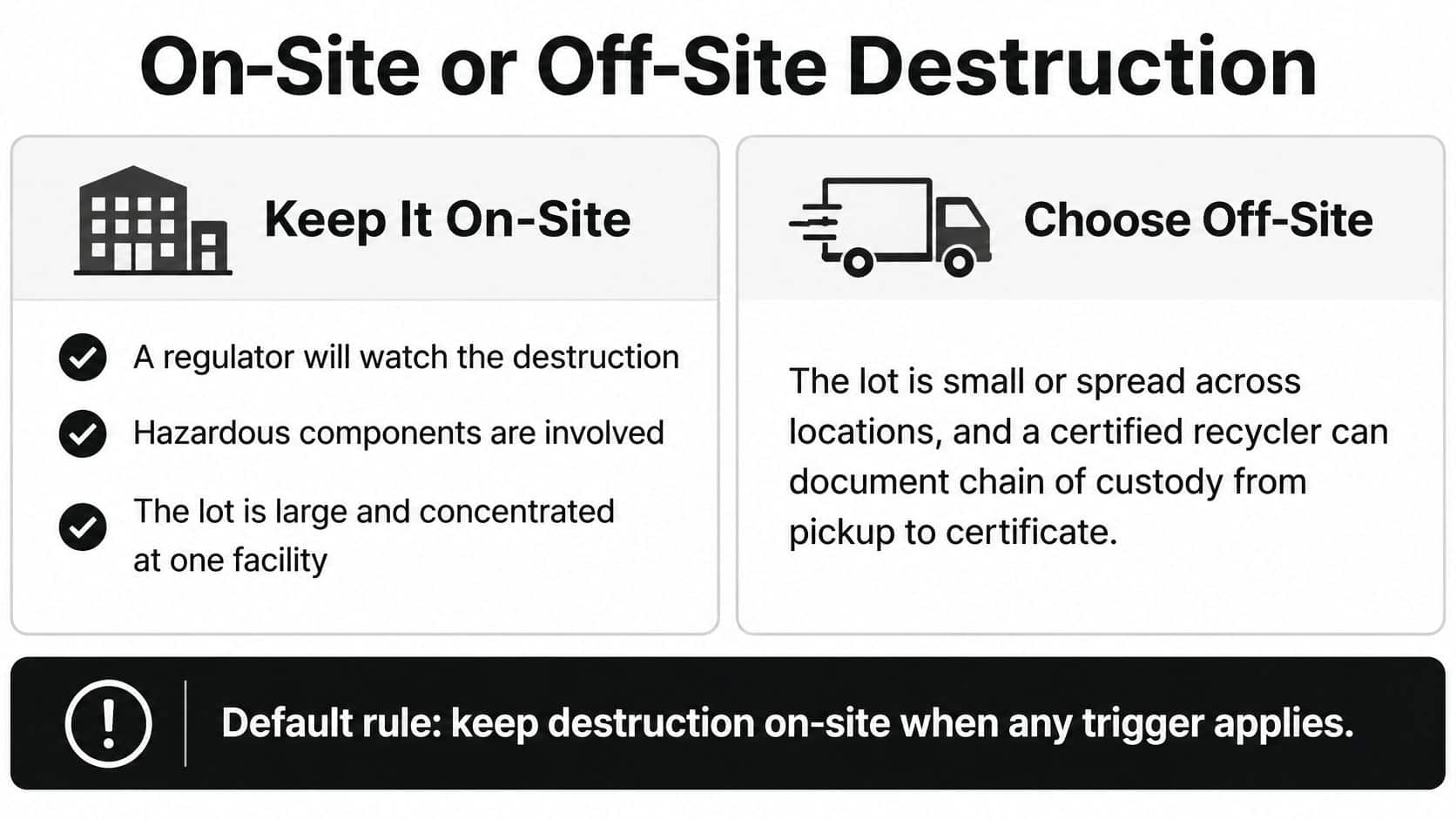
Keep destruction on-site when a regulator will watch, when hazardous components are involved, or when the lot is large and concentrated at one facility. Choose off-site when units are scattered, arrive in small mixed loads, or need specialized processing.
| Criterion | On-site destruction | Off-site destruction at vendor facility |
|---|---|---|
| Custody control | Stays under your staff until destroyed | Transfers at pickup; needs sealed loads and manifests |
| Witnessing and verification | Your staff or a regulator can watch every unit | Depends on vendor witness, video, or regulator approval |
| Data-bearing devices | Drives can be sanitized before any transport | Vendor must supply sanitization and validation records |
| Volume and logistics | Practical for large, concentrated lots at one site | Better for scattered units, small lots, and mixed loads |
| Cost profile | Equipment or contractor mobilization; no freight | Pickup, transport, and facility fees; little mobilization |
| Best fit | Regulator-witnessed or hazardous items | Mixed electronics spread across multiple sites |
On-site avoids freight and adds equipment or contractor mobilization. Off-site adds pickup and transport charges and shifts custody risk to the transport leg.
A hybrid that holds up
Many enterprises sanitize or shred drives on-site, then ship chassis and components off-site under sealed manifests. NIST distinguishes verification (did the chosen sanitization technique finish) from validation (was the information actually gone). A failed validation means you repeat the process with a stronger method, per NIST SP 800-88 Rev. 2. A crushed laptop doesn't prove the SSD is gone.
Ask any vendor three questions before you decide. Will they subcontract any step? Can a witness attend? Do they provide serial-level records? Side-by-side notes on on-site versus off-site ITAD services in Georgia help a facilities lead compare those answers against a real pickup plan.
Vetting an ITAD Partner or Recycler Before You Sign
Certified electronics recyclers operate under environmental standards meant to maximize reuse and recycling, minimize risk to people and the environment, and keep downstream handlers accountable. The EPA's description of certified electronics recyclers also treats destruction of all data on used electronics as part of that framework. Certification is the first filter, not the file.

Request these items before you sign:
- Current R2 or e-Stewards certificate: Ask for the audit date, not a logo on a slide.
- NAID AAA when data destruction is in scope: Scheduled and unannounced audits matter more than a marketing claim.
- Named downstream processors: Each facility should show its own certification.
- Written sub-processor disclosure: You should know who touches the product after pickup.
- A sample certificate with asset-level fields: Serial, method, date, location, operator, exceptions, and recycling disposition.
- Witness policy: Confirm whether your staff or a regulator can attend.
- Insurance certificates: General liability and cyber, current and named.
- Two references from recall or regulated-product work: Ask how they reconciled a short count.
FTC due diligence expectations add an independent audit review and a check of the vendor's information-security procedures. Beyond Surplus, an Atlanta-based ITAD provider, offers on-site or off-site hard drive shredding, certificates of recycling and data destruction, and nationwide pickup for businesses, so it can serve as a benchmark when you request the same items from any vendor.
Walk away from three red flags. The vendor won't name downstream facilities. The certificate states only a total weight. There's no way to reconcile serial numbers. A vendor due diligence checklist keeps that request list in one place so procurement and IT aren't scoring vendors on different criteria.
How to Run a Recalled-Product Destruction Workflow
CPSC guidance requires recalled products to stay quarantined and segregated through the distribution chain, and the recalling firm must monitor any third party so recalled goods aren't mixed with other returns, as the CPSC handbook on regulated products states. Build the workflow around that duty.
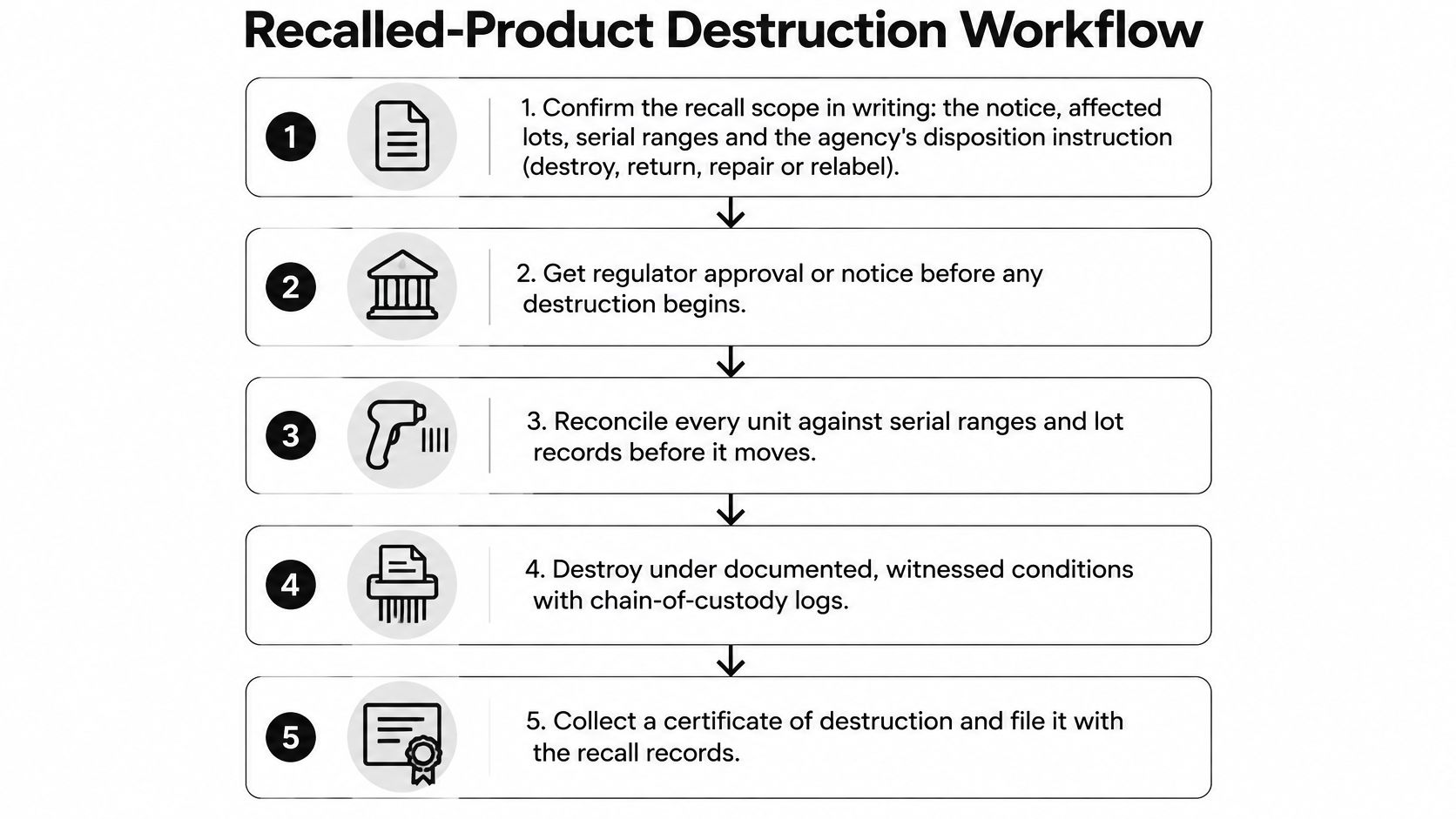
- Confirm the recall scope in writing. Capture the notice, affected lots, serial ranges, and the agency's instruction to destroy, return, repair, or relabel. Destroying the wrong population creates a new problem.
- Get regulator approval or notice before anything is destroyed. Log the date and the contact name. Starting early is how files get rejected.
- Tag and quarantine. Label every box and pallet with the recall ID and stage it away from returns and salvage. Commingling is the failure CPSC warns about.
- Capture item-level IDs at intake. Scan barcode or serial per unit and reconcile counts against the shipping documents. Most files fail at this step, because an unrecorded serial can't be matched to a destruction log later.
- Write vendor instructions. Cover segregation, no salvage, the approved method, and a signed certificate. Verbal direction doesn't survive a staff change.
- Seal and transport. Use tamper-evident seals and a manifest that lists serial numbers, plus GPS tracking when you have it.
- Sanitize data-bearing media before physical destruction. Record the validation result per device. A chassis photo isn't a media record.
- Destroy under observation. Photograph sealed loads and the output. Have a witness sign a log with date, operator, and quantity. This is the second failure point. Destruction with no witness log or photos can't be proven.
- Update the inventory system. Mark each recalled ID destroyed and close the recall line.
- Assemble the file. Keep the certificate, manifest, witness record, photos, and final reconciliation under your records policy.
A vendor certificate without proof that every unit stayed isolated is the failure mode CPSC points at when third-party processors mix recalled goods with other returns.
For on-site work, the record should name the destruction date, product, quantity, the employee who did the work, and the witness. Where CPSC oversight applies, ask for verification in advance so an investigator can watch or set another method, consistent with CPSC recall guidance for firms. Keep those custody transfers in a chain-of-custody documentation set that travels with the lot.
Cost and Timeline Drivers to Plan For
The budget depends on what must be counted, moved, and documented. For recalled electronics, confirming which models, serial numbers, and lots fall within the CPSC or FDA notice helps avoid paying to transport units outside its scope. Resolve uncertain units before requesting a pickup quote.
- Regulator response time: Build in time for required notice and any method approval before processing. The schedule depends on the regulator's response.
- Pallets versus individual units: Serial-level intake takes more labor than recording pallet weight. Include that work in the quote.
- Transport distance: A local pickup and a multi-state collection require different routing. Miles and stop count affect cost.
- Witness or regulator travel: Observation may constrain scheduling and add travel costs.
- Per-device sanitization: Drives and servers require time for sanitization and verification. Specify device types and verification needs when estimating labor.
- Batteries and hazardous components: Separate handling and documentation may add charges beyond standard shredding.
Three phases, one hard stop
Plan for approval and notice, staging and transport, then destruction and records. Set a deadline for completing the file, including the reconciled count of recalled units. A vendor certificate records a destruction event, but it may not establish that every unit covered by the notice was accounted for.
Ask vendors to price the work by task, including intake, transport, processing, and records. Compare quotes against the same scope and unit list. Changing quantities or adding locations after scheduling can affect both price and timing, so document scope changes before authorizing extra work.
The timeline also depends on when units are ready for collection and whether the receiving facility can handle the product and its components. Confirm those requirements before booking. Keep the final schedule tied to the recall inventory, then check that the completed records reconcile to it.
Audit Gaps That Break a Destruction Trail
A destruction certificate does not explain every unit in a recall. The file must reconcile units distributed, returned, corrected, destroyed, and still unaccounted for. U.S. PIRG's analysis of CPSC recalls reports that many recalled products are not returned or discarded, underscoring why the record needs to account for gaps rather than imply every unit reached a destruction facility. U.S. PIRG Education Fund analysis of CPSC recalls
A 2014 summary of CPSC progress reports found that only 10% of recalled children's products in 2012 had been successfully corrected or destroyed. The source also reports that manufacturers corrected or destroyed 94% of the products they held. Those figures describe reported progress, not a complete accounting of every recalled unit, so they should not be treated as a full disposition breakdown. Alston & Bird CPSC recall snapshot
| Audit gap | Why it fails review | Fix before destruction |
|---|---|---|
| Partial lots and short counts | Certificate totals do not match received units | Reconcile received, destroyed, and variance per lot; approve variances in writing |
| Serial-number gaps | You cannot show that specific recalled serials were destroyed | Capture serials at intake and match them to the destruction log |
| Mixed pallets with unrecalled stock | Commingling weakens proof that recalled units were segregated | Use labeled quarantine areas and sealed loads |
| Certificate without item detail | A weight or pallet count does not identify the units | Require an asset-level list, photos, and a witness signature |
| Intact storage media in a crushed chassis | Data may remain readable after physical destruction | Verify sanitization per device before physical destruction |
| Units never returned | The difference between distributed and recovered units remains unexplained | Record outreach, effectiveness checks, and a reason for each unrecovered unit |
Build the file around the regulator's requirements
Recall figures describe different things: reported corrections, consumer response, or the number of recall events. They cannot substitute for a lot-level reconciliation. For example, Sedgwick reported 3,301 recall events affecting 759 million units across five tracked U.S. industries in 2023. That scale makes identifier-level records important: if a serial is missing, the file cannot establish whether that unit was destroyed, remains with a customer, or was never recovered. Sedgwick State of the Nation release
Requirements also depend on the regulator and product. FDA's 21 CFR Part 7 addresses returned or corrected quantities, effectiveness checks, distribution records, and final disposition. Before closing a recall, map each requirement to a record in the file. Then pull completed files on a regular schedule and trace each recalled unit from intake through its documented outcome. A data destruction audit checklist can help verify that device-level evidence supports the final record.
Start Your Recall Destruction File This Week
The next 48 hours are about choosing the evidence row and locking scope, not about shredding.
- Read the recall notice and pick your evidence row. The issuing agency and hazard class decide which record applies.
- Shortlist two or three vendors with the vetting list. Request sample certificates and the downstream processor list before any site visit.
- Book no pickup until scope is confirmed in writing and the intake count is complete. Moving extra units is a cost you can't recover in the file.
- Schedule the intake count under the recall ID you have already assigned.
- Atlanta-area businesses can schedule pickup from metro sites directly. Multi-state operations should group lots by site before booking.
Certificates of recycling and data destruction, plus pickup across the contiguous United States for business customers, belong in that vendor comparison. Have the recall scope and quantities ready so the destruction can be scoped accurately. Contact Beyond Surplus for certified electronics recycling and secure IT asset disposal.
Beyond Surplus handles commercial product destruction, IT asset disposal, and chain-of-custody records for recalled electronics, with certificates of recycling and data destruction that tie back to asset identifiers. If your team is closing a recall in Atlanta or across multiple sites, bring the notice, the quantities, and the serial ranges. Visit Beyond Surplus to schedule certified electronics recycling and secure IT asset disposal.


