

A recall notice hits before the store opens, and one pallet of the affected SKU is already on a transfer truck. Two registers can still sell it. Returns has three units sitting in the same bin as good stock. Ask who owns the count and you get four different answers from the store, the distribution center, the e-commerce site, and the marketplace seller.
That is recalled product disposal for retailers in real time. The unit that leaves without a record is the failure. Disposal is not a dumpster decision. It is a file a reviewer can walk from the shelf to a final quantity.
Table of Contents
- Disposal Paths and the Approval Each One Needs
- Seven-Step Workflow from Quarantine to Reconciliation
- Records That Prove Chain of Custody
- Data Destruction for Electronics Before Disposal
- Choosing a Destruction Vendor and Contract Terms
- Communicating, Recovering Costs and Reporting Results
- Build Your Disposal Plan Before the Next Recall
Disposal Paths and the Approval Each One Needs
Every route a recalled unit can take ends at an approval, and the approval changes with the route. Under the CPSC Recall Handbook, recalled-product disposal is a controlled corrective action. Retailers pull goods from shelves, displays, inventory, and return desks, mark them recalled and illegal to sell, distribute, or donate, and place them in quarantine. Destruction itself needs CPSC approval, and the agency may witness the work or set another verification method. A case that leaves the building on a salvage pickup, because someone treated it like ordinary waste, is a unit you cannot rebuild later.
The paperwork splits by location. Off-site destruction needs a written request to CPSC, written direction to the vendor, segregation during transit, clear box or pallet identification, and a certificate of destruction at the end. On-site destruction needs a dated report stating the products and the unit counts destroyed. CPSC staff recommend keeping compliance records for at least five years.
Destruction is the rare remedy, which is why its documentation has to be the strongest. In the CPSC recall-remedy summary, refunds alone were 1,105, or about 55%, of 2,001 recall remedies; disposals numbered 23, or 1.1%. Repairs and replacements fill most of the rest. A national chain still faces real exposure on that small share when the units it destroyed cannot be proved to a reviewer.
The seven routes
| Disposition path | When it applies | Approval needed | Proof retained |
|---|---|---|---|
| Return to recalling company | Recall instructions call for product return | Recalling company's corrective-action plan | Return manifest with unit counts |
| Repair or replace in place | Recall remedy is a fix or a swap | Recalling company | Repair or replacement log by serial or lot |
| Off-site destruction | Product cannot be returned and must be destroyed | Written request to CPSC and written direction to the vendor | Certificate of destruction |
| On-site destruction | Retailer has equipment and an approved method | CPSC approval; agency may witness | Dated report stating products and unit count destroyed |
| Authorized recycling | Recall allows material recovery after data removal | Recalling firm's written direction; confirm the regulator's position | Recycler certificate with quantities and dates |
| Medical device destruction | Recalled product is an FDA-regulated medical device | FDA district recall coordinator contacted before destruction | Records of product, quantity, method, date and responsible parties |
| Prohibited channels | Sale, donation or salvage resale of recalled units | Not permitted under recall rules | No disposition record; treat as a compliance failure |
Speed and documentation pull against each other. Quarantine the same day or registers keep selling the item. Destroy before written direction and you can wipe out the evidence the corrective-action plan still needs. Hold first, approval second, destruction last.
Who owns the unit
A store owns the shelf and the returns desk. A distribution center owns reserve, cross-dock, and outbound trailers. An e-commerce fulfillment site owns pick faces and ship-confirm. A marketplace seller owns the listing even when a 3PL holds the carton. California Health and Safety Code section 108046 shows how sharp that split gets. When a retailer receives a recall or warning and sold the product during the prior 18 months, it must remove the item from shelves or program registers within three days of notice. A first seller must also accept recalled products for return to the manufacturer or distributor.
Medical stock is a separate path. FDA recall guidance requires firms to contact the district recall coordinator before destroying a recalled device. The FDA may review the method and may witness it. Records still have to show product, quantity, method, date, and responsible parties whether or not an investigator was there.
Practical rule: Name one owner per location before any notice arrives. An owner has a name, a site, and a count to defend; a shared inbox has none of those.
Seven-Step Workflow from Quarantine to Reconciliation
Treat the recall as reverse logistics with a count at both ends. The picture below is the sequence. The slips under each step are where units go missing.
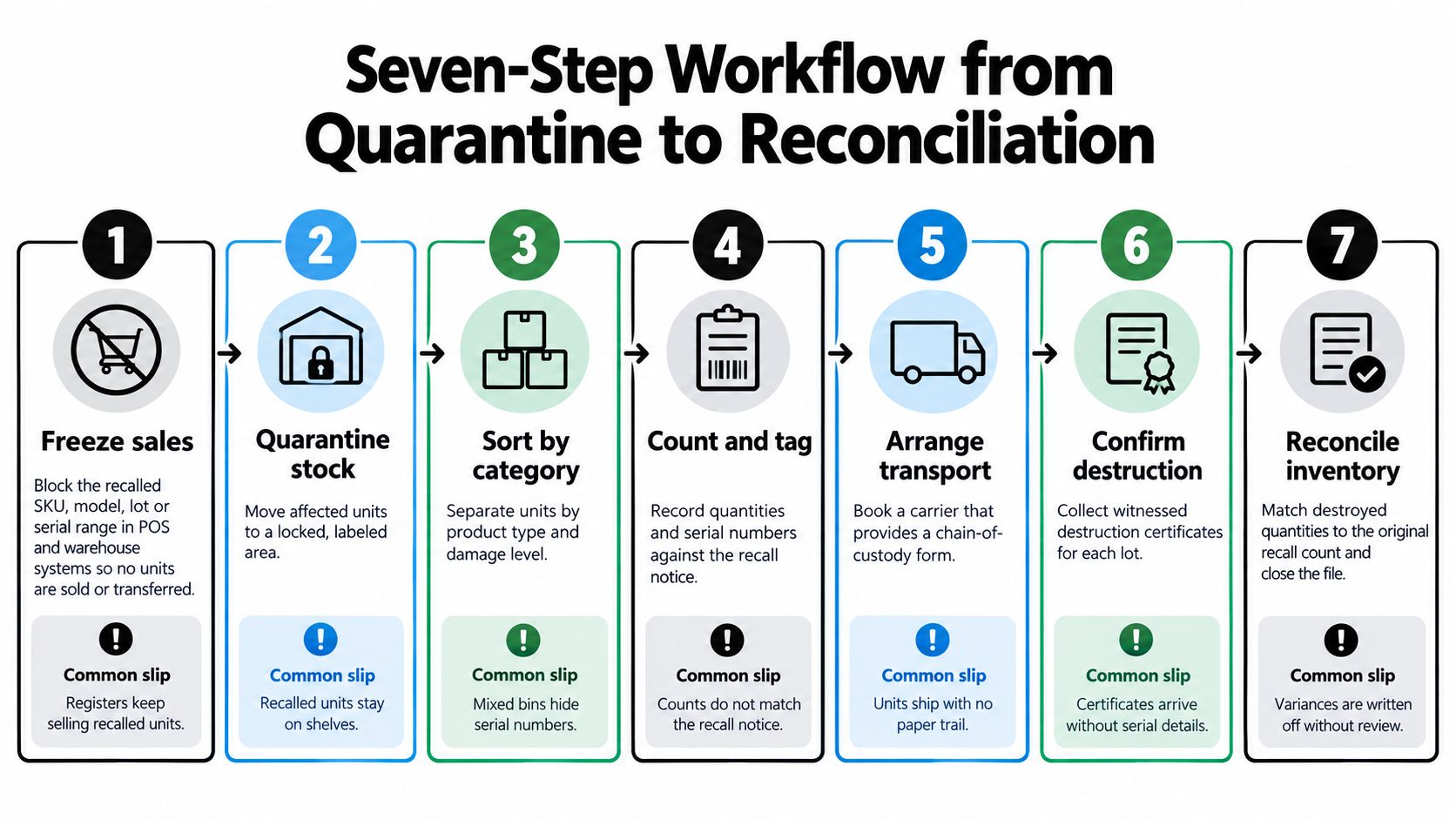
Run the seven steps in order
- Freeze sales. Block the recalled SKU, model, lot, or serial range in the POS and the warehouse system so replenishment and transfers stop. A broad product description is the slip that leaves registers selling the item.
- Quarantine physically. Pull units from shelves, displays, backrooms, and returns desks. Mark them recalled and not for sale, donation, or transfer. Commingling recalled and good stock is how a later cycle count "finds" units you already thought were gone. A locked cage and a recalled-product quarantine service beat a corner of the stockroom.
- Reconcile identifiers before you count. Match SKU, model, lot, serial, and quantity to the notice. Counting first, then discovering the lot range was narrower, inflates the affected total.
- Locate every unit. Walk stores, distribution centers, returns processing, transit, third-party logistics sites, and employee areas. For units already in customer hands, log each contact attempt and the return or refund offer, and keep those lines in the file until the count closes. The XTREME EDEALS hardware inventory guide is a useful check on how serial-level stock gets lost between systems.
- Assign a disposition code. Use return, repair, destruction, or authorized recycling, and only under written direction. Guessing the code at the dock is how product hits the wrong truck.
- Seal and log every handoff. Tamper-evident containers, labeled boxes and pallets, and a signature at each transfer. An unlabeled gaylord is an open invitation to mix lots.
- Prove the end state and close the math. Destruction or recycling records need quantities, dates, method, and responsible parties. Reconcile that total to the original affected-unit count. Any gap goes to an exception report, not a shrug.
Why the last step is the real close
Recall "success" is often corrected units divided by units sold. Units removed from use can kill the hazard and still never show up in that ratio. A three-way match of point-of-sale data, warehouse scans, and processor certificates catches the difference. The CPSC report to Congress on recall notificationRecallNotificationEffectiveness.pdf) shows how uneven store execution is. In a New York City study of nine food recalls, only 85% of managers were aware of the recall, and removal was 85% at chain stores versus 56% at independent stores.
Require a sign-off from each location, photos where the cage or the empty shelf proves the pull, and escalation when a site misses the service window. Electronic alerts reach the chains. Smaller sites need a phone or portal follow-up or they stay open.
Records That Prove Chain of Custody
The first thing an auditor opens is the certificate quantity, then the reconciliation sheet under it. If those two numbers disagree, the logo on the PDF does not matter. Off-site and on-site destruction only count when the file behind them is complete.
The file, record by record
| Record | Required contents | Retention or use |
|---|---|---|
| Reconciliation sheet | SKU, model, lot, serial range and quantity by location | Keep in recall file; basis for final count |
| Quarantine log | Location, unit count, date, responsible person, container or seal ID | Keep in recall file |
| Transfer manifest | Pickup date, carrier, unit count, container IDs and seal numbers | Keep with chain-of-custody records |
| Written vendor instructions | Disposition method, segregation rules, labeling, vendor contacts | At least five years |
| Certificate of destruction | Vendor, date, method, quantities, serial or asset list | At least five years |
| On-site destruction report | Date, products, unit count destroyed, method, witnesses | At least five years |
| Data destruction certificate | Device serials, wipe or destruction method, verification result | Keep with recall file and any data-protection records |
| Exception report | Unexplained quantity differences and how each was resolved | Keep until the count closes |
Reviewers then test three ties. Certificate quantities must equal the reconciliation. Serial or lot numbers must appear on the notice. Dates must fall inside the quarantine window, not before the freeze and not weeks after the product was already loose.
One owner, one recall number
A single disposal receipt is weak proof. The same recall now lives in store systems, the web order platform, and a vendor portal. Keep the POS export, the scan file, and the portal confirmation in one folder. Chain-of-custody documentation only works if those pieces sit together.
Name one records owner and file everything under the recall number. A shared drive with twelve versions of the spreadsheet is how a clean destruction still fails review.
Data Destruction for Electronics Before Disposal
The miss I see most often is a recalled payment terminal treated as a plastic housing problem. The defect may be a battery or a charger. The device can still hold keys, configuration, and information taken from a consumer report.
The FTC Disposal Rule applies to any business that maintains or possesses consumer reports, or information derived from them, for a business purpose. Disposal must use reasonable measures so that information cannot be read or reconstructed. Destroying or erasing electronic files and media is one accepted measure. A contractor is allowed after due diligence. The rule covers consumer report information. Other customer data on a device should get the same destruction method under your data policy and state breach-notice rules. Don't stretch the rule to every byte on a POS.
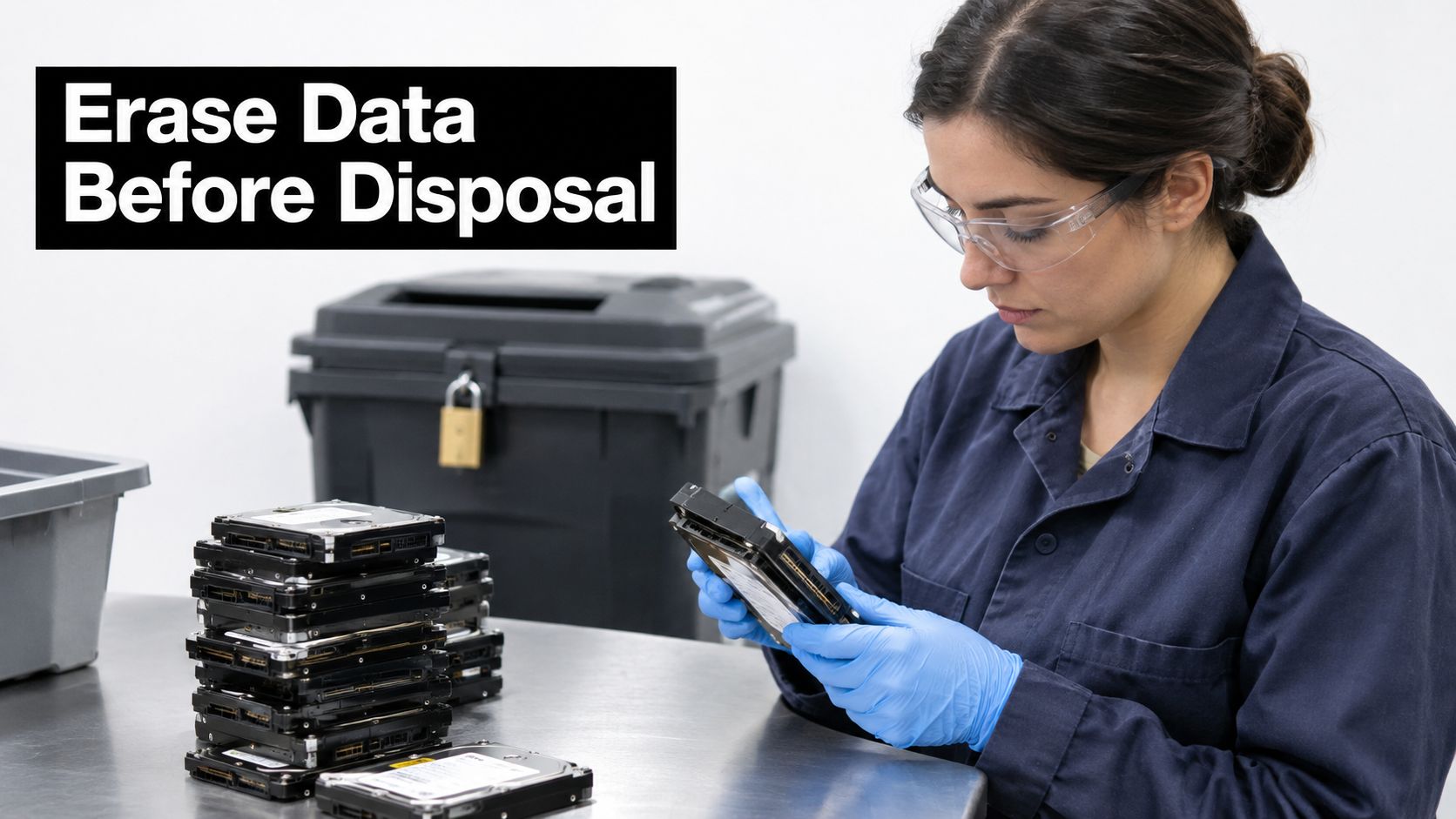
Pick the method before the dock
The FTC's disposal standard is risk-based. Reasonableness turns on the sensitivity of the information, the costs and benefits of available methods, and changes in technology. Paper examples are burning, pulverizing, or shredding until the information cannot practicably be read or reconstructed. Electronic media needs destruction or erasure that prevents reconstruction. There is no single tool.
NIST SP 800-88 gives a shared vocabulary. Clear is a logical sanitize. Purge resists laboratory recovery. Destroy makes recovery infeasible. A short walk-through of NIST 800-88 data destruction standards helps the team use those words the same way on the certificate. Overwriting is a poor bet on flash because wear leveling leaves blocks the pass never touches. Cryptographic erase or physical destruction is the safer route there.
| Device class | Data at risk | Acceptable method | Proof retained |
|---|---|---|---|
| Laptops and desktops with hard drives | User files, saved credentials, business records | Certified overwrite wipe or physical shredding | Wipe report or shred certificate by serial |
| SSDs and flash storage | Data in wear-leveled blocks that overwriting may miss | Cryptographic erase or physical destruction | Destruction certificate by serial |
| Servers, storage arrays and NAS | Client records, databases, backups | Physical destruction, on-site or witnessed off-site | Certificate listing each drive serial |
| POS and payment terminals | Keys, configuration, cardholder-related data | Remove or zeroize keys per the device maker's procedure, then destroy | Destruction record with device IDs |
| Mobile devices and tablets | Accounts, stored messages, cached data | Factory reset with activation lock removed, or physical destruction | Wipe or destruction record by IMEI or serial |
| Networking gear with stored configs | Admin credentials, network topology | Configuration wipe, factory reset or destruction | Record by device serial |
Decide the method by device class before the recall, not while the truck is idling. Contractor due diligence is part of the same choice. Review an independent audit, check references, require a recognized trade-association certification, and read the contractor's information-security procedures. A certificate that lists serials is the proof. A one-line "data destroyed" stamp is not.
Choosing a Destruction Vendor and Contract Terms
A destruction vendor is part of the evidence chain, not a scrap hauler. The CPSC recall procedures say a retailer should not independently destroy recalled consumer products without documented authorization. Send the request in writing, hold the inventory securely, and expect the agency to witness disposal or set another verification method. Your job is to prove the approved disposition happened, down to the unit.
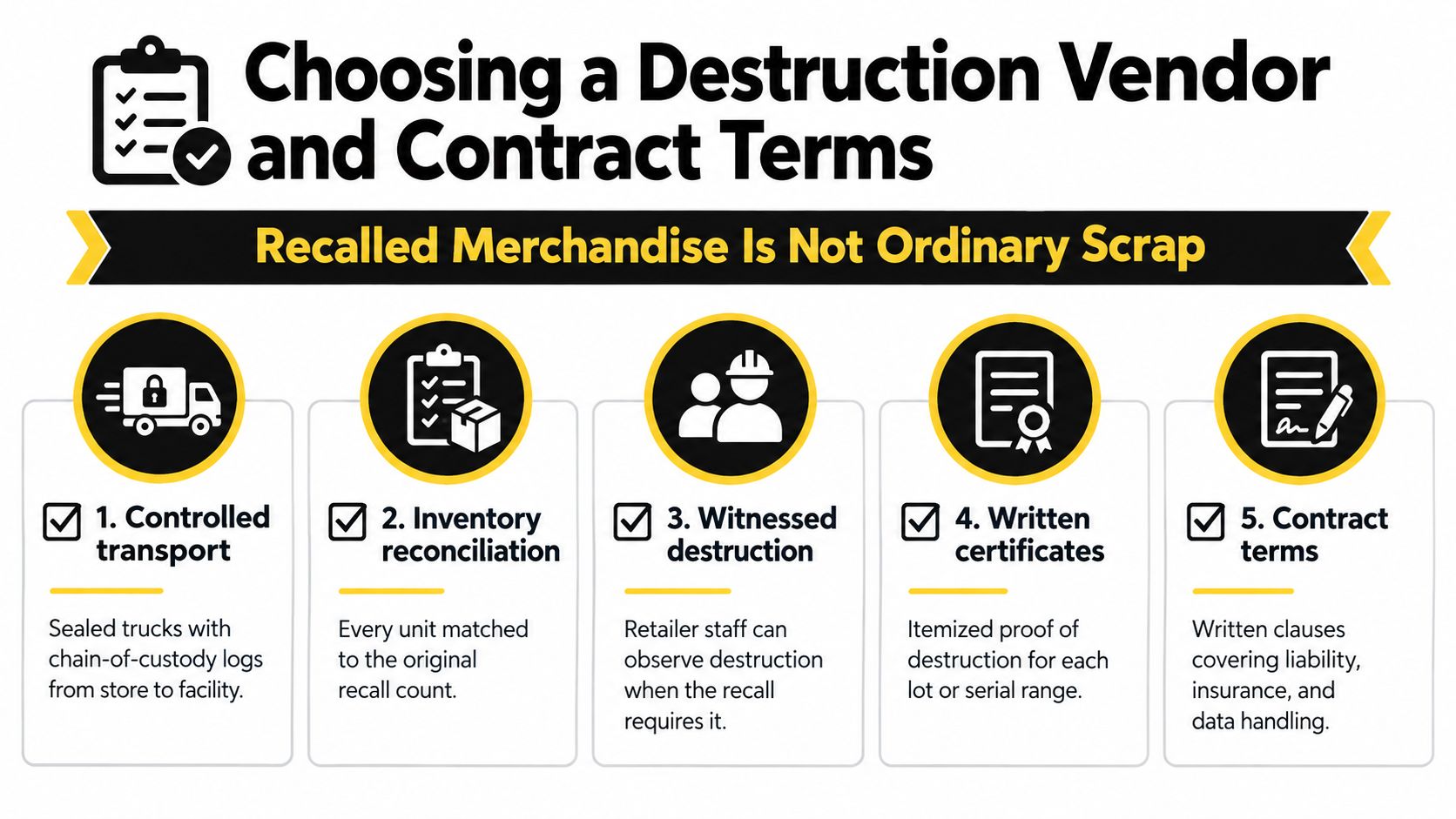
What to confirm before you sign
Start where counts usually go missing: after the pallet leaves your dock. Ask who touches it next, where it is processed, and which record closes each handoff.
- Downstream control: Get named final processors and any subcontracted site, plus the record that shows material transfer between them.
- Recall-fit references: Speak with retail clients that shipped sealed, serialized lots under a deadline, not only general recycling accounts.
- Certifications as a screen: R2 or e-Stewards can narrow the field; your audit, questionnaire, and contract still decide the award.
- Insurance matched to exposure: Coverage should address transport, processing, and data exposure when devices are in scope.
- Subcontractor disclosure: Require written notice before any handoff. A silent transfer is where a clean count turns into a disputed one.
Clauses that keep the count intact
Make evidence a contract deliverable. Include a right to audit, serial-level certificates due within a fixed number of business days, sealed and tracked transport with GPS or manifest logging, and a witnessed-destruction option for lots the regulator wants observed. Set a data-incident notice window, indemnification, and a chain of custody that names each handoff. State who owns the quarantine count at each node: store, distribution center, e-commerce returns queue, or marketplace seller account. The retailer obtains written disposal authorization before anything is destroyed.
Beyond Surplus is one option for on- or off-site shredding, certified wiping, and certificates of recycling and data destruction; hold every vendor to the same documentation standard, whether you score it with your own template or a vendor due diligence checklist, and confirm current service details before you book a load.
Communicating, Recovering Costs and Reporting Results
Waiting for customers to bring product back is a slow way to stop sales. Historical recall studies commonly report average response rates of only 6 to 10%. The Rutgers recall-effectiveness analysis cites OECD figures of roughly 50% correction after a direct alert versus 6% after a press release, with effectiveness falling about 10 percentage points for each additional year a product stays on the market. SKU-specific notices and an immediate system block beat a headline.
Three audiences, three artifacts
Stores need one source of truth and a daily status until their count closes. The recalling firm needs quantities in quarantine and in transit, reported against its corrective-action plan. Auditors need the whole file in one place. The pitfall is treating a press release, or a processor's attestation, as proof of completion when nobody reconciled the quantity.
Getting money back without losing the trail
Read the recall agreement and the supplier chargeback terms for destruction, transport, labor, and storage. Tie every invoice to the recall number. Net any buyback or commodity proceeds against logistics and destruction fees so the close shows cost, not a pile of unrelated bills. Marketplace sellers should also read product liability guidance for eCommerce sellers before they assume a listing takedown ends their exposure.
Report the same six metrics at a fixed interval during the recall and again at closure.
| Metric | Calculation | What it shows |
|---|---|---|
| Reconciliation rate | Units with a final disposition divided by original affected units | Whether every unit is accounted for |
| Destruction proof rate | Destroyed units covered by certificates divided by units destroyed | Whether paperwork matches physical disposal |
| Store confirmation rate | Stores confirming removal divided by stores that received notice | Retail execution gap between chains and independents |
| Open exceptions | Count of unexplained quantity differences | Remaining audit exposure |
| Hours to POS block | Time from recall notice to system block on the recalled SKU | Speed of stopping new sales |
| Net recovery | Buyback or commodity proceeds minus logistics and destruction fees | Net cost of the recall disposal |
Build Your Disposal Plan Before the Next Recall
Finish this list before the next notice, not during it.
- Pre-approve one destruction vendor with a signed contract that includes audit rights and a witnessed-destruction option.
- Build a disposition matrix by product class that maps each class to an approved path and a data method.
- Stock a quarantine kit with tamper-evident seals, pallet and box labels, log sheets, and sealed bags.
- Prepare four templates: a written disposal request, a store closure attestation with a sign-off line, a certificate field list that matches the reconciliation sheet, and an exception report.
- Run a tabletop once a year. Pick one SKU, issue a fictional notice, and time how long stores take to block and confirm. Secure electronics recycling for multi-location companies is easier to schedule when that drill already names the sites.
Review the plan at the start of each new recall cycle. Paths, workflow, data methods, and vendor clauses drift if nobody opens them between events.
A disposal file is only as strong as its weakest unit count.
Confirm the vendor, the location owners, and the templates this quarter.
Beyond Surplus provides certified electronics recycling, secure data destruction, and documented product destruction for commercial recalled inventory, including chain-of-custody records retailers can put in the recall file. Schedule a pickup and lock the destruction path before the next notice, rather than hunting for a vendor while registers are still live. Visit Beyond Surplus to review services and set a date.


