The most common advice on a recalled tool is also the one that creates liability: scrap it and clear the cage. A distributor finds circular saws and drills behind a lock, a contractor finds the same models on a job trailer, and someone books a hauler as if the hazard ends when the door rolls down. It doesn't.
Physical destruction isn't the default remedy. A manufacturer program may still require return, repair, or replacement. Cutting the housing first can erase that path and interfere with Consumer Product Safety Commission oversight. I would freeze the inventory before anyone reaches for a grinder.
For facility, procurement, and EHS managers, recalled power tool destruction services only work after the remedy is confirmed, every serial is controlled, and the battery is classed. What follows is the evidence file that proves those three things, and the points where a shredder without approval makes the recall worse.
Table of Contents
- Confirm the Remedy Before Any Cut
- Choose On-Site or Off-Site Destruction
- Process Every Recalled Tool in Order
- Move Lithium Batteries Without Starting a Fire
- Build a Certificate an Auditor Can Reconcile
- Hire a Vendor and Close the Recall File
Confirm the Remedy Before Any Cut
Say a distributor or a contractor opens a cage of recalled saws and drills and treats a scrap pickup as the closeout. That assumption fails. Cutting a tool can violate a manufacturer remedy that still requires return, repair, or replacement, and it can interfere with CPSC oversight. Ordinary recycling isn't a recall remedy.
The CPSC Recall Handbook draws that line. Destruction may require prior approval, the agency may want to witness or otherwise verify it, and recalled products must not be commingled with other goods or sent to salvage. The handbook also recommends written instructions to any third-party destruction vendor and a certificate or affidavit identifying the product, quantity, and destruction date.
Match the notice before you classify the cage
Run these checks in order. Don't skip to a blade because the cage is full.
- Match model and serial or lot. Use the CPSC recall listing and the manufacturer's notice as the reference. A similar housing or a shared battery platform isn't a match.
- Ship the return program when that is the remedy. Quarantine matched units and move them only under the manufacturer's instructions. Destroying them to free floor space removes a repair or replacement path the notice still requires.
- Destroy only with written authority. That means written instructions, room for an agency witness or other verification, no commingling, and no salvage. The certificate or affidavit has to name the product, quantity, and destruction date.
| Path | Use it when | Do not | Evidence to keep |
|---|---|---|---|
| Manufacturer return | Remedy is refund, repair, or replacement | Destroy, scrap, or mix with other goods | RMA, carrier receipt, serial or lot list |
| Approved destruction | Written instructions allow destruction or CPSC may witness it | Send units to salvage or ordinary recycling | Certificate naming product, quantity, and date |
| Quarantine | Model match or remedy is still unclear | Resell, donate, or issue a certificate | Hold log, photos, unmatched serials |
| Damaged-battery isolation | Pack is swollen, hot, leaking, smoking, or fire-involved | Trash, municipal recycling, or a standard pickup | Separate packaging record and carrier name |
The lots are larger than a dumpster plan
A review of CPSC enforcement records found at least 93 power-tool recalls from 2001 through 2018. Approximately 30% of those recalls addressed laceration hazards, 28% involved fire or burn hazards, 27% concerned other injury risks, and 15% involved shock or electrocution.
Recent announcements are big enough to swamp a branch. In 2025, the CPSC recall of RYOBI cordless walk-behind mowers covered approximately 217,500 units in the United States because of a fire hazard. The CPSC recall of RIDGID cordless framing nailers covered approximately 64,000 units in the United States because they could involuntarily discharge a nail. The CPSC recall of RYOBI pressure washers covered approximately 764,000 units in the United States because of a projectile hazard.
Practical rule: Freeze resale, donation, and scrap until the path and the evidence standard are written. A cage tag that says "recall" isn't that standard.
Choose On-Site or Off-Site Destruction
Picture two loads that shouldn't share a work order. A plant holds 40 recalled corded saws in one building, and a regulator may witness the cut. That job stays on site. A regional distributor, a school district, or a contractor has the same models scattered across jobsites and branches. That job needs pickup, aggregation, and off-site destruction.
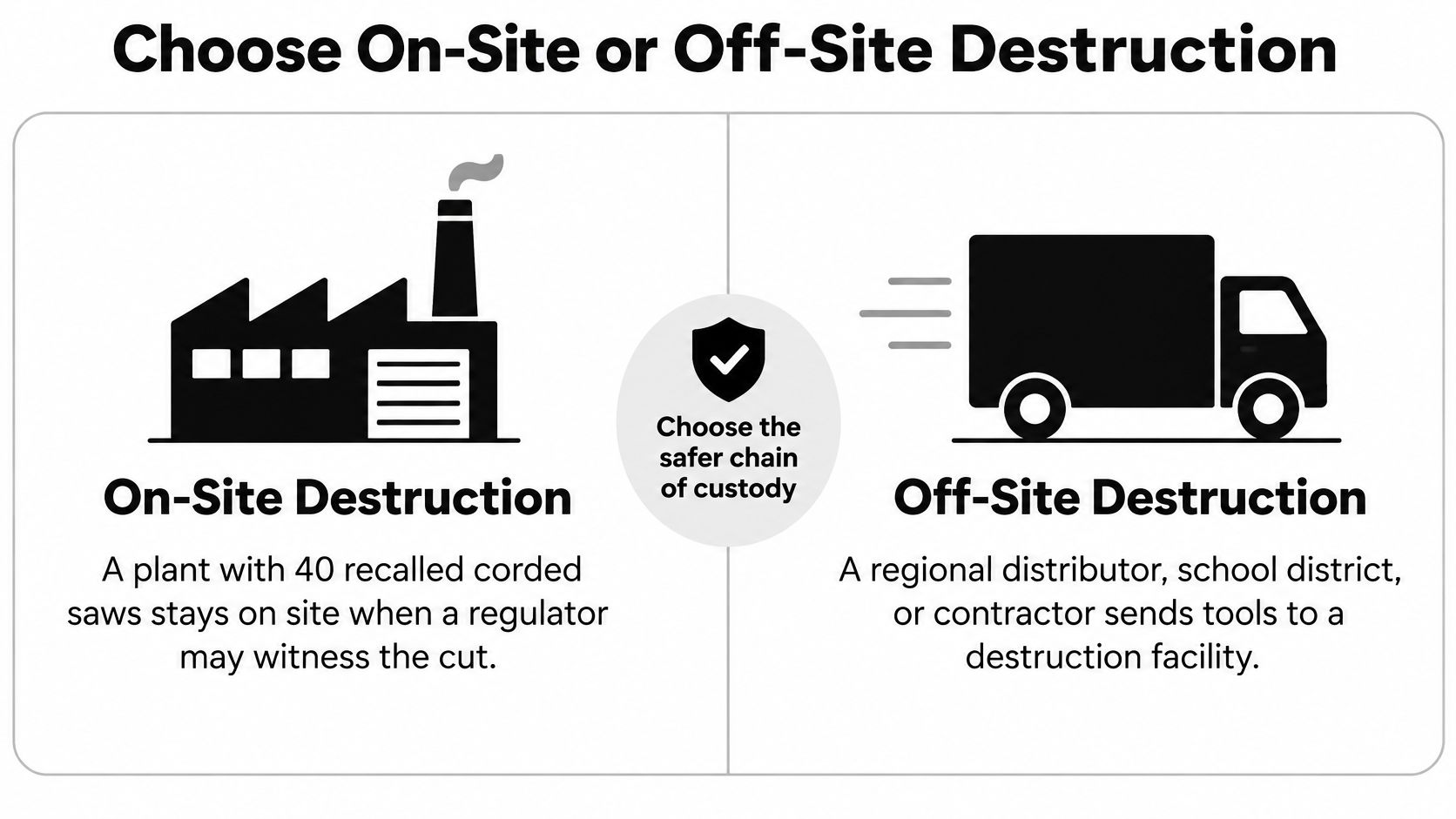
The same custody choice shows up when teams compare on-site versus off-site ITAD services. For tools, witness access and immobility pull you on site. Dispersed stock and volume pull you off site.
| Criterion | On-site destruction | Off-site destruction |
|---|---|---|
| Best fit | A witness may attend and stock is in one building | Tools are spread across jobsites, schools, or branches |
| Who controls the cut | Your staff and any invited witness see each unit | Vendor crew works after documented intake |
| Battery movement | Damaged packs stay put until a qualified carrier is arranged | Only screened, correctly classed packs leave the dock |
| Proof created | Photos, zero-energy log, and witness notes | Custody form, transport record, and destruction certificate |
| Capacity | Small batches and spot recalls | Lots on the scale of tens or hundreds of thousands of units |
| Main cost driver | Downtime, PPE, guarding, and staff time | Freight, hazmat classification, and reconciliation labor |
Capacity, not convenience, sets the site
Ordinary waste handling wasn't built for recall scale. On October 17, 2000, the CPSC announced a coordinated recall of approximately 180,000 power tools made by three manufacturers. Switches could stick and the tool could keep running after the trigger was released. Those tools sold from January through September 2000 at prices from $55 to $500. A later announcement dated May 10, 2001, covered about 58,000 Milwaukee and DEWALT electric drills. Lots of that size blow past a dumpster workflow for distributors, contractors, manufacturers, schools, and facility operators.
Off-site work doesn't start when the truck arrives. It starts when serials are captured, batteries are classed, and a chain-of-custody form names who holds the goods. On-site work still needs PPE, guarding, a stop-work rule for damaged packs, and the same serial reconciliation. Battery packaging and the station sequence belong in the procedure that follows, not in the site decision.
A witnessed cut in your building and a certified cut at a vendor both fail if the serial list and the destroyed count don't match.
Process Every Recalled Tool in Order
The destruction sequence starts with the remedy, not the cutting station. If the recall calls for an approved return, keep the tool intact and follow that route. Use destruction only when the remedy permits it, and hold each unit until its identity and disposition are recorded.
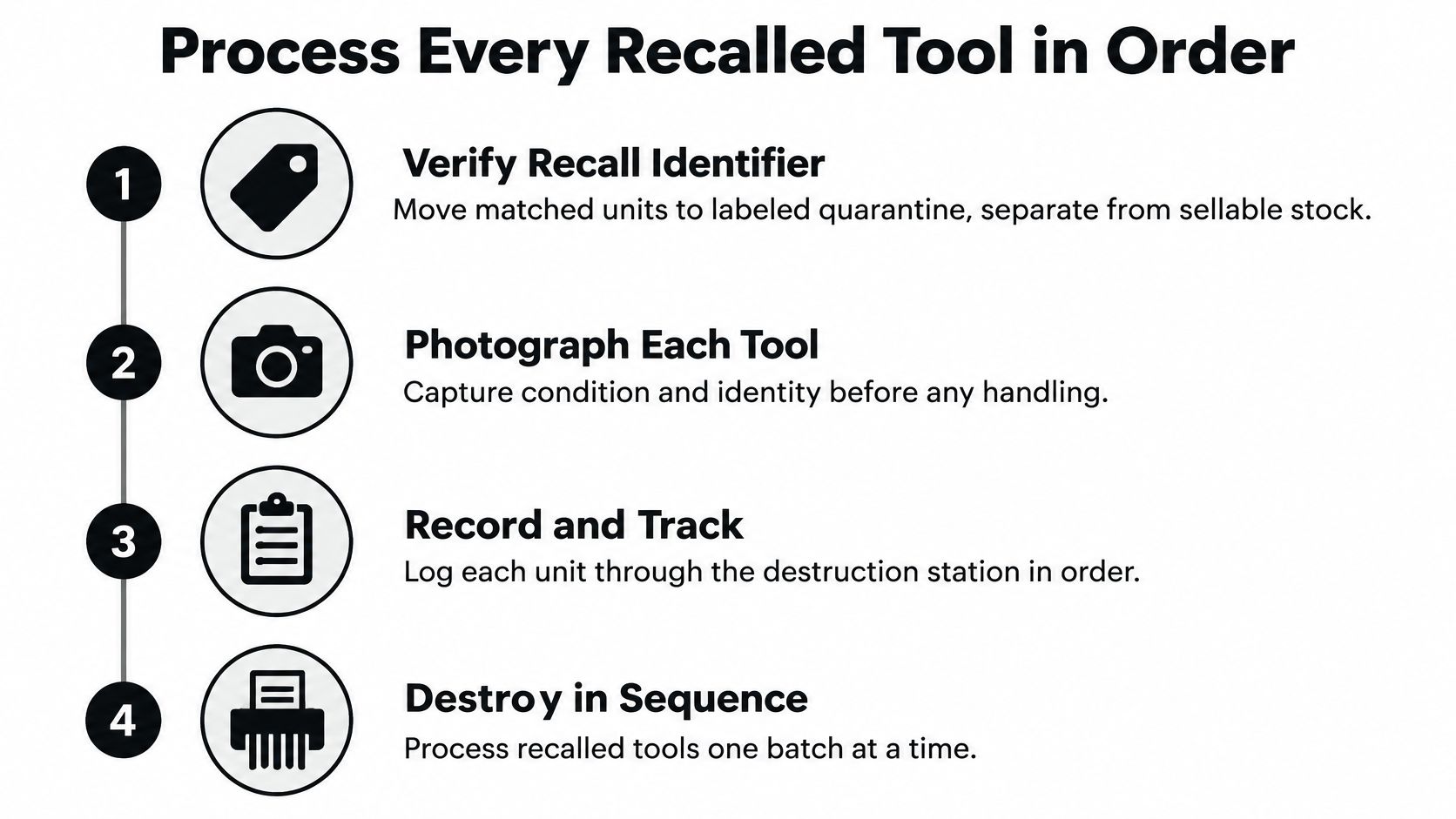
- Verify the identifier and quarantine. Match the unit to the recall notice, then move it to a labeled hold area, separate from sellable stock. Keep lots distinct so a serial number cannot disappear into a shippable bin.
- Photograph and log before opening the housing. Record the manufacturer, model, serial or lot number, and recall number. Photograph the data plate while it is intact. Once the identifier is destroyed, the batch is harder to reconcile.
- Remove detachable batteries before processing. Set each pack aside for the applicable battery handling and transport procedure. Do not leave a pack in the tool until the cut.
- Control hazardous energy. Unplugging alone is not enough. Follow OSHA's hazardous-energy sequence: prepare for shutdown, stop the equipment, isolate each energy source, apply lockout/tagout, release or restrain stored energy, and verify isolation before work. For a cordless tool, confirm the pack is removed and check for damaged or hidden secondary cells. For a corded tool, disconnect the supply, apply site lockout controls when powered equipment is involved, and verify a zero-energy state with an appropriate tester.
- Disable the tool only after controls are in place. Use a tool-specific risk assessment, PPE, guarding, and a stop-work rule for swollen or damaged lithium-ion packs. Cut, drill, or crush the functional components only when the approved remedy calls for destruction. Keep the identifier readable or rely on the record made before processing.
- Record the outcome. Log the method, operator, date, and destination of the battery and metal fractions. A bin marked “scrap” does not identify where the material went.
- Hold the certificate if counts do not reconcile. Quarantine any unit with a missing serial, unverified battery, or unexplained quantity variance. Do not close the file while the record has a gap.
If you have to power a tool again
OSHA's guidance requires inspection and employee clearance before temporary re-energization for testing or positioning, followed by renewed isolation before servicing resumes. A positioning check does not replace that second lockout.
Set the release threshold at 100% serial-number reconciliation and 100% documented zero-energy verification. Warehouse teams handling recalled product disposal can apply the same stop rule: an unresolved serial or count variance keeps the lot on hold.
After disablement, tool housings may look like ordinary jobsite waste, but a dumpster rate does not document serial-level control. Use compare construction debris hauling costs only as a general hauling comparison, not as evidence that the recalled lot has been properly reconciled.
Move Lithium Batteries Without Starting a Fire
Physical destruction is not the default remedy for a recalled tool. First confirm whether the manufacturer requires an approved return or permits destruction. If destruction is approved, screen each battery pack before arranging transport. Separate intact removable packs from swollen, punctured, overheated, leaking, or fire-involved packs. Hold anything you cannot classify on site.
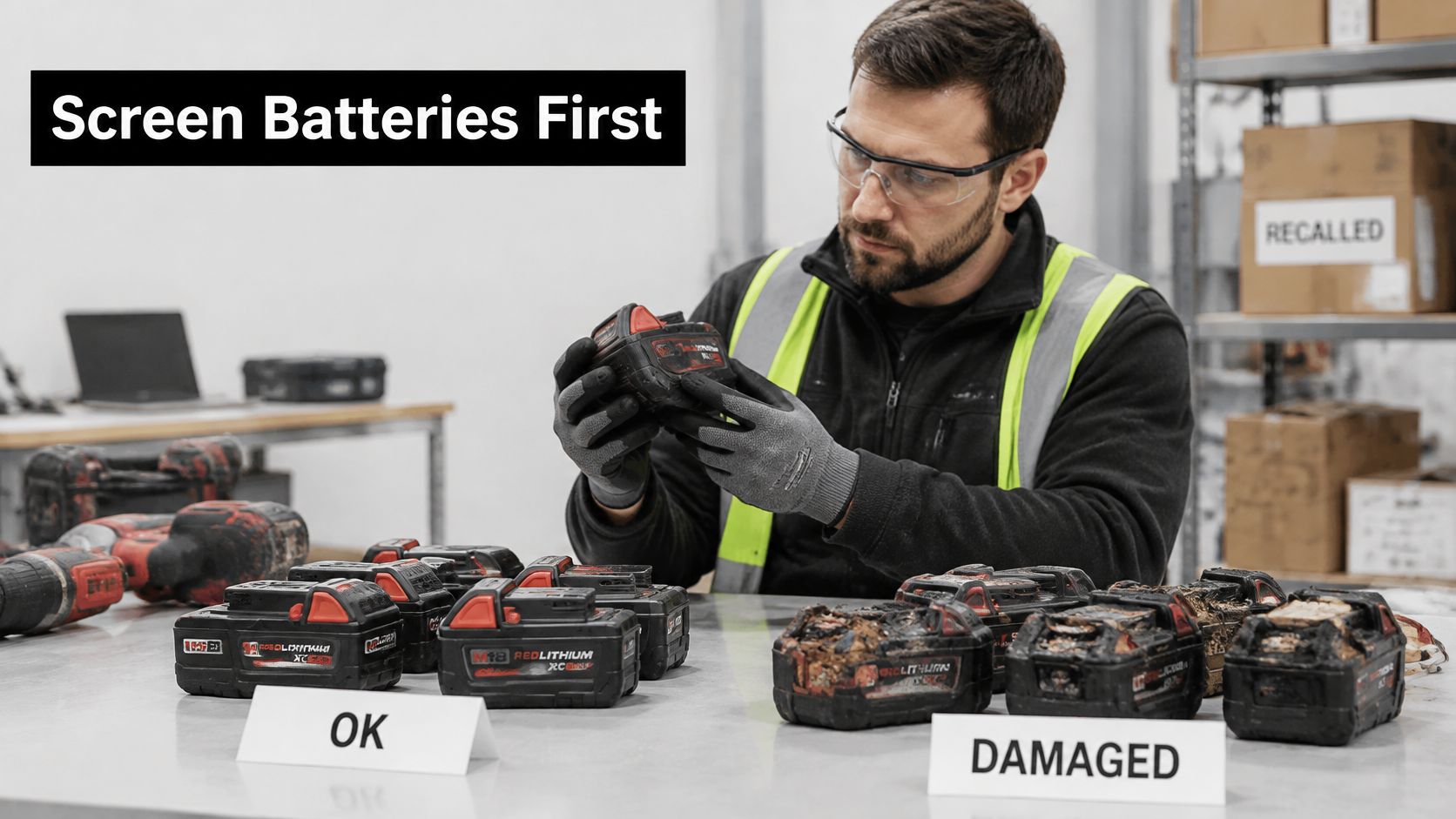
Intact packs and damaged packs take different roads
Send an ordinary used removable pack to a specialized battery recycler or a household hazardous-waste program that accepts business material. Cover its terminals with nonconductive tape, or bag each pack separately. Businesses handling their own used batteries must follow RCRA requirements. Damaged or defective lithium batteries require special packaging, labeling, transportation, and segregation under the EPA battery collection guidance.
Damaged packs need a separate route. Package each in nonflammable inner material, add absorbent nonflammable cushioning, and use compliant outer packaging with the correct labels. Transport must follow DOT rules. Trained staff or a hazmat carrier may package them; a general courier may not. Call a hazardous-materials carrier about any damaged pack. If a pack is hot or has smoked, involve the local fire authority before moving it.
| Battery condition | Action | Packaging | Carrier or authority |
|---|---|---|---|
| Intact removable pack | Send to battery recycler or household hazardous-waste channel | Tape terminals or bag each pack separately | Specialized battery recycler |
| Swollen, punctured, or leaking | Isolate and stop the standard route | Individual nonflammable inner packaging, absorbent cushioning, compliant outer pack | Hazmat carrier under DOT rules |
| Hot, smoking, or fire-involved | Isolate and do not move until cleared | Follow hazmat carrier instructions | Hazmat carrier and local fire authority |
| Condition unknown | Hold on site and classify | Cover terminals, bag the pack, and store it apart from other goods | No carrier until the pack is classed |
A battery recycler, including a provider of lithium battery recycling services, can handle the pack only after its condition is classified. Keep each pack accounted for with its tool record. An unverified battery leaves a gap in the recall file, even if the tool itself has been destroyed.
A stable, unclassed pack stays put. Clearing the dock is not worth moving a battery whose condition is unknown.
Build a Certificate an Auditor Can Reconcile
Regulators and insurers don't ask whether a truck left full. They ask you to prove every recalled unit. A destruction certificate is an audit exhibit, and one missing serial should block its release.
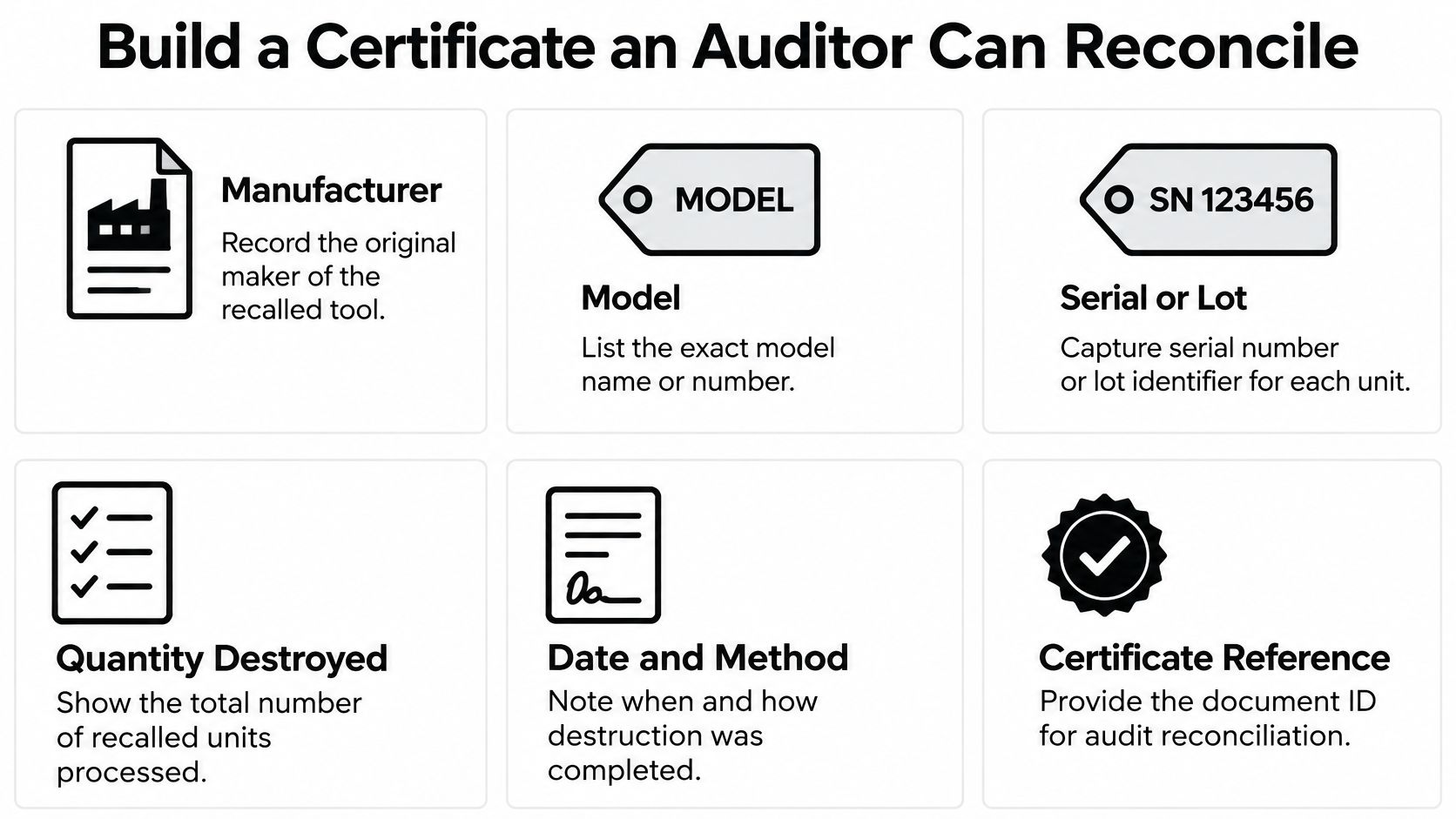
Fields that have to survive a file review
Build the certificate so a stranger can reconcile it without calling the operator:
- Manufacturer and model, plus serial or lot for each unit
- Recall reference and quantity
- Destruction date, method, and operator
- Battery destination, and where metal and plastic fractions went
- Witness or photo verification
The EPA guidance on used lithium-ion batteries is why the battery line can't be blank: packs that ride into ordinary trash or municipal recycling can be crushed and start fires, so the certificate has to show they left on a battery route. The tool itself should be rendered permanently unusable, typically by controlled disassembly followed by cutting, drilling, or crushing critical functional components, while the serial evidence stays intact. A certificate of destruction for recalls is only useful if those fields are filled.
The three-way match
Reconcile the quarantine log, the transport count, and the destroyed count. Photograph identifiers before the cut. When the recall instructions allow it, photograph or video the disabling cut too. Don't put recalled goods and ordinary e-waste on the same certificate.
Exception handling is part of the match, not a footnote. Unidentified housings stay quarantined. Extra units get a new line, not a rounded total. A partial lot is reported as partial. If one serial is missing, the certificate waits.
A shredder photo with no serial list doesn't transfer liability.
Keep the file at least as long as your product-liability and record schedule. Five to seven years is a practical planning floor when counsel hasn't set a shorter rule, and it only serves as a floor until counsel and that schedule confirm the actual period. Reject any vendor certificate that lacks method, date, and an identifier list.
Hire a Vendor and Close the Recall File
Procurement can paste this into a bid. A generic scrap quote isn't a recalled-product program, and accepting one is how a company authorizes the wrong cut.
Require a written recalled-product SOP, hazmat-capable transport partners, battery screening before pickup, and a refusal to take damaged packs on a standard route. Require serial or lot reconciliation before any certificate, photo retention when the recall instructions authorize it, and a named exception process. Ask for insurance certificates, references from manufacturers or distributors, and recycling credentials that apply to commercial e-waste. A vendor due diligence checklist is the right place to record those answers before you award the work.
Clauses worth putting in the service level
- Pickup window: State the window for contiguous U.S. business sites, not a vague "as available."
- Custody start: Name the minute custody begins, which is documented receipt of identified goods, not arrival of an empty trailer.
- Certificate turnaround: Clock it from the moment the count matches, not from the day the truck was booked.
- Liability transfer: It moves on documented receipt of identified goods. A trailer at the dock doesn't transfer anything.
Strike three items from any bid: salvage rights, commingling with other customers' loads, and destruction before the remedy is confirmed. Those terms recreate the failures a recall file is supposed to prevent.
Beyond Surplus handles product destruction for organizations that need chain-of-custody paperwork and certificates of recycling or destruction. Confirm service coverage and the dispatch location directly with Beyond Surplus before you book. Send the recall notice, the serial list, and the battery condition notes, then schedule certified destruction only after the return-versus-destroy path is confirmed.
Beyond Surplus provides certified electronics recycling and secure product destruction for commercial sites, with chain-of-custody records when recalled tools must leave a facility under an approved remedy. Send the recall notice, the serial list, and the battery notes only after you know whether the path is return or destruction. Visit Beyond Surplus to confirm coverage and schedule the work.