A mixed pallet sits in your facility's back room: older drop-side cribs, newer fixed-side frames, loose hardware, and mattresses nobody has matched to a purchase order. Procurement wants the space cleared. Your facility manager needs to know which units can leave, which require a manufacturer remedy, and what paperwork will prove the unsafe inventory never returned to use.
Recalled crib destruction services are an inventory-control process, not ordinary furniture hauling. For childcare operators, retailers, healthcare facilities, and warehouse managers, the job starts with product identity and ends with reconciled records. A photograph of a pile doesn't establish what was destroyed, who handled it, or whether usable frames disappeared along the way.
Table of Contents
- Which Recalled Cribs Must Be Destroyed
- Choosing On-Site, Off-Site, or Manufacturer Return
- Methods and Proof That Transfers Liability
- Step-by-Step Destruction Workflow
- Costs, Scheduling, and Common Failures
- FAQ and Sample Documentation
- Confirm the Remedy Then Book Destruction
Which Recalled Cribs Must Be Destroyed
Start with the manufacture date and written compliance evidence. The CPSC's full-size baby crib guidance says full-size and non-full-size cribs manufactured before June 28, 2011 should be destroyed unless the reseller has written proof that they meet applicable federal requirements. Immobilizing a drop-side with replacement hardware doesn't make that crib eligible for the used marketplace.
That distinction matters on a mixed pallet. A newer-looking finish, an unopened hardware bag, or a manager's recollection that the crib was repaired isn't compliance evidence. Neither is the absence of injuries at your facility.
Destroy, return, or hold by crib status
Use this classification table during intake. For accessories, the cutting instructions apply when the specific recall requires that method, not as a universal rule for every bumper or mattress.
| Situation | Required action | Proof to keep |
|---|---|---|
| Child Craft drop-side, made 2000–2009 | Stop use, destroy and discard | Recall notice; no repair was available |
| Any drop-side, even with hardware that locks the side | Destroy; do not resell or donate | Model and date stamp |
| Full-size or non-full-size made before June 28, 2011, no written compliance proof | Destroy | Note that proof is missing |
| Pre-2011 crib with written proof it meets the federal standard and is not recalled | Resale only if all parts are present | Written compliance evidence |
| Open recall that still offers return or repair | Follow the maker's remedy; don't destroy first | Written confirmation from the manufacturer |
| Recalled crib bumpers | Cut apart, then photograph, when the notice directs | Before-and-after photos of the cut pieces |
| Recalled crib mattress | Cut in half, then photograph, when the notice directs | Photo showing the mattress cut through |
| Missing date stamp, mixed pallet, or incomplete hardware | Quarantine; destroy if identity stays unresolved | Intake line with no quantity gap |
Classify individual units, not entire pallets
Record the manufacturer, model, permanent date stamp, and affected production range. Compare those identifiers with the specific recall notice. A recall may cover a production batch rather than every crib sold under the same brand.
Keep unidentified units in quarantine while staff examine receiving records, packaging, and manufacturer correspondence. Don't borrow an identity from a similar frame beside it. Missing hardware also prevents staff from treating an otherwise identifiable crib as ready for resale.
For a commercial cleanout, connect the classification sheet to the work order for recalled baby product disposal services. Give the person approving disposition access to both documents.
Practical rule: Every received crib should appear in the intake log, the applicable disposition record, and the final closeout paperwork, with zero unexplained quantity variance.
Treat that as your service acceptance target, not a claim that sampling proves safety. Checking representative frames can help organize the inspection, but it can't clear an unexamined unit.
Choosing On-Site, Off-Site, or Manufacturer Return
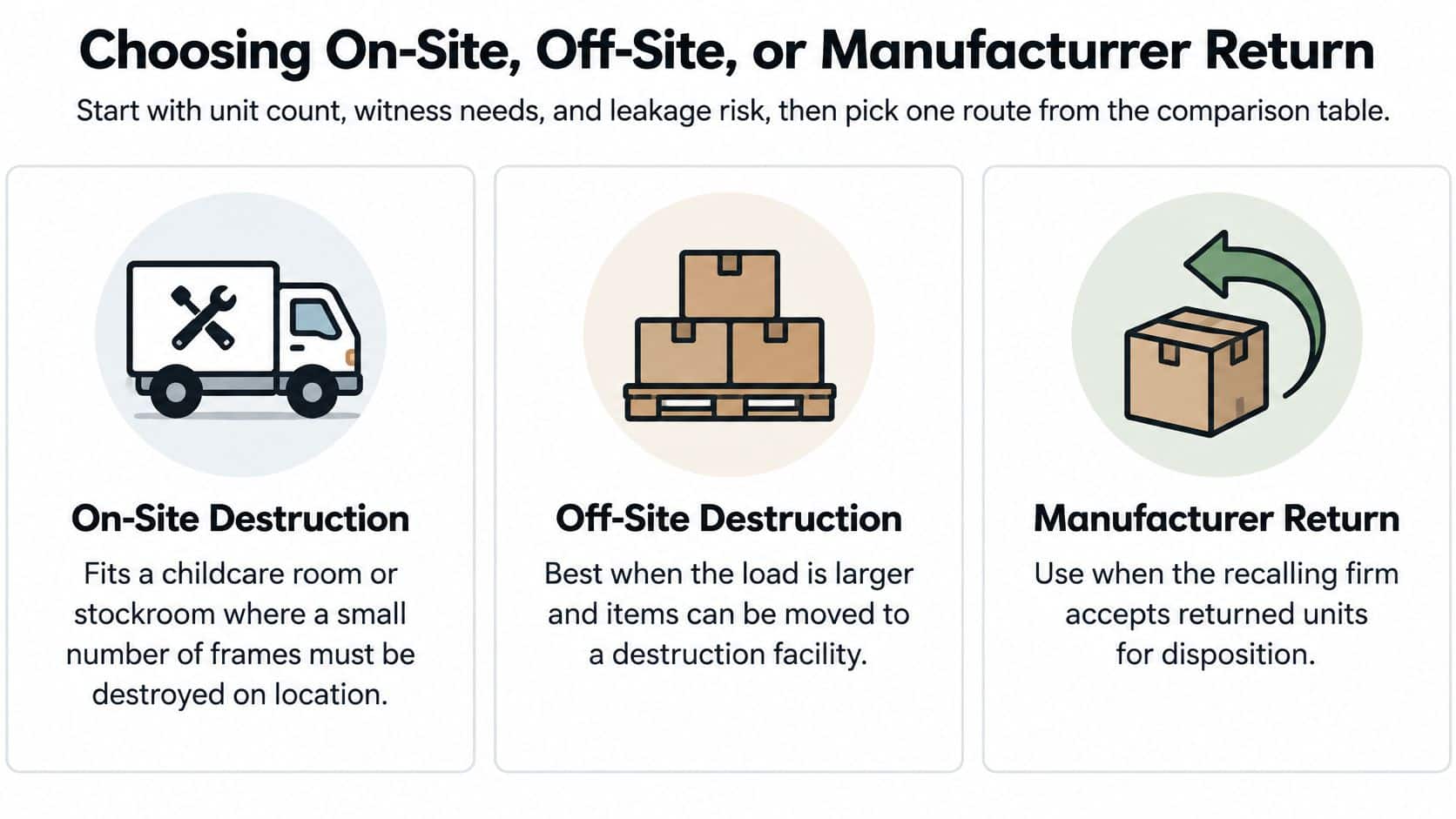
A receiving log shows several crib models, different date stamps, and a manufacturer remedy still in progress. The disposition decision starts with the recall notice, not the tool choice: confirm which units are affected and whether the manufacturer requires a return, repair, replacement, or destruction. Then choose a route based on the unit count, witness needs, and risk of units leaving the controlled process.
Where to destroy a recalled crib load
| Route | Best when | Controls | Proof |
|---|---|---|---|
| On-site destruction | Small count, occupied facility, or witness required | Closed work zone, no salvage, parts rendered unusable before removal | Destruction record with unit count and photos |
| Off-site processor | Many frames, mixed brands, or limited staff | Labeled pallets, written instructions, chain of custody, resale prohibited | Certificate stating product description and quantity |
| Manufacturer remedy return | The recall notice offers a remedy and requires return | Hold units securely until return instructions are confirmed | Return receipt or written remedy confirmation |
On-site work keeps the process visible, but a witness does not replace a controlled work area. Keep children and customers away, stabilize each frame before work begins, and provide secure containers for sharp components. Never cut cribs in occupied childcare rooms.
Off-site processing shifts the work away from daily operations and adds custody handoffs. Record who releases the load, who accepts it, and which pallet identifiers appear on the shipping paperwork. A photo of a pile alone cannot establish which units were processed or whether the count matches the intake log.
Manufacturer return preserves an available remedy when the recalling firm requires units back. A repair kit may instead require the crib to remain secured at the facility. Obtain written instructions before deciding whether units should be returned or destroyed.
Plan for mixed inventory and difficult handling
Recall volumes can involve many units, so plan the workflow around individually identified cribs rather than assuming one matching product. The CPSC's Hampshire crib recall covered approximately 3,200 U.S. units and 120 additional units sold in Canada in 2024.
For bulky items, review guidance on how to safely remove heavy furniture from home. For commercial crib handling, use a paired lift for awkward full-size frames, clear the travel path, and secure loose hardware in labeled bags.
If the load includes strollers, give them separate work-order lines and handling instructions through recalled stroller disposal services. This keeps each product type tied to its own disposition record.
Methods and Proof That Transfers Liability
The physical outcome should be a crib nobody can rebuild, donate, or list online. Disassembly isn't necessarily destruction. Removing bolts while leaving intact rails, supports, and connecting hardware can produce a kit that somebody else could reassemble.
The CPSC's Child Craft recall notice, issued June 24, 2010, directed owners to “destroy and discard” affected drop-side cribs manufactured between 2000 and 2009. The manufacturer was no longer in business, no repair or replacement remedy was available, and the identified hazards included entrapment, suffocation, and falls.
Match the method to the failure you must prevent
A trained operator should separate rails, mattress supports, fasteners, and drop-side mechanisms, then use the approved cutting, crushing, or breakage method. The result must prevent structural reassembly, not merely make the crib inconvenient to move.
Select tools after assessing the materials. Secure components before cutting and control sharp edges and dust. Don't use an improvised blade on an unidentified mattress or powered assembly.
Where local disposal rules require separation, keep wood, metal, foam, fabric, and plastic in identified material streams. Route electronic rocking components separately from ordinary frame material. Material recovery is appropriate only after the process prevents unsafe product reuse.
Destruction file fields
| Record | Capture | Why it matters |
|---|---|---|
| Unit identity | Model, date stamp, inventory ID, quantity | Prevents substitution of a sellable crib for a recalled unit |
| Photographs | Label before destruction and identifiable parts afterward | A generic pile photo may not satisfy the required evidence |
| Work log | Date, site, operator, method | Supports an on-site affidavit and review |
| Disposition | Cut, crushed, or separated material stream | Shows how the operator prevented reassembly or resale |
| Certificate | Exact description and quantity destroyed | Supports contractual acceptance and any agreed liability allocation |
A certificate doesn't automatically erase every legal responsibility. Liability allocation depends on the contract, applicable law, and what happened. Procurement should have counsel review indemnity, insurance, subcontracting, and acceptance terms instead of treating a certificate title as a legal release.
Specify that the processor must not salvage or remarket condemned units. Make acceptance contingent on matching the certificate to the intake record and resolving exceptions. If the counts disagree, the destruction job remains open.
A photo of a pile proves that a pile existed. It doesn't identify the units in it or establish that every received crib became unusable.
For recalled children's product destruction, attach the required photo views and certificate fields to the purchase order. That gives the operator an evidence standard before the first frame is dismantled, rather than after identifying labels have been lost.
Step-by-Step Destruction Workflow
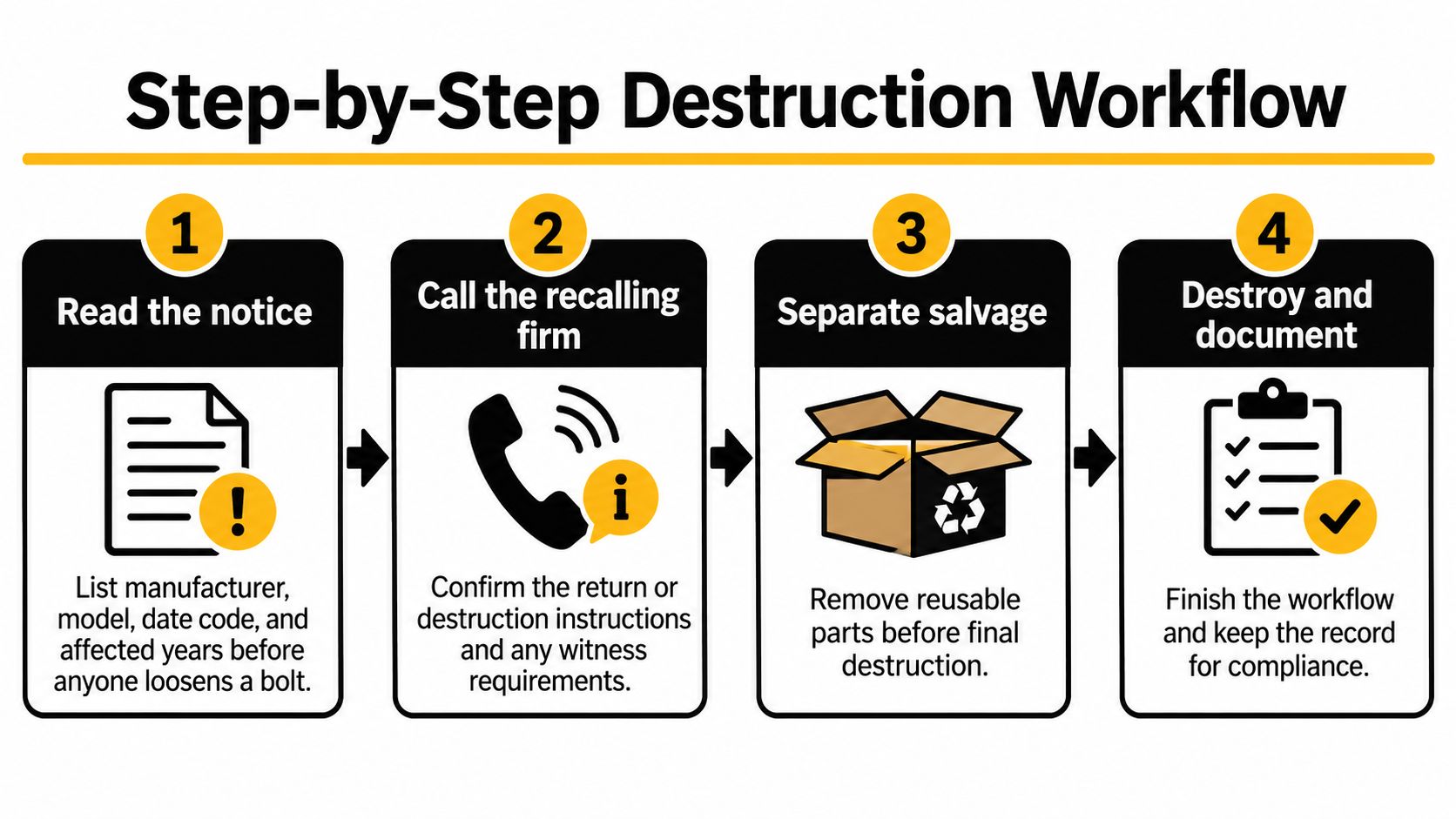
A warehouse may hold cribs from several models and production dates, while only some fall within a recall. Start with an operations owner who can authorize disposition and a receiving contact who can reconcile each unit against the records. Keep the manufacturer's written instructions with the work order so the crew follows the approved remedy rather than its ordinary furniture breakdown process.
The specific recall notice and the manufacturer's written instructions set the required identification, destruction plan, advance notice, and certification steps. For on-site work, an affidavit or processor certificate should record what was completed.
Do not salvage or remarket parts from condemned units. Material sorting happens only after components have been made unusable; rails and hardware must not be set aside for another crib.
Intake and authorization
Read the specific notice. Record the manufacturer, model, date stamp, and affected production range before loosening any bolts. Attach the notice to the work order so reviewers can see why each unit is being dispositioned.
Confirm the remedy with the recalling firm. Obtain written return, repair, or destruction instructions. If advance notice is requested for a witness or verification, arrange it before work begins.
Quarantine and tag the inventory. Separate recalled units from sellable nursery stock and occupied areas. Mark each crib, box, and pallet as recalled, with instructions prohibiting sale, donation, and salvage.
Create a unit register. Assign an inventory identifier to each crib and record its model, date stamp, and quantity. Treat unclear identities as exceptions. Do not guess at missing details.
Photograph identity before damage. Capture the product label and an overall view of each intact crib. Include its inventory identifier in the image, or use a photo index that connects the image to the unit.
Processing and closeout
Follow the authorized destruction method. Separate structural components and hardware, then render them unusable as directed. Stop if the crib's construction differs from the approved plan.
Handle accessories under their own notices. Cut bumpers apart or cut mattresses through only when their recall instructions require it. Photograph the specified result before covering or loading the pieces.
Complete the work log. Record the operator, date, location, method, and final material disposition. For transported loads, attach dispatch and receiving records to the same job file.
Reconcile and collect signed evidence. Compare the certificate or on-site affidavit with the intake record, and resolve missing records before closing the job. Release the work zone only after debris is removed and staff confirm no intact recalled product remains.
For warehouse recalled-product disposal, give receiving staff the approved register before collection. A pallet count can match while individual cribs inside it do not, so reconcile the units as well as the pallets.
Costs, Scheduling, and Common Failures
Request a quote against a defined inventory and evidence package. There isn't a supported national price to apply to every crib load, and a basic hauling quote may exclude identification, controlled destruction, photography, or closeout documentation.

Build a quote that procurement can compare
| Work-order item | What to specify |
|---|---|
| Mobilization | Site access, loading location, parking, and transport |
| Destruction | Frame count, construction materials, and authorized method |
| Labor | Disassembly needs, awkward lifts, and access restrictions |
| Evidence | Unit photographs, witness arrangements, affidavit, and certificate |
| Material processing | Separate streams and local acceptance requirements |
| Exceptions | Unidentified units, added accessories, and count discrepancies |
Ask for mobilization and processing charges to be separated. Describe stairs, restricted loading hours, narrow doors, and whether staff will pre-stage the inventory. Otherwise, competing quotes may price different jobs.
Schedule cutting only after the remedy is confirmed and any requested witness arrangements are resolved. Where cribs are in active institutional use, arrange an appropriate safe sleeping alternative immediately when taking the recalled units out of service. Don't leave unsafe units available while waiting for pickup.
Prevent avoidable rework
The CPSC's Little Pea Shop crib bumper notice illustrates recall-specific cutting and photographic proof requirements. Facility teams must translate those instructions into controlled work without creating additional hazards from blades, dust, awkward lifting, or exposed edges.
Common failures belong on the supervisor's inspection sheet:
- False clearance: Staff treat a clean finish or locked drop-side as evidence that a crib is compliant.
- Premature destruction: A crew damages inventory before the manufacturer confirms how to preserve the remedy.
- Untraceable transport: A hauler takes unmarked frames without a signed inventory handoff.
- Weak evidence: Staff photograph a closed dumpster instead of identifiable destroyed components.
- Mixed storage: Employees put recalled and sellable cribs on the same pallet.
- Incomplete destruction: Intact structural parts remain accessible after the job.
A small accessory may be straightforward to cut under its notice. A facility-wide inventory requires more than repeating that action across a crowded stockroom.
Acceptance test: If staff can rebuild the condemned crib from the parts left behind, the physical work isn't finished.
Budget for exception handling as well as cutting. An unresolved label or missing photograph can require more administrative work than dismantling the frame itself.
FAQ and Sample Documentation
Can a repaired older crib be resold?
Only when the applicable compliance evidence supports resale, the crib isn't recalled, and all required parts are present. Hardware that immobilizes a drop-side doesn't establish eligibility. Keep the written evidence with the asset record rather than relying on a repair note alone.
Is a photograph of a dumpster enough?
No. The evidence needs to connect identifiable products with the required destruction outcome. Preserve label photographs before processing, then capture the destroyed components in the views specified by the notice.
Does an affidavit replace a certificate?
Use the document required by the approved process. An affidavit records the sworn account of on-site destruction; a processor's certificate records its completion statement. Neither should omit the exact product description and quantity.
What if the units were sold in Canada?
Confirm with the recalling firm which markets and models the remedy covers. Keep market-specific records rather than assuming a U.S. disposition instruction covers every imported unit.
What if the final count is short?
Leave the job open and trace the discrepancy through receiving, quarantine, loading, and processing records. Use contractual acceptance controls to withhold closeout until the missing units or recording errors are accounted for.
What should the certificate file contain?
Use a certificate of destruction for recalls supported by the following attachments:
- Header: Facility, processing site, work date, operator, and job reference.
- Unit register: Inventory ID, manufacturer, model, date stamp, quantity, and destruction method.
- Photo index: Image filenames mapped to the corresponding inventory identifiers.
- Disposition statement: Confirmation of destruction and prohibition on remarketing.
- Signatures: Operator and authorized company representative, with exceptions identified.
Keep the notice, remedy correspondence, transport receipts, and final reconciliation together. A certificate separated from its supporting records is harder for procurement, an insurer, or an auditor to evaluate.
Confirm the Remedy Then Book Destruction
Pull the applicable CPSC notice and give each crib an authorized disposition before booking a saw or truck. Send the manufacturer the product identifiers and request written instructions. If the firm is unavailable, retain that correspondence and follow the applicable notice rather than inventing a repair.
When destruction is confirmed, provide the processor with the model list, quantities, required photographs, and salvage prohibition. Establish who can approve exceptions and who signs completion. Your purchase order should describe an accepted outcome, not authorize removal from the loading dock.
Keep commercial asset streams distinct
A facility cleanup may also retire servers, laptops, laboratory equipment, or powered components. Those assets need their own disposition specifications. Crib destruction doesn't prove that a laptop's storage media was sanitized, and an electronics recycling receipt doesn't prove that a recalled frame became unusable.
The FTC's Disposal Rule guidance requires reasonable disposal measures for covered consumer-report information. Where retired business equipment contains that information, include the appropriate data-destruction requirements in the electronics work order rather than assuming physical removal satisfies them.
At Beyond Surplus, we provide product destruction with documented chain of custody and sustainable material recovery built in. Certificates of destruction are available upon request. For a combined commercial cleanup, use a consistent asset register while keeping the approved method and completion evidence specific to each product category.
For crib-only loads, select a destruction route that follows the applicable CPSC instructions and supports the necessary affidavit or certificate. Don't assume an electronics-focused processing method is appropriate for every bulky recalled product.
Before approving payment, compare the completion documents with the authorized inventory and resolve outstanding exceptions. Reopen the storage area only after the facility supervisor confirms that recalled products, loose hardware, and cutting debris have been removed.
Stop use today, confirm the remedy, then destroy only the units the notice condemns.
Beyond Surplus offers commercial product destruction with documented chain of custody and sustainable material recovery, alongside secure electronics recycling and IT asset disposal. Visit Beyond Surplus to discuss your commercial inventory, coordinate the appropriate service scope, and request a certificate of destruction for your records.