

Your facility has scooters parked beside the loading dock, a recall notice in someone's inbox, and a recycling pickup already on the calendar. The immediate problem is keeping anyone from riding or charging them. The harder problem is arranging a safe handoff and proving exactly where every recalled unit went.
Recalled scooter disposal services need to solve both problems. For business owners, facility managers, IT teams, and procurement staff, a successful pickup ends with more than an empty staging area. It ends with an accepted disposal route, documented transportation, and records that reconcile to your asset inventory.
Table of Contents
- Recalled Scooter Disposal at a Glance
- Why Recalled Scooters Cannot Go in Ordinary Waste
- How the Disposal Workflow Runs, Step by Step
- Moving Recalled Scooters Safely in Transit
- Proof of Destruction, Chain of Custody and Data Wiping
- Choosing a Recalled Scooter Disposal Vendor
- Schedule Your Recalled Scooter Pickup This Week
Recalled Scooter Disposal at a Glance
Recalled scooter disposal services cover managed collection, transport, battery handling, recycling or destruction, and documentation of recalled or end-of-life electric scooters, with battery hazards assessed rather than treating the equipment as junk.
Start by assigning an owner to the inventory. That person should control the release of scooters from storage, maintain the condition log, and approve changes to the receiving destination. Without a named owner, warehouse staff can mistake an isolated scooter for equipment awaiting ordinary electronics recycling.
The CPSC's powered-scooter recall guidance warns that recalled lithium-ion batteries need a different disposal pathway and that acceptance must be confirmed before delivery. For commercial inventory, don't assume a municipal program accepts business-generated waste, even when a recall notice mentions that program.
Disposal Route and Records by Scooter Condition
| Scooter condition | Required route | Records to keep |
|---|---|---|
| Recalled, battery intact | Follow recall instructions, then use a household hazardous-waste program that explicitly accepts the business shipment or an authorized battery recycler | Recall notice, serial number, photos, receiving confirmation |
| Recalled, battery swollen, punctured or damaged | Isolate; arrange specialized packaging and a permitted hazardous-waste facility or qualified recycler | Condition log, isolation date, transport record, final certificate |
| Recall status unclear | Treat as damaged as an interim handling precaution; no pickup until written acceptance | Written acceptance instructions, serial number |
| End-of-life, not under recall | Authorized battery-recycling pathway, not general e-waste | Certificate of recycling, serial number |
| Holds business data or connected accounts | Select and document the appropriate NIST method, clear, purge or destroy, before transfer where safe | Sanitization method record, certificate of destruction where applicable |
Apply the data row alongside the relevant battery-condition row. Removing an account connection doesn't make a recalled battery safe, and removing a battery doesn't establish that stored information has been sanitized.
For every asset, maintain a master record connecting the recall notice, serial number, photographs, isolation date, receiving confirmation, and final certificate. If a field doesn't apply, record the reason rather than leaving an unexplained blank.
Routing rule: A receiving facility's willingness to accept ordinary electronics doesn't establish its willingness to accept recalled battery-containing devices.
Keep these boundaries explicit in the work order:
- Never household trash: Don't release recalled inventory into ordinary waste collection.
- Never curbside recycling: A recycling symbol isn't an acceptance authorization.
- Never a mixed e-waste gaylord: Keep suspect scooters out of bulk containers used for routine IT equipment disposal.
Why Recalled Scooters Cannot Go in Ordinary Waste
The U.S. Consumer Product Safety Commission reported that micromobility injuries increased 127% from 2017 through 2021, reaching 77,200 emergency-room-treated injuries, while deaths increased from 5 to 48; e-scooters accounted for 68 deaths over that period, and fires ranked among the leading hazards in fatal incidents.
Those figures concern micromobility use broadly, not disposal alone. The waste-management evidence addresses the downstream problem: an EPA analysis of publicly reported incidents identified 245 fires linked to mismanaged end-of-life lithium-ion batteries at 64 U.S. waste-management facilities, including 139 fires at landfills.
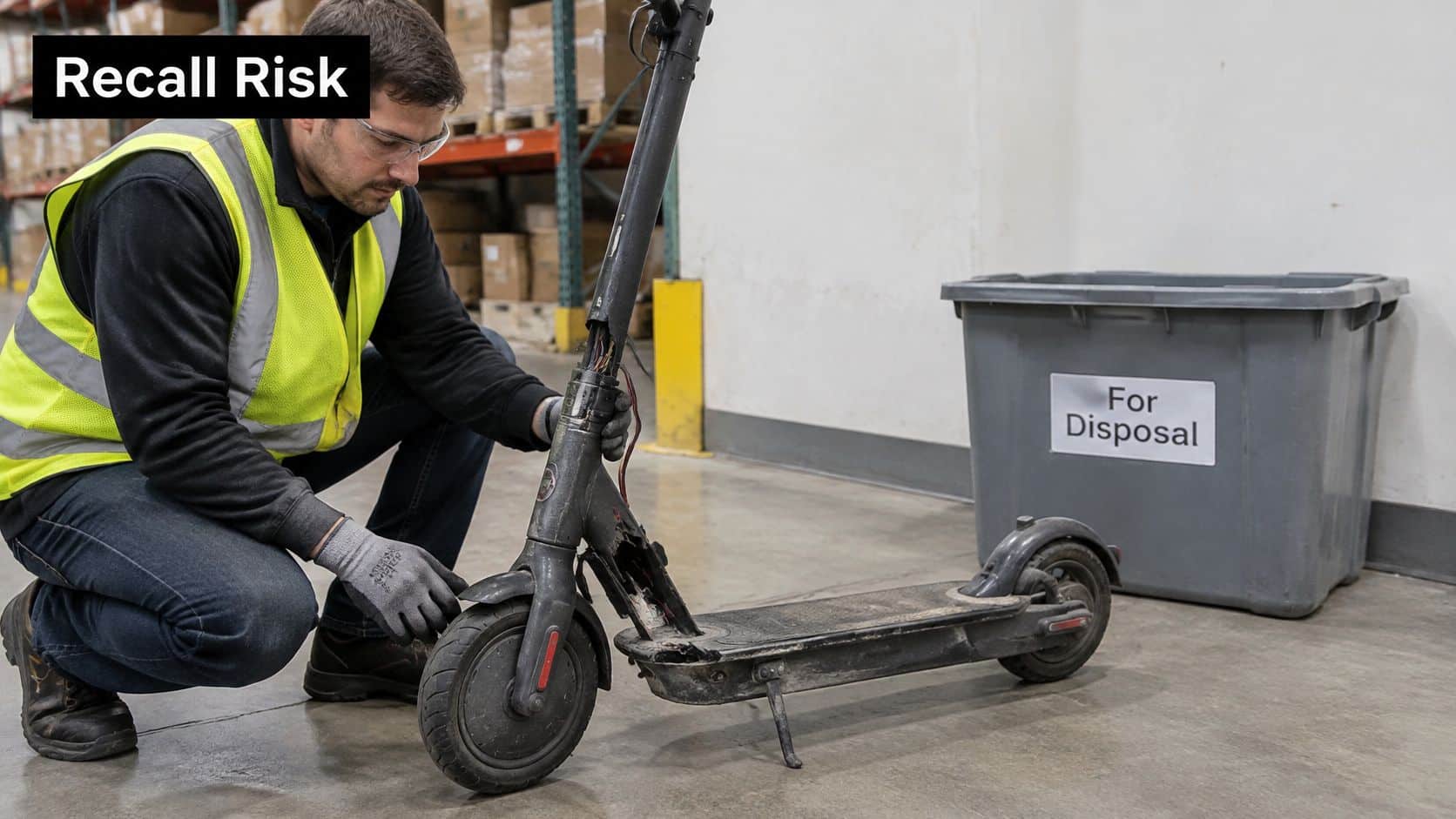
A recalled scooter isn't simply waste with a battery inside. For handling decisions, treat it as a battery with a frame around it.
A damaged battery is like a loaded spring packed in a box of paper. It may remain quiet until someone compresses, punctures, or heats it. In a shared waste container, ignition can expose the surrounding load, not just the scooter.
Separate Maintenance From Recall Disposition
Maintenance resources serve a different purpose. For mixed vehicle fleets, scooter filter maintenance advice from Sixrace belongs with routine service planning, not with instructions for releasing a recalled electric scooter back into operation. A maintenance task doesn't resolve a battery recall.
Remove affected inventory from normal resale and reuse channels while you establish the remedy and disposal route. Our universal-waste regulations guidance provides context for battery management, but a general waste classification doesn't replace recall-specific handling instructions.
Sort units into intact, damaged, or unknown battery condition before choosing a route. Model and serial information establish recall applicability; battery condition determines the handling controls the receiving facility needs to assess.
How the Disposal Workflow Runs, Step by Step
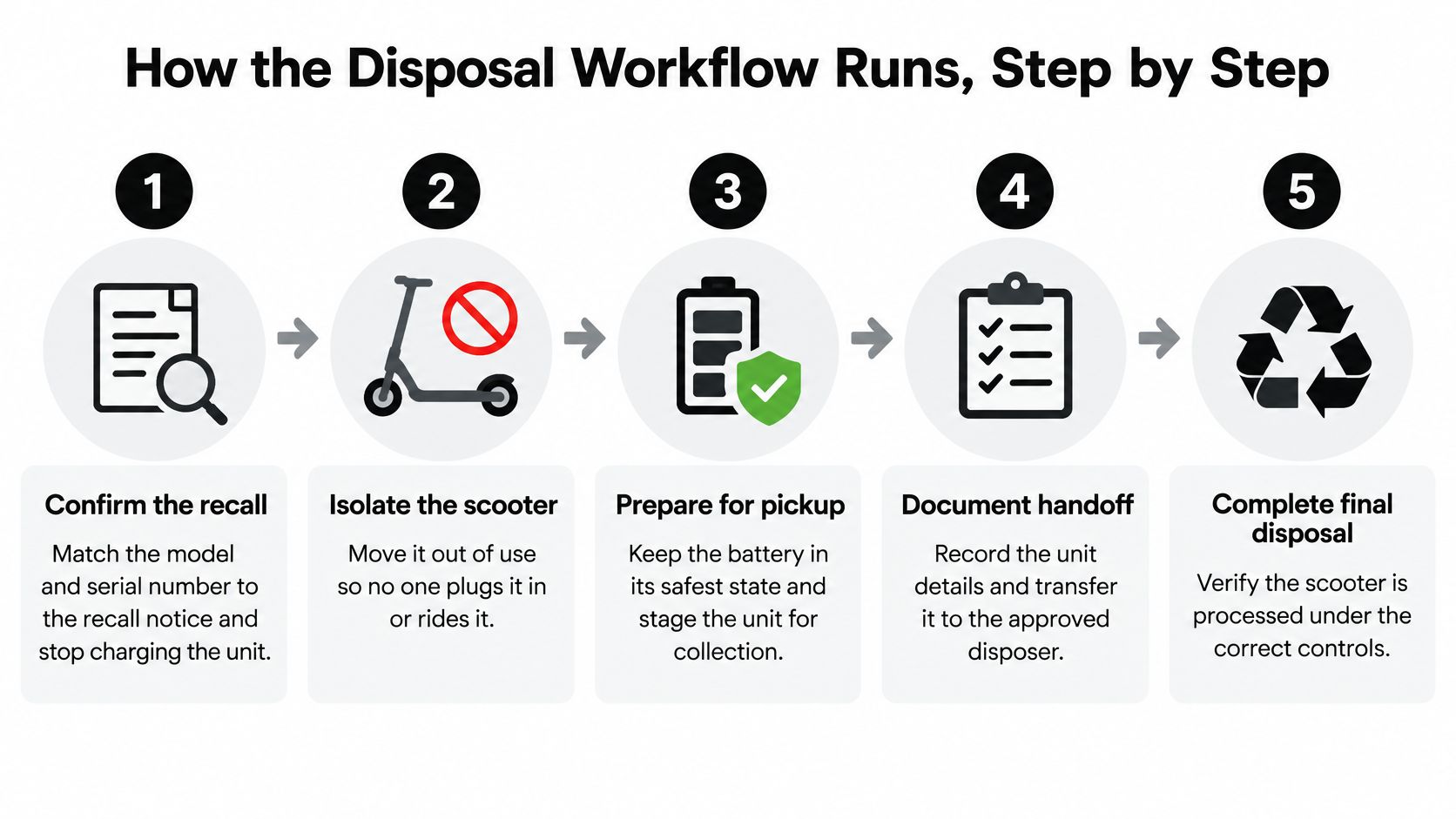
The CPSC's Transpro scooter recall notice directs owners to stop use and charging and warns against ordinary trash, recycling streams, and retail battery-collection boxes. Build your operating procedure around the applicable notice, then add commercial custody controls.
From Identification to Accepted Pickup
Confirm the recall. Match the model and serial number against the notice, then stop use and charging. The common mistake is checking only the model name when the affected inventory may be defined more narrowly.
Isolate the scooter. Use a designated area away from combustible materials and prevent accidental activation or charging. Don't stage suspect units beside other batteries, and don't let untrained employees open damaged packs to inspect cells.
Document the condition. Photograph identifying labels and visible damage without manipulating the battery, then record the isolation date. Taking pictures only after relocation can leave uncertainty about when damage occurred.
Obtain written acceptance. Give the receiving facility the recall notice, inventory, and condition photographs. Confirm that its acceptance covers commercial recalled inventory, not merely ordinary batteries or electronics.
The visual workflow summarizes the major handoffs; your operating log should retain the detailed steps.
From Packaging to Closure
Prepare approved containment. Have qualified personnel implement the packaging instructions accepted for the battery's condition. Don't substitute a general shipping carton or improvise battery removal to make the scooter fit.
Release to compliant transportation. Check the shipment against the approved inventory and transport documents before loading. Booking an ordinary parcel collection because it's convenient bypasses the hazard review.
Verify receipt and processing. Obtain the receiving record and confirm that the accepted recycling or destruction route was followed. A pickup signature proves collection, not final disposition.
Reconcile the certificate. Match the final documentation to every serial number, using an attached asset schedule if the certificate covers a load. Don't close the case on verbal confirmation.
Consider a hypothetical campus fleet of 40 scooters, with six showing swelling. Prioritize those six for qualified assessment and a separate accepted handling plan; that doesn't mean moving them before safe packaging and transportation are ready.
Our recalled-product disposal guidance for warehouses supports organizing inventory before release. Completion should mean a single evidence file containing the recall notice, asset log, acceptance letter, transport record, receiving record, and final certificate.
Moving Recalled Scooters Safely in Transit
Transportation needs its own hazard review. A recycler may accept the material, but that acceptance doesn't make every carrier, container, or loading method suitable.
According to EPA guidance on used lithium-ion batteries, lithium batteries are hazardous materials subject to transportation requirements covering packaging, hazard communication, markings, labels, shipping papers, emergency-response information, and trained personnel; damaged, defective, or recalled batteries cannot travel by air and must meet specialized packaging provisions under 49 CFR 173.185(f).
Don't confuse a universal-waste paperwork provision with permission to ship informally. The transport plan must address the actual battery condition and applicable shipping requirements.
Give Damaged Units Their Own Handling Plan
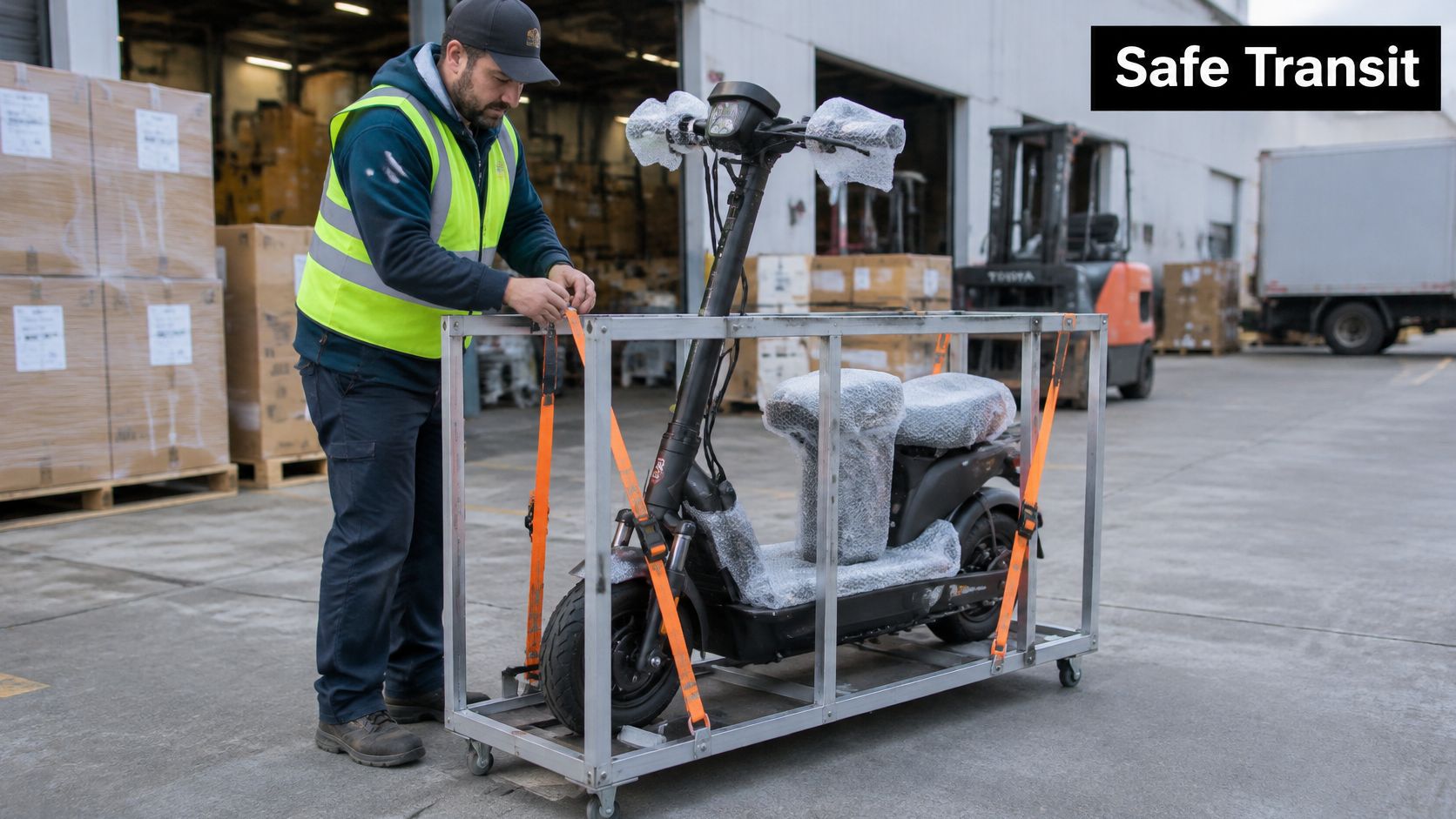
Suppose a warehouse has 12 recalled scooters, and four show battery damage. In this hypothetical shipment, the damaged four receive separately specified containment, condition photographs, and separate entries on the shipping record. Prioritize their collection once the qualified handler approves the arrangement; the remaining eight still follow the recall-specific route.
Impact-resistant containment, protection against terminal short circuits, and segregation of suspect units are functional controls, not packaging preferences. A wrapped pallet may stabilize equipment while doing little to address a damaged battery's transport hazard. Photographs of a crate aren't a substitute for the packaging specification.
For business pickups, our team handles palletizing, loading, and delivery to the recycling facility, arriving prepared for full removal from any location type. Recalled-device acceptance and condition-specific arrangements still need confirmation before dispatch.
Use our recalled battery-device disposal service information to frame the shipment discussion. Before the truck arrives, obtain a written plan covering:
- Packaging specification: Containment appropriate to the accepted battery condition.
- Markings and labels: Hazard communication applicable to the shipment.
- Shipping papers: Required descriptions and emergency-response information.
- Personnel training: Confirmation that assigned personnel have the required hazmat training.
- Receiving confirmation: Named destination and written acceptance criteria.
If a unit's condition changes after approval, pause its release and notify the handler. A plan approved for an intact-looking battery shouldn't carry over to a newly swollen or leaking pack.
Proof of Destruction, Chain of Custody and Data Wiping
Safety disposition and administrative evidence are separate deliverables. A processor can safely destroy a scooter while leaving your organization unable to establish which asset was processed. Conversely, an attractive certificate doesn't correct unsafe handling.
Connected accounts, removable storage, and associated diagnostic devices introduce another task. Don't assume every scooter stores business information, but include those that do in the IT asset disposal review.
Match Sanitization to the Actual Media
The NIST media-sanitization guidance distinguishes clear, purge, and destroy, with the method selected according to the media and information sensitivity. Apply that framework to storage, not as a blanket instruction to shred an assembled battery-containing scooter.
| Method | What it does | Scooter-related application |
|---|---|---|
| Clear | Uses logical techniques to remove data from user-accessible storage while preserving normal reuse | Suitable supported storage where the risk assessment permits clearing |
| Purge | Uses stronger logical or physical techniques to make recovery substantially infeasible | Sensitive information on supported removable media or diagnostic equipment |
| Destroy | Physically renders the media unusable | Storage that cannot be reliably sanitized or isn't approved for reuse |
Don't power up or charge a hazardous scooter merely to access an account menu. Coordinate safe media handling, use administrative account controls where available, and document any sanitization deferred to the qualified processor.
The FTC Disposal Rule guidance applies specifically to consumer-report information held for business purposes and requires reasonable disposal measures; it also describes due diligence when selecting a destruction contractor. That scope shouldn't be expanded into a claim that every scooter record falls under the rule.
Build an Asset-Level Evidence File
Keep the recall notice, manufacturer correspondence, asset inventory, serial numbers, isolation dates, facility acceptance, transporter details, and final certificate together. Maintain separate site entries for offices, campuses, and warehouses so a consolidated collection can still reconcile to each location.
The CPSC's Swagtron recall notice illustrates why product-specific remedy instructions matter. Follow only the applicable notice's instructions, and retain reimbursement or replacement correspondence alongside disposition records.
A refund documents the commercial remedy. It doesn't, by itself, prove where the recalled unit went.
Our IT asset disposal includes full chain-of-custody documentation and compliant transportation. Every load receives a Certificate of Recycling and Data Destruction, and our terms provide that all liability transfers to Beyond Surplus. Retain those terms with the certificate rather than assuming the document alone explains every responsibility.
Use our certificate-of-destruction guidance for recalls when specifying evidence requirements. The cheapest route becomes a poor purchase if it cannot demonstrate safe handling and completed processing.
Choosing a Recalled Scooter Disposal Vendor
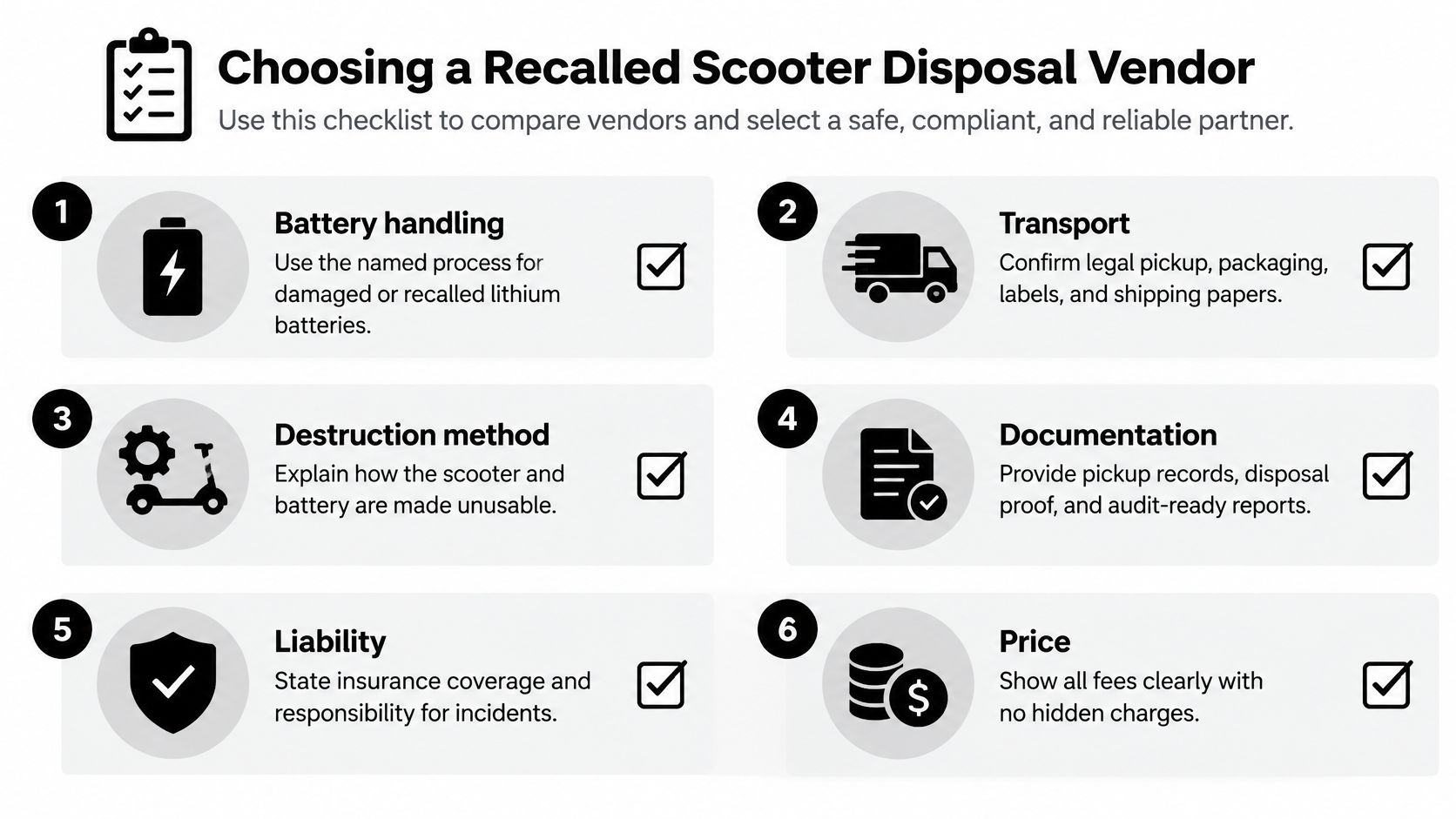
Require written answers before comparing prices. Evaluate battery handling, transport, destruction method, documentation, liability, and price, in that order. A low fee doesn't compensate for an unnamed downstream destination or missing shipment controls.
Give each bidder the same inventory and condition information. Otherwise, one quote may cover ordinary end-of-life scooters while another accounts for damaged recalled batteries, making the apparent price comparison misleading.
Vendor Criteria and Red Flags
| Criterion | Strong answer | Red flag |
|---|---|---|
| Battery handling | Named battery or hazardous-waste pathway with written acceptance | Ordinary e-waste bin or general recycling |
| Transport | Hazmat-trained crew, compliant containment, shipping papers | Standard parcel or mixed e-waste gaylord |
| Destruction | NIST method named for data-bearing media per unit, with on-site or off-site processing identified; separate battery disposition explained | A claim that everything is shredded, with no method or battery controls stated |
| Documentation | Certificate per load matched to serial numbers | Summary email with no serial detail |
| Liability | Written terms stating who carries risk after pickup | Verbal assurances only |
| Price | Fee compared against the complete included document set | Payment offered for recalled units without a documented recall-compliant disposition plan |
Ask how the provider makes recalled products unavailable for unauthorized reuse without creating an unsafe processing step. Media destruction and battery treatment aren't interchangeable, even when the same contractor coordinates both.
The checklist is useful for procurement review, but the supporting documents determine whether an answer passes.
Compare Scope Before the Headline Fee
Our qualifying business equipment pickups can be free, with removal, packing, and transportation included. That general offer shouldn't be treated as a recalled-scooter quote before the battery condition and handling scope are accepted.
Every client receives the same NAID certified destruction and Certificate of Recycling, whether the pickup is free or carries a flat fee. Keep that service standard separate from the shipment-specific question of how recalled batteries will be handled.
For organizations comparing international programs, myhalo's resource to compare Singapore electronics recycling options offers a separate regional comparison starting point, not U.S. recalled-battery compliance guidance.
Use our product recall reverse logistics service information to define collection and reporting scope. Choose the proposal whose written answers would withstand an audit, not just the lowest quote.
Schedule Your Recalled Scooter Pickup This Week
Start the scheduling process this week with a unit count and condition inventory. Requesting a pickup window is useful; committing to one before acceptance and packaging are settled isn't.
Gather the information the logistics team needs to assess the job:
- Recall identification: Applicable notices, model details, and serial-number list.
- Battery condition: Counts by condition and photographs of visible damage taken without disturbing the packs.
- Site information: Collection address, operating hours, loading access, stairs, elevators, and staging constraints.
- Evidence requirements: Asset-level reporting, site references, and the certificate format your compliance team expects.
Customers can request a recycling pickup or drop-off by phone, email, or online form. Use the website's contact form to provide the inventory, then obtain written confirmation that recalled scooters are accepted and under what terms before booking the collection.
A Pickup Request You Can Adapt
The following is a hypothetical request, not a statement about a particular shipment:
Subject: Recalled scooter pickup request, 14 units at [site address]
We have recall notices and serial numbers for all units. Four units show battery damage and are isolated. Please confirm acceptance criteria, pickup window, packaging responsibilities, transport arrangements, and certificate format.
Check the first substantive reply for written acceptance, the transport plan, the packaging method, and the certificate format. If any item is missing, resolve it before issuing the purchase order or releasing the scooters.
Assign someone at the site to meet the collection crew and reconcile the released inventory. Give that person authority to hold back an unlisted unit or stop loading if a battery's condition differs from the approved description.
Keep scheduling separate from emergency response. If a battery is heating, smoking, hissing, or otherwise showing an active failure, keep people away and activate the facility's emergency procedures rather than moving it for pickup.
A clear request lets the logistics team assess the material instead of guessing from a message that says only electronic waste pickup. Book the accepted handling plan, not just an available truck.
Beyond Surplus offers business electronics recycling, product destruction, secure IT asset disposal, and documented pickup logistics to support controlled recalled-equipment disposition. Visit Beyond Surplus to submit your scooter inventory, confirm acceptance and handling requirements, and arrange a pickup with the documentation your organization needs.


